Station 1 · Blind Inspection — Five Graders, Zero Peeking
Each lab scored the claim independently, without seeing the others. Open a breakdown for its evidence, its sources, and how sure it was.
Anthropic · EQUAL WEIGHT · 33.2s
claude-opus-5
93%BALONEY
ROUND-1 BREAKDOWN
Evidence offered for the claim
The belief is widespread because it was long a plot device in film and television police procedurals, and because some individual departments historically used informal 'wait and see' practices for low-risk adult cases before modern reporting standards were adopted.
There is a kernel of truth for competent adults: adults have a legal right to leave home without telling anyone, so in many jurisdictions police may take a report but apply a risk assessment and open only a limited inquiry if there are no indications of danger — which can be perceived by families as being told to 'wait.'
Practical variation exists: what a call-taker or desk officer does in a given agency is not uniform, and anecdotal reports of families being turned away and told to come back later do occur, which keeps the myth alive.
In some countries outside the US/UK, formal missing-person procedures and waiting-period customs differ, so the claim is not universally false as a description of every police force worldwide.
Evidence against the claim
US federal law forbids any waiting period for minors: the National Child Search Assistance Act of 1990 (now codified at 34 U.S.C. § 41308) requires law enforcement to accept a missing-child report and enter it into the FBI's NCIC within two hours, and prohibits establishing a waiting period before accepting the report.
Suzanne's Law, enacted as part of the PROTECT Act of 2003, extended the no-waiting-period/immediate NCIC entry requirement to missing persons under age 21.
The Department of Justice's NamUs program and NCMEC both state publicly that there is no waiting period to report a person missing, and urge reporting immediately because the first hours are the most critical.
UK police guidance (police.uk) and the charity Missing People explicitly state that you do not have to wait 24 hours — you should report someone missing as soon as you believe they are missing.
For adults in the US there is likewise no statutory 24-hour rule; agencies may enter an adult into NCIC's Missing Person File at any time, and many state statutes and agency policies expressly bar refusing or delaying a report.
Investigative best practice is the opposite of waiting: evidence degrades, surveillance footage is overwritten, scent trails fade, and abduction/homicide risk is concentrated in the first hours, which is why agencies encourage immediate reporting.
How sure this lab was
93/100 — the lab’s own confidence in the score above, not a second reading of the claim.
Very limited/qualified: some agencies advise making quick, safe preliminary checks or gathering information before or while reporting a non-urgent missing-person case, which may be confused with a waiting period; this does not amount to a 24-hour requirement.
The belief is widespread enough that multiple official missing-person resources explicitly address it as a myth, but that is evidence of the myth’s prevalence, not evidence that the rule exists.
Evidence against the claim
USA.gov states that there is no waiting period to report a missing person and that a report can be filed as soon as you think someone is missing.
The UK Metropolitan Police states that you do not have to wait 24 hours before contacting police about a missing person.
Australia’s National Missing Persons Coordination Centre states that waiting 24 hours before reporting someone missing is a myth and that a person can be reported missing at any time.
For missing children, the National Center for Missing & Exploited Children instructs people to immediately call law enforcement, contradicting any 24-hour waiting rule.
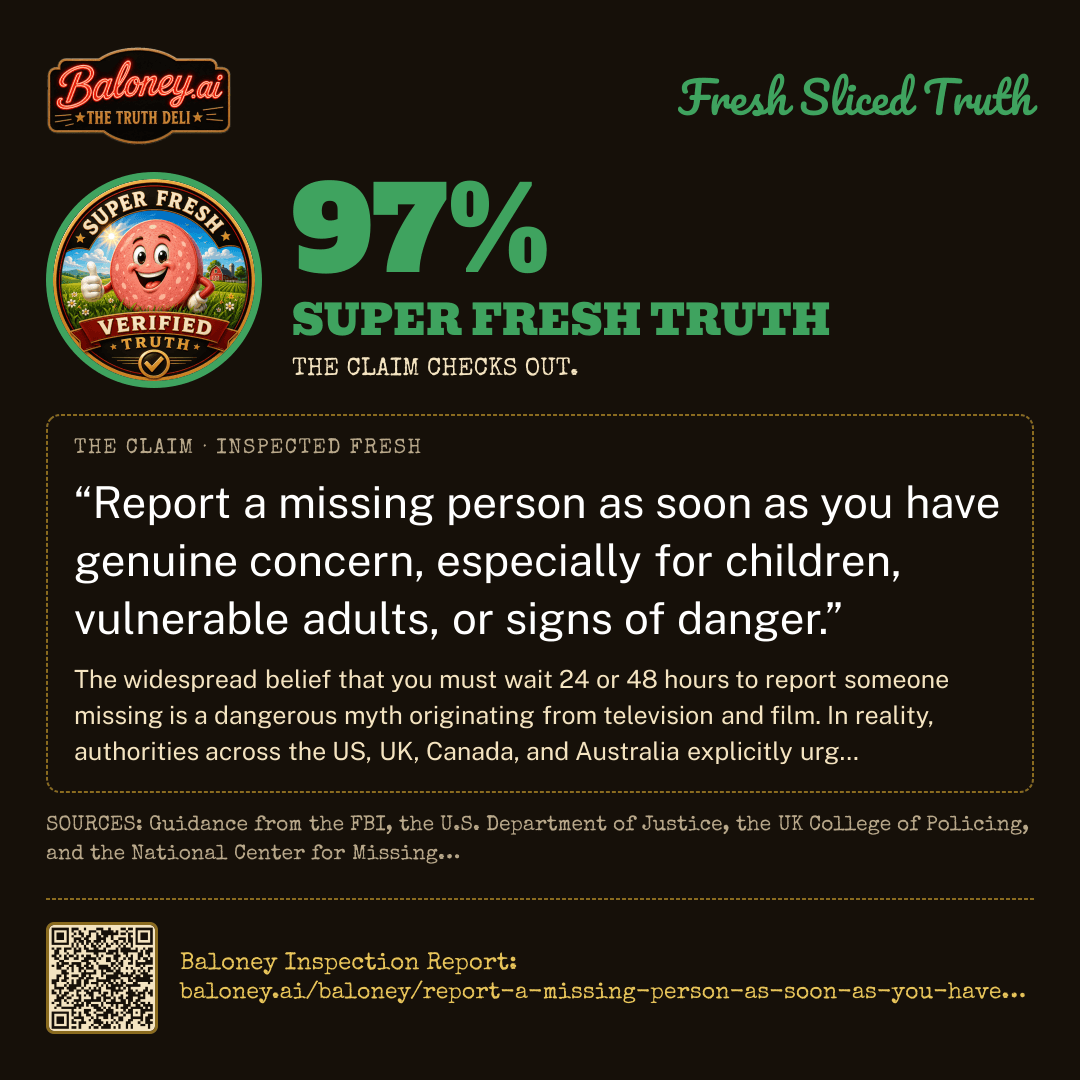
Overall, the claim is false as a general rule; prompt reporting is encouraged, especially for children, vulnerable adults, suspicious circumstances, or any immediate danger.
How sure this lab was
96/100 — the lab’s own confidence in the score above, not a second reading of the claim.
The concept of a 24-hour waiting period is a pervasive trope in crime television shows, movies, and literature, which has led to widespread public belief in the rule.
Historically, before modern communication and tracking, some local police desks may have informally advised families to wait to see if a healthy adult returned home before filing paperwork, though this was a localized procedural habit rather than a legal mandate.
Evidence against the claim
Law enforcement agencies across the United States, including local police departments and the FBI, explicitly state that there is no 24-hour or 48-hour waiting period to report someone missing.
Police urge the public to report a missing person as soon as they realize the person is missing and potentially in danger, as the first 24 to 48 hours are the most critical for search and rescue or criminal investigations.
The National Child Search Assistance Act (42 U.S.C. 5779) strictly prohibits any law enforcement agency in the U.S. from requiring a waiting period before accepting a missing child report.
How sure this lab was
99/100 — the lab’s own confidence in the score above, not a second reading of the claim.
Some members of the public believe there is a 24‑hour (or 48‑hour) waiting period, and this belief can affect how quickly they report someone missing, which is evidence that the *claim* has social traction even though it is not a legal or policy requirement.[1][3][8][9][14][15]
Popular TV crime dramas and movies frequently portray police telling families to wait 24 hours, which has helped entrench the idea in public consciousness, creating the impression that such a rule exists.[3][8]
Because most missing children are found safe within 24 hours, some people may infer that waiting a day is reasonable before contacting authorities, even though official guidance generally says to report concerns immediately.[2][5]
Evidence against the claim
A Police Magazine feature explicitly states that there is "no truth nor logic" to the belief that one must wait 24 or 48 hours to report a missing person, and emphasizes that no such waiting period is required by law or policy.[1][12]
The Australian National Missing Persons Coordination Centre fact sheet, published on an official missingpersons.gov.au domain, states unequivocally: "You do not have to wait 24 hours before reporting someone as missing," and encourages prompt reporting whenever there are safety concerns.[2][5]
The UK’s official police advice page says: "You do not have to wait 24 hours to report someone missing. If you think someone is in danger you can report them missing right away," and instructs people to call 999 in emergencies, directly contradicting any mandatory waiting period.[4]
The UK National Crime Agency notes that "It is a common belief that you have to wait 24 hours before reporting but this is not true, you can make a report to the police as soon as you think a person is missing," explicitly labeling the 24‑hour rule as a misconception.[9]
A CBC News explainer on reporting missing persons in Canada reports that police and advocates describe the 24‑hour rule as a mistaken belief likely originating from American TV shows, and a Thunder Bay police officer confirms that there is no such policy.[3]
An article in Palm Beach Florida Weekly quotes law enforcement stating that officers are "required by law to accept any missing person report and required to accept it immediately," and calls the idea of waiting 24 or 48 hours a myth that wastes valuable time.[10]
The New York City News Service explainer on NYPD procedures quotes a former NYPD sergeant saying "There is a common myth among the public that you have to wait 24 hours before you report someone missing, but that’s not the case" and stresses that waiting 24 hours loses valuable time; NYPD guidance says no set amount of time must pass before reporting.[14]
A missing persons research hub article labels the 24‑ or 48‑hour waiting period as one of the most recognized myths in the missing persons field, and states: "Truth: There is no time restriction on how much time has to pass before someone is reported missing" and "no amount of time has to pass before reporting someone missing to the police."[6]
A specialized site on missing‑person investigations asserts that there is "no 24‑hour waiting period" in any U.S. state, city, or jurisdiction and that there is no law, regulation, or federal provision requiring such a delay before reporting a missing person, calling the rule "wrong" and "a myth."[15]
The UK charity Missing People advises: "You do not have to wait 24 hours to report a person missing" and tells people they may report someone immediately if concerned, reinforcing that early reporting is appropriate and there is no mandatory delay.[13]
Malaysia’s Inspector‑General of Police publicly states that the claim you must wait 24 hours to report a missing person is "a myth and baseless" and that "There is no regulation or law" requiring such a delay, directly refuting the claim in that jurisdiction.[7]
Police officers quoted in multiple news and explanatory articles say they have never worked under policies that require a 24‑hour waiting period and that there is no benefit to waiting; instead, they warn that delays increase risk by losing crucial investigative time.[1][3][8][10][14]
How sure this lab was
95/100 — the lab’s own confidence in the score above, not a second reading of the claim.
The idea is a long-standing trope in television, films, and crime fiction, which has made many people believe a 24-hour wait is required policy.
Evidence against the claim
U.S. federal and local law enforcement, including the FBI, state there is no waiting period and urge reporting a missing person as soon as there is genuine concern.
The National Center for Missing & Exploited Children states there is no waiting period to report a missing child.
The Adam Walsh Child Protection and Safety Act requires missing-child information to be entered into NCIC promptly, not after a 24-hour delay.
Police guidance in the UK, Canada, and Australia likewise tells the public to report immediately and treats the 24-hour rule as a myth.
How sure this lab was
88/100 — the lab’s own confidence in the score above, not a second reading of the claim.
All five evaluators independently found the claim false as a legal or policy rule, clustering at 91–99. I weighted U.S. statutes (National Child Search Assistance Act; Suzanne’s Law / PROTECT Act), NamUs/NIJ, NCMEC, FBI/NCIC, USA.gov, police.uk, the UK National Crime Agency, and Australia’s National Missing Persons Coordination Centre as decisive primary sources. ‘Evidence for’ is only the myth’s TV origin, adults’ right to leave, and rare anecdotal desk-officer delays—none of which creates a 24-hour requirement. Minor evaluator differences on historical informal wait-and-see habits or non-US/UK variation do not change the result: prompt reporting is required or urged everywhere cited, and delay harms investigations.
The five reports fully agree the statement is false in the US, UK, Australia, Canada and other cited jurisdictions, that television popularized it, and that official guidance is to report at once. They differ only in emphasis: one notes possible historic informal practices and non-universal customs; the others treat the 24-hour rule as a myth with no supporting law or policy.
ZOMBIE FLAG: TRUE — DEBUNK HISTORY ON RECORD
Blind Validation Master · never saw the Primary’s work
claude-opus-5
97% BALONEY
All five independent assessments converge tightly (91-99) on the claim being false, and the underlying evidence is overwhelming and multi-jurisdictional. In the U.S., federal law affirmatively forbids waiting periods for minors (National Child Search Assistance Act, 34 U.S.C. § 41308, extended to under-21s by Suzanne's Law/PROTECT Act), with NCIC entry required within two hours; for adults there is no statutory waiting period either, and agencies may enter a missing adult into NCIC at any time. Official bodies that would be the source of any such rule — USA.gov, FBI, NamUs/NIJ, LAPD, NYPD, UK police.uk, the Metropolitan Police, the National Crime Agency, Australia's National Missing Persons Coordination Centre, Canadian police, and even Malaysia's IGP — explicitly publish the 24-hour rule as a myth and urge immediate reporting. Investigative logic runs the opposite way: footage is overwritten, scent trails fade, and risk is concentrated in the first hours, so any delay is actively harmful. The only points in the claim's favour are non-exculpatory: its prevalence as a TV/film trope, historical informal 'wait and see' desk practices for low-risk adults, and the fact that police may apply a risk assessment and open only a limited inquiry for a competent adult — which families may misperceive as being told to wait. None of that establishes a required waiting period, and the claim as written ('You must wait') states a mandatory rule that does not exist anywhere cited. Because this misconception has been formally and repeatedly debunked by official agencies across multiple countries yet continues to circulate widely — and because acting on it can cost lives during the most critical window — it sits at the very top of the scale, just short of the reserved 99.
AGREEMENT TEST PASSED — MASTERS SCORED 95% AND 97% · BLIND VALIDATION CONFIRMED THIS SCORE · NO RE-EVALUATION REQUIRED
The Evidence
Evidence offered for the claim
Television and film tropeDEBUNKED — Crime dramas long showed police telling families to wait 24 hours, which made the idea feel like policy. Official agencies call this a plot device, not a rule.
Adults may leave voluntarilyDEBUNKED — Competent adults can disappear without notice, so police sometimes open only a limited inquiry if there is no sign of danger. Families can hear that as ‘wait,’ but a report is still taken at once.
Historic informal wait-and-seeDEBUNKED — Some desks once suggested seeing whether a healthy adult returned before paperwork. Modern statutes and written policies bar any such delay.
Anecdotal turn-awaysDEBUNKED — Families sometimes say they were told to come back later. Those incidents keep the myth alive but contradict law and published agency policy.
Evidence against the claim
U.S. federal law for children and young people The National Child Search Assistance Act requires police to accept a missing-child report and enter it in NCIC within two hours and forbids any waiting period; Suzanne’s Law extends the same rule to persons under 21.
U.S. adult reports and national programs There is no statutory 24-hour rule for adults; NamUs, NCMEC, USA.gov and the FBI state a report can be filed as soon as someone is believed missing and urge immediate contact.
United Kingdom guidance police.uk, the Metropolitan Police, the National Crime Agency and the charity Missing People all state you do not have to wait 24 hours and should report as soon as you believe a person is missing.
Australia, Canada and other jurisdictions Australia’s National Missing Persons Coordination Centre calls the 24-hour wait a myth; Canadian police and Malaysia’s Inspector-General likewise say there is no such law or policy.
Investigative urgency Evidence degrades, cameras overwrite, and abduction or homicide risk is highest in the first hours, which is why agencies treat delay as harmful rather than required.
Sources · Reliability · Why Accepted or Discounted
Source
Type
Reliability
Ruling
Cornell Legal Information Institute (34 U.S.C. § 41308)
edu
92
ACCEPTED — Primary statutory text of the National Child Search Assistance Act.
NamUs / National Institute of Justice / U.S. Department of Justice
gov
95
ACCEPTED — Official U.S. missing-persons program stating there is no waiting period.
National Center for Missing & Exploited Children
other
90
ACCEPTED — Lead U.S. child-search NGO; consistent public instruction to report at once.
FBI National Crime Information Center
gov
95
ACCEPTED — Operator of the national missing-person file; no waiting-period rule.
USA.gov
gov
95
ACCEPTED — Federal public-facing statement that a report can be filed immediately.
U.S. Congress (PROTECT Act / Suzanne’s Law)
gov
93
ACCEPTED — Extends immediate NCIC entry to missing persons under 21.
police.uk
gov
90
ACCEPTED — UK national police portal: do not wait 24 hours.
Metropolitan Police Service
gov
90
ACCEPTED — Explicit UK force guidance matching police.uk.
UK National Crime Agency
gov
90
ACCEPTED — Labels the 24-hour rule a common false belief.
Missing People (UK charity)
other
80
ACCEPTED — Specialist charity aligned with UK police advice.
Australian National Missing Persons Coordination Centre
gov
93
ACCEPTED — Official fact sheet: waiting 24 hours is a myth.
Los Angeles Police Department
gov
95
ACCEPTED — Major U.S. agency stating no waiting period.
Washington State Office of the Attorney General
gov
95
ACCEPTED — State-level confirmation of immediate reporting.
Police Magazine
news
80
ACCEPTED — Trade article quoting practitioners that the wait has neither truth nor logic.
CBC News
news
90
ACCEPTED — Canadian explainer quoting police that the rule is a TV-derived mistake.
Missing Persons Research Hub
other
75
ACCEPTED — Specialist summary consistent with primary agency statements.
Malay Mail
news
75
ACCEPTED — Reports Malaysia’s Inspector-General calling the claim baseless.
Palm Beach Florida Weekly
news
70
ACCEPTED — Quotes U.S. officers required by law to take reports immediately.
The Daily Illini
news
70
ACCEPTED — Secondary student-press piece aligned with the same official line.
Serve It Fresh
Ready to Serve19 servings
Serve it the way you want it
The Verdict
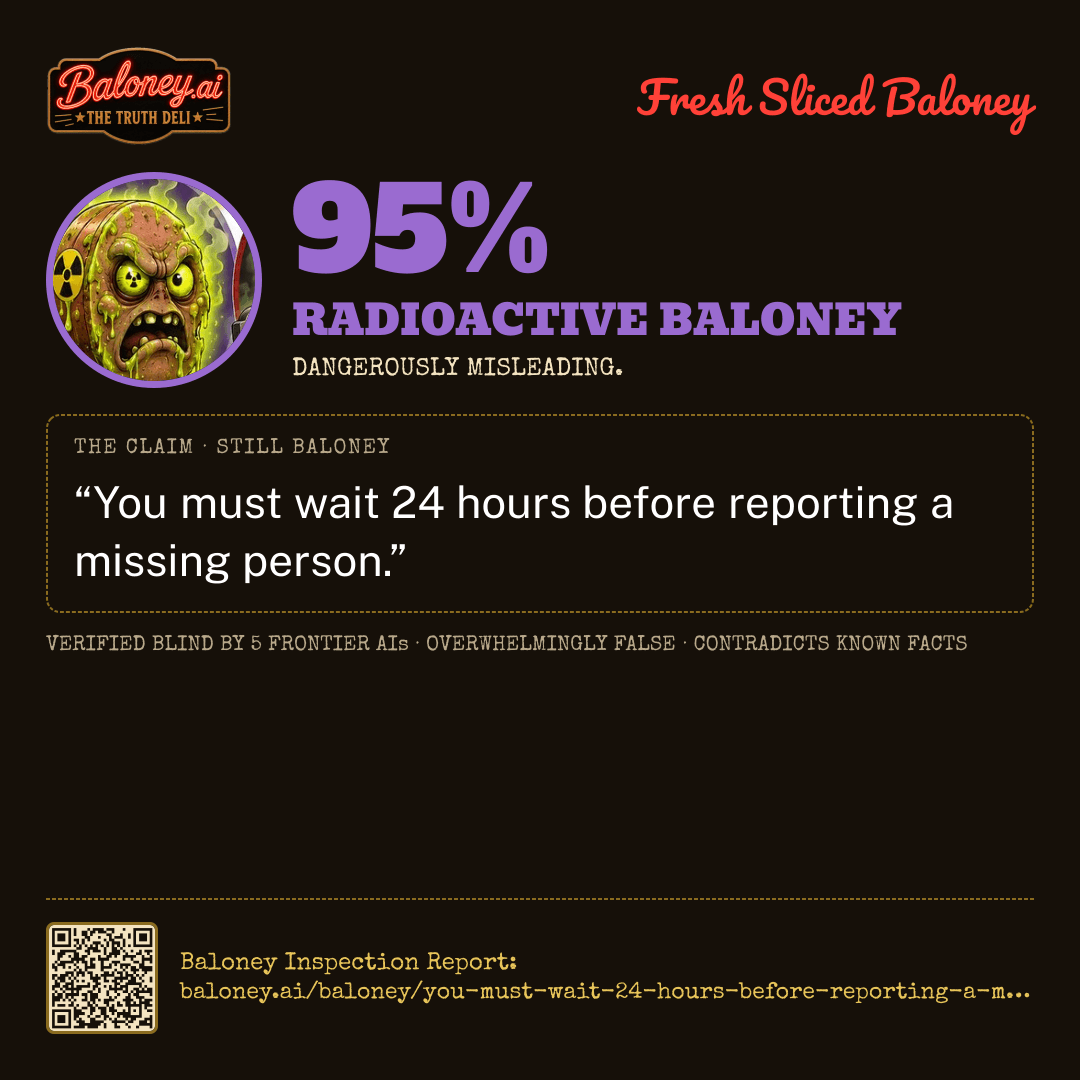
95% RADIOACTIVE BALONEY — DANGEROUSLY TOXIC “You must wait 24 hours before reporting a missing person.” Verified blind by 5 frontier AIs · Baloney Inspection Report: baloney.ai/baloney/you-must-wait-24-hours-before-reporting-a-missing-person