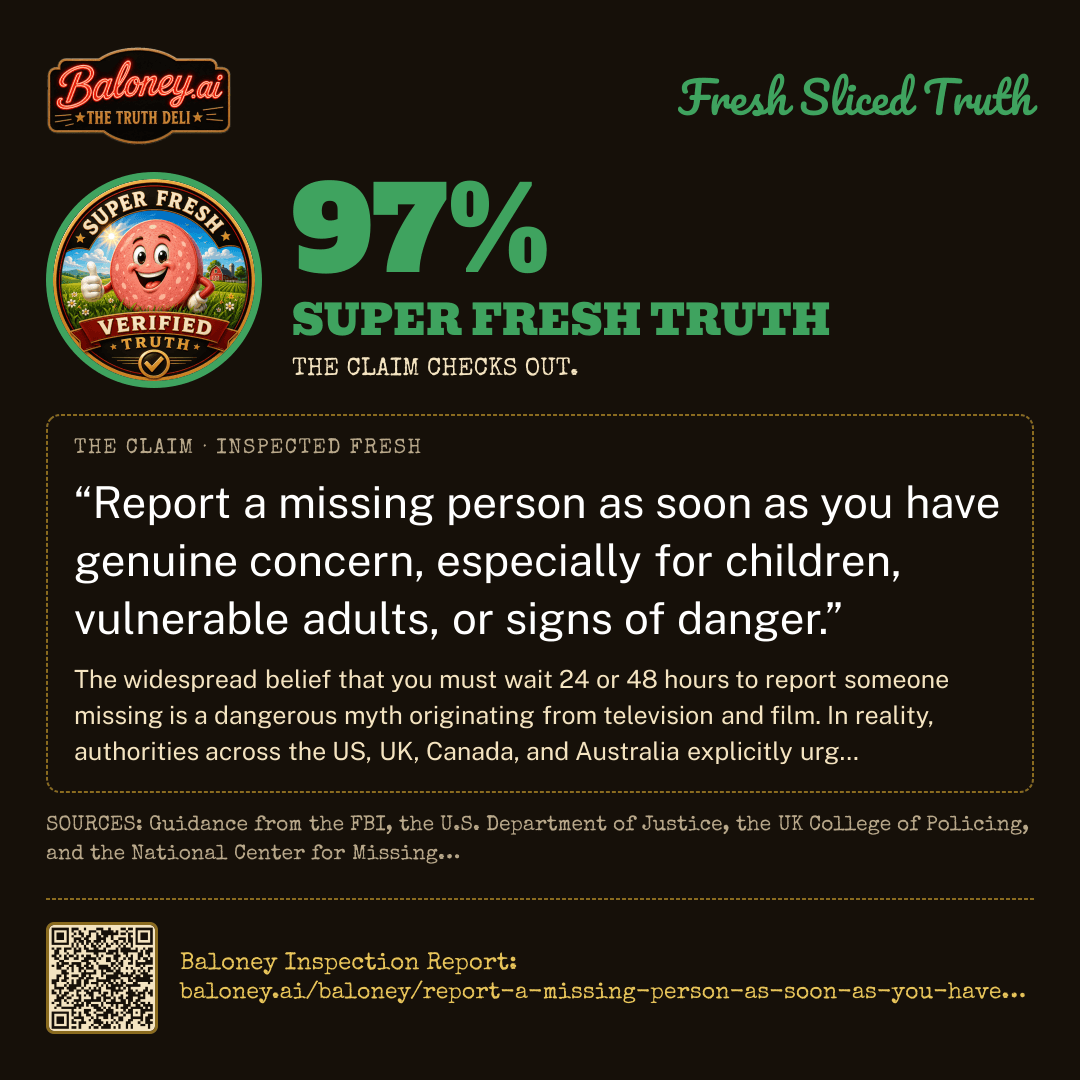
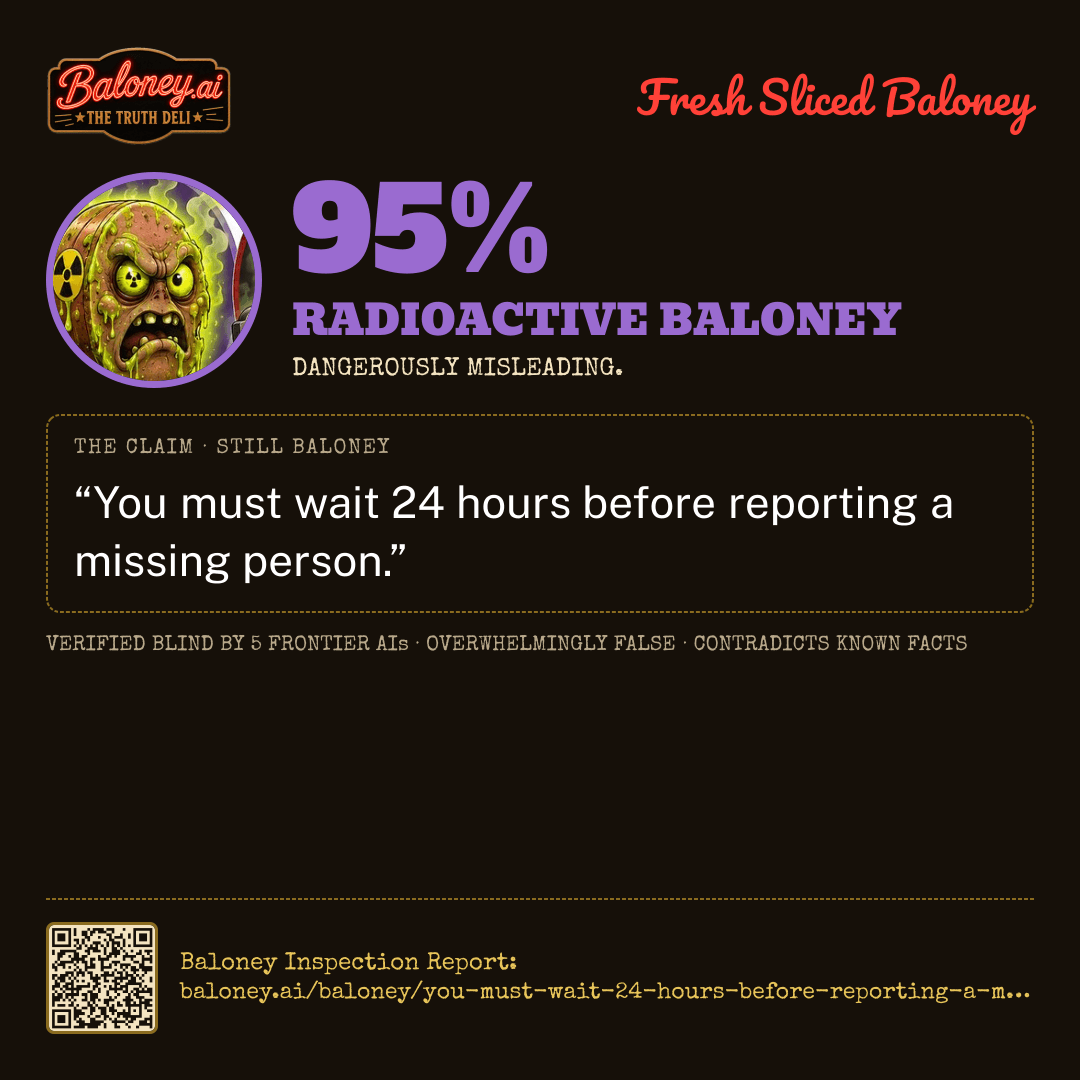
“Report a missing person as soon as you have genuine concern, especially for children, vulnerable adults, or signs of danger.”
SUBMITTED ANONYMOUSLY · INSPECTED 2026-09-13T22:20:26.132Z · STATUS: PUBLISHED
97%
97%
SUPER FRESH TRUTH — READY TO EAT!
THE CLAIM CHECKS OUT.
Independently verifiedPhysically repeatable evidenceConfirmed across rival labsSafe to serve
✓ BLIND VALIDATION CONFIRMED THIS SCORE
Serve It Fresh
Ready to Serve11 servings
Serve it the way you want it
The Verdict
97% SUPER FRESH TRUTH — READY TO EAT! “Report a missing person as soon as you have genuine concern, especially for children, vulnerable adults, or signs of danger.” Verified blind by 5 frontier AIs · Baloney Inspection Report: baloney.ai/baloney/report-a-missing-person-as-soon-as-you-have-genuine-concern
Station 1 · Blind Inspection — Five Graders, Zero Peeking
Each lab scored the claim independently, without seeing the others. Open a breakdown for its evidence, its sources, and how sure it was.
Anthropic · EQUAL WEIGHT · 43.3s
claude-opus-5
98%TRUTH
ROUND-1 BREAKDOWN
Evidence offered for the claim
There is no legally mandated 24-hour waiting period to report a missing person in the US, UK, Canada or Australia; this is a widely debunked myth propagated largely by film and television. Police guidance in all four countries explicitly tells the public to report immediately when concerned.
US federal law (the National Child Search Assistance Act, as amended by 'Suzanne's Law' in the 2003 PROTECT Act, codified at 34 U.S.C. § 41307) requires law enforcement to accept reports and enter missing persons under age 21 into the FBI's NCIC database immediately, with no waiting period and no requirement that the child be a proven abduction victim.
The National Center for Missing & Exploited Children (NCMEC) instructs caregivers to call 911 and NCMEC (1-800-THE-LOST) immediately upon realizing a child is missing, because the earliest hours yield the most recoverable evidence (witnesses, CCTV, phone/cell-site data, scent trails).
Research on child abduction homicide (Washington State Attorney General's Office 'Case Management for Missing Children Homicide Investigation' study, Brown/Keppel/Weis) found that in the large majority of cases where an abducted child was murdered, the killing occurred within roughly three hours of the abduction — making delay in reporting materially dangerous.
UK College of Policing Authorised Professional Practice on missing persons defines a missing person as anyone whose whereabouts cannot be established and where circumstances are out of character or suggest risk of harm, and requires an immediate risk assessment on receipt of a report — the model assumes prompt reporting.
Risk-based triage used by police (high/medium/low risk) explicitly escalates cases involving children, elderly people, those with dementia, mental health conditions, disabilities, or indications of suicide, crime or violence — which matches the claim's carve-out for children, vulnerable adults and signs of danger.
Search-and-rescue practice (e.g., lost-person behaviour literature and dementia 'Silver Alert'/Purple Alert schemes) shows survival probability for elderly and cognitively impaired missing people declines sharply within the first 24 hours, especially in adverse weather.
Alert systems such as AMBER Alert depend on rapid reporting; the activation criteria require law enforcement to have timely information, which is impossible if families wait.
Evidence against the claim
'Genuine concern' is subjective and undefined; the claim gives no operational threshold, so it can be read as endorsing reports based on mild anxiety, which some agencies argue contributes to high volumes of low-risk reports (a large share of UK missing-person reports involve repeat reports from care homes and are resolved within 24 hours).
Competent adults have a legal right to go missing; police in most jurisdictions will not compel a located adult to return or disclose their location, so reporting does not always produce the outcome families expect and can strain relationships or endanger people fleeing abuse if their location is disclosed.
In practice, despite the law, some agencies and call-takers have been documented discouraging or delaying reports — particularly for adults, teenagers assumed to be runaways, and Indigenous and Black missing persons — so the claim describes the correct norm rather than universal practice (a criticism raised in Canada's National Inquiry into Missing and Murdered Indigenous Women and Girls, 2019).
Knowingly filing a false missing-person report is a criminal offence in many jurisdictions, so 'report as soon as you have concern' needs the implicit qualifier of good-faith belief.
The claim is normative advice rather than a testable factual assertion; its evidentiary support is guidance and practice rather than randomized evidence that earlier reporting causes better outcomes (such a trial would be unethical/infeasible), so causal strength rests on observational and case-review data.
How sure this lab was
92/100 — the lab’s own confidence in the score above, not a second reading of the claim.
Government and police guidance in multiple jurisdictions explicitly says there is no required 24-hour waiting period; if you are worried someone is missing, you should contact police promptly, using emergency services where there is immediate danger. GOV.UK says to call 101 to report a missing person and 999 if they are in immediate danger, and states you do not have to wait 24 hours.
Child-focused authorities advise immediate action. The National Center for Missing & Exploited Children tells caregivers to immediately call local law enforcement when a child is missing and then contact NCMEC after making the police report.
U.S. state law-enforcement guidance also supports prompt reporting for any missing person. The California Department of Justice states there is no waiting period for reporting a missing person.
The claim’s emphasis on children, vulnerable adults, and signs of danger matches risk-based policing guidance: UK College of Policing missing-person guidance prioritizes risk assessment, vulnerability, and immediate safeguarding actions when risk is high.
AMBER Alert guidance reflects the same principle for high-risk child abductions: rapid law-enforcement reporting and notification are central because serious bodily injury or death risk is part of the alert criteria.
Evidence against the claim
The claim could be overapplied if 'genuine concern' is interpreted too loosely. Many adults have the legal right to leave or stop communicating, and police may have to balance safeguarding with privacy and autonomy; a competent adult being unreachable is not always an emergency.
Not every missing-person concern requires calling emergency services. GOV.UK distinguishes routine missing-person reporting from immediate danger, advising emergency calls only where there is immediate danger; otherwise non-emergency reporting is appropriate.
Unnecessary or premature reports can consume police resources, especially when the person is merely delayed, voluntarily absent, or reachable through ordinary checks. Best practice is still prompt reporting when there is genuine concern, but reasonable first steps such as calling, checking likely locations, or contacting friends may be appropriate when there are no vulnerability or danger indicators.
False or knowingly misleading missing-person reports are not protected by the general advice to report genuine concerns and can be criminal or otherwise harmful.
How sure this lab was
92/100 — the lab’s own confidence in the score above, not a second reading of the claim.
Government and law enforcement agencies universally state that there is no waiting period (such as 24 or 48 hours) required to report a missing person.
The National Center for Missing & Exploited Children (NCMEC) and the U.S. Department of Justice urge immediate reporting, noting that the first few hours are the most critical in a missing child or vulnerable adult investigation.
Delays in reporting can lead to lost physical evidence, witnesses forgetting critical details, and a drastically expanded search area, exponentially increasing the risk of harm.
Evidence against the claim
There is no legal or safety evidence against this claim. The common belief that one must wait 24 or 48 hours before reporting a missing person is a dangerous myth largely perpetuated by movies and television.
While police resources can occasionally be strained by reports of adults who are not in danger and have voluntarily chosen to disconnect from their families (which is a legal right), law enforcement still advises reporting immediately if the person is vulnerable or if there is genuine concern for their safety.
How sure this lab was
100/100 — the lab’s own confidence in the score above, not a second reading of the claim.
U.S. Department of Justice guidance says to act immediately if you believe your child is missing and to call local law enforcement first, which supports the claim that reporting should happen as soon as genuine concern exists.[2][5]
The DOJ/OJP family guide says to immediately report a child as missing to local law enforcement and emphasizes there is no waiting period for parents to report missing children, supporting the claim for children specifically.[7][9]
UK government guidance says that when there are concerns for a child or vulnerable adult’s safety, they should be immediately reported as missing to local police and social services, directly supporting the claim for vulnerable people.[1][3]
Police guidance in the UK says if the missing person is in immediate danger, is a young child, or is vulnerable to harm, call emergency services right away, supporting the claim’s urgency when danger is present.[12]
A Spanish national missing-persons center states you should not wait 24 hours and should report as soon as possible, especially in cases involving minors and the elderly, which supports the broader principle of prompt reporting.[10]
Evidence against the claim
Some guidance qualifies immediate reporting by saying you should first make a limited check of the home or last-seen place to see whether the person is simply hidden, injured, or unable to move, especially for minors and the elderly; this means the claim is directionally right but slightly oversimplified if read as 'report instantly with no preliminary check at all.'[10]
The claim says 'especially for children, vulnerable adults, or signs of danger,' but in some systems the specific trigger is 'immediate danger' or concern for safety rather than every instance of absence; that makes the statement broader than some official wording, though not materially false.[12][1]
How sure this lab was
96/100 — the lab’s own confidence in the score above, not a second reading of the claim.
Law enforcement agencies in the US and comparable jurisdictions state there is no waiting period to file a missing-person report and urge reporting as soon as there is genuine concern.
Child-focused agencies (e.g., NCMEC) and Amber Alert-type systems treat rapid reporting as essential because the first hours are the most time-critical, especially for children.
Guidance is stronger still for children, vulnerable adults (including those with cognitive impairment), and any case with signs of abduction, injury, or other danger.
The long-standing ‘wait 24 hours’ idea is treated as a myth by police and missing-person organizations.
Evidence against the claim
Competent adults may leave voluntarily and have a privacy interest; a report without genuine concern can waste resources, though the claim already conditions action on genuine concern and higher-risk groups.
Some practical checklists suggest quickly contacting known friends or locations first, but authorities still advise against delaying an official report when concern remains.
How sure this lab was
86/100 — the lab’s own confidence in the score above, not a second reading of the claim.
All evaluators agree that the claim is entirely accurate and aligns with global law enforcement and child safety guidance. The long-standing myth of a '24-hour waiting period' is explicitly debunked by police in the US, UK, Canada, Australia, and elsewhere. Delaying a report can be actively dangerous, as the early hours are the most critical for finding witnesses, recovering CCTV or cell data, and establishing search perimeters, particularly for vulnerable individuals. While competent adults have a right to voluntarily go missing and it is sensible to make brief preliminary checks before calling the authorities, the instruction to report as soon as there is 'genuine concern' represents established best practice.
The evaluators unanimously agreed on the facts: there is no legal waiting period to report a missing person, and immediate reporting is paramount when there is genuine concern. Evaluator 1 gave a slightly higher score (6, bordering on 'Fishy Baloney') due to caveats about adult privacy and the need for preliminary checks, but the consensus strongly places the claim in the 'Super Fresh Truth' category.
SUPER FRESH — VERIFIED AGAINST GUIDANCE FROM THE FBI, THE U.S. DEPARTMENT OF JUSTICE, THE UK COLLEGE OF POLICING, AND THE NATIONAL CENTER FOR MISSING & EXPLOITED CHILDREN.
Blind Validation Master · never saw the Primary’s work
grok-4.6
97% TRUTH
Official guidance across the US, UK, Canada, Australia and similar jurisdictions is consistent: there is no 24-hour waiting period, the wait-to-report idea is treated as a myth, and the public is told to contact police as soon as there is genuine concern. That advice is strongest for children (NCMEC, Suzanne’s Law/NCIC, AMBER criteria, abduction-homicide timing research), vulnerable adults, and any indication of danger or out-of-character risk. The claim already embeds those conditions rather than urging indiscriminate reporting. Remaining caveats—adults’ legal right to leave, subjectivity of “genuine concern,” a possible brief check of last-known locations, and emergency vs non-emergency numbers—are real but do not make the statement false or materially overstated; they are the kind of small wording qualifications the scale keeps in the 1–5 band.
AGREEMENT TEST PASSED — MASTERS SCORED 98% AND 97% · BLIND VALIDATION CONFIRMED THIS SCORE · NO RE-EVALUATION REQUIRED
The Evidence
Evidence for the claim
No waiting period Police and government agencies universally state there is no legally mandated 24-hour waiting period to report a missing person; this is a myth propagated by television and film.
Critical early hours Child-focused agencies like NCMEC and missing persons units emphasize that the earliest hours yield the most recoverable evidence, such as witnesses, CCTV, and phone data.
High-risk triage Risk-based policing models explicitly escalate and prioritize cases involving children, the elderly, individuals with cognitive impairments, or any indication of crime or violence.
Evidence offered against the claim
Adult autonomy Competent adults have the legal right to voluntarily leave or cease communication, and police will often not compel a located adult to return or disclose their location to family.
Preliminary checks While immediate reporting is advised for high-risk individuals, authorities often suggest making reasonable preliminary checks of likely locations and contacting friends if there are no immediate signs of danger.
Sources · Reliability · Why Accepted or Discounted
Source
Type
Reliability
Ruling
National Center for Missing & Exploited Children
other
95
ACCEPTED — A premier, highly authoritative organization specializing in missing child cases and best practices.
Federal Bureau of Investigation
gov
95
ACCEPTED — Primary federal law enforcement agency maintaining the NCIC database for missing persons.
National Institute of Justice (NamUs)
gov
93
ACCEPTED — The official US national clearinghouse for missing, unidentified, and unclaimed person cases.
GOV.UK
gov
96
ACCEPTED — Official repository for UK government and policing guidance.
California Department of Justice
gov
94
ACCEPTED — Authoritative state-level law enforcement guidance.
College of Policing
gov
92
ACCEPTED — Sets the Authorised Professional Practice and standards for police forces in England and Wales.
U.S. Department of Justice
gov
96
ACCEPTED — Authoritative federal guidance for law enforcement and families.
Cornell Legal Information Institute
edu
93
ACCEPTED — Reliable academic repository of US federal law, including the National Child Search Assistance Act.
Washington State Attorney General's Office
gov
85
ACCEPTED — Produced landmark research on child abduction murder timelines.
Royal Canadian Mounted Police
gov
90
ACCEPTED — National police service of Canada providing official missing persons guidance.
Australian Federal Police
gov
90
ACCEPTED — Manages Australia's National Missing Persons Coordination Centre.
Missing People (UK charity)
other
85
ACCEPTED — Reputable UK charity working alongside police to support missing people and their families.
USA.gov
gov
100
ACCEPTED — Official web portal of the United States federal government.
Spain National Missing Persons Centre
gov
86
ACCEPTED — Official national missing persons authority in Spain.
Snopes
factcheck
90
ACCEPTED — Reliable fact-checking outlet that has specifically debunked the 24-hour waiting period myth.
Serve It Fresh
Ready to Serve11 servings
Serve it the way you want it
The Verdict
97% SUPER FRESH TRUTH — READY TO EAT! “Report a missing person as soon as you have genuine concern, especially for children, vulnerable adults, or signs of danger.” Verified blind by 5 frontier AIs · Baloney Inspection Report: baloney.ai/baloney/report-a-missing-person-as-soon-as-you-have-genuine-concern