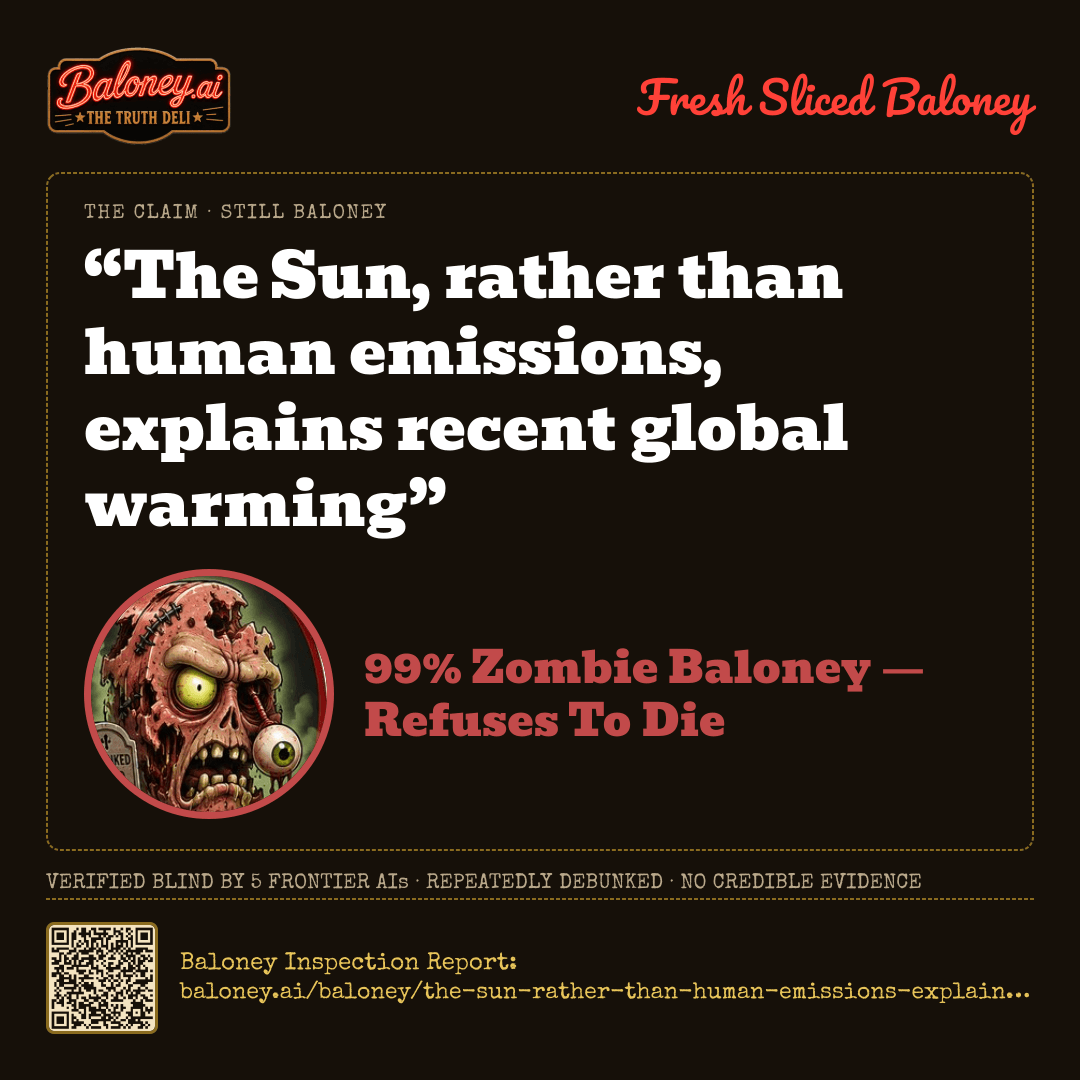
“The Sun, rather than human emissions, explains recent global warming”99% Zombie Baloney — Refuses To DieVerified blind by 5 frontier AIs · Baloney Inspection Report: baloney.ai/baloney/the-sun-rather-than-human-emissions-explains-recent-global
The Rating Card
The correction — what is actually true
The Baloney Sampler
The reports found that the Sun influences climate, but does not explain recent global warming instead of human emissions. Satellite measurements show no sustained increase in solar energy during the period of sharp warming, while the IPCC, NASA, and NOAA identify human influence as the dominant cause.
The finding rests on several matching lines of evidence: natural forcings alone cannot reproduce the warming, the troposphere and surface are warming while the stratosphere cools, and the estimated human forcing is far larger than solar forcing. Solar variability may have contributed to some earlier warming and historical climate changes, but not the recent long-term trend.
Other ways to slice it — phrasings that might have changed the rating
“Solar variability contributed meaningfully to global warming during the early twentieth century, roughly from 1910 to 1940.” The reports state that rising solar irradiance may have contributed to part of that specific episode, alongside a rebound from volcanic cooling.
“The Sun’s approximately 11-year cycle produces small, detectable changes in climate and short-term temperature variability.” The reports recognize solar variability as a genuine natural forcing that can create modest cyclic effects without generating the long-term warming trend.
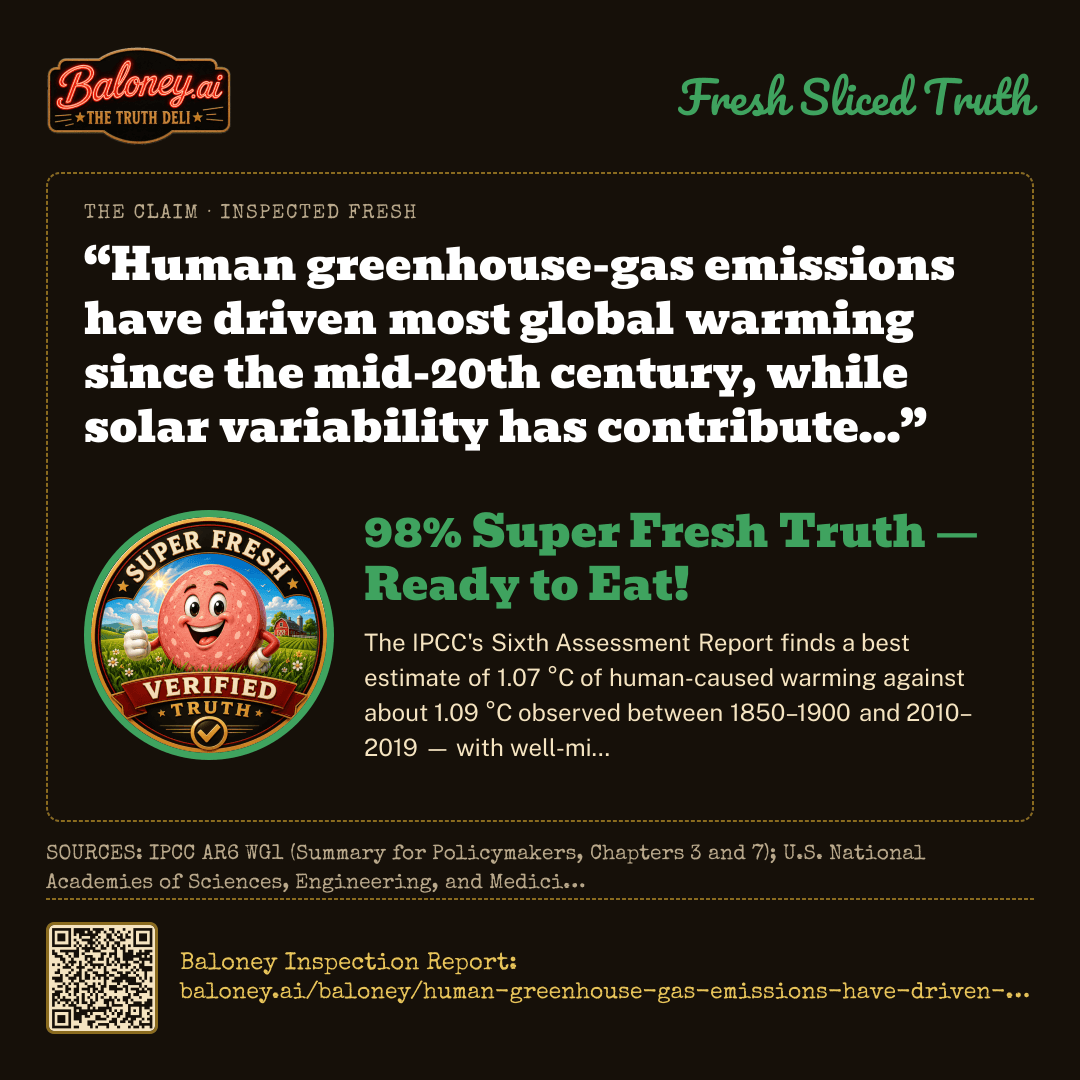
“Human greenhouse-gas emissions, rather than solar variability, are the dominant cause of recent global warming.” The IPCC, NASA, and NOAA findings identify human influence as dominant, supported by the absence of a sustained solar increase and the observed tropospheric-warming and stratospheric-cooling pattern.
Written from the panel’s reports by Perplexity · sonar-pro. Nothing here changed the score.
04:25:58SCORING MODEL V2 — MEDIAN OF 5 COUNTED LAB SCORES: 97, 99, 99, 95, 87 → 97. ZOMBIE RULE: THE PRIMARY MASTER FLAGS A LONG DEBUNK HISTORY, THE BLIND MASTER SCORES 99, THE COUNTED MEDIAN IS 97 — PUBLISHED AS 99.✓
04:25:58SOURCE RULE — LABS CITED 32 SOURCES: 0 DISCARDED FOR HAVING NO URL, 1 DISCARDED AS DEAD LINKS (404/410), 4 COULD NOT BE OPENED BY US AND ARE MARKED UNVERIFIED.✓
04:25:58SOURCE RULE — PRIMARY MASTER RULED ON 20 SOURCES: 0 DISCARDED FOR HAVING NO URL, 0 DISCARDED AS DEAD LINKS, 4 MARKED UNVERIFIED, 16 VERIFIED.✓
How This One Was Sliced
Station 1 · Blind Inspection — Five Graders, Zero Peeking
Each lab scored the claim independently, without seeing the others. Open a breakdown for its evidence, its sources, and how sure it was.
Anthropic · EQUAL WEIGHT · 51.2s
claude-opus-5
97%BALONEY
ROUND-1 BREAKDOWN
Evidence offered for the claim
The Sun is unambiguously the ultimate energy source for Earth's climate, and solar variability has demonstrably driven past climate changes: the Maunder Minimum (c. 1645-1715) coincided with the coldest phase of the Little Ice Age, and orbital (Milankovitch) changes in solar distribution pace the ice-age cycles.
Solar forcing does appear to have contributed meaningfully to the early-20th-century warming (roughly 1910-1940), when total solar irradiance (TSI) rose alongside a rebound from volcanic cooling; attribution studies assign a non-trivial solar share to that specific episode.
A minority of researchers (e.g., Connolly, Soon et al. 2021, Research in Astronomy and Astrophysics) argue that if one selects high-variability TSI reconstructions and rural-only temperature series, the Sun could explain a large fraction of post-1850 Northern Hemisphere land warming — the one published line of argument that supports the claim.
Solar ultraviolet variability and possible indirect pathways (cosmic-ray/cloud hypotheses, solar influence on stratospheric dynamics and regional circulation such as the North Atlantic Oscillation) are real areas of ongoing research, so solar influence on regional climate is not zero.
Evidence against the claim
Direct satellite measurements of total solar irradiance since 1978 show no upward trend — a slight decline across recent cycles — while global mean surface temperature rose roughly 0.6-0.8 °C over the same period. The two curves diverge, which is fatal to a solar explanation of recent warming.
Solar activity reached a multi-decadal minimum during 2008-2010 and cycle 24 (2009-2019) was the weakest in about a century, yet the 2010s and 2020s contain every one of the warmest years in the instrumental record; 2023 and 2024 set records.
The vertical fingerprint is wrong for the Sun. Increased solar output warms the whole atmospheric column, including the stratosphere. Observations show tropospheric warming with simultaneous stratospheric cooling — the signature of greenhouse-gas trapping of outgoing infrared, not of increased incoming sunlight.
Additional fingerprints contradict solar forcing: nights are warming faster than days, winters faster than summers, and satellites directly measure reduced outgoing longwave radiation in CO2 absorption bands with matching increases in downwelling infrared at the surface (Harries et al. 2001; Feldman et al. 2015).
IPCC AR6 (2021) assesses total anthropogenic forcing 1750-2019 at about 2.72 W/m² versus solar irradiance forcing of roughly 0.01 W/m² — a difference of more than two orders of magnitude. AR6 states the likely human contribution to 1850-1900 to 2010-2019 warming is 0.8-1.3 °C against observed warming of 1.07 °C, with natural drivers contributing -0.1 to +0.1 °C.
Isotopic and chemical evidence identifies fossil carbon as the source of rising CO2: atmospheric CO2 is becoming depleted in carbon-13 and carbon-14 (the Suess effect) and atmospheric oxygen is declining in step with combustion stoichiometry — a pattern the Sun cannot produce.
Statistical studies that remove El Niño, volcanic aerosol and solar-cycle variability from the temperature record (Foster & Rahmstorf 2011) find the underlying warming trend is essentially unchanged, showing the solar cycle modulates but does not generate the trend.
The high-solar-variability reconstructions needed to support the claim are outliers; the broader literature and the community TSI composites used by IPCC and NOAA show only ~0.05-0.1% variation over a solar cycle and no significant secular rise since the mid-20th century.
How sure this lab was
97/100 — the lab’s own confidence in the score above, not a second reading of the claim.
The Sun is the climate system’s dominant energy source, and solar output does vary, especially over the roughly 11-year solar cycle; those variations can produce small, detectable climate effects.
Solar variability is a real natural forcing and may have contributed modestly to some historical climate fluctuations, including parts of early-20th-century warming, so it is not scientifically irrelevant.
Some temperature records show short-term wiggles that can line up partly with solar-cycle timing, but this supports only a small cyclic influence, not the claim that the Sun explains recent long-term warming instead of human emissions.
Evidence against the claim
Direct satellite measurements since the late 1970s show no sustained increase in total solar irradiance while global surface temperature has risen sharply; the timing is opposite of what the claim requires.
The IPCC AR6 concludes it is unequivocal that human influence has warmed the atmosphere, ocean and land, and estimates that observed warming since 1850–1900 is explained by human-caused forcing, while combined natural drivers such as solar and volcanic forcing contributed approximately zero to recent warming.
Greenhouse-gas warming has a distinctive fingerprint: warming in the lower atmosphere and at the surface, with cooling in the stratosphere. A brighter Sun would tend to warm both layers. Observed stratospheric cooling therefore supports greenhouse forcing rather than solar forcing.
Attribution studies find that recent warming cannot be reproduced using natural forcings alone, but is reproduced when anthropogenic greenhouse gases and aerosols are included.
The magnitude of recent solar forcing is far too small compared with human-caused greenhouse-gas forcing to explain the observed warming trend.
How sure this lab was
97/100 — the lab’s own confidence in the score above, not a second reading of the claim.
The Sun is the primary source of Earth's energy, and historical variations in solar irradiance and orbital patterns (Milankovitch cycles) have driven past climate shifts, such as the Ice Ages and the Maunder Minimum.
During the early 20th century (roughly 1900 to 1940), a slight increase in solar irradiance likely contributed to a portion of the minor global warming observed during that specific period.
Evidence against the claim
Satellite instruments have directly measured solar energy reaching Earth since 1978. These records show no net increase in solar irradiance, despite this being the period of the most rapid and significant global temperature rise on record.
Observations of the atmosphere show that the lower atmosphere (troposphere) is warming while the upper atmosphere (stratosphere) is cooling. If the Sun were responsible for global warming, all layers of the atmosphere would warm. A cooling stratosphere while the troposphere warms is the distinct physical fingerprint of greenhouse gas trapping heat.
Climate models are unable to reproduce the observed modern warming trends using natural factors (like solar and volcanic activity) alone; the warming can only be explained when human-emitted greenhouse gases are included.
The Intergovernmental Panel on Climate Change (IPCC), representing the global scientific consensus, unequivocally concludes that human activities, principally through emissions of greenhouse gases, have unequivocally caused global warming, with solar variability playing a negligible role in recent decades.
How sure this lab was
100/100 — the lab’s own confidence in the score above, not a second reading of the claim.
The Sun is a genuine natural climate driver: changes in solar activity can influence Earth’s climate, and the Sun’s approximately 11-year cycle produces small variations in incoming solar energy.[https://science.nasa.gov/climate-change/causes/]
Solar variability may have contributed to some past climate changes, so it is not scientifically correct to say that the Sun has no climatic influence.[https://science.nasa.gov/climate-change/causes/]
Separating human-caused warming from natural variability is scientifically difficult, and natural climate drivers—including solar changes—are included in climate attribution analyses.[https://gml.noaa.gov/education/faq_cat-1.html]
Evidence against the claim
Satellite measurements since 1978 show no upward trend in the solar energy reaching Earth, while global temperature has risen markedly; this contradicts the Sun as the explanation for the recent warming trend.[https://science.nasa.gov/climate-change/faq/is-the-sun-causing-global-warming/]
The observed pattern—warming at Earth’s surface and lower atmosphere alongside cooling in the stratosphere—is consistent with increased heat-trapping greenhouse gases and inconsistent with increased solar output as the primary cause.[https://science.nasa.gov/climate-change/faq/is-the-sun-causing-global-warming/]
NASA reports that average solar energy since 1750 has remained constant or decreased slightly, and that solar variability cannot reproduce the observed warming trend without increased greenhouse gases.[https://science.nasa.gov/climate-change/causes/]
The IPCC concludes that it is unequivocal that human influence has warmed the atmosphere, ocean, and land, and that observed increases in well-mixed greenhouse gases since about 1750 are unequivocally caused by human activities.[https://www.ipcc.ch/report/ar6/wg1/chapter/summary-for-policymakers/]
The IPCC estimates human-caused radiative forcing in 2019 relative to 1750 at 2.72 W/m², with the warming mainly due to increased greenhouse-gas concentrations.[https://www.ipcc.ch/report/ar6/wg1/downloads/report/IPCC_AR6_WGI_SPM_final.pdf]
NOAA summarizes the attribution evidence by stating that observed global warming is unlikely to result from natural variability alone and that human activities are at least partially responsible.[https://gml.noaa.gov/education/faq_cat-1.html]
How sure this lab was
98/100 — the lab’s own confidence in the score above, not a second reading of the claim.
The Sun is Earth's primary energy source; multi-century solar minima (e.g., Maunder Minimum) coincided with cooler intervals such as the Little Ice Age.
Late-20th-century solar activity was relatively high (a grand maximum), overlapping the early part of the instrumental warming record.
A minority of papers and the cosmic-ray/cloud hypothesis (Svensmark and related work) argue solar and heliospheric effects are larger than mainstream radiative-forcing estimates.
Evidence against the claim
Satellite TSI records since 1978 show no rising trend and a slight decline across recent solar cycles while global surface temperature and ocean heat content rose sharply.
Anthropogenic greenhouse-gas radiative forcing (~2.7 W/m² since 1750, concentrated in recent decades) greatly exceeds estimated solar forcing for the same period (~0.05 W/m² or less).
Detection-and-attribution studies and CMIP-class models reproduce the observed warming only when anthropogenic forcings are included; solar, volcanic, and internal variability cannot.
The observed vertical fingerprint (tropospheric warming plus stratospheric cooling) matches greenhouse-gas forcing, not an increase in solar output (which would warm the stratosphere).
IPCC AR6, NASA, NOAA, and EPA conclude it is unequivocal that human influence, primarily GHG emissions, caused recent warming; solar contribution is negligible.
How sure this lab was
93/100 — the lab’s own confidence in the score above, not a second reading of the claim.
The statement is overwhelmingly contradicted by the evidence summarized across all five reports. The Sun is Earth’s ultimate energy source and solar variability has influenced past climate changes, including the approximately 11-year cycle and some historical fluctuations. However, direct satellite observations show no sustained increase in solar energy during the period of sharp recent warming. The observed combination of surface and tropospheric warming with stratospheric cooling is the expected fingerprint of greenhouse-gas forcing, not increased solar output. Attribution assessments report that natural drivers alone cannot reproduce recent warming, whereas simulations including human greenhouse-gas emissions can. The reports also identify a large forcing imbalance: approximately 2.72 W/m² of anthropogenic forcing since 1750 versus roughly 0.01 W/m² from solar irradiance in the IPCC assessment. I treated the IPCC, NASA, NOAA, EPA, and the cited peer-reviewed studies as relevant and mutually reinforcing; I discounted no cited source entirely, but gave less weight to Skeptical Science and the minority high-variability solar reconstructions because the reports characterize them as secondary or outlier arguments rather than the prevailing attribution evidence. The wording 'rather than human emissions' makes the claim categorically false even though the Sun has a genuine, modest climatic influence.
All five evaluators scored the claim as overwhelmingly false, with recommended scores from 87 to 99. They agreed that solar variability affects climate and may have contributed to some historical or early-20th-century warming, but also agreed that recent warming is not explained primarily by the Sun. Their common evidence was the absence of a sustained recent increase in solar irradiance, the tropospheric-warming/stratospheric-cooling fingerprint, the much larger estimated human greenhouse-gas forcing, and attribution studies requiring anthropogenic forcings. The main disagreement was one of degree: Reports 1, 2, and 4 gave near-maximal scores; Report 3 discussed minority solar reconstructions and several additional fingerprints; Report 5 assigned the lowest score because it gave more space to solar-minimum history and minority solar hypotheses. None treated those qualifications as sufficient to support the statement.
ZOMBIE FLAG: TRUE — DEBUNK HISTORY ON RECORD
Blind Validation Master · never saw the Primary’s work
gemini-3.1-pro-preview
99% BALONEY
The claim that the Sun is responsible for recent global warming is overwhelmingly contradicted by observational data and scientific consensus. Since 1978, satellite measurements have shown no net increase in solar energy reaching Earth, yet global surface temperatures have risen sharply over this same period. Additionally, atmospheric observations show the lower atmosphere (troposphere) is warming while the upper atmosphere (stratosphere) is cooling. This is the distinct physical fingerprint of greenhouse gas heat-trapping; if the Sun were the primary cause, all atmospheric layers would be warming. Major scientific bodies, including the IPCC, NASA, and NOAA, unequivocally conclude that human greenhouse gas emissions are the dominant driver of recent climate change, with solar variability playing a negligible role. Because this assertion has been repeatedly and thoroughly debunked yet continues to circulate widely, it squarely qualifies as 'Zombie Baloney'.
AGREEMENT TEST PASSED — BOTH MASTERS SCORED 99% · BLIND VALIDATION CONFIRMED THIS SCORE · NO RE-EVALUATION REQUIRED
Median of 5 counted lab scores: 97, 99, 99, 95, 87 → 97.
Zombie rule: the Primary Master flags a long debunk history, the Blind Master scores 99, the counted median is 97 — published as 99.
The Evidence
Evidence offered for the claim
The Sun powers Earth’s climate The Sun is Earth’s primary or ultimate energy source, and changes in solar activity—including the approximately 11-year cycle—can produce detectable climate effects.
Solar variability shaped past climate Solar variability and orbital changes have contributed to past climate shifts, including ice-age cycles and cooler intervals associated with the Maunder Minimum and the Little Ice Age. This establishes that the Sun influences climate, but does not establish that it explains recent warming.
Some early-20th-century warming had a solar component Several reports state that increased solar irradiance, together with recovery from volcanic cooling, likely contributed to part of the warming around 1900–1940 or 1910–1940. This is limited to a historical episode and does not support the claim about recent warming as a whole.
Minority high-variability solar reconstructionsDEBUNKED — Report 3 identified a minority of researchers who use higher-variability total-solar-irradiance reconstructions and selected Northern Hemisphere rural temperature series to argue for a larger solar contribution after 1850. The report characterized this as an outlier line of argument, while the other reports relied on mainstream composites and attribution assessments.
Possible indirect solar pathwaysDEBUNKED — Solar ultraviolet variability, stratospheric dynamics, regional circulation, and proposed cosmic-ray/cloud mechanisms remain areas of research, and solar influence on regional climate is not zero. The reports did not find these mechanisms sufficient to explain the recent global trend.
Evidence against the claim
No sustained rise in solar irradiance Satellite measurements since 1978 show no net increase in total solar irradiance, with some reports describing a slight decline across recent cycles, while global temperature rose sharply. NASA also summarizes the longer record as showing no net increase since the 1950s or 1880, depending on the cited page.
The atmospheric fingerprint is greenhouse warming Observations show warming at Earth’s surface and in the troposphere alongside cooling in the stratosphere. Increased solar output would tend to warm the atmospheric column, whereas this vertical pattern is consistent with heat-trapping greenhouse gases.
Human forcing is much larger The reports cite IPCC AR6 estimates of approximately 2.72 W/m² of anthropogenic radiative forcing since 1750 versus roughly 0.01 W/m² from solar irradiance, making the solar contribution far too small to account for observed recent warming.
Natural forcings cannot reproduce the trend Attribution studies and climate-model experiments summarized by the evaluators find that solar, volcanic, and internal variability alone cannot reproduce the observed recent warming, while simulations including human greenhouse gases and aerosols can.
Recent warming continued during weak solar activity Solar activity reached a multi-decadal minimum around 2008–2010, and cycle 24 was unusually weak, yet the 2010s and 2020s included the warmest years in the instrumental record. This timing is inconsistent with solar output as the primary cause.
Additional radiation and carbon evidence Report 3 cites reduced outgoing longwave radiation in CO2 absorption bands, increased downwelling infrared radiation at the surface, and atmospheric carbon-isotope and oxygen changes consistent with fossil-fuel combustion. These observations support human greenhouse-gas forcing.
Sources · Reliability · Why Accepted or Discounted
ACCEPTED — Authoritative summary of solar variability and human causes.
Every link was opened when this claim was inspected. A dead link was discarded before publication; “unverified” means the site refused our automated check and the link is the one the panel cited. A source without a URL was never kept.
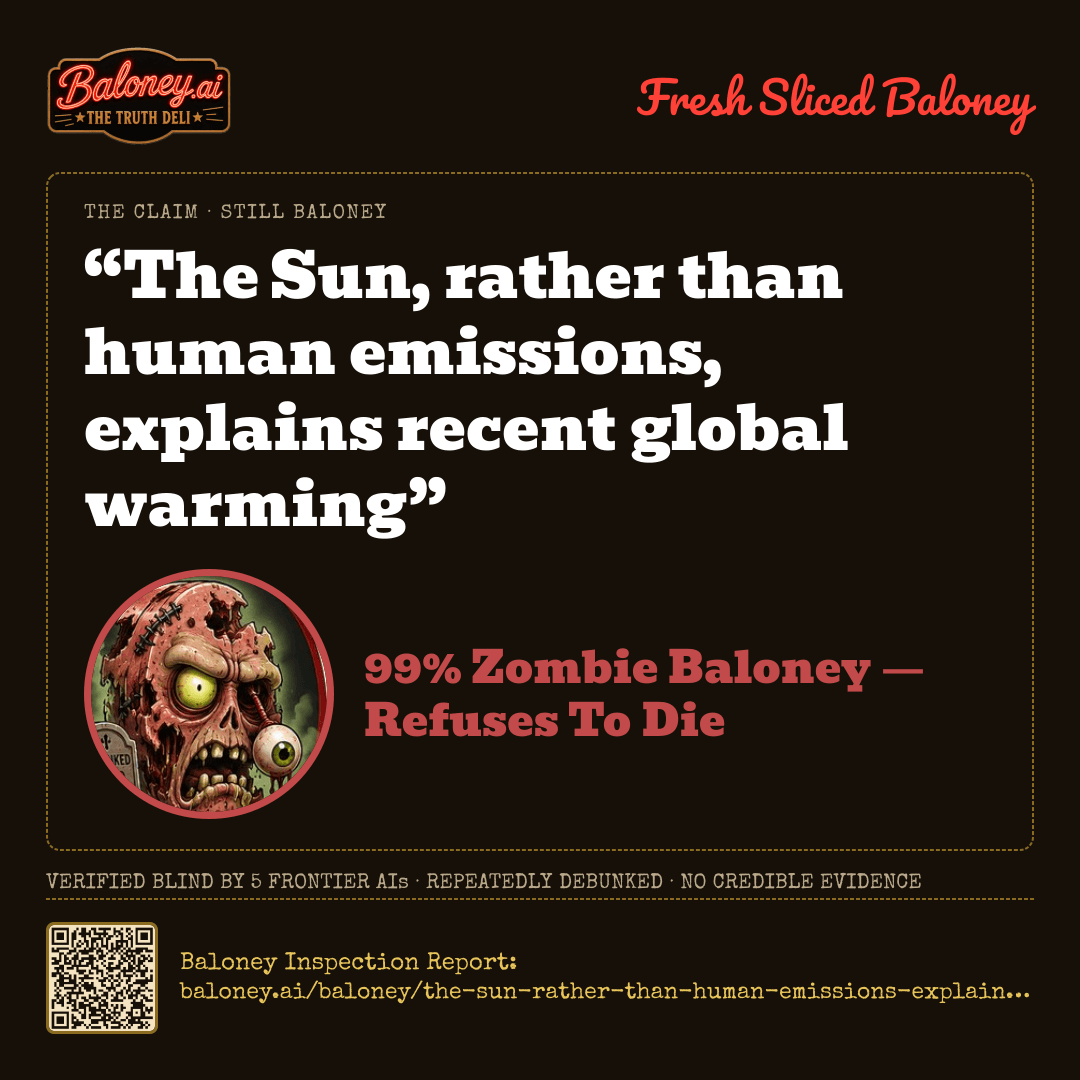
“The Sun, rather than human emissions, explains recent global warming”99% Zombie Baloney — Refuses To DieVerified blind by 5 frontier AIs · Baloney Inspection Report: baloney.ai/baloney/the-sun-rather-than-human-emissions-explains-recent-global
Support The Truth Deli
Buy The Truth Deli Merch
“Democracy Makes America Great”
Veritate Libertas — Latin for “Through Truth, Liberty.”
Democracy is what makes America great. But without truth — honest, real, scientifically validated truth — democracy fails. The baloney slicer is on: feeding fresh sliced truth to protect what makes America great. Democracy.