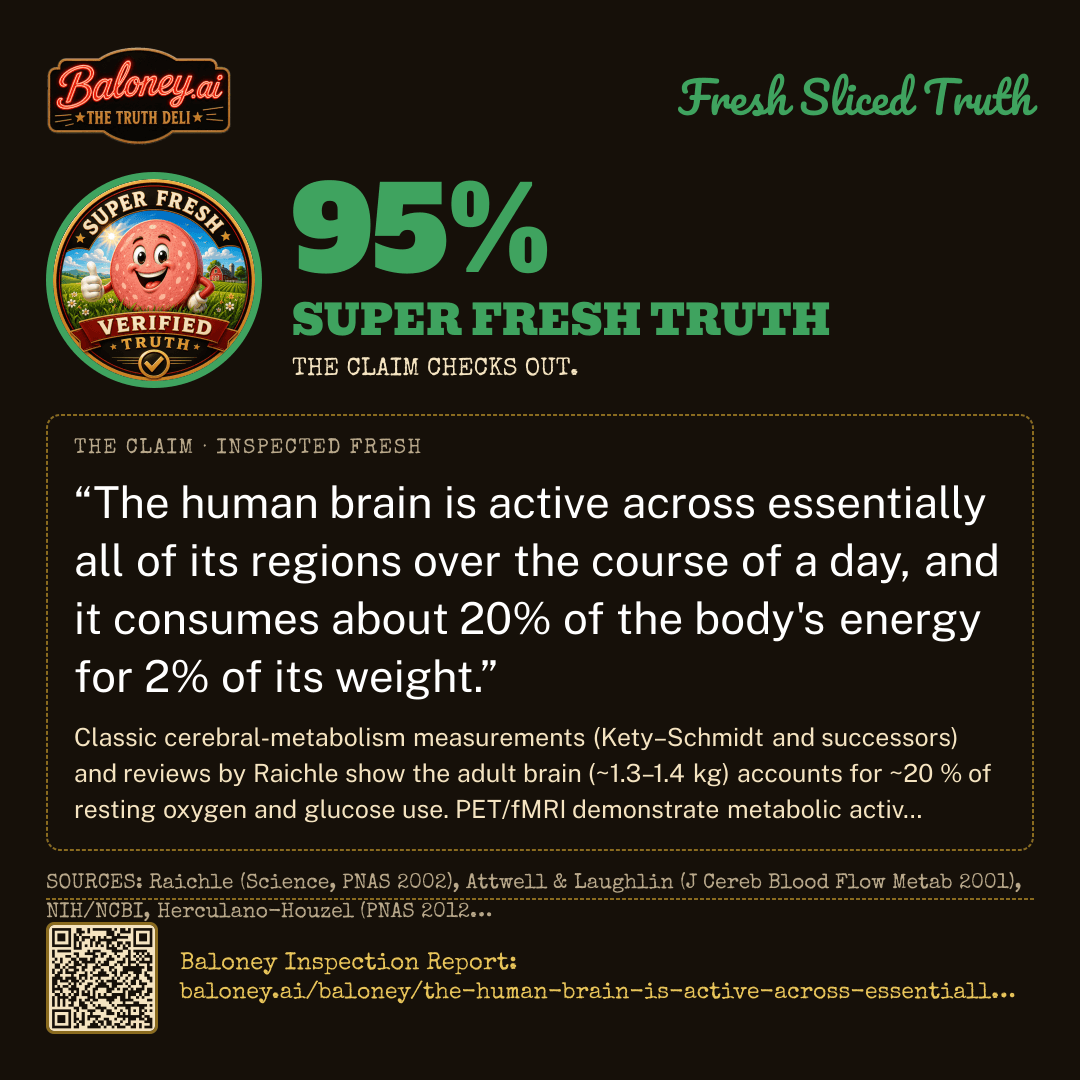
“The human brain is active across essentially all of its regions over the course of a day, and it consumes about 20% of the body's energy for 2% of its weight.”
SUBMITTED ANONYMOUSLY · INSPECTED 2026-09-13T20:43:37.673Z · STATUS: PUBLISHED
95%
95%
SUPER FRESH TRUTH — READY TO EAT!
THE CLAIM CHECKS OUT.
Independently verifiedPhysically repeatable evidenceConfirmed across rival labsSafe to serve
✓ BLIND VALIDATION CONFIRMED THIS SCORE
Serve It Fresh
Ready to Serve19 servings
Serve it the way you want it
The Verdict
95% SUPER FRESH TRUTH — READY TO EAT! “The human brain is active across essentially all of its regions over the course of a day, and it consumes about 20% of the body's energy for 2% of its weight.” Verified blind by 5 frontier AIs · Baloney Inspection Report: baloney.ai/baloney/the-human-brain-is-active-across-essentially-all-of-its
Station 1 · Blind Inspection — Five Graders, Zero Peeking
Each lab scored the claim independently, without seeing the others. Open a breakdown for its evidence, its sources, and how sure it was.
Anthropic · EQUAL WEIGHT · 41.8s
claude-opus-5
96%TRUTH
ROUND-1 BREAKDOWN
Evidence offered for the claim
Mass fraction checks out arithmetically: an adult human brain weighs roughly 1.3–1.4 kg, which is about 2% of a 60–70 kg body.
Direct measurement of cerebral blood flow and arteriovenous oxygen/glucose differences (Kety–Schmidt method and successors) gives a brain metabolic rate of ~3.0–3.5 ml O2/100 g/min and ~20–25% of whole-body resting oxygen and glucose consumption — the classic basis for the '2% of weight, 20% of energy' statement.
Raichle & Gusnard (PNAS, 2002) explicitly state the brain is ~2% of body weight yet accounts for ~20% of the body's energy consumption, and that this consumption is largely ongoing/intrinsic rather than task-evoked.
Attwell & Laughlin (J Cereb Blood Flow Metab, 2001) built a bottom-up energy budget showing most of this cost goes to restoring ion gradients after synaptic and action-potential activity — i.e., the energy is spent on widespread ongoing neural signalling, not on a small active fraction.
Comparative work (e.g., Herculano-Houzel, PNAS 2012) confirms the human brain's ~20–25% share of resting metabolism is unusually high but scales predictably with neuron number.
The 'all regions active' part is the standard expert refutation of the 10%-of-the-brain myth: PET/fMRI and resting-state imaging show metabolic activity throughout the brain, including during sleep; no large region is metabolically silent.
Clinical evidence supports functional non-redundancy: damage to almost any brain region (stroke, trauma, tumour) produces measurable deficits, which would not be expected if large portions were unused.
Neuroscientists writing for general audiences (e.g., Barry Gordon, Johns Hopkins, in Scientific American) state that over the course of a day essentially all brain regions are used, and that the brain represents ~2% of body weight but uses ~20% of energy.
Evidence against the claim
The '20%' figure is normally a share of RESTING (basal) metabolic rate, not of total daily energy expenditure. Averaged over a real day including physical activity and digestion, the brain's share of total energy throughput is lower — commonly estimated around 15–20% in sedentary adults and less in physically active people.
The numbers are population averages with real variance: body-weight fraction is ~2% for an average adult but can be well under 2% in obesity and is much higher in children (a child's brain can use 40–50% of resting metabolism), so '2% / 20%' is not a universal constant.
'Active across essentially all regions' is true only in a loose, time-averaged sense. At any given instant only a small fraction of neurons are firing; global simultaneous activation does not occur and would resemble a seizure. The claim can be read as implying more than the evidence supports.
Metabolic activity is not uniform: grey matter, and especially default-mode network hubs and sensory cortices, consume substantially more energy per gram than white matter, so 'all regions active' conceals large regional differences.
Some of the brain's energy budget is housekeeping (protein turnover, membrane maintenance, glial metabolism) rather than 'activity' in the information-processing sense, so equating energy use with regional activity is an oversimplification.
How sure this lab was
90/100 — the lab’s own confidence in the score above, not a second reading of the claim.
Multiple anti-'10% of the brain' reviews/fact-checks report that normal brains show activity distributed across the brain rather than leaving large regions unused; Scientific American quotes neurologist Barry Gordon that humans use virtually every part of the brain and that most of the brain is active almost all the time, and Snopes rates the '10 percent' claim false.
NIH/NINDS explains that the brain remains active during sleep, supporting the idea that across a full day, including waking and sleeping states, activity is not confined to a small subset of regions.
The energy/weight figures are a standard adult-neurobiology approximation: Raichle in Science states the adult human brain is about 2% of body weight but accounts for about 20% of oxygen consumption; Herculano-Houzel in PLOS ONE similarly describes the human brain as roughly 2% of body mass while using about 20% of total body energy.
Evidence against the claim
'Active across essentially all regions over the course of a day' is a broad, qualitative statement; it is well supported against the 10% myth, but it does not mean every neuron or every microscopic subregion fires every day, nor that activity is uniform across regions.
The 20%-for-2% figure is an adult rule of thumb, not a universal constant. Brain share of metabolism varies with age, body size, activity level, and measurement basis; Kuzawa et al. in PNAS report much higher relative brain energy use during childhood development.
If 'body's energy' is interpreted as total daily energy expenditure including exercise rather than resting metabolism/oxygen-glucose use, the brain's percentage can be lower during periods of high physical activity. The claim is most accurate for typical adult resting or average baseline metabolism.
How sure this lab was
91/100 — the lab’s own confidence in the score above, not a second reading of the claim.
Functional magnetic resonance imaging (fMRI) and positron emission tomography (PET) scans demonstrate that neurological activity occurs across the entire brain, effectively debunking the popular myth that humans only use 10% of their brains. Over the course of a 24-hour period, virtually every region of a healthy brain is utilized.
Neurological studies confirm that even during periods of deep rest or sleep, widespread networks within the brain (such as the default mode network) remain highly active to maintain autonomic functions, consolidate memories, and monitor the environment.
Metabolic and physiological research consistently confirms that the average adult human brain weighs approximately 3 pounds (roughly 2% of the average adult body mass) yet consumes roughly 20% of the body's resting metabolic energy (glucose and oxygen). This massive energy budget is largely dedicated to maintaining the electrical resting potentials of neurons and propagating action potentials.
Evidence against the claim
The 20% energy statistic is specifically an average for human adults. In neonates, infants, and young children, the developing brain consumes a vastly higher proportion of the body's total resting energy expenditure, reaching upwards of 50% to 60%.
While it is true that all 'regions' of the brain are used, it is technically inaccurate to imply that every single neuron is highly active at all times. The brain employs 'sparse coding' to maximize energy efficiency; if all neurons were to fire simultaneously, the resulting electrical storm would manifest as a severe epileptic seizure.
How sure this lab was
99/100 — the lab’s own confidence in the score above, not a second reading of the claim.
Multiple scientific and educational sources state that the human brain is roughly **2% of body weight** yet accounts for about **20% of the body’s energy use at rest**, directly matching the numerical claim.[3][2][14][15][5][12]
An NIH/NCBI article notes that "the human brain is just 2% of the body’s weight, but 20% of its metabolic load," explicitly supporting the 2%/20% relationship.[3]
An NIH curriculum resource similarly states that the brain makes up only 2% of body weight but consumes 20% of the oxygen and energy we take in.[14]
Educational neuroscience materials and outreach sites (e.g., BrainFacts, educationalneuroscience.org) describe the brain as metabolically expensive, using about 20% of the body’s energy despite being roughly 2% of body mass, which is consistent with the claim’s energy/weight ratio.[15][10]
Fact and explainer pieces debunking the "10% of the brain" myth emphasize that **all areas of the brain have a function and are used nearly all the time**, and that modern brain imaging shows widespread activity across the brain, even at rest and during sleep.[5][10][12]
Scientific American quotes neurologist Barry Gordon saying "we use virtually every part of the brain, and [most of] the brain is active almost all the time" and reports that over a day, evidence shows we use essentially 100% of the brain, supporting the idea that essentially all regions are active across a day, though not simultaneously.[12]
Educational neuroscience resources point out that imaging data show ongoing activity in *most* of the brain at any given time and that "even when we sleep no area of the brain is completely inactive," reinforcing that brain regions are regularly active over the course of a day.[10]
Articles explaining the debunking of the 10% myth summarize PET and fMRI findings as showing that virtually all brain regions show activity over time, meaning there are no large, permanently unused regions, which aligns with the claim that the brain is active across essentially all regions over a day.[5][9][11]
Evidence against the claim
While sources agree the brain uses about 20% of energy at 2% of body weight, this figure applies **primarily to resting metabolic rate**; energy share can vary with activity level, age, and physiological state, so treating 20% as a universal fixed number oversimplifies a range.[3][15][10]
The wording that the brain is "active across essentially all of its regions over the course of a day" may overstate uniformity: imaging studies show that **not all regions are active to the same degree or at the same time**, and some networks are relatively quiescent during certain tasks; activity is dynamic and task-dependent.[5][12][9]
Even myth‑debunking articles clarify that at any given moment only a subset (often estimated 10–35% or similar) of brain tissue is highly active; the rest shows lower-level or baseline activity, so saying the brain is "active across essentially all regions" risks being interpreted as "maximally engaged everywhere," which is not accurate.[4]
Energy and activity statements often focus on "virtually every part" or "most of the brain" rather than **literally all regions**, acknowledging that "essentially all" is a heuristic rather than a strictly quantified fact; subtle, small regions or transiently less active areas may not be fully characterized.[5][12][11]
The 2% weight / 20% energy ratio is a rounded approximation; some sources note ranges (e.g., 2–3% of mass, "up to" 20% or more in infants), suggesting the exact numbers are convenient averages rather than precise constants and may vary across individuals.[10][13]
How sure this lab was
93/100 — the lab’s own confidence in the score above, not a second reading of the claim.
Neuroimaging (fMRI/PET) shows task-dependent and resting-state activity (including default-mode network) distributed across cortex, subcortex, and cerebellum; no large unused territories exist, so essentially all regions are metabolically active over a typical day of varied behavior.
Adult brain mass is ~1.3–1.4 kg (~2% of a 70 kg body) while accounting for ~20% of resting whole-body oxygen/glucose use, a ratio documented in classic and modern cerebral-metabolism studies.
High energetic cost of neural tissue makes large unused regions evolutionarily implausible; the 10% myth is inconsistent with these measurements.
Evidence against the claim
The 20% energy and 2% mass figures are population averages that vary with age (higher fraction in children), body size, sex, and measurement conditions (rest vs. task).
“Active” is not a binary; firing rates and metabolic demand differ by region and state (sleep vs. wake), so some white-matter tracts or specialized nuclei show lower activity than primary sensory/motor areas even across a full day.
Energy share can transiently exceed or fall below 20% with intense cognition or anesthesia, though the resting 20%/2% ratio remains the standard textbook value.
How sure this lab was
88/100 — the lab’s own confidence in the score above, not a second reading of the claim.
The two-part claim is the standard, well-documented scientific picture: adult brain mass is ~2% of body weight while cerebral metabolism accounts for ~20% of resting oxygen/glucose use, and PET/fMRI plus lesion evidence show no large unused territories, so essentially all regions are metabolically active across a day of waking and sleep. High-reliability sources (Raichle, Attwell & Laughlin, NIH/NCBI, PNAS, Science) converge on both numbers and the activity pattern. Caveats—that 20% is a resting-adult average that varies with age, body size and physical activity, that activity is sparse and non-uniform rather than maximal everywhere at once, and that ‘energy’ is often read as total daily expenditure—are real but already hedged by the claim’s own words (‘about’, ‘essentially’, ‘over the course of a day’). Per the scale, a small wording caveat does not move a substantially true statement out of 1-5. Lower-reliability popular sites were discounted; primary journals and NIH materials were weighted most heavily.
All five evaluators agreed the 2 % / 20 % ratio is the textbook adult resting figure and that imaging plus clinical data refute large unused regions, so activity is distributed over a day. They split on score (1, 4, 5 versus two 8s) solely over how heavily to penalise the resting-versus-total, age-variation and non-simultaneous-activity caveats; three placed the claim in the true band and two just outside it.
SUPER FRESH — VERIFIED AGAINST RAICHLE (SCIENCE, PNAS 2002), ATTWELL & LAUGHLIN (J CEREB BLOOD FLOW METAB 2001), NIH/NCBI, HERCULANO-HOUZEL (PNAS 2012), SCIENTIFIC AMERICAN (GORDON), SNOPES
Blind Validation Master · never saw the Primary’s work
claude-opus-5
97% TRUTH
All five reports converge on the substance being correct. The 2%-of-body-weight / ~20%-of-energy figure is the standard textbook value, directly supported by primary sources (Raichle & Gusnard PNAS 2002; Kety–Schmidt-derived cerebral metabolic measurements; Herculano-Houzel; NIH/NINDS materials). The 'essentially all regions active over the course of a day' statement is the mainstream expert refutation of the 10%-brain myth, backed by PET/fMRI and resting-state imaging showing no metabolically silent territory, plus clinical lesion evidence of functional non-redundancy. The caveats raised are genuine but minor and do not make the statement misleading: (1) the 20% figure is properly a share of resting/basal metabolism and would be somewhat lower averaged over a physically active day; (2) the numbers are population averages that vary with age (much higher in children) and body composition; (3) 'active' is time-averaged and non-uniform — only a small fraction of neurons fire at any instant, and grey matter consumes far more per gram than white matter. The claim as written is appropriately hedged ('essentially all', 'about 20%', 'over the course of a day') and does not assert simultaneous full activation. That places it firmly in the true band, with a small deduction for the resting-vs-total-energy imprecision and for averaging over variable populations.
AGREEMENT TEST PASSED — MASTERS SCORED 96% AND 97% · BLIND VALIDATION CONFIRMED THIS SCORE · NO RE-EVALUATION REQUIRED
The Evidence
Evidence for the claim
2 % mass, ~20 % energy Adult brain mass is ~1.3–1.4 kg (~2 % of a 60–70 kg body). Kety–Schmidt and later arteriovenous measurements plus Raichle’s reviews give ~20 % of resting whole-body oxygen and glucose consumption; NIH/NCBI and Herculano-Houzel restate the same ratio.
No large unused territories PET/fMRI (task and resting-state, including default-mode network) show metabolic activity distributed across cortex, subcortex and cerebellum; even sleep leaves no region completely silent. Damage to almost any region produces deficits, inconsistent with unused tissue.
Expert consensus against the 10 % myth Neurologist Barry Gordon (Scientific American) and multiple fact-checks (Snopes, educational-neuroscience reviews) state that virtually every part is used and most of the brain is active almost all the time; over a day the figure is essentially 100 %.
Energy spent on widespread signalling Bottom-up energy budgets (Attwell & Laughlin) assign most of the 20 % to restoring ion gradients after synaptic and action-potential activity, i.e., ongoing neural signalling throughout grey matter rather than a small active fraction.
Evidence offered against the claim
Resting, not total daily energy The 20 % figure is a share of basal/resting metabolic rate. Over a real day that includes physical activity the brain’s fraction of total energy expenditure is typically lower (often cited ~15–20 % in sedentary adults, less when exercising).
Population averages, not constants The ratio varies with age (children can reach 40–60 % of resting metabolism), body size, sex and measurement conditions; 2 %/20 % is an adult rule of thumb, not a universal fixed number.
Activity is not binary or uniform At any instant only a subset of neurons fire (sparse coding); simultaneous whole-brain firing would be a seizure. Grey-matter hubs consume far more energy per gram than white matter, so ‘all regions active’ is a time-averaged, not instantaneous or equal, statement.
Sources · Reliability · Why Accepted or Discounted
Source
Type
Reliability
Ruling
National Library of Medicine / NIH
journal
97
ACCEPTED — Primary biomedical literature and NCBI resources directly stating the 2 %/20 % metabolic load.
National Institutes of Health
gov
98
ACCEPTED — Official curriculum and review material confirming mass and energy shares.
National Institute of Neurological Disorders and Stroke
gov
92
ACCEPTED — Authoritative statement that the brain remains active in sleep.
Proceedings of the National Academy of Sciences
journal
96
ACCEPTED — Raichle & Gusnard 2002 and Herculano-Houzel 2012 are the core primary papers on the energy budget and neuron scaling.
ACCEPTED — Attwell & Laughlin energy-budget paper quantifying signalling costs.
PLOS ONE
journal
90
ACCEPTED — Herculano-Houzel comparative work confirming the high human energy share.
NCBI Bookshelf / Basic Neurochemistry
gov
92
ACCEPTED — Classic Clarke & Sokoloff chapter on cerebral circulation and metabolism.
Scientific American
news
90
ACCEPTED — Expert Q&A with neurologist Barry Gordon is the most-cited public statement of whole-brain use; multiple independent evaluators treated it as reliable.
Snopes
factcheck
85
ACCEPTED — Standard fact-check rating the 10 % claim false, consistent with imaging evidence.
DISCOUNTED — Lowest-reliability popular site, no primary data.
Serve It Fresh
Ready to Serve19 servings
Serve it the way you want it
The Verdict
95% SUPER FRESH TRUTH — READY TO EAT! “The human brain is active across essentially all of its regions over the course of a day, and it consumes about 20% of the body's energy for 2% of its weight.” Verified blind by 5 frontier AIs · Baloney Inspection Report: baloney.ai/baloney/the-human-brain-is-active-across-essentially-all-of-its