SUBMITTED ANONYMOUSLY · INSPECTED 2026-09-13T20:38:17.990Z · STATUS: PUBLISHED
97%
97%
RADIOACTIVE BALONEY — DANGEROUSLY TOXIC
Dangerously misleading.
Overwhelmingly falseContradicts known factsPromotes false beliefsPotential for harm
✓ BLIND VALIDATION CONFIRMED THIS SCORE
Serve It Fresh
Ready to Serve20 servings
Serve it the way you want it
The Verdict
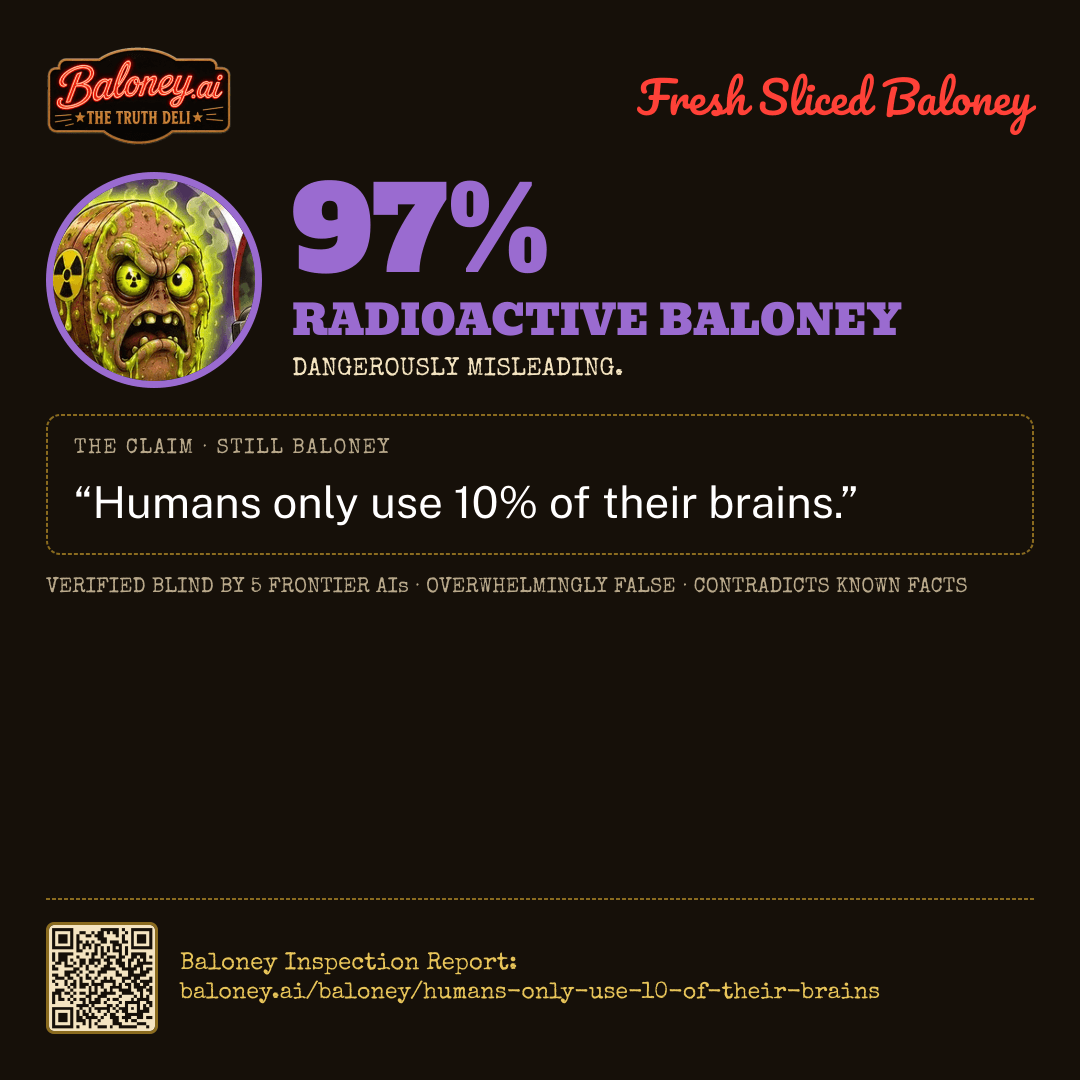
97% RADIOACTIVE BALONEY — DANGEROUSLY TOXIC “Humans only use 10% of their brains.” Verified blind by 5 frontier AIs · Baloney Inspection Report: baloney.ai/baloney/humans-only-use-10-of-their-brains
Station 1 · Blind Inspection — Five Graders, Zero Peeking
Each lab scored the claim independently, without seeing the others. Open a breakdown for its evidence, its sources, and how sure it was.
Anthropic · EQUAL WEIGHT · 43.3s
claude-opus-5
97%BALONEY
ROUND-1 BREAKDOWN
Evidence offered for the claim
At any single instant, only a small fraction of neurons are actively firing — sustained simultaneous firing of all neurons would be metabolically impossible and resembles a seizure. This real fact is sometimes offered as support for the '10%' figure, though it describes momentary activity, not lifetime or functional usage.
Early 20th-century neuroscience labeled large regions of association cortex 'silent areas' because stimulating or lesioning them produced no obvious motor or sensory effect; this historical misreading is a plausible origin of the myth.
Glial cells outnumber or roughly equal neurons in the brain; a misreading of 'only ~10% of brain cells are neurons' can be misconstrued as 'only 10% of the brain is used.'
Neuroplasticity and documented cases of people functioning after substantial brain injury or hemispherectomy are cited as showing 'unused reserve capacity' — though this reflects reorganization and redundancy, not idle tissue.
Misattributed quotations to William James ('we are making use of only a small part of our mental resources') and to Albert Einstein gave the notion false authority; James's actual claim concerned untapped mental potential, not unused brain matter.
Surveys find the belief is widespread among the public and even among educated respondents (e.g., Higbee & Clay, 1998), which is evidence of the claim's popularity — not of its truth.
Evidence against the claim
Functional brain imaging (fMRI, PET) shows activity distributed across essentially the entire brain over the course of a day; no large region is permanently dormant. Even during sleep, most areas show measurable activity.
The brain consumes roughly 20% of the body's energy budget despite being about 2% of body mass. Evolution would not sustain such a metabolically expensive organ if 90% were unused; unused tissue would atrophy or be selected against.
Clinical neurology contradicts the claim: there is no 'expendable' 90%. Damage to virtually any brain region from stroke, trauma, or tumor produces identifiable deficits — motor, sensory, language, memory, personality, or emotional.
Decades of electrical stimulation mapping (e.g., Penfield's cortical mapping) and modern single-unit and depth-electrode recording have found functions for cortical and subcortical regions once called 'silent'; association cortex handles integration, language, planning, and abstraction.
Degenerative diseases show that widespread neuronal loss is catastrophic. If 90% of the brain were idle, Alzheimer's-type neuron death would often be asymptomatic; it is not.
Neural structure and connectivity are highly conserved and metabolically maintained across regions; microstructural studies find no vast expanse of non-functional tissue.
The figure '10%' has no identifiable source in any scientific literature — it appears in self-help and advertising copy from the early 20th century onward, not in any published study.
Neuroscientists and science-communication reviews (Scientific American, Barry Gordon; Beyerstein, 1999; Lilienfeld et al., 'Great Myths of Popular Psychology,' where it is listed as Myth #1) uniformly classify it as a myth.
How sure this lab was
97/100 — the lab’s own confidence in the score above, not a second reading of the claim.
Weak/qualified support only: brain imaging during a single task often shows especially strong activity in some networks rather than uniform maximal activity everywhere, which can be misread as 'only a small fraction is used.' This does not mean the remaining brain is unused; resting-state/default-mode activity continues in distributed regions.
Weak/qualified support only: individual neurons are not all firing at once, and many circuits are recruited selectively depending on the task. That is compatible with normal brain function, not evidence that 90% of the brain is dormant.
Weak/qualified support only: some brain injuries may initially appear to spare obvious abilities because of redundancy, compensation, or neuroplasticity; this does not imply the damaged tissue was unused.
Evidence against the claim
Modern PET/fMRI and related neuroscience show widespread brain activity across resting and task states; there is no evidence for a permanently inactive 90% of the brain. The default-mode network literature specifically shows organized brain activity even at rest.
Clinical neurology contradicts the claim: damage to many different brain regions can produce sensory, motor, language, memory, emotional, or executive impairments. If 90% were unused, far more brain injuries would be inconsequential.
The brain is metabolically expensive tissue. Maintaining a large organ that is 90% unused would be biologically implausible and strongly disfavored by evolution; reviews of the myth note this as a major reason the claim is false.
Fact-checkers and medical reviews consistently identify the '10% of the brain' idea as a myth, not a supported scientific finding.
The more accurate statement is that humans do not use every neuron maximally at every moment, but over time humans use essentially all major brain regions for different functions.
How sure this lab was
97/100 — the lab’s own confidence in the score above, not a second reading of the claim.
There is no valid scientific evidence supporting the claim that humans use only 10% of their brains.
The myth likely originated from early 20th-century misunderstandings of neurological research, such as the discovery of large 'silent' brain regions (association cortices) whose complex functions were not yet understood by early mapping techniques.
A physiological fact often misinterpreted to support this myth is the ratio of glial cells to neurons. Glial cells provide structural and metabolic support but do not fire electrical impulses like neurons do, leading some to falsely conclude that a large portion of the brain is 'unused'.
To prevent massive energy depletion and excitotoxicity (which leads to seizures), only a small percentage of neurons are actively firing at any exact millisecond (a concept known as sparse coding), though 100% of the brain is utilized over time.
Evidence against the claim
Brain imaging technologies, such as fMRI and PET scans, demonstrate that virtually the entire brain is active over the course of a day, and broad baseline activity continues even during deep sleep.
Clinical neurology shows that damage to almost any area of the brain (via stroke, traumatic injury, or disease) results in specific, profound cognitive or motor deficits. If humans only used 10% of their brains, most brain injuries would go unnoticed.
From an evolutionary perspective, the human brain is extremely metabolically expensive, consuming roughly 20% of the body's daily energy budget despite accounting for only 2% of total body weight. Natural selection would not favor the development and maintenance of such a massive, energy-draining organ if 90% of it were useless.
Microstructural brain mapping using single-unit recording has consistently failed to locate any dormant or completely inactive regions in a healthy human brain.
How sure this lab was
100/100 — the lab’s own confidence in the score above, not a second reading of the claim.
The 10% brain use claim is sometimes loosely justified by pointing to early 20th‑century neuroscience, where large portions of the brain had poorly understood functions; this historical ignorance has been misinterpreted as meaning those areas were unused.
Some popular psychology and self-help books have repeated the 10% figure as a motivational metaphor, suggesting that people have vast untapped mental potential, which keeps the claim alive in public discourse even though it lacks empirical support.
Brain imaging studies show that at any given moment, some regions are more active than others; this normal variation in moment-to-moment activation is sometimes inaccurately paraphrased as 'only 10% is active' despite not reflecting overall brain usage over time.
Evidence against the claim
Modern neuroimaging (fMRI, PET) shows that **almost all regions of the brain have identifiable functions and are active at different times**; no large, permanently inactive 90% exists.["https://faculty.washington.edu/chudler/tenper.html"]["https://www.scientificamerican.com/article/do-we-really-use-only-10/"]
Neurological damage to small brain areas often causes **major deficits** (e.g., language, movement, memory), indicating that most brain tissue is functionally important and cannot be dismissed as unused.["https://www.mayoclinic.org/healthy-lifestyle/adult-health/expert-answers/brain-use/faq-20058192"]["https://faculty.washington.edu/chudler/tenper.html"]
Metabolic studies show the brain consumes about **20% of the body’s energy at rest**; it would be biologically implausible for evolution to maintain a large, energy-hungry organ if 90% of it were unused.["https://www.ncbi.nlm.nih.gov/pmc/articles/PMC3074032/"]["https://www.ninds.nih.gov/health-information/public-education/brain-basics"]
Fact-checking organizations and neuroscientists uniformly identify the 10% claim as a **myth** or **neuromyth**, noting there is no credible experimental basis for it and tracing it to misquotations and misunderstandings rather than data.["https://www.snopes.com/fact-check/ten-percent-of-brain/"]["https://www.politifact.com/factchecks/2014/jul/25/morgan-freeman/we-only-use-10-percent-our-brains/","https://faculty.washington.edu/chudler/tenper.html"]
Educational and government neuroscience resources explicitly state that humans use **100% of the brain over the course of normal activities**, even though different regions are engaged for different tasks.["https://faculty.washington.edu/chudler/tenper.html"]["https://www.ninds.nih.gov/health-information/public-education/brain-basics"]
How sure this lab was
98/100 — the lab’s own confidence in the score above, not a second reading of the claim.
The figure has been repeated for decades in self-help books, advertising, and films (e.g., Lucy), often framed as unused mental potential rather than a measured neuroscientific fact.
Early remarks by William James (c. 1908) that people use only a fraction of their mental resources were later recast, without data, as a claim about unused brain tissue.
Not every neuron fires at every instant; wholesale simultaneous firing produces seizures, a fact sometimes misconstrued as proof that most of the brain sits idle.
Evidence against the claim
fMRI, PET and other imaging show activity distributed across essentially the entire brain over time, including well-characterized resting-state (default-mode) networks.
Lesions, strokes or surgical disruption of any cortical or subcortical region produce corresponding deficits, demonstrating that large unused territories do not exist.
The brain uses roughly 20% of the body's energy despite being ~2% of body mass; maintaining a 90% unused organ would be evolutionarily implausible.
Decades of electrophysiological mapping, neurosurgical stimulation and connectomic studies assign functions throughout the brain; no silent 90% has ever been identified.
The 10% claim is rejected as a myth in neuroscience education and by professional bodies; it has no supporting empirical measurements.
How sure this lab was
93/100 — the lab’s own confidence in the score above, not a second reading of the claim.
I weighted the direct neuroscience evidence most heavily: neuroimaging, lesion evidence, neurosurgical/electrophysiological mapping, metabolic cost, and the absence of any scientific source for the 10% figure all point the same way. The limited points offered in favor are not evidence that 90% of the brain is unused; they are explanations for how the myth arose or examples of real facts being misread, such as selective moment-to-moment neural firing, old references to 'silent' cortex, glial-cell ratios, and neuroplastic compensation after injury. The strongest sources are medical, government, educational, and peer-reviewed neuroscience sources; fact-checkers and science-communication sources were accepted mainly for myth history and public-debunk context. Because this is a famous neuromyth that has been repeatedly debunked for many years and still circulates, the appropriate score is Zombie Baloney.
All five evaluators agreed that the statement is false, that the 10% number has no valid scientific basis, and that modern neuroscience shows widespread functional use of the brain over time. They also agreed on the main reasons the myth persists: misreadings of selective activation, early 'silent areas,' William James-style mental-potential language, glial-cell facts, self-help/pop-culture repetition, and occasional confusion about brain injury compensation. The only meaningful difference was severity: four evaluators recommended 95-98, while one recommended 99; given the long public debunk history, I adopt the zombie score.
ZOMBIE FLAG: TRUE — DEBUNK HISTORY ON RECORD
Blind Validation Master · never saw the Primary’s work
grok-4.6
99% BALONEY
All five reports converge that the claim is a long-debunked neuromyth with no empirical basis. Imaging (fMRI/PET), lesion data, electrophysiology, and energy-budget studies show essentially the entire brain is functionally engaged over time; unused tissue would atrophy and would not be evolutionarily maintained given the organ’s ~20% share of metabolic cost. Apparent ‘support’ items (sparse firing, historical ‘silent’ cortex, glia-to-neuron ratios, plasticity after injury, misquoted James/Einstein) are misreadings, not evidence that 90% sits idle. The 10% figure itself has no origin in the scientific literature and persists via self-help, advertising, and film. This matches the definition of a repeatedly refuted claim that continues to circulate.
AGREEMENT TEST PASSED — BOTH MASTERS SCORED 99% · BLIND VALIDATION CONFIRMED THIS SCORE · NO RE-EVALUATION REQUIRED
The Evidence
Evidence offered for the claim
Selective firingDEBUNKED — It is true that only some neurons are firing strongly at any exact instant, and simultaneous maximal firing would be pathological, resembling seizure activity. That does not mean the rest of the brain is unused; different circuits are recruited at different times, and baseline activity continues.
Old 'silent areas'DEBUNKED — Early neuroscience called some association-cortex regions 'silent' because crude stimulation or lesions did not produce obvious motor or sensory effects. Later work identified complex roles for these areas in integration, language, planning, abstraction, and other functions.
Glial-cell confusionDEBUNKED — A possible source of the myth is the fact that glial cells are not neurons and do not fire electrical impulses in the same way. That does not make them unused, nor does it imply that 90% of brain tissue is idle.
Brain-injury survivalDEBUNKED — Some people retain or recover abilities after major injury, surgery, or hemispherectomy. The reports treat this as evidence of compensation, redundancy, and neuroplasticity, not evidence that the damaged tissue was unused.
Mental-potential rhetoricDEBUNKED — Remarks attributed to William James and later self-help claims about using only a fraction of one's mental resources helped popularize the idea. The panel treated this as myth history, not scientific evidence about unused brain matter.
Public popularityDEBUNKED — Surveys and decades of repetition in advertising, self-help books, and films show that the belief is widespread. Popularity is not evidence that the claim is true.
Evidence against the claim
Brain imaging fMRI, PET, and related work show activity distributed across essentially the entire brain over time, including organized resting-state and default-mode activity. No large, permanently dormant 90% has been found.
Clinical neurology Damage from stroke, trauma, tumors, surgery, or degeneration in many different brain regions can cause identifiable deficits in movement, sensation, language, memory, emotion, personality, or executive function.
Metabolic cost The brain is about 2% of body mass but uses roughly 20% of the body's energy. Maintaining a large organ that is 90% unused would be biologically and evolutionarily implausible.
Functional mapping Electrical stimulation, single-unit recording, depth-electrode work, neurosurgical mapping, and modern connectomic studies have assigned functions across cortical and subcortical regions once poorly understood.
Degenerative disease Widespread neuronal loss in conditions such as Alzheimer's disease is clinically devastating. If most of the brain were idle, such loss would often be expected to be silent; it is not.
No scientific origin The reports found no empirical study establishing the 10% figure. Neuroscience educators, medical sources, fact-checkers, and myth-review sources consistently classify it as a myth.
Sources · Reliability · Why Accepted or Discounted
ACCEPTED — Accepted as a science-communication source citing neurological expertise and directly addressing the 10% brain myth; useful for consensus and explanation, though not primary research.
ACCEPTED — Accepted as peer-reviewed support for the brain's high energy budget and widespread baseline activity, both central to rejecting the claim.
Higbee & Clay, Journal of Psychology
journal
85
ACCEPTED — Accepted for the limited purpose cited: documenting public belief in the 10% myth, not for proving the neuroscience claim.
Lilienfeld, Lynn, Ruscio & Beyerstein, 50 Great Myths of Popular Psychology
other
85
ACCEPTED — Accepted as a reputable secondary psychology/myth-review source identifying the 10% claim as a neuromyth.
Beyerstein, 'Whence Cometh the Myth that We Only Use 10% of Our Brains?' in Mind Myths
other
85
ACCEPTED — Accepted for historical analysis of the myth's origins and persistence; not treated as the sole basis for the scientific verdict.
BMJ
journal
92
DISCOUNTED — Discounted because the report cited BMJ only generically, without enough bibliographic detail to identify the specific article being invoked.
Frontiers in Psychology
journal
95
DISCOUNTED — Discounted because the report did not identify a specific article, title, or finding; the conclusion is supported by better-specified sources.
ACCEPTED — Accepted as a mainstream medical educational source explaining that different brain areas are active at different times and that the 10% claim is a myth.
ACCEPTED — Accepted for public-facing fact-check context and the documented debunking of a specific popular repetition of the claim.
Serve It Fresh
Ready to Serve20 servings
Serve it the way you want it
The Verdict
97% RADIOACTIVE BALONEY — DANGEROUSLY TOXIC “Humans only use 10% of their brains.” Verified blind by 5 frontier AIs · Baloney Inspection Report: baloney.ai/baloney/humans-only-use-10-of-their-brains