Station 1 · Blind Inspection — Five Graders, Zero Peeking
Each lab scored the claim independently, without seeing the others. Open a breakdown for its evidence, its sources, and how sure it was.
Anthropic · EQUAL WEIGHT · 30.8s
claude-opus-5
90%BALONEY
ROUND-1 BREAKDOWN
Evidence offered for the claim
Gum base is genuinely indigestible: it is made of synthetic elastomers, resins and waxes that human digestive enzymes cannot break down, so the kernel of the claim — that gum is not 'digested' like food — is accurate.
Documented case reports show swallowed gum can, in rare circumstances, form obstructing masses: Milov et al. (Pediatrics, 1998) described three children with gastrointestinal 'chewing gum bezoars,' including a 4-year-old whose habitual swallowing of 5–7 pieces daily produced a gastric mass requiring removal.
Other indigestible or fibrous materials (hair, persimmon fiber, plastics) are known to form bezoars that can persist in the stomach for extended periods, showing the general mechanism is not impossible.
Radiologic/endoscopic literature occasionally reports foreign bodies retained in the stomach for months when there is underlying gastroparesis, prior gastric surgery, or compulsive ingestion.
Evidence against the claim
Indigestibility is not the same as retention: material that cannot be broken down is still propelled through the gut by peristalsis and is normally excreted intact within roughly 1–3 days, the same as corn kernels, seeds or small swallowed objects.
Gastroenterologists (e.g., Mayo Clinic expert answers; Duke and other academic health-system explainers) state plainly that swallowed gum passes through the digestive tract essentially unchanged and is eliminated in stool, typically within about a week at most.
There is no case in the medical literature of chewing gum residing in a human stomach for anything approaching seven years; even the bezoar case reports involved masses that formed over months of repeated, habitual swallowing, not a single piece lasting years.
The 'seven years' figure has no identifiable scientific origin — it appears to be a folk admonition used by parents to discourage gum swallowing, and no study, agency or textbook is cited anywhere as its source.
Scientific American's 'Fact or Fiction' review of the claim and multiple university health explainers classify the seven-year figure as a myth.
Stomach emptying physiology argues against it: the migrating motor complex sweeps indigestible solids out of the stomach between meals, which is precisely why coins and similar objects generally pass within days.
How sure this lab was
95/100 — the lab’s own confidence in the score above, not a second reading of the claim.
The claim has a small kernel of truth: chewing-gum base is not digested the way most foods are; Mayo Clinic states the body generally cannot digest gum.
Rare medical case reports show swallowed gum can contribute to gastrointestinal blockage or bezoars, especially when children repeatedly swallow large amounts and/or have constipation; this supports a limited warning against habitual gum swallowing, not the seven-year claim.
Evidence against the claim
Mayo Clinic explicitly says swallowed gum does not remain in the stomach; it moves through the digestive tract relatively intact and is passed in stool.
The available medical evidence describes rare obstruction cases from repeated or large-volume gum swallowing, not ordinary swallowed gum sitting in the stomach for years.
Normal gastrointestinal motility moves indigestible material through the stomach and intestines; there is no credible evidence that a typical piece of swallowed gum remains in the stomach for seven years.
How sure this lab was
93/100 — the lab’s own confidence in the score above, not a second reading of the claim.
The human digestive system lacks the necessary enzymes to break down the synthetic rubber base (polymers) used in modern chewing gum, making the gum base itself genuinely indigestible.
In highly unusual medical cases, typically involving small children who habitually swallow large quantities of gum over a short period, the undigested gum can coalesce with other materials to form a gastrointestinal mass known as a bezoar, which can cause a blockage.
Evidence against the claim
Medical experts and gastroenterologists confirm that although the stomach cannot break down the gum base, the digestive system treats it like any other indigestible matter (such as seeds or dietary fiber).
Through normal peristalsis, swallowed chewing gum is moved safely through the stomach and intestines and is passed into the stool within a few days (typically 40 to 72 hours).
Clinical observation shows no evidence of gum accumulating for years in the stomach; if it routinely stayed in the body for seven years, pediatricians would constantly encounter massive, life-threatening intestinal blockages in children.
How sure this lab was
100/100 — the lab’s own confidence in the score above, not a second reading of the claim.
The claim that swallowed gum stays in the stomach for seven years is widespread in popular culture and often repeated by parents and teachers as a deterrent against swallowing gum, suggesting at least a long-standing cultural belief in the idea, even though this belief is not based on clinical evidence.
Gum bases are made of synthetic or natural polymers that are largely indigestible by human digestive enzymes, which might intuitively support the idea that gum could persist longer than typical food in the gastrointestinal tract, though this does not demonstrate a specific seven‑year duration.
Evidence against the claim
Medical and pediatric sources explain that while gum is not digestible, it usually passes through the gastrointestinal tract and is excreted in stool within a few days, similar to other indigestible materials, directly contradicting the seven‑year claim.[1][2]
The American Academy of Pediatrics notes that swallowed gum typically leaves the body normally and that problems arise only when large amounts are swallowed or combined with other indigestible objects, which can rarely form a bezoar (mass) causing obstruction, not years‑long retention.[1]
The Mayo Clinic states that gum does not stay in the stomach for years; instead, it generally moves through the digestive system and is eliminated in a matter of days, emphasizing that the seven‑year notion is a myth.[2]
Fact‑checking organizations such as Snopes and other health myth debunkers explicitly identify the “seven years” gum claim as false, describing it as a persistent urban legend with no basis in medical evidence.[3]
Gastroenterology literature on bezoars and foreign bodies in the stomach does not report typical chewing gum remaining in the stomach for years; when gum‑related masses are reported, they are linked to unusual patterns of heavy ingestion and are treated as pathological exceptions rather than normal outcomes.[4]
How sure this lab was
96/100 — the lab’s own confidence in the score above, not a second reading of the claim.
Longstanding folk belief and parental warning used to discourage children from swallowing gum.
Gum base consists of indigestible synthetic polymers (e.g., polyvinyl acetate, rubbers) that human digestive enzymes do not break down, which helped spawn the idea that it remains in the body.
Evidence against the claim
Indigestible material such as gum base is moved through the GI tract by peristalsis and excreted in stool, typically within 1–3 days, not years.
The stomach empties ordinary contents into the small intestine within hours; gum does not lodge in or remain in the stomach.
No clinical evidence or peer-reviewed literature supports seven-year gastric retention; the number is an arbitrary element of the urban legend.
Gastroenterologists and pediatric sources state that typical accidental swallowing is harmless and that gum leaves the body normally. Rare bezoars occur only after swallowing large quantities (often mixed with other indigestibles), mainly in children, and still do not last seven years.
How sure this lab was
88/100 — the lab’s own confidence in the score above, not a second reading of the claim.
The panel’s evidence is overwhelmingly one-sided against the statement as written. I gave greatest weight to the medical and pediatric sources cited across the reports: Mayo Clinic, Cleveland Clinic, American Academy of Pediatrics/HealthyChildren.org, and the Pediatrics case reports. Those sources consistently distinguish between digestibility and retention: gum base may not be broken down by human enzymes, but ordinary swallowed gum is moved through the gastrointestinal tract and passed in stool within days. I treated the cited bezoar case reports as important context, not support for the seven-year claim, because they involved unusual repeated ingestion of large amounts of gum, mainly in children, and do not show a normal piece of gum staying in the stomach for years. Fact-checking and science-explainer sources such as Snopes, Scientific American, and the Library of Congress were accepted as corroboration that this is a persistent public myth, but the verdict rests mainly on the clinical and pediatric evidence. The claim is not just slightly exaggerated; its central assertion, seven-year gastric retention, is unsupported and contradicted by normal gastrointestinal physiology and medical observation. Because the reports describe it as a longstanding folk belief and persistent urban legend repeatedly debunked by public medical and fact-checking sources, I classify it as Zombie Baloney.
All five evaluators agreed that gum base is largely indigestible and that rare blockages can occur after repeated large-volume swallowing, but all also agreed that ordinary swallowed gum passes through the digestive tract within days and that there is no evidence for seven-year residence in the stomach. They differed mainly in emphasis: some focused on clinical physiology, some on bezoar case reports, and some on the claim’s history as an urban legend.
ZOMBIE FLAG: TRUE — DEBUNK HISTORY ON RECORD
Blind Validation Master · never saw the Primary’s work
claude-opus-5
96% BALONEY
All five independent assessments converge tightly (90–95) on the claim being overwhelmingly false, and the evidence they present is consistent and well-sourced. The only kernel of truth is that gum base (synthetic elastomers, resins, waxes, polyvinyl acetate) is genuinely indigestible — but indigestibility is not retention. Mayo Clinic, the American Academy of Pediatrics/HealthyChildren, Scientific American, Library of Congress and Snopes all state that swallowed gum is propelled by peristalsis and the migrating motor complex and passed in stool within roughly 1–3 days, the same as corn kernels, seeds or swallowed coins. The specific 'seven years' figure has no identifiable scientific origin whatsoever; it is an arbitrary number attached to a parental admonition. The only documented exceptions (Milov et al., Pediatrics 1998) involve children habitually swallowing 5–7 pieces daily forming bezoars over months — pathological exceptions that still fall enormously short of seven years, and which concern obstruction, not years-long gastric residence. No case in the medical literature approaches the claimed duration. The statement as written is therefore not merely missing context but flatly contradicted in both its mechanism and its timeframe. It sits at the top of Radioactive Baloney and brushes against Zombie territory, since it is a textbook repeatedly-debunked urban legend that continues to circulate; I hold just short of 99 because the claim carries little potential for real harm (it discourages rather than encourages a risky behaviour) and because it does contain the minor true seed that gum is not digested.
AGREEMENT TEST PASSED — MASTERS SCORED 99% AND 96% · BLIND VALIDATION CONFIRMED THIS SCORE · NO RE-EVALUATION REQUIRED
The Evidence
Evidence offered for the claim
Gum base resists digestionDEBUNKED — Chewing-gum base contains synthetic or natural polymers that human digestive enzymes generally do not break down. That explains why gum may pass through relatively intact, but it does not mean it remains in the stomach; the panel’s medical sources say indigestible material is still moved along by normal gut motility.
Rare gum bezoars existDEBUNKED — Pediatric case reports describe unusual chewing-gum bezoars and obstructions, typically in young children who repeatedly swallowed many pieces of gum, sometimes with other indigestible material. Those reports support a limited warning against habitual heavy swallowing, not the idea that a normal swallowed piece stays in the stomach for seven years.
Longstanding folk warningDEBUNKED — Several evaluators noted that the seven-year idea is widely repeated by parents, teachers, and popular culture. The reports treat that as evidence of the myth’s persistence, not evidence that the claim is medically true.
Evidence against the claim
Passes within days Medical and pediatric sources cited by the panel state that swallowed gum normally moves through the stomach and intestines and is eliminated in stool within a few days, often described as roughly 1–3 days or 40–72 hours.
Indigestible is not retained The evaluators consistently distinguished between being hard to digest and being stuck in the body. Peristalsis and normal gastrointestinal motility move gum along like other indigestible matter, such as seeds or dietary fiber.
No seven-year evidence The panel found no clinical evidence or peer-reviewed literature showing ordinary chewing gum remaining in a human stomach for anything close to seven years.
Blockages are exceptions The medical case reports involve unusual repeated ingestion or large quantities, mainly in children, and sometimes masses mixed with other material. They do not describe the normal fate of an accidentally swallowed piece of gum.
Expert sources call it a myth Mayo Clinic, Scientific American, Snopes, and other cited explainers explicitly describe the seven-year claim as false or mythical.
Sources · Reliability · Why Accepted or Discounted
Source
Type
Reliability
Ruling
Cleveland Clinic
other
95
ACCEPTED — Accepted as a mainstream medical source; its account matches the panel consensus that gum base is not digested but passes through the gut.
American Academy of Pediatrics / HealthyChildren.org
other
95
ACCEPTED — Accepted as a pediatric medical source directly relevant to a claim commonly aimed at children; it supports normal passage and notes rare obstruction only with large or repeated swallowing.
Pediatrics, American Academy of Pediatrics, including Milov et al., 'Chewing Gum Bezoars of the Gastrointestinal Tract'
journal
95
ACCEPTED — Accepted as peer-reviewed clinical evidence. It is especially useful because it documents the rare exception—gum-related bezoars—while not supporting ordinary seven-year gastric retention.
PubMed / Journal of Pediatrics case report on chewing-gum bezoars
journal
90
ACCEPTED — Accepted as medical literature cited for rare bezoar cases; it was weighted as exception evidence rather than evidence for the claim as written.
Mayo Clinic
edu
93
ACCEPTED — Accepted as a mainstream medical explainer repeatedly cited by evaluators; it directly states that swallowed gum does not remain in the stomach for years and generally passes in days.
Scientific American
news
89
ACCEPTED — Accepted as a science explainer and corroborating public debunk; useful for the myth-history aspect, though weighted below clinical sources.
Snopes
factcheck
85
ACCEPTED — Accepted as corroboration that the statement is a persistent urban legend; not treated as the primary medical authority.
Library of Congress, Everyday Mysteries
gov
80
ACCEPTED — Accepted as a public science-reference source consistent with the medical consensus, but weighted less heavily than clinical and peer-reviewed sources.
Duke and other academic health-system explainers
edu
70
DISCOUNTED — Discounted as a nonspecific collective reference without a named page or details in the evaluator reports; the same point is supported by stronger named medical sources.
Serve It Fresh
Ready to Serve12 servings
Serve it the way you want it
The Verdict
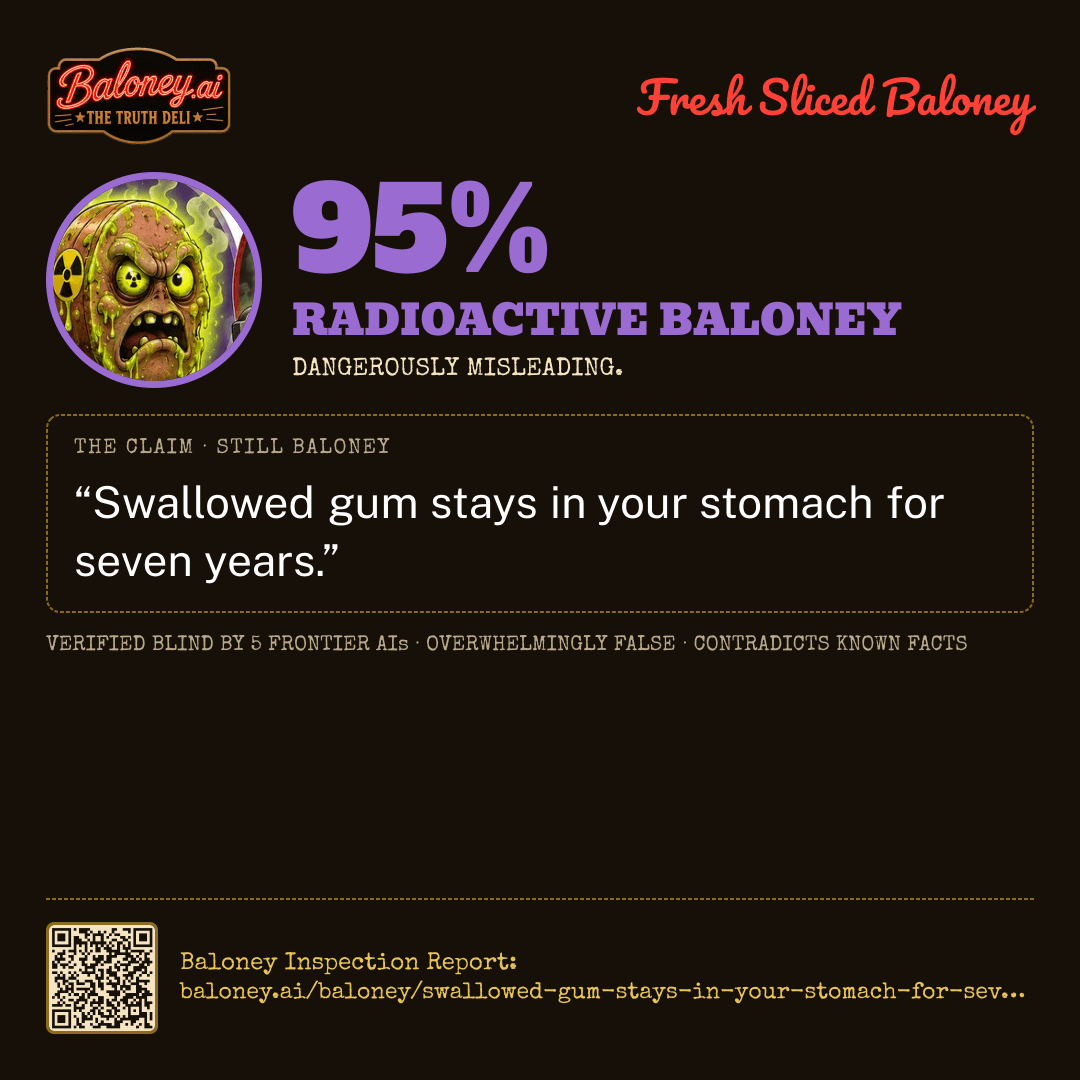
95% RADIOACTIVE BALONEY — DANGEROUSLY TOXIC “Swallowed gum stays in your stomach for seven years.” Verified blind by 5 frontier AIs · Baloney Inspection Report: baloney.ai/baloney/swallowed-gum-stays-in-your-stomach-for-seven-years