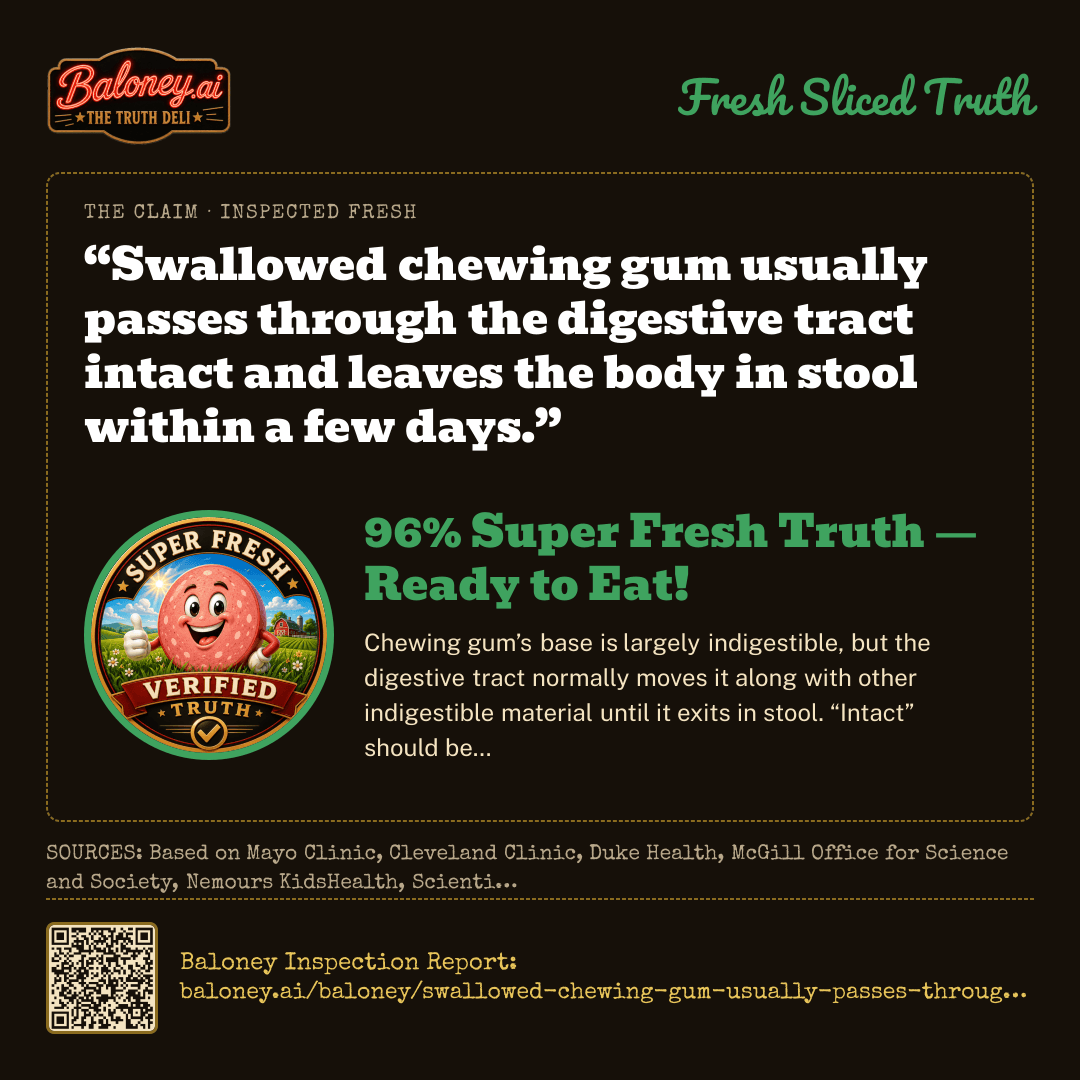
“Swallowed chewing gum usually passes through the digestive tract intact and leaves the body in stool within a few days.”96% Super Fresh Truth — Ready to Eat!Verified blind by 5 frontier AIs · Baloney Inspection Report: baloney.ai/baloney/swallowed-chewing-gum-usually-passes-through-the-digestive
The Rating Card
The claim this refutes
The Baloney Sampler
The reports found the claim is essentially right: chewing-gum base is largely indigestible, but a normally swallowed piece is moved along by the gut and excreted in stool rather than staying in the stomach. Mayo Clinic, Cleveland Clinic and Duke Health all support ordinary passage through the digestive tract; Cleveland Clinic and other accepted sources give timing consistent with a few days.
The caveats are about wording and rare exceptions. “Intact” means relatively intact, because sweeteners, flavorings and other soluble ingredients may dissolve or be absorbed while the gum base remains. Pediatrics/American Academy of Pediatrics case reports and Mayo Clinic note rare bezoars or blockages, mainly when children repeatedly swallow large amounts, so the word “usually” matters.
Other ways to slice it — phrasings that might have changed the rating
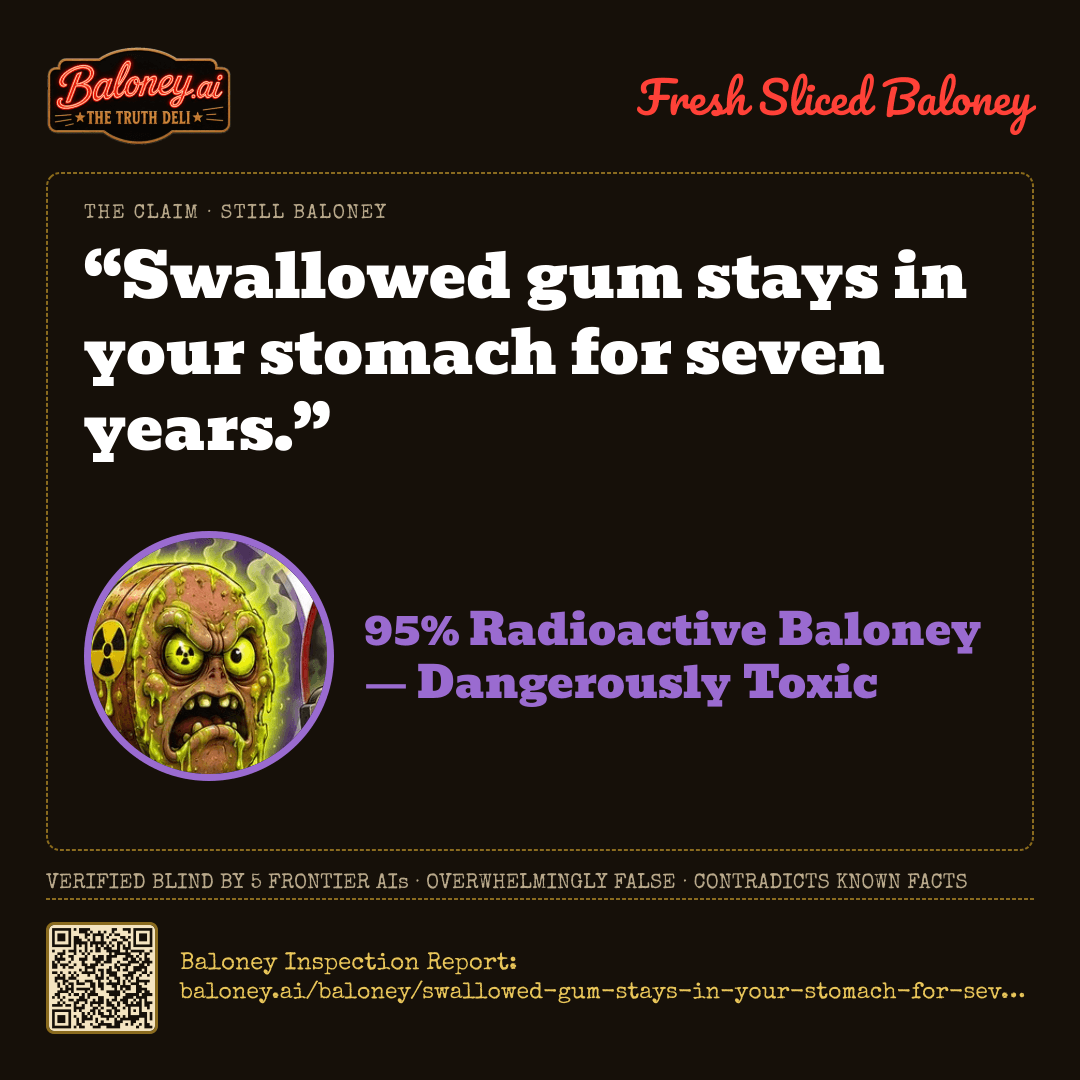
“Swallowed chewing gum stays in the stomach for seven years.” The reports say this common claim has no basis and that gum normally moves through the digestive tract rather than remaining in the stomach.
“Every swallowed piece of chewing gum leaves the body completely unchanged within 72 hours.” The reports note that soluble ingredients can dissolve or be absorbed, transit time varies, and rare blockages have been documented.
“Children who repeatedly swallow large quantities of chewing gum can develop gastrointestinal bezoars or obstruction.” The accepted pediatric case-report evidence describes rare gum-related bezoars mainly in children who habitually swallowed many pieces.
Written from the panel’s reports by OpenAI · gpt-5.5. Nothing here changed the score.
18:03:01SCORING MODEL V2 — MEDIAN OF 5 COUNTED LAB SCORES: 4, 3, 2, 4, 2 → 3. FRESH RULE: THE PRIMARY MASTER SCORES 3 AND THE BLIND MASTER 4 — BOTH SUPER FRESH TRUTH — AND THE COUNTED MEDIAN IS 3, ON THE TRUE SIDE. PUBLISHED AS 4, THE MORE CAUTIOUS OF THE TWO MASTERS.✓
18:03:01SOURCE RULE — LABS CITED 20 SOURCES: 0 DISCARDED FOR HAVING NO URL, 6 DISCARDED AS DEAD LINKS (404/410), 4 COULD NOT BE OPENED BY US AND ARE MARKED UNVERIFIED.✓
18:03:01SOURCE RULE — PRIMARY MASTER RULED ON 12 SOURCES: 0 DISCARDED FOR HAVING NO URL, 0 DISCARDED AS DEAD LINKS, 4 MARKED UNVERIFIED, 8 VERIFIED.✓
How This One Was Sliced
Station 1 · Blind Inspection — Five Graders, Zero Peeking
Each lab scored the claim independently, without seeing the others. Open a breakdown for its evidence, its sources, and how sure it was.
Anthropic · EQUAL WEIGHT · 27.5s
claude-opus-5
96%TRUTH
ROUND-1 BREAKDOWN
Evidence offered for the claim
The gum base (a mixture of elastomers, resins and waxes) is indigestible, but indigestible material routinely transits the gastrointestinal tract by peristalsis and is excreted in stool — the same fate as corn hulls, seeds, or small swallowed objects. Gastroenterologists cited in mainstream coverage state a single swallowed piece of gum typically clears in roughly 1–7 days, consistent with normal transit time.
The widely repeated '7 years in your stomach' claim has been examined by science journalists and clinicians and found to have no basis; no physiological mechanism retains gum base in the stomach for years.
Pediatric literature on gum-related bezoars (obstructing masses) reports them only in the context of repeated, habitual swallowing of many pieces — the rarity of such case reports is itself evidence that ordinary single-piece swallowing passes uneventfully.
Children's-health and hospital patient-education pages (Nemours KidsHealth, Cleveland Clinic, Duke Health) uniformly tell parents that swallowed gum passes through and out in the stool within a few days and is not a cause for alarm.
Evidence against the claim
The gum does not always emerge fully 'intact' in a literal sense: sugars, softeners, flavorings and some other components are digested or absorbed, so what passes is the residual gum base, often broken up or altered in appearance — 'intact' is loose wording.
Documented exceptions exist: Milov et al. (Pediatrics, 1998) described children who developed gastrointestinal gum bezoars requiring removal after chronically swallowing large numbers of pieces, and additional case reports describe obstruction or choking in small children. So 'usually' is correct but not 'always'.
Transit time is variable; constipation, very young age, or unusually large amounts can delay passage beyond 'a few days'.
The 'few days' figure is a clinical rule of thumb based on normal GI transit rather than a directly measured, controlled study of gum transit specifically — there is little primary experimental research quantifying it.
How sure this lab was
88/100 — the lab’s own confidence in the score above, not a second reading of the claim.
Mayo Clinic says swallowed gum is not digested, but it does not remain in the stomach; it moves relatively intact through the digestive system and is excreted in stool, directly supporting the core claim.
NHS states that swallowed chewing gum usually passes through the digestive system and comes out in stool, giving a typical timeframe of about 40 hours, which fits the claim's 'within a few days.'
Snopes debunks the seven-years-in-the-stomach myth and explains that although gum base is largely indigestible, swallowed gum normally passes through the digestive tract and is eliminated like other indigestible material.
Evidence against the claim
The word 'intact' is slightly imprecise: gum base may pass relatively intact, but sweeteners, flavorings, and other soluble ingredients can dissolve or be digested before excretion.
Rare complications are documented. A Pediatrics case report described chewing-gum bezoars causing gastrointestinal obstruction or severe constipation in children, especially with repeated swallowing of large amounts of gum. This does not refute 'usually,' but it is an important exception.
Transit time varies by person and bowel habits, so 'within a few days' is a reasonable generalization rather than a guaranteed timeframe for every individual.
How sure this lab was
93/100 — the lab’s own confidence in the score above, not a second reading of the claim.
Medical consensus confirms that while the human body cannot chemically break down the synthetic polymers and elastomers that make up a chewing gum base, the gum does not remain in the stomach.
The digestive tract relies on strong, rhythmic muscle contractions (peristalsis) to push indigestible materials—like gum, fiber, corn, and seeds—through the stomach, small intestine, and large intestine.
Gastroenterologists note that swallowed chewing gum typically passes through a healthy digestive system and is excreted intact in stool within a few days (usually 40 to 72 hours), consistent with a person's normal bowel transit time.
Evidence against the claim
In exceedingly rare cases, typically involving young children who swallow massive amounts of gum in a very short time frame (or swallow it alongside other indigestible items like sunflower seeds or coins), the gum can form an intestinal mass called a bezoar. These blockages do not pass on their own and require medical intervention. However, the claim's use of the word 'usually' correctly accounts for these medical anomalies.
How sure this lab was
98/100 — the lab’s own confidence in the score above, not a second reading of the claim.
Chewing-gum base is not digestible, but an ordinarily swallowed piece generally moves through the gastrointestinal tract relatively intact and is eliminated in stool rather than remaining in the stomach for years. Mayo Clinic states that it passes through the digestive system and out in stool; its gastroenterologist describes excretion as generally rapid.[https://www.mayoclinic.org/diseases-conditions/indigestion/expert-answers/digestive-system/faq-20058446][https://newsnetwork.mayoclinic.org/discussion/mayo-clinic-minute-does-gum-get-stuck-in-your-stomach/]
Cleveland Clinic gives an approximate transit time of about 40 hours for a swallowed piece and says it comes out whole because it cannot be digested.[https://health.clevelandclinic.org/what-happens-when-you-swallow-gum]
Duke Health explains that gum base is insoluble and travels through the same path as other indigestible material before being excreted in stool.[https://www.dukehealth.org/blog/myth-or-fact-it-takes-seven-years-digest-chewing-gum]
McGill University's Office for Science and Society reports that gum is not metabolized, broken down, or absorbed like most food, but usually passes within roughly 24–48 hours.[https://www.mcgill.ca/oss/article/health/gum-and-7-year-myth]
Evidence against the claim
The wording is too absolute if interpreted as applying to every swallowed piece: Mayo Clinic notes rare intestinal blockages when large amounts of gum are combined with constipation, particularly in children.[https://www.mayoclinic.org/diseases-conditions/indigestion/expert-answers/digestive-system/faq-20058446]
Gum does not necessarily remain completely unchanged: most gum ingredients, such as sweeteners and flavorings, can be processed or absorbed, while the gum base is the relatively indigestible portion. Therefore, 'intact' is best understood as referring to the gum base or recognizable mass, not every ingredient.[https://healthline.com/health/how-long-does-gum-take-to-digest]
The exact time is variable and cannot reliably be stated as a fixed few-day interval for every person; sources describe approximate transit times ranging from about 24–48 hours to less than seven days, while Mayo Clinic uses the less precise term 'relatively intact' and 'generally' rapid.[https://www.mcgill.ca/oss/article/health/gum-and-7-year-myth][https://health.clevelandclinic.org/what-happens-when-you-swallow-gum][https://www.mayoclinic.org/diseases-conditions/indigestion/expert-answers/digestive-system/faq-20058446]
How sure this lab was
95/100 — the lab’s own confidence in the score above, not a second reading of the claim.
Gum base is composed of indigestible synthetic polymers and resins that human digestive enzymes cannot break down, so the chewed mass remains largely intact.
Normal whole-gut transit time in healthy people is about 24–72 hours, so indigestible objects of this size typically appear in stool within a few days.
Major science and pediatric sources state that swallowed chewing gum passes through the GI tract and is excreted in feces within days, which is the established correction to the old ‘seven-year’ myth.
Evidence against the claim
Rare case reports describe chewing-gum bezoars causing obstruction, almost always after swallowing large quantities (especially in children) or mixing gum with other indigestible material.
The claim’s ‘usually’ already covers these uncommon exceptions; they do not describe ordinary passage.
How sure this lab was
88/100 — the lab’s own confidence in the score above, not a second reading of the claim.
The claim is substantially accurate. The strongest evidence comes from medical and pediatric sources cited across the reports: Mayo Clinic, Cleveland Clinic, Duke Health, Nemours KidsHealth, McGill’s Office for Science and Society, and pediatric case-report literature all support the central point that gum base is largely indigestible but is normally moved through the gastrointestinal tract and excreted in stool rather than remaining in the stomach. I gave particular weight to clinician-facing or institutionally reviewed medical sources and to the Pediatrics case report because they directly address both ordinary passage and the rare obstruction exception. I treated Scientific American and Healthline as useful secondary sources, but not as decisive on their own. The main caveats are wording-related: “intact” is best read as “relatively intact,” because soluble ingredients such as sweeteners and flavorings may dissolve or be absorbed; and “within a few days” is a normal-transit generalization, not a guarantee for every person. Rare gum bezoars or obstruction have been reported, especially in children repeatedly swallowing large quantities, but the claim says “usually,” so those exceptions do not materially undermine it.
All five evaluators agreed that the statement is essentially true. They differed only on how much to penalize the loose word “intact,” the variable transit time, and rare obstruction cases; their recommended scores all remained in the true range.
SUPER FRESH — VERIFIED AGAINST BASED ON MAYO CLINIC, CLEVELAND CLINIC, DUKE HEALTH, MCGILL OFFICE FOR SCIENCE AND SOCIETY, NEMOURS KIDSHEALTH, SCIENTIFIC AMERICAN, AND PEDIATRICS CASE-REPORT EVIDENCE.
Blind Validation Master · never saw the Primary’s work
sonar-pro
96% TRUTH
The statement is substantially true as written. Multiple reports cite medical and clinical sources stating that a normally swallowed piece of chewing gum is not digested, moves through the gastrointestinal tract relatively intact, and is excreted in stool—often in roughly 24–72 hours, though transit time varies. The qualifier “usually” appropriately allows for rare exceptions, including intestinal bezoars or obstruction after repeatedly swallowing large quantities, particularly in children. “Intact” is somewhat imprecise because soluble ingredients such as sweeteners and flavorings may dissolve or be absorbed; more precisely, the largely indigestible gum base or recognizable mass passes through. These wording and timing caveats warrant a modest deduction, but they do not make the central claim misleading or false.
AGREEMENT TEST PASSED — MASTERS SCORED 97% AND 96% · BLIND VALIDATION CONFIRMED THIS SCORE · NO RE-EVALUATION REQUIRED
Median of 5 counted lab scores: 4, 3, 2, 4, 2 → 3.
Fresh rule: the Primary Master scores 3 and the Blind Master 4 — both Super Fresh Truth — and the counted median is 3, on the true side. Published as 4, the more cautious of the two masters.
The Evidence
Evidence for the claim
Normal passage Multiple medical sources cited by the panel state that swallowed gum does not remain in the stomach; it normally moves through the digestive system with other indigestible material and leaves in stool.
Indigestible gum base The gum base is largely resistant to human digestive enzymes, so the residual chewed mass can pass through the gut relatively intact even though some ingredients may dissolve or be absorbed.
Few-day timeframe Sources cited by the evaluators describe typical passage on the order of about 24–48 hours, about 40 hours, or generally within several days, consistent with ordinary gastrointestinal transit.
Rare exceptions support “usually” Pediatric case reports describe obstruction or bezoars mainly after children repeatedly swallowed large quantities of gum, which supports treating complications as uncommon exceptions rather than the ordinary outcome.
Evidence offered against the claim
“Intact” is loose Sweeteners, flavorings, softeners and other soluble components may be dissolved, digested or absorbed; what generally passes is the indigestible gum base or recognizable gum mass, not every original ingredient unchanged.
Rare blockages occur Case reports describe chewing-gum bezoars and gastrointestinal obstruction, especially in children who chronically swallowed many pieces or swallowed gum with other indigestible objects.
Timing varies Transit time depends on individual bowel habits, constipation, age and amount swallowed, so “within a few days” is a reasonable usual timeframe rather than a promise for every swallowed piece.
Sources · Reliability · Why Accepted or Discounted
ACCEPTED — Accepted as a reputable clinical patient-education source directly addressing swallowed gum, ordinary passage through the digestive tract, and rare blockage exceptions.
ACCEPTED — Accepted as a high-reliability medical source for the main claim that gum passes through and is excreted, with caveats about rare blockages.
ACCEPTED — Accepted as a Mayo Clinic clinician-explainer supporting the same medical point, though weighted slightly below formal clinical reference material.
ACCEPTED — Accepted as a reputable hospital health-education source giving an approximate transit time and explaining why gum comes out largely undigested.
ACCEPTED — Accepted as a reputable academic health-system source explaining that gum base is insoluble and follows the normal path of indigestible material.
ACCEPTED — Accepted as mainstream science journalism summarizing clinician and scientific understanding; useful corroboration but not the primary basis for the verdict.
ACCEPTED — Accepted as the same reputable hospital explainer cited with a trailing-slash URL, directly supporting ordinary passage and approximate timing.
ACCEPTED — Accepted as pediatric patient-education material consistent with the medical consensus that swallowed gum usually passes in stool within a few days.
Every link was opened when this claim was inspected. A dead link was discarded before publication; “unverified” means the site refused our automated check and the link is the one the panel cited. A source without a URL was never kept.
“Swallowed chewing gum usually passes through the digestive tract intact and leaves the body in stool within a few days.”96% Super Fresh Truth — Ready to Eat!Verified blind by 5 frontier AIs · Baloney Inspection Report: baloney.ai/baloney/swallowed-chewing-gum-usually-passes-through-the-digestive