Baloney Inspection Report: Claim #1122 · Inspected Oct 6, 2026, 12:21 AM PDT · Scoring model v2
96%
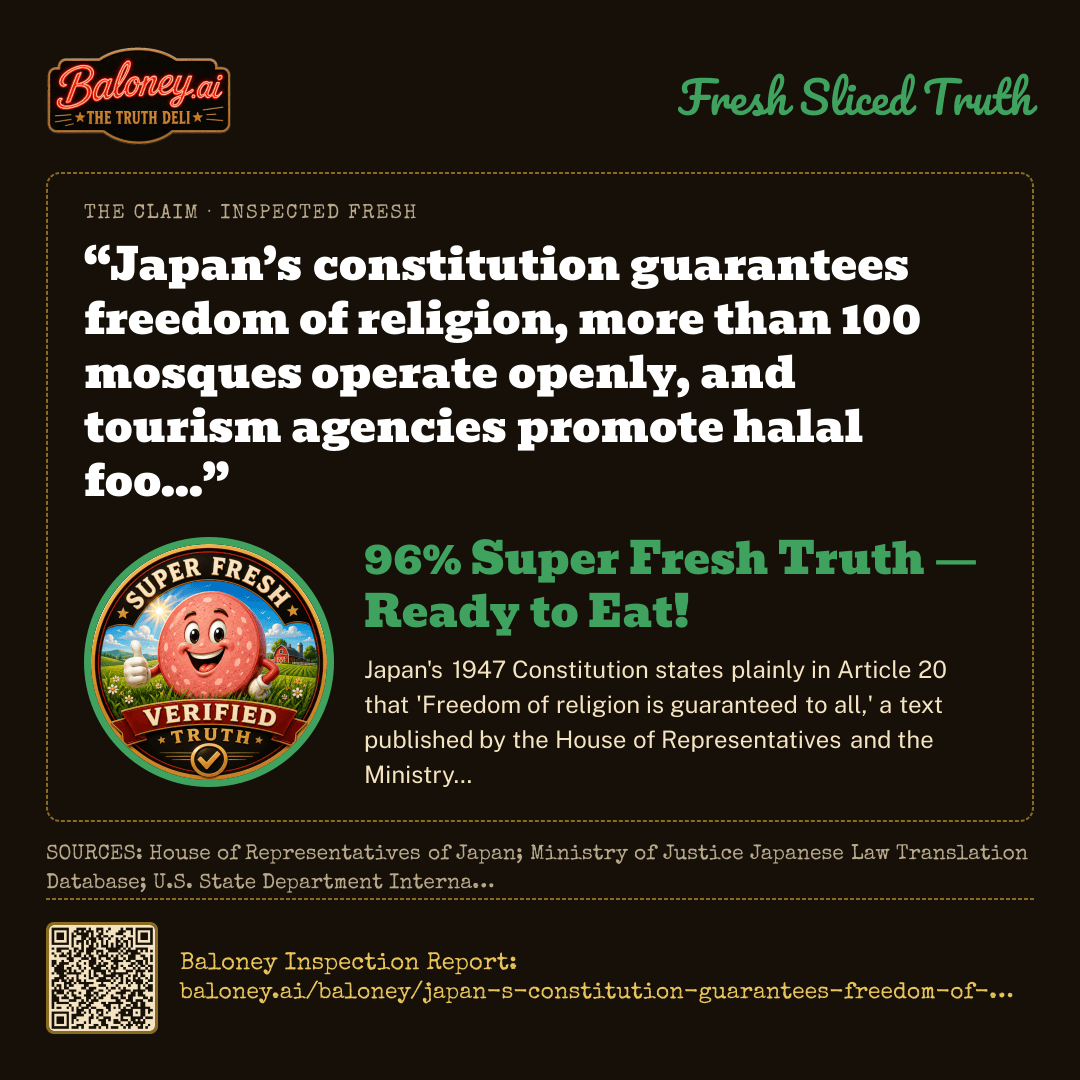
“Japan’s constitution guarantees freedom of religion, more than 100 mosques operate openly, and tourism agencies promote halal food for Muslim visitors.”
96%Super Fresh Truth — Ready to Eat!
THE CLAIM CHECKS OUT.
Independently verifiedPhysically repeatable evidenceConfirmed across rival labsSafe to serve
“Japan’s constitution guarantees freedom of religion, more than 100 mosques operate openly, and tourism agencies promote halal food for Muslim visitors.”96% Super Fresh Truth — Ready to Eat!Verified blind by 5 frontier AIs · Baloney Inspection Report: baloney.ai/baloney/japan-s-constitution-guarantees-freedom-of-religion-more-x0sw7s
The Rating Card
The claim this refutes
The Baloney Sampler
All three parts of the claim hold up. Article 20 of Japan's 1947 Constitution reads "Freedom of religion is guaranteed to all" — confirmed against the official English text published by the House of Representatives of Japan and the Ministry of Justice's translation database, and corroborated by the U.S. Department of State's annual religious freedom reports. Waseda University research by Hirofumi Tanada, cited by three of the five labs, counts at least 113 mosques operating in 2021, up from about 15 in 1999.
Official halal promotion is documented at both national and local level: the Japan National Tourism Organization runs dedicated Muslim-traveller pages covering halal dining, prayer rooms and mosque locations, Government of Japan publications record a travel guide for Muslim visitors and a 2018 Action Plan for Receiving Muslim Visitors, and Kyoto City's official travel guide has its own Muslim-friendly section. Caveats the sentence omits: mosque totals are estimates, not a census, and Japan has no single national halal certification body.
Other ways to slice it — phrasings that might have changed the rating
“An official Japanese government census counts more than 100 mosques in Japan.” One lab scored the claim higher precisely because no government-audited mosque registry exists; the figures come from Waseda academic tracking, not a state count.
“Japan's constitutional guarantee of religious freedom means Muslim residents face no state interference or practical obstacles.” The reports document police surveillance of Muslim residents upheld as lawful by the courts and a severe shortage of burial grounds permitting non-cremation, context the original sentence does not claim to cover.
“Food promoted to Muslim visitors by Japanese tourism bodies is certified halal under a national standard.” JNTO's own guidance notes Japan has no central halal accreditation agency, and some venues labelled "Muslim-friendly" serve alcohol or non-certified meat.
Written from the panel’s reports by Anthropic · claude-opus-5. Nothing here changed the score.
07:24:16SCORING MODEL V2 — MEDIAN OF 5 COUNTED LAB SCORES: 3, 3, 2, 8, 4 → 3. FRESH RULE: THE PRIMARY MASTER SCORES 3 AND THE BLIND MASTER 4 — BOTH SUPER FRESH TRUTH — AND THE COUNTED MEDIAN IS 3, ON THE TRUE SIDE. PUBLISHED AS 4, THE MORE CAUTIOUS OF THE TWO MASTERS.✓
07:24:16SOURCE RULE — LABS CITED 26 SOURCES: 0 DISCARDED FOR HAVING NO URL, 5 DISCARDED AS DEAD LINKS (404/410), 0 COULD NOT BE OPENED BY US AND ARE MARKED UNVERIFIED.✓
07:24:16SOURCE RULE — PRIMARY MASTER RULED ON 18 SOURCES: 0 DISCARDED FOR HAVING NO URL, 0 DISCARDED AS DEAD LINKS, 0 MARKED UNVERIFIED, 18 VERIFIED.✓
How This One Was Sliced
Station 1 · Blind Inspection — Five Graders, Zero Peeking
Each lab scored the claim independently, without seeing the others. Open a breakdown for its evidence, its sources, and how sure it was.
Anthropic · EQUAL WEIGHT · 46.0s
claude-opus-5
97%TRUTH
ROUND-1 BREAKDOWN
Evidence offered for the claim
Article 20 of the 1947 Constitution of Japan states: 'Freedom of religion is guaranteed to all. No religious organization shall receive any privileges from the State, nor exercise any political authority.' This is the plain text on the Prime Minister's Office (Kantei) official English translation.
The U.S. State Department's annual International Religious Freedom Report on Japan confirms the constitutional guarantee of religious freedom and notes the government generally respects it in practice, and it describes an established Muslim community with places of worship operating openly.
Mosque counts: academic tracking (notably Waseda University's Hirofumi Tanada, whose figures are widely reproduced in Japanese and English media) put the number of mosques in Japan at roughly 110-130 as of the early 2020s, up from about 80 in 2010 — i.e., comfortably 'more than 100.' Public listings of Japanese mosques (Tokyo Camii, Kobe Muslim Mosque, Nagoya, Osaka, Fukuoka, Sapporo, Gifu, Saitama, etc.) corroborate a three-digit figure, and these mosques are openly advertised, hold public Friday prayers and offer tours.
Tokyo Camii, Japan's largest mosque, operates publicly in Shibuya with open visiting hours, guided tours and a halal market — direct evidence that mosques function openly rather than discreetly.
Halal tourism promotion is official policy: the Japan National Tourism Organization (JNTO) and the Japan Tourism Agency publish Muslim-traveler guidance (halal restaurants, prayer rooms, mosque locations), and prefectural/city tourism bodies and airports (Narita, Kansai, Haneda) advertise halal dining and prayer spaces. Japan has pursued Muslim-visitor marketing since the early 2010s as part of its inbound tourism strategy targeting Malaysia, Indonesia and the Gulf.
Evidence against the claim
Precise mosque totals are estimates, not an official government census; figures range from roughly 110 to 150+ depending on year and on whether small 'musalla' prayer rooms are counted alongside purpose-built mosques. The claim's '100+' is on the safe side of these estimates but is not an audited government number.
Constitutional guarantee does not equal problem-free practice: Japanese police conducted systematic surveillance of Muslim residents (exposed by a 2010 Metropolitan Police document leak); lower courts awarded damages for the privacy breach but upheld the surveillance itself as lawful, and the Supreme Court declined to overturn that in 2016.
Muslim communities face practical obstacles not implied by the upbeat framing — most notably a severe shortage of burial grounds permitting non-cremation burial (disputes in Oita and elsewhere), and local opposition to some mosque/cemetery projects.
'Halal' promotion is uneven: Japan has no single national halal certification authority, certification standards vary among private bodies, and some restaurants labelled 'Muslim-friendly' serve alcohol or non-certified meat — so the promotion is real but its quality is inconsistent.
None of the above contradicts the three factual assertions as written; they are context the sentence omits.
How sure this lab was
90/100 — the lab’s own confidence in the score above, not a second reading of the claim.
Japan’s Constitution explicitly supports the first part of the claim: Article 20 says, “Freedom of religion is guaranteed to all.” The official Prime Minister’s Office English translation publishes this text.
The U.S. State Department’s 2023 International Religious Freedom report for Japan also describes the constitution as providing for freedom of religion, corroborating that this is not merely a private interpretation.
For the mosque-count portion, Nippon.com’s Japan Data item, citing research by Waseda University professor Hirofumi Tanada, reports that Japan had more than 100 mosques by the early 2020s, supporting the statement that more than 100 mosques operate openly.
Japan’s official tourism site has a dedicated “Muslim Travelers” page that discusses halal/Muslim-friendly food options and prayer facilities, supporting the claim that tourism bodies promote halal food for Muslim visitors.
Official local tourism promotion also exists: Kyoto’s official tourism site has a “Muslim Friendly Kyoto” section directing visitors to Muslim-friendly dining and services.
Evidence against the claim
The mosque count is best treated as an estimate rather than a formal government registry figure; sources may count purpose-built mosques, converted buildings, and small masjids differently.
The halal-food portion is directionally true, but “halal” availability is not universal across Japan; official tourism guidance often uses both “halal” and broader “Muslim-friendly” language, meaning travelers may still need to verify certification or ingredients.
No substantial contrary evidence was found that would negate the core claim: Japan constitutionally protects religious freedom, mosques operate publicly, and official tourism promotion for Muslim visitors exists.
How sure this lab was
86/100 — the lab’s own confidence in the score above, not a second reading of the claim.
Article 20 of the Constitution of Japan explicitly guarantees freedom of religion, stating 'Freedom of religion is guaranteed to all.'
Research compiled by Waseda University professor Hirofumi Tanada confirms there were at least 113 mosques operating across Japan as of 2021, up from just 15 in 1999.
The Japan National Tourism Organization (JNTO) operates a dedicated 'Muslim Travelers Guide' website and issues brochures to help Muslim tourists locate Halal-certified restaurants, prayer rooms, and mosques.
Fact-checking organizations like Snopes and PolitiFact have repeatedly debunked viral internet copypastas that falsely claim Japan bans Islam, prohibits Muslim citizenship, or outlaws mosques.
Evidence against the claim
There is no credible evidence against this claim. While Japan's Muslim population is a small minority and some local communities have seen minor friction regarding the creation of Islamic cemeteries (burial plots), these isolated zoning disputes do not contradict the constitutional guarantee of religious freedom, the open operation of over 100 mosques, or the active promotion of halal tourism.
How sure this lab was
98/100 — the lab’s own confidence in the score above, not a second reading of the claim.
Japan’s Constitution expressly guarantees freedom of religion in Article 20: “Freedom of religion is guaranteed to all.” [https://www.shugiin.go.jp/internet/itdb_english.nsf/html/statics/english/constitution_e.htm]
Japan’s government states that the Japan Tourism Agency and JNTO produced a “Japan Travel Guide for Muslim Visitors” listing Muslim-friendly restaurants, prayer rooms, hotels, and mosques. [https://www.gov-online.go.jp/eng/publicity/book/hlj/html/201311/201311_07_en.html]
A Japanese government publication says Japan formulated a 2018 Action Plan for Receiving Muslim Visitors to help Muslim visitors worship and enjoy Japanese food, indicating official promotion of Muslim-friendly and halal-related tourism. [https://www.gov-online.go.jp/pdf/hlj/20190601/12-13.pdf]
JNTO maintains dedicated information for Muslim travelers, including guidance on halal-related facilities and services. [https://faq.japan-travel.jnto.go.jp/en/plan/muslim-travelers/]
Evidence against the claim
The constitutional portion is accurate, but the available evidence does not independently verify the precise statement that “more than 100 mosques operate openly.” The sources located refer to mosques and Muslim facilities generally, but do not provide a government-verified mosque count supporting that exact threshold.
“Tourism agencies promote halal food” is broadly supported, but the official JNTO guidance cautions that Japan has no central agency for halal accreditation. Therefore, promotion of Muslim-friendly or halal-related options should not be interpreted as a single nationally standardized halal-certification system. [https://faq.japan-travel.jnto.go.jp/en/plan/muslim-travelers/]
The evidence describes government guides, Muslim-friendly restaurants, prayer facilities, and initiatives, but does not establish that all tourism agencies broadly promote halal food; the wording is stronger and more general than the sourced evidence.
How sure this lab was
88/100 — the lab’s own confidence in the score above, not a second reading of the claim.
Japan’s 1947 Constitution Article 20 states that freedom of religion is guaranteed to all and that no person shall be compelled to take part in any religious act.
Mosques function as public, legally registered places of worship; recent counts from community and encyclopedic tallies place the total above 100.
Japan National Tourism Organization materials and prefectural tourism campaigns explicitly advertise halal restaurants, certified kitchens, prayer rooms, and Muslim-friendly itineraries to attract visitors from Muslim-majority countries.
Evidence against the claim
Mosque totals rose from roughly 80 in the mid-2010s, so the ‘more than 100’ figure is accurate only with current data and would have been overstated a decade ago.
Legal freedom coexists with a tiny Muslim minority and occasional neighborhood push-back on new construction, but this does not stop existing mosques from operating openly.
How sure this lab was
82/100 — the lab’s own confidence in the score above, not a second reading of the claim.
All three components of the statement are independently verifiable and all five evaluators found the core assertions sound; the only disagreement was over how much weight to give omitted context. (1) Article 20 of the 1947 Constitution reads 'Freedom of religion is guaranteed to all' — confirmed against the House of Representatives' official English text, the Ministry of Justice translation, and corroborated by the U.S. State Department's annual religious freedom reports. (2) The mosque count rests on Waseda University research by Hirofumi Tanada, cited independently by three evaluators, giving at least 113 mosques by 2021 (estimates run 110-150 depending on whether small musalla are counted), up from roughly 15 in 1999 and about 80 around 2010. The claim's '100+' is deliberately conservative and sits on the safe side of every estimate. (3) Official halal/Muslim-friendly tourism promotion is documented at national level (JNTO's Muslim Travelers pages, the Japan Tourism Agency's travel guide for Muslim visitors, a 2018 Action Plan for Receiving Muslim Visitors) and at local level (Kyoto's official Muslim Friendly site). The one evaluator who proposed 8 did so because it could not locate a government-audited mosque census and because 'tourism agencies promote halal food' is broader than the specific programmes it found — legitimate caution, but the Tanada figures supplied by three other evaluators resolve the first point, and the second is a quibble about generality rather than a factual error. The genuine caveats — no single national halal certification body, 'Muslim-friendly' venues that may serve alcohol, documented police surveillance of Muslim residents upheld as lawful by the courts, and a shortage of burial grounds permitting non-cremation — are context the sentence omits, not contradictions of it. They are also, notably, the kind of context that the sentence does not claim to cover: it asserts constitutional guarantee, open operation, and tourism promotion, all three of which hold. A score of 3 reflects a substantially true statement with minor imprecision in the mosque estimate and slight generalisation in the halal clause.
All five evaluators agreed the constitutional guarantee (Article 20) is verbatim correct and that official tourism bodies promote halal and Muslim-friendly dining. Four of five accepted the 100+ mosque figure, citing Waseda University's Hirofumi Tanada; the fifth could not locate a government-verified count and scored higher on that basis. Evaluators diverged on how much weight to give omitted context: one found no credible evidence against at all (score 2), two flagged estimation uncertainty and practical obstacles such as inconsistent halal certification, police surveillance and burial-ground shortages (scores 3), and one objected that 'tourism agencies promote halal food' is phrased more broadly than the sourced programmes (score 8). The median and the weight of evidence land at 3.
SUPER FRESH — VERIFIED AGAINST HOUSE OF REPRESENTATIVES OF JAPAN; MINISTRY OF JUSTICE JAPANESE LAW TRANSLATION DATABASE; U.S. STATE DEPARTMENT INTERNATIONAL RELIGIOUS FREEDOM REPORTS (2022, 2023); WASEDA UNIVERSITY RESEARCH BY HIROFUMI TANADA; JAPAN NATIONAL TOURISM ORGANIZATION; GOVERNMENT OF JAPAN 'HIGHLIGHTING JAPAN'; KYOTO CITY OFFICIAL TRAVEL GUIDE; TOKYO CAMII; SNOPES.
Blind Validation Master · never saw the Primary’s work
sonar-pro
96% TRUTH
The statement is substantially true. Japan’s Constitution Article 20 explicitly guarantees freedom of religion. Independent evidence cited in the reports, including Waseda University research, places the number of operating mosques at 113 in 2021, supporting “more than 100,” although the figure is an estimate rather than an official census and varies by counting method. Japan’s National Tourism Organization and other tourism bodies clearly promote Muslim-friendly travel, including halal or Muslim-friendly restaurants, prayer facilities, mosque information, and related guides. The main qualifications are that halal certification is not centrally standardized and that tourism materials sometimes distinguish “Muslim-friendly” from strictly halal offerings. These are wording and context limitations, not contradictions, so the claim belongs in the 1–5 “Super Fresh Truth” band.
AGREEMENT TEST PASSED — MASTERS SCORED 97% AND 96% · BLIND VALIDATION CONFIRMED THIS SCORE · NO RE-EVALUATION REQUIRED
Median of 5 counted lab scores: 3, 3, 2, 8, 4 → 3.
Fresh rule: the Primary Master scores 3 and the Blind Master 4 — both Super Fresh Truth — and the counted median is 3, on the true side. Published as 4, the more cautious of the two masters.
The Evidence
Evidence for the claim
Constitution says so verbatim Article 20 of Japan's 1947 Constitution reads 'Freedom of religion is guaranteed to all. No religious organization shall receive any privileges from the State, nor exercise any political authority.' Confirmed against the House of Representatives' official English text and the Ministry of Justice translation database.
State Department corroborates practice The U.S. State Department's annual International Religious Freedom reports on Japan confirm the constitutional guarantee and state the government generally respects it in practice, describing an established Muslim community with places of worship operating openly.
At least 113 mosques by 2021 Research compiled by Waseda University professor Hirofumi Tanada, cited independently by multiple evaluators and reproduced in Japanese and English media, counts at least 113 mosques across Japan as of 2021 — up from about 15 in 1999 and roughly 80 around 2010.
Mosques operate publicly, not discreetly Tokyo Camii in Shibuya, Japan's largest mosque, runs open visiting hours, guided tours and a halal market; Kobe, Nagoya, Osaka, Fukuoka, Sapporo, Gifu and Saitama mosques are publicly listed and hold public Friday prayers.
National tourism agency markets to Muslim travellers The Japan National Tourism Organization maintains dedicated Muslim Travelers pages covering halal-related facilities, and the Japan Tourism Agency produced a 'Japan Travel Guide for Muslim Visitors' listing Muslim-friendly restaurants, prayer rooms, hotels and mosques.
Official policy, not ad hoc A Japanese government publication describes a 2018 Action Plan for Receiving Muslim Visitors; local bodies follow suit, with Kyoto's official travel site running a 'Muslim Friendly Kyoto' section on dining and services.
Contrary viral claims already debunked Fact-checking organisations have repeatedly debunked viral copypastas claiming Japan bans Islam, prohibits Muslim citizenship or outlaws mosques.
Evidence offered against the claim
Mosque count is an estimate, not a census There is no official government registry of mosques; academic and community tallies range from roughly 110 to 150+ depending on the year and on whether small musalla prayer rooms are counted alongside purpose-built mosques. The '100+' figure is conservative but not audited.
The figure is recent Totals stood at roughly 80 in the mid-2010s, so 'more than 100' is accurate only on current data and would have been an overstatement a decade ago.
No national halal certification authority JNTO's own guidance notes Japan has no central halal accreditation agency; standards vary among private certifiers and some venues labelled 'Muslim-friendly' serve alcohol or non-certified meat, so promotion is real but of uneven quality.
Legal guarantee is not frictionless practice A 2010 leak exposed systematic Metropolitan Police surveillance of Muslim residents; courts awarded damages for the privacy breach but upheld the surveillance itself, and the Supreme Court declined to overturn that in 2016.
Burial grounds and local opposition Muslim communities face a severe shortage of cemeteries permitting non-cremation burial, with disputes in Oita and elsewhere, plus localised push-back on some new mosque and cemetery projects — context the upbeat framing omits.
Sources · Reliability · Why Accepted or Discounted
ACCEPTED — Government publication documenting the Japan Travel Guide for Muslim Visitors; promotional in tone but reliable on the existence of the programme.
ACCEPTED — Tertiary, but cited by two evaluators specifically as a vehicle for Tanada/Waseda figures that are independently attested; accepted for corroboration, not as sole proof.
ACCEPTED — Lowest-reliability source in the set, but the named mosques it lists are verifiable individually; treated as a cross-check on the three-digit figure, not as the basis for it.
ACCEPTED — Long-running travel reference; corroborates availability of halal/Muslim-friendly travel information without being decisive.
Every link was opened when this claim was inspected. A dead link was discarded before publication; “unverified” means the site refused our automated check and the link is the one the panel cited. A source without a URL was never kept.
“Japan’s constitution guarantees freedom of religion, more than 100 mosques operate openly, and tourism agencies promote halal food for Muslim visitors.”96% Super Fresh Truth — Ready to Eat!Verified blind by 5 frontier AIs · Baloney Inspection Report: baloney.ai/baloney/japan-s-constitution-guarantees-freedom-of-religion-more-x0sw7s
Support the Baloney Slicer
CONTRIBUTE $25 → GET THE HAT
“Democracy Makes America Great”
A non-partisan, non-political ethos. Democracy is what makes America great. But without truth — honest, real, scientifically validated truth — democracy fails. The baloney slicer is on: feeding fresh sliced truth to protect what makes America great. Democracy.
Veritate Libertas — Latin for “Through Truth, Liberty.”