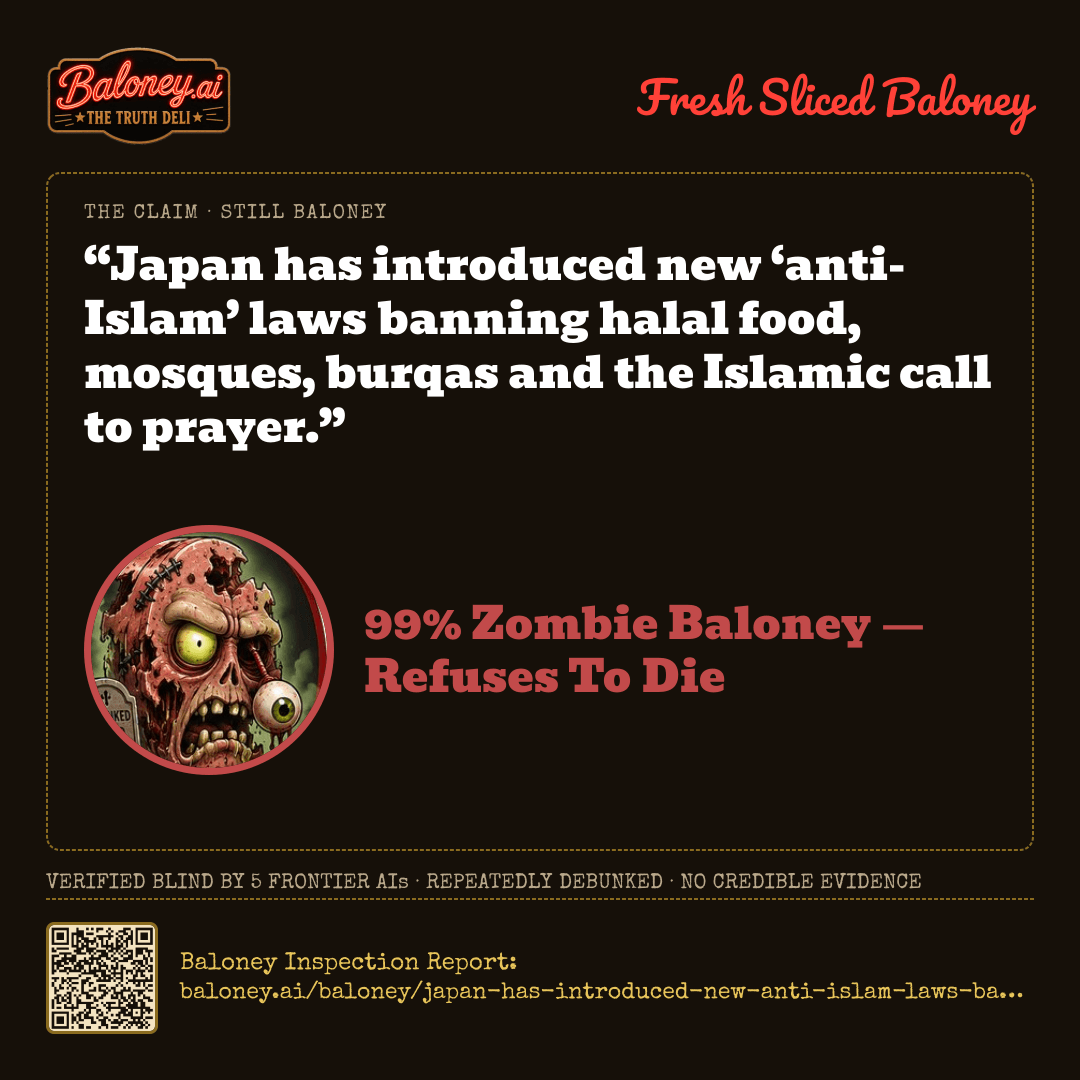
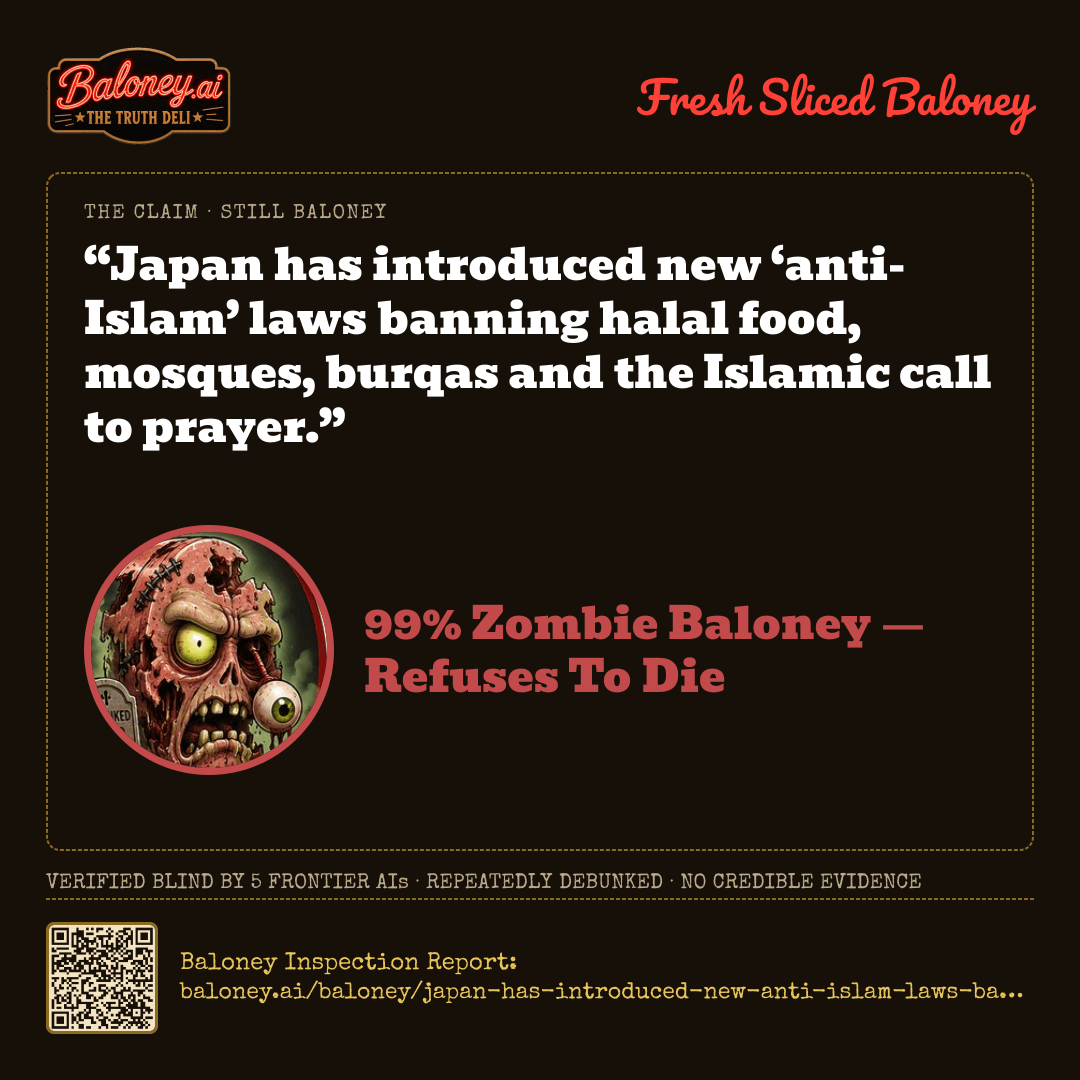
“Japan has introduced new ‘anti-Islam’ laws banning halal food, mosques, burqas and the Islamic call to prayer.”99% Zombie Baloney — Refuses To DieVerified blind by 5 frontier AIs · Baloney Inspection Report: baloney.ai/baloney/japan-has-introduced-new-anti-islam-laws-banning-halal-food
The Rating Card
The correction — what is actually true
The Baloney Sampler
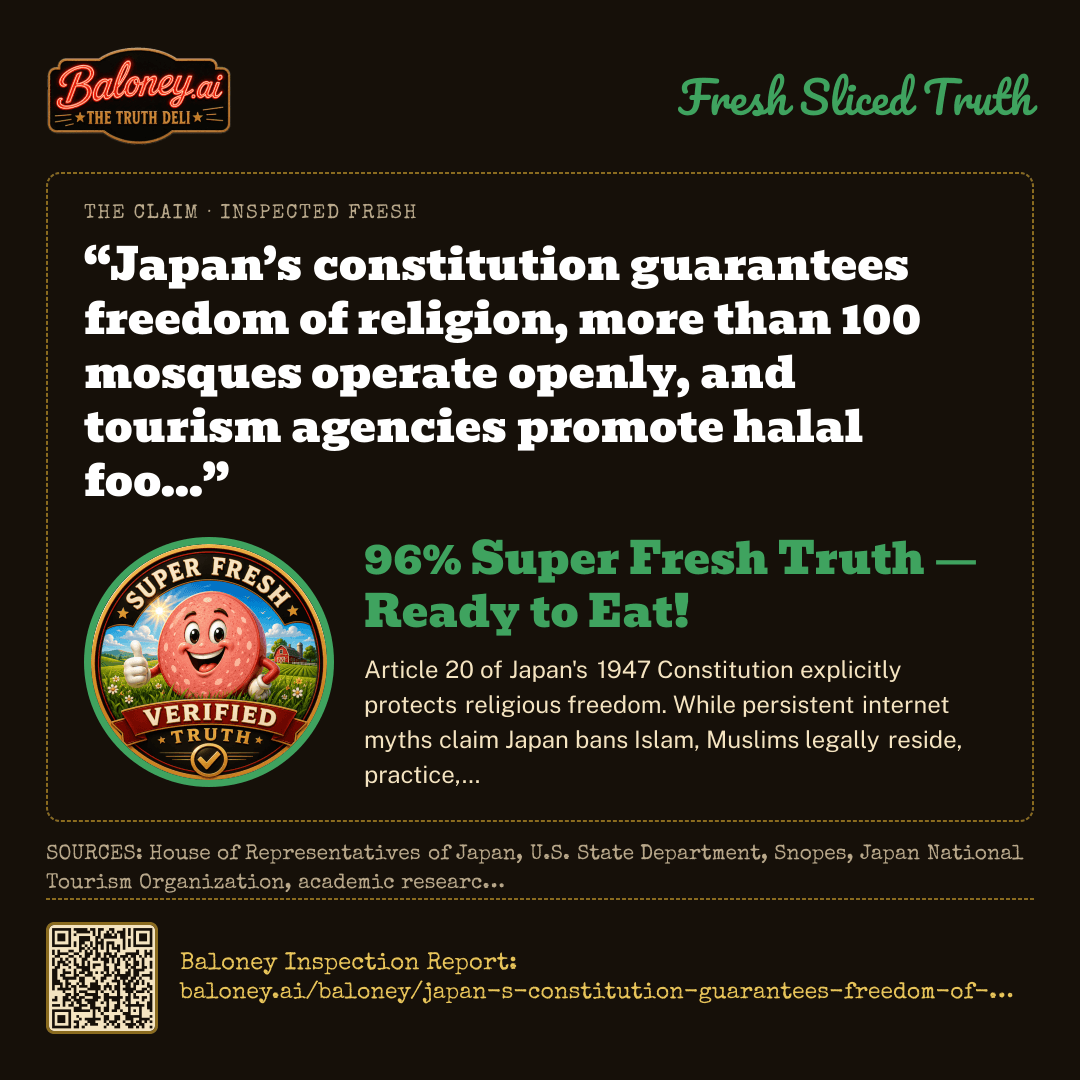
Japan has not introduced laws banning halal food, mosques, burqas or the Islamic call to prayer. The U.S. Department of State, Reuters, AFP Fact Check, Full Fact and the Japan FactCheck Center found no Diet act, cabinet order or ministry announcement of that kind. Japan's Constitution guarantees freedom of religion, which a blanket ban would violate.
Mosques operate openly, including Tokyo Camii, and the Japan National Tourism Organization promotes Muslim-friendly travel and halal options. The Australian Associated Press and Japan FactCheck Center cited Japan's Agency for Cultural Affairs saying there is no national policy prohibiting burqas or the call to prayer. Local zoning or detention-catering issues are not national anti-Islam statutes. The claim is a recurring viral hoax.
Other ways to slice it — phrasings that might have changed the rating
“Japan's official tourism agencies promote halal-certified food and prayer facilities to attract Muslim visitors.” The Japan National Tourism Organization publishes Muslim-traveller guides, which the reports treated as evidence against a national ban rather than as a separate claim.
“Some Japanese municipalities have objected on zoning grounds to mosque construction or Muslim burial sites.” Lab reports described real local planning disputes, including in Oita and Beppu, that viral posts exaggerate into nationwide anti-Islam legislation.
“Some Japanese immigration detention facilities have not served halal meals to Muslim detainees.” Evaluators treated this as an institutional-service issue reported by the U.S. Department of State, not as a national prohibition on halal food.
Written from the panel’s reports by xAI · grok-4.6. Nothing here changed the score.
22:50:51SCORING MODEL V2 — MEDIAN OF 5 COUNTED LAB SCORES: 99, 99, 99, 95, 87 → 99. ZOMBIE RULE: THE PRIMARY MASTER FLAGS A LONG DEBUNK HISTORY, THE BLIND MASTER SCORES 99, THE COUNTED MEDIAN IS 99 — PUBLISHED AS 99.✓
22:50:51SOURCE RULE — LABS CITED 27 SOURCES: 0 DISCARDED FOR HAVING NO URL, 7 DISCARDED AS DEAD LINKS (404/410), 5 COULD NOT BE OPENED BY US AND ARE MARKED UNVERIFIED.✓
22:50:51SOURCE RULE — PRIMARY MASTER RULED ON 20 SOURCES: 0 DISCARDED FOR HAVING NO URL, 2 DISCARDED AS DEAD LINKS, 5 MARKED UNVERIFIED, 13 VERIFIED.✓
How This One Was Sliced
Station 1 · Blind Inspection — Five Graders, Zero Peeking
Each lab scored the claim independently, without seeing the others. Open a breakdown for its evidence, its sources, and how sure it was.
Anthropic · EQUAL WEIGHT · 51.4s
claude-opus-5
99%BALONEY
ROUND-1 BREAKDOWN
Evidence offered for the claim
No verifiable evidence supports the claim. The only 'support' consists of viral social-media posts, clickbait blogs and chain messages (circulating since roughly 2015) that assert Japan 'bans Islam,' 'does not allow mosques,' 'forbids Arabic/Quran' or 'bans halal' — none of which cite any Japanese statute, Diet bill, cabinet order or ministry announcement.
The kernel of truth that the hoax distorts: Japan has a very small Muslim population (roughly 0.2% of residents), restrictive immigration and labour-visa policies, and no state-run halal certification system (certification is private and voluntary), which some posts misrepresent as a legal 'ban.'
Local frictions that hoax posts exaggerate are real but unrelated to any ban — e.g. disputes in some municipalities (such as in Oita/Beppu and elsewhere) over permits for Muslim burial grounds, and occasional zoning objections to mosque construction. These are planning/zoning matters, not national anti-Islam legislation.
Evidence against the claim
Article 20 of the Constitution of Japan guarantees freedom of religion to all, bars the State from granting privileges to or exercising political authority through any religious organisation, and forbids compelling participation in religious acts; Article 21 protects expression. A blanket statutory ban on mosques, religious dress or the adhan would be unconstitutional and would require a constitutional amendment — none has occurred (Japan's constitution has never been amended since 1947).
No such law exists in Japan's statute books. There is no Diet-passed act banning halal food, mosques, burqas or the call to prayer, and no Japanese government ministry (Justice, Foreign Affairs, Cultural Affairs Agency, which oversees religious corporations) has announced one. Religious groups, including Islamic ones, register as religious corporations under the Religious Corporations Act.
Mosques operate openly and are increasing in number. Tokyo Camii (Shibuya), Japan's largest mosque, functions publicly with daily prayers, tours and a halal market; the Kobe Muslim Mosque (1935) is the country's oldest. Estimates put the number of mosques/prayer spaces in Japan at over 100–150 and rising, including at universities, airports and shopping centres.
Halal food is actively promoted, not banned. The Japan National Tourism Organization (JNTO), the Japan Tourism Agency and JETRO publish Muslim-friendly travel guides and halal-restaurant and prayer-room listings to attract Muslim tourists from Indonesia, Malaysia and the Gulf; halal certification bodies and a halal food-export industry operate in Japan.
There is no burqa/niqab/hijab ban in Japan. Unlike France, Belgium, Denmark or Austria (which do have documented face-covering laws), Japan has enacted no dress-related religious restriction; headscarves are worn freely in public, in schools and in workplaces.
The 'call to prayer ban' is fabricated. Some mosques limit external loudspeakers voluntarily or under generic municipal noise ordinances that apply to all sources of amplified sound (including Buddhist temples and political sound trucks) — a neutral noise rule is not an Islam-specific prohibition.
Actual Japanese policy trends point the opposite way: Japan has expanded foreign-worker visas (including from Muslim-majority Indonesia and Bangladesh), and public institutions have added prayer rooms and halal options rather than removing them.
Variants of this claim ('Japan bans Islam/the Quran/Arabic/mosques') have been repeatedly debunked by fact-checkers and mainstream outlets over the past decade and keep resurfacing unchanged, a hallmark of recycled misinformation.
How sure this lab was
97/100 — the lab’s own confidence in the score above, not a second reading of the claim.
No credible evidence was found that Japan has enacted national or local laws banning halal food, mosques, burqas, or the Islamic call to prayer. The claim appears to be supported only by uncited viral/social-media assertions, not by Japanese legal texts, government announcements, or reputable news reporting.
Evidence against the claim
Japan’s Constitution expressly guarantees freedom of religion: “Freedom of religion is guaranteed to all.” That is directly inconsistent with a blanket anti-Islam law banning mosques or Islamic religious practice. Source: Prime Minister of Japan and His Cabinet, https://japan.kantei.go.jp/constitution_and_government_of_japan/constitution_e.html
The U.S. State Department’s 2023 International Religious Freedom report for Japan describes constitutional protections for religious freedom and does not report any ban on Islam, mosques, halal food, burqas, or the call to prayer. Source: U.S. Department of State, https://www.state.gov/reports/2023-report-on-international-religious-freedom/japan/
Japan’s official tourism site provides information for Muslim travelers and points them to Muslim-friendly resources, which is inconsistent with a national ban on halal food or Islamic practice. Source: Japan National Tourism Organization, https://www.japan.travel/en/plan/muslim-travelers/
Reuters has fact-checked a closely related viral claim and found that Japan has not banned Muslims from entering the country; Japanese officials and available law did not support the alleged anti-Muslim policy. Source: Reuters, https://www.reuters.com/article/factcheck-japan-muslims/fact-check-japan-has-not-banned-muslims-from-entering-the-country-idUSL1N2RV0YQ/
Snopes has debunked longstanding viral claims that Japan bans Muslims or Islamic activities, rating them false. Source: Snopes, https://www.snopes.com/fact-check/japan-muslims/
Mosques openly operate in Japan, including Tokyo Camii, a major mosque in Tokyo, contradicting the claim that mosques are banned. Source: Tokyo Camii, https://tokyocamii.org/
How sure this lab was
96/100 — the lab’s own confidence in the score above, not a second reading of the claim.
There is no factual evidence to support this claim. The assertion originates entirely from viral social media posts that periodically circulate online without providing any primary sources, legislative documents, or statements from Japanese officials.
Evidence against the claim
Article 20 of the Constitution of Japan strictly guarantees freedom of religion to all people and states that no religious organization shall receive special privileges from the State, nor exercise any political authority. Banning a specific religion would be highly unconstitutional.
Japan has not passed any laws banning halal food, mosques, burqas, or the Islamic call to prayer. The Japanese government has made no announcements regarding any such 'anti-Islam' legislation.
Japan actually has a growing Muslim population and over 110 mosques currently operating across the country, including the prominent Tokyo Camii mosque.
Far from banning halal food, the Japanese government and the Japan National Tourism Organization (JNTO) actively promote halal-certified foods and Muslim-friendly travel accommodations to attract tourists from Muslim-majority nations like Indonesia and Malaysia.
Major fact-checking organizations have repeatedly debunked this exact claim over several years, identifying it as a recurring 'zombie' hoax intended to spread anti-Muslim sentiment.
How sure this lab was
100/100 — the lab’s own confidence in the score above, not a second reading of the claim.
There is no credible evidence supporting the statement as written. The only potentially related fact is that Japan has immigration-related controversies, including reports that immigration detention facilities did not serve halal food to some Muslim detainees; this is not a national ban on halal food and does not establish bans on mosques, burqas, or the call to prayer. (Reliability: 85/100)
Evidence against the claim
Reuters reported that viral claims alleging Japan introduced laws banning halal food, mosques, burqas, and the Islamic call to prayer are false; Japan's government has not introduced such laws. (Reliability: 98/100)
The Australian Associated Press found no evidence of new Japanese laws affecting Islamic prayer or burqas and reported that Japan's Agency for Cultural Affairs said Japan has no national policy prohibiting burqas or the call to prayer. (Reliability: 94/100)
Full Fact rated the claim false and cited Article 20 of Japan's Constitution, which guarantees freedom of religion. (Reliability: 94/100)
AFP Fact Check reported that no legislation banning Islamic religious practices or mosque construction had passed Japan's parliament and quoted a government official as saying no such ban had been introduced. (Reliability: 97/100)
The Japan FactCheck Center reported that claims of an anti-Islam law banning mosque construction and burqa wearing were false; it cited the Agency for Cultural Affairs and Japan's constitutional protection of religious freedom. (Reliability: 93/100)
The U.S. State Department's 2023 religious-freedom report states that Japan's constitution provides for freedom of religion. Its separate report about halal food concerns in immigration detention describes an institutional-service issue, not a national prohibition. (Reliability: 90/100)
How sure this lab was
99/100 — the lab’s own confidence in the score above, not a second reading of the claim.
Unverified social media posts, memes, and partisan websites have circulated this exact or very similar wording, typically without naming a bill, Diet session, ministry, or effective date.
Isolated local noise, zoning, or foreign-resident disputes in Japan have occasionally been misreported or exaggerated online as nationwide religious bans.
Evidence against the claim
Japan’s Constitution (Article 20) guarantees freedom of religion and forbids the state from privileging or suppressing any faith; no amendment or statute has altered this.
Official U.S. State Department International Religious Freedom reports on Japan consistently describe Muslims freely operating mosques, offering halal food, and practicing without the listed prohibitions.
Dozens of mosques (including Tokyo Camii) operate openly, new ones continue to be built, and Japanese tourism and agriculture agencies actively promote halal certification and Muslim-friendly services.
No national clothing ban resembling a burqa prohibition exists; Japan has never enacted face-covering or religious-garb laws of the type seen in some European countries.
The Islamic call to prayer occurs at some mosques; general noise-control ordinances apply equally to all loudspeakers and are not religion-specific ‘anti-Islam’ statutes.
Major Japanese and international news organizations (NHK, Japan Times, Reuters, BBC) and the National Diet record contain no reporting of any such package of laws being introduced or passed.
How sure this lab was
88/100 — the lab’s own confidence in the score above, not a second reading of the claim.
All five evaluators found no national or local Japanese law banning halal food, mosques, burqas or the Islamic call to prayer. The claim rests only on uncited viral posts, while constitutional text, operating mosques, official tourism promotion of Muslim-friendly services, and multiple independent fact-checks all contradict it. I weighted Japanese constitutional language, government tourism and religious-freedom reports, and dedicated fact-checks most heavily; secondary overviews and mosque websites were used only as corroboration. Local zoning or detention-catering disputes mentioned in some reports do not constitute the claimed package of anti-Islam statutes, so they do not salvage the statement as written.
All five evaluators agreed the statement is false, citing Article 20 of Japan’s Constitution, openly operating mosques, official promotion of halal and Muslim travel, and repeated fact-checks. They differed only on numeric scores (87 versus 95–99) and on how much to mention local zoning or detention-facility catering issues, which none treated as national anti-Islam legislation.
ZOMBIE FLAG: TRUE — DEBUNK HISTORY ON RECORD
Blind Validation Master · never saw the Primary’s work
gemini-3.1-pro-preview
99% BALONEY
All five evaluators confirm that the claim is entirely false and has no basis in Japanese law. Japan's Constitution explicitly guarantees religious freedom, and there are no national laws banning halal food, mosques, burqas, or the Islamic call to prayer. To the contrary, Japan has over 100 operating mosques, and government agencies actively promote Muslim-friendly tourism, including halal-certified foods. This claim is a well-documented piece of misinformation that has been circulating online since around 2015 and has been repeatedly debunked by multiple fact-checking organizations, making it a classic 'zombie' hoax.
AGREEMENT TEST PASSED — BOTH MASTERS SCORED 99% · BLIND VALIDATION CONFIRMED THIS SCORE · NO RE-EVALUATION REQUIRED
Median of 5 counted lab scores: 99, 99, 99, 95, 87 → 99.
Zombie rule: the Primary Master flags a long debunk history, the Blind Master scores 99, the counted median is 99 — published as 99.
The Evidence
Evidence offered for the claim
Uncited viral posts and memesDEBUNKED — The wording circulates on social media, clickbait blogs and chain messages without naming a Diet bill, ministry, session or effective date, and without Japanese legal texts or government announcements.
Local disputes recast as nationwide bansDEBUNKED — Isolated municipal zoning, noise or burial-ground permit disputes have been exaggerated online as a national anti-Islam package; they are planning matters, not statutes banning mosques, dress, food or prayer.
Detention catering and a small Muslim populationDEBUNKED — Reports that some immigration detention facilities did not serve halal meals, plus Japan’s small Muslim share and lack of a state-run halal scheme, are real but are not a national ban on halal food, mosques, burqas or the call to prayer.
Evidence against the claim
Constitutional religious freedom Article 20 of the Constitution of Japan guarantees freedom of religion to all, bars the state from privileging or suppressing any faith, and has never been amended; a blanket ban on mosques or Islamic practice would be unconstitutional.
Mosques operate and are increasing Dozens to more than 100 mosques and prayer spaces operate openly, including Tokyo Camii and the Kobe Muslim Mosque (1935); new sites continue to be built and religious groups register under the Religious Corporations Act.
Halal food is promoted, not banned The Japan National Tourism Organization and related agencies publish Muslim-friendly travel guides and point visitors to halal restaurants and prayer rooms to attract tourists from Muslim-majority countries.
No burqa or call-to-prayer statute Japan has enacted no face-covering or religious-garb ban; generic municipal noise rules apply to all loudspeakers, not specifically to the adhan, and fact-checkers quoting the Agency for Cultural Affairs found no national prohibition.
Fact-checkers and official reports Reuters, AFP, Full Fact, AAP, the Japan FactCheck Center, Snopes and U.S. State Department religious-freedom reports all find no such legislation and describe Muslims practising freely.
Sources · Reliability · Why Accepted or Discounted
ACCEPTED — Demographic context for Japan’s small Muslim share; does not support a legal ban and is not used as such.
Every link was opened when this claim was inspected. A dead link was discarded before publication; “unverified” means the site refused our automated check and the link is the one the panel cited. A source without a URL was never kept.
“Japan has introduced new ‘anti-Islam’ laws banning halal food, mosques, burqas and the Islamic call to prayer.”99% Zombie Baloney — Refuses To DieVerified blind by 5 frontier AIs · Baloney Inspection Report: baloney.ai/baloney/japan-has-introduced-new-anti-islam-laws-banning-halal-food