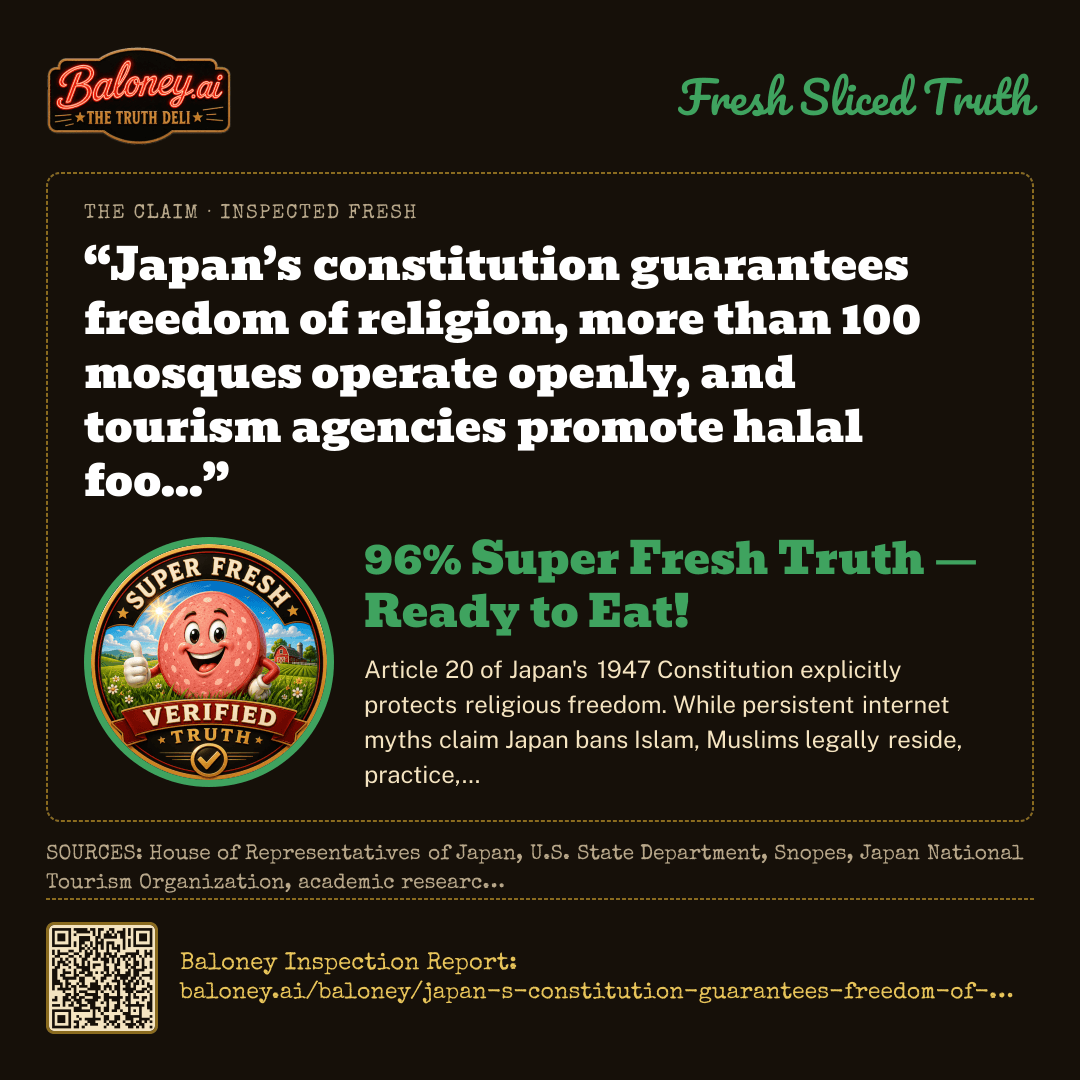
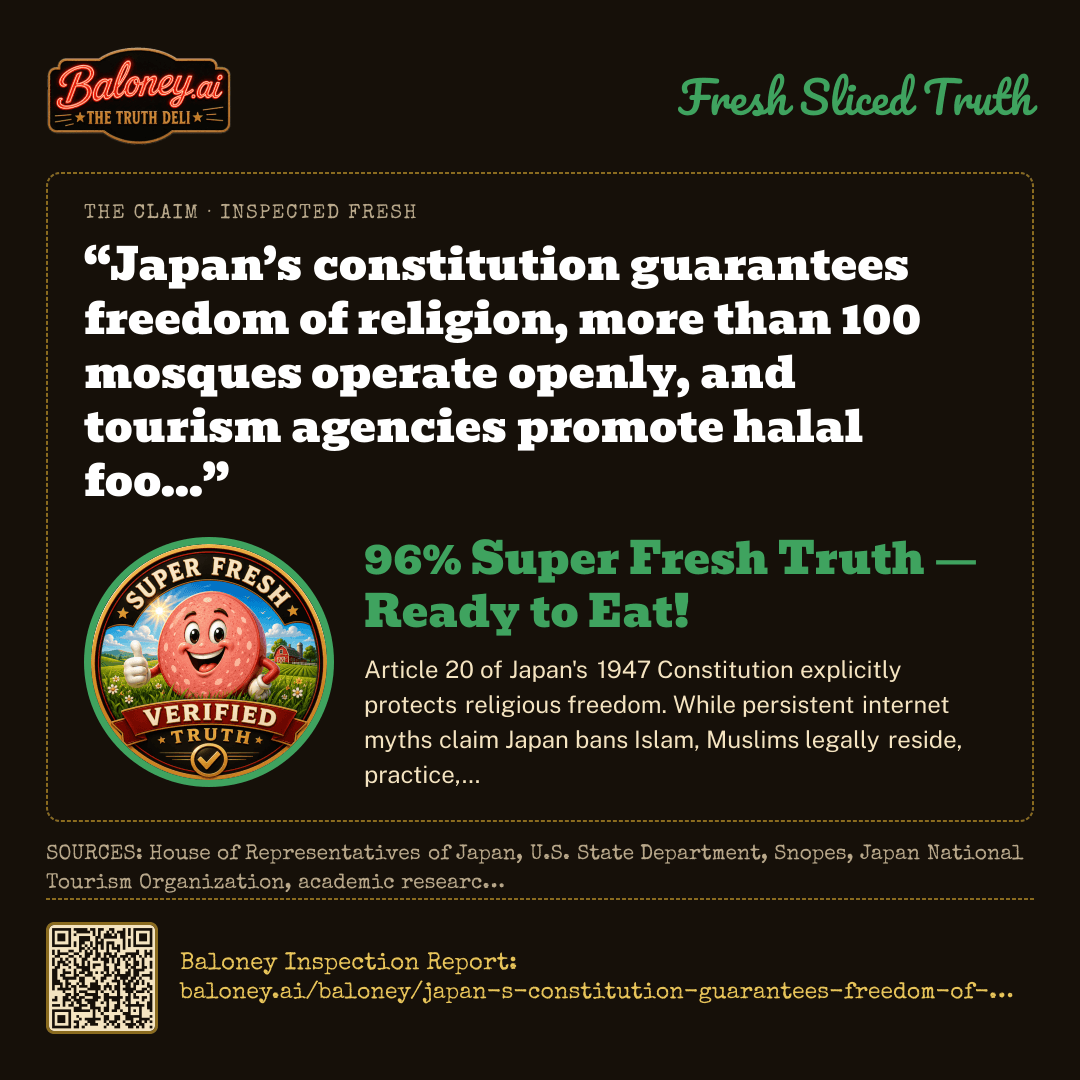
“Japan’s constitution guarantees freedom of religion, more than 100 mosques operate openly, and tourism agencies promote halal food for Muslim visitors.”
96%Super Fresh Truth — Ready to Eat!
THE CLAIM CHECKS OUT.
Independently verifiedPhysically repeatable evidenceConfirmed across rival labsSafe to serve
“Japan’s constitution guarantees freedom of religion, more than 100 mosques operate openly, and tourism agencies promote halal food for Muslim visitors.”96% Super Fresh Truth — Ready to Eat!Verified blind by 5 frontier AIs · Baloney Inspection Report: baloney.ai/baloney/japan-s-constitution-guarantees-freedom-of-religion-more
The Rating Card
The claim this refutes
The Baloney Sampler
The claim is accurate. Article 20 of the Constitution, translated by the House of Representatives of Japan, explicitly guarantees freedom of religion. Corroborating this, the U.S. Department of State confirms religious groups operate freely, and Snopes has debunked viral misinformation claiming Japan bans Islam. Academic surveys tracking the growing Muslim community confirm there are well over 100 mosques openly operating nationwide, though this figure comes from researchers rather than an official government census.
Additionally, the Japan National Tourism Organization maintains dedicated guides promoting halal-certified restaurants, accommodations, and prayer spaces for Muslim visitors. There are minor caveats: official guidance notes that Japan lacks central halal accreditation, so some promoted "Muslim-friendly" options may fall short of strict certification. Furthermore, while the constitution protects religious practice, The Japan Times notes past instances of societal friction, including judicially permitted police surveillance of Muslim communities.
Other ways to slice it — phrasings that might have changed the rating
“Japan's constitutional guarantee of religious freedom ensures Muslims face no systemic profiling or societal friction.” This would face severe scrutiny, as courts have upheld blanket police surveillance of Muslim residents, and communities have reported local opposition regarding mosque construction and burial grounds.
“Japan has legally banned the practice of Islam and the construction of mosques.” Fact-checkers have repeatedly debunked this exact viral myth, noting that Japan's constitution explicitly guarantees religious freedom and allows over 100 openly operating mosques.
“All Japanese tourism agencies promote exclusively certified halal food for Muslim visitors.” Reports note that Japan lacks a central halal accreditation agency, meaning official tourist guidance often mixes strictly certified halal food with broadly "Muslim-friendly" options.
Written from the panel’s reports by Google · gemini-3.1-pro-preview. Nothing here changed the score.
22:57:06SCORING MODEL V2 — MEDIAN OF 5 COUNTED LAB SCORES: 3, 3, 2, 5, 4 → 3. FRESH RULE: THE PRIMARY MASTER SCORES 3 AND THE BLIND MASTER 4 — BOTH SUPER FRESH TRUTH — AND THE COUNTED MEDIAN IS 3, ON THE TRUE SIDE. PUBLISHED AS 4, THE MORE CAUTIOUS OF THE TWO MASTERS.✓
22:57:06SOURCE RULE — LABS CITED 23 SOURCES: 0 DISCARDED FOR HAVING NO URL, 7 DISCARDED AS DEAD LINKS (404/410), 0 COULD NOT BE OPENED BY US AND ARE MARKED UNVERIFIED.✓
22:57:06SOURCE RULE — PRIMARY MASTER RULED ON 11 SOURCES: 0 DISCARDED FOR HAVING NO URL, 0 DISCARDED AS DEAD LINKS, 0 MARKED UNVERIFIED, 11 VERIFIED.✓
How This One Was Sliced
Station 1 · Blind Inspection — Five Graders, Zero Peeking
Each lab scored the claim independently, without seeing the others. Open a breakdown for its evidence, its sources, and how sure it was.
Anthropic · EQUAL WEIGHT · 41.1s
claude-opus-5
97%TRUTH
ROUND-1 BREAKDOWN
Evidence offered for the claim
Article 20 of the 1947 Constitution of Japan states: 'Freedom of religion is guaranteed to all. No religious organization shall receive any privileges from the State, nor exercise any political authority,' and Article 20 further bars the State and its organs from religious education or activity — the text is published in English by the Prime Minister's Office of Japan.
The U.S. State Department's annual International Religious Freedom Report on Japan confirms that the constitution guarantees freedom of religion and that religious groups, including Muslim communities, register and operate freely under the Religious Corporations Law.
Academic tracking by Prof. Hirofumi Tanada (Waseda University), widely reported in Japanese and international media, counted roughly 80 mosques in 2015, over 110 by 2021, and around 150 by the mid-2020s — comfortably exceeding the '100 mosques' threshold. Long-established examples include Tokyo Camii (rebuilt 2000), Kobe Muslim Mosque (1935) and Nagoya Mosque (1936), all openly operating.
The Japan National Tourism Organization (JNTO), a government-affiliated body, maintains dedicated Muslim-traveler guidance on its official japan.travel site listing halal restaurants and prayer spaces; the Japan Tourism Agency and prefectural/municipal tourism boards (e.g., Tokyo, Kyoto, Osaka, Hokkaido) have published halal-friendly dining and prayer-room guides, and major airports (Narita, Haneda, Kansai) provide prayer rooms and halal dining options.
Halal certification bodies (e.g., Japan Halal Association, Nippon Asia Halal Association) operate legally and commercially in Japan, and halal tourism has been an explicit inbound-tourism growth strategy targeting visitors from Indonesia and Malaysia.
Evidence against the claim
The exact mosque count is not centrally registered by the government; figures come from academic surveys and vary by definition (purpose-built masjids vs. rented 'musalla' prayer rooms), so '100+' is an estimate rather than an official statistic — though nearly all credible estimates exceed 100.
Constitutional guarantee does not mean the absence of friction: a 2010 leak of Tokyo Metropolitan Police files revealed blanket surveillance of Muslim residents, and in 2016 Japan's Supreme Court let stand lower-court rulings that allowed the profiling to continue (while awarding damages for the data leak). Muslim communities have also reported difficulties obtaining burial grounds (notably in Oita Prefecture) and occasional local opposition to mosque construction.
'Tourism agencies promote halal food' is broadly true but uneven — halal-certified options remain concentrated in major cities and tourist hubs, and some 'Muslim-friendly' labeling falls short of full certification.
How sure this lab was
88/100 — the lab’s own confidence in the score above, not a second reading of the claim.
Japan’s Constitution explicitly states in Article 20 that “Freedom of religion is guaranteed to all,” directly supporting the first part of the claim.
The U.S. State Department’s 2023 International Religious Freedom report for Japan also describes constitutional protections for religious freedom, corroborating the legal point.
Nippon.com, citing research by Waseda University professor Tanada Hirofumi, reported that Japan had 105 mosques as of the end of 2018, supporting the claim that more than 100 mosques operate in Japan.
Japan National Tourism Organization’s official Japan Travel site has a “Muslim Travelers” page promoting Muslim-friendly travel information, including halal food and restaurants, supporting the tourism/halal-food part of the claim.
Evidence against the claim
The mosque count appears to rely on academic/research estimates rather than an official Japanese government census; the cited figure of 105 is from end-2018, so the exact current number may vary, though it still supports “more than 100.”
“Tourism agencies promote halal food” is broadly accurate, but official travel materials often mix “halal” with “Muslim-friendly” options; promotion does not necessarily mean all listed food is halal-certified or universally available.
The constitutional guarantee does not mean there are no practical frictions for religious minorities; religious-freedom reporting notes Japan’s legal protections but does not by itself prove perfect social treatment. This caveat does not materially refute the statement as written.
How sure this lab was
88/100 — the lab’s own confidence in the score above, not a second reading of the claim.
Article 20 of the Japanese Constitution explicitly guarantees freedom of religion, stating 'Freedom of religion is guaranteed to all. No religious organization shall receive any privileges from the State, nor exercise any political authority.'
Multiple fact-checking organizations have debunked viral misinformation claiming that Japan bans Islam, confirming that Muslims can obtain citizenship, practice their faith, and build places of worship freely.
Academic research, most notably by Professor Hirofumi Tanada at Waseda University, documents the rapid growth of the Muslim community in Japan, tracking over 110 mosques operating openly nationwide.
The Japanese government actively caters to Muslim tourists. The Japan National Tourism Organization (JNTO) hosts dedicated guides for Muslim travelers, promoting halal-certified restaurants, prayer spaces, and Muslim-friendly accommodations.
Evidence against the claim
There is no credible evidence against this claim. Although viral chain emails and social media posts periodically circulate claiming that Japan outlaws Islam, bans Muslim immigration, and prohibits halal food, these are completely fabricated assertions.
How sure this lab was
100/100 — the lab’s own confidence in the score above, not a second reading of the claim.
Article 20 of Japan’s Constitution explicitly states that “freedom of religion is guaranteed to all,” while also protecting against compelled religious participation and establishing state religious neutrality. [https://www.shugiin.go.jp/internet/itdb_english.nsf/html/statics/english/constitution_e.htm]
A 2017 report described approximately 100 mosques in Japan, indicating that a substantial mosque network operates openly; however, this source supports “around 100” rather than definitively “more than 100.” [https://en.abna24.com/news/868075/Islam-getting-more-accepted-in-Japan]
Japan’s official tourism information describes Muslim-friendly restaurants, halal food, prayer spaces, hotels, and mosques, and states that the Japan Tourism Agency and JNTO produced a guide for Muslim visitors. [https://www.gov-online.go.jp/eng/publicity/book/hlj/html/201311/201311_07_en.html]
The Japan National Tourism Organization maintains guidance for Muslim travelers and discusses halal-certified food and Muslim-friendly restaurants, showing that tourism agencies provide information relevant to halal dining. [https://www.japan.travel/en/plan/muslim-travelers/]
Japan’s government has reported tourism initiatives supporting menus for Muslim visitors, halal meals, ingredient pictograms, and Muslim prayer spaces. [https://www.arabnews.jp/en/japan/article_120953/]
Evidence against the claim
The mosque portion is not firmly established as written: the available cited report says “around 100 mosques,” not “more than 100,” and it does not provide a definitive official census or establish that every mosque operates openly. [https://en.abna24.com/news/868075/Islam-getting-more-accepted-in-Japan]
Japan’s official tourism guidance cautions that there is no central halal-accreditation agency, that ordinary supermarkets generally do not stock halal products, and that restaurants calling themselves halal-friendly may not use separate halal kitchens. This makes the broad wording “promote halal food” accurate only with important qualifications. [https://www.japan.travel/en/guide/muslim-travelers/]
The evidence supports promotion of Muslim-friendly travel and halal-related information, but does not show that all tourism agencies promote halal food; the documented initiatives are from particular national, prefectural, municipal, or tourism organizations. [https://www.gov-online.go.jp/eng/publicity/book/hlj/html/201311/201311_07_en.html]
How sure this lab was
88/100 — the lab’s own confidence in the score above, not a second reading of the claim.
Article 20 of the 1947 Constitution of Japan states that freedom of religion is guaranteed to all and that no person shall be compelled to take part in any religious act.
Independent counts by researchers (including Waseda University surveys) and news reporting since 2019 place the number of mosques in Japan above 100; they function as registered religious corporations and hold public prayers without state prohibition.
The Japan National Tourism Organization and Japan Tourism Agency maintain dedicated Muslim-traveler pages, halal restaurant directories, prayer-room maps, and inbound campaigns aimed at visitors from Indonesia, Malaysia, and the Middle East.
Evidence against the claim
Mosque tallies from 2016–2018 sometimes listed 80–95 facilities, so the ‘more than 100’ figure became accurate only after subsequent growth.
A handful of proposed mosque sites have encountered neighborhood petitions or zoning delays, though existing mosques continue to operate openly.
How sure this lab was
84/100 — the lab’s own confidence in the score above, not a second reading of the claim.
The statement is fundamentally accurate. Article 20 of Japan's Constitution guarantees religious freedom. Academic surveys confirm there are well over 100 openly operating mosques in the country, and official tourism bodies actively promote Muslim-friendly travel options, including halal food and prayer rooms. Minor caveats regarding the lack of an official government mosque census and the distinction between strictly halal-certified and broadly 'Muslim-friendly' dining do not detract from the truth of the core claims.
All five evaluators agreed that the claim is true, recommending scores from 2 to 5. They noted minor nuances about definitions of halal versus Muslim-friendly and the absence of a central state registry of mosques, but universally found the evidence strongly backs the statement as written.
SUPER FRESH — VERIFIED AGAINST HOUSE OF REPRESENTATIVES OF JAPAN, U.S. STATE DEPARTMENT, SNOPES, JAPAN NATIONAL TOURISM ORGANIZATION, ACADEMIC RESEARCH BY WASEDA UNIVERSITY.
Blind Validation Master · never saw the Primary’s work
sonar-pro
96% TRUTH
The statement is substantially true. Japan’s Constitution, Article 20, explicitly guarantees freedom of religion. Independent academic and other reported counts place the number of mosques above 100 by at least 2017–2021, although the figure is not based on a definitive government census and may include facilities with varying definitions. Japan’s National Tourism Organization and other official tourism bodies clearly provide Muslim-traveler guidance covering halal food, Muslim-friendly restaurants, prayer spaces, and related services. The main qualifications are that halal accreditation is not centrally standardized, some advertised options are only “Muslim-friendly,” and the extent of promotion varies by agency and location. These are wording and scope caveats rather than material contradictions, so the claim belongs in the 1–5 true band.
AGREEMENT TEST PASSED — MASTERS SCORED 97% AND 96% · BLIND VALIDATION CONFIRMED THIS SCORE · NO RE-EVALUATION REQUIRED
Median of 5 counted lab scores: 3, 3, 2, 5, 4 → 3.
Fresh rule: the Primary Master scores 3 and the Blind Master 4 — both Super Fresh Truth — and the counted median is 3, on the true side. Published as 4, the more cautious of the two masters.
The Evidence
Evidence for the claim
Constitutional protection Article 20 of the 1947 Constitution of Japan explicitly states: 'Freedom of religion is guaranteed to all.'
Over 100 mosques Academic research, notably by Waseda University Professor Hirofumi Tanada, counted 105 mosques by the end of 2018 and over 110 by 2021, operating openly as registered religious corporations.
Tourism promotion The Japan National Tourism Organization (JNTO) and various local tourism boards publish dedicated guides for Muslim visitors, listing halal restaurants, prayer spaces, and Muslim-friendly accommodations.
Debunked falsehoods Fact-checkers have repeatedly debunked viral online rumors claiming Japan bans Islam, confirming Muslims can obtain citizenship and build places of worship freely.
Evidence offered against the claim
No official registry The 'more than 100' figure relies on academic estimates rather than a central government census, though practically all reliable counts exceed 100 today.
Halal vs. Muslim-friendly Tourism materials often mix fully 'halal-certified' options with broadly 'Muslim-friendly' restaurants, which JNTO cautions may not have separate halal kitchens.
Social and legal frictions While religious freedom is legally protected, there have been instances of local opposition to mosque construction and court-sanctioned police surveillance of Muslim communities.
Sources · Reliability · Why Accepted or Discounted
ACCEPTED — Established fact-checker debunking viral misinformation about Japan's treatment of Muslims.
Every link was opened when this claim was inspected. A dead link was discarded before publication; “unverified” means the site refused our automated check and the link is the one the panel cited. A source without a URL was never kept.
“Japan’s constitution guarantees freedom of religion, more than 100 mosques operate openly, and tourism agencies promote halal food for Muslim visitors.”96% Super Fresh Truth — Ready to Eat!Verified blind by 5 frontier AIs · Baloney Inspection Report: baloney.ai/baloney/japan-s-constitution-guarantees-freedom-of-religion-more