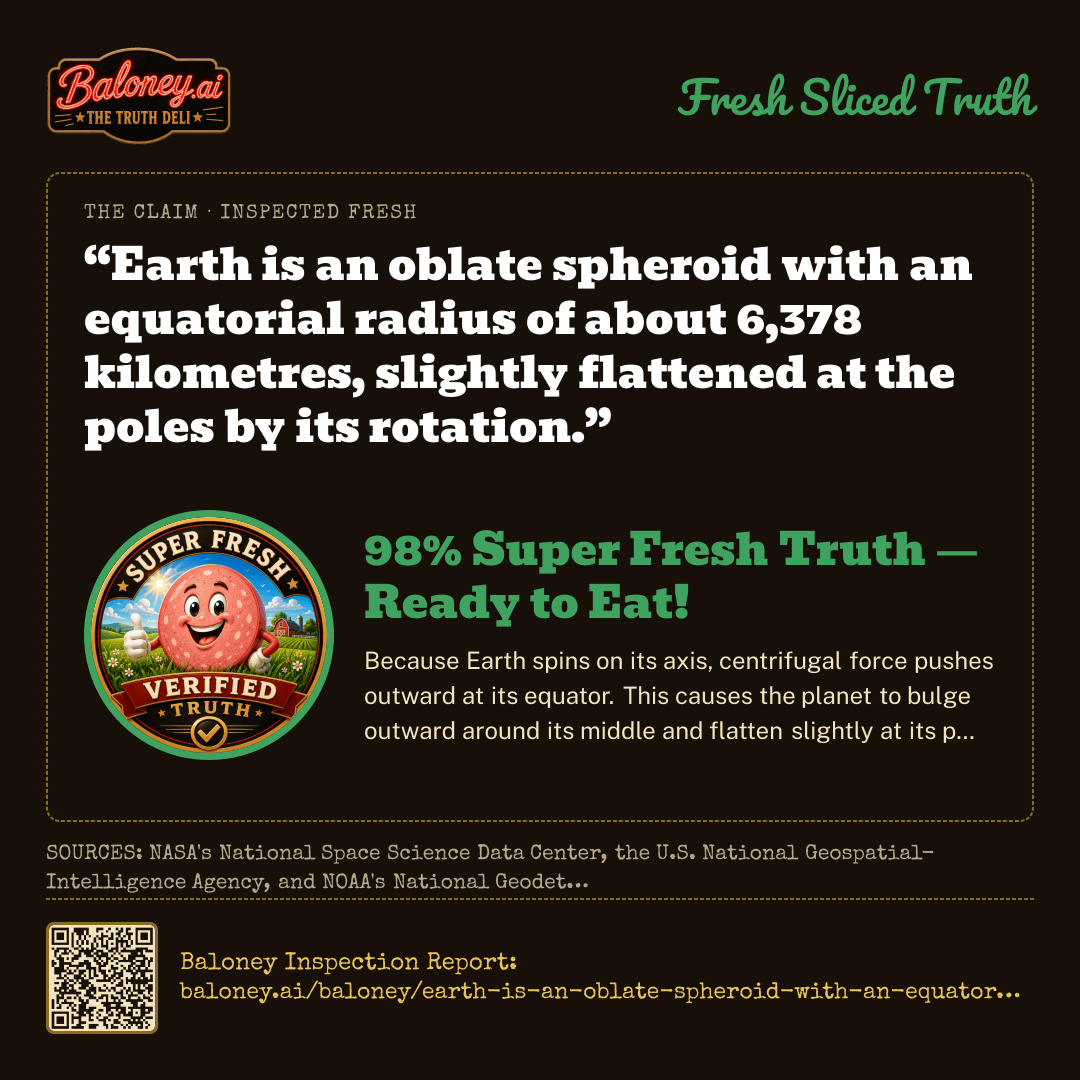
“Earth is an oblate spheroid with an equatorial radius of about 6,378 kilometres, slightly flattened at the poles by its rotation.”98% Super Fresh Truth — Ready to Eat!Verified blind by 5 frontier AIs · Baloney Inspection Report: baloney.ai/baloney/earth-is-an-oblate-spheroid-with-an-equatorial-radius-of-z6iopu
The Rating Card
The claim this refutes
The Baloney Sampler
The claim is scientifically accurate. Standard reference models used by the U.S. National Geospatial-Intelligence Agency, NASA, and NOAA define Earth as an oblate spheroid. Centrifugal force from the planet's rotation creates a bulge at the equator and flattens the poles. Satellite measurements confirm the equator sits roughly 21 kilometres farther from Earth's centre than the poles, giving an accepted equatorial radius of exactly 6,378.137 kilometres.
Strictly speaking, Earth is not a mathematically perfect spheroid. Because of unequal mass distribution, ocean trenches, and mountains, its exact physical shape is slightly irregular and bumpy—a surface scientists call a geoid. The equator itself is also very slightly elliptical rather than a perfect circle. However, these natural variations are minimal, making an oblate spheroid an exceptionally accurate approximation for mapping and global geodesy.
Other ways to slice it — phrasings that might have changed the rating
“Earth is a mathematically perfect oblate spheroid with a uniform, perfectly circular equator.” The reports note Earth is very slightly triaxial and its true shape is an irregular, bumpy geoid affected by topography and uneven mass distribution.
“Earth is a perfect sphere, meaning its radius is exactly the same at both the equator and the poles.” Authoritative geodetic measurements show the equatorial radius is roughly 21 kilometres larger than the polar radius due to centrifugal force from rotation.
“Earth is an oblate spheroid whose exact flattening is permanently static and shaped entirely by rotation.” The reports highlight that Earth's shape is also influenced by mantle convection, glacial isostatic adjustment, and ice-mass changes, which cause measurable ongoing variations.
Written from the panel’s reports by Google · gemini-3.1-pro-preview. Nothing here changed the score.
07:23:26SCORING MODEL V2 — MEDIAN OF 5 COUNTED LAB SCORES: 2, 2, 1, 3, 2 → 2. FRESH RULE: THE PRIMARY MASTER SCORES 1 AND THE BLIND MASTER 2 — BOTH SUPER FRESH TRUTH — AND THE COUNTED MEDIAN IS 2, ON THE TRUE SIDE. PUBLISHED AS 2, THE MORE CAUTIOUS OF THE TWO MASTERS.✓
07:23:26SOURCE RULE — LABS CITED 18 SOURCES: 0 DISCARDED FOR HAVING NO URL, 0 DISCARDED AS DEAD LINKS (404/410), 1 COULD NOT BE OPENED BY US AND ARE MARKED UNVERIFIED.✓
07:23:26SOURCE RULE — PRIMARY MASTER RULED ON 12 SOURCES: 0 DISCARDED FOR HAVING NO URL, 0 DISCARDED AS DEAD LINKS, 1 MARKED UNVERIFIED, 11 VERIFIED.✓
How This One Was Sliced
Station 1 · Blind Inspection — Five Graders, Zero Peeking
Each lab scored the claim independently, without seeing the others. Open a breakdown for its evidence, its sources, and how sure it was.
Anthropic · EQUAL WEIGHT · 32.5s
claude-opus-5
98%TRUTH
ROUND-1 BREAKDOWN
Evidence offered for the claim
NASA's Earth Fact Sheet lists an equatorial radius of 6,378.137 km and a polar radius of 6,356.752 km, giving a flattening of 0.00335 (≈1/298.26) — exactly the 'slightly flattened at the poles' shape described.
The World Geodetic System 1984 (WGS 84), the reference ellipsoid used by GPS and global geodesy, defines Earth's semi-major (equatorial) axis as 6,378,137 m with inverse flattening 298.257223563, i.e. an oblate spheroid.
The equatorial bulge is physically explained by rotation: centrifugal effect in a self-gravitating, deformable rotating body produces hydrostatic flattening, a result dating to Newton's Principia and confirmed by the 18th-century French geodetic arc expeditions to Lapland and Peru.
Satellite geodesy (e.g., GRACE, LAGEOS, satellite laser ranging) measures the J2 gravitational coefficient (~1.0826×10⁻³), which directly quantifies the rotational oblateness, independently confirming the ~21 km equator-to-pole radius difference.
Direct imagery and altimetry from spacecraft, plus everyday phenomena (ship hulls disappearing over the horizon, lunar eclipse shadow, differing star fields by latitude), confirm the overall spheroidal shape.
Rounding 'about 6,378 km' matches the accepted 6,378.137 km to better than 0.003%.
Evidence against the claim
Strictly speaking, Earth's true figure is the geoid, an irregular equipotential surface that deviates from the best-fit ellipsoid by roughly −106 m to +85 m; 'oblate spheroid' is an excellent approximation, not an exact description.
Earth is very slightly triaxial — the equator itself is not perfectly circular (equatorial radii differ by roughly 70–140 m), so a biaxial oblate spheroid is an idealization.
Topography (Chimborazo's summit is the point farthest from Earth's centre; Everest is the highest above sea level) means the physical surface departs from any smooth ellipsoid by up to ~20 km peak-to-trough.
Rotation is the dominant but not sole influence on the figure: mantle convection, glacial isostatic adjustment and ice-mass changes cause measurable secular variation in J2 (the flattening is not perfectly static).
None of these caveats contradict the claim; they are refinements at the sub-kilometre or wording level.
How sure this lab was
99/100 — the lab’s own confidence in the score above, not a second reading of the claim.
NASA’s Earth Fact Sheet lists Earth’s equatorial radius as 6,378.137 km and polar radius as 6,356.752 km, showing the equator is about 21.4 km farther from the center than the poles—consistent with an oblate spheroid.
NOAA explains that Earth is not a perfect sphere but is slightly flattened at the poles and bulges at the equator because of its rotation, matching the claim’s causal explanation.
The claim’s phrase “about 6,378 kilometres” is appropriately rounded from the standard equatorial radius value of 6,378.137 km.
Evidence against the claim
Minor caveat: Earth is not a mathematically perfect oblate spheroid; its real shape is more precisely described as an irregular geoid/reference ellipsoid because of topography and variations in gravity. This does not materially undermine the claim as written.
Minor caveat: the exact radius depends on the reference model used, but the cited equatorial radius of about 6,378 km is the standard accepted value.
How sure this lab was
99/100 — the lab’s own confidence in the score above, not a second reading of the claim.
Geodetic reference systems, notably the World Geodetic System (WGS 84) used by GPS, define Earth's equatorial radius as exactly 6,378.137 kilometers and its polar radius as 6,356.752 kilometers.
Physical laws and satellite measurements confirm that Earth's rotation creates a centrifugal force that pushes mass outward at the equator, resulting in an equatorial bulge and a slight flattening at the poles, making the planet an oblate spheroid.
Evidence against the claim
From a highly pedantic standpoint, Earth is not a mathematically perfect oblate spheroid. Because of unequal mass distribution, mountains, and ocean trenches, its true and exact shape is slightly irregular and bumpy, technically referred to as a 'geoid'. However, an oblate spheroid is the standard, accurate geometric approximation used in science.
How sure this lab was
100/100 — the lab’s own confidence in the score above, not a second reading of the claim.
Authoritative geodetic models define Earth as an oblate ellipsoid: the National Geodetic Survey states that Earth’s equatorial radius is larger than its polar radius.[https://geodesy.noaa.gov/research/geopotential-datums/geopotential-surface.shtml]
NASA lists Earth’s equatorial radius as 6,378.137 km and polar radius as 6,356.752 km, confirming slight polar flattening and an equatorial radius of about 6,378 km.[https://nssdc.gsfc.nasa.gov/planetary/factsheet/earthfact.html]
The U.S. National Geospatial-Intelligence Agency’s WGS 84 reference system specifies a semi-major axis of 6,378,137 meters and an Earth flattening factor of 1/298.257223563.[https://earth-info.nga.mil/index.php?dir=wgs84&action=wgs84]
NASA explains that Earth’s equatorial bulge results from its rotation, with the equatorial radius exceeding the polar radius.[https://pwg.gsfc.nasa.gov/stargaze/Srotfram1.htm]
Evidence against the claim
The statement is scientifically accurate as written, so there is no substantial contrary evidence. The only qualification is that an oblate spheroid is an idealized reference figure: Earth’s physical shape is more irregular and is more precisely represented by the geoid, which reflects variations in gravity and topography.[https://geodesy.noaa.gov/research/geopotential-datums/geopotential-surface.shtml]
The phrase 'flattened at the poles by its rotation' identifies the principal physical cause, but Earth’s exact shape also reflects mass distribution, internal structure, tides, and other geophysical effects; these are refinements rather than contradictions.
How sure this lab was
99/100 — the lab’s own confidence in the score above, not a second reading of the claim.
Geodetic measurements (satellite laser ranging, GNSS/GPS, VLBI, and gravimetry) give a mean equatorial radius of 6378.137 km (WGS 84), matching the claimed ~6378 km.
Polar radius is ~6356.752 km, so Earth is an oblate spheroid (flattening f ≈ 1/298.257) produced by rotational centrifugal force, as predicted by Newton and confirmed by modern observations.
This reference ellipsoid is the standard first-order model used by NASA, NOAA/NGS, IERS, and mapping agencies worldwide.
Evidence against the claim
The physical surface is a geoid that departs from a perfect mathematical oblate spheroid by tens of meters (topography, ice, and mass anomalies).
The equator itself has a very small ellipticity, so the figure is not a pure spheroid of revolution.
How sure this lab was
95/100 — the lab’s own confidence in the score above, not a second reading of the claim.
The statement accurately reflects the widely accepted scientific consensus on Earth's shape and dimensions. Measurements from satellite geodesy confirm an equatorial radius of approximately 6,378 kilometers (6,378.137 km in the WGS 84 reference system). The physical mechanism described—flattening at the poles and bulging at the equator due to centrifugal force from the planet's rotation—is completely accurate. Minor caveats regarding Earth's irregular geoid shape represent higher-order refinements, not contradictions, so the claim receives the highest possible score.
All five evaluators were in complete agreement. They unanimously concluded the claim is factually accurate, correctly citing standard geodetic data and the physical effects of Earth's rotation. All evaluators also noted the minor pedantic distinction that Earth's exact shape is an irregular geoid, but agreed this does not detract from the truth of the statement.
SUPER FRESH — VERIFIED AGAINST NASA'S NATIONAL SPACE SCIENCE DATA CENTER, THE U.S. NATIONAL GEOSPATIAL-INTELLIGENCE AGENCY, AND NOAA'S NATIONAL GEODETIC SURVEY.
Blind Validation Master · never saw the Primary’s work
gpt-5.5
98% TRUTH
The claim is strongly supported by all five reports. Multiple authoritative geodetic and space-agency sources cited in the reports give Earth’s equatorial radius as about 6,378.137 km and polar radius as about 6,356.752 km, showing a roughly 21 km equatorial bulge and polar flattening. WGS 84 and other standard reference ellipsoids model Earth as an oblate spheroid, and the reports consistently identify rotation as the main physical cause of the flattening. The only caveats are technical refinements: Earth is not a perfect mathematical spheroid, because its real surface/geoid has irregularities from topography, gravity variations, and slight triaxiality. These do not materially undermine the statement as written, which uses 'about' and describes the standard first-order shape accurately.
AGREEMENT TEST PASSED — MASTERS SCORED 99% AND 98% · BLIND VALIDATION CONFIRMED THIS SCORE · NO RE-EVALUATION REQUIRED
Median of 5 counted lab scores: 2, 2, 1, 3, 2 → 2.
Fresh rule: the Primary Master scores 1 and the Blind Master 2 — both Super Fresh Truth — and the counted median is 2, on the true side. Published as 2, the more cautious of the two masters.
The Evidence
Evidence for the claim
Equatorial radius of ~6,378 km Standard geodetic reference models, such as the World Geodetic System (WGS 84) used by GPS and NASA, define Earth's equatorial radius as 6,378.137 kilometers, matching the claim perfectly.
Oblate spheroid due to rotation Physical laws dictate that a rotating, self-gravitating body will bulge at the equator and flatten at the poles due to centrifugal force. Satellite observations confirm Earth's polar radius is about 21.4 km shorter than its equatorial radius.
Evidence offered against the claim
Earth's true shape is a geoid Strictly speaking, Earth is not a mathematically perfect ellipsoid. Topography (mountains and ocean trenches) and unequal mass distribution make its true physical surface an irregular, bumpy 'geoid', though an oblate spheroid remains the standard and highly accurate geometric approximation.
Sources · Reliability · Why Accepted or Discounted
ACCEPTED — Excellent, accessible explanation of Earth's shape from a primary scientific agency.
Every link was opened when this claim was inspected. A dead link was discarded before publication; “unverified” means the site refused our automated check and the link is the one the panel cited. A source without a URL was never kept.
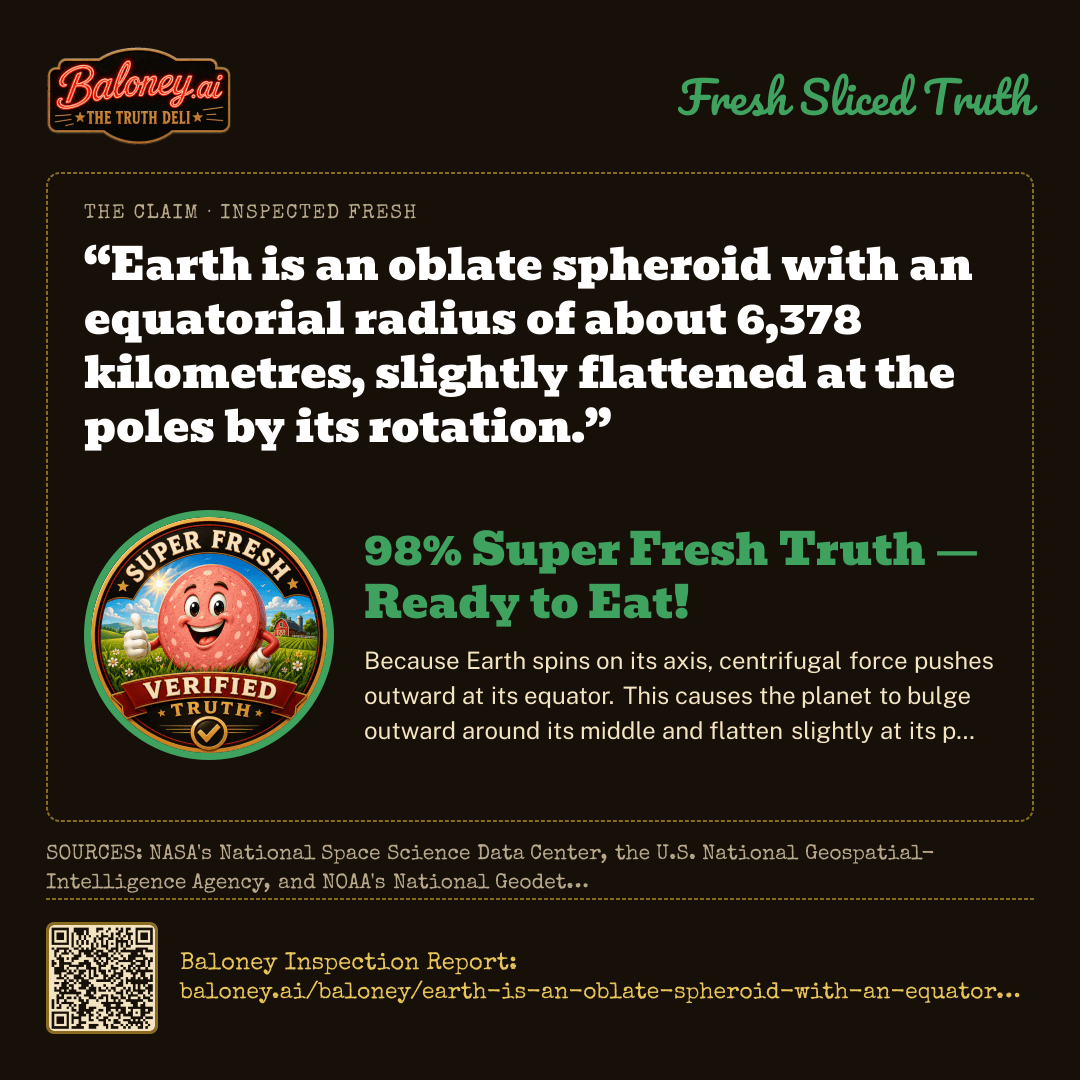
“Earth is an oblate spheroid with an equatorial radius of about 6,378 kilometres, slightly flattened at the poles by its rotation.”98% Super Fresh Truth — Ready to Eat!Verified blind by 5 frontier AIs · Baloney Inspection Report: baloney.ai/baloney/earth-is-an-oblate-spheroid-with-an-equatorial-radius-of-z6iopu
Support the Baloney Slicer
CONTRIBUTE $25 → GET THE HAT
“Democracy Makes America Great”
A non-partisan, non-political ethos. Democracy is what makes America great. But without truth — honest, real, scientifically validated truth — democracy fails. The baloney slicer is on: feeding fresh sliced truth to protect what makes America great. Democracy.
Veritate Libertas — Latin for “Through Truth, Liberty.”