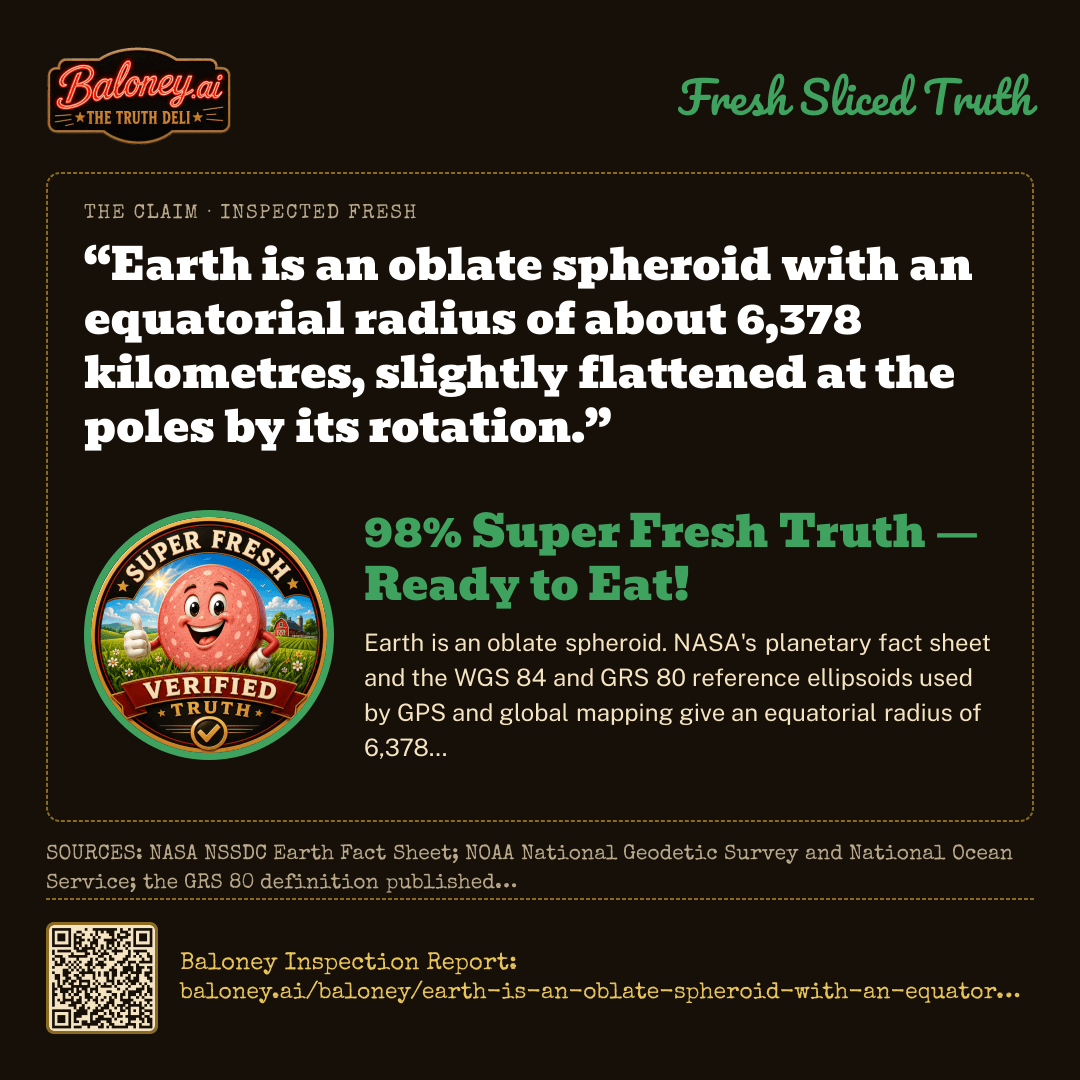
“Earth is an oblate spheroid with an equatorial radius of about 6,378 kilometres, slightly flattened at the poles by its rotation.”98% Super Fresh Truth — Ready to Eat!Verified blind by 5 frontier AIs · Baloney Inspection Report: baloney.ai/baloney/earth-is-an-oblate-spheroid-with-an-equatorial-radius-of
The Rating Card
The claim this refutes
The Baloney Sampler
All five labs found the same numbers, with no dispute anywhere on the panel. NASA's Goddard/NSSDC Earth Fact Sheet gives an equatorial radius of 6,378.137 km against a polar radius of 6,356.752 km, a flattening of about 1/298.257 — the same geometry built into the WGS 84 and GRS 80 reference ellipsoids used by GPS and mapping, the latter defined in the peer-reviewed Bulletin Géodésique. NOAA's National Geodetic Survey and National Ocean Service describe the same rotational bulge and polar flattening.
The stated cause holds up too: rotation's centrifugal effect, predicted by Newton, confirmed by 18th-century meridian-arc surveys, and measured today by satellite laser ranging, GNSS and NASA JPL's GRACE/GRACE-FO gravimetry. Every lab raised one caveat — Earth's true figure is the geoid, departing from the best-fit ellipsoid by roughly -106 m to +85 m, with topography departing far more and the equator itself slightly non-circular. The claim's own words 'about' and 'slightly' already cover that.
Other ways to slice it — phrasings that might have changed the rating
“Earth's radius is about 6,378 kilometres.” The reports note that some sources quote 6,371 km (mean/volumetric) or 6,356.8 km (polar), so the figure is correct only when specified as the equatorial value, which the original claim does.
“Earth is exactly an oblate spheroid, with a perfectly circular equator of constant radius.” Every lab flagged that the true equipotential figure is the geoid, departing from the best-fit ellipsoid by roughly -106 m to +85 m, with the equator itself varying by some 70–140 m.
“Earth's rotation is the sole cause of its polar flattening and equatorial bulge.” The panel found rotation is the dominant but not the only contributor, with mantle convection, glacial isostatic adjustment and ice-mass redistribution producing small measurable changes in J2.
Written from the panel’s reports by Anthropic · claude-opus-5. Nothing here changed the score.
21:54:55SCORING MODEL V2 — MEDIAN OF 5 COUNTED LAB SCORES: 2, 2, 1, 3, 3 → 2. FRESH RULE: THE PRIMARY MASTER SCORES 2 AND THE BLIND MASTER 2 — BOTH SUPER FRESH TRUTH — AND THE COUNTED MEDIAN IS 2, ON THE TRUE SIDE. PUBLISHED AS 2, THE MORE CAUTIOUS OF THE TWO MASTERS.✓
21:54:55SOURCE RULE — LABS CITED 22 SOURCES: 0 DISCARDED FOR HAVING NO URL, 3 DISCARDED AS DEAD LINKS (404/410), 1 COULD NOT BE OPENED BY US AND ARE MARKED UNVERIFIED.✓
21:54:55SOURCE RULE — PRIMARY MASTER RULED ON 15 SOURCES: 0 DISCARDED FOR HAVING NO URL, 0 DISCARDED AS DEAD LINKS, 1 MARKED UNVERIFIED, 14 VERIFIED.✓
How This One Was Sliced
Station 1 · Blind Inspection — Five Graders, Zero Peeking
Each lab scored the claim independently, without seeing the others. Open a breakdown for its evidence, its sources, and how sure it was.
Anthropic · EQUAL WEIGHT · 24.4s
claude-opus-5
98%TRUTH
ROUND-1 BREAKDOWN
Evidence offered for the claim
NASA's planetary fact sheet lists Earth's equatorial radius as 6,378.137 km and polar radius as 6,356.752 km, giving a flattening of about 0.0033528 (1/298.257) — exactly the oblate-spheroid geometry described in the claim.
The WGS 84 reference ellipsoid used by GPS and virtually all modern geodesy and mapping defines Earth as an oblate ellipsoid of revolution with semi-major (equatorial) axis a = 6,378,137 m and inverse flattening 1/f = 298.257223563.
The physical cause is as stated: the centrifugal effect of Earth's ~24-hour rotation pushes mass outward at the equator, producing an equatorial bulge of roughly 21 km relative to the poles. Newton predicted this in the Principia (1687), and the 18th-century French Geodesic Missions to Lapland and Peru confirmed it by measuring the length of a degree of latitude at different latitudes.
Satellite laser ranging, GRACE/GRACE-FO gravimetry, and satellite orbit perturbations (the J2 dynamic form factor) independently measure the oblateness to sub-metre precision, agreeing with the quoted figures.
The same rotational flattening is observed on other rotating planets (e.g., Jupiter and Saturn are visibly more oblate because they spin faster), consistent with the physical mechanism cited.
Direct imagery from crewed and robotic spacecraft, as well as millennia of observations (ships' hulls disappearing over the horizon, lunar eclipse shadows, latitude-dependent star visibility), confirm Earth's overall sphericity.
Evidence against the claim
Strictly speaking, Earth is not a perfect oblate spheroid: the true equipotential surface (the geoid) departs from the best-fit ellipsoid by roughly -106 m to +85 m, and topography departs much more (Everest ~8.8 km, Mariana Trench ~11 km). The claim's word 'is' is a modelling idealisation, though a standard and universally accepted one.
Earth is very slightly triaxial — the equator itself is not an exact circle, with the equatorial radius varying by roughly 70–140 m around it — so 'equatorial radius' is an average value. This is far below the precision implied by 'about 6,378 kilometres'.
Some sources quote 6,371 km (mean/volumetric radius) or 6,356.8 km (polar radius), so the single figure 6,378 km is correct only if understood as the equatorial value — which the claim does specify.
Rotation is the dominant but not the sole contributor to the observed shape; mantle convection, glacial isostatic adjustment and ice-mass redistribution produce small, measurable secular changes in J2. These are perturbations of order parts per billion and do not undercut the claim.
How sure this lab was
98/100 — the lab’s own confidence in the score above, not a second reading of the claim.
NASA's Earth Fact Sheet lists Earth's equatorial radius as 6,378.137 km and polar radius as 6,356.752 km, showing the equator is larger than the pole-to-center distance and matching the claim's 'about 6,378 kilometres.'
NASA also lists Earth's flattening as 0.003353, consistent with an oblate spheroid/ellipsoid rather than a perfect sphere.
NOAA/NCEI explains that Earth's rotation causes it to bulge at the equator and flatten at the poles, directly supporting the stated cause.
The Geodetic Reference System 1980 scientific standard defines an Earth reference ellipsoid with semi-major axis 6,378,137 m and flattening about 1/298.257, closely matching modern geodetic values.
Evidence against the claim
The main caveat is that Earth is not a perfect oblate spheroid: its actual physical shape is more accurately modeled as a geoid with irregularities from gravity variations, topography, ocean trenches, and mass distribution.
Different reference models and measurement conventions can give slightly different radii, but these differences do not materially contradict the claim because it says 'about 6,378 kilometres.'
How sure this lab was
99/100 — the lab’s own confidence in the score above, not a second reading of the claim.
Satellite geodesy and precise astronomical measurements consistently confirm that Earth's overall shape is an oblate spheroid.
The World Geodetic System (WGS 84), which is the standard reference frame used by GPS and cartographers worldwide, defines Earth's equatorial radius as precisely 6,378.137 kilometers and its polar radius as approximately 6,356.752 kilometers.
Basic physics dictates that Earth's rotation generates centrifugal force, which is strongest at the equator. Over billions of years, this rotational force caused the planet to bulge at the equator and flatten at the poles, perfectly matching the claim.
Evidence against the claim
From a highly pedantic geological standpoint, Earth is not a mathematically perfect oblate spheroid. Due to uneven mass distribution and topographical features like mountains and ocean trenches, its true shape is an irregular surface known as a 'geoid' (often described as slightly pear-shaped). However, 'oblate spheroid' remains the universally accepted, accurate geometric approximation for the planet.
How sure this lab was
100/100 — the lab’s own confidence in the score above, not a second reading of the claim.
NASA reports Earth's equatorial radius as 6,378.137 km and polar radius as 6,356.752 km, directly supporting an oblate rather than spherical shape.[1]
NASA states that Earth is almost, but not quite, a perfect sphere: its equatorial radius is about 6,378 km and its polar radius about 6,357 km, so it is slightly flattened at the poles.[2]
NOAA describes Earth as flattened at the poles and bulging at the equator, and says geodesy approximates it with an ellipsoid of revolution.[3]
The approximately 21 km difference between equatorial and polar radii is consistent with the established rotationally induced equatorial bulge.[1][3]
Evidence against the claim
The statement is a simplified model: Earth's physical surface is irregular and is more precisely represented by a geoid, while an oblate spheroid is a reference approximation.[4]
The wording 'by its rotation' omits other smaller contributors to Earth's exact shape, including variations in mass distribution and geophysical processes; rotation is nevertheless the principal cause of the broad equatorial bulge.
Different terrestrial reference ellipsoids use slightly different radius values, so 6,378 km is an approximation rather than a unique exact radius.[3]
How sure this lab was
98/100 — the lab’s own confidence in the score above, not a second reading of the claim.
Geodetic reference systems (WGS 84, GRS 80) and decades of satellite laser ranging, GNSS, VLBI and gravimetry give an equatorial radius of 6378.137 km and polar radius of 6356.752 km.
The observed flattening (f ≈ 1/298.257) matches the centrifugal effect of Earth's rotation, as predicted by Newton and confirmed by 18th-century meridian-arc surveys and modern satellite geodesy.
The oblate-spheroid (reference-ellipsoid) model is the operational standard for GPS, mapping, orbital mechanics and planetary fact sheets.
Evidence against the claim
Earth's actual figure is the geoid, which departs from a perfect mathematical ellipsoid by tens of metres because of topography and internal density variations; the claim is therefore a highly accurate first-order description rather than a statement of exact geometry.
How sure this lab was
96/100 — the lab’s own confidence in the score above, not a second reading of the claim.
All five evaluators independently converged on the same factual picture, and the underlying numbers are not in dispute anywhere in the panel: NASA's Earth Fact Sheet and the WGS 84 / GRS 80 reference ellipsoids give an equatorial radius of 6,378.137 km against a polar radius of 6,356.752 km, a flattening of about 1/298.257. That is precisely the geometry the claim describes, and the stated cause — rotational centrifugal effect producing an equatorial bulge — is the textbook physical explanation, predicted by Newton, confirmed by the 18th-century French geodesic missions and measured today to sub-metre precision by satellite laser ranging, GNSS, VLBI and GRACE/GRACE-FO gravimetry. I weighted the government geodetic and space-agency sources (NASA NSSDC, NOAA National Geodetic Survey, NOAA National Ocean Service) most heavily because they are the operational authorities for these constants, and the peer-reviewed GRS 80 definition in Bulletin Geodesique corroborates them independently. The only evidence against, raised by every evaluator, is the same caveat: Earth's true equipotential figure is the geoid, which departs from the best-fit ellipsoid by roughly -106 m to +85 m, topography departs far more, and the equator itself is very slightly non-circular. That is a refinement of an idealised model, not a contradiction — and the claim's own hedging words, 'about' and 'slightly', already accommodate it. The scale's instruction is explicit that a small modelling caveat does not push a substantially true statement out of the true band. The claim is about as well-established as any quantitative statement in physical science, so it sits near the floor of the Super Fresh Truth band rather than the middle of it.
Unanimous on substance: all five evaluators judged the claim true and placed it in the 1-3 Super Fresh Truth band, all citing the same NASA figures of 6,378.137 km equatorial and 6,356.752 km polar radius, and all accepting rotation as the cause of the flattening. All five also independently raised the identical caveat that Earth's exact figure is the geoid rather than a perfect ellipsoid. The only divergence was in how much that caveat should cost: two evaluators scored 3, two scored 2, one scored 1, reflecting differing views on whether 'is an oblate spheroid' should be read as an exact geometric assertion or as the standard modelling idealisation. No evaluator disputed any number, the causal mechanism, or the direction of the flattening.
SUPER FRESH — VERIFIED AGAINST NASA NSSDC EARTH FACT SHEET; NOAA NATIONAL GEODETIC SURVEY AND NATIONAL OCEAN SERVICE; THE GRS 80 DEFINITION PUBLISHED IN BULLETIN GEODESIQUE; NASA JPL GRACE-FO.
Blind Validation Master · never saw the Primary’s work
gpt-5.5
98% TRUTH
The reports unanimously support the statement. Multiple authoritative geodetic and space-agency sources give Earth’s equatorial radius as about 6,378.137 km and polar radius as about 6,356.752 km, demonstrating an equatorial bulge and polar flattening consistent with an oblate spheroid/reference ellipsoid. They also agree that Earth’s rotation is the principal physical cause of this flattening. The only caveats are technical: Earth is not a perfect mathematical spheroid, since the geoid, topography, mass-distribution variations, and slight triaxiality introduce smaller irregularities; and the radius value is approximate and model-dependent. These caveats do not materially undermine the statement as written, especially because it says “about” and describes the standard first-order shape. The claim is therefore substantially true.
AGREEMENT TEST PASSED — BOTH MASTERS SCORED 98% · BLIND VALIDATION CONFIRMED THIS SCORE · NO RE-EVALUATION REQUIRED
Median of 5 counted lab scores: 2, 2, 1, 3, 3 → 2.
Fresh rule: the Primary Master scores 2 and the Blind Master 2 — both Super Fresh Truth — and the counted median is 2, on the true side. Published as 2, the more cautious of the two masters.
The Evidence
Evidence for the claim
NASA's measured radii match the claim NASA's planetary fact sheet lists Earth's equatorial radius as 6,378.137 km and polar radius as 6,356.752 km, with a flattening of 0.003353 — an oblate shape, not a sphere. NASA separately states Earth is 'almost, but not quite' a perfect sphere.
WGS 84 and GRS 80 define exactly this shape The World Geodetic System 1984 used by GPS and global cartography, and the Geodetic Reference System 1980 scientific standard, both define Earth as an ellipsoid of revolution with semi-major axis 6,378,137 m and inverse flattening 298.257.
Rotation is the established cause NOAA describes Earth as bulging at the equator and flattened at the poles as a result of its rotation. Centrifugal effect is strongest at the equator, producing the roughly 21 km excess over the polar radius.
Predicted by Newton, confirmed by survey Newton predicted rotational flattening in the Principia (1687); the 18th-century French Geodesic Missions to Lapland and Peru confirmed it by measuring the length of a degree of latitude at different latitudes.
Independently measured from orbit Satellite laser ranging, VLBI, GNSS, GRACE/GRACE-FO gravimetry and the J2 dynamic form factor derived from satellite orbit perturbations all measure the oblateness to sub-metre precision, agreeing with the quoted figures.
Same effect seen on other planets Faster-spinning planets such as Jupiter and Saturn are visibly more oblate, consistent with the rotational mechanism cited in the claim.
Evidence offered against the claim
The true figure is the geoid Earth's actual equipotential surface departs from the best-fit ellipsoid by roughly -106 m to +85 m because of internal density variations, and topography departs far more (Everest ~8.8 km, Mariana Trench ~11 km). 'Oblate spheroid' is a highly accurate first-order model, not exact geometry.
The equator is not a perfect circle Earth is very slightly triaxial, with the equatorial radius varying by roughly 70-140 m around the equator, so 'equatorial radius' is strictly an average — a difference far below the precision implied by 'about 6,378 kilometres'.
Rotation is dominant but not the only factor Mantle convection, glacial isostatic adjustment and ice-mass redistribution produce small measurable secular changes in the oblateness. These are perturbations of order parts per billion and do not undercut the claim.
Different ellipsoids, slightly different numbers Various reference ellipsoids and conventions give marginally different radii, and other commonly quoted figures (6,371 km mean, 6,356.8 km polar) refer to different quantities — but the claim explicitly specifies the equatorial value and hedges it with 'about'.
Sources · Reliability · Why Accepted or Discounted
DISCOUNTED — Software documentation for HYSPLIT mapping routines; it is a programming reference rather than a geodetic authority and adds nothing the geodesy sources do not establish better.
ACCEPTED — Edited reference work used as background corroboration; it agrees with the government geodetic sources and carries no independent weight here.
ACCEPTED — Tertiary source, accepted only as corroboration because its figures match the NASA and NOAA primary data; it was not decisive to the verdict.
ACCEPTED — Tertiary source used for the geoid-versus-ellipsoid caveat, which is independently confirmed by NOAA; corroborative weight only.
Every link was opened when this claim was inspected. A dead link was discarded before publication; “unverified” means the site refused our automated check and the link is the one the panel cited. A source without a URL was never kept.
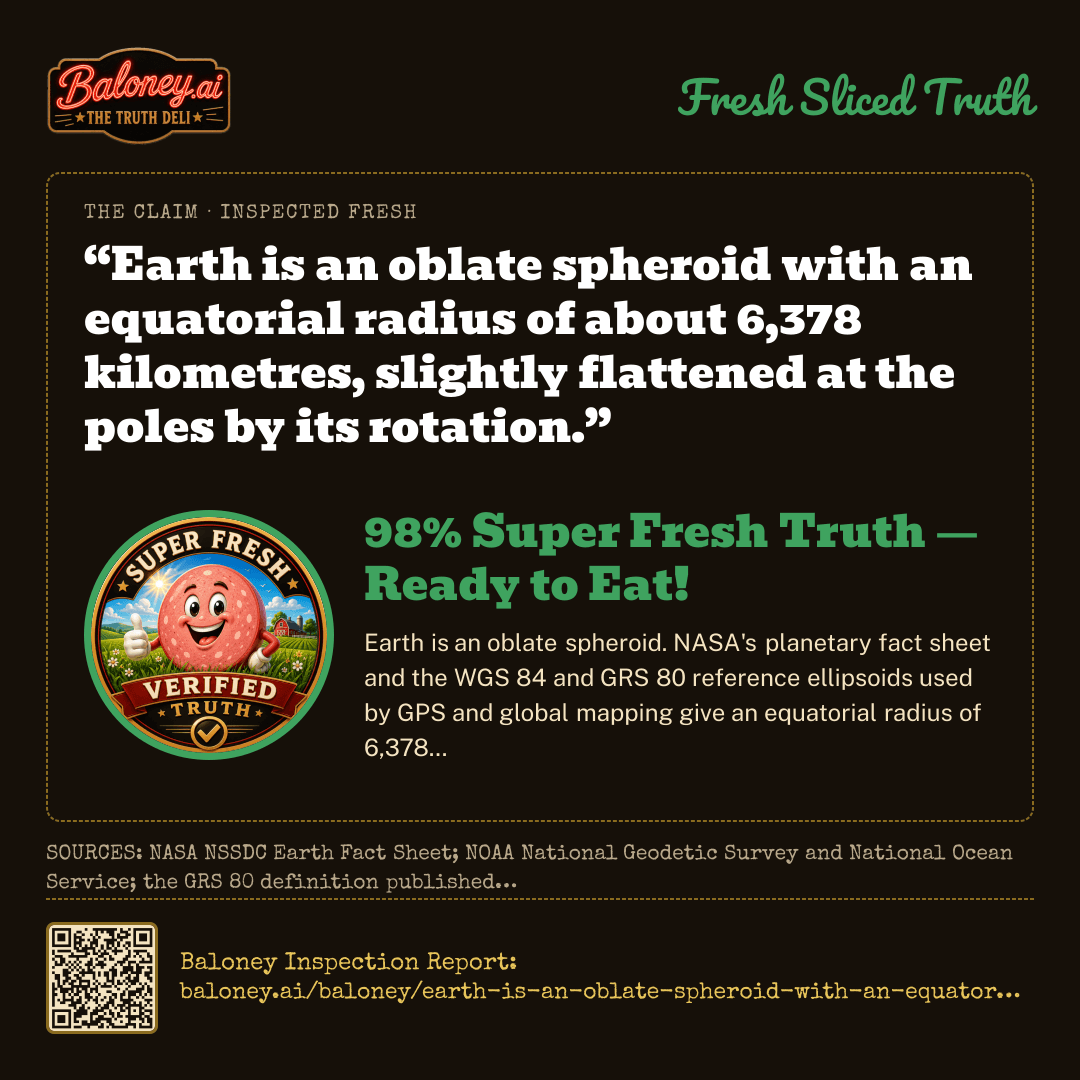
“Earth is an oblate spheroid with an equatorial radius of about 6,378 kilometres, slightly flattened at the poles by its rotation.”98% Super Fresh Truth — Ready to Eat!Verified blind by 5 frontier AIs · Baloney Inspection Report: baloney.ai/baloney/earth-is-an-oblate-spheroid-with-an-equatorial-radius-of