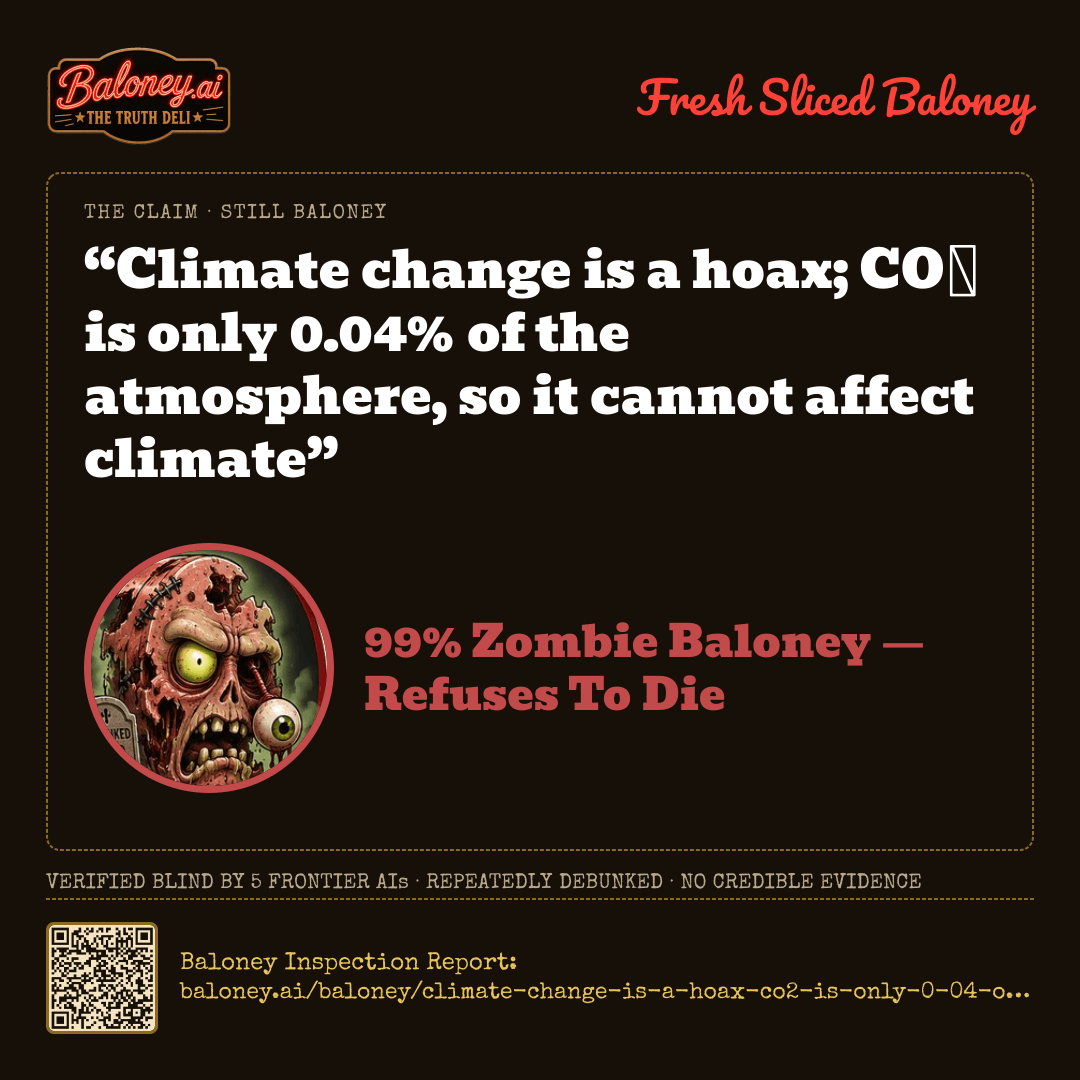
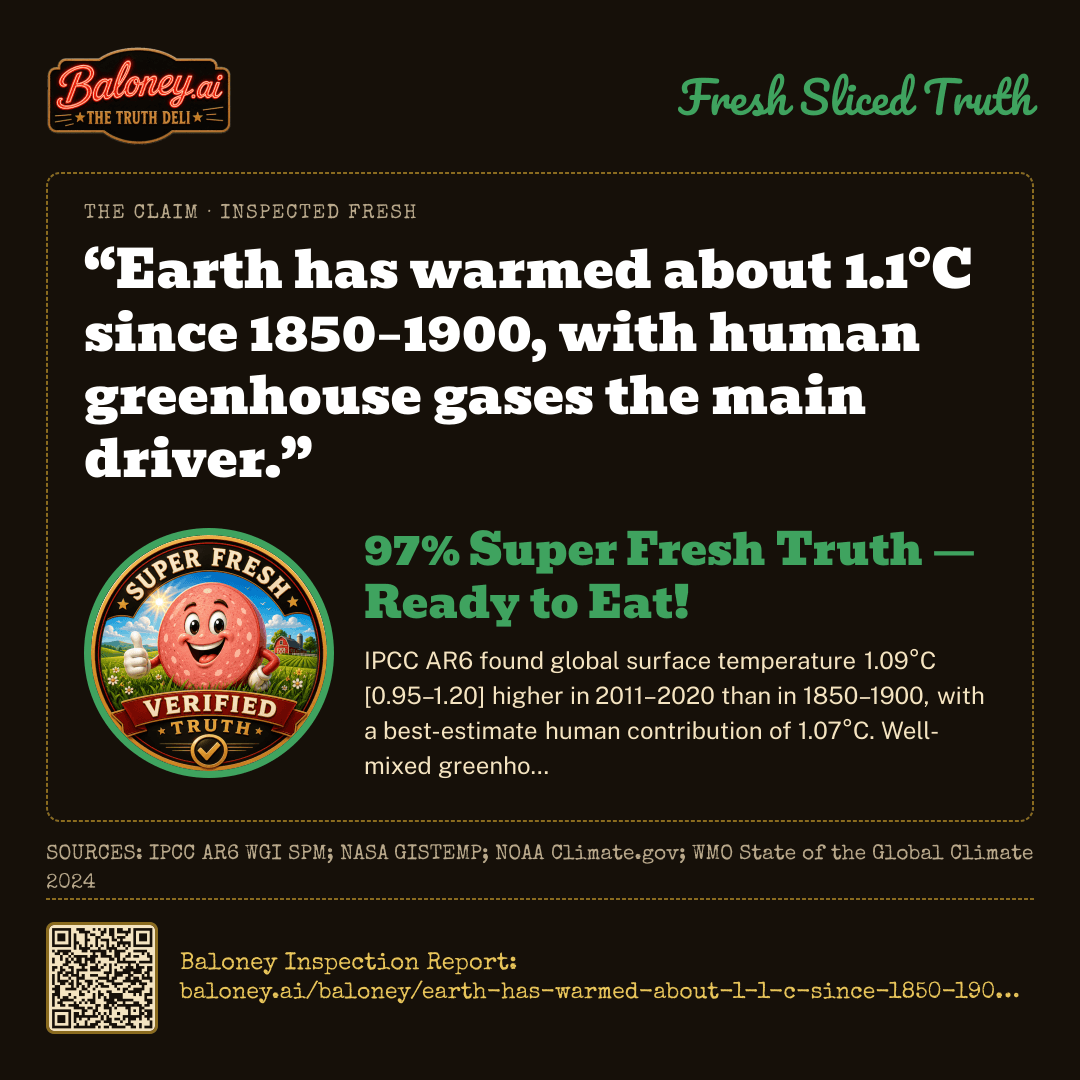
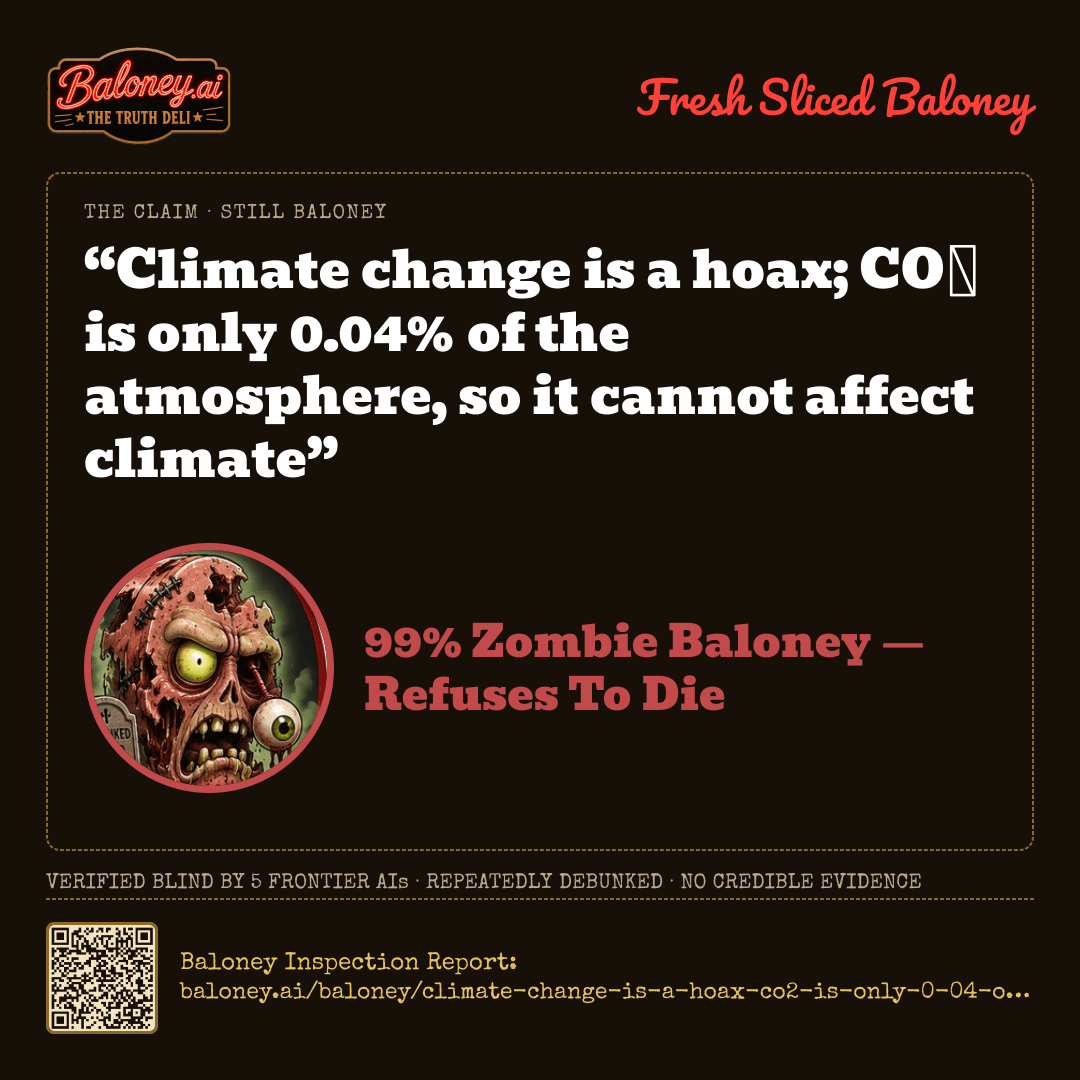
“Climate change is a hoax; CO₂ is only 0.04% of the atmosphere, so it cannot affect climate”99% Zombie Baloney — Refuses To DieVerified blind by 5 frontier AIs · Baloney Inspection Report: baloney.ai/baloney/climate-change-is-a-hoax-co2-is-only-0-04-of-the-atmosphere
The Rating Card
The correction — what is actually true
The Baloney Sampler
The arithmetic is right and the conclusion is wrong. CO₂ really is about 0.04% of the atmosphere — roughly 420 ppm on NOAA's Global Monitoring Laboratory record — and nitrogen and oxygen really do dominate by volume. But the panel found that climatic effect depends on how a molecule absorbs infrared radiation, not on how abundant it is. Nitrogen and oxygen are essentially transparent to outgoing heat; CO₂ absorbs it strongly near 15 micrometres, laboratory physics established by Tyndall in the 1860s and quantified by Arrhenius in 1896.
The 'hoax' half fares worse. NASA records the observed warming, ocean heat gain, sea-level rise and ice loss; the IPCC AR6 Working Group I report calls human influence on the climate unequivocal; Lacis et al. in Science showed that removing CO₂ tips a model Earth into an icebound state. The reports note the rise from about 280 ppm to over 420 ppm carries a fossil-fuel isotopic fingerprint. Trace amounts routinely matter — ozone blocks lethal ultraviolet at far smaller concentrations.
Other ways to slice it — phrasings that might have changed the rating
“Carbon dioxide makes up about 0.04% of the atmosphere by volume.” The reports agree this numerical premise is accurate at roughly 420–425 ppm, and it is the only part of the original statement the panel found supportable.
“CO₂ is not the only influence on climate; solar variability, volcanic aerosols, land-use change, clouds and ocean variability also matter.” One lab noted explicitly that climate is influenced by many factors besides CO₂, so a claim framed this way would not rest on the trace-gas fallacy.
“Water vapour, not CO₂, is the largest single contributor to Earth's natural greenhouse effect.” Two reports acknowledge water vapour's dominant role in the natural greenhouse effect, while Lacis et al. address what happens to it without a CO₂-sustained baseline.
Written from the panel’s reports by Anthropic · claude-opus-5. Nothing here changed the score.
20:26:23SCORING MODEL V2 — MEDIAN OF 5 COUNTED LAB SCORES: 99, 99, 99, 95, 92 → 99. ZOMBIE RULE: THE PRIMARY MASTER FLAGS A LONG DEBUNK HISTORY, THE BLIND MASTER SCORES 99, THE COUNTED MEDIAN IS 99 — PUBLISHED AS 99.✓
20:26:23SOURCE RULE — LABS CITED 32 SOURCES: 0 DISCARDED FOR HAVING NO URL, 0 DISCARDED AS DEAD LINKS (404/410), 4 COULD NOT BE OPENED BY US AND ARE MARKED UNVERIFIED.✓
20:26:23SOURCE RULE — PRIMARY MASTER RULED ON 20 SOURCES: 0 DISCARDED FOR HAVING NO URL, 0 DISCARDED AS DEAD LINKS, 3 MARKED UNVERIFIED, 17 VERIFIED.✓
How This One Was Sliced
Station 1 · Blind Inspection — Five Graders, Zero Peeking
Each lab scored the claim independently, without seeing the others. Open a breakdown for its evidence, its sources, and how sure it was.
Anthropic · EQUAL WEIGHT · 47.6s
claude-opus-5
99%BALONEY
ROUND-1 BREAKDOWN
Evidence offered for the claim
The numerical part of the claim is roughly correct: CO₂ is a trace gas, currently about 420–425 parts per million, i.e. ~0.042% of the atmosphere by volume (NOAA Global Monitoring Laboratory). In 1750 it was ~280 ppm (0.028%).
CO₂ is indeed minor compared with nitrogen (~78%) and oxygen (~21%), and water vapour is the single largest contributor to the natural greenhouse effect — a point sometimes cited to argue CO₂ is unimportant.
That is the entirety of the supportable content. No peer-reviewed evidence supports the inference that a low concentration implies no climatic effect, and no credible body of evidence supports 'climate change is a hoax.'
Evidence against the claim
Concentration is not the same as potency. N₂ and O₂ are symmetric diatomic molecules with no dipole moment change in their vibrational modes, so they are essentially transparent to infrared radiation. CO₂, H₂O, CH₄ and N₂O absorb and re-emit outgoing longwave radiation. The relevant physics is absorption cross-section, not percentage abundance.
Removing CO₂ and other non-condensing greenhouse gases from a model Earth causes the planet to collapse into an icebound state within decades, because water vapour condenses out without the CO₂-sustained baseline warmth (Lacis et al., Science, 2010: CO₂ is the 'principal control knob' of Earth's temperature).
The trace-gas argument proves too much: ozone is ~0.00006% of the atmosphere yet blocks nearly all lethal UV-B; 0.1% blood alcohol is legally incapacitating; a few ppm of cyanide is fatal. Small fractions routinely have large effects.
Humans have raised CO₂ by ~50% since pre-industrial times — a change confirmed as fossil-derived by isotopic fingerprinting (declining ¹³C/¹²C and ¹⁴C-free carbon, the Suess effect) and by the simultaneous decline in atmospheric O₂ consistent with combustion.
Satellites directly measure the predicted effect: increased downwelling longwave radiation at CO₂ absorption wavelengths at the surface, and decreased outgoing longwave radiation to space in those same bands — the observational signature of an enhanced greenhouse effect, not of solar forcing.
The stratosphere is cooling while the troposphere warms. Increased solar output would warm both. This pattern is a specific fingerprint of greenhouse forcing.
The infrared absorption of CO₂ was demonstrated experimentally by John Tyndall in the 1860s and quantified by Arrhenius in 1896; it is 19th-century laboratory physics, not a modern political claim.
The IPCC AR6 Working Group I report (2021) states it is 'unequivocal' that human influence has warmed the atmosphere, ocean and land, with ~1.1°C of warming since 1850–1900 attributable to human activity.
Multiple independent surface temperature records (NASA GISTEMP, NOAA, HadCRUT, Berkeley Earth), plus ocean heat content, sea level rise, ice sheet and glacier mass loss, and Arctic sea ice decline, all agree. A 'hoax' would require independent falsification by competing institutions, governments and private datasets worldwide, including thermometers, satellites, floats and ice cores.
Surveys of the peer-reviewed literature find ~97–99% agreement among publishing climate scientists that recent warming is human-caused; every major national academy of science endorses this position.
The claim is internally incoherent as written: if CO₂ truly 'cannot affect climate,' this would contradict the well-established explanation of past climate changes (glacial–interglacial cycles, the PETM) in which CO₂ acts as a major amplifier or driver.
How sure this lab was
99/100 — the lab’s own confidence in the score above, not a second reading of the claim.
A narrow factual premise is correct: atmospheric CO₂ is a trace gas, currently a little over 420 ppm, or about 0.042% of dry air, according to NOAA measurements.
Climate is influenced by many factors besides CO₂, including solar variability, volcanic aerosols, land-use changes, clouds, aerosols, ocean variability, and feedbacks. That means any claim implying CO₂ is the only climate factor would be incomplete.
The statement’s intuition—that a small atmospheric fraction sounds too small to matter—is a common lay inference, but it is not evidence that CO₂ cannot affect climate; radiative impact depends on infrared absorption properties, not just bulk percentage.
Evidence against the claim
The central conclusion is false: small concentration does not imply small climatic effect. CO₂ absorbs outgoing infrared radiation in specific bands; radiative forcing depends on molecular absorption physics, not on whether the gas is a large percentage of the atmosphere.
Direct atmospheric observations have measured an increase in surface radiative forcing from rising CO₂. Feldman et al. in Nature found observational evidence that CO₂ increases produced measurable changes in downwelling infrared radiation from 2000 to 2010.
CO₂ has risen from about 280 ppm before industrialization to over 420 ppm today, a roughly 50% increase. That change is large relative to its preindustrial level and is primarily due to human fossil-fuel use and land-use change.
The IPCC AR6 concluded it is unequivocal that human influence has warmed the atmosphere, ocean, and land. This directly contradicts the claim that climate change is a hoax.
Multiple independent indicators—global surface temperature rise, ocean heat content increase, glacier and ice-sheet mass loss, sea-level rise, and shifts in extremes—are consistent with greenhouse-gas-driven warming and are not plausibly explained by a hoax.
The claim uses a misleading denominator: nitrogen and oxygen dominate atmospheric volume but are mostly transparent to Earth’s outgoing infrared radiation. Trace gases such as CO₂, methane, and nitrous oxide matter because they interact strongly with infrared radiation.
How sure this lab was
98/100 — the lab’s own confidence in the score above, not a second reading of the claim.
It is factually accurate that carbon dioxide (CO₂) currently makes up approximately 0.04% of the Earth's atmosphere by volume (roughly 420 parts per million).
The vast majority of the Earth's atmosphere is indeed made up of non-greenhouse gases, specifically nitrogen (about 78%) and oxygen (about 21%).
Evidence against the claim
The claim that a trace amount of a substance cannot have a massive impact is a logical fallacy. In many physical and biological systems, small concentrations cause massive effects (e.g., a blood alcohol level of 0.08% causes severe impairment, and trace amounts of ozone protect the Earth from deadly UV radiation).
Unlike nitrogen and oxygen, which are transparent to infrared radiation, CO₂ is a greenhouse gas. Its molecular structure allows it to absorb and re-emit infrared energy, effectively trapping heat that would otherwise escape into space.
Since the Industrial Revolution, human activities have increased atmospheric CO₂ by roughly 50%. This increase has demonstrably altered the Earth's energy balance, leading to a measured increase in global average temperatures.
The assertion that climate change is a 'hoax' is contradicted by over a century of climate physics, massive amounts of observational data (rising sea levels, shrinking ice sheets, warming oceans), and the unanimous consensus of major global scientific institutions.
How sure this lab was
100/100 — the lab’s own confidence in the score above, not a second reading of the claim.
Atmospheric CO₂ is a trace gas, making up approximately 0.04% of the atmosphere by volume.[https://science.nasa.gov/earth/climate-change/greenhouse-gases/the-atmosphere-getting-a-handle-on-carbon-dioxide/]
The claim’s observation that CO₂ is a small fraction of the atmosphere is numerically correct; however, that fact alone does not establish that it cannot affect climate.
The supplied evidence does not support the broader assertion that climate change is a hoax.
Evidence against the claim
CO₂ and other trace gases absorb infrared radiation at specific wavelengths, reducing the rate at which heat escapes to space; NASA states that these gases play major roles in Earth’s greenhouse effect despite their small atmospheric concentration.[https://science.nasa.gov/earth/climate-change/greenhouse-gases/the-atmosphere-getting-a-handle-on-carbon-dioxide/]
The IPCC concludes that human influence has unequivocally warmed the atmosphere, ocean, and land, and identifies increased greenhouse-gas concentrations as the main human driver.[https://www.ipcc.ch/report/ar6/wg1/chapter/summary-for-policymakers/]
The IPCC concludes that the industrial-era increase in atmospheric CO₂ is unequivocally caused by human activities and that human influence is the main driver of many observed changes.[https://www.ipcc.ch/report/ar6/wg1/chapter/technical-summary/]
The IPCC describes greenhouse gases as trapping infrared radiation near Earth’s surface, thereby warming the climate.[https://www.ipcc.ch/report/ar6/wg1/chapter/chapter-3/]
The argument confuses concentration with climatic effect: a gas need not be abundant to have a substantial radiative effect. Water vapor, ozone, methane, and CO₂ are all atmospheric trace gases or minor constituents with important radiative properties.[https://science.nasa.gov/earth/climate-change/greenhouse-gases/the-atmosphere-getting-a-handle-on-carbon-dioxide/]
The statement that climate change is a hoax is contradicted by multiple independent lines of evidence synthesized by the IPCC, including observed warming, atmospheric composition, ocean and land changes, and attribution studies.[https://www.ipcc.ch/report/ar6/syr/longer-report/]
How sure this lab was
98/100 — the lab’s own confidence in the score above, not a second reading of the claim.
Atmospheric CO₂ concentration is approximately 0.04% (~420–424 ppm by volume, or 0.042%), which is a factually correct statement of its mixing ratio.
Nitrogen (~78%) and oxygen (~21%) dominate dry air and do not strongly absorb thermal infrared radiation, a point sometimes invoked to downplay CO₂.
Evidence against the claim
Climate change is not a hoax: multiple independent observational records (surface thermometers, satellites, ocean heat content, ice mass, sea level) show ~1.1–1.2 °C of global warming since the late 19th century, with a clear human fingerprint.
CO₂ is a greenhouse gas whose infrared absorption bands (notably ~15 µm) are well-characterized by laboratory spectroscopy; even at ~0.04% it reduces outgoing longwave radiation, producing a radiative forcing of roughly 2 W/m² from the industrial-era increase, amplified by water-vapor feedback.
Pre-industrial CO₂ was ~280 ppm; the rise to >420 ppm is overwhelmingly from fossil-fuel combustion (confirmed by ¹³C/¹⁴C isotopes and the decline in atmospheric O₂). This increase, together with other GHGs, accounts for the observed warming within the range of climate sensitivity (~3 °C per CO₂ doubling) assessed by IPCC AR6.
Trace concentrations routinely produce large effects (stratospheric ozone at ~0.00001% blocks UV; CFCs at ppt levels depleted ozone). The ‘too small a percentage’ argument is a long-standing, repeatedly refuted fallacy.
Scientific consensus is robust: NASA, NOAA, IPCC, National Academies and 97–99 % of publishing climate scientists conclude that recent climate change is real and primarily anthropogenic.
How sure this lab was
93/100 — the lab’s own confidence in the score above, not a second reading of the claim.
All five evaluators converge on the same structure: the arithmetic premise is right and the conclusion built on it is wrong. CO₂ really is about 0.042% of dry air (~420–425 ppm, NOAA Mauna Loa record), and nitrogen and oxygen really do dominate by volume. Nothing else in the statement survives. The inference from 'small fraction' to 'cannot affect climate' is a category error: radiative effect depends on a molecule's infrared absorption cross-section, not its abundance. N₂ and O₂ are symmetric diatomics with no vibrational dipole change and are essentially transparent to thermal infrared; CO₂ absorbs strongly near 15 µm, which is 19th-century laboratory physics (Tyndall, Arrhenius) rather than a modern political position. Multiple evaluators independently supplied the observational closure: satellite-measured reductions in outgoing longwave radiation in CO₂ bands, directly measured increases in surface downwelling infrared attributable to rising CO₂ (Feldman et al., Nature), stratospheric cooling alongside tropospheric warming — a fingerprint of greenhouse forcing rather than solar forcing — and the isotopic and O₂-decline evidence that the rise from ~280 to >420 ppm is fossil-derived. The 'hoax' half of the statement is the more serious falsehood and is contradicted by independent, institutionally separate datasets (GISTEMP, NOAA, HadCRUT, Berkeley Earth, ocean heat content, sea level, ice mass), which would all have to be coordinated frauds for the claim to hold. I weighted the primary measurement records (NOAA GML, GISTEMP, Berkeley Earth) and the peer-reviewed physics (Lacis et al. 2010, Feldman et al. 2015) most heavily, because they establish the mechanism and the observation independently of any consensus argument; consensus surveys were treated as corroborating rather than load-bearing. Recommended scores ranged 92–99 with high confidence throughout; I take 99 because the statement is not merely wrong but is a specific, named, long-rebutted talking point still in active circulation, with a documented debunk history going back decades.
Unanimous on substance. All five accepted the 0.04% figure as numerically correct (more precisely ~0.042%) and all five rejected the inference and the 'hoax' characterisation. The only divergence was severity: four evaluators placed the claim at 95–99, one at 92, apparently crediting the claim slightly more for its accurate numerical premise. No evaluator offered any evidence supporting the conclusion, and no evaluator dissented on the underlying physics or the attribution.
ZOMBIE FLAG: TRUE — DEBUNK HISTORY ON RECORD
Blind Validation Master · never saw the Primary’s work
sonar-pro
99% BALONEY
The claim contains one narrow, approximately correct premise: CO₂ is about 0.04% of the atmosphere, or roughly 420 ppm. However, the inference that such a small concentration cannot affect climate is false. The reports consistently explain that climatic influence depends on infrared absorption properties, not atmospheric percentage; CO₂ absorbs outgoing infrared radiation and contributes to the greenhouse effect. They also report that atmospheric CO₂ has risen by about 50% from roughly 280 ppm before industrialization to above 420 ppm, with the increase attributable primarily to human activity. Independent observations—including warming of the atmosphere, ocean and land, rising ocean heat and sea levels, ice loss, and measured radiative changes—are presented as consistent with human-caused greenhouse warming. The IPCC evidence cited in the reports concludes that human influence has unequivocally warmed the climate. Thus, the statement is overwhelmingly false as written: its numerical premise is correct, but its central conclusion that climate change is a hoax and that CO₂ cannot affect climate is contradicted by established physics and multiple independent lines of evidence.
AGREEMENT TEST PASSED — BOTH MASTERS SCORED 99% · BLIND VALIDATION CONFIRMED THIS SCORE · NO RE-EVALUATION REQUIRED
Median of 5 counted lab scores: 99, 99, 99, 95, 92 → 99.
Zombie rule: the Primary Master flags a long debunk history, the Blind Master scores 99, the counted median is 99 — published as 99.
The Evidence
Evidence offered for the claim
CO₂ is ~0.04% of the atmosphere Correct as stated. NOAA's Mauna Loa record puts atmospheric CO₂ at roughly 420–425 ppm, about 0.042% of dry air by volume. This is the one accurate element of the claim.
Nitrogen and oxygen dominate the airDEBUNKED — Also correct: nitrogen is ~78% and oxygen ~21% of dry air. But the panel noted that both are symmetric diatomic molecules with no change in dipole moment during vibration, so they are essentially transparent to outgoing infrared radiation and contribute almost nothing to the greenhouse effect. Abundance is the wrong metric.
Therefore CO₂ cannot affect climateDEBUNKED — Refuted. Radiative forcing depends on a gas's infrared absorption bands, not its percentage of the atmosphere. CO₂'s ~15 µm absorption is characterised by laboratory spectroscopy going back to Tyndall in the 1860s and Arrhenius in 1896, and the industrial-era rise produces roughly 2 W/m² of forcing.
Climate has other drivers besides CO₂DEBUNKED — True as far as it goes — solar variability, volcanic aerosols, land use, clouds and ocean variability all matter, and one evaluator flagged this explicitly. But none of these explain the observed pattern, and the claim does not actually make this argument; it asserts CO₂ has no effect at all.
Evidence against the claim
Trace amounts routinely have huge effects Stratospheric ozone is around 0.00001–0.00006% of the atmosphere yet blocks nearly all lethal UV-B; CFCs at parts-per-trillion depleted it; 0.08–0.1% blood alcohol is incapacitating. The 'too small a percentage' argument proves far too much.
The increase is ~50%, and it is ours CO₂ has risen from ~280 ppm pre-industrial to over 420 ppm. Isotopic fingerprinting (declining ¹³C/¹²C, ¹⁴C-free carbon — the Suess effect) and the simultaneous decline in atmospheric O₂ identify fossil-fuel combustion as the source.
The effect has been directly measured Satellites record reduced outgoing longwave radiation in CO₂ absorption bands, and Feldman et al. (Nature, 2015) measured the corresponding increase in downwelling infrared at the surface attributable to rising CO₂ over 2000–2010.
Stratospheric cooling is a greenhouse fingerprint The stratosphere is cooling while the troposphere warms. Increased solar output would warm both layers. This pattern is a specific signature of greenhouse forcing, not of the sun.
CO₂ is the control knob Lacis et al. (Science, 2010) showed that removing CO₂ and other non-condensing greenhouse gases from a model Earth collapses the planet into an icebound state within decades, because water vapour condenses out without the CO₂-sustained baseline warmth.
Warming is observed across independent datasets About 1.1–1.2 °C of warming since 1850–1900 appears in NASA GISTEMP, NOAA, HadCRUT and Berkeley Earth, corroborated by ocean heat content, sea-level rise, glacier and ice-sheet mass loss and Arctic sea-ice decline. A hoax would require coordinated falsification across competing institutions, governments, satellites, thermometers, floats and ice cores.
IPCC AR6: unequivocal The IPCC's Sixth Assessment concludes it is unequivocal that human influence has warmed the atmosphere, ocean and land, and identifies rising greenhouse-gas concentrations as the main human driver.
The consensus is near-total Surveys of the peer-reviewed literature find 97–99% agreement among publishing climate scientists that recent warming is human-caused, and every major national academy of science endorses this position.
The claim is internally incoherent If CO₂ 'cannot affect climate,' the well-established explanation of glacial–interglacial cycles and the PETM — in which CO₂ acts as a major amplifier or driver — would have to be abandoned with nothing to replace it.
Sources · Reliability · Why Accepted or Discounted
ACCEPTED — Advocacy-leaning site, but this specific rebuttal is sourced to the same primary literature the panel cites and was used only for the trace-gas fallacy framing, not for any load-bearing fact.
ACCEPTED — Specialist science journalism with transparent methodology; used for attribution framing, not as a primary source.
Every link was opened when this claim was inspected. A dead link was discarded before publication; “unverified” means the site refused our automated check and the link is the one the panel cited. A source without a URL was never kept.
“Climate change is a hoax; CO₂ is only 0.04% of the atmosphere, so it cannot affect climate”99% Zombie Baloney — Refuses To DieVerified blind by 5 frontier AIs · Baloney Inspection Report: baloney.ai/baloney/climate-change-is-a-hoax-co2-is-only-0-04-of-the-atmosphere
Support The Truth Deli
Buy The Truth Deli Merch
“Democracy Makes America Great”
Veritate Libertas — Latin for “Through Truth, Liberty.”
Democracy is what makes America great. But without truth — honest, real, scientifically validated truth — democracy fails. The baloney slicer is on: feeding fresh sliced truth to protect what makes America great. Democracy.