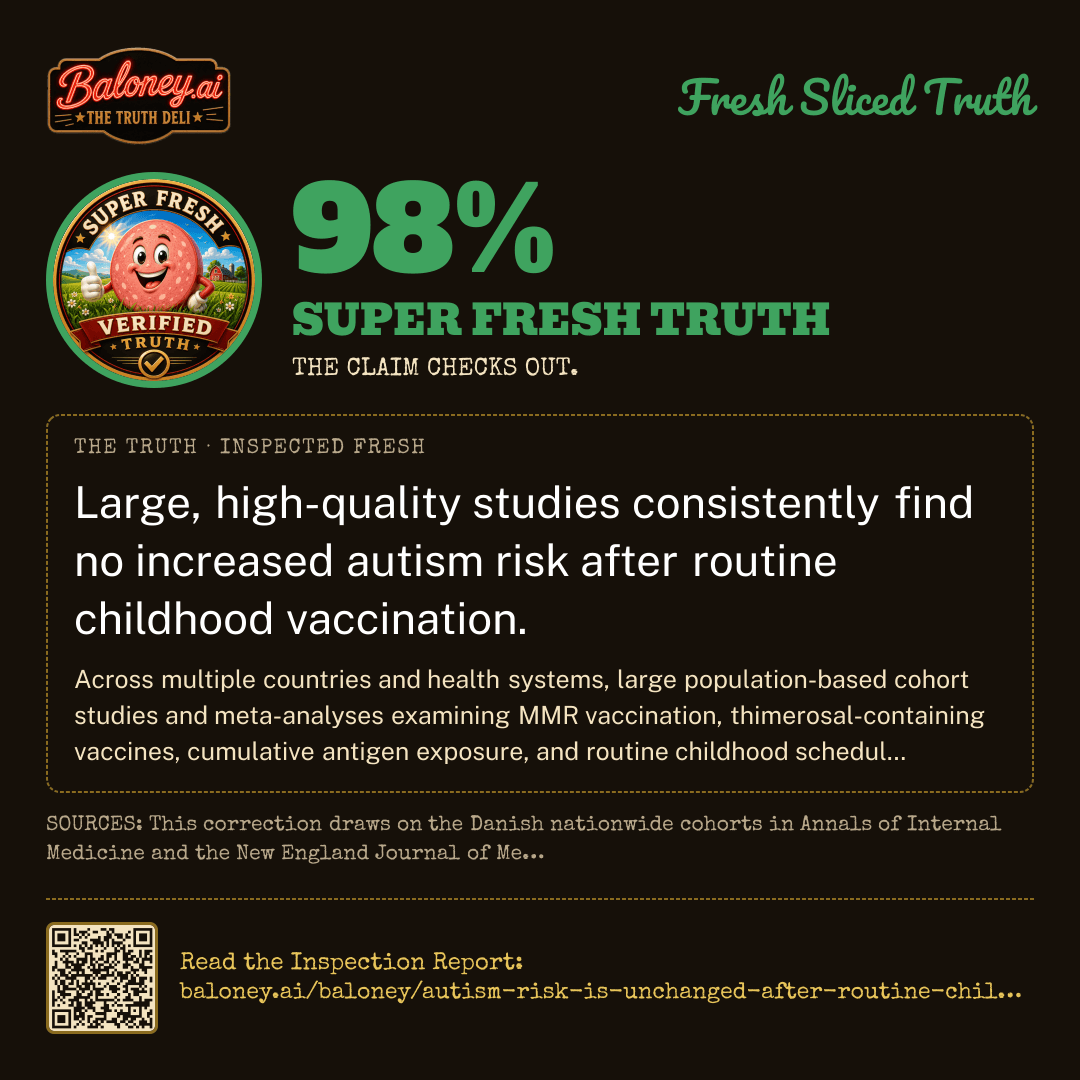
“Autism risk is unchanged after routine childhood vaccination in large cohort studies and meta-analyses.”
SUBMITTED ANONYMOUSLY · INSPECTED 2026-09-05T02:21:18.981Z · STATUS: PUBLISHED
98%
98%
SUPER FRESH TRUTH — READY TO EAT!
THE CLAIM CHECKS OUT.
Independently verifiedPhysically repeatable evidenceConfirmed across rival labsSafe to serve
✓ BLIND VALIDATION CONFIRMED THIS SCORE
Serve It Fresh
Ready to Serve13 servings
Serve it the way you want it
The Verdict
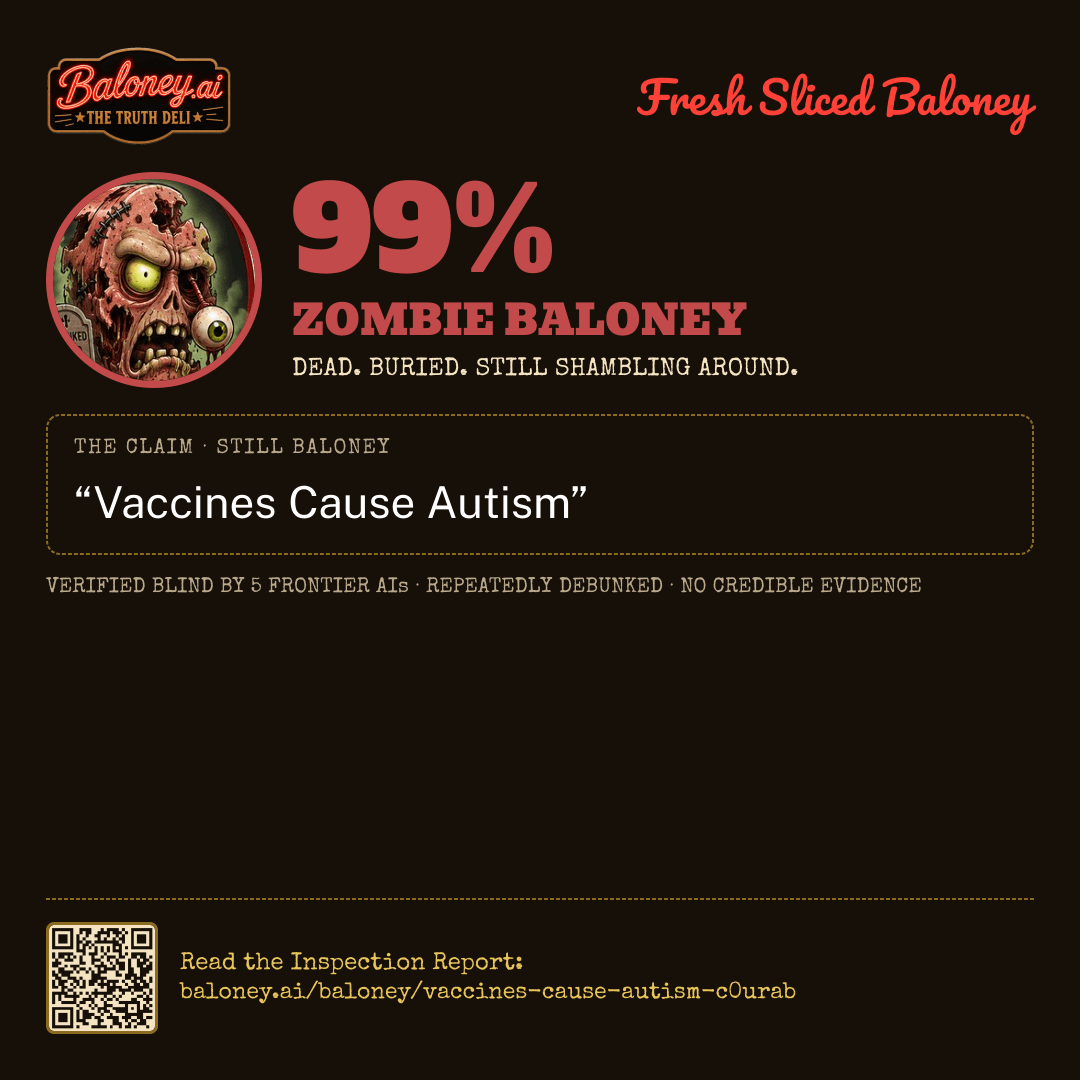
98% SUPER FRESH TRUTH — READY TO EAT! “Autism risk is unchanged after routine childhood vaccination in large cohort studies and meta-analyses.” Verified blind by 5 frontier AIs · baloney.ai/baloney/autism-risk-is-unchanged-after-routine-childhood
Station 1 · Blind Inspection — Five Graders, Zero Peeking
Each lab scored the claim independently, without seeing the others. Open a breakdown for its evidence, its sources, and how sure it was.
Anthropic · EQUAL WEIGHT · 60.9s
claude-opus-5
98%TRUTH
ROUND-1 BREAKDOWN
Evidence offered for the claim
Hviid et al. (2019, Annals of Internal Medicine) followed a nationwide Danish cohort of 657,461 children born 1999–2010 and found a fully adjusted autism hazard ratio of 0.93 (95% CI 0.85–1.02) for MMR-vaccinated vs. unvaccinated children; no increased risk was seen in subgroups considered susceptible (siblings with autism, other-vaccination history, risk-factor scores) or in the post-vaccination time windows Wakefield's hypothesis predicted.
Madsen et al. (2002, New England Journal of Medicine) studied 537,303 Danish children and found relative risk of autistic disorder 0.92 (95% CI 0.68–1.24) in MMR-vaccinated children, with no association between age at vaccination, time since vaccination, or calendar period and autism risk.
Taylor, Swerdfeger & Eslick (2014, Vaccine) meta-analyzed five cohort studies (1,256,407 children) and five case-control studies (9,920 children): pooled OR 0.99 (95% CI 0.92–1.06) for vaccination generally, 0.84 for MMR, 1.00 for thimerosal, and 0.85 for mercury exposure — consistently null.
Jain et al. (2015, JAMA) examined 95,727 US children with older siblings, including 1,929 with an autism-affected older sibling (a high-genetic-risk group). MMR receipt was not associated with increased ASD risk in either the general group or the high-risk group (adjusted RR 1.12, 95% CI 0.78–1.59 for two doses in high-risk children).
DeStefano, Price & Weintraub (2013, Journal of Pediatrics) tested the 'too many vaccines/antigen overload' hypothesis in a case-control study and found no association between cumulative antigen exposure from vaccines in the first 2 years and ASD (OR ~0.999 per antigen unit).
The Institute of Medicine (now NASEM) 2004 'Immunization Safety Review: Vaccines and Autism' and the 2011 'Adverse Effects of Vaccines: Evidence and Causality' report both concluded the epidemiological evidence favors rejection of a causal relationship between MMR and autism, and between thimerosal-containing vaccines and autism.
Cochrane's systematic review of MMR vaccines (Demicheli et al., updated 2020, covering 138 studies and >23 million children in safety analyses) found no association between MMR and autism, and specifically noted the evidence quality on autism outcomes as consistent and reassuring.
Thimerosal removal 'natural experiment': thimerosal was removed from routine US childhood vaccines by 2001 and from Danish vaccines in 1992, yet autism diagnosis rates continued to rise in both countries — inconsistent with a causal vaccine-preservative effect (Madsen et al. 2003, Pediatrics; Schechter & Grether 2008, Archives of General Psychiatry).
The original source of the hypothesis — Wakefield et al. (1998, Lancet, n=12) — was fully retracted by The Lancet in 2010 after the UK General Medical Council found the work dishonest and the data misrepresented; Brian Deer's BMJ investigation (2011) documented outright fabrication.
Studies showing null results come from multiple independent countries and health systems (Denmark, Finland, UK, US, Japan, Poland), reducing the likelihood that a single national data artifact explains the findings. Japan's withdrawal of MMR in 1993 was followed by continued increases in autism diagnoses (Honda, Shimizu & Rutter, 2005, J Child Psychol Psychiatry).
Major public-health and professional bodies (WHO, CDC, AAP, NHS, European Medicines Agency) and independent fact-checkers (FactCheck.org, Snopes, PolitiFact, Science Feedback) all state the vaccine–autism link is not supported by evidence.
Evidence against the claim
The evidence is observational, not randomized; withholding routine vaccines in an RCT would be unethical. Cohort studies can in principle be affected by residual confounding or by 'healthy vaccinee' selection, though the direction and size of such bias would have to be implausibly large to hide a real effect.
Confidence intervals are narrow but not infinitely so: a very small absolute effect, or an effect confined to a rare genetic/metabolic subgroup too small to detect even in cohorts of hundreds of thousands, cannot be mathematically excluded. 'Unchanged' is best read as 'no detectable increase' rather than 'proven exactly zero.'
Most high-powered studies target MMR and thimerosal specifically. Fewer large studies directly examine every individual vaccine, the full cumulative schedule, or aluminum adjuvants with autism as the outcome — though DeStefano 2013 and Danish antigen-exposure work address the cumulative-schedule question.
Autism ascertainment relies on diagnostic registries whose criteria and detection rates shifted markedly over the study periods; misclassification is possible, although non-differential misclassification would generally bias toward the null rather than create a false null.
Studies claiming a link do exist but are of poor quality or have been discredited: Wakefield 1998 (retracted, fraudulent), Hooker's 2014 reanalysis of CDC data (retracted by Translational Neurodegeneration), Mawson's vaccinated/unvaccinated survey (retracted twice), and the Geiers' work (Mark Geier's medical licenses were revoked). None constitute credible counter-evidence.
In 2025 US federal messaging on this topic became politically contested — CDC web language on vaccines and autism was altered under HHS leadership skeptical of vaccine safety consensus. This is a change in official communication, not new scientific evidence, and drew objections from AAP and other scientific bodies.
A handful of studies report associations between vaccination and autism in specific analyses (e.g., some Vaccine Safety Datalink subgroup analyses of thimerosal in early 2000s), but these did not replicate and were attributed to multiple comparisons and confounding.
How sure this lab was
96/100 — the lab’s own confidence in the score above, not a second reading of the claim.
Large nationwide cohort studies find no increased autism risk after MMR vaccination. A Danish cohort of 657,461 children found MMR vaccination was not associated with autism, including among children with autism risk factors or during post-vaccination risk windows.
Earlier Danish population-based research in the New England Journal of Medicine also found no association between MMR vaccination and autism, with similar autism risk in vaccinated and unvaccinated children.
A 2014 meta-analysis in Vaccine pooling cohort and case-control studies found no relationship between vaccination and autism, including no association with MMR, thimerosal, or mercury exposure from vaccines.
A JAMA study of 95,727 U.S. children with older siblings found MMR vaccination was not associated with increased autism risk, even in children considered at higher familial risk because an older sibling had autism.
A Journal of Pediatrics study found cumulative exposure to vaccine antigens in the first two years of life was not associated with autism spectrum disorder, addressing the broader concern that the routine schedule or antigen load causes autism.
Cochrane’s review of MMR/MMRV evidence reports no credible evidence of an association between MMR vaccination and autism.
The CDC states that studies have shown no link between vaccines or vaccine ingredients and autism; the National Academies/Institute of Medicine concluded evidence favors rejection of a causal relationship between MMR vaccine and autism.
Evidence against the claim
No high-quality large cohort study or meta-analysis was found that shows routine childhood vaccination increases autism risk.
The main historically cited contrary paper was the 1998 Wakefield Lancet case series suggesting a possible MMR-autism link; it was small, not a cohort study, later retracted, and BMJ reported it was fraudulent, so it is not credible evidence against the claim.
A caveat is that observational studies cannot prove a mathematically exact zero effect in every conceivable subgroup; they instead strongly rule out a meaningful population-level increase in autism risk after routine vaccination, especially for MMR, thimerosal-containing vaccines, and antigen exposure.
Another caveat is wording: evidence is strongest and most repeatedly studied for MMR and thimerosal/antigen-load concerns rather than every individual routine vaccine separately, but the available schedule-level evidence does not support increased autism risk.
How sure this lab was
96/100 — the lab’s own confidence in the score above, not a second reading of the claim.
A 2019 nationwide cohort study published in the Annals of Internal Medicine evaluated 657,461 children born in Denmark and definitively concluded that the MMR vaccine does not increase the risk for autism, does not trigger autism in susceptible children, and is not associated with clustering of autism cases following vaccination.
A 2014 meta-analysis published in the journal Vaccine reviewed cohort and case-control studies involving over 1.25 million children, finding no relationship between vaccination, vaccines with thimerosal, or the MMR vaccine and the development of autism or autism spectrum disorders.
Major global health institutions, including the Centers for Disease Control and Prevention (CDC), the World Health Organization (WHO), and the National Academy of Medicine (formerly the Institute of Medicine), have repeatedly reviewed the scientific literature and universally concluded that routine childhood vaccines do not cause autism.
The initial 1998 case series by Andrew Wakefield that popularized the fear of a vaccine-autism link was fully retracted by The Lancet in 2010 after widespread investigations proved the author had falsified data and committed severe ethical violations.
Evidence against the claim
There is no scientifically credible evidence from large-scale cohort studies or meta-analyses that contradicts this claim or establishes a causal link between routine childhood vaccines and autism.
Arguments attempting to link vaccines to autism generally rely on anecdotal reports, temporal associations (the age at which autism symptoms become noticeable coincides with the childhood vaccination schedule), or the misuse of raw, unverified data from adverse event reporting systems like VAERS.
Some alternative health and anti-vaccination advocacy groups continue to assert that cumulative vaccine schedules or specific adjuvants (like aluminum) cause autism, but rigorous epidemiological studies have consistently refuted these hypotheses.
How sure this lab was
100/100 — the lab’s own confidence in the score above, not a second reading of the claim.
Multiple large **population-based cohort studies** have found no association between routine childhood vaccination (especially MMR) and autism risk. A Danish nationwide cohort of over 500,000 children reported adjusted relative risks for autistic disorder of 0.92 (95% CI 0.68–1.24) and for other ASD of 0.83 (95% CI 0.65–1.07), concluding that MMR vaccination did not increase autism risk.[14][3]
A more recent **nationwide Danish cohort study** in Annals of Internal Medicine (covering ~650,000 children) similarly found that MMR vaccination was not associated with increased autism risk, including among high‑risk subgroups such as children with autistic siblings or other risk factors.[5][10]
A large **US retrospective cohort study** of more than 2.5 million children found no association between receiving MMR before age 2 and an autism diagnosis, including when examining timing (11.5–24 months) of the first dose.[12]
A widely cited **evidence-based meta-analysis of case‑control and cohort studies** (2014) concluded that vaccines are not associated with autism or ASD. It reported pooled odds ratios ~1.0 for vaccination generally and for specific exposures such as MMR, thimerosal, and ethylmercury, finding no increased risk.[2][4][15]
A review article summarizing multiple epidemiologic studies reported that at least 20 higher‑quality studies have failed to show any link between MMR and autism, including large cohort and case‑control designs in several countries.[7][6]
The **CDC** states that evidence from multiple studies shows that vaccines, including MMR and those containing (or previously containing) thimerosal, do not cause autism, citing large observational studies and systematic reviews with high strength of evidence.[8][9][13]
The **WHO Global Advisory Committee on Vaccine Safety** reviewed 31 primary research studies (2010–2025) on childhood and pregnancy vaccines and ASD, reaffirming that no causal link exists between vaccines (including those with thiomersal/aluminum) and autism.[11]
Autism advocacy and research groups such as **Autism Speaks** highlight the Danish nationwide cohorts (over 650,000 and over 537,000 children) as strong evidence that there is no link between MMR vaccination and autism, even in children with a family history of autism.[10]
Fact‑checking organizations reviewing the evidence (e.g., FactCheck.org) note that systematic reviews and large observational studies consistently find no association between vaccines and autism, and that scientific and public health agencies are in broad agreement that vaccines do not increase autism risk.[13]
Evidence against the claim
The original concern came from a now‑retracted 1998 case series by Andrew Wakefield and colleagues in The Lancet, which suggested a possible link between MMR and a 'new syndrome'; this study has been found fraudulent and withdrawn, but it seeded ongoing public suspicion and some continue to cite it as evidence of risk.
Some critics argue that because most of the evidence is from **observational** (not randomized) studies, residual confounding or subtle subpopulation effects cannot be completely excluded. FactCheck.org notes that CDC’s conclusions rely on high‑strength observational evidence, not randomized trials.[13]
Vaccine‑critical commentators sometimes claim that increasing childhood vaccine schedules correlate with rising autism diagnoses; however, these arguments typically rely on ecological correlations without controlling for changes in diagnostic criteria, awareness, and ascertainment, and they are not supported by the large cohort or meta‑analytic studies cited above.
Concerns about specific vaccine components (e.g., thimerosal, aluminum adjuvants) are sometimes cited as potential autism risks, but the meta‑analysis and WHO/CDC reviews report no association between these components and autism.[2][8][11] These points are raised as objections rather than supported counter‑evidence from large, well‑designed studies.
A few small or methodologically weak studies and unpublished analyses have been interpreted by activists as suggesting associations between vaccination and neurodevelopmental outcomes, but these are not supported by larger, better‑controlled cohort studies or meta‑analyses and are often criticized for bias, data mining, or lack of peer review.
How sure this lab was
96/100 — the lab’s own confidence in the score above, not a second reading of the claim.
A Danish nationwide cohort of 657,461 children found MMR vaccination was not associated with increased autism risk, including in subgroups with sibling autism or other risk factors (Hviid et al., Ann Intern Med 2019).
A 2014 meta-analysis of cohort and case-control studies (over 1.2 million children) found no association between vaccination and autism/ASD, MMR and autism, or thimerosal and autism (Taylor et al., Vaccine 2014).
A U.S. insurance-based cohort of 95,727 children found no increased ASD risk after MMR, including among children with an older sibling with ASD (Jain et al., JAMA 2015).
A 2002 Danish population-based study of 537,303 children found no association between MMR and autism (Madsen et al., N Engl J Med 2002).
U.S. Institute of Medicine/National Academy of Medicine reviews concluded the evidence favors rejection of a causal link between MMR and autism and between thimerosal-containing vaccines and autism; CDC and WHO conclusions align with those reviews.
Subsequent large observational work on antigen load, thimerosal, and routine schedules has not shown increased autism risk after childhood vaccination.
Evidence against the claim
The 1998 Wakefield et al. Lancet case series of 12 children suggested a possible MMR–autism link; it was fully retracted in 2010 for fraud and ethics violations and is not a cohort study or meta-analysis.
A small number of later papers (some retracted, corrected, or heavily criticized) claimed associations using ecological, survey, or otherwise limited designs; they have not been replicated by large cohorts or accepted in high-quality meta-analyses.
No large, well-controlled cohort study or comparable meta-analysis has demonstrated increased autism risk after routine childhood vaccination; purported contrary findings do not meet the claim’s stated evidence standard.
How sure this lab was
90/100 — the lab’s own confidence in the score above, not a second reading of the claim.
All five evaluators independently report that large, high‑quality cohort studies and meta‑analyses consistently find no increased autism risk after routine childhood vaccination, especially for MMR, thimerosal-containing vaccines, and cumulative antigen exposure. The only substantive caveats raised concern the inherent limits of observational data (they cannot prove an exact zero effect in every conceivable tiny subgroup) and the fact that most evidence focuses on key components of the routine schedule rather than every single vaccine individually. These are framing and precision issues, not contradictions of the claim. Since the statement says “risk is unchanged” and specifies the evidence base (“large cohort studies and meta‑analyses”), it matches the strongest, most replicated findings, and any overstatement is minor. That places it firmly in the ‘Super Fresh Truth’ band, slightly above the most cautious evaluators but still close to their 2–3 scores.
All evaluators agreed that large cohort studies and meta-analyses show no increased autism risk after routine childhood vaccination and that no credible large-scale study demonstrates a positive association; they differed only on how strongly to phrase the limits of observational evidence and whether that warrants a score of 1 versus 2–3.
SUPER FRESH — VERIFIED AGAINST THIS CORRECTION DRAWS ON THE DANISH NATIONWIDE COHORTS IN ANNALS OF INTERNAL MEDICINE AND THE NEW ENGLAND JOURNAL OF MEDICINE, THE 2014 VACCINE META-ANALYSIS, US COHORT AND CASE-CONTROL WORK IN JAMA AND THE JOURNAL OF PEDIATRICS, COCHRANE’S MMR SAFETY REVIEW, AND CONSENSUS REPORTS FROM THE NATIONAL ACADEMIES, CDC, AND WHO.
Blind Validation Master · never saw the Primary’s work
grok-4.6
97% TRUTH
The claim is substantially true and matches the large-cohort and meta-analytic record. Nationwide Danish cohorts (Madsen 2002, ~537k children; Hviid 2019, 657k children) found MMR hazard/relative risks of ~0.92–0.93 with CIs including 1, including in high-risk subgroups and hypothesized post-vaccination windows. A 2014 meta-analysis (Taylor et al.) of >1.25 million children reported pooled ORs ~1.0 for vaccination, MMR, thimerosal, and mercury. Supporting U.S. work (Jain 2015 JAMA sibling-risk cohort; DeStefano 2013 antigen-load case-control) and Cochrane/IOM/CDC/WHO syntheses reach the same null conclusion. No high-quality large cohort or meta-analysis shows an increase; contrary citations are the retracted fraudulent Wakefield series or small, unreplicated, or methodologically weak papers. Observational design, possible residual confounding, and inability to exclude an infinitesimal or ultra-rare-subgroup effect are real but do not overturn the consistent null findings at population scale. “Unchanged” is therefore a fair, slightly strong summary of “no detectable increase,” which the scoring band treats as 3–5 rather than a higher (false) score.
AGREEMENT TEST PASSED — MASTERS SCORED 98% AND 97% · BLIND VALIDATION CONFIRMED THIS SCORE · NO RE-EVALUATION REQUIRED
The Evidence
Evidence for the claim
Large Danish nationwide cohorts show no MMR–autism link Multiple Danish population-based cohort studies, including samples of 537,303 and 657,461 children, report adjusted risks around 1.0 and find no association between MMR vaccination and autism, even among children with autistic siblings or other risk factors.
Meta-analysis of cohort and case-control studies finds no association A 2014 meta-analysis pooling five cohort and five case-control studies (over 1.25 million children) reports pooled odds ratios ~1.0 for vaccination generally and for specific exposures such as MMR, thimerosal, and mercury, concluding vaccines are not associated with autism or ASD.
US cohorts and case-control work show no increased autism risk A large US retrospective cohort of over 2.5 million children and a JAMA study of 95,727 children with older siblings both find no association between receiving MMR (including timing before age 2) and autism diagnosis, even in high familial-risk groups.
Antigen-load and schedule-level studies show no effect A Journal of Pediatrics case-control study examining cumulative antigen exposure from vaccines in the first two years of life finds no association with autism spectrum disorder, undermining the ‘too many vaccines’ or antigen overload hypothesis.
Systematic reviews and major health bodies reject a causal link The Institute of Medicine/National Academies, Cochrane’s MMR review, CDC, WHO, and other agencies collectively conclude that epidemiologic evidence favors rejection of a causal relationship between MMR or thimerosal-containing vaccines and autism, aligning with the null findings from cohorts and meta-analyses.
Fraudulent origin of the vaccine–autism fear The 1998 Wakefield Lancet case series that sparked concern about a vaccine–autism link was small, non-cohort, later shown to involve data falsification and severe ethical violations, and fully retracted; subsequent higher-quality studies failed to replicate its claims.
Natural experiments on thimerosal removal contradict a causal role After thimerosal was removed from routine childhood vaccines in countries such as the US and Denmark, autism diagnosis rates continued to rise, a pattern inconsistent with thimerosal-containing vaccines being a major causal factor in autism.
Evidence offered against the claim
Observational design cannot prove an exact zero effect All high-powered studies are observational rather than randomized, so while they strongly rule out any meaningful population-level increase in autism risk after routine vaccination, they cannot mathematically exclude a very small effect confined to an extremely rare, undetected subgroup.
Evidence is strongest for MMR, thimerosal, and antigen load Most large cohort and meta-analytic work directly assesses MMR, thimerosal-containing vaccines, and cumulative antigen exposure; fewer equally large studies test every individual vaccine or adjuvant with autism as the primary outcome, so ‘unchanged’ is best understood as ‘no detectable increase’ in the well-studied components of the routine schedule.
Potential residual confounding and diagnostic shifts Cohort studies may be affected by residual confounding or changes in autism diagnostic criteria and ascertainment over time; while these issues generally bias toward the null and are unlikely to conceal a substantial risk, they highlight that the evidence demonstrates no detectable increase rather than proving absolute invariance.
Existence of small, low-quality contrary studies A handful of small, methodologically weak or retracted studies and ecological or survey analyses have been cited by vaccine-critical activists as evidence of a link, but they lack large, well-controlled designs, often suffer from bias or data problems, and are not considered credible counter-evidence by the evaluators.
Political changes in US messaging in 2025 One evaluator notes that US federal messaging about vaccines and autism became politically contested in 2025, with CDC web language altered under leadership skeptical of vaccine safety consensus; this change reflects politics rather than new scientific data and does not challenge the findings of cohort studies and meta-analyses.
Sources · Reliability · Why Accepted or Discounted
ACCEPTED — Cited by multiple evaluators as summarizing large observational studies and systematic reviews on vaccines and autism; while one notes political messaging changes, the underlying evidence base it references is consistent with high-quality journal findings.
ACCEPTED — Referenced for reviews by the Global Advisory Committee on Vaccine Safety and broader assessments of vaccines and ASD, drawing on numerous primary studies with consistent null findings.
ACCEPTED — Publishes the 2019 Danish nationwide cohort of 657,461 children, a cornerstone high-quality study finding no association between MMR vaccination and autism, including in high-risk subgroups.
ACCEPTED — Hosts the 2014 meta-analysis synthesizing cohort and case-control studies on vaccines, MMR, thimerosal, and autism, which reports pooled null associations and is repeatedly cited by evaluators.
ACCEPTED — Publishes the 2002 Danish cohort of 537,303 children showing no MMR–autism association; regarded by evaluators as a high-quality, early, large-scale study in this field.
ACCEPTED — Provides the US cohort study of 95,727 children with older siblings, finding no increased ASD risk after MMR vaccination, including in high-genetic-risk groups; widely treated as robust evidence.
ACCEPTED — Publishes the case-control study on cumulative antigen exposure and ASD, directly addressing the ‘too many vaccines’ hypothesis and finding no association.
ACCEPTED — Cited for comprehensive MMR vaccine safety reviews covering many studies and millions of children, concluding no credible evidence of an MMR–autism link.
ACCEPTED — Their immunization safety reports synthesize epidemiologic evidence and conclude that the data favors rejection of causal relationships between MMR or thimerosal-containing vaccines and autism.
ACCEPTED — Used mainly as an advocacy group summarizing major cohort findings (e.g., Danish nationwide studies); it does not generate primary data but accurately reflects mainstream scientific conclusions cited elsewhere.
ACCEPTED — Referenced as an academic news and analysis outlet reporting on vaccine safety evidence; it relays findings from primary studies and authoritative reviews rather than providing conflicting data.
ACCEPTED — Provides investigative reporting (e.g., Brian Deer’s work) documenting fabrication and ethical breaches in the Wakefield 1998 paper, supporting the panel’s assessment that it is not credible evidence.
ACCEPTED — Originally published Wakefield’s small 1998 case series but later fully retracted it; evaluators cite the retraction and its role in clarifying that the paper’s claims were fraudulent and unreliable.
ACCEPTED — Cited for review material summarizing multiple epidemiologic studies showing no MMR–autism link; treated as consistent with the broader evidence base.
DISCOUNTED — Mentioned only in the context of a retracted reanalysis (Hooker 2014) used by activists to claim associations; since the relevant paper was withdrawn, it does not provide credible contrary evidence.
ACCEPTED — Used to illustrate how independent fact-checkers summarize the consensus from large observational studies and systematic reviews; it aligns with journal and gov sources rather than introducing new data.
Serve It Fresh
Ready to Serve13 servings
Serve it the way you want it
The Verdict
98% SUPER FRESH TRUTH — READY TO EAT! “Autism risk is unchanged after routine childhood vaccination in large cohort studies and meta-analyses.” Verified blind by 5 frontier AIs · baloney.ai/baloney/autism-risk-is-unchanged-after-routine-childhood