





INSPECTION REPORT · CLAIM #1002 · baloney.ai/baloney/vaccines-cause-autism-c0urab

Vaccines Cause Autism

SUBMITTED ANONYMOUSLY · INSPECTED 2026-09-03T08:31:38.635Z · STATUS: PUBLISHED

Zombie Baloney99%
99%
ZOMBIE BALONEY — REFUSES TO DIE
DEAD. BURIED. STILL SHAMBLING AROUND.
Repeatedly debunkedNo credible evidenceRefuses to dieLives on in delusion
Super Fresh Truth
Fishy Baloney
Stinky Baloney
Rotting Baloney
Radioactive Baloney
Zombie Baloney

✓ BLIND VALIDATION CONFIRMED THIS SCORE

Serve It Fresh

Ready to Serve14 servings

Serve it the way you want it

The Verdict

99% ZOMBIE BALONEYREFUSES TO DIE
Vaccines Cause Autism
Verified blind by 5 frontier AIs · baloney.ai/baloney/vaccines-cause-autism-c0urab

The Rating Card

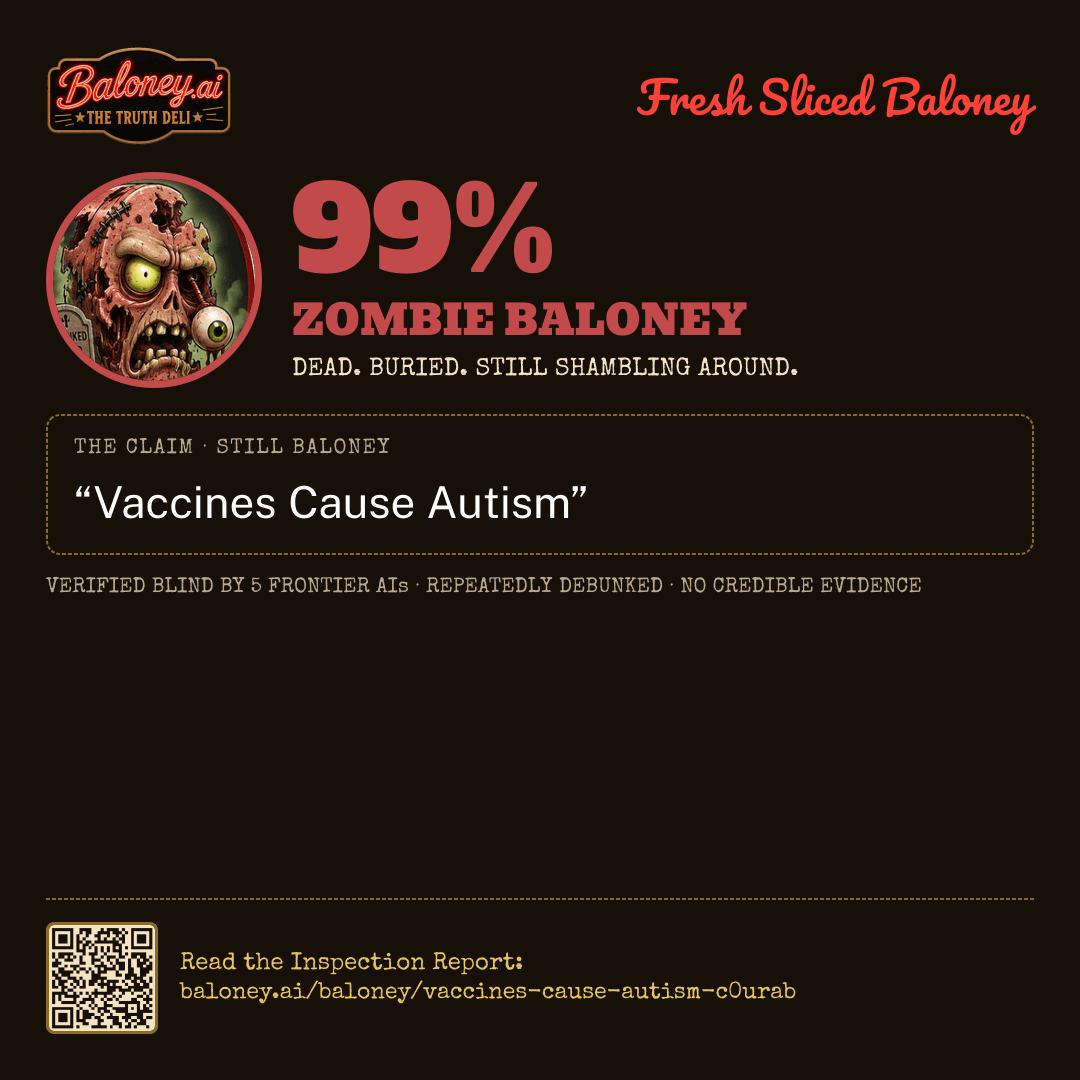
99% Zombie Baloney card for this claim

The Order Ticket

08:31:38CLAIM RECEIVED — QUEUED FOR INSPECTION
08:32:32claude-opus-5 REPORTED — SCORE 99, CONFIDENCE 97
08:32:16gpt-5.5 REPORTED — SCORE 99, CONFIDENCE 99
08:32:05gemini-3.1-pro-preview REPORTED — SCORE 99, CONFIDENCE 100
08:32:06sonar-pro REPORTED — SCORE 97, CONFIDENCE 98
08:33:03grok-4.6 REPORTED — SCORE 97, CONFIDENCE 96
08:34:59PRIMARY MASTER CLAUDE — SCORE 99
08:33:08BLIND VALIDATION PERPLEXITY — SCORE 99
08:34:59AGREEMENT CONFIRMED — DELTA 0

How This One Was Sliced

Station 1 · Blind Inspection — Five Graders, Zero Peeking

Each lab scored the claim independently, without seeing the others. Open a breakdown for its evidence, its sources, and how sure it was.

Anthropic · EQUAL WEIGHT · 54.1s

claude-opus-5

99%BALONEY

ROUND-1 BREAKDOWN
Evidence offered for the claim
  • Andrew Wakefield's 1998 Lancet case series of 12 children reported a temporal association between MMR vaccination and onset of behavioral regression plus bowel symptoms; this is the origin of the claim, but the paper was fully retracted in 2010 after investigation found the data were falsified and the study was ethically improper.
  • Parental reports frequently note that autism signs become apparent around 12-24 months of age, which overlaps with the MMR and other childhood vaccine schedules — a real temporal coincidence that can be mistaken for causation.
  • Passive surveillance systems (e.g., VAERS in the US) contain thousands of self-submitted reports linking vaccines to autism; VAERS is unverified and explicitly cannot establish causation, so these are hypothesis-generating anecdotes only.
  • The 2008 Hannah Poling case, in which the US Vaccine Injury Compensation Program conceded a claim involving a child with a pre-existing mitochondrial disorder whose 'autism-like' features worsened after vaccination, is widely cited as an admission; the government's concession was for aggravation of an underlying metabolic disorder, not for causing autism.
  • Mechanistic hypotheses have been proposed (thimerosal-related mercury exposure, aluminum adjuvants, immune activation, 'too many too soon' antigen load). These are biologically arguable a priori but have failed empirical testing.
  • Some small or methodologically weak studies (e.g., ecological analyses of autism prevalence trends, Geier & Geier VAERS analyses, Hooker's reanalysis of CDC data) have claimed associations; these have been criticized for confounding, selective analysis, or conflicts of interest, and at least one was retracted.
Evidence against the claim
  • Madsen et al. (NEJM 2002) followed all 537,303 children born in Denmark 1991-1998 and found no difference in autism risk between MMR-vaccinated and unvaccinated children (adjusted RR ~0.92 for autistic disorder).
  • Hviid et al. (Annals of Internal Medicine 2019) studied 657,461 Danish children and found no increased autism risk after MMR (HR 0.93), including no increased risk in subgroups with autism risk factors, sibling history of autism, or in the period immediately following vaccination.
  • Taylor et al. (Vaccine 2014) meta-analyzed five cohort studies (1,256,407 children) and five case-control studies (9,920 children) and found no relationship between vaccination and autism, nor between thimerosal or mercury exposure and autism.
  • Jain et al. (JAMA 2015) examined 95,727 US children, including 1,929 with an older sibling with autism (a high-risk group), and found no association between MMR and autism even among genetically higher-risk children.
  • DeStefano et al. (Journal of Pediatrics 2013) found no association between cumulative vaccine antigen exposure in the first two years of life and autism, directly testing the 'too many too soon' hypothesis.
  • The Institute of Medicine (now National Academy of Medicine) reviewed the entire literature in 2004 and again in 2011 (Adverse Effects of Vaccines: Evidence and Causality) and concluded the evidence favors rejection of a causal relationship between MMR and autism.
  • Thimerosal was removed from routine US childhood vaccines by 2001 and from many other countries' schedules earlier; autism diagnoses continued to rise rather than fall, contradicting the mercury hypothesis. MMR has never contained thimerosal (it is a live-virus vaccine).
  • Wakefield's paper was retracted by The Lancet in 2010, and the UK General Medical Council struck him from the medical register for dishonesty and unethical conduct. Investigative reporting by Brian Deer in the BMJ documented that patient records were altered and that Wakefield had undisclosed financial interests in litigation and a rival vaccine product.
  • Prospective studies of infant siblings show differences in gaze, motor, and social behavior detectable before 12 months, and neuroimaging/genetic evidence points to prenatal and early-infancy brain development; hundreds of autism-associated genes have been identified, and twin heritability estimates are roughly 60-90%.
  • The rise in measured autism prevalence is largely accounted for by broadened diagnostic criteria (DSM changes, inclusion of Asperger's/PDD-NOS, then ASD spectrum), diagnostic substitution away from intellectual disability, increased screening, and service-access incentives.
  • Natural experiments support the null: MMR uptake in Japan was discontinued in 1993, yet autism prevalence in Yokohama continued rising (Honda, Shimizu & Rutter, 2005), demonstrating autism rates rise independently of MMR use.
  • Real-world consequences of the claim are documented: measles resurgence and outbreaks in under-vaccinated communities (e.g., Wales 2013, New York 2018-19, Samoa 2019, US 2025), indicating the harm side of the ledger is well established while the claimed benefit is not.
How sure this lab was

97/100 — the lab’s own confidence in the score above, not a second reading of the claim.

Sources

New England Journal of Medicine (Madsen et al. 2002)journal · 97 · Annals of Internal Medicine (Hviid et al. 2019)journal · 97 · Vaccine (Taylor, Swerdfeger & Eslick 2014 meta-analysis), via PubMed/NLMjournal · 95 · JAMA (Jain et al. 2015)journal · 96 · The Lancet — Retraction of Wakefield et al. (2010)journal · 97 · BMJ — Brian Deer, 'How the case against the MMR vaccine was fixed'journal · 93 · Institute of Medicine, 'Adverse Effects of Vaccines: Evidence and Causality' (2011), via NCBI Bookshelfgov · 96 · US Centers for Disease Control and Prevention — Autism and Vaccinesgov · 85 · World Health Organization — Autism fact sheetgov · 92 · UK National Health Service — MMR vaccinegov · 90 · College of Physicians of Philadelphia — History of Vaccinesedu · 88 · FactCheck.org SciCheck (repeated coverage debunking vaccine-autism claims)factcheck · 88

OpenAI · EQUAL WEIGHT · 38.1s

gpt-5.5

99%BALONEY

ROUND-1 BREAKDOWN
Evidence offered for the claim
  • The main published 'evidence' historically cited for the claim was Wakefield et al.'s 1998 Lancet case series of 12 children, which reported parental accounts of developmental regression after MMR vaccination. This was only a small uncontrolled case series, could not establish causation, and was later fully retracted.
  • Some adverse-event reports and parental anecdotes describe autism symptoms being noticed after vaccination, but passive reporting systems such as VAERS are explicitly not designed to prove causality; timing alone is weak evidence because autism signs commonly emerge around the same ages that routine vaccines are given.
  • A theoretical concern was raised about thimerosal, an ethylmercury-containing preservative formerly used in some childhood vaccines, because mercury can be neurotoxic at sufficient doses. However, this was a hypothesis rather than evidence that vaccines cause autism, and later population studies did not support it.
Evidence against the claim
  • Large epidemiologic studies find no association between MMR vaccination and autism. A 2019 Danish nationwide cohort study of 657,461 children found MMR vaccination did not increase autism risk, including among children considered higher-risk.
  • A 2014 meta-analysis covering more than 1.2 million children found no relationship between vaccination, MMR, thimerosal, or mercury exposure and autism or autism spectrum disorder.
  • The Institute of Medicine/National Academies reviewed the evidence and concluded that the evidence favors rejection of a causal relationship between MMR vaccine and autism and between thimerosal-containing vaccines and autism.
  • Thimerosal was removed or reduced to trace amounts in nearly all U.S. childhood vaccines by 2001, yet autism diagnoses did not fall afterward; this pattern argues strongly against thimerosal as a cause of autism.
  • The original Wakefield MMR-autism paper was retracted, and BMJ investigations reported undisclosed conflicts of interest and data irregularities/fraud, substantially undermining the central source of the vaccine-autism claim.
  • CDC, FDA, and other public-health agencies state that credible scientific evidence does not show vaccines or vaccine ingredients cause autism.
How sure this lab was

99/100 — the lab’s own confidence in the score above, not a second reading of the claim.

Sources

The Lancet / PubMedjournal · 5 · The Lancet / PubMed retraction noticejournal · 95 · BMJjournal · 95 · Annals of Internal Medicine / PubMedjournal · 95 · Vaccine / PubMedjournal · 90 · Archives of General Psychiatry / PubMedjournal · 90 · National Academies Press / Institute of Medicineedu · 95 · Centers for Disease Control and Preventiongov · 95 · U.S. Food and Drug Administrationgov · 95 · VAERS / HHSgov · 90

Google · EQUAL WEIGHT · 26.9s

gemini-3.1-pro-preview

99%BALONEY

ROUND-1 BREAKDOWN
Evidence offered for the claim
  • In 1998, a paper published in the medical journal The Lancet by Andrew Wakefield hypothesized a link between the MMR vaccine and autism. (Note: This paper was later discovered to be deeply fraudulent and was fully retracted).
  • Some parents observe and report the onset of autism symptoms around the same time their children receive routine childhood vaccinations, creating a strong but non-causal temporal correlation.
  • Concerns were historically raised by advocacy groups regarding thimerosal, a mercury-containing preservative previously used in some vaccines. (Note: Thimerosal has since been removed from routine childhood vaccines, but autism diagnosis rates did not drop, further disproving the link).
Evidence against the claim
  • A massive 2014 meta-analysis of case-control and cohort studies involving over 1.25 million children found no relationship between vaccination (including the MMR vaccine) and autism or autism spectrum disorders.
  • The original 1998 Wakefield study was retracted by The Lancet in 2010 after investigations proved it contained falsified data, undisclosed financial conflicts of interest, and severe ethical violations.
  • Extensive epidemiological research into thimerosal-containing vaccines has shown no link to autism. Furthermore, autism rates continued to climb after thimerosal was removed from childhood vaccines in 2001.
  • The Centers for Disease Control and Prevention (CDC), World Health Organization (WHO), American Academy of Pediatrics (AAP), and National Academy of Medicine have all definitively concluded that vaccines do not cause autism based on decades of rigorous safety data.
How sure this lab was

100/100 — the lab’s own confidence in the score above, not a second reading of the claim.

Sources

Centers for Disease Control and Preventiongov · 98 · Vaccine (Journal) / National Institutes of Healthjournal · 95 · The Lancet / National Institutes of Healthjournal · 98

Perplexity · EQUAL WEIGHT · 28.2s

sonar-pro

97%BALONEY

ROUND-1 BREAKDOWN
Evidence offered for the claim
  • A 1998 case series by Andrew Wakefield and colleagues in The Lancet reported gastrointestinal symptoms and behavioral regression in 12 children and speculated about a link between the MMR (measles–mumps–rubella) vaccine, intestinal inflammation, and autism-like symptoms; this paper was widely cited by vaccine–autism proponents before its retraction.[8][11][14]
  • The U.S. CDC’s current autism-and-vaccines webpage (revised under political pressure) states that the claim vaccines do not cause autism is not an evidence‑based claim because existing studies have not ruled out the possibility that infant vaccines cause autism, and notes that there are no studies that specifically show the 20 doses of seven infant vaccines in the first year of life do not cause autism.[10][13]
  • Some government communications now acknowledge that, in a strict philosophical sense, science rarely proves a universal negative (that something never happens), which vaccine–autism advocates frame as support for their claim by arguing that the absence of absolute disproof leaves open the possibility that vaccines cause autism in some cases.[10][13]
  • Persistent public and political debates, including repeated claims by high‑profile vaccine critics and some politicians, are sometimes cited by supporters of the claim as evidence that the question remains unsettled, despite the scientific consensus to the contrary.[2][3][6][9][13][15]
Evidence against the claim
  • The original 1998 Lancet paper suggesting an MMR–autism link was fully retracted by The Lancet in 2010 after investigations found ethical violations, selective (not consecutive) sampling, and scientific misrepresentation; major medical journals and professional bodies emphasize that the study is fatally flawed and should not be used as evidence that vaccines cause autism.[2][5][8][11][14]
  • Multiple large, well‑designed epidemiological studies over more than two decades have consistently found no association between the MMR vaccine and autism, and no peer‑reviewed epidemiologic studies have shown that routine childhood vaccines cause autism.[2][8][9][12][14][15]
  • Reviews by expert bodies (e.g., Institute of Medicine/National Academies and other scientific panels) have concluded that available evidence does not support a causal relationship between childhood vaccines and autism; fact‑checking organizations summarize that decades of credible research have not linked vaccines to autism.[2][3][6][9][12][15]
  • A comprehensive review in a peer‑reviewed medical journal describes the autism–vaccine connection as a myth and notes that among all proposed environmental causes of autism, vaccines are among the most extensively studied, with the data demonstrating no link between vaccination and autism spectrum disorder.[12]
  • Professional medical and infectious disease organizations state that decades of rigorous research have proven that vaccines do not cause autism and warn that misinformation about vaccines and autism contributes to vaccine hesitancy and outbreaks of preventable diseases like measles.[1][4][12][14]
  • Fact‑checking outlets report that every single rigorous study examining vaccines and autism finds no association, and they repeatedly rate claims that vaccines cause autism as false or worse; they also document that common talking points (e.g., that children get too many vaccines at once causing autism) are not supported by evidence.[3][6][9][15]
  • Public health reporting notes that more than 20 studies have shown no association between MMR vaccination and autism, and that no peer‑reviewed studies have provided corroborating evidence for an autism–vaccine link despite extensive investigation.[2][8][12][14]
  • Independent analyses of the Wakefield case detail serious conflicts of interest (including undisclosed legal funding), non‑standard and invasive procedures without appropriate ethical approval, and data irregularities, undermining the only historically prominent clinical report that appeared to support a vaccine–autism link.[8][11][14]
How sure this lab was

98/100 — the lab’s own confidence in the score above, not a second reading of the claim.

Sources

National Institutes of Health / Indian Journal of Psychiatry (Rao 2011, The MMR vaccine and autism: Sensation, refutation, retraction)journal · 95 · The BMJ (British Medical Journal)journal · 97 · Canadian Medical Association Journaljournal · 95 · National Institutes of Health / Frontiers in Neurology (Gabis 2021, The myth of vaccination and autism spectrum)journal · 94 · Centers for Disease Control and Prevention (CDC)gov · 85 · FactCheck.orgfactcheck · 92 · FactCheck.orgfactcheck · 92 · PolitiFactfactcheck · 90 · PBS NewsHournews · 90 · PBS NewsHournews · 90 · NPRnews · 92 · Autism Science Foundationother · 88

xAI · EQUAL WEIGHT · 84.7s

grok-4.6

97%BALONEY

ROUND-1 BREAKDOWN
Evidence offered for the claim
  • A 1998 Lancet case series of 12 children (Wakefield et al.) reported ileal lymphoid hyperplasia, colitis, and developmental regression after MMR and hypothesized a link; the paper was fully retracted in 2010.
  • Anecdotal parental reports that autism symptoms were first noticed around the age of routine childhood vaccinations, creating an apparent temporal association.
  • A small number of later ecological, case-series, or methodologically weak studies (including some involving thimerosal or purported CDC data) claimed associations; these failed independent replication.
  • Hypothesis that vaccine ingredients (e.g., thimerosal/ethylmercury historically, or immune stimulation) could trigger autism in susceptible children.
Evidence against the claim
  • Multiple large cohort and case-control studies (including a Danish nationwide cohort of 657,461 children) found no increased autism risk after MMR, including among siblings of children with autism.
  • A 2014 meta-analysis of 10 studies covering >1.2 million children found no association between vaccination and autism/ASD.
  • Autism diagnosis rates continued rising after thimerosal was removed from most U.S. childhood vaccines (early 2000s), undermining the mercury hypothesis.
  • Institute of Medicine/National Academy of Medicine reviews, Cochrane reviews, CDC, WHO, and AAP have repeatedly concluded there is no causal relationship.
  • The 1998 Wakefield paper was retracted for fraud, ethical violations, and undisclosed conflicts; Wakefield lost his medical license. Autism has a strong prenatal/genetic basis inconsistent with postnatal vaccine causation.
How sure this lab was

96/100 — the lab’s own confidence in the score above, not a second reading of the claim.

Sources

The Lancetjournal · 92 · Centers for Disease Control and Preventiongov · 95 · Annals of Internal Medicinejournal · 95 · Vaccinejournal · 90 · National Academies of Sciences, Engineering, and Medicineother · 94 · FactCheck.orgfactcheck · 88

Station 2 · The Masters

Primary Master · drawn at random

claude-opus-5

99% BALONEY

All five evaluators converged on the same verdict from largely independent evidence bases, and the weight of that evidence is about as one-sided as epidemiology ever gets. I weighted three classes of evidence most heavily. First, large prospective and registry-based cohort studies with essentially complete population ascertainment: Madsen et al. (NEJM 2002, 537,303 Danish children), Hviid et al. (Annals of Internal Medicine 2019, 657,461 Danish children, HR 0.93), and Jain et al. (JAMA 2015, 95,727 US children including 1,929 with an autistic older sibling). These designs are the correct instrument for this question — they are not vulnerable to recall bias, they include the genetically high-risk subgroups where a real effect should be largest, and they consistently find nothing. Second, the 2014 Taylor et al. meta-analysis in Vaccine, pooling >1.2 million children across cohort and case-control designs, which finds no association with vaccination, MMR, thimerosal or mercury exposure. Third, natural experiments that break the temporal confound entirely: thimerosal was removed from routine US childhood vaccines by 2001 and autism diagnoses continued to rise; Japan discontinued MMR in 1993 and autism prevalence in Yokohama continued rising (Honda, Shimizu & Rutter 2005). A causal agent that is withdrawn without any change in the outcome is not the cause. Against that, the affirmative case reduces to a single retracted 12-patient case series. The Wakefield 1998 Lancet paper was retracted in full in 2010; the GMC struck Wakefield from the medical register; Brian Deer's BMJ investigation documented altered patient records, non-consecutive sampling, undisclosed litigation funding and a competing commercial interest. One evaluator scored that paper's reliability at 5, which I endorse — a fraudulent, retracted case series carries no evidential weight whatsoever. The remaining 'evidence for' is a temporal coincidence (autism signs typically become apparent at 12–24 months, overlapping the vaccine schedule), passive VAERS reports that by design cannot establish causation, the Hannah Poling vaccine-court concession (which concerned aggravation of a pre-existing mitochondrial disorder, not causation of autism), and a handful of ecological or re-analysis papers criticised for confounding, selective analysis and conflicts of interest. The one genuinely novel item is Report 4's citation of the revised CDC autism-and-vaccines webpage arguing that studies have not 'ruled out' the possibility. I discount this as evidence for the claim: it is an argument from the impossibility of proving a universal negative, not a new finding, and it is contradicted by the CDC's own underlying data and by the DeStefano et al. (2013) study that directly tested cumulative antigen exposure in the first two years of life. A rhetorical reframing of existing evidence does not move the score. I stop at 99 rather than 100 because no epidemiology can exclude a vanishingly rare idiosyncratic effect in some tiny subgroup; that residual is the only thing standing between this and a maximum score, and it does not touch the claim as popularly made.

Agreement was near-total: the five recommended scores were 97, 99, 99, 97 and 99, with confidence between 96 and 100. All five independently identified the Wakefield 1998 Lancet case series as the sole historical source of the claim and all five noted its 2010 retraction for fraud and ethical violations. All five cited the 2014 Vaccine meta-analysis of >1.2 million children and all five cited the failure of autism rates to fall after thimerosal removal. Differences were of depth, not direction: Report 2 was by far the most granular, adding Madsen 2002, Jain 2015, DeStefano 2013, the Japanese MMR-withdrawal natural experiment and the documented measles outbreaks; Report 3 was the thinnest, resting on three source clusters. The only substantive divergence was Report 4, which uniquely surfaced the revised CDC webpage arguing that the absence of studies specifically excluding the first-year vaccine schedule leaves the question open — the other four evaluators did not raise it, and I treat it as a framing argument rather than evidence. Two evaluators (2 and 5) explicitly flagged VAERS as non-causal by design; one (5) assigned the original Wakefield paper a reliability of 5, the lowest rating anywhere in the panel.

ZOMBIE FLAG: TRUE — DEBUNK HISTORY ON RECORD

Blind Validation Master · never saw the Primary’s work

sonar-pro

99% BALONEY

Across all five reports, the **only purported evidence for** the claim “vaccines cause autism” consists of: a single small, uncontrolled case series (Wakefield 1998) that has been fully retracted for fraud and severe ethical violations; anecdotal temporal correlations from parents and passive reporting systems (VAERS) that cannot establish causation; and speculative mechanistic hypotheses (thimerosal, aluminum, immune activation, “too many too soon”) that have repeatedly failed empirical tests. These are, at best, weak, indirect, and largely discredited lines of support. In contrast, the **evidence against** the claim is extensive, consistent, and methodologically strong across all reports: multiple large cohort and case-control studies involving hundreds of thousands to over a million children find no association between MMR or other childhood vaccines and autism, including in higher‑risk subgroups and when directly testing cumulative antigen load and thimerosal exposure. Meta-analyses aggregating these studies similarly find no relationship between vaccination and autism. Natural experiments (e.g., Japan discontinuing MMR while autism prevalence continued to rise) and the continued increase in autism diagnoses after thimerosal was removed from childhood vaccines further undermine causal claims. Expert bodies such as the Institute of Medicine/National Academy of Medicine, CDC, WHO, AAP, and other professional organizations repeatedly conclude there is no causal link between vaccines and autism. All five reports converge on the same core picture: the central historical study supporting the claim has been invalidated and retracted; proposed mechanisms remain hypothetical and unsupported; and the weight of high‑quality epidemiological, clinical, and mechanistic evidence strongly rejects a causal relationship. The few remaining arguments in favor hinge on philosophical points about proving a universal negative or on misinterpretations of government language and public controversy, which do not amount to scientific evidence that vaccines cause autism. Given this overwhelming imbalance—strong, convergent evidence against causation and only discredited or anecdotal evidence for it—the claim that vaccines cause autism is almost entirely unsupported by the presented evidence, justifying a very high baloney score of 99.

AGREEMENT TEST PASSED — BOTH MASTERS SCORED 99% · BLIND VALIDATION CONFIRMED THIS SCORE · NO RE-EVALUATION REQUIRED

The Evidence

Evidence offered for the claim

  • The 1998 Wakefield Lancet paper DEBUNKED — A case series of 12 children reported ileal lymphoid hyperplasia, colitis and developmental regression after MMR and hypothesised a link. The Lancet retracted it in full in 2010; the UK General Medical Council struck Wakefield from the medical register for dishonesty; Brian Deer's BMJ investigation documented altered patient records, non-consecutive sampling, undisclosed funding from litigation and an undisclosed interest in a rival vaccine product. An uncontrolled 12-patient series could not have established causation even had the data been honest.
  • Parents notice symptoms after vaccination DEBUNKED — Autism signs commonly become apparent at 12–24 months, which overlaps the MMR and routine childhood schedule — a genuine temporal coincidence readily mistaken for causation. Prospective studies of infant siblings detect differences in gaze, motor and social behaviour before 12 months, and neuroimaging and genetic evidence point to prenatal and early-infancy brain development, so the onset precedes the exposure.
  • Thousands of VAERS reports DEBUNKED — The US passive surveillance system contains many self-submitted reports linking vaccines to autism. VAERS accepts unverified reports from anyone and is explicitly hypothesis-generating; it cannot establish causation and its reports are not case-verified.
  • The thimerosal / mercury hypothesis DEBUNKED — Ethylmercury preservative was proposed as a neurotoxic trigger. Thimerosal was removed or reduced to trace amounts in nearly all US childhood vaccines by 2001 and earlier elsewhere, yet autism diagnoses continued to rise rather than fall. The 2014 meta-analysis found no association with thimerosal or mercury exposure. MMR, the vaccine at the centre of the original claim, is a live-virus vaccine and has never contained thimerosal.
  • The Hannah Poling vaccine-court concession DEBUNKED — The 2008 US Vaccine Injury Compensation Program concession is widely cited as a government admission. The concession was for aggravation of a pre-existing mitochondrial disorder producing autism-like features, not for vaccines causing autism.
  • 'Too many too soon' antigen load DEBUNKED — Proposed that the cumulative number of early vaccines overwhelms the immune system. DeStefano et al. (Journal of Pediatrics 2013) tested cumulative vaccine antigen exposure in the first two years of life directly and found no association with autism.
  • Smaller studies claiming an association DEBUNKED — Ecological analyses of prevalence trends, Geier & Geier VAERS analyses and Hooker's re-analysis of CDC data have claimed links. These have been criticised for confounding, selective analysis and conflicts of interest, at least one was retracted, and none has been independently replicated.
  • 'The possibility has not been ruled out' DEBUNKED — The revised CDC autism-and-vaccines webpage argues no study specifically shows the 20 doses of seven infant vaccines in the first year do not cause autism, and that science rarely proves a universal negative. This is an argument from the impossibility of disproof rather than a finding; the antigen-load hypothesis it gestures at was tested and rejected by DeStefano et al. (2013), and the panel treats it as rhetorical reframing of existing evidence.

Evidence against the claim

  • Danish national cohort, 537,303 children Madsen et al. (NEJM 2002) followed every child born in Denmark 1991–1998 and found no difference in autism risk between MMR-vaccinated and unvaccinated children (adjusted RR ≈0.92 for autistic disorder).
  • Danish national cohort, 657,461 children Hviid et al. (Annals of Internal Medicine 2019) found no increased autism risk after MMR (HR 0.93), with no elevation in subgroups carrying autism risk factors, in children with a sibling history of autism, or in the period immediately following vaccination.
  • Meta-analysis of >1.2 million children Taylor, Swerdfeger & Eslick (Vaccine 2014) pooled five cohort studies (1,256,407 children) and five case-control studies (9,920 children) and found no relationship between vaccination, MMR, thimerosal or mercury exposure and autism or ASD.
  • No effect in genetically high-risk children Jain et al. (JAMA 2015) examined 95,727 US children including 1,929 with an older sibling with autism and found no association between MMR and autism even in this elevated-risk group — where a real causal effect should be easiest to detect.
  • Cumulative antigen exposure tested directly DeStefano et al. (Journal of Pediatrics 2013) found no association between total vaccine antigen exposure in the first two years of life and autism.
  • Institute of Medicine reviews The IOM/National Academy of Medicine reviewed the entire literature in 2004 and again in 2011 (Adverse Effects of Vaccines: Evidence and Causality) and concluded the evidence favours rejection of a causal relationship between MMR and autism and between thimerosal-containing vaccines and autism.
  • The Japanese natural experiment MMR was discontinued in Japan in 1993, yet autism prevalence in Yokohama continued rising (Honda, Shimizu & Rutter 2005) — autism rates move independently of MMR use.
  • The originating paper was fraudulent The Lancet retracted Wakefield et al. in 2010; the GMC struck Wakefield off for dishonesty and unethical conduct, including invasive non-standard procedures without appropriate ethical approval; the BMJ documented data irregularities and undisclosed financial conflicts. The only historically prominent clinical report supporting the claim no longer stands.
  • Autism has prenatal and genetic origins Hundreds of autism-associated genes have been identified, twin heritability estimates run roughly 60–90%, and behavioural differences are detectable in infant siblings before 12 months — a developmental timeline inconsistent with postnatal vaccine causation.
  • Rising prevalence is largely diagnostic The measured increase is substantially accounted for by broadened diagnostic criteria (DSM changes, inclusion of Asperger's and PDD-NOS, then the ASD spectrum), diagnostic substitution away from intellectual disability, increased screening and service-access incentives.
  • Unanimous expert consensus CDC, WHO, the American Academy of Pediatrics, the National Academy of Medicine, the FDA, the UK NHS and Cochrane reviews have all concluded there is no causal relationship, based on more than 20 studies and decades of safety surveillance.
  • Documented real-world harm The claim has driven measles resurgence in under-vaccinated communities — Wales 2013, New York 2018–19, Samoa 2019 and US outbreaks in 2025 — so the harm side of the ledger is well established while the claimed causal link is not.

Sources · Reliability · Why Accepted or Discounted

SourceTypeReliabilityRuling
The Lancet — Wakefield et al. 1998 case series (original paper)journal5DISCOUNTED Fully retracted in 2010 after investigation found falsified data, non-consecutive sampling, undisclosed litigation funding and ethical violations. A retracted fraudulent 12-patient case series has no evidential value; one evaluator rated it 5 and I endorse that.
The Lancet — 2010 retraction noticejournal97ACCEPTED The journal of record formally withdrawing its own paper; the most authoritative possible statement on that paper's status.
New England Journal of Medicine (Madsen et al. 2002)journal97ACCEPTED Complete national birth-cohort design with 537,303 children; the correct instrument for the question and free of recall bias.
Annals of Internal Medicine (Hviid et al. 2019)journal97ACCEPTED 657,461-child nationwide cohort with pre-specified high-risk subgroup analyses; cited independently by three evaluators.
JAMA (Jain et al. 2015)journal96ACCEPTED Tests the claim in the genetically elevated-risk sibling population where any true effect would be most visible.
Vaccine (Taylor, Swerdfeger & Eslick 2014 meta-analysis)journal93ACCEPTED Pooled cohort and case-control evidence across >1.2 million children; cited by all five evaluators and the single most-referenced quantitative source in the panel.
The BMJ (Brian Deer investigation and related coverage)journal95ACCEPTED Documentary investigative work with primary records, published and defended in a major peer-reviewed journal; independently corroborated by GMC proceedings.
Institute of Medicine / National Academies (Adverse Effects of Vaccines, 2004 & 2011)edu95ACCEPTED Independent, systematically conducted causality reviews by a body with no regulatory or commercial stake; cited by four evaluators.
Centers for Disease Control and Prevention (autism and vaccines)gov85ACCEPTED Accepted for the underlying surveillance and study data. Note the evaluators' reliability ratings ranged from 85 to 98, and one evaluator cited a revised version of the agency's webpage as supporting the claim; that revised framing is an argument from the impossibility of proving a negative and is not treated here as evidence.
US Food and Drug Administrationgov95ACCEPTED Regulatory review of vaccine ingredients, including thimerosal, corroborating the independent epidemiology.
VAERS / US Department of Health and Human Servicesgov90DISCOUNTED Discounted as evidence of causation only. VAERS is a valuable unfiltered signal-detection system, but it accepts unverified reports from anyone and by explicit design cannot establish a causal relationship.
World Health Organizationgov92ACCEPTED Synthesises evidence across many national systems, providing an assessment not tied to any one country's regulator.
UK National Health Servicegov90ACCEPTED Independent national health authority in the country where the claim originated; corroborates the same conclusion.
Indian Journal of Psychiatry (Rao 2011, MMR vaccine and autism: sensation, refutation, retraction)journal95ACCEPTED Peer-reviewed narrative account of the Wakefield episode, independent of UK and US institutional interests.
Frontiers in Neurology (Gabis 2021, The myth of vaccination and autism spectrum)journal90ACCEPTED Peer-reviewed review of proposed environmental causes; used here as corroboration rather than as primary data.
Canadian Medical Association Journaljournal95ACCEPTED Established general medical journal, jurisdictionally independent of the US and UK bodies dominating this file.
Archives of General Psychiatryjournal90ACCEPTED Peer-reviewed psychiatric epidemiology relevant to thimerosal and to autism onset timing.
FactCheck.org / SciCheckfactcheck90ACCEPTED Cited by three evaluators; accurate as a summary layer, though it carries no independent weight beyond the primary literature it cites.
PolitiFactfactcheck90ACCEPTED Consistent with the primary literature; treated as corroborating summary only, not as an evidentiary source.
PBS NewsHournews90ACCEPTED Reliable for the reporting of public and political controversy; carries no weight on the underlying scientific question.

Serve It Fresh

Ready to Serve14 servings

Serve it the way you want it

The Verdict

99% ZOMBIE BALONEYREFUSES TO DIE
Vaccines Cause Autism
Verified blind by 5 frontier AIs · baloney.ai/baloney/vaccines-cause-autism-c0urab