








Anthropic · EQUAL WEIGHT · 45.0s
claude-opus-5
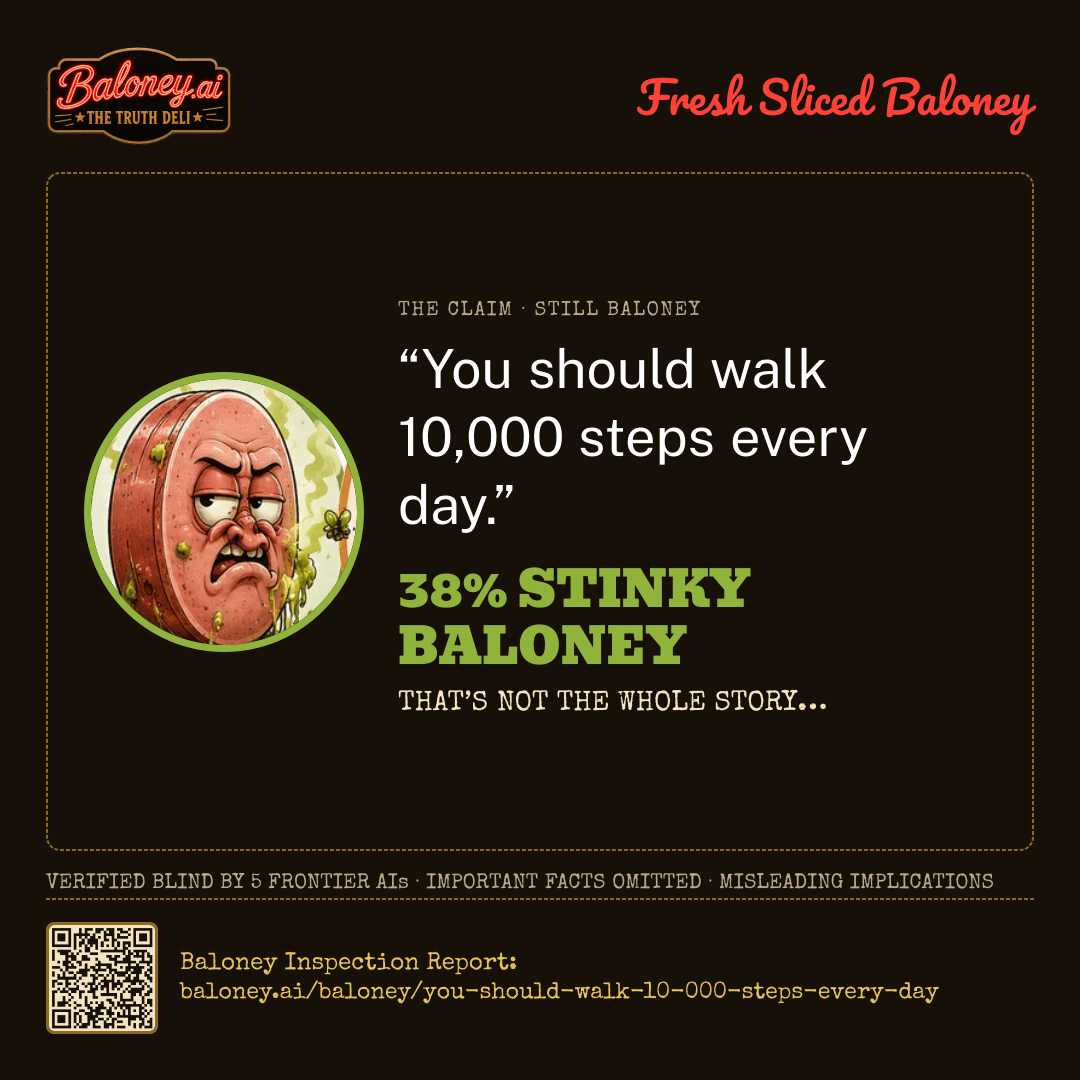
30%BALONEY
ROUND-1 BREAKDOWN
- Large cohort studies consistently show a strong inverse dose-response between daily step count and all-cause mortality: in Saint-Maurice et al. (JAMA, 2020), US adults taking ~8,000 steps/day had roughly 51% lower all-cause mortality than those taking 4,000, and 12,000 steps/day was associated with ~65% lower mortality, so aiming for 10,000 sits inside a well-supported beneficial range.
- Step counts near 10,000/day comfortably satisfy the WHO and US HHS guidelines of 150-300 minutes/week of moderate-intensity activity, which are themselves backed by extensive evidence for reduced cardiovascular disease, type 2 diabetes, several cancers, depression and all-cause mortality.
- Evidence suggests no harm and some additional benefit at higher step counts for certain outcomes: del Pozo Cruz et al. (JAMA Neurology, 2022) found the optimal dose for lower dementia incidence was around 9,800 steps/day, and mortality curves in most meta-analyses continue to decline (with diminishing returns) past 10,000 rather than turning upward.
- As a public-health heuristic, a simple round target is easy to remember and measure with ubiquitous phones/watches, and randomized and observational work on step-based goal setting shows step targets increase activity relative to no target.
- Most adults in high-income countries average well below 10,000 steps (commonly 4,000-6,000), so for the typical person the advice pushes behaviour in a direction that the evidence clearly supports.
- The number has no scientific origin: it derives from the Japanese pedometer 'manpo-kei' ('10,000-step meter') marketed around the 1964 Tokyo Olympics, chosen partly because the character 万 (10,000) resembles a walking figure. It was a marketing slogan, not a research-derived threshold.
- Mortality benefit plateaus well before 10,000 steps for many groups. Lee et al. (JAMA Internal Medicine, 2019) found that in older women, benefits levelled off at roughly 7,500 steps/day, with no further mortality reduction beyond that.
- The 15-cohort meta-analysis by Paluch et al. (Lancet Public Health, 2022) found the optimal range was approximately 6,000-8,000 steps/day for adults aged 60+ and 8,000-10,000 for adults under 60, with no additional mortality benefit above those levels - i.e., 10,000 is above the useful threshold for older adults.
- Substantial benefit begins at much lower counts: meta-analytic work (e.g., Banach et al., European Journal of Preventive Cardiology, 2023) finds measurable mortality reductions starting around 2,500-4,000 steps/day, so framing 10,000 as a 'should' may discourage the least-active people who would gain the most from small increases.
- No government or major health authority (WHO, CDC, US HHS, NHS) prescribes 10,000 steps in its official physical activity guidelines; they specify minutes of moderate-to-vigorous activity, partly because step counts ignore intensity, and devices vary in accuracy.
- The word 'should' implies a universal obligation. Feasibility and appropriateness vary by age, disability, occupation, and health status, and equivalent benefits can be obtained through cycling, swimming, or resistance training that register few or no steps.
84/100 — the lab’s own confidence in the score above, not a second reading of the claim.
SourcesJAMA Internal Medicine (Lee et al., 2019, 'Association of Step Volume and Intensity With All-Cause Mortality in Older Women')journal · 95 · JAMA (Saint-Maurice et al., 2020, 'Association of Daily Step Count and Step Intensity With Mortality Among US Adults')journal · 95 · The Lancet Public Health (Paluch et al., 2022, Steps for Health Collaborative meta-analysis of 15 cohorts)journal · 95 · JAMA Neurology (del Pozo Cruz et al., 2022, daily steps and dementia incidence)journal · 92 · European Journal of Preventive Cardiology (Banach et al., 2023, meta-analysis of daily steps and mortality)journal · 88 · World Health Organization - Physical Activity fact sheet / 2020 Guidelinesgov · 95 · US Department of Health and Human Services - Physical Activity Guidelines for Americans, 2nd ed.gov · 95 · US Centers for Disease Control and Prevention - Physical Activity Basics for Adultsgov · 92 · UK National Health Service - Exercise guidelinesgov · 90 · Harvard Health Publishing (Harvard Medical School) - '10,000 steps a day - or fewer?'edu · 85 · BBC News - reporting on the marketing origin of the 10,000-step targetnews · 82