Baloney Inspection Report: Claim #1068 · Inspected Sep 30, 2026, 11:36 AM PDT · Scoring model v2
 52%
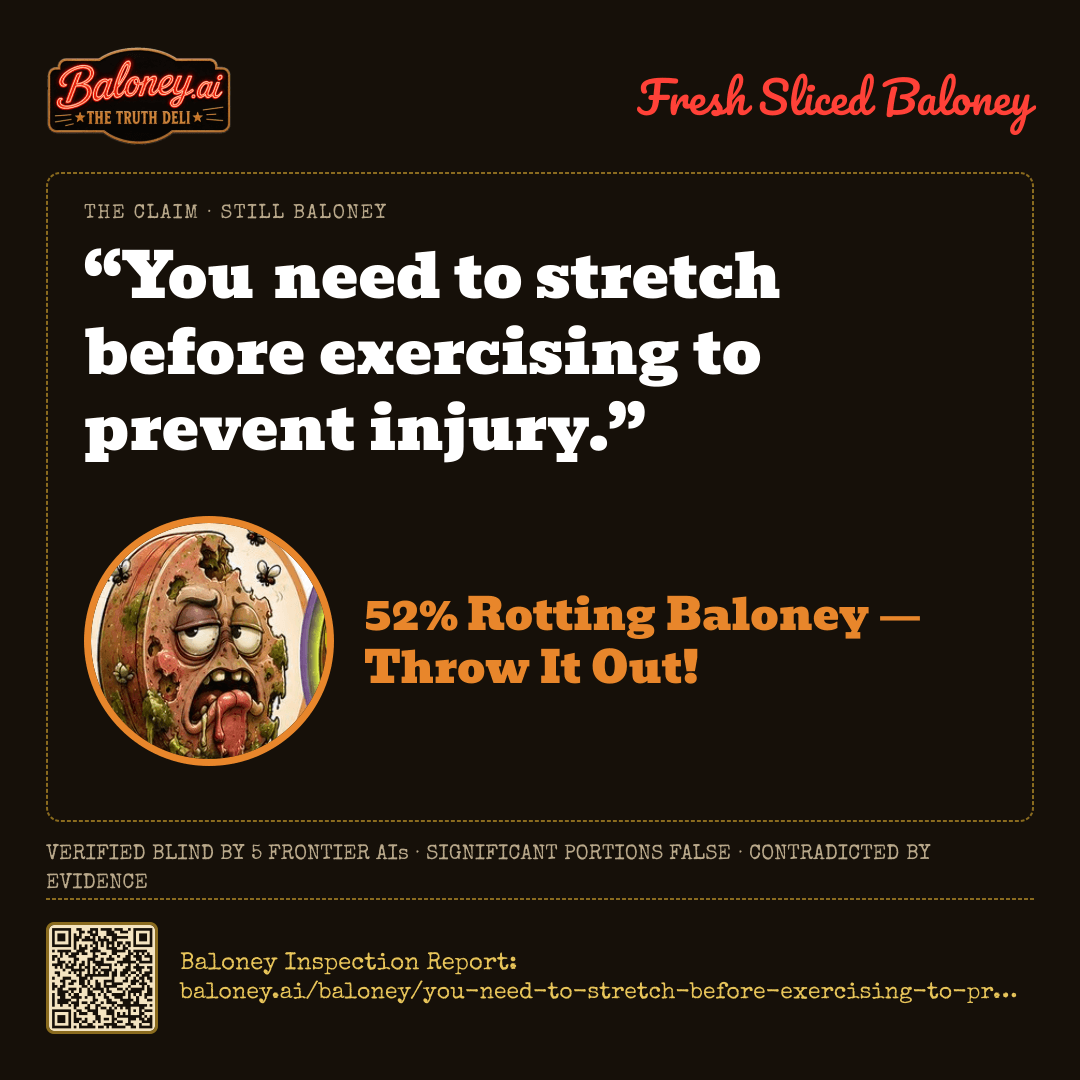
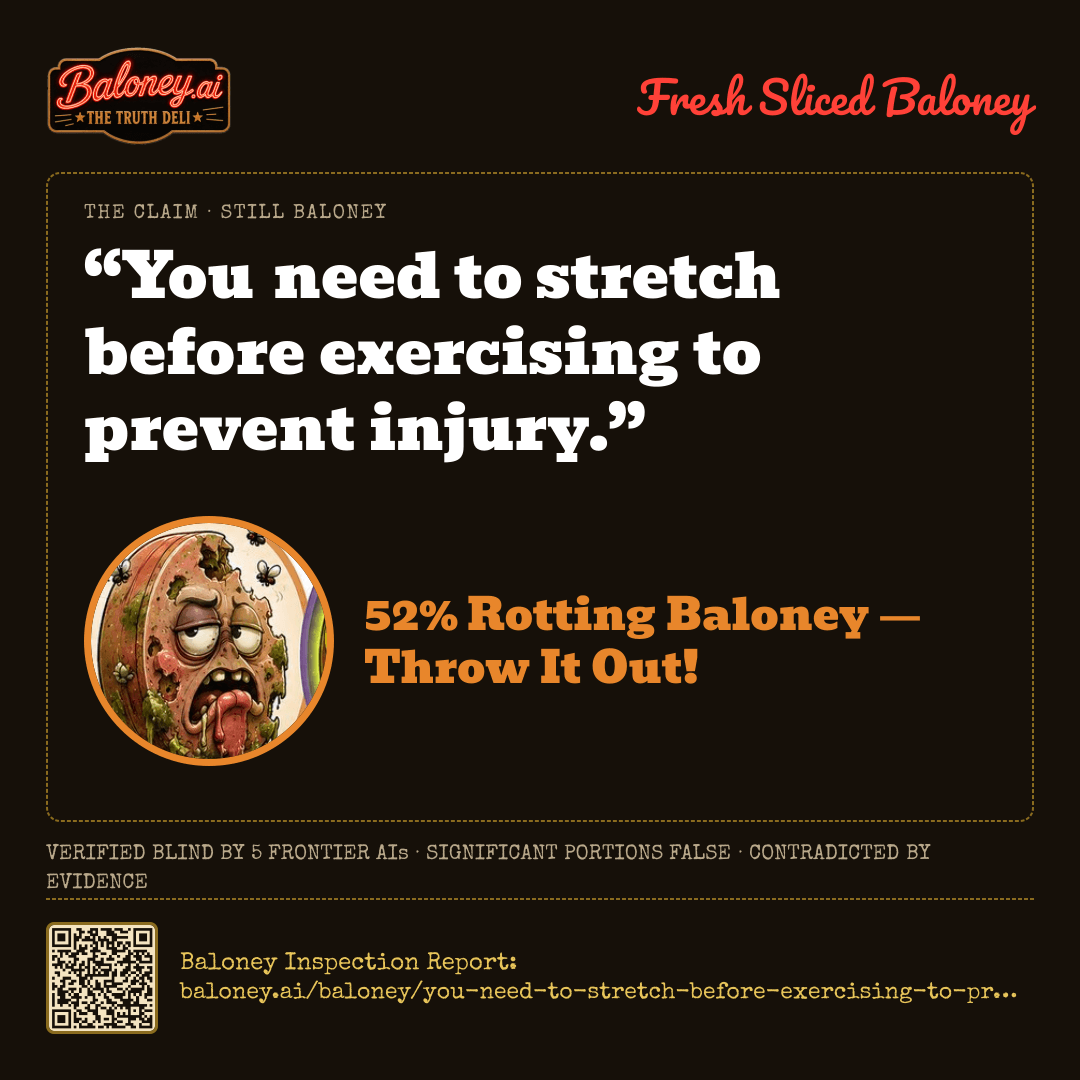
52%“You need to stretch before exercising to prevent injury.”
52%Rotting Baloney — Throw It Out!
Most of this claim has spoiled.
Significant portions falseContradicted by evidenceUnsupported assertionsDeceptive narrative
✓ BLIND VALIDATION CONFIRMED THIS SCORE
Serve It Fresh
Ready to Serve14 servings
Serve it the way you want it
The Verdict
 “You need to stretch before exercising to prevent injury.”52% Rotting Baloney — Throw It Out!Verified blind by 5 frontier AIs · Baloney Inspection Report: baloney.ai/baloney/you-need-to-stretch-before-exercising-to-prevent-injury
The Baloney Sampler
The reports found that “you need to stretch before exercising to prevent injury” overstates the evidence. The strongest accepted evidence—systematic reviews and trials cited through the British Medical Journal, NIH/NLM PubMed, the British Journal of Sports Medicine, and the Cochrane Database of Systematic Reviews—does not show a meaningful reduction in overall injury risk from routine pre-exercise stretching.
There is a smaller kernel of truth: stretching can increase range of motion, and it may help in flexibility-heavy activities or with some muscle, tendon, or ligament injuries. But a warm-up or dynamic, sport-specific preparation is not the same as static stretching, and the reports found no universal need to stretch first to prevent injury.
Resting on British Medical Journal · NIH/NLM PubMed · British Journal of Sports Medicine · Cochrane Database of Systematic Reviews
Other ways to slice it — phrasings that might have changed the rating
- “A sport-specific warm-up before hard exercise helps reduce injury risk.” The reports distinguish warm-up and dynamic preparation from stretching, and practical guidance supports preparation before activity.
- “Pre-exercise stretching may reduce some muscle, tendon, or ligament strains in sprinting or high-flexibility sports.” Several reports found limited, activity-specific evidence for benefits in musculotendinous injuries or flexibility-demanding sports.
- “Routine static stretching before exercise is not required for most people to prevent overall injury.” The accepted reviews and trials found no meaningful overall injury-prevention benefit from routine pre-exercise stretching.
Written from the panel’s reports by OpenAI · gpt-5.5. Nothing here changed the score.
The Order Ticket
18:36:07CLAIM RECEIVED — QUEUED FOR INSPECTION✓
18:36:44claude-opus-5 REPORTED — SCORE 52, CONFIDENCE 85✓
18:36:43gpt-5.5 REPORTED — SCORE 55, CONFIDENCE 92✓
18:36:30gemini-3.1-pro-preview REPORTED — SCORE 99, CONFIDENCE 98✓
18:36:22sonar-pro REPORTED — SCORE 32, CONFIDENCE 96✓
18:37:33grok-4.6 REPORTED — SCORE 52, CONFIDENCE 82✓
18:38:14PRIMARY MASTER CHATGPT — SCORE 55✓
18:37:42BLIND VALIDATION PERPLEXITY — SCORE 52✓
18:38:26AGREEMENT CONFIRMED — DELTA 3✓
18:38:26SCORING MODEL V2 — MEDIAN OF 5 COUNTED LAB SCORES: 52, 55, 99, 32, 52 → 52.✓
18:38:26SOURCE RULE — LABS CITED 27 SOURCES: 0 DISCARDED FOR HAVING NO URL, 0 DISCARDED AS DEAD LINKS (404/410), 11 COULD NOT BE OPENED BY US AND ARE MARKED UNVERIFIED.✓
18:38:26SOURCE RULE — PRIMARY MASTER RULED ON 18 SOURCES: 0 DISCARDED FOR HAVING NO URL, 0 DISCARDED AS DEAD LINKS, 5 MARKED UNVERIFIED, 13 VERIFIED.✓
How This One Was Sliced
Station 1 · Blind Inspection — Five Graders, Zero Peeking
Each lab scored the claim independently, without seeing the others. Open a breakdown for its evidence, its sources, and how sure it was.
Anthropic · EQUAL WEIGHT · 37.4s
claude-opus-5
52%BALONEY
ROUND-1 BREAKDOWN
Evidence offered for the claim- Some systematic reviews do find a protective signal: Behm et al. (2016, Applied Physiology, Nutrition, and Metabolism) reported that static stretching within a warm-up was associated with reduced overall injury incidence, particularly muscle strains, even though it acutely impairs power output.
- Military recruit and soccer trials cited in reviews (e.g., Amako et al.) found fewer muscle/tendon injuries in stretching groups, suggesting sport-specific benefit for activities with high eccentric/sprinting demand (hamstring, groin strains).
- Nearly all major health bodies (Mayo Clinic, NHS, ACSM) do recommend some pre-activity preparation — a warm-up and often dynamic stretching — so the general instinct behind the claim (don't go cold into hard exercise) is sound.
- Stretching reliably increases range of motion, and inadequate flexibility is a plausible (though not proven) contributor to some strain injuries.
- Not stretching at all is not shown to be safer; the literature shows no benefit rather than harm from stretching per se, so the advice is low-risk even where it is ineffective.
Evidence against the claim- Herbert & Gabriel's BMJ systematic review (2002) concluded that stretching before or after exercise does not meaningfully reduce delayed-onset muscle soreness or injury risk in young healthy adults; military trials showed risk reductions too small to be clinically useful.
- Thacker et al. (2004, Medicine & Science in Sports & Exercise) reviewed 361 studies and found insufficient evidence to endorse or discontinue routine pre-exercise stretching to prevent injury, concluding other interventions warranted more attention.
- Lauersen et al. (2014, British Journal of Sports Medicine) meta-analysis of injury-prevention RCTs found strength training reduced sports injuries by ~⅓ to ½ and proprioception training helped, while stretching produced no statistically significant injury reduction.
- The benefit that does exist appears to come from the warm-up (raising muscle temperature, sport-specific movement), not from stretching itself; warm-up and stretching are frequently conflated in popular advice.
- Static stretching immediately before activity acutely reduces strength, power and sprint speed (well-replicated), which is why many sports bodies moved to dynamic warm-ups — evidence that the specific 'stretch first' prescription is not simply beneficial.
- The word 'need' is unsupported: no randomized evidence shows that omitting pre-exercise stretching causes injury, and the U.S. Physical Activity Guidelines do not list pre-exercise stretching as an injury-prevention requirement.
- McHugh & Cosgrave's review (2010, Scandinavian Journal of Medicine & Science in Sports) found the injury-prevention case depends heavily on sport type, with little support for general recommendations.
How sure this lab was85/100 — the lab’s own confidence in the score above, not a second reading of the claim.
SourcesBMJ (Herbert & Gabriel, 2002)journal · 95 · Med Sci Sports Exerc / PubMed (Thacker et al., 2004)journal · 93 · British Journal of Sports Medicine (Lauersen et al., 2014)journal · 93 · Applied Physiology, Nutrition, and Metabolism (Behm et al., 2016)journal · 88 · Scand J Med Sci Sports / PubMed (McHugh & Cosgrave, 2010)journal · 85 · Cochrane Database of Systematic Reviews (Herbert, de Noronha & Kamper, 2011)journal · 95 · Mayo Clinicedu · 85 · U.S. Dept. of Health and Human Servicesgov · 92
OpenAI · EQUAL WEIGHT · 36.2s
gpt-5.5
55%BALONEY
ROUND-1 BREAKDOWN
Evidence offered for the claim- Pre-exercise stretching can acutely increase range of motion, which may be useful for activities that require high flexibility; this supports stretching for some performance/comfort goals, though not a universal injury-prevention requirement.
- Some reviews report limited/preliminary evidence that static stretching may reduce certain musculotendinous strain injuries, especially in activities involving sprinting or rapid stretch-shortening actions, but this does not extend clearly to overall injury prevention.
- Reviews distinguish stretching from a broader warm-up: dynamic mobility/stretching as part of an active, sport-specific warm-up may be reasonable, but the injury-prevention benefit is more attributable to the full warm-up/neuromuscular preparation than to stretching alone.
Evidence against the claim- A BMJ systematic review found that stretching before or after exercise did not produce clinically important reductions in injury risk; the authors concluded stretching was not shown to meaningfully prevent injury.
- A randomized trial of 1,538 army recruits found a typical pre-exercise stretching protocol did not meaningfully reduce lower-limb exercise-related injuries compared with no stretching.
- A systematic review in Journal of Athletic Training concluded there was not sufficient evidence to endorse routine stretching before or after exercise to prevent injuries among competitive or recreational athletes.
- Later reviews similarly conclude that static stretching before exercise does not reduce all-cause or overuse injury rates, and any possible benefit appears limited to specific muscle/tendon strain contexts rather than general exercise injury prevention.
- The word “need” is too strong: evidence supports warming up and using activity-specific preparation, but routine pre-exercise stretching is not required for most people to prevent injury.
How sure this lab was92/100 — the lab’s own confidence in the score above, not a second reading of the claim.
SourcesBMJjournal · 95 · Medicine & Science in Sports & Exercise / PubMedjournal · 90 · Journal of Athletic Training / PubMed Centraljournal · 88 · Research in Sports Medicine / PubMedjournal · 84 · Scandinavian Journal of Medicine & Science in Sports / PubMedjournal · 86
Google · EQUAL WEIGHT · 22.9s
gemini-3.1-pro-preview
99%BALONEY
ROUND-1 BREAKDOWN
Evidence offered for the claim- Historically, fitness instructors and physical educators widely recommended static stretching before workouts under the assumption that increasing muscle compliance prevents strains and tears.
- Dynamic stretching (actively moving joints through their full range of motion) as part of a comprehensive warm-up can help prepare muscles for physical activity and is linked to better performance.
- For specialized activities requiring extreme flexibility and a large range of motion (such as gymnastics, martial arts, or ballet), pre-exercise stretching may be necessary to perform specific movements safely.
Evidence against the claim- Multiple landmark systematic reviews and meta-analyses have concluded that static stretching before exercise does not produce a clinically significant reduction in the risk of sports injuries.
- Clinical evidence indicates that warming up (e.g., light aerobic activity to increase muscle temperature and blood flow) is the primary driver of injury prevention, not the stretching component often performed alongside it.
- Research shows that holding static stretches before a workout can actually temporarily decrease muscle strength, power, and explosive performance, a phenomenon known as stretch-induced strength loss.
- Attempting to stretch 'cold' muscles before raising the body's core temperature can itself increase the likelihood of muscle strains and micro-tears.
How sure this lab was98/100 — the lab’s own confidence in the score above, not a second reading of the claim.
SourcesBritish Medical Journal (BMJ)journal · 95 · National Institutes of Health / PubMedgov · 95 · Mayo Clinicother · 90 · Harvard Health Publishingedu · 90
Perplexity · EQUAL WEIGHT · 14.9s
sonar-pro
32%BALONEY
ROUND-1 BREAKDOWN
Evidence offered for the claim- A pragmatic randomized trial found that stretching before and after physical activity did not significantly reduce overall injury risk, but it reduced injuries to muscles, ligaments, and tendons (hazard ratio 0.75, 95% CI 0.59–0.96). This provides limited evidence that stretching may prevent some specific injuries, though not injury overall.
- A systematic review reported preliminary evidence that static stretching may reduce musculotendinous injuries, even though it did not reduce overall injury rates.
- CDC educational guidance recommends a brief warm-up before stretching and describes warm-up and stretching as measures that may help reduce injury risk; this is practical guidance, not strong proof that stretching itself prevents injury.
Evidence against the claim- A systematic review found no significant reduction in total injuries from stretching (odds ratio 0.93, 95% CI 0.78–1.11) and concluded that evidence was insufficient to endorse routine stretching before or after exercise for injury prevention.
- A randomized trial found no clinically important or statistically significant reduction in all-injury risk from stretching before and after exercise (hazard ratio 0.97, 95% CI 0.84–1.13).
- A systematic review and meta-analysis of randomized trials found no beneficial effect for stretching on sports injuries (relative risk 0.963, 95% CI 0.846–1.095), while strength training and proprioception training showed stronger preventive effects.
- An American Family Physician evidence review states that stretching before exercise does not reduce injury risk; its cited review of six trials involving 5,130 participants found no significant reduction in lower-limb soft-tissue injuries (relative risk 0.85, 95% CI 0.65–1.10).
- The claim says stretching is necessary, but the evidence does not establish necessity. Injury-prevention effects, if present, appear limited to some injury types or specific programs, and a general warm-up is not equivalent to static stretching.
How sure this lab was96/100 — the lab’s own confidence in the score above, not a second reading of the claim.
SourcesPubMed; systematic reviewjournal · 96 · PubMed; randomized trialjournal · 96 · British Journal of Sports Medicinejournal · 97 · American Family Physicianjournal · 90 · NCBI Bookshelf; systematic reviewgov · 94 · Centers for Disease Control and Preventiongov · 93 · PubMed; systematic literature reviewjournal · 94
xAI · EQUAL WEIGHT · 86.2s
grok-4.6
52%BALONEY
ROUND-1 BREAKDOWN
Evidence offered for the claim- Pre-exercise stretching has been standard coaching and PE advice for decades on the theory that greater range of motion reduces muscle-strain risk.
- In flexibility-demanding sports (gymnastics, dance, martial arts), regular stretching including pre-session work is associated with needed ROM and is still practiced.
- A general warm-up that can include light/dynamic stretching raises tissue temperature and is widely accepted as reducing some injury risk.
Evidence against the claim- Multiple systematic reviews of RCTs (including a 2014 BJSM meta-analysis) found stretching programs produce no statistically significant reduction in overall sports-injury rates.
- A 2004 systematic review in Medicine & Science in Sports & Exercise concluded evidence is insufficient to recommend stretching before or after exercise to prevent injury.
- Static stretching of cold muscles can temporarily reduce strength/power and itself risks strain; current medical guidance (e.g., Mayo Clinic) treats stretching as post-warm-up or post-exercise flexibility work, not a required pre-exercise injury-prevention step.
- The phrasing 'you need to' overstates necessity: injury risk is driven far more by training load, prior injury, and strength than by a pre-exercise stretch routine.
How sure this lab was82/100 — the lab’s own confidence in the score above, not a second reading of the claim.
SourcesMayo Clinicother · 94 · British Journal of Sports Medicinejournal · 93 · NIH/NLM (Med Sci Sports Exerc. 2004)gov · 90
Station 2 · The Masters
Primary Master · drawn at random
gpt-5.5
55% BALONEY
I weighted randomized trials, systematic reviews and meta-analyses most heavily, especially the BMJ review, the Medicine & Science in Sports & Exercise review, the BJSM injury-prevention meta-analysis, the army-recruit and physical-activity trials, and the Cochrane-style evidence summaries cited by the evaluators. Those sources consistently report that routine stretching before exercise does not meaningfully reduce overall injury risk. I gave some weight to evidence that stretching may help in narrower contexts, such as activities requiring high range of motion or possibly reducing certain musculotendinous strains, but that evidence does not support the statement as written. I treated Mayo Clinic, Harvard Health, CDC and other guidance sources as useful for practical interpretation, but less decisive than trials and systematic reviews. The key problem is the word “need”: the evidence supports warming up and activity-specific preparation, not a universal requirement to stretch before exercise to prevent injury.
All five evaluators agreed that the claim is overstated and that stretching before exercise has not been shown to prevent injuries overall. They also agreed that warm-ups, dynamic preparation, sport-specific mobility work, strength training and proprioception are more defensible injury-prevention strategies. They differed mainly on severity: one evaluator rated the claim as heavily debunked, while another gave more credit to limited evidence for reduced muscle, tendon or ligament injuries in some contexts. The consensus is that the claim contains a common kernel of practical advice—do not begin hard exercise cold—but misidentifies stretching as necessary.
Blind Validation Master · never saw the Primary’s work
sonar-pro
52% BALONEY
The statement is substantially misleading because the word “need” implies that pre-exercise stretching is necessary for injury prevention, but multiple systematic reviews and randomized trials found no practically useful or statistically significant reduction in overall injury risk. A meta-analysis of 25 randomized trials found no beneficial effect from stretching (RR 0.963, 95% CI 0.846–1.095), while strength and proprioception training showed clearer protective effects.[2] Earlier reviews likewise found no significant reduction in total injuries and insufficient evidence to recommend routine stretching.[4] There is limited, activity-specific evidence that stretching may reduce some muscle, tendon, or ligament injuries, and stretching can increase range of motion; it may therefore be useful for flexibility-demanding sports. However, that does not establish a universal requirement, and a general warm-up or dynamic, sport-specific preparation should not be conflated with static stretching. Because the claim overstates a mostly unsupported general rule while retaining a small kernel of truth for particular activities, it belongs in the “Rotting Baloney” range rather than the “Radioactive” range.
AGREEMENT TEST PASSED — MASTERS SCORED 55% AND 52% · BLIND VALIDATION CONFIRMED THIS SCORE · NO RE-EVALUATION REQUIRED
How the number was reached · scoring model v2 · how our models work
- Median of 5 counted lab scores: 52, 55, 99, 32, 52 → 52.
The Evidence
Evidence offered for the claim
- Flexibility sports Stretching can be useful before activities that demand large ranges of motion, such as gymnastics, dance, martial arts or ballet. That supports sport-specific preparation, not a universal rule that everyone must stretch before exercising to prevent injury.
- Possible strain reduction Some trials and reviews reported limited signals that stretching programs may reduce certain muscle, tendon or ligament injuries, including a hazard ratio of 0.75 for those injury types in one pragmatic trial. The same evidence did not show a clear reduction in overall injuries.
- Warm-up confusion DEBUNKED — A general warm-up may reduce injury risk and can include dynamic mobility or stretching. The panel treated this as only partial support because the benefit appears tied to warming up and sport-specific preparation, not to stretching itself as a required injury-prevention step.
- Traditional advice DEBUNKED — Coaches and physical educators long recommended pre-exercise static stretching on the theory that greater range of motion would prevent strains. Randomized trials and systematic reviews have not validated that broad claim.
Evidence against the claim
- No overall injury reduction Multiple systematic reviews and meta-analyses found that stretching before or after exercise did not produce a statistically or clinically meaningful reduction in overall sports or exercise injury rates.
- Randomized trials Trials in military recruits and general physical-activity settings found no meaningful all-injury reduction from typical stretching protocols compared with no stretching.
- Better-supported prevention The injury-prevention evidence is stronger for strength training, proprioception training, load management, warm-ups and sport-specific neuromuscular preparation than for routine pre-exercise stretching.
- Static-stretch drawbacks Static stretching immediately before activity can temporarily reduce strength, power and sprint performance, and stretching cold muscles is discouraged by several practical guidance sources.
- Necessity overstated The claim says people need to stretch before exercise to prevent injury. The evidence does not show that omitting pre-exercise stretching causes injury, nor that stretching is a general requirement for safe exercise.
Sources · Reliability · Why Accepted or Discounted
| Source | Type | Reliability | Ruling |
|---|
| Mayo Clinicunverified | other | 94 | ACCEPTED — Accepted for practical medical guidance distinguishing stretching from warming up; weighted below trials and systematic reviews. |
| British Journal of Sports Medicineunverified | journal | 97 | ACCEPTED — Accepted as a high-value meta-analysis comparing injury-prevention interventions, including stretching. |
| NIH/NLM PubMed | gov | 90 | ACCEPTED — Accepted as a PubMed-indexed review source cited for the limits of evidence on stretching and injury prevention. |
| British Medical Journalunverified | journal | 95 | ACCEPTED — Accepted as a central systematic review finding no clinically important injury-prevention effect from stretching. |
| National Institutes of Health / PubMed | gov | 96 | ACCEPTED — Accepted as a major systematic review concluding evidence was insufficient to endorse routine stretching for injury prevention. |
| Harvard Health Publishing | edu | 90 | ACCEPTED — Accepted for general health guidance on stretching, but not treated as primary evidence of injury prevention. |
| PubMed | journal | 96 | ACCEPTED — Accepted as a randomized trial relevant to whether stretching before and after activity reduces injury risk. |
| American Family Physician | journal | 90 | ACCEPTED — Accepted as an evidence review summarizing trial data for clinicians; secondary to the underlying systematic reviews. |
| NCBI Bookshelf | gov | 94 | ACCEPTED — Accepted as a government-hosted evidence synthesis relevant to stretching and injury outcomes. |
| Centers for Disease Control and Prevention | gov | 93 | ACCEPTED — Accepted for practical safety guidance on warming up and stretching, but not as proof that stretching itself prevents injury. |
| PubMed | journal | 94 | ACCEPTED — Accepted as a literature review contributing nuance about possible injury-type-specific effects. |
| Medicine & Science in Sports & Exercise / PubMed | journal | 90 | ACCEPTED — Accepted as a randomized military-recruit trial directly testing a pre-exercise stretching protocol. |
| Journal of Athletic Training / PubMed Central | journal | 88 | ACCEPTED — Accepted as a review source concluding evidence was insufficient to endorse routine stretching for injury prevention. |
| Research in Sports Medicine / PubMed | journal | 84 | ACCEPTED — Accepted as a relevant review, though weighted less than larger meta-analyses and randomized trials. |
| Scandinavian Journal of Medicine & Science in Sports / PubMed | journal | 86 | ACCEPTED — Accepted for sport-specific nuance about when stretching might affect particular injury types. |
| Applied Physiology, Nutrition, and Metabolismunverified | journal | 88 | ACCEPTED — Accepted for a more favorable review of stretching within warm-ups, but interpreted as limited and context-dependent. |
| Cochrane Database of Systematic Reviewsunverified | journal | 95 | ACCEPTED — Accepted as a high-reliability systematic review source on stretching and soreness or injury-related outcomes. |
| U.S. Department of Health and Human Services | gov | 92 | ACCEPTED — Accepted for official physical-activity guidance showing that pre-exercise stretching is not listed as a universal injury-prevention requirement. |
Every link was opened when this claim was inspected. A dead link was discarded before publication; “unverified” means the site refused our automated check and the link is the one the panel cited. A source without a URL was never kept.
Serve It Fresh
Ready to Serve14 servings
Serve it the way you want it
The Verdict
“You need to stretch before exercising to prevent injury.”52% Rotting Baloney — Throw It Out!Verified blind by 5 frontier AIs · Baloney Inspection Report: baloney.ai/baloney/you-need-to-stretch-before-exercising-to-prevent-injury