Baloney Inspection Report: Claim #1065 · Inspected Sep 30, 2026, 11:36 AM PDT · Scoring model v2
 45%
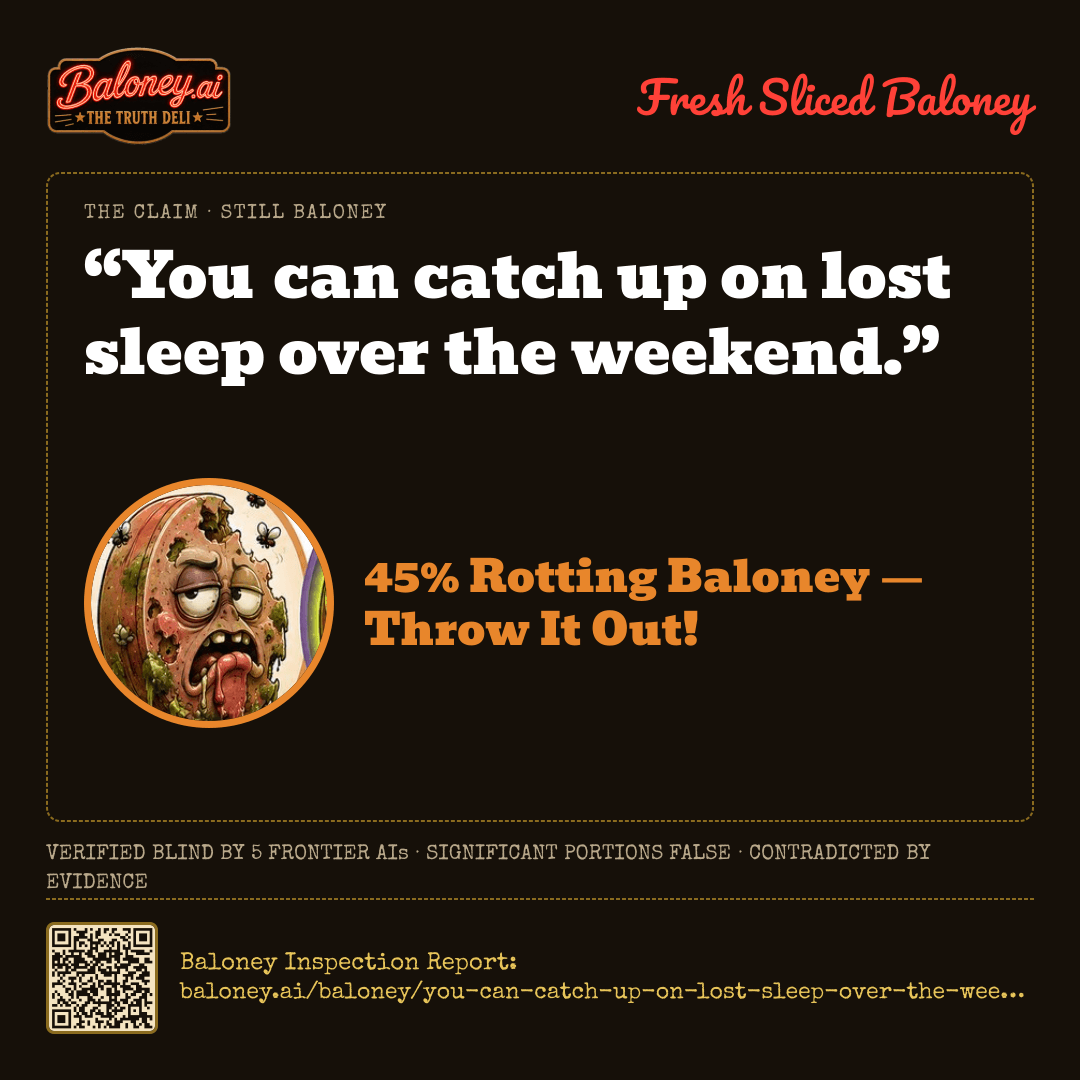
45%“You can catch up on lost sleep over the weekend.”
45%Rotting Baloney — Throw It Out!
Most of this claim has spoiled.
Significant portions falseContradicted by evidenceUnsupported assertionsDeceptive narrative
✓ BLIND VALIDATION CONFIRMED THIS SCORE
Serve It Fresh
Ready to Serve13 servings
Serve it the way you want it
The Verdict
 “You can catch up on lost sleep over the weekend.”45% Rotting Baloney — Throw It Out!Verified blind by 5 frontier AIs · Baloney Inspection Report: baloney.ai/baloney/you-can-catch-up-on-lost-sleep-over-the-weekend
The Baloney Sampler
The claim has a real but limited core: extra weekend sleep can ease sleepiness, improve mood and alertness, and help after an occasional short night. Journal of Sleep Research cohort evidence also links longer weekend sleep with better outcomes than staying short on sleep every day, but those findings are observational, not proof that the debt is erased.
As a general promise, the claim fails. Current Biology and NIH summaries found weekend recovery sleep did not fix key effects of weekday restriction, including metabolic disruption, and Sleep Medicine Reviews found typical weekend catch-up does not fully restore sleep or function. CDC and NHLBI guidance points to regular adequate sleep, not weekend oversleep, as the practical answer.
Resting on Current Biology · National Institutes of Health · Sleep Medicine Reviews · Journal of Sleep Research
Other ways to slice it — phrasings that might have changed the rating
- “One or two longer weekend sleeps can partly reduce sleepiness and improve short-term alertness after an occasional short night.” The reports found real short-term recovery in subjective sleepiness, mood, alertness, and some performance measures after acute sleep loss.
- “Weekend catch-up sleep fully reverses the metabolic and cognitive effects of chronic weekday sleep restriction.” Controlled studies and reviews found weekend recovery did not fully restore insulin sensitivity, energy balance, or neurobehavioral performance after repeated restriction.
- “Keeping a regular schedule with enough sleep every night is a better strategy than relying on sleeping in on weekends.” The reports cite CDC, NHLBI, and other guidance favoring consistent adequate sleep, and note that weekend sleep shifts can create social jetlag and circadian misalignment.
Written from the panel’s reports by OpenAI · gpt-5.5. Nothing here changed the score.
The Order Ticket
18:36:19CLAIM RECEIVED — QUEUED FOR INSPECTION✓
18:36:19claude-opus-5 REPORT CARRIED OVER FROM THE EARLIER RUN — SCORE 45, CONFIDENCE 84✓
18:36:19gpt-5.5 REPORT CARRIED OVER FROM THE EARLIER RUN — SCORE 45, CONFIDENCE 86✓
18:36:19gemini-3.1-pro-preview REPORT CARRIED OVER FROM THE EARLIER RUN — SCORE 65, CONFIDENCE 95✓
18:36:32sonar-pro REPORTED — SCORE 24, CONFIDENCE 94✓
18:36:19grok-4.6 REPORT CARRIED OVER FROM THE EARLIER RUN — SCORE 61, CONFIDENCE 76✓
18:38:16PRIMARY MASTER CHATGPT — SCORE 45✓
18:37:52BLIND VALIDATION CLAUDE — SCORE 52✓
18:37:27AGREEMENT CONFIRMED — DELTA 7✓
18:37:27SCORING MODEL V2 — MEDIAN OF 5 COUNTED LAB SCORES: 45, 45, 65, 24, 61 → 45.✓
18:37:27SOURCE RULE — LABS CITED 26 SOURCES: 0 DISCARDED FOR HAVING NO URL, 5 DISCARDED AS DEAD LINKS (404/410), 8 COULD NOT BE OPENED BY US AND ARE MARKED UNVERIFIED.✓
18:37:27SOURCE RULE — PRIMARY MASTER RULED ON 18 SOURCES: 0 DISCARDED FOR HAVING NO URL, 0 DISCARDED AS DEAD LINKS, 6 MARKED UNVERIFIED, 12 VERIFIED.✓
How This One Was Sliced
Station 1 · Blind Inspection — Five Graders, Zero Peeking
Each lab scored the claim independently, without seeing the others. Open a breakdown for its evidence, its sources, and how sure it was.
Anthropic · EQUAL WEIGHT · 40.2s
claude-opus-5
45%BALONEY
ROUND-1 BREAKDOWN
Evidence offered for the claim- Sleep is homeostatically regulated: after restriction, the body shows rebound effects (increased slow-wave sleep and REM density, longer sleep duration when allowed), and acute measures such as subjective sleepiness and simple reaction-time performance improve substantially after one or two nights of extended sleep.
- Large prospective cohort work (Åkerstedt et al., Journal of Sleep Research, 2019, ~38,000 Swedish adults) found that mortality risk associated with short weekday sleep was attenuated in people who slept longer on weekends, suggesting weekend recovery sleep has some real-world protective value.
- Epidemiological studies in Korean adults have associated 'weekend catch-up sleep' with lower BMI/obesity prevalence among chronically short sleepers, consistent with partial mitigation of metabolic harm.
- A study presented at the European Society of Cardiology Congress 2024 (UK Biobank accelerometry data) reported that participants with the most weekend compensatory sleep had roughly 20% lower risk of incident heart disease than those with the least.
- For a single night of acute sleep loss (e.g., one late night), recovery sleep does restore most measurable performance and alertness — the 'debt' from occasional short sleep is largely repayable.
- Mainstream sleep-medicine sources (CDC, Harvard Health, Sleep Foundation) acknowledge that short-term sleep debt can be partly repaid, while advising against relying on it.
Evidence against the claim- The strongest controlled test of the claim — Depner et al., Current Biology, 2019 — put adults through weekday sleep restriction plus ad libitum weekend recovery sleep. Weekend recovery sleep did not prevent insulin sensitivity loss or after-dinner snacking-driven weight gain; in the recovery group, whole-body insulin sensitivity was actually worse than in the group restricted continuously, and gains were lost once restriction resumed.
- Classic chronic sleep restriction work (Van Dongen et al., Sleep, 2003; Belenky et al., 2003) showed cumulative, dose-dependent neurobehavioral deficits that were not fully reversed by one to three nights of recovery sleep, and subjects were largely unaware of their impairment — meaning 'feeling fine' Monday is not evidence of recovery.
- Catch-up sleep shifts sleep timing and creates 'social jetlag' (circadian misalignment), which is itself independently associated with obesity, metabolic syndrome, depression and cardiometabolic risk in multiple cohort studies; the fix can carry its own cost and worsens Sunday-night insomnia.
- Observational weekend-catch-up findings (mortality, BMI, ESC heart-disease abstract) are correlational, subject to confounding and reverse causation, and several are conference abstracts not yet fully peer-reviewed — they cannot establish that catch-up sleep causes recovery.
- Not all physiological domains recover on the same timescale: immune/inflammatory markers, glucose regulation and some attention measures lag behind subjective sleepiness, so people can feel restored while remaining measurably impaired.
- There is no evidence that a chronic, months-long deficit (e.g., 5–6 h nightly for years) can be repaid in one or two long weekend mornings; sleep debt appears to accumulate faster than weekend hours can offset it.
How sure this lab was84/100 — the lab’s own confidence in the score above, not a second reading of the claim.
SourcesCurrent Biology (Depner et al., 2019)journal · 93 · Journal of Sleep Research (Åkerstedt et al., 2019)journal · 86 · Sleep / Van Dongen et al. 2003 (via PubMed, NIH)journal · 93 · U.S. Centers for Disease Control and Preventiongov · 88 · National Heart, Lung, and Blood Institute (NIH)gov · 90 · Harvard Health Publishingedu · 83 · European Society of Cardiology (ESC Congress 2024 press release on catch-up sleep)other · 74
OpenAI · EQUAL WEIGHT · 27.4s
gpt-5.5
45%BALONEY
ROUND-1 BREAKDOWN
Evidence offered for the claim- Partial catch-up is real: after acute sleep restriction, recovery sleep typically includes longer sleep and can improve sleepiness and some performance measures, so an occasional short night can be partly offset by later extra sleep.
- A large Swedish cohort study reported that, among people under 65, short weekday sleep combined with longer weekend sleep was not associated with the same elevated mortality risk seen in people who slept short hours both weekdays and weekends, suggesting weekend sleep may mitigate some harms of habitual short weekday sleep.
- The claim is more plausible for small, short-term sleep debt than for chronic sleep restriction: a weekend may help someone feel and function better after a limited period of insufficient sleep.
Evidence against the claim- The claim is misleading if taken to mean a weekend fully erases chronic sleep debt. In a randomized Current Biology lab study, weekend recovery sleep did not prevent weight gain, reduced insulin sensitivity, and circadian disruption during repeated cycles of weekday sleep restriction.
- Cognitive recovery can lag behind subjective feelings. In controlled sleep-restriction research, performance improved after recovery sleep but often did not fully return to baseline after only a few recovery nights.
- Public-health sleep advice emphasizes consistently getting enough sleep and keeping a regular schedule, including weekends; relying on weekend oversleep can create irregular timing/social jet lag and is not equivalent to adequate nightly sleep.
- Observational studies suggesting benefits of weekend catch-up cannot prove causation and may be affected by health, work schedule, socioeconomic, or lifestyle confounding.
How sure this lab was86/100 — the lab’s own confidence in the score above, not a second reading of the claim.
SourcesJournal of Sleep Researchjournal · 90 · Current Biologyjournal · 93 · Journal of Sleep Researchjournal · 90 · National Heart, Lung, and Blood Institutegov · 88
Google · EQUAL WEIGHT · 23.2s
gemini-3.1-pro-preview
65%BALONEY
ROUND-1 BREAKDOWN
Evidence offered for the claim- Sleeping in on the weekend can provide temporary relief from acute daytime sleepiness and improve short-term mood and subjective alertness.
- Some epidemiological research indicates that individuals who compensate for weekday sleep debt with longer weekend sleep may have a lower mortality risk compared to those who persistently sleep too little every day of the week, suggesting some physiological benefit to catch-up sleep.
Evidence against the claim- Clinical research shows that weekend recovery sleep fails to prevent or reverse metabolic dysregulation, such as reduced insulin sensitivity and weight gain, caused by chronic weekday sleep restriction.
- Shifting sleep schedules significantly on the weekend causes 'social jetlag', which disrupts the body's natural circadian rhythm and makes it much harder to fall asleep on Sunday night and wake up on Monday morning.
- Cognitive deficits, diminished focus, and degraded neurobehavioral performance accumulated over consecutive days of sleep deprivation are not fully restored by only one or two nights of extended weekend sleep.
How sure this lab was95/100 — the lab’s own confidence in the score above, not a second reading of the claim.
SourcesNational Institutes of Healthgov · 98 · Current Biologyjournal · 95 · Journal of Sleep Researchjournal · 90
Perplexity · EQUAL WEIGHT · 12.7s
sonar-pro
24%BALONEY
ROUND-1 BREAKDOWN
Evidence offered for the claim- Weekend recovery sleep can provide some short-term relief: controlled research found participants slept about 1.1 additional hours over the weekend and reduced after-dinner energy intake compared with continued insufficient sleep.[https://pmc.ncbi.nlm.nih.gov/articles/PMC12798825/]
- Some observational evidence links limited weekend catch-up sleep with better outcomes. One prospective study reported that short weekend catch-up sleep among adults with normal overall sleep duration was associated with lower mortality than no catch-up sleep.[https://pmc.ncbi.nlm.nih.gov/articles/PMC10900010/]
- A population study found weekend catch-up sleep was associated with compensation for some metabolic disadvantages associated with insufficient weekday sleep, although this was observational evidence rather than proof that sleep debt was fully repaid.[https://pmc.ncbi.nlm.nih.gov/articles/PMC7200717/]
Evidence against the claim- The statement is too absolute: controlled research found that weekend recovery sleep did not prevent metabolic disruption when weekday sleep restriction resumed, and its benefits were transient.[https://pmc.ncbi.nlm.nih.gov/articles/PMC12798825/]
- A review of recovery-sleep research concluded that the typical weekend catch-up pattern does not fully restore lost sleep or neurobehavioral function and does not protect against renewed chronic sleep restriction.[https://pmc.ncbi.nlm.nih.gov/articles/PMC10108639/]
- In a representative nationwide sample of 12,637 adults, napping and weekend catch-up sleep fully compensated for severe sleep debt in only about one-quarter of participants.[https://pubmed.ncbi.nlm.nih.gov/32866843/]
- A randomized study found that weekend recovery sleep did not reverse the adverse energy-balance effects associated with insufficient sleep.[https://pubmed.ncbi.nlm.nih.gov/34059916/]
- A large device-measured cohort study found no association between weekend catch-up sleep and all-cause mortality or cardiovascular-disease incidence, conflicting with claims that weekend sleep extension reliably provides broad long-term protection.[https://pubmed.ncbi.nlm.nih.gov/38895883/]
- Weekend catch-up sleep can shift circadian timing and may worsen the transition back to an early weekday schedule, making it an imperfect substitute for consistently adequate sleep.[https://pmc.ncbi.nlm.nih.gov/articles/PMC12798825/]
How sure this lab was94/100 — the lab’s own confidence in the score above, not a second reading of the claim.
SourcesCurrent Biology via PubMed Centraljournal · 96 · Sleep Medicine Reviews via PubMed Centraljournal · 94 · Journal of Sleep Research via PubMedjournal · 93 · Sleep via PubMedjournal · 94 · Sleep via PubMedjournal · 94 · BMC Public Health via PubMed Centraljournal · 88 · Nutrients via PubMed Centraljournal · 86
xAI · EQUAL WEIGHT · 77.9s
grok-4.6
61%BALONEY
ROUND-1 BREAKDOWN
Evidence offered for the claim- Extra sleep on weekends can temporarily reduce subjective sleepiness and restore some alertness and mood after several nights of restriction.
- Some observational studies associate weekend catch-up sleep with lower BMI or better metabolic markers among weekday short-sleepers.
- Additional time in bed can allow partial recovery of slow-wave sleep that was lost during the week.
Evidence against the claim- Lab experiments show weekend recovery sleep does not fully reverse metabolic effects (e.g., insulin sensitivity) or inflammatory changes from weekday restriction.
- Sleeping in on weekends often creates circadian misalignment (social jetlag), which is linked to poorer cardiometabolic and cognitive outcomes.
- Public-health guidance (CDC and similar) emphasizes a consistent sleep-wake schedule seven days a week rather than weekend catch-up.
- One or two nights of extra sleep typically do not restore all cognitive performance, immune, or cardiovascular deficits from accumulated sleep loss.
How sure this lab was76/100 — the lab’s own confidence in the score above, not a second reading of the claim.
Sources Station 2 · The Masters
Primary Master · drawn at random
gpt-5.5
45% BALONEY
I weighted controlled sleep-restriction and recovery studies most heavily because they directly test whether weekend recovery sleep reverses the effects of lost sleep. Those studies support a limited version of the claim: extra weekend sleep can reduce sleepiness and improve some short-term alertness and mood. But they also show that one or two recovery nights do not reliably restore metabolic function, cognitive performance, or protection from renewed weekday restriction. Reviews and classic chronic sleep-restriction work reinforced that subjective recovery can outpace objective recovery. Observational cohort findings suggesting lower mortality, lower BMI, or better metabolic markers among people who sleep longer on weekends were accepted as relevant but given less causal weight because the evaluators consistently noted confounding and reverse-causation concerns. Public-health and NIH/NHLBI guidance was accepted for the practical conclusion that regular adequate sleep is preferable to relying on weekend catch-up. Overall, the statement has a real core for occasional or short-term sleep loss, but as written it omits the crucial limits and implies a level of recovery the evidence does not support.
All five evaluators agreed that weekend sleep can provide partial, short-term relief and that it does not fully erase chronic weekday sleep restriction. They disagreed mainly on scoring: the lower-score report treated the wording as merely overbroad, while the higher-score reports treated the common implication of fully catching up over a weekend as substantially false and potentially harmful.
Blind Validation Master · never saw the Primary’s work
claude-opus-5
52% BALONEY
All five evaluators agree the claim contains a kernel of truth wrapped in a misleading absolute. The supportive evidence is real: sleep is homeostatically regulated, so extended weekend sleep produces slow-wave/REM rebound, reduces subjective sleepiness, and largely restores performance after a single acute short night; large observational cohorts (Akerstedt et al., ~38,000 Swedish adults) and Korean/UK Biobank analyses associate weekend catch-up with attenuated mortality, BMI and cardiovascular risk relative to persistent short sleep. However, the claim as written asserts that lost sleep can be recovered, and the best controlled test of exactly that proposition (Depner et al., Current Biology 2019) found weekend recovery sleep failed to prevent weight gain and insulin sensitivity loss — insulin sensitivity was actually worse in the recovery group — with benefits evaporating once restriction resumed. Classic chronic restriction work (Van Dongen 2003) shows cumulative neurobehavioral deficits not reversed by one to three recovery nights, while subjects remain unaware of their impairment; a Sleep Medicine Reviews synthesis concludes the typical weekend pattern does not fully restore sleep or function; and a nationwide sample of 12,637 adults found naps plus weekend catch-up fully compensated severe sleep debt in only about a quarter of people. The supportive epidemiology is correlational and confounded, and one large device-measured cohort found no mortality/CVD association at all. Additionally, the practice itself carries costs via social jetlag and circadian misalignment, and mainstream guidance (NIH/NHLBI, CDC) explicitly frames weekend catch-up as unable to fix sleep deprivation. So the statement is defensible only for trivial, acute debt and is contradicted by experimental evidence for the chronic weekday-restriction pattern most people mean when they say it. That places it in the 'significant portions false, contradicted by evidence' band rather than merely 'missing context' — but not in the overwhelmingly-false band, since genuine partial recovery does occur. Mid-Rotting Baloney, consistent with the median of the peer assessments.
AGREEMENT TEST PASSED — MASTERS SCORED 45% AND 52% · BLIND VALIDATION CONFIRMED THIS SCORE · NO RE-EVALUATION REQUIRED
How the number was reached · scoring model v2 · how our models work
- Median of 5 counted lab scores: 45, 45, 65, 24, 61 → 45.
The Evidence
Evidence offered for the claim
- Short-term relief Extra weekend sleep can reduce subjective sleepiness and improve alertness, mood, and some simple performance measures after short periods of restricted sleep.
- Partial recovery sleep After restriction, the body can show rebound sleep, including longer sleep and recovery of some slow-wave sleep, so an occasional short night may be partly offset by later extra sleep.
- Observational benefits DEBUNKED — Some cohort and population studies linked weekend catch-up sleep with lower mortality, lower BMI, or better metabolic markers among short weekday sleepers, but these findings are observational and do not prove that the weekend sleep caused full recovery.
Evidence against the claim
- Metabolic effects persist Controlled research found that weekend recovery sleep did not prevent or reverse important metabolic effects of weekday sleep restriction, including reduced insulin sensitivity, weight gain, and adverse energy-balance changes.
- Cognitive recovery is incomplete Chronic sleep-restriction studies show cumulative neurobehavioral deficits that may not fully return to baseline after one to three nights of recovery sleep, even when people feel less sleepy.
- Circadian disruption Sleeping much later on weekends can create social jetlag, shifting circadian timing and making the return to an early weekday schedule harder.
- Guidance favors consistency Public-health and sleep-medicine guidance emphasizes getting enough sleep regularly and keeping a consistent sleep-wake schedule rather than relying on weekend catch-up.
- Chronic debt is different The evidence does not support the idea that weeks, months, or years of too little sleep can be repaid by one or two long weekend mornings.
Sources · Reliability · Why Accepted or Discounted
| Source | Type | Reliability | Ruling |
|---|
| Current Biology via PubMed Central | journal | 96 | ACCEPTED — Directly relevant controlled evidence on weekend recovery sleep after restriction; given high weight for causality. |
| BMC Public Health via PubMed Central | journal | 88 | ACCEPTED — Relevant prospective observational evidence on mortality, accepted with lower causal weight. |
| Nutrients via PubMed Central | journal | 86 | ACCEPTED — Relevant population evidence on metabolic markers, but observational and not proof of full recovery. |
| Sleep Medicine Reviews via PubMed Central | journal | 94 | ACCEPTED — Review evidence directly addressing recovery sleep and neurobehavioral restoration; useful for synthesis. |
| Journal of Sleep Research via PubMed | journal | 93 | ACCEPTED — Representative sample evidence on whether naps and weekend catch-up compensate for sleep debt; relevant and moderately strong. |
| Sleep via PubMed | journal | 94 | ACCEPTED — Randomized evidence on energy-balance effects; directly relevant to limits of weekend recovery. |
| Sleep via PubMed | journal | 94 | ACCEPTED — Large device-measured cohort evidence; relevant as a counterweight to claims of broad long-term protection. |
| Journal of Sleep Researchunverified | journal | 90 | ACCEPTED — Large cohort evidence on weekday and weekend sleep duration; accepted as suggestive but observational. |
| Current Biologyunverified | journal | 93 | ACCEPTED — Direct controlled study of weekend recovery sleep; central to the verdict. |
| Journal of Sleep Researchunverified | journal | 90 | ACCEPTED — Relevant controlled sleep-restriction and recovery evidence on performance recovery. |
| National Heart, Lung, and Blood Institute | gov | 88 | ACCEPTED — Government health guidance; useful for the practical consensus on sleep deprivation and regular sleep. |
| National Institutes of Healthunverified | gov | 98 | ACCEPTED — Government research summary of a directly relevant controlled study; accepted as a reliable secondary account. |
| Current Biologyunverified | journal | 95 | ACCEPTED — Full journal article for the key randomized weekend recovery sleep study; heavily weighted. |
| Journal of Sleep Researchunverified | journal | 90 | ACCEPTED — Full-text link to the same relevant cohort evidence on weekday and weekend sleep patterns. |
| Sleep via PubMed | journal | 93 | ACCEPTED — Classic chronic sleep-restriction evidence on cumulative neurobehavioral impairment; relevant to incomplete recovery. |
| U.S. Centers for Disease Control and Prevention | gov | 88 | ACCEPTED — Public-health guidance on sleep duration and habits; useful but not a direct experimental test. |
| Harvard Health Publishing | edu | 83 | ACCEPTED — Mainstream medical education source; accepted for general guidance, with less weight than primary studies. |
| European Society of Cardiology | other | 74 | DISCOUNTED — Conference press-release evidence was not treated as decisive because it is not presented here as a full peer-reviewed paper and is vulnerable to the same observational limitations. |
Every link was opened when this claim was inspected. A dead link was discarded before publication; “unverified” means the site refused our automated check and the link is the one the panel cited. A source without a URL was never kept.
Serve It Fresh
Ready to Serve13 servings
Serve it the way you want it
The Verdict
“You can catch up on lost sleep over the weekend.”45% Rotting Baloney — Throw It Out!Verified blind by 5 frontier AIs · Baloney Inspection Report: baloney.ai/baloney/you-can-catch-up-on-lost-sleep-over-the-weekend