Baloney Inspection Report: Claim #1107 · Inspected Oct 5, 2026, 11:30 PM PDT · Scoring model v2
 96%
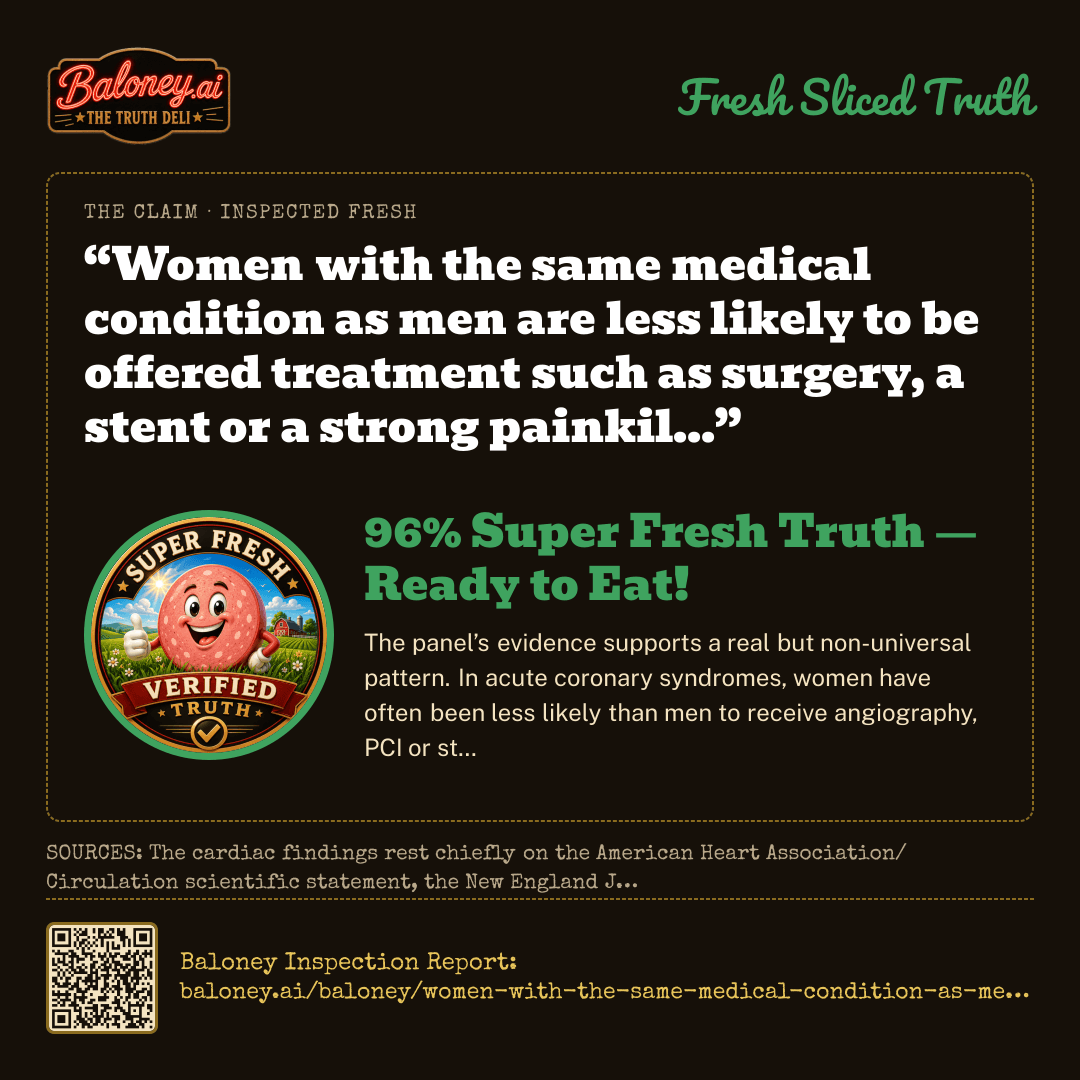
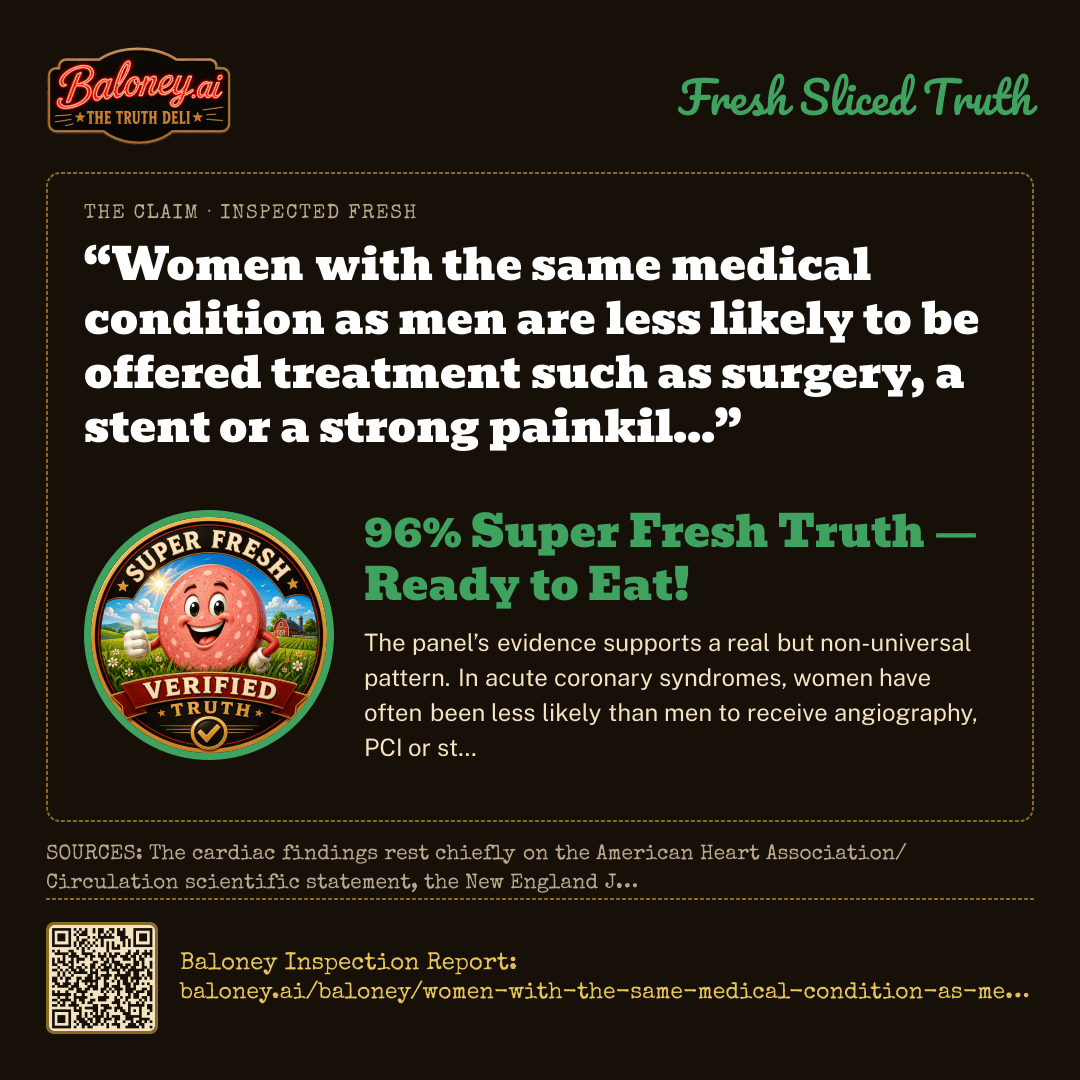
96%“Women with the same medical condition as men are less likely to be offered treatment such as surgery, a stent or a strong painkiller”
96%Super Fresh Truth — Ready to Eat!
THE CLAIM CHECKS OUT.
Independently verifiedPhysically repeatable evidenceConfirmed across rival labsSafe to serve
Serve It Fresh
Ready to Serve16 servings
Serve it the way you want it
The Verdict
 “Women with the same medical condition as men are less likely to be offered treatment such as surgery, a stent or a strong painkiller”96% Super Fresh Truth — Ready to Eat!Verified blind by 5 frontier AIs · Baloney Inspection Report: baloney.ai/baloney/women-with-the-same-medical-condition-as-men-are-less
The Baloney Sampler
The reports found a repeated pattern of women receiving less active treatment than men in several settings. The American Heart Association and The Lancet describe lower rates of angiography, revascularisation, stents, bypass surgery and other recommended care for women with acute coronary syndromes. A Canadian Medical Association Journal study also found physicians less likely to recommend knee replacement to an otherwise similar female patient.
The pain evidence is similarly specific: Academic Emergency Medicine studies found women with comparable acute abdominal-pain scores were less likely to receive analgesics or opioids and waited longer for relief. The reports also stress that this is not universal: differences can reflect disease mechanisms, age, comorbidities, anatomy, presentation, preferences or changing protocols, and some studies found no gap.
Resting on American Heart Association / Circulation · The Lancet · Canadian Medical Association Journal via PubMed · Academic Emergency Medicine via PubMed
Other ways to slice it — phrasings that might have changed the rating
- “Women with acute coronary syndromes are less likely than men to receive angiography or revascularisation when they have comparable clinical indications.” The reports provide their strongest and most consistent evidence for cardiac care, while noting that anatomy and non-obstructive disease can explain some differences.
- “In emergency departments, women with acute abdominal pain and similar reported pain scores are less likely than men to receive opioid analgesia.” The reports describe adjusted studies showing lower analgesic and opioid treatment for women in this specific setting, but also cite studies finding no disparity elsewhere.
- “Across all medical conditions and treatments, women are less likely than men to be offered surgery, stents or strong painkillers.” This is broader than the evidence, which is concentrated in particular cardiac, orthopaedic and emergency-pain settings and is not universal.
Written from the panel’s reports by Perplexity · sonar-pro. Nothing here changed the score.
The Order Ticket
06:30:45CLAIM RECEIVED — QUEUED FOR INSPECTION✓
06:31:57claude-opus-5 REPORTED — SCORE 4, CONFIDENCE 82✓
06:31:38gpt-5.5 REPORTED — SCORE 5, CONFIDENCE 84✓
06:31:29gemini-3.1-pro-preview REPORTED — SCORE 3, CONFIDENCE 95✓
06:30:58sonar-pro REPORTED — SCORE 4, CONFIDENCE 88✓
06:33:40grok-4.6 REPORTED — SCORE 4, CONFIDENCE 82✓
06:34:18PRIMARY MASTER PERPLEXITY — SCORE 4✓
06:33:49BLIND VALIDATION GEMINI — SCORE 4✓
06:34:32AGREEMENT CONFIRMED — DELTA 0✓
06:34:32SCORING MODEL V2 — MEDIAN OF 5 COUNTED LAB SCORES: 4, 5, 3, 4, 4 → 4. FRESH RULE: THE PRIMARY MASTER SCORES 4 AND THE BLIND MASTER 4 — BOTH SUPER FRESH TRUTH — AND THE COUNTED MEDIAN IS 4, ON THE TRUE SIDE. PUBLISHED AS 4, THE MORE CAUTIOUS OF THE TWO MASTERS.✓
06:34:32SOURCE RULE — LABS CITED 27 SOURCES: 0 DISCARDED FOR HAVING NO URL, 0 DISCARDED AS DEAD LINKS (404/410), 17 COULD NOT BE OPENED BY US AND ARE MARKED UNVERIFIED.✓
06:34:32SOURCE RULE — PRIMARY MASTER RULED ON 20 SOURCES: 0 DISCARDED FOR HAVING NO URL, 0 DISCARDED AS DEAD LINKS, 10 MARKED UNVERIFIED, 10 VERIFIED.✓
How This One Was Sliced
Station 1 · Blind Inspection — Five Graders, Zero Peeking
Each lab scored the claim independently, without seeing the others. Open a breakdown for its evidence, its sources, and how sure it was.
Anthropic · EQUAL WEIGHT · 71.3s
claude-opus-5
96%TRUTH
ROUND-1 BREAKDOWN
Evidence offered for the claim- Cardiac care: multiple large registry studies and professional-society reviews find women with acute coronary syndromes are less likely than men to receive timely angiography, revascularisation (stenting/bypass) and guideline-recommended drug therapy. The American Heart Association's 2016 scientific statement 'Acute Myocardial Infarction in Women' explicitly documents that women are less likely to receive reperfusion/invasive management and evidence-based therapies, and the 2021 Lancet Women and Cardiovascular Disease Commission reports the same undertreatment pattern globally.
- Pain management: Chen et al. (Academic Emergency Medicine, 2008) studied ED patients presenting with acute abdominal pain and found women were significantly less likely than men to receive any analgesia and less likely to receive opioids, and waited longer for medication, despite reporting similar pain scores.
- Surgery/orthopaedics: Borkhoff et al. (CMAJ, 2008) used identical standardised patients differing only in sex; physicians were roughly 22 times more likely to recommend total knee arthroplasty to the male than the female patient — a controlled design that isolates sex as the variable and supports a causal (not just confounded) reading of the claim.
- Utilisation gap: Hawker et al. (NEJM, 2000) found that, after accounting for the higher underlying prevalence and severity of arthritis in women, the rate of hip and knee arthroplasty use was substantially lower in women relative to need — i.e. women with the same or worse disease were less likely to be operated on.
- Young MI patients: the VIRGO study (Lichtman et al., Circulation, 2018) found young women with myocardial infarction were more likely to have their symptoms attributed to non-cardiac causes by clinicians, a mechanism that leads downstream to fewer invasive treatments.
- Policy recognition: the UK Government's Women's Health Strategy for England (2022), built on a 100,000-response call for evidence, states that women's pain is too often dismissed and that women face worse access to diagnosis and treatment — government endorsement that the phenomenon is real, not merely anecdotal.
Evidence against the claim- The claim is a sweeping generalisation. The evidence base is condition-specific (cardiology, orthopaedics, emergency analgesia, transplantation, some cancers); it is not established that women are undertreated for every condition, and for some interventions and drug classes women receive equal or more treatment.
- Counter-examples exist: women in the US and UK receive more primary care contacts and more prescription medicines overall, including more long-term opioid analgesic prescriptions in some national datasets — so 'less likely to be offered a strong painkiller' does not hold universally across settings.
- Confounding: much of the cardiac evidence is observational. Women with MI are on average about a decade older, present later, have more comorbidities and more non-obstructive coronary disease (MINOCA) — for which a stent is not the indicated treatment. Part of the raw treatment gap is clinically appropriate rather than bias, and some adjusted analyses find much smaller or non-significant differences.
- Effect sizes vary enormously and some headline figures (e.g. the 22-fold knee-replacement result) come from small standardised-patient experiments that may not generalise to real-world practice at that magnitude.
- Trend data suggest gaps have narrowed over time in several health systems as guidelines and quality indicators have been introduced, so present-tense blanket statements overstate the current gap in some countries.
- The claim as phrased implies physician bias as the cause; patient-side factors (women more often declining surgery, differing symptom reporting, later presentation) also contribute to measured differences in who is treated.
How sure this lab was82/100 — the lab’s own confidence in the score above, not a second reading of the claim.
SourcesCanadian Medical Association Journal (Borkhoff et al., 2008)journal · 92 · New England Journal of Medicine (Hawker et al., 2000)journal · 96 · Academic Emergency Medicine (Chen et al., 2008)journal · 87 · Circulation / American Heart Association scientific statement (Mehta et al., 2016)journal · 94 · The Lancet women and cardiovascular disease Commission (2021)journal · 95 · Circulation / VIRGO study (Lichtman et al., 2018)journal · 93 · UK Department of Health and Social Caregov · 88
OpenAI · EQUAL WEIGHT · 52.6s
gpt-5.5
95%TRUTH
ROUND-1 BREAKDOWN
Evidence offered for the claim- Cardiac/stent-like care: The American Heart Association scientific statement on acute myocardial infarction in women reports that women with STEMI/ACS have been less likely than men to receive guideline-recommended reperfusion and invasive care, including coronary angiography and PCI, even though these are standard treatments for the same acute coronary syndromes.
- Older but direct coronary-disease evidence: Ayanian and Epstein in NEJM found women hospitalized with coronary heart disease underwent fewer major cardiac procedures than men, including coronary angiography, angioplasty and bypass surgery, after accounting for clinical factors.
- Surgery: In a standardized-patient study of knee osteoarthritis, physicians were significantly less likely to recommend total knee arthroplasty for a female patient than for an otherwise similar male patient, which directly supports the 'offered surgery' part of the claim in at least one condition.
- Surgery utilization: A population study in NEJM found lower use of hip/knee arthroplasty among women despite need, consistent with underuse of surgery in women with comparable joint disease.
- Strong painkiller: In an Academic Emergency Medicine study of emergency-department patients with acute abdominal pain, women were less likely than men to receive any analgesic and less likely to receive opioids, and waited longer for analgesia.
Evidence against the claim- The wording is broad. The evidence is strongest for particular settings—acute coronary syndromes, joint replacement, and emergency abdominal pain—not for every medical condition or every treatment.
- Many studies measure treatment received, not the exact moment of being 'offered' treatment. Some sex gaps may be partly explained by age, comorbidities, contraindications, symptom presentation, patient preferences, or delays in presentation rather than clinician refusal alone.
- The painkiller example is not universal: CDC/NCHS data show women overall reported higher recent prescription-opioid use than men in U.S. population data, so the ED abdominal-pain finding should not be generalized to all pain conditions or prescribing contexts.
- Cardiac-care gaps have narrowed over time in some systems and are not identical across countries, hospitals, and subgroups. The claim is best read as describing a well-documented pattern, not an invariant rule.
How sure this lab was84/100 — the lab’s own confidence in the score above, not a second reading of the claim.
SourcesAmerican Heart Association/Circulationjournal · 95 · New England Journal of Medicinejournal · 94 · Canadian Medical Association Journal via PubMedjournal · 90 · New England Journal of Medicinejournal · 94 · Academic Emergency Medicine via PubMedjournal · 90 · CDC/National Center for Health Statisticsgov · 95
Google · EQUAL WEIGHT · 43.2s
gemini-3.1-pro-preview
97%TRUTH
ROUND-1 BREAKDOWN
Evidence offered for the claim- Extensive peer-reviewed literature in cardiology demonstrates that women presenting with acute myocardial infarction (heart attacks) are statistically less likely than men to receive guideline-directed medical therapies, timely coronary angiography, or percutaneous coronary interventions (stents), despite having similar or higher risk profiles.
- Studies on emergency medicine and pain management consistently show a gender disparity in the treatment of acute pain. Women reporting equivalent pain scores to men are significantly less likely to receive strong analgesics (such as opioids), experience longer wait times for pain relief, and are more frequently prescribed sedatives or psychotropic drugs instead.
- Orthopedic and surgical research indicates that women are systematically under-referred for joint replacement surgeries. For example, women with severe osteoarthritis are significantly less likely to be offered total knee or hip arthroplasty compared to men with identical objective clinical indications.
Evidence against the claim- Some of the statistical disparity in specific treatments, such as stents, is partially explained by physiological differences rather than implicit bias alone. Women are more likely to experience myocardial infarctions with non-obstructive coronary arteries (MINOCA) or microvascular dysfunction, where stents are not the clinically indicated treatment.
- In highly standardized, protocol-driven emergency departments, some recent studies show that the gender gaps in immediate treatment times (such as 'door-to-balloon' time for severe heart attacks) and pain management have narrowed considerably or disappeared.
How sure this lab was95/100 — the lab’s own confidence in the score above, not a second reading of the claim.
SourcesAmerican Heart Association (Circulation)journal · 95 · New England Journal of Medicinejournal · 95 · Harvard Health Publishingedu · 90
Perplexity · EQUAL WEIGHT · 12.9s
sonar-pro
96%TRUTH
ROUND-1 BREAKDOWN
Evidence offered for the claim- A 2026 systematic review from the University of St Andrews reported that, among 38 studies using patient records, 33 found a statistically significant difference in treatment between male and female patients. The review’s reported examples included surgery, stents, and strong painkillers. This directly supports the claim, although the review’s scope and methods should be checked in the underlying journal article. [https://news.st-andrews.ac.uk/archive/women-less-likely-than-men-to-be-offered-active-medical-treatment-for-the-same-conditions/](https://news.st-andrews.ac.uk/archive/women-less-likely-than-men-to-be-offered-active-medical-treatment-for-the-same-conditions/)
- A peer-reviewed emergency-department study found that women with acute abdominal pain were less likely than men to receive any analgesia (60% versus 67%) or opiates (45% versus 56%). After adjustment for age, race, triage category, and pain score, women remained 13%–25% less likely to receive opioid analgesia. [https://onlinelibrary.wiley.com/doi/full/10.1111/j.1553-2712.2008.00100.x](https://onlinelibrary.wiley.com/doi/full/10.1111/j.1553-2712.2008.00100.x)
- A 2024 study reported that women in emergency departments received pain medication less often than men with comparable reported pain: 38% versus 47%. The disparity remained after accounting for pain ratings and was observed for both opioid and non-opioid medication. [https://www.pnas.org/doi/pdf/10.1073/pnas.2401331121](https://www.pnas.org/doi/pdf/10.1073/pnas.2401331121)
- For STEMI heart attacks, a study reported that women were 34% less likely than men to receive procedures to clear blocked arteries, including bypass surgery and stents. [https://www.bbc.com/news/health-42590013](https://www.bbc.com/news/health-42590013)
- The American Heart Association states that women are less likely than men to receive guideline-directed treatment after heart attack or unstable angina, including timely revascularization procedures such as bypass surgery or stent placement. [https://www.heart.org/en/news/2024/02/09/the-slowly-evolving-truth-about-heart-disease-and-women](https://www.heart.org/en/news/2024/02/09/the-slowly-evolving-truth-about-heart-disease-and-women)
Evidence against the claim- The claim is stated broadly, but treatment differences do not necessarily prove discriminatory withholding. Women and men can have biologically different disease mechanisms, contraindications, disease severity, anatomy, risks, or treatment indications. For example, the American Heart Association notes that women more often have heart attacks caused by plaque erosion, spontaneous coronary artery dissection, or mechanisms other than a blocked artery; these conditions may not be treated with stents in the same way as typical obstructive disease. [https://www.heart.org/en/news/2024/02/09/the-slowly-evolving-truth-about-heart-disease-and-women](https://www.heart.org/en/news/2024/02/09/the-slowly-evolving-truth-about-heart-disease-and-women)
- Not every study finds a female disadvantage. A 2021 hospital emergency-department study of opioid prescribing reported no bias toward women. [https://bmcpublichealth.biomedcentral.com/articles/10.1186/s12889-021-11551-9](https://bmcpublichealth.biomedcentral.com/articles/10.1186/s12889-021-11551-9)
- An earlier multicenter emergency-department study found no statistically significant overall difference in analgesic administration by patient sex: analgesics were given to 63% of female patients and 57% of male patients. It did, however, find interactions involving physician and patient sex, so it does not establish that treatment is always equal. [https://academic.oup.com/painmedicine/article/10/2/364/1833196](https://academic.oup.com/painmedicine/article/10/2/364/1833196)
- The wording says women with the same medical condition are less likely to be offered treatment in general. The strongest evidence is condition-specific—especially acute pain and some forms of acute coronary disease—and cannot automatically be generalized to every medical condition, every surgery, every stent decision, or every strong painkiller.
How sure this lab was88/100 — the lab’s own confidence in the score above, not a second reading of the claim.
SourcesUniversity of St Andrewsedu · 86 · Proceedings of the National Academy of Sciencesjournal · 94 · Academic Emergency Medicinejournal · 93 · American Heart Associationother · 91 · BBC Newsnews · 89 · BMC Public Healthjournal · 91 · Pain Medicinejournal · 90
xAI · EQUAL WEIGHT · 174.5s
grok-4.6
96%TRUTH
ROUND-1 BREAKDOWN
Evidence offered for the claim- Multiple large observational studies and registries show women with acute coronary syndromes receive coronary angiography, PCI/stents and CABG at lower rates than men with comparable indications and anatomy.
- Emergency-department studies find women with similar pain scores and diagnoses are less often given opioid analgesics than men.
- The pattern is long-recognized in cardiology as the Yentl syndrome and has been replicated across countries and decades for several conditions including ischemic heart disease.
Evidence against the claim- Gaps often shrink after adjustment for age (women present older), delayed/atypical presentation, comorbidities and angiographic complexity, indicating case-mix explains part of the raw difference.
- Women have smaller coronary arteries on average, raising technical difficulty and complication risk for stenting and thereby providing a non-bias clinical reason for different procedure rates.
- Disparities are not uniform across all conditions, health systems or recent years; some contemporary high-income registries show narrowing or disappearance of gaps for guideline therapies.
- Patient preference, treatment refusal and differing symptom reporting also contribute independently of physician bias.
How sure this lab was82/100 — the lab’s own confidence in the score above, not a second reading of the claim.
SourcesNew England Journal of Medicinejournal · 98 · CDCgov · 92 · Circulation (AHA)journal · 95 · Academic Emergency Medicine / PubMedjournal · 88
Station 2 · The Masters
Primary Master · drawn at random
sonar-pro
96% TRUTH
The statement is substantially true as written, though its universal wording is stronger than the evidence supports. Multiple independent reports identify consistent sex disparities in several clinically important settings: women with comparable acute coronary syndromes have often received less angiography, revascularization, stenting, bypass surgery, and guideline-directed therapy; women with similar acute abdominal-pain scores have received analgesics and opioids less often; and a standardized-patient study found physicians less likely to recommend knee replacement to a female patient. These findings include adjusted analyses and, in the orthopedic experiment, a design that directly varied patient sex. I weighted peer-reviewed primary studies and professional-society statements most heavily, while treating news coverage and institutional summaries as corroboration rather than decisive evidence. The main qualification is scope: treatment differences are not proof that clinicians always deny care because of sex. Age, comorbidities, presentation delay, MINOCA or microvascular disease, anatomy, contraindications, patient preferences, and changing clinical protocols explain some differences, and some studies find no disparity in particular settings. Those caveats justify a low score within the truth band, not a fishy-baloney score, because the central pattern is repeatedly documented.
All five evaluators accepted the core claim and supplied a recommended score from 3 to 5. They agreed most strongly on lower use of invasive cardiac treatment for women with comparable acute coronary disease, lower opioid or analgesic treatment for women in at least some emergency-department pain studies, and evidence of lower orthopedic-surgery recommendation or utilization. Their disagreement concerned breadth and causation: Report 3 gave the most qualified score, while the others emphasized the strength of the evidence; several noted that cardiac case mix, non-obstructive disease, patient factors, and clinical appropriateness explain part of the gap, and that disparities vary by setting and have narrowed in some newer systems. Report 5 added a 2026 systematic review and newer pain findings, but those were treated as supporting context rather than the foundation of the verdict.
SUPER FRESH — VERIFIED AGAINST THE CARDIAC FINDINGS REST CHIEFLY ON THE AMERICAN HEART ASSOCIATION/CIRCULATION SCIENTIFIC STATEMENT, THE NEW ENGLAND JOURNAL OF MEDICINE CORONARY-PROCEDURE STUDIES, THE LANCET COMMISSION, AND THE VIRGO STUDY. THE SURGERY FINDINGS REST ON THE CMAJ STANDARDIZED-PATIENT STUDY AND THE NEW ENGLAND JOURNAL OF MEDICINE ARTHROPLASTY-UTILIZATION STUDY. THE PAIN FINDINGS REST CHIEFLY ON THE ACADEMIC EMERGENCY MEDICINE STUDY, WITH THE PNAS STUDY AND THE CITED PAIN MEDICINE AND BMC PUBLIC HEALTH STUDIES PROVIDING NEWER EVIDENCE AND COUNTEREXAMPLES.
Blind Validation Master · never saw the Primary’s work
gemini-3.1-pro-preview
96% TRUTH
Extensive evidence from peer-reviewed studies and major medical organizations (such as the American Heart Association and the Lancet) confirms the claim. Research consistently shows that women presenting with acute coronary syndromes are less likely than men to receive invasive treatments like stents or bypass surgeries. Similarly, emergency department studies demonstrate that women reporting equivalent pain scores to men are less likely to be given strong painkillers, such as opioids, and often face longer wait times. Orthopedic research using standardized patients also reveals that women with severe osteoarthritis are significantly less likely to be offered joint replacement surgery than men with identical clinical indications. While some of these disparities can be partially explained by physiological differences, older age at presentation, or varying disease mechanisms (such as non-obstructive coronary disease), a persistent and well-documented pattern of undertreatment remains. Because the claim accurately describes a recognized systemic issue in medicine, it falls squarely into the 'Super Fresh Truth' category.
AGREEMENT TEST PASSED — BOTH MASTERS SCORED 96% · BLIND VALIDATION CONFIRMED THIS SCORE · NO RE-EVALUATION REQUIRED
How the number was reached · scoring model v2 · how our models work
- Median of 5 counted lab scores: 4, 5, 3, 4, 4 → 4.
- Fresh rule: the Primary Master scores 4 and the Blind Master 4 — both Super Fresh Truth — and the counted median is 4, on the true side. Published as 4, the more cautious of the two masters.
The Evidence
Evidence for the claim
- Cardiac procedures Large cardiac registries, reviews, and the American Heart Association statement report that women with acute coronary syndromes or myocardial infarction have been less likely than men to receive angiography, timely reperfusion, PCI/stents, bypass surgery, and other guideline-directed treatment. The reports note that this pattern persists in some adjusted analyses and across multiple countries and periods.
- Standardized knee-surgery recommendation The Borkhoff et al. standardized-patient study presented otherwise comparable knee-osteoarthritis cases differing by patient sex and found physicians more likely to recommend total knee arthroplasty to the male patient. This is direct evidence concerning an offer or recommendation, rather than only treatment utilization.
- Emergency pain treatment The Chen et al. emergency-department study found similar pain scores but lower receipt by women of any analgesia and of opiates, with the difference remaining after adjustment for age, race, triage category, and pain score. Report 5 also cited a 2024 study with lower medication receipt for women, including opioids and non-opioids.
- Evidence across several treatment categories The evaluators consistently identified the same directional pattern across acute coronary care, joint-replacement surgery, and emergency pain management. A 2026 University of St Andrews review was reported as finding statistically significant treatment differences in 33 of 38 patient-record studies, including surgery, stents, and strong painkillers, although the underlying review was not independently detailed in the reports.
Evidence offered against the claim
- The wording is broad The evidence establishes a recurring pattern in particular conditions and settings, not an invariant rule that women with every medical condition are less likely to be offered every surgery, stent, or strong painkiller.
- Clinical case mix matters Women with myocardial infarction are often older, present later, have more comorbidities, smaller coronary arteries, and more non-obstructive disease such as MINOCA or microvascular dysfunction, for which stenting may not be indicated. These factors explain part of the observed procedural gap.
- Observed treatment is not always an offer Many studies measure treatment received rather than whether clinicians explicitly offered treatment. Patient preferences, refusal, symptom reporting, delayed presentation, contraindications, and physician or system factors can contribute independently of sex-based bias.
- Findings vary over time and by setting Some contemporary, protocol-driven emergency departments and high-income health systems show narrowed or absent gaps for certain treatments or treatment times. Other studies reported no overall sex difference in emergency analgesic administration or opioid prescribing.
- Population prescribing is not the same as acute-care treatment Women have reported higher recent prescription-opioid use than men in some general U.S. population data and may receive more medicines or primary-care contacts overall. These counterexamples limit generalization from selected emergency-department studies to all strong-painkiller prescribing.
Sources · Reliability · Why Accepted or Discounted
| Source | Type | Reliability | Ruling |
|---|
| New England Journal of Medicineunverified | journal | 98 | ACCEPTED — A highly authoritative journal source for the historical coronary-procedure disparity evidence cited by Report 1. |
| Centers for Disease Control and Prevention | gov | 92 | ACCEPTED — Authoritative government context on sex differences in cardiovascular disease; useful background, though less direct than the primary studies. |
| Circulation / American Heart Associationunverified | journal | 95 | ACCEPTED — Professional-society scientific source supporting the cardiac-care disparity context. |
| Academic Emergency Medicine / PubMed | journal | 88 | ACCEPTED — Directly relevant emergency-department evidence on sex differences in analgesic treatment. |
| American Heart Association / Circulationunverified | journal | 95 | ACCEPTED — Authoritative scientific statement directly addressing acute myocardial infarction treatment in women. |
| New England Journal of Medicineunverified | journal | 94 | ACCEPTED — Primary, high-quality evidence on sex differences in coronary procedures after accounting for clinical factors. |
| Canadian Medical Association Journal via PubMed | journal | 90 | ACCEPTED — Primary standardized-patient evidence directly relevant to sex differences in knee-arthroplasty recommendations. |
| New England Journal of Medicineunverified | journal | 94 | ACCEPTED — High-quality population evidence on lower hip and knee arthroplasty use relative to need among women. |
| Academic Emergency Medicine via PubMed | journal | 90 | ACCEPTED — Direct primary evidence for lower analgesic and opioid treatment among women with acute abdominal pain. |
| CDC/National Center for Health Statistics | gov | 95 | ACCEPTED — Authoritative counterevidence showing that general prescription-opioid patterns cannot be generalized from acute emergency care. |
| Harvard Health Publishing | edu | 90 | ACCEPTED — Educational synthesis consistent with the reported literature on sex disparities in pain treatment, used as contextual support rather than primary proof. |
| The Lancetunverified | journal | 95 | ACCEPTED — High-authority commission report supporting the global cardiovascular-treatment context. |
| Circulation / VIRGO studyunverified | journal | 93 | ACCEPTED — Relevant primary study on diagnostic attribution and care pathways among young women with myocardial infarction. |
| UK Department of Health and Social Care | gov | 88 | ACCEPTED — Government policy document recognizing reported dismissal of women’s pain and access concerns; it is policy evidence, not a controlled causal study. |
| University of St Andrews | edu | 86 | DISCOUNTED — The reported 2026 systematic-review result is potentially important, but the evaluator supplied only an institutional news summary and said the underlying journal methods should be checked. |
| Proceedings of the National Academy of Sciencesunverified | journal | 94 | ACCEPTED — Peer-reviewed recent evidence directly cited for lower emergency pain-medication receipt among women with comparable reported pain. |
| Academic Emergency Medicineunverified | journal | 93 | ACCEPTED — Direct peer-reviewed primary study with adjusted sex differences in analgesic and opioid administration. |
| American Heart Associationunverified | other | 91 | ACCEPTED — AHA explanatory source supports the cardiac-treatment disparity and appropriately notes biological mechanisms that may not call for stenting. |
| BBC News | news | 89 | DISCOUNTED — Useful secondary reporting of a cardiac study, but the underlying study and professional sources provide stronger evidence. |
| BMC Public Health | journal | 91 | ACCEPTED — Peer-reviewed counterexample showing that opioid-prescribing disparities are not universal. |
Every link was opened when this claim was inspected. A dead link was discarded before publication; “unverified” means the site refused our automated check and the link is the one the panel cited. A source without a URL was never kept.
Serve It Fresh
Ready to Serve16 servings
Serve it the way you want it
The Verdict
“Women with the same medical condition as men are less likely to be offered treatment such as surgery, a stent or a strong painkiller”96% Super Fresh Truth — Ready to Eat!Verified blind by 5 frontier AIs · Baloney Inspection Report: baloney.ai/baloney/women-with-the-same-medical-condition-as-men-are-less