Baloney Inspection Report: Claim #1076 · Inspected Sep 29, 2026, 6:39 PM PDT · Scoring model v2
 82%
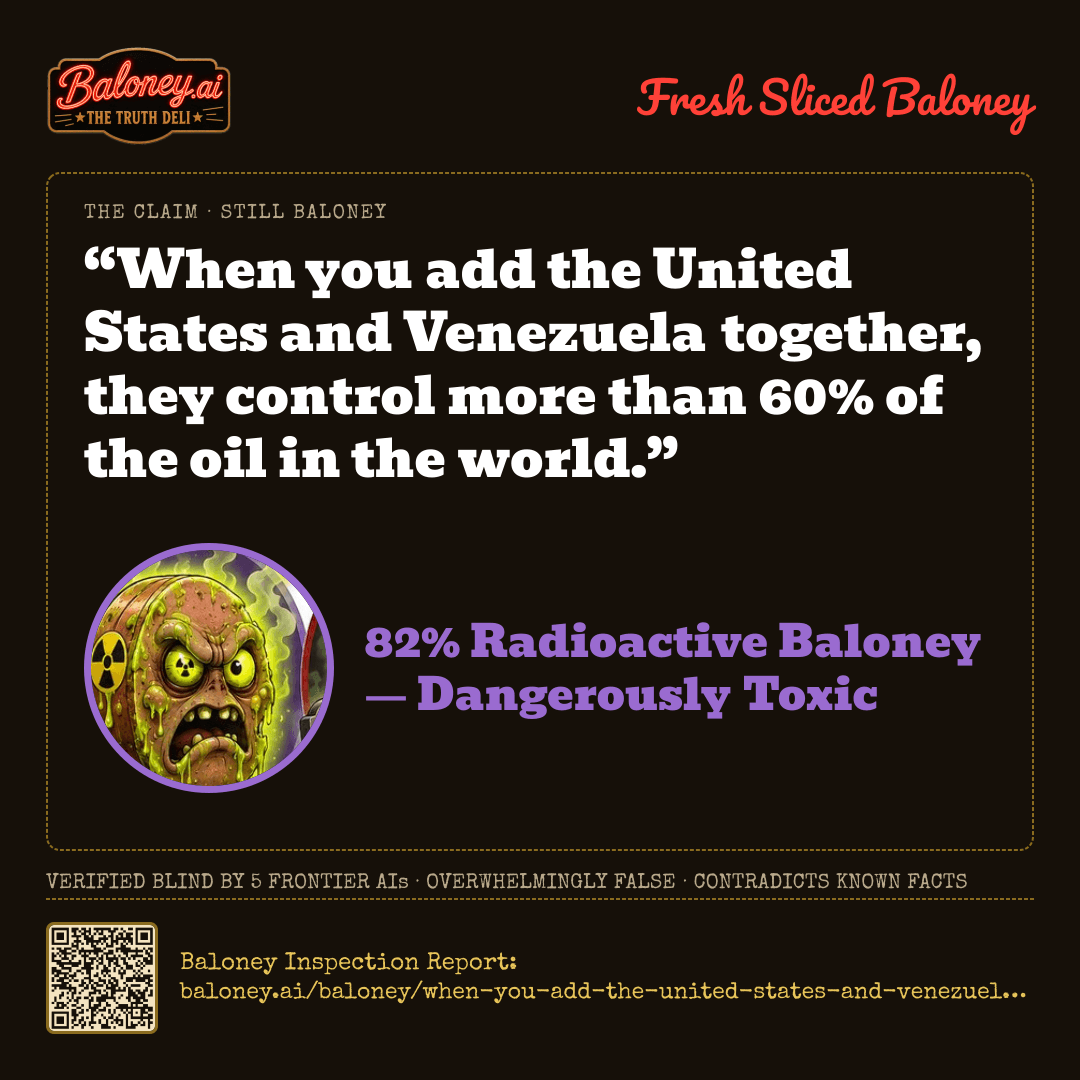
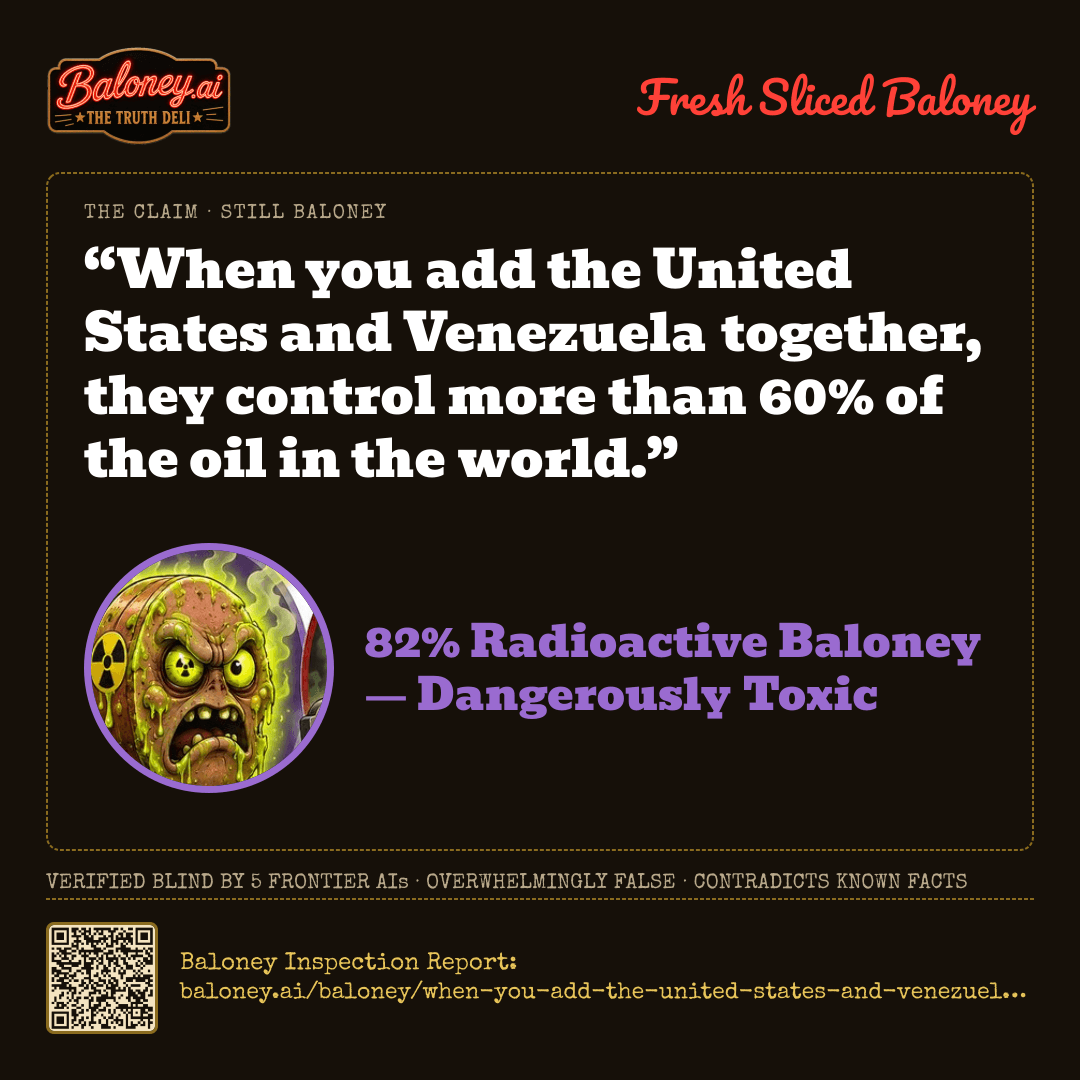
82%“When you add the United States and Venezuela together, they control more than 60% of the oil in the world.”
82%Radioactive Baloney — Dangerously Toxic
Dangerously misleading.
Overwhelmingly falseContradicts known factsPromotes false beliefsPotential for harm
✓ BLIND VALIDATION CONFIRMED THIS SCORE
Serve It Fresh
Ready to Serve11 servings
Serve it the way you want it
The Verdict
 “When you add the United States and Venezuela together, they control more than 60% of the oil in the world.”82% Radioactive Baloney — Dangerously ToxicVerified blind by 5 frontier AIs · Baloney Inspection Report: baloney.ai/baloney/when-you-add-the-united-states-and-venezuela-together-they
The Baloney Sampler
The United States and Venezuela together hold about 20-22 percent of the world's proved crude-oil reserves, not more than 60 percent. Venezuela has about 303 billion barrels and the United States about 44-50 billion, against a world total of roughly 1.6-1.7 trillion barrels. Combined production is also in the low-20-percent range. These findings rest on figures from the U.S. Energy Information Administration, OPEC, and the CIA World Factbook.
Nonstandard oil-in-place and technically recoverable figures, including USGS estimates for Venezuela's Orinoco Belt, are not oil anyone controls and are not comparable to global proved reserves. They still do not establish a 60 percent share. The Associated Press and France 24 independently put the combined U.S.-Venezuela share at about 22 percent of proved reserves and about 23 percent of production.
Resting on U.S. Energy Information Administration · Organization of the Petroleum Exporting Countries · CIA World Factbook · Associated Press
Other ways to slice it — phrasings that might have changed the rating
- “When you add the United States and Venezuela together, they hold about 20 percent of the world's proved oil reserves.” EIA, OPEC, and CIA figures used across the reports put the combined proved-reserve share at roughly 20-22 percent, the standard metric for such a claim.
- “Venezuela holds the world's largest proved crude-oil reserves.” Every lab report treated Venezuela's roughly 303 billion barrels as the world's largest proved-reserve total and as the only accurate premise in the original claim.
- “The United States is the world's largest producer of petroleum and other liquids.” The reports found U.S. output near 20 percent of global supply while Venezuela contributes well under 1 percent, so a production claim about the United States alone matches the evidence.
Written from the panel’s reports by xAI · grok-4.6. Nothing here changed the score.
The Order Ticket
01:39:15CLAIM RECEIVED — QUEUED FOR INSPECTION✓
01:39:47claude-opus-5 REPORTED — SCORE 82, CONFIDENCE 93✓
01:40:06gpt-5.5 REPORTED — SCORE 82, CONFIDENCE 94✓
01:39:50gemini-3.1-pro-preview REPORTED — SCORE 85, CONFIDENCE 99✓
01:39:22sonar-pro REPORTED — SCORE 90, CONFIDENCE 97✓
01:40:48grok-4.6 REPORTED — SCORE 78, CONFIDENCE 88✓
01:42:12PRIMARY MASTER GROK — SCORE 84✓
01:40:54BLIND VALIDATION CHATGPT — SCORE 86✓
01:43:14AGREEMENT CONFIRMED — DELTA 4✓
01:43:14SCORING MODEL V2 — MEDIAN OF 5 COUNTED LAB SCORES: 82, 82, 85, 90, 78 → 82.✓
01:43:14SOURCE RULE — LABS CITED 25 SOURCES: 0 DISCARDED FOR HAVING NO URL, 1 DISCARDED AS DEAD LINKS (404/410), 6 COULD NOT BE OPENED BY US AND ARE MARKED UNVERIFIED.✓
01:43:14SOURCE RULE — PRIMARY MASTER RULED ON 18 SOURCES: 0 DISCARDED FOR HAVING NO URL, 0 DISCARDED AS DEAD LINKS, 5 MARKED UNVERIFIED, 13 VERIFIED.✓
How This One Was Sliced
Station 1 · Blind Inspection — Five Graders, Zero Peeking
Each lab scored the claim independently, without seeing the others. Open a breakdown for its evidence, its sources, and how sure it was.
Anthropic · EQUAL WEIGHT · 31.7s
claude-opus-5
82%BALONEY
ROUND-1 BREAKDOWN
Evidence offered for the claim- Venezuela does hold the world's largest proved crude oil reserves — roughly 303 billion barrels, or about 17–18% of the global proved total — so the claim's implicit premise that Venezuela is an oil heavyweight is correct (EIA country analysis; CIA World Factbook country comparison).
- The United States has been the world's largest producer of petroleum and other liquids since 2018, supplying roughly 20% of global output (~20–22 million b/d of total liquids, ~13 million b/d crude), so on a *production* basis the U.S. share is large (EIA FAQ).
- If one abandons the standard 'proved reserves' metric and counts total oil *in place* / technically speculative resources, the numbers grow enormously: the Orinoco Belt holds on the order of 1.2–1.4 trillion barrels in place, and the U.S. Green River oil-shale formation contains an estimated 1.5–3 trillion barrels of kerogen in place (USGS/EIA). Under that non-standard framing, a 'more than half the world's oil' talking point can be constructed — but oil-in-place is not oil anyone 'controls' or can produce, and such figures are not comparable to global reserve totals.
- Combined, the two countries do sit at or near the top of both key league tables (Venezuela #1 in reserves, U.S. #1 in production), which likely explains the intuition behind the exaggeration.
Evidence against the claim- Proved reserves: world total is roughly 1.6–1.7 trillion barrels. Venezuela ~303 billion (≈17–18%), the United States ~44–48 billion (≈3%). Combined that is roughly 20–21% — barely a third of the claimed 60% (EIA, CIA World Factbook, Energy Institute Statistical Review).
- Production: global supply is roughly 100–103 million b/d. The U.S. contributes about 20–22 million b/d of total liquids; Venezuela has averaged only about 0.7–1.0 million b/d in recent years (well under 1% of world supply). Combined ≈21%, again nowhere near 60%.
- Saudi Arabia (~267 Bbbl), Iran (~209 Bbbl), Canada (~170 Bbbl), Iraq (~145 Bbbl), Russia, Kuwait and the UAE together hold well over half of world proved reserves on their own — mathematically leaving no room for a U.S.+Venezuela 60% share.
- On any of the three standard metrics used by energy agencies — proved reserves, current production, or export volumes — the U.S.-plus-Venezuela figure lands in the 20–25% range. Reaching 60% requires substituting a non-standard 'oil in place' metric for one country while comparing it against proved reserves for the rest of the world, which is an apples-to-oranges error.
- On exports specifically the claim is weakest of all: the U.S. is a modest net exporter of crude and Venezuela's exports have collapsed under sanctions and infrastructure decay; the two together do not remotely 'control' global oil trade, which is dominated by Saudi Arabia, Russia, Iraq and the UAE.
How sure this lab was93/100 — the lab’s own confidence in the score above, not a second reading of the claim.
SourcesU.S. Energy Information Administrationgov · 97 · U.S. Energy Information Administrationgov · 97 · CIA World Factbookgov · 88 · U.S. Energy Information Administration (U.S. Crude Oil and Natural Gas Proved Reserves report)gov · 97 · Energy Institute (formerly BP Statistical Review of World Energy)other · 92 · U.S. Energy Information Administration, International Energy Datagov · 96 · International Energy Agencyother · 93
OpenAI · EQUAL WEIGHT · 51.4s
gpt-5.5
82%BALONEY
ROUND-1 BREAKDOWN
Evidence offered for the claim- Venezuela is legitimately one of the largest oil-reserve holders: EIA says Venezuela has the world's largest proved crude-oil reserves, about 303 billion barrels. The United States also has substantial proved reserves; EIA reported 48.3 billion barrels of U.S. crude oil and lease condensate proved reserves at year-end 2023.
- A very loose, nonstandard reading based on unconventional resources makes both countries look larger: USGS estimated 513 billion barrels of technically recoverable heavy oil in Venezuela's Orinoco Oil Belt. But that is not the same as proved reserves or 'control' of world oil, and it still does not by itself verify the 60% figure.
Evidence against the claim- Using the standard metric for 'oil in the world'--proved crude-oil reserves--the claim is far off. The CIA World Factbook's country-comparison table puts world proved crude-oil reserves at roughly 1.7 trillion barrels, while Venezuela plus the United States total only about 350 billion barrels, around one-fifth of the world, not more than 60%.
- Using recent EIA figures gives the same result: Venezuela is about 303 billion barrels and the United States 48.3 billion barrels, for about 351 billion barrels combined. Against a world total near 1.7 trillion barrels, that is about 20-21%; to exceed 60%, the two countries would need to control more than 1 trillion barrels.
- A production-based interpretation also does not rescue the claim. The United States is the world's largest oil producer, but Venezuela's production is much smaller; combined U.S.-Venezuela output is nowhere near 60% of global oil production.
- The word 'control' is misleading. Proved reserves, technically recoverable resources, oil in place, and current production are different concepts; oil physically in the ground is not automatically economically recoverable or controlled by a government or market actor.
How sure this lab was94/100 — the lab’s own confidence in the score above, not a second reading of the claim.
SourcesU.S. Energy Information Administrationgov · 96 · U.S. Energy Information Administrationgov · 96 · CIA World Factbookgov · 88 · U.S. Geological Surveygov · 95 · BP Statistical Review of World Energy 2022other · 84
Google · EQUAL WEIGHT · 34.8s
gemini-3.1-pro-preview
85%BALONEY
ROUND-1 BREAKDOWN
Evidence offered for the claim- Venezuela does possess the largest proven crude oil reserves of any single country in the world.
- The United States is currently the world's leading daily producer of crude oil.
Evidence against the claim- According to data from OPEC and the U.S. Energy Information Administration (EIA), total global proven oil reserves stand at approximately 1.5 to 1.7 trillion barrels.
- Venezuela's world-leading reserves are estimated at approximately 303 billion barrels, which accounts for roughly 17% to 19% of the global total.
- The United States holds roughly 44 to 50 billion barrels of proven oil reserves, accounting for approximately 2.5% to 3% of the global total.
- Combined, the United States and Venezuela control roughly 20% to 22% of the world's proven oil reserves, which is mathematically nowhere near the 60% alleged in the claim.
- Even if the word 'control' was interpreted as daily oil production rather than reserves, the United States produces roughly 20% to 22% of the world's oil and Venezuela produces roughly 1%, combining for less than a quarter of global production.
How sure this lab was99/100 — the lab’s own confidence in the score above, not a second reading of the claim.
SourcesOrganization of the Petroleum Exporting Countries (OPEC)gov · 90 · U.S. Energy Information Administrationgov · 95 · Worldometerother · 75
Perplexity · EQUAL WEIGHT · 7.3s
sonar-pro
90%BALONEY
ROUND-1 BREAKDOWN
Evidence offered for the claim- Venezuela has the world's largest proven crude-oil reserves, and the United States also has a large reserve base. [However, no credible source in the reviewed evidence supports their combined share exceeding 60%.]
- A U.S.-Venezuela arrangement reportedly gives the United States rights to Venezuelan fields containing about 65 billion barrels of proven reserves; counting those rights does not make the countries’ combined reserves exceed 60% of the global total. [8]
Evidence against the claim- The U.S. Energy Information Administration figures cited by The New York Times put Venezuela's proven reserves at about 303 billion barrels and U.S. reserves at about 46 billion barrels. Together, that is approximately 349 billion barrels out of nearly 1.6 trillion worldwide, or about 22%, not more than 60%. [2]
- The Organization of the Petroleum Exporting Countries reports global proven crude-oil reserves of 1,567 billion barrels at the end of 2024. Using the reported U.S. and Venezuelan figures, their combined share is about 22.3%. [6]
- Associated Press independently concludes that the combined U.S.-Venezuelan reserves account for only about 22% of the world's nearly 1.6 trillion barrels. [8]
- If 'oil' means current production rather than reserves, the claim is also unsupported: the reported combined U.S. and Venezuelan production is about 23% of global production, far below 60%. [2]
- France 24's fact-check similarly estimates the combined share at roughly 21.9% of global proven reserves and about 23.2% of current production. [4]
- The statement is ambiguous about whether 'control' means geological reserves, ownership, legal rights, or production. Under the standard reserves and production measures reported by official statistics and fact-checkers, it is substantially false. [2][4][8]
How sure this lab was97/100 — the lab’s own confidence in the score above, not a second reading of the claim.
SourcesOrganization of the Petroleum Exporting Countriesgov · 95 · The New York Timesnews · 93 · Associated Pressfactcheck · 96 · France 24factcheck · 88 · BBCnews · 94
xAI · EQUAL WEIGHT · 93.1s
grok-4.6
78%BALONEY
ROUND-1 BREAKDOWN
Evidence offered for the claim- Venezuela holds the world's largest proven oil reserves, typically reported at roughly 300 billion barrels (about 17-18% of the global total).
Evidence against the claim- U.S. proved crude oil reserves are on the order of 44-69 billion barrels depending on source, year, and whether lease condensate is included.
- Global proved oil reserves are approximately 1.6-1.7 trillion barrels.
- U.S. plus Venezuelan proved reserves therefore total roughly 350-370 billion barrels, or about 20-22% of the world, not more than 60%.
- Combined oil production of the two countries is roughly 13-15 million barrels per day versus a world total near 100 million barrels per day (~14%), also far below 60%.
- No standard definition of oil (proved reserves, production, or consumption) yields a combined U.S.+Venezuela share near 60%.
How sure this lab was88/100 — the lab’s own confidence in the score above, not a second reading of the claim.
SourcesU.S. Energy Information Administrationgov · 95 · CIA World Factbookgov · 90 · Our World in Dataedu · 88 · Energy Institute (Statistical Review of World Energy)other · 92
Station 2 · The Masters
Primary Master · drawn at random
grok-4.6
84% BALONEY
All five evaluators found the statement overwhelmingly false on every standard metric. Official proved-reserve figures put Venezuela at about 303 billion barrels and the United States at about 44–50 billion, together roughly 350 billion of a world total near 1.6–1.7 trillion barrels, or about 20–22 percent—not more than 60 percent. Combined production is in a similar low-20-percent range. I weighted EIA, OPEC, and CIA statistics most heavily because they are the primary official series the evaluators used and they agree closely. Speculative oil-in-place and technically recoverable figures raised by two evaluators were treated as non-standard and still insufficient. A reported U.S. claim on some Venezuelan fields also fails to close the gap. Differences among evaluators were limited to exact barrel counts and whether reserves or production was the intended meaning; none found a path to 60 percent.
The five evaluators agreed that combined U.S. and Venezuelan proved reserves and production each fall around 20–23 percent of the world total, far below 60 percent, and that Venezuela is the top reserve holder while the United States is the top producer. They differed slightly on U.S. reserve totals (about 44–69 billion barrels) and world totals (about 1.5–1.7 trillion), and two discussed oil-in-place estimates that they themselves said do not support the claim.
Blind Validation Master · never saw the Primary’s work
gpt-5.5
86% BALONEY
The reports are unanimous that the claim is false under the standard ways such a statement would be measured. Venezuela has very large proved oil reserves, about 303 billion barrels, and the U.S. has roughly 44-50 billion barrels. Combined, that is about 350 billion barrels out of a global total around 1.6-1.7 trillion barrels, or roughly 20-22%, not more than 60%. Interpreting “oil” as current production also does not rescue the claim: the U.S. is a major producer, but Venezuela is not producing enough for the two together to approach 60% of world output; estimates in the reports put the combined share far below that, around the low 20% range or less depending on the production metric. The word “control” is ambiguous, and there are nonstandard ways to cite huge oil-in-place or technically recoverable resource figures, but the reports agree those are not comparable to proved reserves and do not support the statement as written. Because the claim is not a minor exaggeration but overstates the combined share by roughly a factor of three, it merits a high Radioactive Baloney score.
AGREEMENT TEST PASSED — MASTERS SCORED 84% AND 86% · BLIND VALIDATION CONFIRMED THIS SCORE · NO RE-EVALUATION REQUIRED
How the number was reached · scoring model v2 · how our models work
- Median of 5 counted lab scores: 82, 82, 85, 90, 78 → 82.
The Evidence
Evidence offered for the claim
- Venezuela has the world’s largest proved reserves Evaluators consistently report Venezuelan proved crude-oil reserves at about 303 billion barrels, roughly 17–18 percent of the global total, so Venezuela is a genuine oil heavyweight.
- The United States is the top oil producer The United States has been the world’s largest producer of petroleum and other liquids in recent years, with substantial proved reserves of about 44–50 billion barrels.
- Oil-in-place figures are enormous DEBUNKED — Orinoco Belt oil in place and U.S. Green River kerogen are estimated in the trillions of barrels, but oil-in-place is not proved reserves, is not economically controlled production, and cannot be compared with global reserve totals to reach 60 percent.
- U.S. rights to some Venezuelan fields DEBUNKED — A reported arrangement giving the United States rights to Venezuelan fields with about 65 billion barrels of proved reserves still leaves the combined share far below 60 percent of the world total.
Evidence against the claim
- Combined proved reserves are about 22 percent EIA, OPEC, and CIA figures put Venezuela at about 303 billion barrels and the United States at about 44–50 billion, together about 349–351 billion of nearly 1.6–1.7 trillion barrels worldwide, or about 20–22 percent.
- Combined production is also far below 60 percent The United States produces roughly 20–22 percent of world oil; Venezuela produces about 1 percent or less. Combined output is about 14–23 percent of a global total near 100 million barrels per day.
- Other countries already hold most proved reserves Saudi Arabia, Iran, Canada, Iraq, Russia, Kuwait, and the UAE together hold well over half of world proved reserves, leaving no mathematical room for a U.S.–Venezuela share above 60 percent.
- No standard definition of oil reaches 60 percent Proved reserves, current production, and export volumes all put the two countries in the 20–25 percent range. Reaching 60 percent requires mixing non-standard oil-in-place figures for one country with proved reserves for the rest of the world.
Sources · Reliability · Why Accepted or Discounted
| Source | Type | Reliability | Ruling |
|---|
| Organization of the Petroleum Exporting Countriesunverified | gov | 95 | ACCEPTED — Primary OPEC statistical series used for global proved-reserve totals. |
| The New York Timesunverified | news | 93 | ACCEPTED — Fact-check citing EIA reserve figures consistent with other official sources. |
| Associated Pressunverified | factcheck | 96 | ACCEPTED — Independent fact-check concluding a combined share of about 22 percent. |
| France 24 | factcheck | 88 | ACCEPTED — Fact-check estimating combined reserves near 21.9 percent and production near 23.2 percent. |
| BBC | news | 94 | ACCEPTED — Cited as supporting news coverage; does not contradict official reserve statistics. |
| U.S. Energy Information Administration | gov | 96 | ACCEPTED — Authoritative U.S. proved-reserves report used across multiple evaluations. |
| CIA World Factbook | gov | 90 | ACCEPTED — Standard country comparison of proved crude-oil reserves. |
| Our World in Data | edu | 88 | ACCEPTED — Secondary compilation of proved-reserve data consistent with EIA and Energy Institute figures. |
| Energy Instituteunverified | other | 92 | ACCEPTED — Widely used Statistical Review of World Energy for global reserve and production totals. |
| Organization of the Petroleum Exporting Countriesunverified | gov | 90 | ACCEPTED — OPEC data graphs on reserves, consistent with other official totals. |
| U.S. Energy Information Administration | gov | 96 | ACCEPTED — EIA FAQ on U.S. and world oil production used by multiple evaluators. |
| Worldometer | other | 75 | DISCOUNTED — Tertiary aggregator with the lowest cited reliability; primary EIA, OPEC, and CIA figures already cover the same ground. |
| U.S. Energy Information Administration | gov | 97 | ACCEPTED — EIA country analysis for Venezuela, the main source for the 303-billion-barrel figure. |
| CIA World Factbook | gov | 88 | ACCEPTED — Country-comparison table of proved crude-oil reserves, consistent with EIA and OPEC. |
| U.S. Energy Information Administration | gov | 96 | ACCEPTED — EIA international production data used to test a production-based reading of the claim. |
| International Energy Agency | other | 93 | ACCEPTED — Authoritative oil-market report supporting global supply context. |
| U.S. Geological Survey | gov | 95 | ACCEPTED — USGS estimate of technically recoverable Orinoco heavy oil, cited only to show that even this non-proved figure does not establish 60 percent control. |
| BP Statistical Review of World Energy 2022 | other | 84 | ACCEPTED — Predecessor statistical review; figures align with the later Energy Institute series. |
Every link was opened when this claim was inspected. A dead link was discarded before publication; “unverified” means the site refused our automated check and the link is the one the panel cited. A source without a URL was never kept.
Serve It Fresh
Ready to Serve11 servings
Serve it the way you want it
The Verdict
“When you add the United States and Venezuela together, they control more than 60% of the oil in the world.”82% Radioactive Baloney — Dangerously ToxicVerified blind by 5 frontier AIs · Baloney Inspection Report: baloney.ai/baloney/when-you-add-the-united-states-and-venezuela-together-they