Baloney Inspection Report: Claim #1089 · Inspected Sep 30, 2026, 3:30 PM PDT · Scoring model v2
 88%
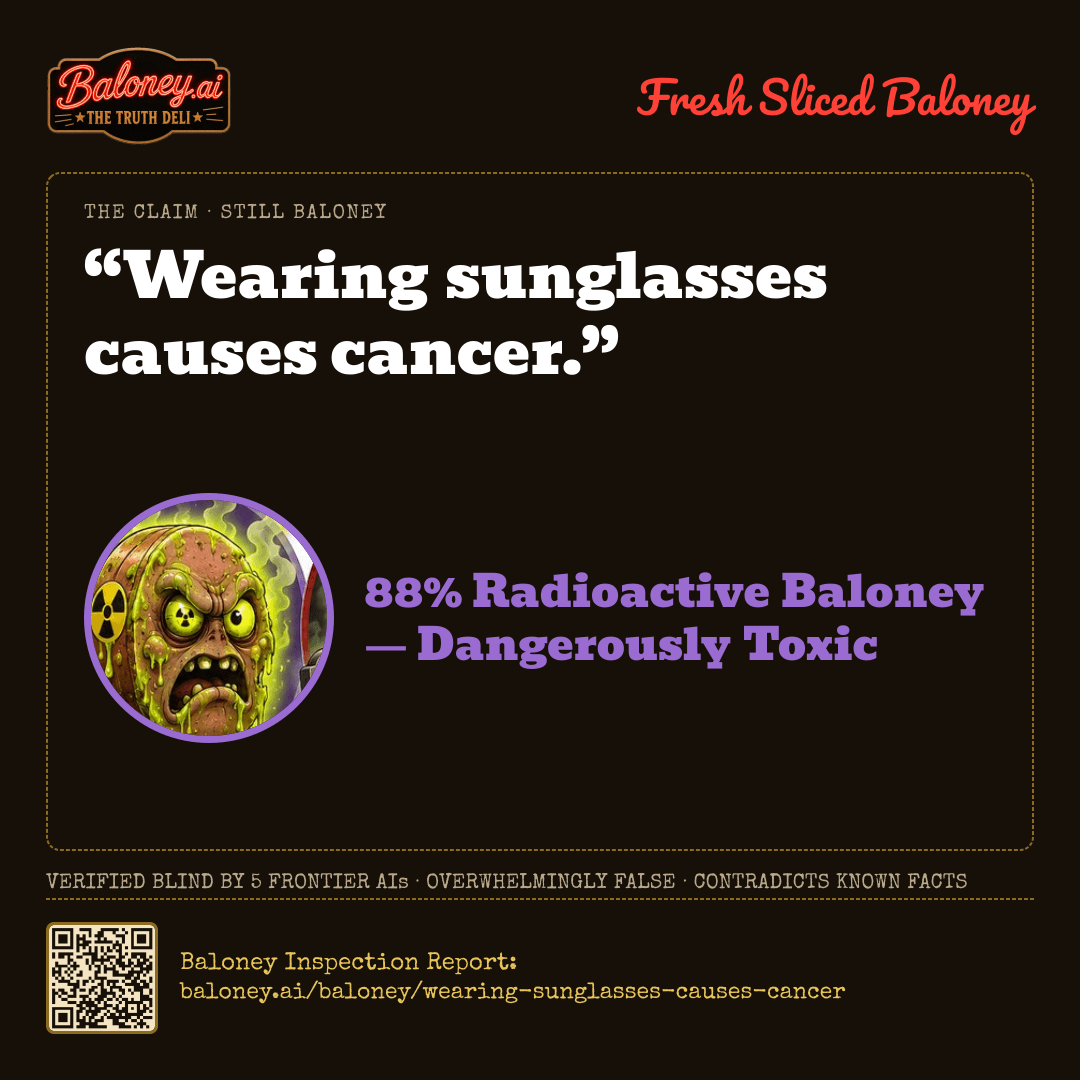
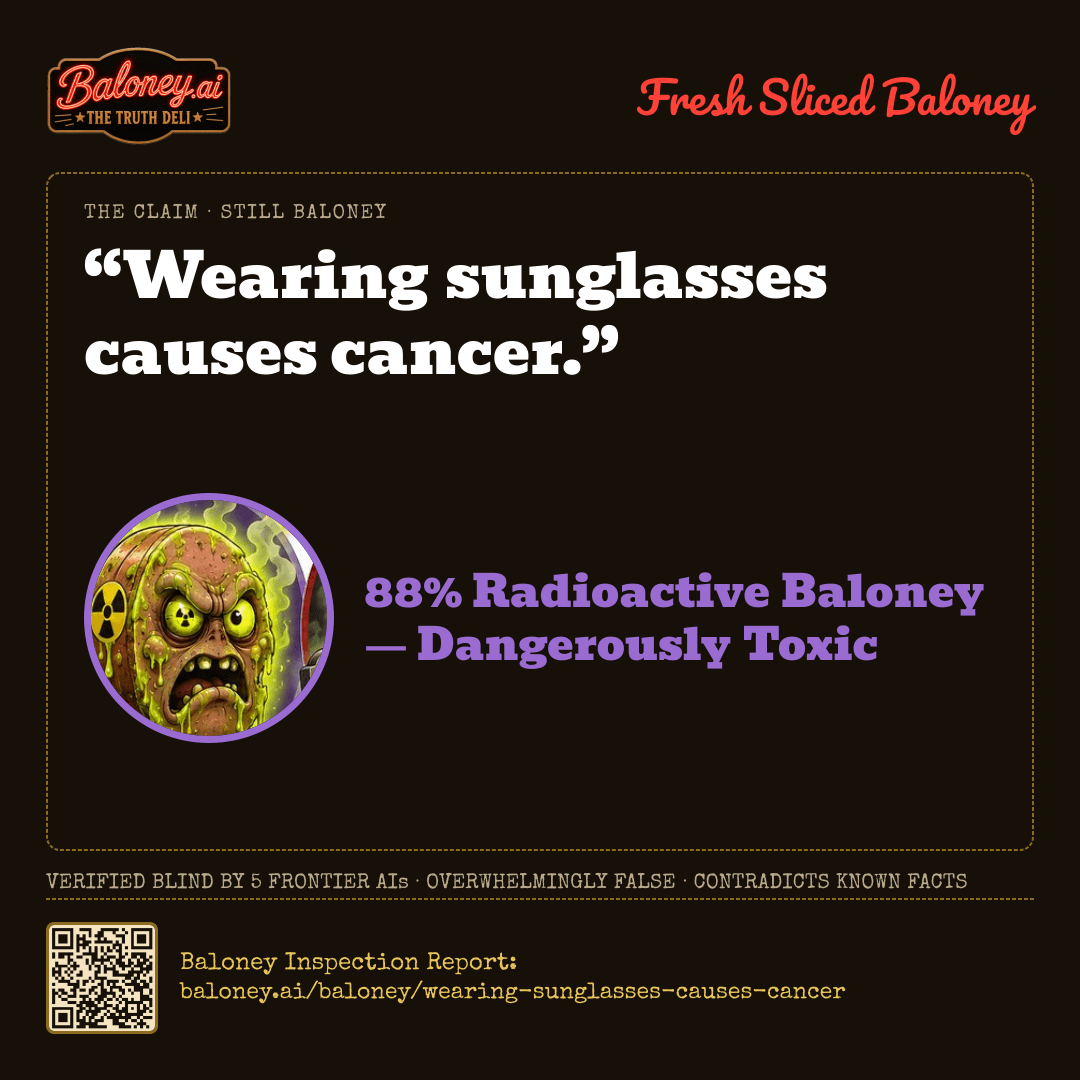
88%“Wearing sunglasses causes cancer.”
88%Radioactive Baloney — Dangerously Toxic
Dangerously misleading.
Overwhelmingly falseContradicts known factsPromotes false beliefsPotential for harm
Serve It Fresh
Ready to Serve10 servings
Serve it the way you want it
The Verdict
 “Wearing sunglasses causes cancer.”88% Radioactive Baloney — Dangerously ToxicVerified blind by 5 frontier AIs · Baloney Inspection Report: baloney.ai/baloney/wearing-sunglasses-causes-cancer
The Baloney Sampler
The reports found no credible scientific evidence that ordinary sunglasses cause cancer. They found that ultraviolet radiation—not sunglasses—is the established carcinogenic exposure, and that major health authorities recommend UV-blocking sunglasses to protect the eyes and surrounding skin.
The reports rejected the idea that sunglasses suppress protective tanning through the eyes, describing tanning as a response driven by UV exposure in the skin. They noted limited caveats: dark lenses without UV filtering may fail to protect or theoretically increase eye exposure, but that concerns inadequate protection rather than sunglasses causing cancer.
Resting on World Health Organization · Centers for Disease Control and Prevention · American Cancer Society · U.S. Food and Drug Administration
Other ways to slice it — phrasings that might have changed the rating
- “Wearing sunglasses that do not block ultraviolet radiation can increase ultraviolet exposure to the eyes.” The reports say dark lenses without UV filtering may dilate the pupils while admitting UV, potentially increasing ocular exposure.
- “Wearing UV-blocking sunglasses reduces the risk of ultraviolet-related damage to the eyes and skin around them.” The reports cite health authorities recommending UV-blocking sunglasses because ultraviolet radiation causes cancer and other eye damage.
- “Wearing sunglasses causes people to stay outdoors longer, which can increase their total ultraviolet exposure.” The reports identify prolonged outdoor exposure as a possible behavioral pathway, while distinguishing it from cancer caused by wearing sunglasses.
Written from the panel’s reports by Perplexity · sonar-pro. Nothing here changed the score.
The Order Ticket
22:30:15CLAIM RECEIVED — QUEUED FOR INSPECTION✓
22:30:59claude-opus-5 REPORTED — SCORE 88, CONFIDENCE 93✓
22:30:52gpt-5.5 REPORTED — SCORE 88, CONFIDENCE 90✓
22:30:46gemini-3.1-pro-preview REPORTED — SCORE 99, CONFIDENCE 100✓
22:30:23sonar-pro REPORTED — SCORE 97, CONFIDENCE 97✓
22:31:48grok-4.6 REPORTED — SCORE 87, CONFIDENCE 90✓
22:32:12PRIMARY MASTER PERPLEXITY — SCORE 97✓
22:31:56BLIND VALIDATION GEMINI — SCORE 99✓
22:32:20AGREEMENT MODERATE DISAGREEMENT — DELTA 11✓
22:32:20SCORING MODEL V2 — MEDIAN OF 5 COUNTED LAB SCORES: 88, 88, 99, 97, 87 → 88.✓
22:32:20SOURCE RULE — LABS CITED 29 SOURCES: 0 DISCARDED FOR HAVING NO URL, 4 DISCARDED AS DEAD LINKS (404/410), 1 COULD NOT BE OPENED BY US AND ARE MARKED UNVERIFIED.✓
22:32:20SOURCE RULE — PRIMARY MASTER RULED ON 20 SOURCES: 0 DISCARDED FOR HAVING NO URL, 0 DISCARDED AS DEAD LINKS, 1 MARKED UNVERIFIED, 19 VERIFIED.✓
How This One Was Sliced
Station 1 · Blind Inspection — Five Graders, Zero Peeking
Each lab scored the claim independently, without seeing the others. Open a breakdown for its evidence, its sources, and how sure it was.
Anthropic · EQUAL WEIGHT · 44.0s
claude-opus-5
88%BALONEY
ROUND-1 BREAKDOWN
Evidence offered for the claim- A long-circulating internet/alt-health hypothesis claims sunglasses block light from reaching the retina, suppressing the pituitary/melanocyte-stimulating-hormone response and thus reducing protective tanning, supposedly raising skin-cancer risk. This is a speculative mechanism promoted in popular health writing; no controlled human study has demonstrated that wearing sunglasses increases cancer incidence.
- There is a narrow, partially legitimate concern about *poor-quality* sunglasses: dark lenses without UV400 filtering cause the pupil to dilate while still admitting UVA/UVB, potentially increasing ultraviolet dose to the lens and retina compared with wearing nothing. Eye-care bodies cite this as a reason to buy UV-blocking lenses — it is an argument against cheap non-UV lenses, not evidence that sunglasses cause cancer.
- Epidemiology of uveal (ocular) melanoma is genuinely mixed — unlike cutaneous melanoma, its link to sunlight exposure is weak and inconsistent — so one cannot claim sunglasses *prevent* all eye cancers. But ambiguity about prevention is not evidence of causation.
- Sunglasses can reduce natural UVB exposure to the eye region and, marginally, alter overall light exposure, which some argue could affect vitamin D or circadian signalling. No cancer-incidence data support this pathway, and vitamin D is produced in skin, not the eyes.
Evidence against the claim- No cancer agency, ophthalmology body, or dermatology body anywhere lists sunglasses as a cancer risk factor. The WHO, US CDC, US National Cancer Institute, and Cancer Research UK all identify ultraviolet radiation itself as the carcinogen and explicitly recommend UV-blocking sunglasses as protective equipment.
- The 'tanning suppression' mechanism is physiologically unsupported: melanogenesis in human skin is driven predominantly by direct UV damage to keratinocytes/melanocytes (p53–POMC–α-MSH signalling in the skin), not by an ocular light signal, and no trial shows sunglass wearers tan less or burn more.
- Roughly 5–10% of all skin cancers occur on the eyelids and periorbital skin, one of the most sun-exposed and thinnest-skinned areas of the body. Wraparound sunglasses physically shade this region, so the plausible direction of effect is protective, not causative.
- UV exposure to the eye is causally linked to cataract, pterygium, photokeratitis, and ocular-surface squamous neoplasia (a conjunctival cancer strongly associated with cumulative UV). UV-filtering sunglasses reduce that exposure, again pointing to reduced, not increased, cancer risk.
- The claim is unfalsifiably vague as written — it specifies no cancer type, no dose, no population, and no mechanism — and no peer-reviewed cohort or case-control study reports elevated cancer incidence among sunglass wearers.
- The claim carries real harm potential: discouraging UV eye protection increases risk of cataract, macular damage and conjunctival neoplasia, particularly in high-UV regions and at high altitude.
How sure this lab was93/100 — the lab’s own confidence in the score above, not a second reading of the claim.
SourcesWorld Health Organizationgov · 95 · World Health Organizationgov · 95 · US National Cancer Institutegov · 96 · US Centers for Disease Control and Preventiongov · 93 · Cancer Research UKother · 92 · American Academy of Ophthalmologyother · 92 · American Academy of Ophthalmologyother · 91 · Skin Cancer Foundationother · 85 · American Cancer Societyother · 90 · UK National Health Servicegov · 90
OpenAI · EQUAL WEIGHT · 36.6s
gpt-5.5
88%BALONEY
ROUND-1 BREAKDOWN
Evidence offered for the claim- Only a narrow, indirect caveat supports any part of the idea: very dark sunglasses that do not block UV could theoretically be worse for the eyes than no sunglasses because dark lenses can dilate pupils while failing to filter ultraviolet radiation. The American Academy of Ophthalmology warns to choose sunglasses that block 99%-100% of UV rays; UV radiation is a known carcinogenic exposure. This is not evidence that sunglasses generally cause cancer—only that inadequate UV protection may fail to protect, or could plausibly increase ocular UV exposure.
- Ultraviolet radiation from sunlight is linked to skin cancers and some eye cancers; therefore, if sunglasses are counterfeit, mislabeled, or lack UV protection, they may not reduce that UV-related risk. This is evidence for careful selection of UV-blocking sunglasses, not for the broad claim as written.
Evidence against the claim- The claim as written is contradicted by major public-health guidance: cancer and eye-health authorities recommend sunglasses that block UVA/UVB as a protective measure against UV exposure, not as a cancer cause.
- The American Cancer Society recommends wraparound sunglasses with at least 99% UV absorption to protect the eyes and surrounding skin from UV rays, which are the relevant carcinogenic exposure.
- The CDC recommends sunglasses that block both UVA and UVB rays as part of sun-safety behavior to reduce UV harm.
- The National Eye Institute says sunglasses protect eyes from UV rays and advises choosing lenses that block 99%-100% of UVA and UVB radiation.
- The strongest established causal agent here is UV radiation, not sunglasses. Proper sunglasses reduce UV exposure; no credible cancer agency identifies ordinary UV-blocking sunglasses as a cancer cause.
How sure this lab was90/100 — the lab’s own confidence in the score above, not a second reading of the claim.
SourcesAmerican Academy of Ophthalmologyother · 88 · American Cancer Societyother · 93 · Centers for Disease Control and Preventiongov · 95 · IARC Monographs / NCBI Bookshelfother · 94
Google · EQUAL WEIGHT · 30.8s
gemini-3.1-pro-preview
99%BALONEY
ROUND-1 BREAKDOWN
Evidence offered for the claim- There is no peer-reviewed scientific evidence supporting the claim that wearing sunglasses causes cancer.
- The claim originates from a viral internet myth promoted by alternative wellness influencers. They incorrectly argue that blocking sunlight from the eyes prevents the brain from signaling the skin to produce melanin (the pigment that protects against burning), supposedly making the body more vulnerable to severe sunburns and skin cancer.
Evidence against the claim- Melanogenesis (tanning) is primarily a localized cellular response triggered directly by UV radiation damaging the DNA in skin cells, not a systemic process controlled by sunlight entering the eyes.
- UV radiation from the sun is a well-established human carcinogen. Failing to protect the eyes and surrounding area significantly increases the risk of developing eyelid cancers, including basal cell carcinoma, squamous cell carcinoma, and melanoma.
- Unprotected UV exposure to the eyes is also linked to intraocular melanoma (cancer inside the eye), as well as severe non-cancerous conditions like cataracts, photokeratitis (snow blindness), and macular degeneration.
- Leading global health organizations, including the CDC, the American Cancer Society, and the American Academy of Ophthalmology, universally recommend wearing sunglasses that block 99% to 100% of UVA and UVB rays specifically to prevent cancer and ocular damage.
How sure this lab was100/100 — the lab’s own confidence in the score above, not a second reading of the claim.
SourcesAmerican Academy of Ophthalmologyother · 95
Perplexity · EQUAL WEIGHT · 8.0s
sonar-pro
97%BALONEY
ROUND-1 BREAKDOWN
Evidence offered for the claim- No credible scientific evidence shows that wearing sunglasses causes cancer. The strongest conceivable argument is indirect: sunglasses might enable someone to remain outdoors longer, increasing overall ultraviolet exposure, but this is a behavioral possibility rather than evidence that sunglasses themselves cause cancer.[https://fullfact.org/health/sunglasses-cancer-moritz/]
Evidence against the claim- The American Cancer Society recommends UV-blocking sunglasses because unprotected ultraviolet exposure can damage the eyes and surrounding skin and may increase the risk of certain eye diseases, possibly including eye cancer.[https://www.cancer.org/cancer/risk-prevention/sun-and-uv/uv-protection.html]
- The FDA recommends sunglasses labeled UV400 or 100% UV protection because they block more than 99% of UVA and UVB radiation.[https://www.fda.gov/consumers/consumer-updates/tips-stay-safe-sun-sunscreen-sunglasses]
- The American Cancer Society recommends UV-protected sunglasses and says they may help reduce cancers of the skin around the eyes; it also notes that the relationship between sunlight and eye melanoma is not proven and, if present, is likely small.[https://www.cancer.org/cancer/types/eye-cancer/causes-risks-prevention/prevention.html]
- AFP Fact Check reported that dermatology experts found no merit in linking sunglasses to cancer and that properly designed UV-blocking eyewear can help prevent sun damage.[https://factcheck.afp.com/doc.afp.com.33YG2KA]
- Full Fact found no credible evidence or scientific basis for the claim that sunglasses cause cancer and reported that verified UV-filtering sunglasses are recommended by health authorities, including the NHS.[https://fullfact.org/health/the-claim-that-sunglasses-cause-cancer-isnt-backed-by-evidence/]
- The CDC states that ultraviolet radiation is carcinogenic and identifies sunglasses as an important measure for protecting the eyes from UV radiation.[https://www.cdc.gov/yellow-book/hcp/environmental-hazards-risks/sun-exposure-in-travelers.html]
How sure this lab was97/100 — the lab’s own confidence in the score above, not a second reading of the claim.
SourcesFull Factfactcheck · 94 · Full Factfactcheck · 94 · AFP Fact Checkfactcheck · 95 · American Cancer Societyother · 93 · American Cancer Societyother · 93 · U.S. Food and Drug Administrationgov · 97 · Centers for Disease Control and Preventiongov · 96
xAI · EQUAL WEIGHT · 92.5s
grok-4.6
87%BALONEY
ROUND-1 BREAKDOWN
Evidence offered for the claim- No peer-reviewed studies, epidemiological data, or statements from health authorities identify wearing sunglasses as a cause of cancer. Weak or misapplied ideas sometimes cited in informal discussion (e.g., that covering the eyes slightly reduces vitamin D or that non-UV-blocking novelty lenses allow more UV into a dilated pupil) do not establish causation and do not apply to ordinary UV-protective sunglasses.
Evidence against the claim- UV radiation is an IARC Group 1 carcinogen that causes cutaneous melanoma, basal-cell and squamous-cell carcinomas (including of the eyelids) and is a risk factor for ocular melanoma; sunglasses that block UVA/UVB reduce that exposure.
- WHO, CDC/NCI, EPA, American Cancer Society and ophthalmology bodies recommend UV-protective sunglasses precisely to lower UV-related cancer and eye-disease risk.
- Sunglasses cover a negligible skin surface and do not meaningfully impair cutaneous vitamin D synthesis, so vitamin-D-cancer hypotheses do not support the claim.
- No credible mechanism exists by which typical sunglasses would induce cancer; inadequate (non-UV-blocking) lenses at worst fail to protect, they do not create a new carcinogenic effect from 'wearing sunglasses.'
How sure this lab was90/100 — the lab’s own confidence in the score above, not a second reading of the claim.
SourcesWorld Health Organizationother · 95 · National Cancer Institutegov · 95 · U.S. Environmental Protection Agencygov · 90
Station 2 · The Masters
Primary Master · drawn at random
sonar-pro
97% BALONEY
The statement is overwhelmingly false as written. All five evaluators agreed that no credible scientific evidence shows ordinary sunglasses cause cancer, while UV radiation itself is the established carcinogenic exposure and UV-blocking sunglasses are recommended to reduce exposure to the eyes and surrounding skin. I weighted the consistent agreement across the reports, the cited public-health and ophthalmology guidance, and the absence of identified epidemiological or peer-reviewed evidence for causation. The limited caveats were retained but do not materially support the broad claim: dark lenses without UV filtering may fail to protect or theoretically increase ocular UV exposure, and sunglasses could hypothetically influence behavior by allowing longer outdoor exposure. Those possibilities concern inadequate protection or behavior, not cancer caused by wearing properly UV-blocking sunglasses. Government health agencies, professional medical organizations, and fact-checkers were accepted because their cited positions directly address UV risk and sunglass safety. Sources cited only through evaluator summaries were not independently expanded beyond those summaries. The score is below 99 because the claim has a documented recurring internet-debunk context, but the supplied reports do not establish a sufficiently long, archetypal multi-year debunk history for the zombie category.
All five evaluators strongly agreed that the claim is false and recommended scores from 87 to 99. They agreed that UV radiation is carcinogenic, that properly UV-blocking sunglasses are protective, and that no credible evidence shows sunglasses cause cancer. They differed mainly in weighting: Reports 1, 2, and 4 emphasized narrow caveats involving non-UV-blocking dark lenses, behavioral exposure, or speculative vitamin-D and tanning theories; Reports 3 and 5 gave greater weight to the complete absence of supporting evidence and the recurring viral myth. No evaluator identified a credible study or health authority supporting the claim.
Blind Validation Master · never saw the Primary’s work
gemini-3.1-pro-preview
99% BALONEY
There is no scientific evidence to support the claim that wearing sunglasses causes cancer. In fact, major health and medical organizations—including the WHO, CDC, American Cancer Society, and the American Academy of Ophthalmology—universally recommend wearing UV-blocking sunglasses to protect against ultraviolet radiation, which is a known carcinogen linked to eyelid skin cancers and certain eye diseases. The claim originates from a repeatedly debunked viral internet myth which falsely asserts that blocking sunlight from entering the eyes prevents the skin from producing melanin. However, melanogenesis (tanning) is a localized cellular response to UV damage in the skin, not a systemic process mediated by the eyes. Because this is a widely circulating and previously debunked falsehood that carries the potential for real public health harm by discouraging the use of protective eyewear, it earns the highest possible 'Zombie Baloney' score.
AI EVALUATORS SHOWED MODERATE DISAGREEMENT — MASTERS SCORED 97% AND 99% · REVIEW THE EVIDENCE CAREFULLY
How the number was reached · scoring model v2 · how our models work
- Median of 5 counted lab scores: 88, 88, 99, 97, 87 → 88.
The Evidence
Evidence offered for the claim
- Non-UV-blocking dark lenses DEBUNKED — Very dark sunglasses that fail to filter UV could dilate the pupils and potentially allow more ultraviolet radiation to reach the eyes than no sunglasses. This is a warning about inadequate or counterfeit protection, not evidence that ordinary UV-blocking sunglasses cause cancer.
- Longer outdoor exposure DEBUNKED — Sunglasses might theoretically encourage someone to remain outdoors longer, increasing total ultraviolet exposure. This is a behavioral possibility and does not show that sunglasses themselves cause cancer.
- Tanning and eye-light theories DEBUNKED — An internet theory claims that blocking light from the eyes disrupts signaling involved in tanning or melanin production, thereby increasing skin-cancer risk. The evaluators report no controlled human study or credible scientific basis demonstrating this mechanism; tanning is primarily a local response in skin cells to UV exposure.
- Uncertain links to some eye cancers DEBUNKED — The relationship between sunlight and ocular melanoma is described as mixed or weak, so sunglasses cannot be said to prevent every eye cancer. Uncertainty about the extent of protection is not evidence that sunglasses cause cancer.
Evidence against the claim
- UV radiation is the carcinogenic exposure The reports identify ultraviolet radiation from sunlight as a known human carcinogen associated with skin cancers and certain eye cancers. The established risk comes from unprotected UV exposure, not from wearing sunglasses.
- Health authorities recommend UV protection The American Cancer Society, CDC, National Eye Institute, FDA, WHO, NCI, EPA, NHS, and ophthalmology organizations recommend sunglasses that block UVA and UVB—generally 99% to 100% or UV400—to reduce UV exposure and related eye and surrounding-skin damage.
- No supporting cancer evidence The evaluators identified no peer-reviewed study, epidemiological evidence, cancer agency, ophthalmology body, or dermatology body that lists ordinary sunglasses as a cancer risk factor or demonstrates increased cancer incidence among wearers.
- Protection around the eyes UV-blocking and wraparound sunglasses can shield the eyes and nearby skin from harmful radiation. The cited guidance links this protection with lower risk of UV-related eye damage, tumors, and cancers of the surrounding skin.
Sources · Reliability · Why Accepted or Discounted
| Source | Type | Reliability | Ruling |
|---|
| American Academy of Ophthalmology | other | 88 | ACCEPTED — Directly supports selecting sunglasses that block 99% to 100% of UV radiation and distinguishes UV protection from lens darkness. |
| American Cancer Society | other | 93 | ACCEPTED — Directly supports UV-blocking sunglasses as protection for the eyes and surrounding skin. |
| Centers for Disease Control and Prevention | gov | 95 | ACCEPTED — Government sun-safety guidance identifying sunglasses that block UVA and UVB as protective behavior. |
| IARC Monographs / NCBI Bookshelf | other | 94 | ACCEPTED — Supports the reports' characterization of ultraviolet radiation as carcinogenic. |
| World Health Organization | other | 95 | ACCEPTED — Authoritative health guidance on UV radiation and associated cancer risk. |
| National Cancer Institute | gov | 95 | ACCEPTED — Directly addresses sunlight and UV exposure as cancer risks rather than sunglasses as causes. |
| U.S. Environmental Protection Agency | gov | 90 | ACCEPTED — Provides government sun-safety guidance consistent with UV protection, including sunglasses. |
| Full Fact | factcheck | 94 | ACCEPTED — Fact-checking assessment reports no credible evidence and explains the protective role of verified UV-filtering sunglasses. |
| U.S. Food and Drug Administration | gov | 97 | ACCEPTED — Government consumer guidance supporting UV400 or 100% UV-protection labeling. |
| American Cancer Society | other | 93 | ACCEPTED — Provides relevant nuance about UV-protected sunglasses and cancers around the eyes, including uncertainty concerning some ocular cancers. |
| AFP Fact Checkunverified | factcheck | 95 | ACCEPTED — Reports expert assessment that the claim lacks merit and that UV-blocking eyewear can prevent sun damage. |
| Centers for Disease Control and Prevention | gov | 96 | ACCEPTED — Supports the reports' characterization of UV as carcinogenic and sunglasses as eye protection. |
| World Health Organization | gov | 95 | ACCEPTED — Authoritative source on ultraviolet radiation and its health effects. |
| Cancer Research UK | other | 92 | ACCEPTED — Supports the role of sunlight and UV exposure in cancer risk. |
| American Academy of Ophthalmology | other | 92 | ACCEPTED — Supports UV-blocking sunglasses as protection against eye damage and potentially blinding eye diseases and tumors. |
| American Academy of Ophthalmology | other | 91 | ACCEPTED — Cited for practical UV-protection guidance and the importance of blocking UVA and UVB. |
| Skin Cancer Foundation | other | 85 | ACCEPTED — Supports the reports' characterization of UV radiation as a skin-cancer risk. |
| American Cancer Society | other | 90 | ACCEPTED — Relevant to risk factors for eye cancer and the distinction between UV exposure and sunglasses. |
| UK National Health Service | gov | 90 | ACCEPTED — Supports the reports' statement that health authorities recommend UV-protective sunglasses. |
| American Academy of Ophthalmology | other | 95 | ACCEPTED — Directly supports UV-blocking sunglasses as a measure to lower ocular damage and tumor risk. |
Every link was opened when this claim was inspected. A dead link was discarded before publication; “unverified” means the site refused our automated check and the link is the one the panel cited. A source without a URL was never kept.
Serve It Fresh
Ready to Serve10 servings
Serve it the way you want it
The Verdict
“Wearing sunglasses causes cancer.”88% Radioactive Baloney — Dangerously ToxicVerified blind by 5 frontier AIs · Baloney Inspection Report: baloney.ai/baloney/wearing-sunglasses-causes-cancer