Overwhelmingly falseContradicts known factsPromotes false beliefsPotential for harm
✓ BLIND VALIDATION CONFIRMED THIS SCORE
Serve It Fresh
Ready to Serve13 servings
Serve it the way you want it
The Verdict
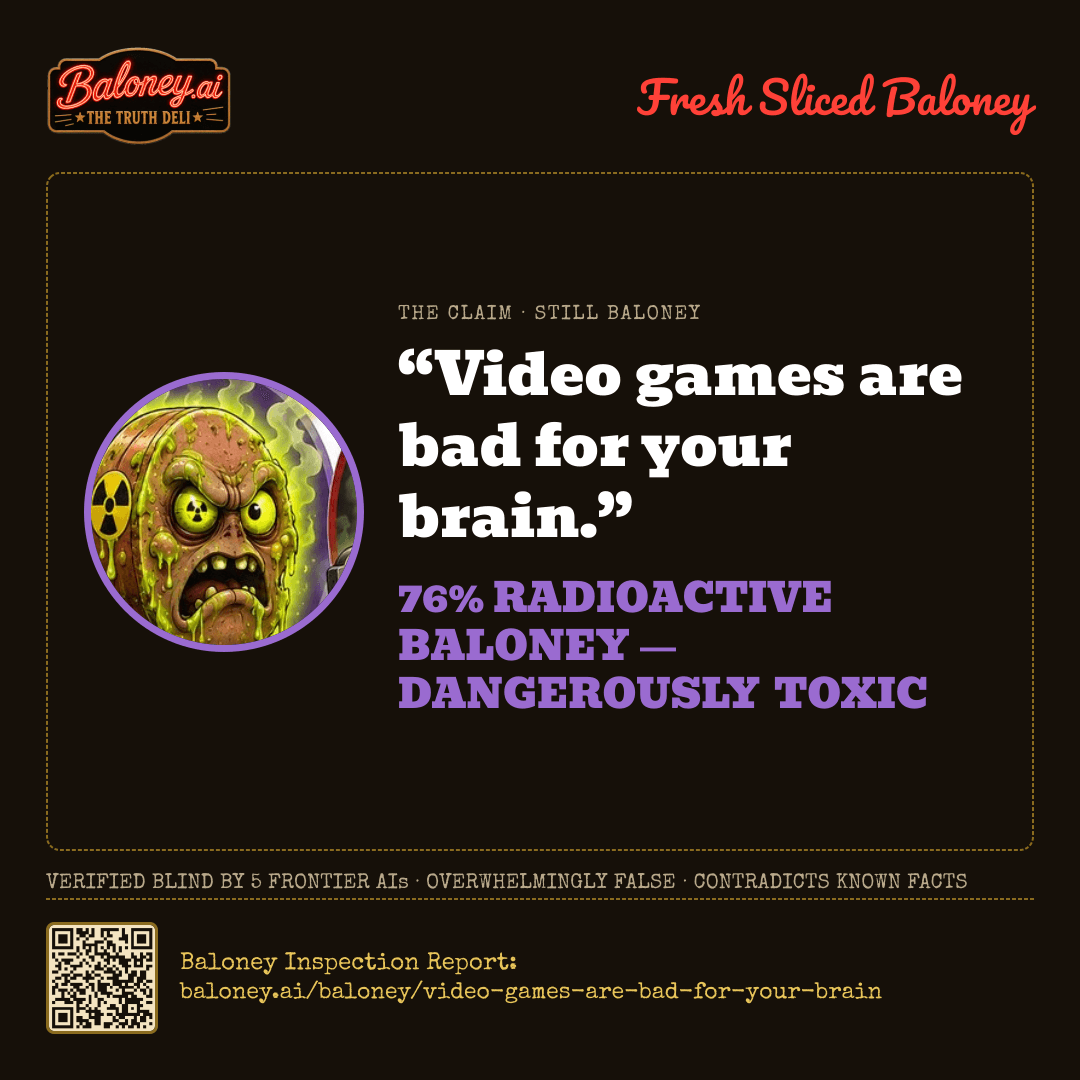
“Video games are bad for your brain.” 76% RADIOACTIVE BALONEY — DANGEROUSLY TOXIC Verified blind by 5 frontier AIs · Baloney Inspection Report: baloney.ai/baloney/video-games-are-bad-for-your-brain
Station 1 · Blind Inspection — Five Graders, Zero Peeking
Each lab scored the claim independently, without seeing the others. Open a breakdown for its evidence, its sources, and how sure it was.
Anthropic · EQUAL WEIGHT · 40.7s
claude-opus-5
76%BALONEY
ROUND-1 BREAKDOWN
Evidence offered for the claim
The World Health Organization added 'Gaming disorder' to ICD-11 (2019/2022), recognizing that a minority of players develop impaired control over gaming that causes significant functional impairment — a genuine mental-health harm.
Neuroimaging and behavioral studies of people with internet/gaming disorder report differences in reward-related circuitry (striatal dopamine response, cue reactivity) and in impulse-control/executive-function measures, patterns partly overlapping with substance-use disorders.
Heavy late-night gaming is associated with shortened and delayed sleep, and sleep loss is a well-established cause of impaired memory consolidation, attention, and mood — an indirect but real route by which excessive gaming can hurt cognition.
Time displacement: hours spent gaming can crowd out homework, reading, exercise and face-to-face socializing, each of which independently supports cognitive and emotional development, particularly in children.
Some experimental and longitudinal studies report short-term increases in aggressive thoughts/affect after violent game play, and some studies link problematic gaming with higher rates of depression and anxiety symptoms (though direction of causation is disputed).
A subset of studies using habitual-gamer samples has reported reduced hippocampal grey matter in players who rely on response-based (striatal) navigation strategies, suggesting effects depend on game type and play style.
Evidence against the claim
The claim is a sweeping generalization: harms are largely documented for excessive or compulsive use (estimated at roughly 1–3% of players in meta-analyses), not for typical, moderate play.
The NIH-funded Adolescent Brain Cognitive Development (ABCD) analysis of ~2,000 nine-and-ten-year-olds found children who played video games ≥3 hours/day performed better than non-gamers on tasks of impulse control and working memory, with associated differences in brain activity.
Action video game training has been repeatedly shown to improve visual selective attention, contrast sensitivity, and speed of visual processing (classic Green & Bavelier work and subsequent replications/meta-analyses).
Intervention studies (e.g., training with Super Mario 64) have found increases in grey matter in the hippocampus, prefrontal cortex and cerebellum — the opposite of 'brain damage'.
Large preregistered studies using objective play-time data from game publishers (Oxford Internet Institute) found little or no meaningful relationship between hours played and wellbeing, and what relationship existed was slightly positive.
The American Psychological Association's 2020 resolution states there is insufficient scientific evidence to link violent video games to criminal violence or delinquency.
Games are used therapeutically and educationally: EndeavorRx (a video-game-based treatment for pediatric ADHD) received FDA authorization in 2020, and games are studied for cognitive training and rehabilitation.
Much of the alarming literature suffers from small samples, cross-sectional designs, publication bias, and inability to separate cause from effect (e.g., people with attention or mood problems may game more, rather than gaming causing the problems).
How sure this lab was
82/100 — the lab’s own confidence in the score above, not a second reading of the claim.
Excessive, compulsive gaming can be harmful for some people: the WHO recognizes 'gaming disorder' as impaired control over gaming, increasing priority given to gaming, and continuation despite negative consequences, severe enough to impair personal, family, social, educational, or occupational functioning.
Longitudinal research in youth has linked pathological/problem gaming with worse mental-health and functioning outcomes, including depression, anxiety, social phobia, and poorer school performance; this supports harm in a vulnerable subset rather than harm from all gaming.
Research syntheses and the American Psychological Association have found a small but reliable association between violent video-game exposure and increased aggressive thoughts/feelings/behavior and reduced prosocial behavior, while also noting that evidence does not show violent games cause criminal violence.
Gaming late at night or for long periods can displace sleep; experimental work in adolescents found prolonged violent gaming before bed worsened sleep measures. Poor sleep is relevant to attention, learning, mood, and brain health.
Evidence against the claim
The blanket claim 'video games are bad for your brain' is too broad: evidence does not show that ordinary or moderate gaming generally damages the brain. Harms are mainly associated with excessive/problematic use, sleep displacement, certain violent content, or individual vulnerability.
Controlled and experimental studies have found cognitive benefits from some games, especially action games, including improved visual selective attention and visuospatial skills.
A randomized training study reported that playing Super Mario 64 increased gray-matter volume in regions including the hippocampus, prefrontal cortex, and cerebellum, suggesting video games can induce adaptive brain plasticity rather than only harm.
A large JAMA Network Open study of children found those reporting 3 or more hours per day of video gaming performed better on working-memory and response-inhibition tasks than non-gamers, though the study was observational and does not prove causation or recommend high use.
Large population research on adolescents has found that moderate gaming is not clearly associated with worse psychosocial adjustment and may be linked to small positive associations, while very high use is where risk tends to appear.
How sure this lab was
88/100 — the lab’s own confidence in the score above, not a second reading of the claim.
Excessive gaming can lead to 'Gaming Disorder,' recognized by the World Health Organization (WHO) in the ICD-11, which involves impaired control over gaming and negative impacts on personal and social functioning.
Neuroimaging studies indicate that severe video game addiction is associated with structural and functional changes in the brain's reward system, similar to substance use disorders.
Some research suggests that playing certain types of games (like first-person shooters that rely on in-game GPS/minimaps) may be correlated with reduced gray matter in the hippocampus, a brain region critical for memory and spatial navigation.
Excessive screen time and the sedentary behavior associated with heavy gaming can negatively impact sleep quality, mood regulation, and overall cognitive health if it displaces physical activity and face-to-face social interaction.
Evidence against the claim
A vast body of neuroscientific research demonstrates that playing action video games can significantly enhance specific cognitive skills, including visual processing, spatial navigation, and selective attention.
A large 2022 study utilizing data from the NIH's Adolescent Brain Cognitive Development (ABCD) Study found that children who played video games performed better on cognitive tests involving impulse control and working memory compared to those who did not play.
Video games are increasingly used for therapeutic purposes; for example, the FDA authorized 'EndeavorRx' in 2020 as the first prescription, game-based digital therapeutic to improve attention function in children with ADHD.
Complex strategy and puzzle games have been shown to improve problem-solving skills, executive functioning, and cognitive flexibility, while multiplayer games can provide meaningful social connectivity.
How sure this lab was
95/100 — the lab’s own confidence in the score above, not a second reading of the claim.
Excessive video game use has been associated with negative brain-related outcomes in some studies, including altered brain structure in people described as addicted to video games and associations with cognitive or behavioral problems in that subgroup.
The strongest evidence for harm is not that ordinary gaming damages the brain, but that *problematic or addictive* gaming can correlate with impaired functioning and brain differences in some observational studies.
Evidence against the claim
Multiple systematic reviews and meta-analyses report neutral-to-positive cognitive effects from video games, including improvements in attention, spatial cognition, executive function, and global cognition in some populations.
A 2026 meta-analysis of 133 studies found a statistically significant but small positive association between video game play and cognitive ability across memory, spatial ability, visual attention, cognitive control, and intelligence.
A 2023 meta-analysis found a moderate, significant training effect on overall cognition from video-game-based cognitive interventions.
A 2019 review of the literature concluded that video gaming can have beneficial effects on the brain, though effects vary by game type and age group.
A Nature Reviews Neuroscience review described both positive and negative ways video games can affect cognition and behavior, not a blanket harmful effect.
How sure this lab was
83/100 — the lab’s own confidence in the score above, not a second reading of the claim.
WHO recognizes Gaming Disorder (ICD-11) for a minority of players with loss of control, priority given to gaming, and continued play despite harm; some neuroimaging of internet gaming disorder reports reward-system and prefrontal differences similar to other addictions.
Excessive play can displace sleep, exercise, and in-person interaction; sleep loss and sedentary time have well-established negative effects on cognition, mood, and developing brains.
AAP and similar pediatric guidance flag high screen/game time in young children as a risk for attention and developmental concerns (observational, dose-related, not unique to games).
Short-term lab studies sometimes show increased aggressive affect/cognition after violent games; a subset of correlational work links heavy use with poorer school/mental-health outcomes (causality and confounding remain disputed).
Evidence against the claim
Action and strategy games have repeatedly been linked to gains in visual attention, spatial cognition, processing speed, and task-switching (e.g., Bavelier/Green line of work and related RCTs/training studies).
Experimental play (e.g., 3D platformers) has been associated with increased hippocampal gray matter; games are used in rehab, ADHD, and cognitive-training contexts.
Large reviews and population studies often find small, mixed, or null average effects of typical (non-disordered) play on well-being and cognition; benefits vs. harms depend on game type, duration, age, and substitution of other activities.
APA and others have walked back strong causal claims about lasting brain/behavioral harm from ordinary play; the brain is plastic and skill-based play can function as training rather than damage.
Blanket ‘games rot the brain’ claims ignore that most players do not meet disorder criteria and that many titles are social, educational, or cognitively demanding.
How sure this lab was
72/100 — the lab’s own confidence in the score above, not a second reading of the claim.
All five evaluators agree that the blanket claim “Video games are bad for your brain” is far too strong: typical, moderate gaming is not shown to generally damage the brain, and there is substantial evidence of cognitive and even structural brain benefits from some games. However, they also converge on clear harms for a minority of players with excessive or disordered use, and on indirect brain‑health risks via sleep loss, sedentary behavior, and time displacement. Because the statement as written implies that video games are broadly and inherently harmful to the brain for gamers in general, and ignores the mixed and often positive evidence, it is substantially misleading and overstates the risk, warranting a high baloney score but not the very top bands reserved for fully debunked claims.
The panel broadly agrees that: (1) gaming disorder and problematic/excessive use can be harmful and are recognized by major health bodies; (2) ordinary or moderate gaming does not generally damage the brain; (3) many studies find cognitive and sometimes structural brain benefits from certain video games; and (4) observed harms are mostly indirect (sleep, displacement of healthy activities, mood) or limited to vulnerable subgroups and violent content effects on aggression. The main disagreement is about how severely to score the blanket claim: one evaluator rated it moderately misleading (34), emphasizing the positive and mixed evidence, while the others rated it in the high‑baloney bands (76–80), focusing on the strong overgeneralization and the potential for harm if people treat all gaming as brain‑damaging.
Blind Validation Master · never saw the Primary’s work
grok-4.6
75% BALONEY
The claim as written is a sweeping generalization that ordinary video-game play damages the brain. The reports consistently show that is not what the evidence supports. Meta-analyses and training studies find small-to-moderate gains in attention, spatial cognition, processing speed, and related skills; some games increase gray-matter volume in hippocampus, prefrontal cortex and cerebellum; large observational data (including ABCD) show children who game several hours a day outperforming non-gamers on working-memory and inhibition tasks; and games are used therapeutically (e.g., FDA-authorized EndeavorRx). Documented harms are concentrated in a small minority who meet Gaming Disorder criteria, or arise indirectly via sleep loss, sedentary time and displacement of other activities. Those real but limited risks do not make the blanket statement true. The claim is therefore overwhelmingly false.
AGREEMENT TEST PASSED — MASTERS SCORED 78% AND 75% · BLIND VALIDATION CONFIRMED THIS SCORE · NO RE-EVALUATION REQUIRED
The Evidence
Evidence offered for the claim
Gaming disorder and brain changes in heavy users Multiple evaluators cite the World Health Organization’s recognition of Gaming Disorder in ICD‑11 and neuroimaging studies showing reward‑system and prefrontal differences in people with internet/gaming disorder, partly resembling patterns seen in other addictions, indicating that severe, compulsive gaming can be associated with harmful brain‑related changes and impaired functioning in a minority of players.
Indirect harms via sleep loss and sedentary behavior Several reports note that excessive gaming can displace sleep, exercise, and in‑person social interaction; pediatric guidance flags high screen and game time in young children as a risk for attention and developmental concerns, and experimental work shows that prolonged or late‑night violent gaming in adolescents worsens sleep, which is known to affect attention, learning, mood, and brain health.
Associations with mental‑health and functional problems Longitudinal and correlational research cited by the evaluators links pathological or problematic gaming in youth with higher rates of depression, anxiety, social phobia, and poorer school performance, as well as dose‑related concerns about attention and developmental outcomes, supporting harm in vulnerable subsets rather than universal damage from all gaming.
Violent games and aggression-related outcomes Research syntheses and statements from the American Psychological Association referenced by the panel report a small but reliable association between violent video‑game exposure and increased aggressive thoughts, feelings, and behavior, along with reduced prosocial behavior, even though they emphasize that this does not amount to evidence that violent games cause criminal violence.
Potential hippocampal impacts in specific play styles Two evaluators mention studies in habitual gamers suggesting that players who rely heavily on response‑based navigation strategies in certain first‑person shooter games (for example, using GPS‑style minimaps) may show reduced hippocampal gray matter, implying that some game types and play strategies could correlate with less favorable brain outcomes, though this is nuanced and not generalized to all gaming.
Evidence against the claim
Typical gaming does not generally damage the brain All reports emphasize that the sweeping claim is too broad: harms are primarily documented for excessive or compulsive use, sleep displacement, certain violent content, or vulnerable individuals, while large population studies and reviews generally find small, mixed, or null average effects of ordinary play on cognition and wellbeing rather than general brain damage.
Documented cognitive benefits of action and strategy games Multiple evaluators cite a robust line of work (including Green & Bavelier and related randomized training studies) showing that action and strategy video games can enhance visual selective attention, contrast sensitivity, spatial cognition, processing speed, task‑switching, and executive functions, indicating that many games train and improve specific cognitive skills.
Structural brain plasticity from certain games Several reports reference randomized training research (such as Super Mario 64 interventions) showing increased gray‑matter volume in regions including the hippocampus, prefrontal cortex, and cerebellum after gaming, demonstrating that some games can induce adaptive structural brain changes rather than causing damage.
Population studies showing better cognition in child gamers The evaluators highlight a large NIH‑funded Adolescent Brain Cognitive Development (ABCD) study and related JAMA Network Open work in children, where those playing video games for three or more hours a day performed better on tasks of working memory and response inhibition than non‑gamers, with associated differences in brain activity; while observational and not prescriptive, these findings contradict a simple ‘bad for your brain’ narrative.
Mixed or neutral average effects on wellbeing Large preregistered studies using objective play‑time data (for example, Oxford Internet Institute analyses) and broader reviews reported by the panel find little or no meaningful relationship between total hours played and wellbeing, with any detectable relationship often slightly positive, suggesting that for most players, game time is not inherently detrimental to mental or cognitive health.
Therapeutic and educational uses of video games The panel notes that video games are used in rehabilitation, ADHD treatment, and cognitive‑training contexts; notably, the FDA authorized EndeavorRx in 2020 as a prescription game‑based digital therapeutic to improve attention in children with ADHD, illustrating that well‑designed games can support, rather than harm, brain function.
Professional bodies reject blanket harm claims Evaluators point out that organizations such as the American Psychological Association have walked back strong causal claims linking ordinary video‑game play with lasting brain or behavioral harm, and their 2020 resolution finds insufficient evidence that violent games cause criminal violence or delinquency, undermining the idea that games are generically bad for the brain.
Systematic reviews find small positive cognitive associations One report cites a 2026 meta‑analysis of 133 studies showing a small but statistically significant positive association between video‑game play and cognitive ability across memory, spatial ability, visual attention, cognitive control, and intelligence, as well as a 2023 meta‑analysis finding moderate training effects on overall cognition from game‑based interventions, further contradicting a blanket harmful characterization.
Sources · Reliability · Why Accepted or Discounted
ACCEPTED — Large open‑access, peer‑reviewed journal; while broad in scope, it is appropriate for empirical and meta‑analytic work on gaming and cognition.
ACCEPTED — Repository of peer‑reviewed biomedical and psychological research; reliable host for studies cited about brain and cognitive effects of gaming.
ACCEPTED — Commercial platform hosting many peer‑reviewed journals; acceptable as a portal, with the underlying journal quality determining study strength.
ACCEPTED — Professional organization statements and resolutions reflect consensus reviews of evidence; appropriate for characterizing expert views on violent games and harm.
ACCEPTED — Top‑tier science journal; includes influential work on action video games and visual attention and contributes strong evidence for cognitive benefits.
ACCEPTED — High‑quality psychiatry and neuroscience journal; the Super Mario structural plasticity study and related gaming research are relevant and reliable.
ACCEPTED — Peer‑reviewed open‑access journal in the JAMA family; its large observational study on children’s gaming and cognition is methodologically solid.
ACCEPTED — Regulatory authority; its authorization of EndeavorRx substantiates therapeutic uses of video‑game‑based interventions for attention in ADHD.
ACCEPTED — Educational outlet affiliated with Harvard Medical School; acceptable for summarizing health guidance on media use, sleep, and exercise displacement.
ACCEPTED — Peer‑reviewed open‑access neuroscience journal; appropriate for studies on brain changes and cognitive effects in gamers.
Serve It Fresh
Ready to Serve13 servings
Serve it the way you want it
The Verdict
“Video games are bad for your brain.” 76% RADIOACTIVE BALONEY — DANGEROUSLY TOXIC Verified blind by 5 frontier AIs · Baloney Inspection Report: baloney.ai/baloney/video-games-are-bad-for-your-brain