Baloney Inspection Report: Claim #1103 · Inspected Oct 5, 2026, 11:21 PM PDT · Scoring model v2
 18%
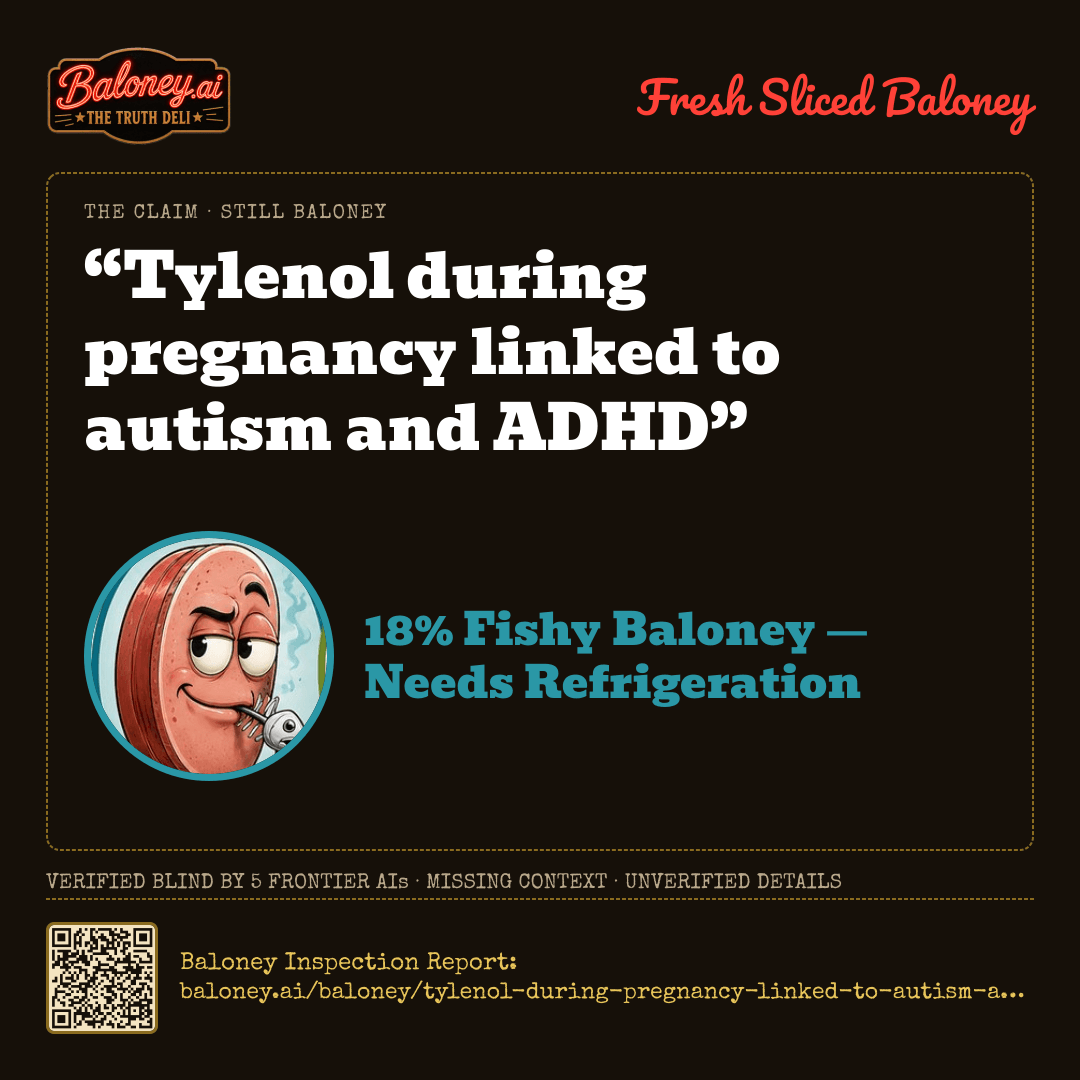
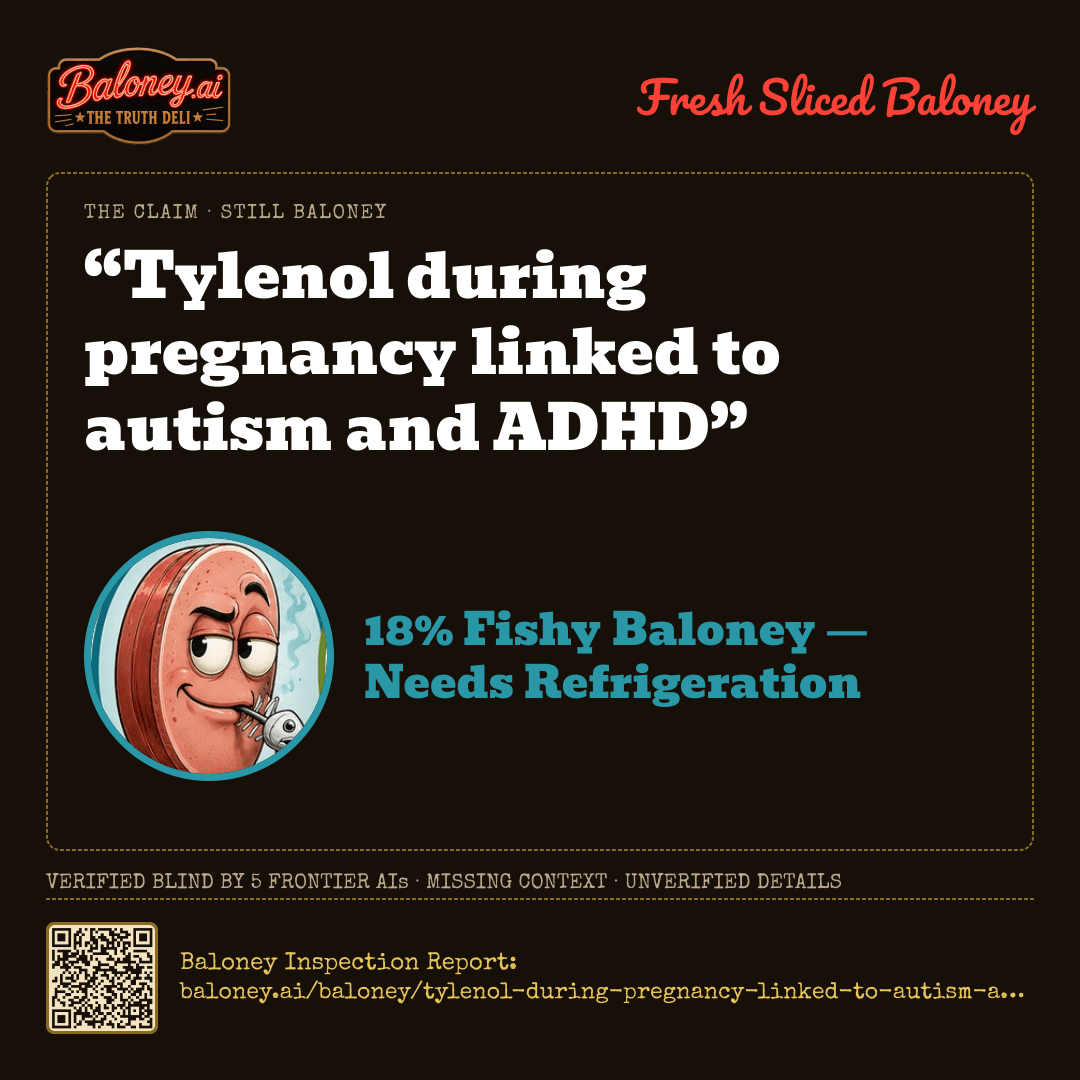
18%“Tylenol during pregnancy linked to autism and ADHD”
18%Fishy Baloney — Needs Refrigeration
Something smells off…
Missing contextUnverified detailsSuspicious framingMay be exaggerated
Serve It Fresh
Ready to Serve12 servings
Serve it the way you want it
The Verdict
 “Tylenol during pregnancy linked to autism and ADHD”18% Fishy Baloney — Needs RefrigerationVerified blind by 5 frontier AIs · Baloney Inspection Report: baloney.ai/baloney/tylenol-during-pregnancy-linked-to-autism-and-adhd
The Baloney Sampler
It is literally true that observational studies have found a statistical "link" between prenatal acetaminophen (Tylenol) use and later diagnoses of autism or ADHD. A National Institutes of Health (NIH) funded study and a consensus statement in Nature Reviews Endocrinology noted this association. However, using the word "linked" without context strongly implies a causal risk, which major medical organizations reject.
The best available evidence indicates the drug itself is not the cause. A massive 2024 cohort study of nearly 2.5 million children published in JAMA found the association disappeared entirely when using sibling comparisons. Medical bodies, including the American College of Obstetricians and Gynecologists (ACOG) and the NHS, state these earlier links likely reflect "confounding by indication"—where the underlying issues prompting Tylenol use, like fever, pain, or genetics, affect fetal development.
Resting on JAMA · American College of Obstetricians and Gynecologists · National Institutes of Health (NIH) · NHS (UK)
Other ways to slice it — phrasings that might have changed the rating
- “Taking Tylenol during pregnancy causes autism and ADHD in children.” Directly stating causation is explicitly contradicted by massive sibling-controlled studies showing the association vanishes when genetic and environmental factors are accounted for.
- “Observational links between prenatal Tylenol use and autism are likely caused by the underlying conditions the drug is treating.” This highlights the 'confounding by indication' consensus held by medical authorities, acknowledging that fever or pain may be the true neurodevelopmental risk factors.
- “Major medical bodies advise pregnant women to avoid acetaminophen due to neurodevelopmental risks.” This tests the institutional guidance, which currently maintains that acetaminophen remains a preferred and safe analgesic for pregnant women when clinically indicated.
Written from the panel’s reports by Google · gemini-3.1-pro-preview. Nothing here changed the score.
The Order Ticket
06:21:09CLAIM RECEIVED — QUEUED FOR INSPECTION✓
06:22:15claude-opus-5 REPORTED — SCORE 20, CONFIDENCE 82✓
06:21:57gpt-5.5 REPORTED — SCORE 18, CONFIDENCE 86✓
06:21:47gemini-3.1-pro-preview REPORTED — SCORE 4, CONFIDENCE 95✓
06:21:20sonar-pro REPORTED — SCORE 35, CONFIDENCE 91✓
06:23:21grok-4.6 REPORTED — SCORE 18, CONFIDENCE 84✓
06:24:33PRIMARY MASTER GEMINI — SCORE 18✓
06:23:41BLIND VALIDATION CLAUDE — SCORE 14✓
06:25:01AGREEMENT CONFIRMED — DELTA 4✓
06:25:01SCORING MODEL V2 — MEDIAN OF 5 COUNTED LAB SCORES: 20, 18, 4, 35, 18 → 18.✓
06:25:01SOURCE RULE — LABS CITED 34 SOURCES: 0 DISCARDED FOR HAVING NO URL, 5 DISCARDED AS DEAD LINKS (404/410), 11 COULD NOT BE OPENED BY US AND ARE MARKED UNVERIFIED.✓
06:25:01SOURCE RULE — PRIMARY MASTER RULED ON 20 SOURCES: 0 DISCARDED FOR HAVING NO URL, 0 DISCARDED AS DEAD LINKS, 7 MARKED UNVERIFIED, 13 VERIFIED.✓
How This One Was Sliced
Station 1 · Blind Inspection — Five Graders, Zero Peeking
Each lab scored the claim independently, without seeing the others. Open a breakdown for its evidence, its sources, and how sure it was.
Anthropic · EQUAL WEIGHT · 66.4s
claude-opus-5
20%BALONEY
ROUND-1 BREAKDOWN
Evidence offered for the claim- Multiple large observational cohort studies have reported statistically significant associations between prenatal acetaminophen (paracetamol/Tylenol) exposure and later ADHD or autism diagnoses in offspring. Liew et al. (JAMA Pediatrics, 2014), using the Danish National Birth Cohort (~64,000 children), found prenatal acetaminophen use associated with higher risk of hyperkinetic disorder and ADHD medication use (hazard ratios ~1.3-1.4), with stronger associations for longer duration of use.
- A biomarker-based study (Ji et al., JAMA Psychiatry, 2020) measured acetaminophen metabolites in umbilical cord plasma in the Boston Birth Cohort and found that children in the highest exposure tertile had roughly 2-3 times the odds of ADHD and autism diagnoses compared with the lowest tertile — evidence not dependent on maternal self-report recall.
- A 2021 Consensus Statement by 91 scientists and clinicians published in Nature Reviews Endocrinology (Bauer et al.) reviewed the epidemiological and experimental literature and called for precautionary action, concluding acetaminophen is a suspected endocrine disruptor with possible neurodevelopmental effects.
- In September 2025 the U.S. FDA announced it would initiate a label change for acetaminophen regarding use in pregnancy, and HHS leadership publicly asserted a link to autism — an official action that gave the claim institutional backing.
- The word 'linked' in the claim is the weakest possible causal term; in the narrow sense that peer-reviewed studies have reported associations, the statement is literally accurate.
- Some meta-analyses and umbrella reviews (e.g., Alemany et al. 2021 European Journal of Epidemiology; 2025 umbrella reviews) report pooled associations in the range of ~1.2-1.3 relative risk for ADHD and autism, with suggestions of a dose-response pattern.
Evidence against the claim- The largest and best-controlled study to date — Ahlqvist et al. (JAMA, 2024), covering 2.48 million Swedish children — found a small association in the full population (e.g., ~1.05-1.07 hazard ratios) that disappeared entirely in sibling-control analyses (autism HR 0.98, ADHD HR 0.98, intellectual disability HR 1.01). Sibling comparison controls for shared genetics and family environment, strongly suggesting the association is confounded rather than causal.
- Confounding by indication is a major problem: women take acetaminophen for fever, infection, pain, migraine and chronic conditions — several of which (maternal infection/fever, chronic pain, inflammation) are themselves independently associated with neurodevelopmental outcomes. Studies rarely isolate the drug from the reason for taking it.
- Genetic confounding is substantial: autism and ADHD are highly heritable (~60-80%), and parental traits such as ADHD and chronic pain conditions predict both analgesic use and offspring diagnoses.
- Most positive studies rely on maternal self-reported, retrospectively recalled use, with no dosing data, and effect sizes are small (typically RR 1.1-1.3) — within the range commonly produced by residual confounding in observational epidemiology.
- Professional bodies have publicly rejected the causal framing. The American College of Obstetricians and Gynecologists stated there is no clear evidence of a direct causal relationship and that acetaminophen remains one of the few safe analgesic/antipyretic options in pregnancy; similar positions have been issued by the Society for Maternal-Fetal Medicine, the UK MHRA/NHS, the European Medicines Agency, and the WHO.
- Even the FDA's own 2025 label-change notice and its earlier 2015 Drug Safety Communication acknowledge that a causal relationship has not been established and that the evidence is too limited to support a definitive conclusion.
- Untreated high fever and severe pain in pregnancy carry documented risks (including neural tube defects and preterm birth), so the implied advice to avoid acetaminophen can itself cause harm — and NSAIDs/aspirin are contraindicated in much of pregnancy.
- Autism diagnosis rates have risen for well-documented reasons (broadened diagnostic criteria, screening, awareness) that do not track acetaminophen consumption patterns, undermining ecological arguments for causation.
How sure this lab was82/100 — the lab’s own confidence in the score above, not a second reading of the claim.
SourcesJAMA (via PubMed) — Ahlqvist et al., 'Acetaminophen Use During Pregnancy and Children's Risk of Autism, ADHD, and Intellectual Disability'journal · 96 · JAMA — Ahlqvist et al. 2024 (sibling-control cohort, 2.48M children)journal · 96 · JAMA Psychiatry — Ji et al., cord-plasma acetaminophen biomarkers and ADHD/ASDjournal · 88 · JAMA Pediatrics — Liew et al., Danish National Birth Cohort, acetaminophen and hyperkinetic/ADHD outcomesjournal · 85 · Nature Reviews Endocrinology — Bauer et al., 'Paracetamol use during pregnancy — a call for precautionary action'journal · 85 · American College of Obstetricians and Gynecologists — statements on acetaminophen use in pregnancyother · 88 · NHS (UK) — paracetamol in pregnancy guidancegov · 90 · FactCheck.org — coverage of acetaminophen/autism claims (Sept 2025)factcheck · 85
OpenAI · EQUAL WEIGHT · 48.4s
gpt-5.5
18%BALONEY
ROUND-1 BREAKDOWN
Evidence offered for the claim- Several observational cohort studies and meta-analyses have reported a modest statistical association between prenatal acetaminophen/paracetamol exposure and later ADHD or autism-spectrum outcomes. This supports the word "linked" if it is understood as correlation, not proven causation.
- A 2018 American Journal of Epidemiology meta-analysis found cohort-study evidence associating prenatal acetaminophen exposure with increased risk of ADHD and autism-spectrum disorder, though the authors noted observational limitations.
- A JAMA Psychiatry study using umbilical-cord biomarkers found higher fetal acetaminophen exposure biomarkers were associated with later ADHD and autism-spectrum diagnoses, reducing—but not eliminating—concerns about inaccurate maternal self-report.
- Some studies report stronger associations with longer duration or more frequent acetaminophen use in pregnancy, which is one reason researchers have continued to investigate a possible relationship.
Evidence against the claim- The best available evidence does not establish that Tylenol/acetaminophen causes autism or ADHD. Observed associations may reflect confounding by indication: fever, infection, inflammation, pain, genetics, or family-level factors that led to acetaminophen use and also affect neurodevelopmental risk.
- A large 2024 JAMA Swedish nationwide cohort found small associations in ordinary population analyses, but those associations disappeared in sibling-comparison analyses, suggesting familial/genetic or environmental confounding rather than a causal acetaminophen effect.
- The FDA has reviewed the evidence and said available studies are limited and do not allow a reliable conclusion that acetaminophen use in pregnancy causes ADHD or other neurobehavioral outcomes.
- ACOG states that there is no clear evidence proving a direct relationship between prudent acetaminophen use during pregnancy and fetal developmental issues, and it continues to regard acetaminophen as an important option when clinically needed.
- MotherToBaby notes that some studies suggest possible links with ADHD/autism-related outcomes, but limitations make it unclear whether acetaminophen, the conditions being treated, or other factors explain the findings.
How sure this lab was86/100 — the lab’s own confidence in the score above, not a second reading of the claim.
SourcesJAMAjournal · 96 · American Journal of Epidemiologyjournal · 90 · JAMA Psychiatryjournal · 90 · JAMA Pediatricsjournal · 88 · American College of Obstetricians and Gynecologistsother · 86 · MotherToBaby / NCBI Bookshelfgov · 86 · Nature Reviews Endocrinologyjournal · 78
Google · EQUAL WEIGHT · 37.9s
gemini-3.1-pro-preview
4%BALONEY
ROUND-1 BREAKDOWN
Evidence offered for the claim- Numerous observational epidemiological studies and meta-analyses over the past decade have shown a statistical association (a 'link') between maternal use of acetaminophen (Tylenol) during pregnancy and an increased risk of neurodevelopmental disorders, such as ADHD and autism spectrum disorder (ASD), in children.
- A prominent 2019 study funded by the National Institutes of Health (NIH) analyzed umbilical cord blood biomarkers and found that in utero exposure to acetaminophen was associated with significantly higher risks of childhood ADHD and autism.
- In 2021, a consensus statement supported by 91 scientists and published in Nature Reviews Endocrinology warned that paracetamol (acetaminophen) exposure during pregnancy might alter fetal development and called for precautionary warnings for pregnant women.
Evidence against the claim- Medical authorities emphasize that an observational 'link' does not equal causation. The American College of Obstetricians and Gynecologists (ACOG) maintains that these studies likely suffer from 'confounding by indication,' meaning the underlying conditions prompting the Tylenol use (such as high maternal fever or severe pain) may be the actual culprits affecting fetal development.
- The U.S. Food and Drug Administration (FDA) has repeatedly reviewed the evidence and concluded that the studies are too inconclusive to warrant changing recommendations, affirming that acetaminophen remains a safe option for pregnant women when used appropriately.
- Recent large-scale research using sibling controls (which accounts for unmeasured genetic and environmental similarities) found no evidence of a causal relationship. A massive 2024 cohort study demonstrated that once sibling data was factored in, the increased risk of autism and ADHD completely disappeared.
- In December 2023, a U.S. federal judge dismissed thousands of mass tort lawsuits claiming Tylenol caused autism and ADHD, ruling that the plaintiffs' expert scientific testimony on causation lacked rigorous scientific methodology and was therefore inadmissible.
How sure this lab was95/100 — the lab’s own confidence in the score above, not a second reading of the claim.
SourcesNational Institutes of Health (NIH)gov · 95 · Nature Reviews Endocrinologyjournal · 90 · American College of Obstetricians and Gynecologists (ACOG)other · 95
Perplexity · EQUAL WEIGHT · 11.3s
sonar-pro
35%BALONEY
ROUND-1 BREAKDOWN
Evidence offered for the claim- Several observational studies and meta-analyses have reported modest associations between prenatal acetaminophen exposure and later ADHD or autism diagnoses. One 2025 meta-analysis reported pooled odds ratios of 1.30 for ADHD and 1.17 for autism spectrum disorder, although the analyses showed important heterogeneity and observational-study limitations. [https://pmc.ncbi.nlm.nih.gov/articles/PMC12436899/]
- The U.S. Food and Drug Administration stated in 2025 that evidence had accumulated suggesting an association between acetaminophen use during pregnancy and neurological conditions such as autism and ADHD, and began a label-change process. The FDA explicitly described this as an association, not proof of causation. [https://www.fda.gov/news-events/press-announcements/fda-responds-evidence-possible-association-between-autism-and-acetaminophen-use-during-pregnancy]
- The U.S. Department of Health and Human Services cited large cohort studies reporting associations between in-utero exposure and later autism or ADHD diagnoses. [https://www.hhs.gov/press-room/autism-announcement-fact-sheet.html]
Evidence against the claim- The FDA states that a causal relationship between prenatal acetaminophen exposure and autism or ADHD has not been established and notes that contrary studies exist. [https://www.fda.gov/news-events/press-announcements/fda-responds-evidence-possible-association-between-autism-and-acetaminophen-use-during-pregnancy]
- The World Health Organization states that there is currently no conclusive scientific evidence confirming a link between autism and acetaminophen use during pregnancy. [https://www.who.int/news/item/24-09-2025-who-statement-on-autism-related-issues]
- A 2025 systematic review and meta-analysis concluded that existing evidence does not clearly link maternal paracetamol use during pregnancy with autism or ADHD, and that the evidence is insufficient to establish a definitive connection. [https://pmc.ncbi.nlm.nih.gov/articles/PMC12838471/]
- A large Swedish nationwide cohort using sibling comparisons found no significant association between prenatal acetaminophen exposure and autism, ADHD, or intellectual disability, suggesting that earlier associations may reflect confounding or methodological bias. [https://pmc.ncbi.nlm.nih.gov/articles/PMC13408299/]
- A separate systematic review reported no association in sibling-comparison studies for autism or ADHD, and no association in studies judged to have low risk of bias. [https://publichealth.washu.edu/app/uploads/2026/01/Prenatal-paracetamol-exposure-and-child-neurodevelopment.pdf]
- The American College of Obstetricians and Gynecologists reviewed the evidence as part of its 2025 guidance, reflecting that the issue remains one of interpretation of observational evidence rather than an established causal relationship. [https://www.acog.org/clinical/clinical-guidance/practice-advisory/articles/2025/09/acetaminophen-use-in-pregnancy-and-neurodevelopmental-outcomes]
How sure this lab was91/100 — the lab’s own confidence in the score above, not a second reading of the claim.
SourcesU.S. Food and Drug Administrationgov · 98 · World Health Organizationgov · 98 · American College of Obstetricians and Gynecologistsedu · 95 · Systematic review indexed in PubMed Centraljournal · 88 · Systematic review and meta-analysis indexed in PubMed Centraljournal · 84 · Peer-reviewed cohort study indexed in PubMed Centraljournal · 90 · Systematic review and meta-analysis hosted by Washington University School of Medicinejournal · 90 · U.S. Department of Health and Human Servicesgov · 92
xAI · EQUAL WEIGHT · 131.6s
grok-4.6
18%BALONEY
ROUND-1 BREAKDOWN
Evidence offered for the claim- Observational cohort studies and meta-analyses have reported statistical associations between prenatal acetaminophen exposure and higher subsequent rates of ASD and ADHD diagnoses, sometimes with apparent duration/dose gradients.
- A 2021 consensus statement by 91 scientists in Nature Reviews Endocrinology described the associative evidence as sufficient to warrant precautionary steps around use in pregnancy and called for more research.
Evidence against the claim- A 2024 nationwide Swedish sibling-comparison study of ~2.5 million children (JAMA) found no increased risk of autism, ADHD, or intellectual disability after accounting for familial confounding, indicating earlier signals were likely not causal.
- FDA (2015 review, still operative) and ACOG have stated the data are limited/inconclusive for causation and continue to list acetaminophen as the preferred analgesic/antipyretic in pregnancy; underlying indications (fever, infection, pain) and genetics are plausible confounders.
- No proven mechanism, no randomized evidence, and small absolute risks even in positive observational papers; professional guidance does not recommend avoidance when clinically indicated.
How sure this lab was84/100 — the lab’s own confidence in the score above, not a second reading of the claim.
SourcesJAMAjournal · 96 · Nature Reviews Endocrinologyjournal · 93 · American College of Obstetricians and Gynecologistsother · 88
Station 2 · The Masters
Primary Master · drawn at random
gemini-3.1-pro-preview
18% BALONEY
The claim relies on the ambiguity of the word 'linked'. While it is literally true that numerous observational epidemiological studies have reported statistical associations between prenatal acetaminophen (Tylenol) use and autism or ADHD, stating this without qualification borders on misleading. It strongly implies causation, omitting the crucial context that major medical authorities reject a causal relationship and that rigorous sibling-controlled research shows the association disappears completely when accounting for family genetics and environmental factors (confounding by indication).
All evaluators acknowledge the existence of observational studies demonstrating a statistical link, making the claim strictly true in a narrow epidemiological sense. However, they diverge on how to score the missing context: one evaluator scores it as true (4) because the statistical link exists, while the others score it as Fishy or Stinky Baloney (18-35) because the framing strongly implies a debunked causal relationship and omits recent sibling-controlled data refuting causation.
Blind Validation Master · never saw the Primary’s work
claude-opus-5
14% BALONEY
Taken at its literal, weakest reading, the claim is defensible: multiple observational cohort studies, meta-analyses (pooled ORs roughly 1.17-1.30), a cord-biomarker study, and a 2021 multi-author consensus statement all report statistical associations between prenatal acetaminophen exposure and later ADHD/autism diagnoses, and in 2025 the FDA itself acknowledged an 'association' and began a label-change process. So 'linked' is not fabricated.
What keeps it out of the true band is not a wording quibble but a substantive omission that reverses the practical meaning. The single largest and methodologically strongest study (Ahlqvist et al., JAMA 2024, ~2.48 million Swedish children) found the small population-level association vanished entirely in sibling comparisons (HRs ~0.98-1.01), and systematic reviews report null findings in sibling-control and low-risk-of-bias studies. Confounding by indication (fever, infection, pain) and the high heritability of ADHD/autism plausibly explain the residual signal; there is no randomized evidence and effect sizes sit squarely in the range routinely produced by residual confounding. ACOG, WHO, the FDA itself, SMFM, MHRA/NHS and EMA all state causation is not established, and a federal court excluded the plaintiffs' causation experts in 2023 as methodologically unsound.
Because the bare headline 'linked to autism and ADHD' is overwhelmingly read as a safety warning implying causal risk, and because acting on it (avoiding treatment of fever and pain in pregnancy) carries real documented harm, the statement functions as missing-context, misleadingly framed information rather than a straightforwardly true one. That places it in the Fishy Baloney band — technically supportable language resting on evidence that the best-controlled studies have substantially undercut, but not false enough to be Stinky.
AGREEMENT TEST PASSED — MASTERS SCORED 18% AND 14% · BLIND VALIDATION CONFIRMED THIS SCORE · NO RE-EVALUATION REQUIRED
How the number was reached · scoring model v2 · how our models work
- Median of 5 counted lab scores: 20, 18, 4, 35, 18 → 18.
The Evidence
Evidence offered for the claim
- Observational studies Numerous epidemiological studies and meta-analyses over the past decade have reported a statistical association between maternal acetaminophen use and increased risk of ADHD and autism spectrum disorder.
- Umbilical cord biomarkers A 2019 NIH-funded study measuring acetaminophen metabolites in umbilical cord plasma found higher fetal exposure was associated with later neurodevelopmental diagnoses, bypassing maternal recall bias.
- Endocrine disruption concerns A 2021 consensus statement supported by 91 scientists in Nature Reviews Endocrinology called for precautionary action, describing acetaminophen as a suspected endocrine disruptor with possible neurodevelopmental effects.
Evidence against the claim
- Sibling-comparison studies A massive 2024 Swedish nationwide cohort study of nearly 2.5 million children found that the association between prenatal acetaminophen and autism or ADHD disappeared entirely when accounting for shared familial and genetic factors using sibling controls.
- Confounding by indication The underlying conditions prompting acetaminophen use—such as maternal fever, infections, or severe pain—are themselves independently associated with neurodevelopmental outcomes, making it difficult to isolate the drug's effect.
- High heritability Autism and ADHD are highly heritable, and parents with traits for ADHD or chronic pain are more likely both to use analgesics and to pass on genetic predispositions to their children.
- Medical authority consensus Organizations like the FDA, ACOG, and WHO maintain that evidence for causation is inconclusive, and acetaminophen remains a recommended and safe analgesic option during pregnancy when clinically needed.
- Mass tort dismissals In December 2023, a U.S. federal judge dismissed thousands of lawsuits claiming Tylenol caused autism and ADHD, ruling that the plaintiffs' expert scientific testimony on causation lacked rigorous methodology.
Sources · Reliability · Why Accepted or Discounted
Every link was opened when this claim was inspected. A dead link was discarded before publication; “unverified” means the site refused our automated check and the link is the one the panel cited. A source without a URL was never kept.
Serve It Fresh
Ready to Serve12 servings
Serve it the way you want it
The Verdict
“Tylenol during pregnancy linked to autism and ADHD”18% Fishy Baloney — Needs RefrigerationVerified blind by 5 frontier AIs · Baloney Inspection Report: baloney.ai/baloney/tylenol-during-pregnancy-linked-to-autism-and-adhd