Baloney Inspection Report: Claim #1129 · Inspected Oct 6, 2026, 9:23 PM PDT · Scoring model v2
 96%
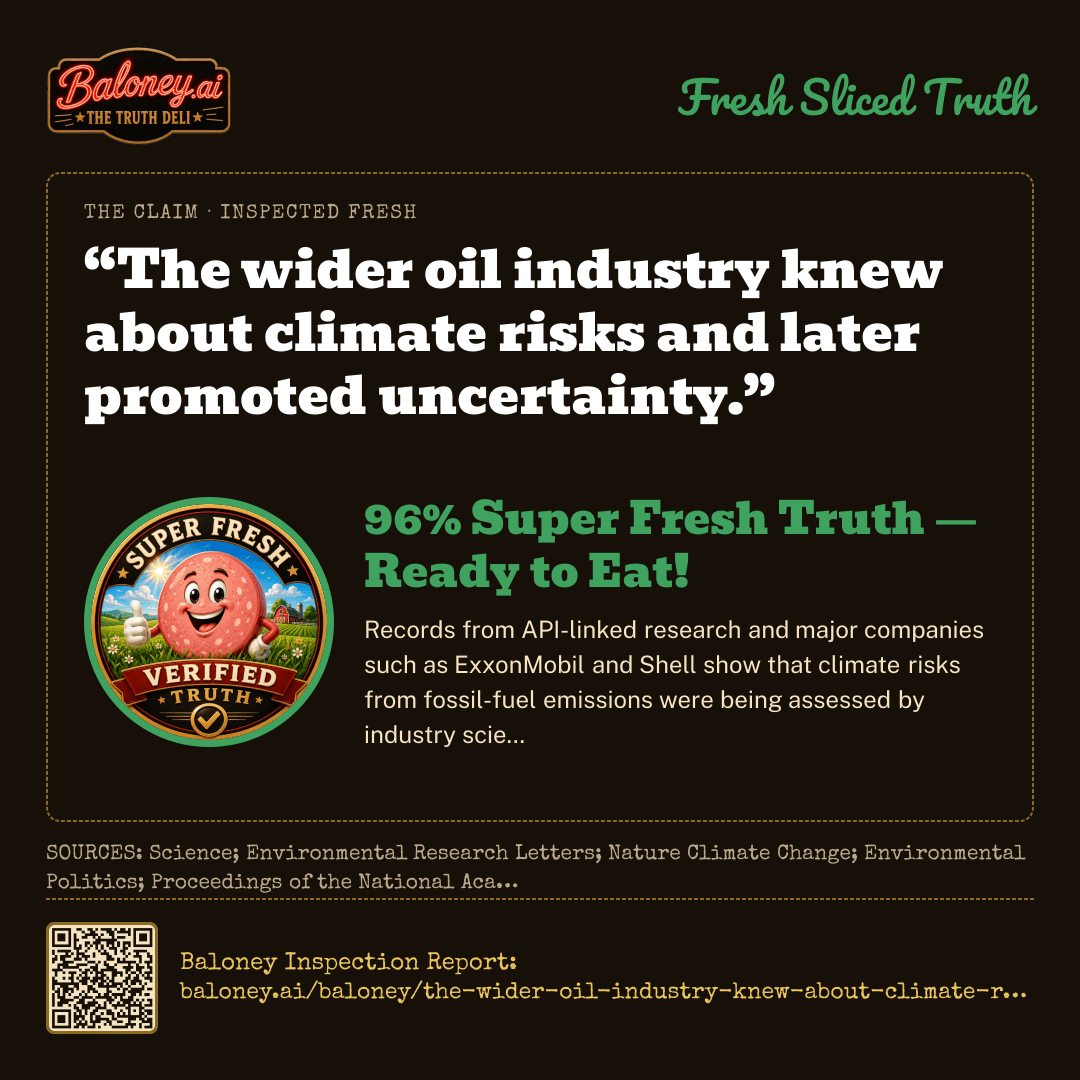
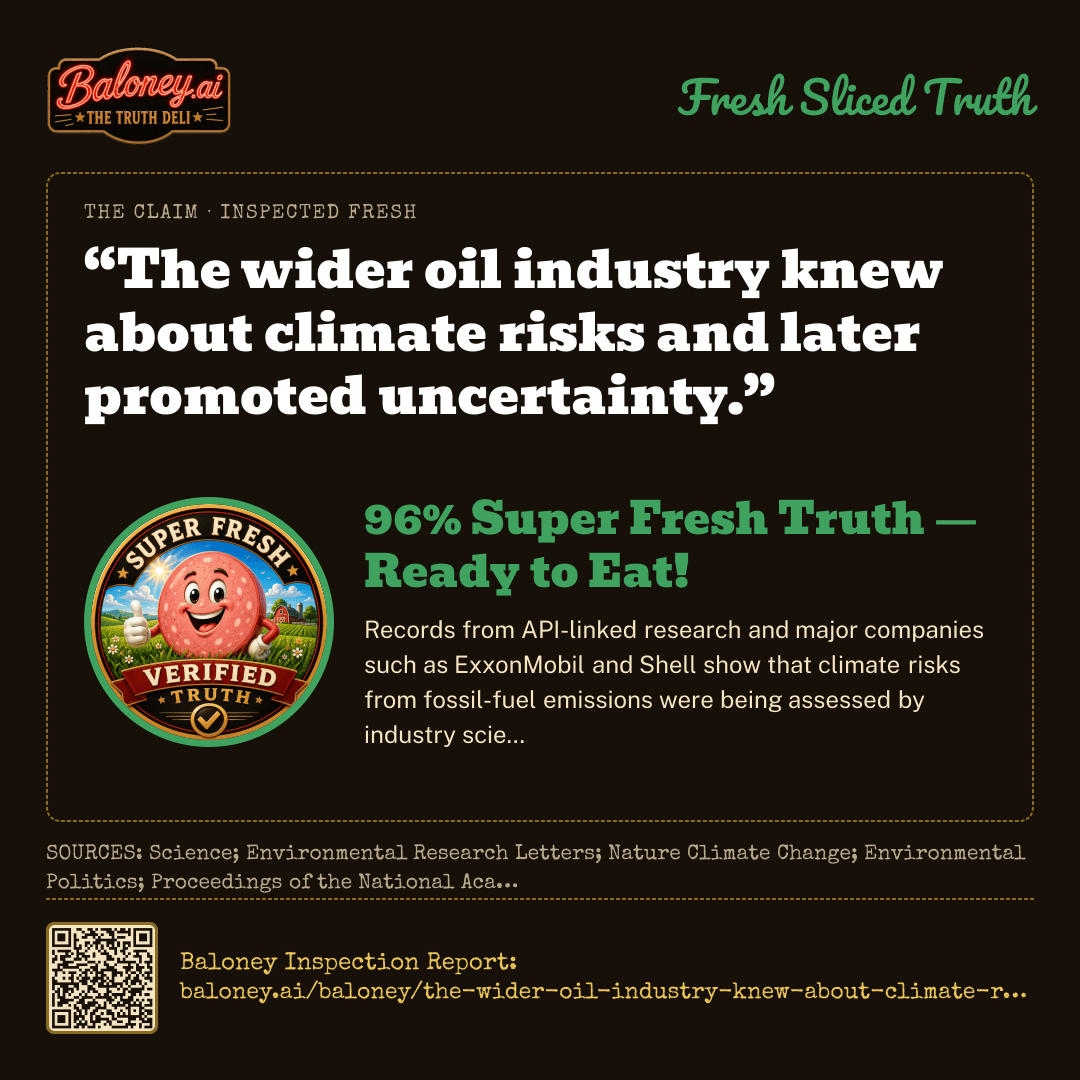
96%“The wider oil industry knew about climate risks and later promoted uncertainty.”
96%Super Fresh Truth — Ready to Eat!
THE CLAIM CHECKS OUT.
Independently verifiedPhysically repeatable evidenceConfirmed across rival labsSafe to serve
Serve It Fresh
Ready to Serve16 servings
Serve it the way you want it
The Verdict
 “The wider oil industry knew about climate risks and later promoted uncertainty.”96% Super Fresh Truth — Ready to Eat!Verified blind by 5 frontier AIs · Baloney Inspection Report: baloney.ai/baloney/the-wider-oil-industry-knew-about-climate-risks-and-later
The Baloney Sampler
The reports found that major oil companies and industry bodies had documented knowledge of fossil-fuel climate risks decades before later public uncertainty campaigns. The evidence includes API-linked research, ExxonMobil’s technically accurate internal projections, Shell’s internal greenhouse-effect report, and peer-reviewed historical analyses. The strongest accepted sources are Science, Nature Climate Change, Environmental Research Letters, and the Proceedings of the National Academy of Sciences.
The reports also found a documented gap between internal or scientific acknowledgment and public messaging. The 1998 API communications plan sought to make the public recognize uncertainty, while analyses found ExxonMobil’s public advertorials emphasized doubt more often than its internal and scientific communications. The evidence is strongest for major Western companies, API, and allied groups rather than every oil producer.
Resting on Science (AAAS) · Environmental Research Letters / IOP Publishing · Nature Climate Change · Proceedings of the National Academy of Sciences
Original Claim Source https://www.documentcloud.org/documents/24223162-1968-stanford-research-institute-sources-abundance-and-fate-of-gaseous-atmospheric-pollutants-prepared-for-american-petroleum-institute/?utm_source=chatgpt.com
Other ways to slice it — phrasings that might have changed the rating
- “ExxonMobil and major oil-industry trade groups knew about fossil-fuel climate risks and later promoted public uncertainty about climate science.” The strongest documentary and peer-reviewed evidence concerns ExxonMobil, API, and allied organizations, so this wording narrows the population to actors directly represented in the reports.
- “Some major oil companies understood that fossil-fuel emissions posed serious climate risks while publicly emphasizing the remaining uncertainty about timing and magnitude.” The reports distinguish between genuine scientific uncertainties and selective public emphasis on those uncertainties, while noting that companies differed in their positions.
- “The oil industry had no documented knowledge of climate risks before promoting uncertainty about climate science.” This is the opposite claim and is directly testable against the reports’ evidence of API-linked warnings, ExxonMobil projections, Shell’s report, and later uncertainty campaigns.
Written from the panel’s reports by Perplexity · sonar-pro. Nothing here changed the score.
The Order Ticket
04:23:20CLAIM RECEIVED — QUEUED FOR INSPECTION✓
04:24:22claude-opus-5 REPORTED — SCORE 3, CONFIDENCE 92✓
04:24:10gpt-5.5 REPORTED — SCORE 4, CONFIDENCE 90✓
04:23:51gemini-3.1-pro-preview REPORTED — SCORE 2, CONFIDENCE 95✓
04:23:30sonar-pro REPORTED — SCORE 4, CONFIDENCE 94✓
04:25:05grok-4.6 REPORTED — SCORE 4, CONFIDENCE 88✓
04:25:36PRIMARY MASTER PERPLEXITY — SCORE 4✓
04:25:10BLIND VALIDATION CHATGPT — SCORE 3✓
04:25:53AGREEMENT CONFIRMED — DELTA 1✓
04:25:53SCORING MODEL V2 — MEDIAN OF 5 COUNTED LAB SCORES: 3, 4, 2, 4, 4 → 4. FRESH RULE: THE PRIMARY MASTER SCORES 4 AND THE BLIND MASTER 3 — BOTH SUPER FRESH TRUTH — AND THE COUNTED MEDIAN IS 4, ON THE TRUE SIDE. PUBLISHED AS 4, THE MORE CAUTIOUS OF THE TWO MASTERS.✓
04:25:53SOURCE RULE — LABS CITED 37 SOURCES: 0 DISCARDED FOR HAVING NO URL, 1 DISCARDED AS DEAD LINKS (404/410), 14 COULD NOT BE OPENED BY US AND ARE MARKED UNVERIFIED.✓
04:25:53SOURCE RULE — PRIMARY MASTER RULED ON 20 SOURCES: 0 DISCARDED FOR HAVING NO URL, 0 DISCARDED AS DEAD LINKS, 9 MARKED UNVERIFIED, 11 VERIFIED.✓
How This One Was Sliced
Station 1 · Blind Inspection — Five Graders, Zero Peeking
Each lab scored the claim independently, without seeing the others. Open a breakdown for its evidence, its sources, and how sure it was.
Anthropic · EQUAL WEIGHT · 62.0s
claude-opus-5
97%TRUTH
ROUND-1 BREAKDOWN
Evidence offered for the claim- Documented early industry knowledge: a 1965 Stanford Research Institute report commissioned by the American Petroleum Institute ('Sources, Abundance, and Fate of Gaseous Atmospheric Pollutants') warned API members that rising CO2 from fossil fuels could raise global temperatures, melt ice caps and raise sea levels — this was an industry-wide trade association product, not a single company's.
- API's own CO2 and Climate Task Force (originally the 'CO2 and Climate Task Force'/Climate and Energy Task Force), active 1979–1983, included representatives from Exxon, Texaco, Shell, Sohio and others and discussed the need to understand CO2-driven warming; minutes are archived in the Smoke & Fumes / Climate Files document collections.
- Exxon's internal scientists produced accurate warming projections: Supran, Rahmstorf & Oreskes (Science, 2023) quantitatively assessed 1977–2003 internal Exxon documents and found 63–83% of their projections were accurate and skillful, with an average warming rate of 0.20 °C/decade — consistent with independent academic and government models of the day.
- Shell's confidential 1988 internal report 'The Greenhouse Effect' and its 1991 public film 'Climate of Concern' show a second major company independently acknowledging fossil-fuel-driven warming and its risks.
- Total/Elf internal documents analysed by Bonneuil, Choquet and Franta (Global Environmental Change, 2021) show the French major was warned internally from 1971 and later participated in doubt-promotion through the Global Climate Coalition.
- The manufactured-uncertainty phase is documented in primary sources: API's 1998 'Global Climate Science Communications Plan' states explicitly that 'victory will be achieved when average citizens understand (recognize) uncertainties in climate science' and budgets millions to recruit and train contrarian spokespeople; it was reported at the time by The New York Times (26 April 1998).
- The Global Climate Coalition — whose members included Exxon, Texaco, Shell Oil, Chevron, API, and auto and coal interests — ran advertising campaigns emphasising scientific uncertainty while its own 1995 internal science advisory primer stated that the basic greenhouse science 'is well established and cannot be denied.'
- Peer-reviewed content analysis (Supran & Oreskes, Environmental Research Letters, 2017) found a systematic discrepancy between ExxonMobil's internal/peer-reviewed documents (acknowledging the reality and seriousness of warming) and its public 'advertorials' (emphasising doubt), with 81% of internal documents acknowledging anthropogenic warming versus 81% of advertorials expressing doubt.
- Investigative journalism by Inside Climate News (2015, Pulitzer finalist) and the Los Angeles Times/Columbia Journalism School independently reconstructed the record from company archives and interviews with former employees.
- A 2022 US House Oversight Committee investigation released internal documents from Exxon, Shell, BP, Chevron and API indicating continued internal doubts about publicly stated climate commitments, extending the pattern beyond a single firm.
Evidence against the claim- 'The wider oil industry' is a collective noun that glosses over real variation: the strongest documentary record concerns Exxon/ExxonMobil, Shell, Total, API and the Global Climate Coalition; evidence is thinner or less public for many national oil companies and smaller independents, so 'the industry' is an aggregation of well-documented major actors plus trade bodies.
- Much of the early science the companies received was not secret — it came from publicly available government and academic work (e.g. the 1965 President's Science Advisory Committee report, Charney Report 1979), so 'knew' reflects informed awareness rather than exclusive private knowledge.
- Genuine scientific uncertainty did exist in the 1970s–80s about magnitude, timing and aerosol offsets, so some early internal caveats were defensible; the clearly indefensible doubt-promotion campaigns are mainly documented from the late 1980s onward.
- Legal outcomes have been mixed: a New York state court ruled for ExxonMobil in the 2019 securities-fraud trial (People v. ExxonMobil), and several climate-deception suits have been dismissed on procedural or preemption grounds — courts have not uniformly validated the 'knew and deceived' framing, though most such rulings turned on narrow legal questions rather than the historical record.
- Some firms' positions shifted publicly: BP and Shell left the Global Climate Coalition in 1997–98, and several European majors later supported carbon pricing, complicating a uniform industry-wide characterisation.
- The claim's chronology ('knew... and later promoted uncertainty') is broadly right but compresses overlapping periods — some companies were funding legitimate climate research while simultaneously funding doubt-promotion.
How sure this lab was92/100 — the lab’s own confidence in the score above, not a second reading of the claim.
SourcesScience (AAAS) — Supran, Rahmstorf & Oreskes, 'Assessing ExxonMobil's global warming projections'journal · 96 · Environmental Research Letters — Supran & Oreskes, 'Assessing ExxonMobil's climate change communications (1977–2014)'journal · 92 · Inside Climate Newsnews · 85 · Los Angeles Times / Columbia Journalism Schoolnews · 88 · The New York Times (John H. Cushman Jr., on the API 1998 communications plan)news · 92 · Climate Files (Climate Investigations Center) — primary document archiveother · 75 · Climate Files — Shell internal report 'The Greenhouse Effect' (1988)other · 75 · The Guardian — Shell's 1991 'Climate of Concern' filmnews · 82 · Center for International Environmental Law — 'Smoke & Fumes' (1950s–60s industry documents incl. 1965 SRI/API report)other · 72 · Union of Concerned Scientists — Climate Deception Dossiers (incl. 1995 Global Climate Coalition internal primer)other · 75 · Global Environmental Change — Bonneuil, Choquet & Franta, 'Early warnings and emerging accountability: Total's responses to global warming, 1971–2021'journal · 90 · Scientific Americannews · 85
OpenAI · EQUAL WEIGHT · 49.5s
gpt-5.5
96%TRUTH
ROUND-1 BREAKDOWN
Evidence offered for the claim- Peer-reviewed historical work documents industry-level knowledge before the public campaigns: Franta reports that oil-industry audiences were warned about CO2/global warming as early as 1959, and that a 1968 Stanford Research Institute report to the American Petroleum Institute warned that fossil-fuel CO2 could produce significant climate changes.
- Exxon-specific evidence is strong and corroborative: a 2023 Science paper found ExxonMobil’s internal climate projections from 1977 onward were broadly accurate and consistent with later observed warming, showing at least one major oil company had technically competent knowledge of the risk.
- Research on ExxonMobil communications found a split between private/technical knowledge and public messaging: Supran and Oreskes found ExxonMobil’s peer-reviewed/internal communications generally acknowledged climate science while many public advertorials emphasized doubt and uncertainty.
- Evidence extends beyond one company: Franta’s Environmental Politics article describes early oil-industry disinformation, including coordinated efforts by industry actors and trade groups to stress uncertainty and oppose climate-policy action.
- A 1998 American Petroleum Institute-associated “Global Climate Science Communications” plan, archived by Climate Files, explicitly framed success as having average citizens and media recognize “uncertainties” in climate science—direct evidence of an industry-linked strategy to promote uncertainty.
- Network research in PNAS found ExxonMobil and API funding was associated with organizations central to the U.S. climate-change countermovement, supporting the claim that industry actors helped amplify uncertainty and opposition to climate-policy consensus.
Evidence against the claim- The wording “the wider oil industry” is broad. The strongest evidence concerns major oil companies, the American Petroleum Institute, and allied coalitions; it does not prove that every oil company, executive, or employee had the same knowledge or participated in uncertainty campaigns.
- Some industry-linked materials did acknowledge climate science. Supran and Oreskes found ExxonMobil’s scientific publications were much more aligned with mainstream climate science than its public advertorials, so the record is mixed rather than uniformly denialist.
- There were genuine scientific uncertainties in earlier decades about the exact magnitude, timing, and regional distribution of climate impacts. The misleading conduct alleged in the evidence is not merely mentioning uncertainty, but selectively emphasizing it in public while internal/technical assessments recognized substantial climate risk.
How sure this lab was90/100 — the lab’s own confidence in the score above, not a second reading of the claim.
SourcesNature Climate Changejournal · 95 · Sciencejournal · 96 · Environmental Research Lettersjournal · 94 · Environmental Politicsjournal · 90 · Proceedings of the National Academy of Sciencesjournal · 93 · Climate Filesother · 82 · InsideClimate Newsnews · 85 · Intergovernmental Panel on Climate Changegov · 97
Google · EQUAL WEIGHT · 31.0s
gemini-3.1-pro-preview
98%TRUTH
ROUND-1 BREAKDOWN
Evidence offered for the claim- Internal documents from the 1970s and 1980s reveal that scientists at major oil companies, including Exxon and Shell, accurately modeled and predicted the global warming effects of fossil fuel emissions.
- The American Petroleum Institute (API), representing the wider oil and gas industry, ran a CO2 task force in the late 1970s and early 1980s that internally acknowledged the severe potential impacts of anthropogenic climate change.
- In 1998, the API drafted a 'Global Climate Science Communications Plan' which explicitly stated that 'victory will be achieved when average citizens understand (recognize) uncertainties in climate science'.
- Throughout the 1990s, the wider oil industry funded groups like the Global Climate Coalition, which ran extensive public relations campaigns emphasizing scientific uncertainty to block regulations like the Kyoto Protocol, despite internal memos conceding that the science of climate change could not be refuted.
Evidence against the claim- Fossil fuel companies have argued in legal defenses and congressional hearings that their public communications were consistent with the genuine scientific uncertainties of the era, denying allegations of coordinated deception.
- Some industry players, such as BP (in 1997) and Shell (in 1998), eventually publicly acknowledged the risks of climate change and withdrew from the Global Climate Coalition, indicating that the 'wider industry' was not an absolute monolith in promoting uncertainty indefinitely.
How sure this lab was95/100 — the lab’s own confidence in the score above, not a second reading of the claim.
SourcesSciencejournal · 95 · Environmental Research Lettersjournal · 90 · The Guardiannews · 85
Perplexity · EQUAL WEIGHT · 9.8s
sonar-pro
96%TRUTH
ROUND-1 BREAKDOWN
Evidence offered for the claim- Peer-reviewed research found that ExxonMobil’s internal documents and scientific publications largely acknowledged that global warming was real and human-caused, while its public advertorials disproportionately emphasized uncertainty and doubt. The study analyzed 187 communications from 1977–2014 and found that 81% of advertorials expressed doubt compared with 12% affirming the science. [https://iopscience.iop.org/article/10.1088/1748-9326/aa815f](https://iopscience.iop.org/article/10.1088/1748-9326/aa815f)
- A 2023 peer-reviewed Science study found that ExxonMobil’s internal climate projections from the late 1970s onward accurately predicted subsequent warming, including the timing of detectable human-caused warming. [https://www.science.org/doi/10.1126/science.abk0063](https://www.science.org/doi/10.1126/science.abk0063)
- Historical documents indicate that oil-industry researchers were warned about climate risks decades ago. A 1968 report commissioned by the American Petroleum Institute discussed rising atmospheric carbon dioxide and potentially serious climate consequences. [https://www.ciel.org/news/smoke-and-fumes/](https://www.ciel.org/news/smoke-and-fumes/)
- Harvard researchers’ review of major oil companies’ communications concluded that companies contributed to climate science while also promoting public doubt and arguments against rapid climate action. [https://news.harvard.edu/gazette/story/2021/09/oil-companies-discourage-climate-action-study-says/](https://news.harvard.edu/gazette/story/2021/09/oil-companies-discourage-climate-action-study-says/)
Evidence against the claim- The strongest evidence concerns ExxonMobil and selected industry organizations, not every company in the wider oil industry. Extending the findings to the entire industry is therefore broader than the cited research directly establishes.
- The existence of uncertainty in climate projections was not itself misleading: ExxonMobil’s internal projections reported uncertainty levels comparable to those in independent academic research. The 2023 Science study found that the company’s scientists did not particularly exaggerate uncertainty in their technical work. [https://www.science.org/doi/10.1126/science.abk0063](https://www.science.org/doi/10.1126/science.abk0063)
- The record does not establish that all oil companies simultaneously possessed identical knowledge or followed a single coordinated strategy. The evidence supports company-specific and organization-specific conduct more directly than a universal claim about the whole industry.
How sure this lab was94/100 — the lab’s own confidence in the score above, not a second reading of the claim.
SourcesEnvironmental Research Letters / IOP Publishingjournal · 98 · Sciencejournal · 99 · Center for International Environmental Lawother · 82 · Harvard Gazetteedu · 92 · CNNnews · 87 · PBS NewsHournews · 91
xAI · EQUAL WEIGHT · 104.5s
grok-4.6
96%TRUTH
ROUND-1 BREAKDOWN
Evidence offered for the claim- Internal scientific work at Exxon, Shell and peers in the 1970s–1980s produced CO2-warming projections that later peer-reviewed studies found were consistent with independent academic and government models, including estimates of detectable warming around 2000.
- Industry-wide briefings predate those studies: API members heard on CO2 and climate as early as 1959, and 1960s consultant reports to the industry described fossil-fuel climate risks.
- Shell’s 1988 confidential greenhouse-effect report and comparable Exxon memos treated climate change as a serious business and environmental risk well before public IPCC reports.
- In the 1990s the Global Climate Coalition (oil, coal, auto) and a 1998 American Petroleum Institute communications plan explicitly aimed to make the public treat climate science as uncertain and to delay binding policy.
- Content analyses (e.g., Supran & Oreskes 2017; Supran, Rahmstorf & Oreskes 2023) found a large gap: internal/academic-quality projections versus public ads and advertorials that stressed doubt.
- Major companies and trade groups later funded think tanks, advertising, and lobbying that amplified remaining uncertainties after their own researchers had already characterized the risks as serious.
Evidence against the claim- The strongest paper trail (internal models plus later PR) is concentrated among large Western majors and associations (ExxonMobil, Shell, API, GCC), not every producer; most national oil companies that dominate global output lack a comparable public documentary record of 1970s–80s research plus 1990s doubt campaigns.
- 1970s–early-1980s climate science still had real uncertainties (sensitivity, aerosols, detection) that IPCC and academic literature also discussed; some industry language tracked those public caveats rather than inventing them from nothing.
- Several European majors later accepted IPCC science in public, backed carbon pricing in principle, and published climate reports, so “promoted uncertainty” is not a complete description of every firm’s entire later record.
- Companies including Exxon also funded external climate research and published some peer-reviewed papers, which they cite against a simple suppression narrative.
- The two-part sequence (knew, then promoted uncertainty) is directionally well supported for core Western players but compresses decades of mixed research, lobbying, and later net-zero messaging into a single industry-wide story.
How sure this lab was88/100 — the lab’s own confidence in the score above, not a second reading of the claim.
SourcesScience (AAAS)journal · 97 · Environmental Research Lettersjournal · 94 · Nature Climate Changejournal · 96 · Scientific Americannews · 87 · Inside Climate Newsnews · 86 · The Guardiannews · 83 · Union of Concerned Scientistsother · 78
Station 2 · The Masters
Primary Master · drawn at random
sonar-pro
96% TRUTH
The statement is substantially true as written. Multiple independent evaluators identified consistent evidence that major oil companies and industry organizations had documented knowledge of fossil-fuel climate risks decades before or during later public uncertainty campaigns. The strongest evidence includes the 1960s API-linked research, ExxonMobil's technically competent internal projections from 1977 onward, Shell's 1988 internal report, and the 1998 API communications plan explicitly seeking public recognition of scientific uncertainty. The wording is somewhat broader than the evidence: the record is strongest for major Western oil companies, API, and allied groups, not every company in the global oil industry; firms also differed in their positions, and legitimate uncertainty existed about magnitude and timing. Those qualifications warrant a low but nonzero baloney score rather than a score of 1.
All five evaluators agreed that the core historical pattern is supported: major oil companies and industry bodies possessed substantial climate-risk knowledge and that at least some later promoted public uncertainty. Reports 2, 3, and 4 recommended 4; Report 1 recommended 3; Report 5 recommended 2. Their main disagreement concerned scope and uniformity, not the central evidence. The evaluators consistently noted that the strongest documentation concerns ExxonMobil, Shell, Total, API, the Global Climate Coalition, and other major Western actors, rather than every oil producer. They also agreed that early scientific uncertainties were genuine and that some companies later acknowledged climate risks or supported climate action. Peer-reviewed studies and primary-document archives were weighted most heavily; journalism and advocacy archives were accepted as corroborating or archival guides, but given less weight than journal articles and original documents.
SUPER FRESH — VERIFIED AGAINST SCIENCE; ENVIRONMENTAL RESEARCH LETTERS; NATURE CLIMATE CHANGE; ENVIRONMENTAL POLITICS; PROCEEDINGS OF THE NATIONAL ACADEMY OF SCIENCES; CLIMATE FILES; CENTER FOR INTERNATIONAL ENVIRONMENTAL LAW; THE NEW YORK TIMES; INSIDE CLIMATE NEWS; LOS ANGELES TIMES/COLUMBIA JOURNALISM SCHOOL
Blind Validation Master · never saw the Primary’s work
gpt-5.5
97% TRUTH
The claim is strongly supported. The reports cite extensive evidence that major oil companies and industry bodies had early knowledge of climate risks: API-commissioned reports in the 1960s warned of fossil-fuel CO2 warming, API ran a CO2/climate task force with multiple company representatives, Exxon’s internal projections were later shown to be accurate, Shell and Total/Elf had internal warnings, and trade groups such as API and the Global Climate Coalition had access to mainstream climate science. The second part is also well documented: the 1998 API communications plan explicitly aimed to make the public recognize climate-science 'uncertainties,' the Global Climate Coalition publicly stressed uncertainty while internal materials acknowledged core greenhouse science, and peer-reviewed analyses found a split between internal/technical acknowledgement and public messaging emphasizing doubt. The main caveat is that 'the wider oil industry' is broad: the strongest evidence concerns large Western majors and trade associations, not every oil company worldwide, and real scientific uncertainties did exist about timing, magnitude, and regional effects. But the wording does not require every firm to have participated, and the evidence supports an industry-level pattern through major companies and representative organizations. Therefore the statement is substantially true with only modest scope and nuance caveats.
AGREEMENT TEST PASSED — MASTERS SCORED 96% AND 97% · BLIND VALIDATION CONFIRMED THIS SCORE · NO RE-EVALUATION REQUIRED
How the number was reached · scoring model v2 · how our models work
- Median of 5 counted lab scores: 3, 4, 2, 4, 4 → 4.
- Fresh rule: the Primary Master scores 4 and the Blind Master 3 — both Super Fresh Truth — and the counted median is 4, on the true side. Published as 4, the more cautious of the two masters.
The Evidence
Evidence for the claim
- Early industry knowledge API-linked research from the 1960s warned that rising fossil-fuel carbon dioxide could cause significant climate change, including warming, ice-cap melting, and sea-level rise. API's late-1970s and early-1980s CO2 task force also brought major-company representatives together to assess the issue.
- Accurate internal projections The 2023 Science study found that most available Exxon and ExxonMobil projections from 1977–2003 accurately forecast subsequent warming and were comparable to independent academic and government models.
- Knowledge at multiple major companies Evidence cited by the evaluators includes Shell's 1988 confidential greenhouse-effect report, Shell's 1991 public film, and research concerning Total/Elf's internal warnings beginning in 1971. This extends the record beyond ExxonMobil alone.
- Explicit uncertainty communications strategy The 1998 API-associated Global Climate Science Communications Plan stated that success would come when average citizens recognized uncertainties in climate science and proposed funding communications and spokesperson efforts. The Global Climate Coalition also publicly stressed uncertainty while an internal 1995 primer reportedly described basic greenhouse science as well established.
- Public-private communications gap The 2017 Environmental Research Letters analysis found a marked difference between ExxonMobil's internal and scientific communications, which generally acknowledged anthropogenic warming, and its public advertorials, which disproportionately expressed doubt.
Evidence offered against the claim
- Industry-wide wording is broad The documentary record is concentrated among major Western companies, API, the Global Climate Coalition, and allied organizations. It does not establish that every oil company, national oil company, executive, or employee possessed identical knowledge or participated in uncertainty promotion.
- Uncertainty was partly genuine Climate science in the 1970s and 1980s contained legitimate uncertainties about climate sensitivity, timing, regional effects, and aerosol offsets. Mentioning uncertainty was not inherently misleading; the strongest evidence concerns selective public emphasis on uncertainty despite stronger internal assessments.
- Industry positions varied BP and Shell left the Global Climate Coalition in the late 1990s, and some European majors later supported carbon pricing or publicly accepted mainstream climate science. Companies also funded climate research and published scientific work, complicating a uniformly coordinated-industry characterization.
- Mixed legal and historical record Courts have not uniformly accepted the legal framing of climate deception, and some cases were resolved for defendants or on procedural grounds. Those outcomes do not directly negate the documentary history, but they caution against treating the claim as a complete account of every company's conduct.
Sources · Reliability · Why Accepted or Discounted
| Source | Type | Reliability | Ruling |
|---|
| Science (AAAS)unverified | journal | 97 | ACCEPTED — Peer-reviewed study directly assesses ExxonMobil's historical climate projections and is the strongest source for the accuracy of internal forecasts. |
| Environmental Research Letters / IOP Publishing | journal | 96 | ACCEPTED — Peer-reviewed content analysis directly examines the contrast between ExxonMobil's internal or scientific communications and its public advertorials. |
| Nature Climate Change | journal | 95 | ACCEPTED — Peer-reviewed historical research supports the account of early industry warnings and later uncertainty-oriented communications. |
| Environmental Politicsunverified | journal | 90 | ACCEPTED — Peer-reviewed historical analysis supports the broader account of oil-industry disinformation and policy opposition. |
| Proceedings of the National Academy of Sciencesunverified | journal | 93 | ACCEPTED — Peer-reviewed network research supports the connection between ExxonMobil/API funding and organizations central to the climate countermovement. |
| Global Environmental Changeunverified | journal | 90 | ACCEPTED — Peer-reviewed study supports evidence that Total's internal warnings and later responses changed over time. |
| Intergovernmental Panel on Climate Change | gov | 97 | ACCEPTED — Authoritative scientific assessment supporting the broader context that anthropogenic climate change is established, though it is not a direct source for historical industry conduct. |
| Climate Files / Climate Investigations Center | other | 82 | ACCEPTED — Primary-document archive directly reproduces the API-associated 1998 communications plan; its archival presentation is useful, though corroboration from peer-reviewed and contemporary reporting is preferred. |
| Climate Files / Climate Investigations Center | other | 75 | ACCEPTED — Primary-document archive provides the cited Shell report and supports the historical record, with a lower reliability rating because it is an archival intermediary rather than the originating company archive. |
| Center for International Environmental Lawunverified | other | 82 | ACCEPTED — Compiles and presents historical industry documents relevant to early climate warnings; used as documentary corroboration rather than sole proof. |
| Center for International Environmental Lawunverified | other | 82 | ACCEPTED — Provides the cited account of early industry warnings and API-linked research, but is weighted below peer-reviewed sources because it is an advocacy organization. |
| Union of Concerned Scientists | other | 78 | ACCEPTED — Useful compilation of primary documents, including the Global Climate Coalition material, but advocacy framing warrants reliance on the underlying documents and corroboration. |
| Inside Climate Newsunverified | news | 85 | ACCEPTED — Investigative reporting based on company records and interviews corroborates Exxon-related documentary evidence. |
| Inside Climate Newsunverified | news | 86 | ACCEPTED — Investigative reporting corroborates the historical account of Exxon research and public communications. |
| Los Angeles Times / Columbia Journalism School | news | 88 | ACCEPTED — Investigative reconstruction based on documentary evidence and interviews; useful corroboration for Exxon history. |
| The New York Timesunverified | news | 92 | ACCEPTED — Contemporary reporting corroborates the 1998 industry communications plan and its policy context. |
| The Guardian | news | 82 | ACCEPTED — Provides corroborating reporting on Shell's 1988 report and 1991 film, though it is secondary reporting. |
| The Guardian | news | 83 | ACCEPTED — Corroborates the Exxon chronology and later funding of climate-denial organizations, with less weight than primary or peer-reviewed evidence. |
| The Guardian | news | 85 | ACCEPTED — Secondary reporting corroborates the early warnings and differences among major companies. |
| Scientific American | news | 85 | ACCEPTED — Provides accessible secondary reporting on the Exxon documentary record and expert analysis. |
Every link was opened when this claim was inspected. A dead link was discarded before publication; “unverified” means the site refused our automated check and the link is the one the panel cited. A source without a URL was never kept.
Serve It Fresh
Ready to Serve16 servings
Serve it the way you want it
The Verdict
“The wider oil industry knew about climate risks and later promoted uncertainty.”96% Super Fresh Truth — Ready to Eat!Verified blind by 5 frontier AIs · Baloney Inspection Report: baloney.ai/baloney/the-wider-oil-industry-knew-about-climate-risks-and-later