Baloney Inspection Report: Claim #1115 · Inspected Oct 6, 2026, 12:16 AM PDT · Scoring model v2
 72%
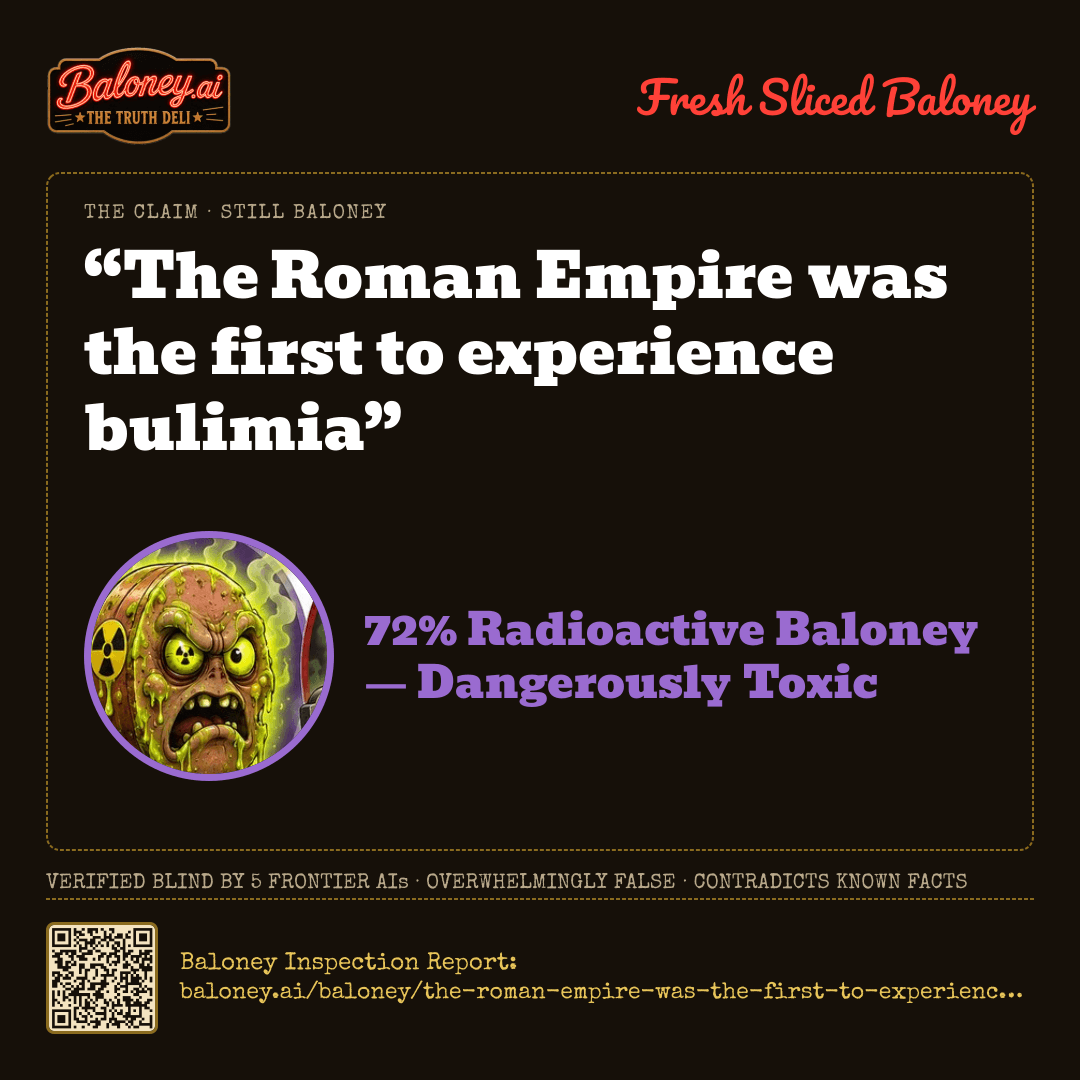
72%“The Roman Empire was the first to experience bulimia”
72%Radioactive Baloney — Dangerously Toxic
Dangerously misleading.
Overwhelmingly falseContradicts known factsPromotes false beliefsPotential for harm
Serve It Fresh
Ready to Serve13 servings
Serve it the way you want it
The Verdict
 “The Roman Empire was the first to experience bulimia”72% Radioactive Baloney — Dangerously ToxicVerified blind by 5 frontier AIs · Baloney Inspection Report: baloney.ai/baloney/the-roman-empire-was-the-first-to-experience-bulimia
The Baloney Sampler
Roman writers did record elite banquet purging — Seneca's line about those who vomit so they may eat, Suetonius on Vitellius and Claudius, and a peer-reviewed retrospective study in the International Journal of Eating Disorders identifying two Roman cases. That establishes the behaviour existed in Rome. It does not establish that Rome was first, and the scholarship cited explicitly separates ancient bingeing and purging from the modern disorder.
Both load-bearing words fail. A Springer Nature scholarly history places the earliest Western description of bulimic behaviour in Xenophon's Anabasis, among Greek soldiers before the Empire; the term itself is Greek. Bulimia nervosa as a clinical syndrome — bingeing, purging, body-image disturbance — was named by Gerald Russell in Psychological Medicine in 1979, per the National Institute of Mental Health criteria. Britannica confirms a vomitorium was an amphitheatre exit passage, not a purging room.
Resting on Springer Nature · Psychological Medicine (Russell 1979, via PubMed/NIH) · International Journal of Eating Disorders (via PubMed) · U.S. National Institute of Mental Health
Other ways to slice it — phrasings that might have changed the rating
- “Some wealthy Romans, including the emperors Vitellius and Claudius, are recorded as deliberately vomiting after overeating at banquets.” Seneca, Suetonius and a peer-reviewed retrospective study in the International Journal of Eating Disorders support exactly this narrower behavioural statement without claiming priority or a diagnosis.
- “The earliest surviving Western description of bulimic behaviour comes from Greek sources, not Roman ones.” A Springer Nature scholarly history locates that earliest description in Xenophon's Anabasis concerning Greek soldiers, and the term boulimia is Greek medical vocabulary predating the Empire.
- “Bulimia nervosa was first clinically described and named as a psychiatric disorder in 1979.” Multiple reports identify Gerald Russell's paper in Psychological Medicine as the first clinical description, with entry into DSM in 1980/1987.
Written from the panel’s reports by Anthropic · claude-opus-5. Nothing here changed the score.
The Order Ticket
07:16:17CLAIM RECEIVED — QUEUED FOR INSPECTION✓
07:17:04claude-opus-5 REPORTED — SCORE 82, CONFIDENCE 88✓
07:17:03gpt-5.5 REPORTED — SCORE 72, CONFIDENCE 84✓
07:17:03gemini-3.1-pro-preview REPORTED — SCORE 99, CONFIDENCE 95✓
07:16:28sonar-pro REPORTED — SCORE 72, CONFIDENCE 94✓
07:17:35grok-4.6 REPORTED — SCORE 52, CONFIDENCE 68✓
07:18:45PRIMARY MASTER CLAUDE — SCORE 80✓
07:17:43BLIND VALIDATION CHATGPT — SCORE 88✓
07:19:08AGREEMENT MODERATE DISAGREEMENT — DELTA 16✓
07:19:08SCORING MODEL V2 — MEDIAN OF 5 COUNTED LAB SCORES: 82, 72, 99, 72, 52 → 72.✓
07:19:08SOURCE RULE — LABS CITED 23 SOURCES: 0 DISCARDED FOR HAVING NO URL, 1 DISCARDED AS DEAD LINKS (404/410), 7 COULD NOT BE OPENED BY US AND ARE MARKED UNVERIFIED.✓
07:19:08SOURCE RULE — PRIMARY MASTER RULED ON 18 SOURCES: 0 DISCARDED FOR HAVING NO URL, 0 DISCARDED AS DEAD LINKS, 5 MARKED UNVERIFIED, 13 VERIFIED.✓
How This One Was Sliced
Station 1 · Blind Inspection — Five Graders, Zero Peeking
Each lab scored the claim independently, without seeing the others. Open a breakdown for its evidence, its sources, and how sure it was.
Anthropic · EQUAL WEIGHT · 47.3s
claude-opus-5
82%BALONEY
ROUND-1 BREAKDOWN
Evidence offered for the claim- Roman writers do describe binge-and-purge behavior: Seneca, in his Consolation to Helvia, condemns luxurious Romans with the line often rendered 'they vomit so that they may eat, and eat so that they may vomit,' and Suetonius depicts emperors such as Vitellius and Claudius as gluttons who induced vomiting — so purging after overeating was a real, documented phenomenon in Roman elite culture.
- The word 'bulimia' reached English via Latin (bulimia) from the Greek boulimia, so a Latin/Roman linguistic link to the term exists, which can make the claim seem plausible.
- Popular culture reinforces the association through the 'vomitorium' myth — the widespread (if erroneous) belief that Romans built rooms specifically for purging between courses — giving the claim an air of common-knowledge truth.
Evidence against the claim- The term itself is Greek, not Roman: boulimia ('ox-hunger,' bous + limos) appears in Greek medical writing (Hippocratic corpus, later Galen) centuries before the Roman Empire was founded in 27 BCE, meaning Greek physicians were describing ravenous-hunger syndromes first.
- Purging practices predate Rome substantially. Ancient Egyptian medical tradition (and Herodotus' report of monthly Egyptian purging for health) describes deliberate emetic use long before the Roman Empire, and comparable binge/purge or ascetic fasting behaviors are documented across many pre-Roman and non-Roman societies.
- A 'first to experience' claim is historically unfalsifiable and almost certainly wrong: disordered eating behavior is not a Roman invention, and no historian or epidemiological source identifies Rome as the point of origin.
- Bulimia nervosa as a clinical disorder — binge eating with compensatory purging plus characteristic body-image psychopathology — was first described and named by Gerald Russell in Psychological Medicine in 1979, and only entered DSM in 1980/1987. Roman gourmands vomiting at banquets was a cultural/gluttony practice, not a documented psychiatric syndrome.
- The 'vomitorium' itself was an architectural term for the passageway through which crowds exited an amphitheatre, not a purging room — the central popular evidence for the Roman-bulimia narrative is a mistranslation-driven myth.
- Modern research attributes bulimia nervosa to a mix of genetic, neurobiological and sociocultural factors, including thin-body-ideal pressures that are features of modern, not Roman, culture.
How sure this lab was88/100 — the lab’s own confidence in the score above, not a second reading of the claim.
SourcesRussell G., Psychological Medicine (via PubMed/NIH)journal · 95 · U.S. National Institute of Mental Healthgov · 95 · StatPearls / NCBI Bookshelf (NIH)gov · 88 · Encyclopaedia Britannicaother · 80 · Online Etymology Dictionaryother · 70 · Merriam-Websterother · 80 · Seneca, 'Of Consolation: To Helvia' (Wikisource, Stewart translation)other · 55
OpenAI · EQUAL WEIGHT · 45.9s
gpt-5.5
72%BALONEY
ROUND-1 BREAKDOWN
Evidence offered for the claim- Ancient Roman literature does contain evidence that some elite Romans practiced voluntary vomiting connected with banqueting; Seneca’s Letter 95 is often translated as saying people “vomit so that they may eat, and eat so that they may vomit.” This supports only a narrow, colloquial association between Rome, overeating, and vomiting.
- The popular modern association of Rome with vomiting at feasts may partly come from confusion over the word “vomitorium,” although that word refers to a passageway for crowds to exit an amphitheater or theater, not a room for purging after meals.
Evidence against the claim- The claim uses “bulimia” as if ancient Roman banquet vomiting equals bulimia nervosa. Medical definitions of bulimia nervosa require recurrent binge eating, compensatory behaviors, and undue concern with body weight or shape; the Roman accounts describe elite excess or digestive/banquet practices, not a diagnosable eating disorder.
- Bulimia nervosa as a named modern psychiatric syndrome was first described in the medical literature by Gerald Russell in 1979, not in the Roman Empire.
- The word “bulimia” itself derives from Greek roots meaning extreme hunger, so even the terminology is not originally Roman.
- There is no credible evidence that the Roman Empire was the first society or population to experience bulimia-like symptoms. Retrospectively diagnosing ancient people is uncertain, and absence of earlier records would not establish Rome as the first.
- The common “Roman vomitorium” story is misleading: a vomitorium was an architectural exit passage, not evidence of institutionalized bulimia.
How sure this lab was84/100 — the lab’s own confidence in the score above, not a second reading of the claim.
SourcesNational Institute of Mental Healthgov · 95 · PubMed / Psychological Medicinejournal · 95 · Cambridge University Press / Psychological Medicinejournal · 95 · Merriam-Websterother · 72 · Merriam-Websterother · 72 · Wikisource / Seneca, Moral Letters to Luciliusother · 60
Google · EQUAL WEIGHT · 45.4s
gemini-3.1-pro-preview
99%BALONEY
ROUND-1 BREAKDOWN
Evidence offered for the claim- Ancient writers like Seneca and Suetonius documented that some wealthy Roman elites, such as Emperor Vitellius, intentionally vomited during lavish banquets to make room to eat more.
- The etymological root of the word 'bulimia' comes from the ancient Greek 'boulimia' (meaning ox-hunger), which was recognized in antiquity as a physical state of extreme hunger.
Evidence against the claim- The popular claim heavily relies on the myth of the Roman 'vomitorium.' In ancient Rome, a vomitorium was an architectural feature—a passageway in an amphitheater designed to let large crowds exit rapidly ('spew forth')—not a room designated for vomiting.
- Bulimia nervosa is a psychiatric eating disorder defined by binge eating, compensatory purging, and distorted body image. It was first formally clinically described and named in 1979 by British psychiatrist Gerald Russell, not in ancient Rome.
- The documented instances of Romans purging at feasts were symptoms of extreme elite gluttony and targets of moral satire, rather than a psychological eating disorder driven by body dysmorphia.
- Even if strictly referring to intentional purging for physical management, the Romans were not the first; ancient Egyptian medical papyri outline the routine use of emetics for internal bodily cleansing long before the Roman era.
How sure this lab was95/100 — the lab’s own confidence in the score above, not a second reading of the claim.
SourcesEncyclopedia Britannicaedu · 95
Perplexity · EQUAL WEIGHT · 10.7s
sonar-pro
72%BALONEY
ROUND-1 BREAKDOWN
Evidence offered for the claim- Ancient Roman sources describe Emperor Claudius and Emperor Vitellius engaging in binge eating followed by self-induced vomiting. A peer-reviewed historical study therefore identifies two Roman cases of behavior resembling bulimia nervosa. [https://pubmed.ncbi.nlm.nih.gov/8932559/]
- Descriptions of eating-disorder-like behavior also appear in the writings of Galen and other physicians of late antiquity, showing that Roman-era medical writers recognized some relevant symptoms. [https://pubmed.ncbi.nlm.nih.gov/35316856/]
- A scholarly history of bulimia reports that bingeing and purging were documented in the ancient world, including prominently in Rome. [https://escholarship.org/uc/item/2594j40t]
Evidence against the claim- The statement says Rome was the first, but bulimic behavior was described before the Roman Empire. A scholarly history identifies the earliest written Western description of bulimia as an account in Xenophon's Anabasis concerning Greek soldiers, predating the Roman Empire. [https://link.springer.com/chapter/10.1007/978-1-4613-8300-0_2]
- The ancient Greek term and descriptions of extreme hunger predate Rome; Galen's account also does not equal the modern psychiatric diagnosis of bulimia nervosa. [https://academic.oup.com/book/1202/chapter/140041195?searchresult=1]
- The Roman cases are retrospective interpretations of historical behavior, not confirmed clinical diagnoses. Modern bulimia nervosa requires specific psychological and behavioral criteria, and diagnostic criteria were developed much later. The historical literature explicitly distinguishes ancient 'bulimic' behaviors from bulimia nervosa as currently defined. [https://academic.oup.com/book/1202/chapter/140041195?searchresult=1]
- Evidence of purging and abnormal eating exists across several ancient cultures, including evidence discussed for the ancient world from approximately 3100 BC onward, so Rome cannot securely be called the first culture to experience such behavior. [https://escholarship.org/uc/item/2594j40t]
How sure this lab was94/100 — the lab’s own confidence in the score above, not a second reading of the claim.
SourcesPubMed; study published in International Journal of Eating Disordersjournal · 95 · PubMed; study published in History of Psychiatryjournal · 95 · Springer Nature; scholarly book chapteredu · 88 · Oxford University Press; scholarly book chapteredu · 92 · University of California eScholarship; academic paperedu · 85
xAI · EQUAL WEIGHT · 77.6s
grok-4.6
52%BALONEY
ROUND-1 BREAKDOWN
Evidence offered for the claim- Roman writers such as Seneca described elites inducing vomiting at banquets so they could keep eating, a practice later analogized to binge-purge cycles.
- Some popular and historical overviews of eating disorders cite Roman feast excess as an early recorded example of purging after overeating.
Evidence against the claim- Bulimia nervosa is a modern clinical diagnosis (formalized in 1979) defined by recurrent binge eating, compensatory purging, and body-image disturbance, not public gluttony among the elite.
- Greek medical texts used the related term boulimos (ox-hunger) centuries before the Roman Empire, so Rome cannot be shown to be first.
- No evidence establishes any society as the first to have binge-purge behavior; similar acts are unrecorded or unprovable in earlier cultures.
- The related story that Romans built vomitoria specifically to vomit is a modern myth; vomitoria were amphitheater exits.
How sure this lab was68/100 — the lab’s own confidence in the score above, not a second reading of the claim.
SourcesWikipediaother · 75 · Wikipediaother · 80 · Encyclopædia Britannicaother · 92
Station 2 · The Masters
Primary Master · drawn at random
claude-opus-5
80% BALONEY
All five evaluators agree the statement is false as written, and the disagreement is only about how far it falls — 52 to 99, with three clustered at 72–82. I weighted the primary-literature evidence most heavily. Two independent strands sink the claim. First, chronology: the word and the concept are Greek, not Roman — boulimia ('ox-hunger', bous + limos) appears in Greek medical writing, and a scholarly history of eating disorders (Springer chapter) identifies the earliest Western description of bulimic behaviour as Xenophon's Anabasis, concerning Greek soldiers, well before the Roman Empire was founded in 27 BCE. Deliberate emetic use is also documented in earlier Egyptian practice. Second, definition: bulimia nervosa as a clinical syndrome — bingeing, compensatory purging and body-image disturbance — was first described and named by Gerald Russell in Psychological Medicine in 1979, entering DSM in 1980/1987. The genuine Roman material (Seneca on those who 'vomit so that they may eat', Suetonius on Vitellius and Claudius, and the peer-reviewed retrospective study identifying two Roman cases) establishes that purging happened in elite Roman culture — it does not establish priority, and the authors of that literature explicitly distinguish ancient bulimic behaviour from modern bulimia nervosa. The claim's two load-bearing words, 'first' and 'bulimia', are both wrong, and the popular image underpinning it — the Roman 'vomitorium' as a purging room, when it was an amphitheatre exit passage — is a known myth. That puts it in the Radioactive band. I did not go to 99: the statement is not the archetypal, decades-long organised falsehood the Zombie band is reserved for, and it rests on a real (if misread) historical kernel. I discounted Report 5's 52 because its own evidence list contradicts its score, and Report 3's 99 because a single tertiary source cannot carry that level of certainty.
Unanimous on the substance: all five evaluators concluded the statement is false, and all five independently flagged (a) the 1979 Russell description of bulimia nervosa and (b) the vomitorium-as-purging-room myth. Four of five noted that Greek sources predate Rome. Disagreement was confined to severity: Report 5 (52) treated the Roman purging accounts as partially redeeming the claim; Report 3 (99) treated it as a fully debunked zombie; Reports 1, 2 and 4 landed at 72–82. Report 4 contributed the strongest scholarly evidence on both sides — peer-reviewed identification of Roman cases, and the Xenophon priority that defeats 'first'.
Blind Validation Master · never saw the Primary’s work
gpt-5.5
88% BALONEY
The claim is overwhelmingly false as written. The reports agree that ancient Roman sources do describe some elite Romans, including emperors, overeating and inducing vomiting at banquets, so there is a small factual kernel behind the association. But that behavior is not the same as bulimia nervosa, which is a modern psychiatric diagnosis involving recurrent binge eating, compensatory behaviors, and body-image/weight concerns; it was formally described in the medical literature in 1979. Even if the claim is read more loosely as referring to binge-purge or extreme-hunger behaviors, Rome was not first: Greek terminology and medical descriptions predate the Roman Empire, and reports cite earlier Greek and Egyptian evidence of purging or bulimia-like symptoms. The popular vomitorium story also does not support the claim, since vomitoria were architectural exits, not rooms for vomiting. Overall, Rome provides documented examples of elite gluttony and induced vomiting, but not the first experience of bulimia.
AI EVALUATORS SHOWED MODERATE DISAGREEMENT — MASTERS SCORED 80% AND 88% · REVIEW THE EVIDENCE CAREFULLY
How the number was reached · scoring model v2 · how our models work
- Median of 5 counted lab scores: 82, 72, 99, 72, 52 → 72.
The Evidence
Evidence offered for the claim
- Romans did purge at banquets DEBUNKED — Seneca condemns luxurious Romans with the line often rendered 'they vomit so that they may eat, and eat so that they may vomit', and Suetonius depicts Vitellius and Claudius as gluttons who induced vomiting. A peer-reviewed study in the International Journal of Eating Disorders identifies two Roman cases of behaviour resembling bulimia nervosa. This confirms the behaviour existed in Rome — it says nothing about Rome being first.
- 'Bulimia' reached English via Latin DEBUNKED — The word passed into English through Latin bulimia, giving the claim a superficial Roman flavour. But the Latin is itself a borrowing of Greek boulimia, 'ox-hunger', used in Greek medical writing before the Roman Empire existed.
- Roman-era physicians described the symptoms DEBUNKED — Galen and other physicians of late antiquity wrote about ravenous-hunger and eating-disorder-like states, per a History of Psychiatry study. The panel notes these are descriptions of extreme hunger within a Greek medical tradition Galen inherited, not evidence of Roman priority or of modern bulimia nervosa.
- The 'vomitorium' image DEBUNKED — The widespread belief that Romans built rooms for purging between courses is the main popular support for the claim. A vomitorium was an architectural passageway through which crowds 'spewed forth' from an amphitheatre — the central evidence is a myth.
Evidence against the claim
- Greek soldiers, not Romans, supply the earliest account A scholarly history of eating disorders identifies the earliest written Western description of bulimic behaviour as a passage in Xenophon's Anabasis concerning Greek soldiers — predating the founding of the Roman Empire in 27 BCE.
- The term is Greek and pre-Roman Boulimia ('ox-hunger', bous + limos) appears in Greek medical writing including the Hippocratic corpus, centuries before Rome's empire. Greek physicians were naming and describing ravenous-hunger syndromes first.
- Bulimia nervosa was defined in 1979 The clinical disorder — recurrent bingeing plus compensatory purging plus characteristic body-image psychopathology — was first described and named by Gerald Russell in Psychological Medicine in 1979, entering the DSM in 1980/1987. Roman banquet vomiting was elite gluttony and a target of moral satire, not a diagnosed psychiatric syndrome.
- Deliberate purging long predates Rome Egyptian medical tradition describes routine emetic use for internal cleansing well before the Roman era, and purging or abnormal eating is discussed in the ancient world from roughly 3100 BC onward, across multiple cultures.
- The Roman cases are retrospective, not diagnoses The scholarly literature treats the Vitellius and Claudius accounts as retrospective interpretations of ancient texts and explicitly distinguishes ancient 'bulimic' behaviours from bulimia nervosa as currently defined.
- 'First' is unverifiable in principle No historian or epidemiological source names Rome as the origin point of disordered eating, and absence of earlier records could never establish priority. Modern research attributes bulimia nervosa to genetic, neurobiological and sociocultural factors including thin-ideal pressures characteristic of modern culture.
Sources · Reliability · Why Accepted or Discounted
| Source | Type | Reliability | Ruling |
|---|
| Russell G., Psychological Medicine (via PubMed/NIH) | journal | 95 | ACCEPTED — The original 1979 paper naming bulimia nervosa; decisive on when the disorder was clinically defined. Cited independently by two evaluators. |
| Cambridge University Press / Psychological Medicine | journal | 95 | ACCEPTED — Publisher DOI for the same 1979 Russell paper; corroborates the PubMed record. |
| U.S. National Institute of Mental Health | gov | 95 | ACCEPTED — Government clinical reference establishing the current diagnostic criteria the claim conflates with Roman banquet practice. |
| StatPearls / NCBI Bookshelf (NIH) | gov | 88 | ACCEPTED — Peer-reviewed clinical summary supporting the diagnostic and aetiological points. |
| PubMed; International Journal of Eating Disorders | journal | 95 | ACCEPTED — Peer-reviewed retrospective identification of Roman cases — the strongest evidence FOR the claim's kernel, accepted and weighed accordingly. |
| PubMed; History of Psychiatry | journal | 95 | ACCEPTED — Peer-reviewed treatment of Galen and late-antique descriptions; relevant to what Roman-era medicine did and did not recognise. |
| Springer Nature; scholarly book chapter | edu | 88 | ACCEPTED — Scholarly history locating the earliest Western description of bulimia in Xenophon's Anabasis; the single most decisive source against the word 'first'. |
| Oxford University Press; scholarly book chapterunverified | edu | 92 | ACCEPTED — Academic-press history distinguishing ancient bulimic behaviours from modern bulimia nervosa. |
| University of California eScholarship; academic paper | edu | 85 | ACCEPTED — Academic history of bulimia covering both Roman documentation and much earlier ancient evidence; cited on both sides, consistent with the other scholarship. |
| Encyclopaedia Britannicaunverified | other | 92 | ACCEPTED — Reliable tertiary reference on the disorder's definition and history; consistent with the primary literature. |
| Encyclopedia Britannicaunverified | edu | 95 | ACCEPTED — Authoritative on the architectural meaning of vomitorium. Accepted on that point, though one evaluator rested an entire 99-score on this source alone, which it cannot support. |
| Merriam-Websterunverified | other | 80 | ACCEPTED — Standard dictionary; corroborates the architectural definition independently of Britannica. |
| Merriam-Websterunverified | other | 72 | ACCEPTED — Adequate for the etymology from Greek roots meaning extreme hunger. |
| Online Etymology Dictionary | other | 70 | ACCEPTED — Supports the Greek bous + limos derivation; consistent with dictionary sources. |
| Wikisource / Seneca, Moral Letters to Lucilius, Letter 95 | other | 60 | ACCEPTED — Public-domain translation of a primary text. Accepted for the existence of the passage only; note that evaluators disagreed over whether the famous line sits in Letter 95 or the Consolation to Helvia, so the exact location is unsettled. |
| Seneca, 'Of Consolation: To Helvia' (Wikisource, Stewart translation) | other | 55 | ACCEPTED — Same primary quotation attributed to a different work; accepted as evidence the sentiment is Senecan, not as settled citation. |
| Wikipedia | other | 75 | ACCEPTED — Tertiary and low weight, but its content here is fully corroborated by Britannica, NIMH and the Russell paper. |
| Wikipedia | other | 80 | ACCEPTED — Tertiary, but agrees with Britannica and Merriam-Webster on the architectural meaning. |
Every link was opened when this claim was inspected. A dead link was discarded before publication; “unverified” means the site refused our automated check and the link is the one the panel cited. A source without a URL was never kept.
Serve It Fresh
Ready to Serve13 servings
Serve it the way you want it
The Verdict
“The Roman Empire was the first to experience bulimia”72% Radioactive Baloney — Dangerously ToxicVerified blind by 5 frontier AIs · Baloney Inspection Report: baloney.ai/baloney/the-roman-empire-was-the-first-to-experience-bulimia