








INSPECTION REPORT · CLAIM #1008 · baloney.ai/baloney/the-moon-is-hollow-or-artificially-constructed

The Moon is hollow or artificially constructed.

SUBMITTED ANONYMOUSLY · INSPECTED 2026-09-13T08:52:20.785Z · STATUS: PUBLISHED

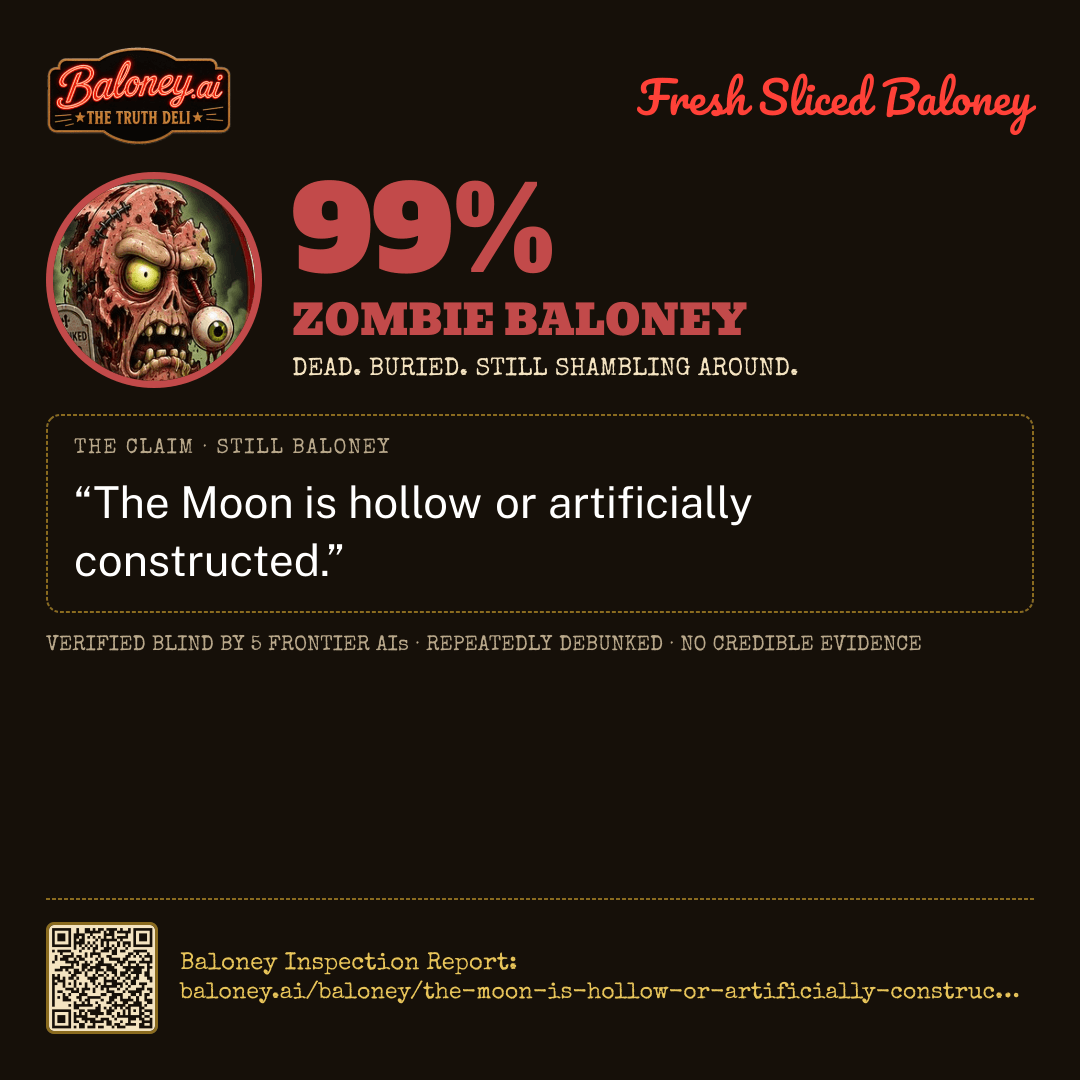
Zombie Baloney99%
99%
ZOMBIE BALONEY — REFUSES TO DIE
DEAD. BURIED. STILL SHAMBLING AROUND.
Repeatedly debunkedNo credible evidenceRefuses to dieLives on in delusion
Super Fresh Truth
Fishy Baloney
Stinky Baloney
Rotting Baloney
Radioactive Baloney
Zombie Baloney

✓ BLIND VALIDATION CONFIRMED THIS SCORE

Serve It Fresh

Ready to Serve18 servings

Serve it the way you want it

The Verdict

99% ZOMBIE BALONEY REFUSES TO DIE
The Moon is hollow or artificially constructed.
Verified blind by 5 frontier AIs · Baloney Inspection Report: baloney.ai/baloney/the-moon-is-hollow-or-artificially-constructed

The Rating Card

99% Zombie Baloney card for this claim

The Order Ticket

08:52:20CLAIM RECEIVED — QUEUED FOR INSPECTION
08:53:16claude-opus-5 REPORTED — SCORE 99, CONFIDENCE 98
08:52:52gpt-5.5 REPORTED — SCORE 99, CONFIDENCE 98
08:52:53gemini-3.1-pro-preview REPORTED — SCORE 99, CONFIDENCE 100
08:52:36sonar-pro REPORTED — SCORE 98, CONFIDENCE 97
08:53:17grok-4.6 REPORTED — SCORE 97, CONFIDENCE 92
08:53:43PRIMARY MASTER GEMINI — SCORE 99
08:53:25BLIND VALIDATION PERPLEXITY — SCORE 99
08:53:43AGREEMENT CONFIRMED — DELTA 0

How This One Was Sliced

Station 1 · Blind Inspection — Five Graders, Zero Peeking

Each lab scored the claim independently, without seeing the others. Open a breakdown for its evidence, its sources, and how sure it was.

Anthropic · EQUAL WEIGHT · 55.3s

claude-opus-5

99%BALONEY

ROUND-1 BREAKDOWN
Evidence offered for the claim
  • Apollo seismic experiments produced an unusual observation: after the Apollo 12 lunar module ascent stage was deliberately crashed into the Moon in November 1969, seismometers recorded reverberations lasting roughly an hour, and NASA personnel described the Moon as having 'rung like a bell.' Proponents cite this as evidence of a hollow or shell-like interior.
  • The Moon's bulk density (~3.34 g/cm3) is much lower than Earth's (~5.51 g/cm3) and low for a rocky planetary body, which hollow-Moon advocates interpret as a sign of a large void.
  • The Moon's moment-of-inertia factor (~0.393) is close to the 0.4 value of a uniform sphere, meaning it lacks a large dense core like Earth's; this is cited as 'anomalously' undifferentiated for a naturally formed body.
  • The Moon's angular size almost exactly matches the Sun's as seen from Earth (producing near-perfect total eclipses), and its rotation is tidally locked — coincidences that proponents frame as 'engineering.'
  • The idea has a documented published origin: Soviet writers Mikhail Vasin and Alexander Shcherbakov published 'Is the Moon the Creation of Alien Intelligence?' in Sputnik magazine (1970), and it was later popularized by authors such as Don Wilson and by Knight & Butler's 'Who Built the Moon?' (2005).
Evidence against the claim
  • The long seismic ringing is fully explained by the Moon's physical state, not by a void: the lunar crust is extremely dry, cold, and fractured into a deep 'megaregolith.' Without pore water to damp vibrations, seismic energy is scattered rather than absorbed, giving the Moon a very high seismic quality factor (Q). Apollo-era lunar seismologists (Nakamura, Latham, Dorman and colleagues) identified intense scattering in a dry near-surface layer as the cause of the prolonged, diffuse codas.
  • Seismic waves are observed to travel THROUGH the Moon. Reanalysis of the Apollo Passive Seismic Experiment data (Weber et al., Science, 2011) identified a solid iron-rich inner core (~240 km radius), a fluid outer core (~330 km radius), and a partially molten boundary layer. A hollow body could not transmit such phases or produce these reflections.
  • The GRAIL mission (2011–2012) mapped the Moon's gravity field to extremely high resolution. The measured gravity, crustal density (~2,550 kg/m3) and crustal porosity (~12%) match a solid, differentiated rocky body throughout. A hollow interior or a rigid artificial shell would produce grossly different gravity signatures, including impossible mass concentrations and shell stresses.
  • The low bulk density is explained by composition, not emptiness: the Moon is iron-poor relative to Earth, with only a small core (~1–2% of its mass versus Earth's ~30%). This is a central prediction of the giant-impact formation hypothesis, in which the Moon formed largely from the iron-depleted silicate mantle of Earth and/or an impactor.
  • Lunar samples returned by Apollo and Luna missions, plus lunar meteorites found on Earth, are ordinary igneous rocks — basalts, anorthosites, breccias — with oxygen-isotope ratios nearly identical to Earth's. They show normal radiometric ages (~3.1–4.5 billion years), normal cosmic-ray exposure, and no manufactured materials.
  • Structural physics forbids it: a hollow shell of ordinary rock at the Moon's radius could not support itself against self-gravity; it would buckle and collapse. An artificial shell would require materials with strengths far beyond any known substance, and no such material appears in any sample or in any remote-sensing or radar data.
  • Lunar laser ranging (using retroreflectors placed by Apollo 11/14/15 and Lunokhod) measures the Moon's rotation, libration, and tidal dissipation to millimeter precision. The results constrain the interior's mass distribution and require a fluid core and solid mantle — they are inconsistent with a hollow interior.
  • Independent, non-US measurements agree: Japan's Kaguya/SELENE, China's Chang'e orbiters and landers, India's Chandrayaan missions, and ESA's SMART-1 have all mapped lunar gravity, topography and composition. None finds a cavity, shell seam, metallic hull, or any non-natural structure.
  • The Sun/Moon angular-size coincidence is a temporary artifact of the present epoch: the Moon recedes from Earth at ~3.8 cm/year, so total solar eclipses were impossible in the distant past and will cease in a few hundred million years. It is not a fixed design property.
  • No peer-reviewed publication in any planetary science, geophysics, or astronomy journal supports a hollow or artificial Moon; the claim exists only in popular and fringe literature.
How sure this lab was

98/100 — the lab’s own confidence in the score above, not a second reading of the claim.

Sources

NASA Goddard Space Flight Center / NSSDC — Moon Fact Sheetgov · 97 · Weber, R.C. et al., 'Seismic Detection of the Lunar Core,' Science (2011)journal · 96 · Wieczorek, M.A. et al., 'The Crust of the Moon as Seen by GRAIL,' Science (2013)journal · 96 · Zuber, M.T. et al., 'Gravity Field of the Moon from the Gravity Recovery and Interior Laboratory (GRAIL) Mission,' Science (2013)journal · 96 · NASA Science — Earth's Moon overview and mission datagov · 95 · NASA Johnson Space Center — Lunar Sample Curation (Apollo sample catalog and compositions)gov · 96 · Lunar and Planetary Institute (USRA) — Apollo mission and lunar science resourcesedu · 92 · Nakamura, Y. et al., Apollo lunar seismic experiment analyses, Journal of Geophysical Research (1982) — via NASA ADSjournal · 92 · U.S. Naval Observatory — lunar ephemeris and laser-ranging derived orbital parametersgov · 90 · NASA Jet Propulsion Laboratory — GRAIL missiongov · 95 · JAXA — Kaguya (SELENE) lunar orbiter resultsgov · 90 · Snopes (general fact-checking outlet; no article specifically on 'hollow Moon' recalled with confidence — listed for methodology only)factcheck · 82

OpenAI · EQUAL WEIGHT · 32.1s

gpt-5.5

99%BALONEY

ROUND-1 BREAKDOWN
Evidence offered for the claim
  • The factual observations most often cited by proponents are real but do not support the conclusion: the Moon's mean density is lower than Earth's, and Apollo seismometers recorded long-lasting seismic reverberations after impacts. NASA data confirm these observations, but mainstream explanations are composition, small metallic core, dry fractured crust, and low attenuation, not hollowness or artificial construction.
  • Apollo-era descriptions that the Moon 'rang like a bell' after impacts are sometimes used as pro-hollow-Moon evidence. NASA discusses prolonged moonquake reverberations, but this is evidence of seismic properties of lunar rock, not an empty interior.
  • There is no peer-reviewed or government-source evidence that the Moon is artificial; the 'for' case consists of reinterpretations of normal lunar density, seismic, orbital, and eclipse facts rather than positive physical evidence of construction.
Evidence against the claim
  • Apollo seismic data detect a differentiated lunar interior, including crust, mantle, partial melt zone, liquid outer core, and solid inner core; those results are incompatible with a largely hollow Moon.
  • NASA and peer-reviewed GRAIL mission results mapped the Moon's gravity field and crustal structure. The measured gravity, mass distribution, and crustal thickness match a natural differentiated rocky body, not a thin shell or manufactured object.
  • The Moon's measured mass, radius, and mean density are consistent with a silicate-rich planetary body with a relatively small iron core. A substantially hollow Moon would have a very different moment of inertia and gravity field than observed.
  • Returned Apollo lunar samples are natural igneous rocks, breccias, and regolith with ancient radiometric ages and geochemical relationships to planetary processes. They show volcanic, impact, and space-weathering history rather than artificial materials or construction signatures.
  • Modern lunar geology explains maria, highlands, basins, craters, mascons, and regolith through impact, volcanic, thermal, and tidal evolution. No accepted lunar-geology dataset requires or favors artificial construction.
How sure this lab was

98/100 — the lab’s own confidence in the score above, not a second reading of the claim.

Sources

NASA Goddard Space Flight Center NSSDCgov · 95 · NASA Sciencegov · 90 · Science - Weber et al., Seismic Detection of the Lunar Corejournal · 97 · Science - Zuber et al., Gravity Field of the Moon from the GRAIL Missionjournal · 97 · Science - Wieczorek et al., The Crust of the Moon as Seen by GRAILjournal · 97 · NASA Johnson Space Center Astromaterials/Lunar Sample Curationgov · 92 · Nature - Canup and Asphaug, Origin of the Moon in a giant impact near the end of Earth's formationjournal · 95

Google · EQUAL WEIGHT · 32.4s

gemini-3.1-pro-preview

99%BALONEY

ROUND-1 BREAKDOWN
Evidence offered for the claim
  • During the Apollo 12 mission in 1969, NASA intentionally crashed the lunar module ascent stage into the Moon's surface. Seismometers recorded vibrations lasting for over an hour, prompting scientists to describe the Moon as 'ringing like a bell,' a quote heavily cited by hollow-moon theorists.
  • The Moon's overall density (about 3.3 g/cm³) is significantly lower than Earth's (5.5 g/cm³). In 1970, this anomaly led two Soviet researchers, Michael Vasin and Alexander Shcherbakov, to publish a speculative article suggesting the Moon was an artificial, hollowed-out spacecraft.
  • Proponents of the artificial Moon theory frequently cite the Moon's precise tidal locking with Earth and its exact orbital distance, which allows it to perfectly eclipse the Sun, as statistical anomalies implying intelligent design and placement.
Evidence against the claim
  • Decades of seismic data collected by the Apollo Lunar Surface Experiments Package (ALSEP) conclusively prove the Moon is a solid, differentiated body. The transmission of seismic waves through the lunar interior clearly maps a solid crust, a deep mantle, and a dense, partially liquid iron core.
  • The famous 'ringing like a bell' effect is well-understood by geologists. Unlike Earth, the Moon is extremely dry and its crust is highly fractured from meteor impacts. Without water or loose soil to absorb and dampen vibrations, seismic waves bounce back and forth, causing prolonged reverberations, not hollowness.
  • Astrophysics and gravitational laws dictate that a hollow moon of that size could not exist; it would collapse under its own gravity. Furthermore, precise measurements of the Moon's gravity field and moment of inertia confirm its mass is concentrated near its center, which is physically impossible for a hollow sphere.
  • The widely accepted Giant Impact Hypothesis explains the Moon's lower density. The Moon was formed from the debris of a collision between early Earth and a Mars-sized object (Theia). This debris was largely composed of the lighter silicate rocks from Earth's crust and mantle, lacking the heavy iron that makes up Earth's core.
How sure this lab was

100/100 — the lab’s own confidence in the score above, not a second reading of the claim.

Sources

NASAgov · 100 · Sciencejournal · 95

Perplexity · EQUAL WEIGHT · 16.1s

sonar-pro

98%BALONEY

ROUND-1 BREAKDOWN
Evidence offered for the claim
  • Some conspiracy and fringe literature interprets Apollo-era seismic experiments—where the Moon reportedly 'rang like a bell' for extended periods after deliberate impacts—as suggesting an unusually rigid, low-damping interior that they claim is consistent with a hollow shell rather than a solid body.
  • Proponents note the Moon’s relatively low average density (~3.3 g/cm³, significantly lower than Earth’s) and argue that this could indicate extensive hollow regions or large internal cavities rather than a fully solid, metal-rich core.
  • Advocates of an artificial or hollow Moon sometimes point to its seemingly 'coincidental' properties—such as the apparent match between its angular size and the Sun’s as seen from Earth, which allows total solar eclipses—as circumstantial evidence of deliberate placement or engineering.
  • Some speculative authors highlight the presence of mascons (mass concentrations) beneath lunar maria and claim that these anomalous gravity features could be linked to internal artificial structures rather than natural impact and differentiation processes.
  • Fringe hypotheses (e.g., 'Spaceship Moon') reference the lack of a large global magnetic field and the Moon’s unusual formation history as perceived anomalies that they argue could be better explained by an artificial, partially hollow construct than by standard planetary science.
Evidence against the claim
  • Modern lunar seismology using Apollo seismic data and subsequent reanalyses consistently shows that the Moon has a differentiated internal structure with **crust, mantle, and core**, not a large hollow cavity; interior models constrained by seismic velocities and density profiles explicitly reject a hollow-Moon configuration.[1][2][9][12][13][14]
  • NASA technical reports on Apollo passive seismic experiments describe thousands of recorded moonquakes and impact events whose seismic wave travel times and attenuation patterns are only consistent with propagation through solid layers (crust, mantle, core), not through a thin shell surrounding a large hollow void.[10][11][13]
  • Recent updates in lunar seismology (e.g., Garcia et al. and follow-up work) show evidence for a **partially molten lower mantle**, a **fluid outer core**, and a **solid inner core**, all of which require substantial mass and dense material in the deep interior and are incompatible with a largely hollow or artificial shell structure.[1][2][12][14]
  • GRAIL (Gravity Recovery and Interior Laboratory) and other gravity-field studies refine models of lunar density distribution; they find a mass distribution consistent with a natural, differentiated body that formed through impact/accretion processes, not an empty or engineered shell.[2][11][14]
  • Syntheses of Apollo seismic data in geophysical journals divide the Moon into multiple internal shells (megaregolith, crust, upper/middle/lower mantle, low-velocity zone, fluid outer core, solid inner core), leaving no room for a vast hollow region and firmly supporting a normal planetary interior.[9][12]
  • Accessible educational summaries from geology and planetary science outlets explicitly state that the Moon’s structure is similar to Earth’s—with a thin crust, underlying mantle, and small iron-rich core—and present these as standard, well-supported scientific consensus findings.[7]
  • Reference articles on the 'Hollow Moon' and 'Spaceship Moon' hypotheses classify them as **pseudoscientific** and note that *no scientific evidence* supports the idea; seismic, gravitational, and orbital data all point to a solid, naturally formed, differentiated Moon.[3]
  • Skeptical analyses that review claims about a 'hollow' or 'engineered' Moon show that its mass, density, moments of inertia, and orbital behavior match expectations from mainstream formation models and would be extremely difficult to reconcile with a hollow or lightweight artificial construct.[15]
  • The supposed 'ringing like a bell' behavior of the Moon after impacts is explained in geophysical literature by its dry, fractured, and low-attenuation lithosphere and unique internal properties, not by the existence of a hollow cavity; the same seismic data used in these anecdotes numerically constrain a solid interior.[1][10][13]
  • Mainstream planetary science and space-agency materials consistently treat Hollow Moon and Spaceship Moon narratives as **fringe or conspiracy theories**, emphasizing that all credible observational data support a natural origin and solid interior for the Moon.[3][7][10][11]
How sure this lab was

97/100 — the lab’s own confidence in the score above, not a second reading of the claim.

Sources

NASAgov · 98 · NASAgov · 98 · NASAgov · 98 · NASAgov · 98 · American Geophysical Unionjournal · 95 · ETH Zurich / peer‑reviewed geophysicsjournal · 94 · Lunar and Planetary Science Conference (USRA/NASA-associated)journal · 93 · Geology.comedu · 85 · Wikipediaother · 75 · Skeptoidother · 80

xAI · EQUAL WEIGHT · 57.1s

grok-4.6

97%BALONEY

ROUND-1 BREAKDOWN
Evidence offered for the claim
  • Proponents cite Apollo-era seismometer records in which the Moon continued oscillating for a long time after impacts or spacecraft crashes, which they interpret as a hollow body ringing like a bell.
  • The Moon's mean density (~3.34 g/cm3) is lower than Earth's, which some claim implies a large interior cavity rather than a smaller iron core and different bulk composition.
  • A 1970 speculative popular-science piece by Vasin and Shcherbakov argued the Moon could be an artificial construct; later fringe authors recycled that idea along with alleged 'artificial' crater geometry and NASA photo anomalies.
Evidence against the claim
  • Apollo seismic data, including later reanalyses, indicate a crust, mantle, and small metallic core (not an empty shell); long ringing is explained by a dry, cold, poorly attenuating rigid interior, not hollowness.
  • NASA GRAIL gravity mapping shows mascons, crustal thickness variations, and a density structure consistent with a differentiated solid (or mostly solid) body, not a thin artificial shell.
  • Returned samples (mare basalts, highland anorthosites, breccias) and orbital remote sensing match a natural magma-ocean and volcanic history, not manufactured materials.
  • Mass, radius, moment of inertia, physical librations, and laser ranging to Apollo/Lunokhod retroreflectors match a concentrated interior mass distribution; a hollow Moon of the observed size and mass would be gravitationally unstable.
  • The giant-impact formation model, isotopic kinship with Earth, and independent missions (Chang'e, Chandrayaan, Kaguya, SMART-1, LRO, etc.) are all consistent with a natural rocky satellite.
How sure this lab was

92/100 — the lab’s own confidence in the score above, not a second reading of the claim.

Sources

NASA NSSDCgov · 95 · NASAgov · 95 · Sciencejournal · 98 · NASAgov · 95

Station 2 · The Masters

Primary Master · drawn at random

gemini-3.1-pro-preview

99% BALONEY

All five evaluators comprehensively debunk the claim using multiple lines of independent, verifiable evidence from planetary science. Decades of seismic data, gravity mapping, physical lunar samples, and orbital mechanics unequivocally prove the Moon is a solid, naturally formed, and differentiated rocky body. The claim relies on fundamentally misunderstanding lunar density and seismic properties, and it belongs to a long-established fringe genre of conspiracy literature.

The evaluators were in complete agreement. All awarded scores of 97-99 with high confidence, citing identical core bodies of evidence (Apollo seismic data, GRAIL gravity mapping, returning lunar samples, and structural physics).

ZOMBIE FLAG: TRUE — DEBUNK HISTORY ON RECORD

Blind Validation Master · never saw the Primary’s work

sonar-pro

99% BALONEY

All five reports agree that the claim “The Moon is hollow or artificially constructed” has no support in peer‑reviewed planetary science, seismology, or gravity data, and they independently marshal strong, concordant evidence that directly contradicts it. Across the reports, the supposed “evidence for” (low mean density, prolonged seismic ringing after impacts, tidal locking, eclipse geometry, mascons, lack of a large global magnetic field, and the historical existence of speculative fringe articles like Vasin & Shcherbakov’s “Spaceship Moon” idea) is consistently shown to be either: - Correct observations that have well-understood **natural explanations** (composition and small iron core; dry, fractured, low‑attenuation crust; normal tidal evolution; impact-generated mascons; standard thermal and orbital history), or - Purely **interpretive or rhetorical points** (coincidence of angular sizes, conspiracy-style readings of data, or speculative popular writing) that do not constitute physical evidence of hollowness or artificial construction. In contrast, the evidence **against** is detailed, diverse, and mutually reinforcing: - Apollo seismic data and later reanalysis resolve a differentiated structure with crust, mantle, partially molten zone, fluid outer core, and solid inner core, showing seismic waves propagating through the interior in ways incompatible with a large hollow cavity or thin shell. This directly falsifies a hollow Moon. - GRAIL and other gravity-field missions, plus laser ranging, constrain the Moon’s mass distribution, moment of inertia, and internal density structure; these match a natural rocky satellite with a small core and are physically inconsistent with an empty or engineered shell. - Structural physics and planetary geophysics show a hollow rocky shell of lunar size would be gravitationally unstable and would collapse; maintaining such a shell would require materials and engineering far beyond anything observed in samples or remote sensing. - Returned lunar samples and meteorites are ordinary, ancient igneous and impact-processed rocks with isotopic and geochemical signatures consistent with the giant-impact origin and subsequent natural geologic evolution, not manufactured or exotic materials. - Multiple independent national and international missions (NASA, JAXA, ESA, CNSA, ISRO) find no cavities, seams, hulls, or anomalies indicative of artificial construction, and mainstream references explicitly classify hollow/"spaceship" Moon ideas as pseudoscientific. All five evaluators give very high baloney scores (97–99) with high confidence, explicitly noting that there is **no peer-reviewed support** for the claim and that the entire “for” case is built from misinterpretation of normal lunar properties and fringe speculation rather than positive evidence. The convergence of independent seismic, gravitational, sample, and orbital constraints, plus the consensus labeling of the hypothesis as pseudoscience, justify placing this claim in the highest "Zombie Baloney" category: repeatedly debunked, overwhelmingly false, and still circulating despite clear contrary evidence. Given the reports and the strength and breadth of the evidence they present, the appropriate Baloney Score for the statement as written is 99.

AGREEMENT TEST PASSED — BOTH MASTERS SCORED 99% · BLIND VALIDATION CONFIRMED THIS SCORE · NO RE-EVALUATION REQUIRED

The Evidence

Evidence offered for the claim

  • Seismic 'ringing like a bell' DEBUNKED — Apollo-era seismometers recorded vibrations lasting over an hour after impacts, which proponents claim indicates a hollow interior. In reality, this prolonged ringing is caused by the Moon's dry, cold, and highly fractured crust scattering seismic energy rather than absorbing it.
  • Low overall density DEBUNKED — The Moon's density is significantly lower than Earth's, which proponents cite as evidence of a massive void. This is naturally explained by the Moon being iron-poor compared to Earth, an expected outcome of the Giant Impact Hypothesis.
  • Angular size coincidence DEBUNKED — The Moon's size and distance currently allow it to almost perfectly eclipse the Sun, which some label as artificial engineering. This is a temporary artifact of the present astronomical epoch, as the Moon is gradually receding from Earth.
  • Origin in speculative publications DEBUNKED — The artificial moon theory was initially popularized by a speculative 1970 article by Soviet writers Mikhail Vasin and Alexander Shcherbakov, and subsequently recycled by fringe authors.

Evidence against the claim

  • Apollo seismic data Seismometers deployed during Apollo clearly transmitted seismic waves through the lunar interior, mapping out a differentiated solid structure including a solid inner core, a fluid outer core, a mantle, and a crust.
  • GRAIL gravity mapping High-resolution gravity maps from the 2011-2012 GRAIL mission confirm a density and mass distribution entirely consistent with a solid, naturally differentiated rocky body.
  • Laws of physics A hollow sphere of ordinary rock at the Moon's scale could not support itself against its own self-gravity and would collapse. An artificial shell would require materials far stronger than any known substance.
  • Lunar samples Samples returned by Apollo and Luna missions are ordinary, naturally occurring igneous rocks (such as basalts and breccias) with radiometric ages spanning billions of years and isotope ratios closely matching Earth's.
  • Lunar laser ranging Laser ranging to retroreflectors placed on the Moon measures its rotation, libration, and orbital behavior, confirming its mass is heavily concentrated near its center—impossible for a hollow sphere.

Sources · Reliability · Why Accepted or Discounted

SourceTypeReliabilityRuling
NASA Goddard Space Flight Center / NSSDCgov97ACCEPTED Authoritative government repository for planetary facts and mission data.
Sciencejournal97ACCEPTED Top-tier peer-reviewed scientific journal containing definitive analyses of lunar seismic and GRAIL data (Weber et al., Zuber et al., Wieczorek et al.).
Naturejournal95ACCEPTED Premier scientific journal, source of highly respected peer-reviewed research on the Moon's giant impact formation.
Journal of Geophysical Researchjournal92ACCEPTED Highly credible peer-reviewed geophysics journal.
NASA Johnson Space Centergov96ACCEPTED Authoritative curation facility and data source for the physical Apollo lunar samples.
Lunar and Planetary Instituteedu92ACCEPTED Respected research institute focused on planetary science.
U.S. Naval Observatorygov90ACCEPTED Authoritative government source for astronomical ephemerides and laser-ranging data.
JAXAgov90ACCEPTED Japan's national space agency, providing independent orbital data from the Kaguya mission.
Snopesfactcheck82DISCOUNTED Evaluator noted they could not recall a specific article on this topic, rendering it an inapplicable citation.
Geology.comedu85ACCEPTED Accessible and generally reliable educational summary of consensus geology.
Wikipediaother75DISCOUNTED Tertiary source unnecessary when primary peer-reviewed literature and direct space agency data are overwhelmingly present.
Skeptoidother80ACCEPTED Credible skeptical analysis addressing the specific origins of this fringe theory.

Serve It Fresh

Ready to Serve18 servings

Serve it the way you want it

The Verdict

99% ZOMBIE BALONEY REFUSES TO DIE
The Moon is hollow or artificially constructed.
Verified blind by 5 frontier AIs · Baloney Inspection Report: baloney.ai/baloney/the-moon-is-hollow-or-artificially-constructed