Station 1 · Blind Inspection — Five Graders, Zero Peeking
Each lab scored the claim independently, without seeing the others. Open a breakdown for its evidence, its sources, and how sure it was.
Anthropic · EQUAL WEIGHT · 46.9s
claude-opus-5
76%BALONEY
ROUND-1 BREAKDOWN
Evidence offered for the claim
Highly practiced or automated activities can genuinely be performed concurrently with little measurable cost (e.g., walking while talking, driving a familiar route while listening to speech), because automated motor routines demand little central executive capacity.
Dual-task interference shrinks dramatically with extensive practice: Schumacher et al. (2001, Psychological Science) reported 'virtually perfect time sharing' on two simple tasks after training, suggesting the central bottleneck is not absolutely fixed.
Tasks using different input and output modalities (e.g., one auditory-vocal, one visual-manual) interfere far less than tasks competing for the same channel, so some genuine parallel processing occurs.
Charron & Koechlin (2010, Science) found the left and right frontal lobes can divide the representation of two concurrent goals, implying a neural mechanism for handling up to two tasks in parallel (but not more).
A small minority appear to be genuine exceptions: Watson & Strayer (2010, Psychonomic Bulletin & Review) identified 'supertaskers' (~2.5% of their sample) who showed no measurable performance decrement in a demanding driving-plus-memory dual task; follow-up imaging work reported differences in frontal/attentional network activity.
In the loose everyday sense of 'multitasking' (interleaving several ongoing projects over minutes or hours), people manage this routinely and productively — the deficits appear mainly at the level of second-by-second attention.
Evidence against the claim
What is usually called multitasking is really rapid task-switching, and switching carries measurable costs in time and accuracy; the American Psychological Association summarizes research showing 'switch costs' that can reduce productivity substantially.
Rubinstein, Meyer & Evans (2001, JEP: Human Perception and Performance) demonstrated that executive control operations needed to reconfigure task rules produce reliable time losses that grow with task complexity and unfamiliarity.
Pashler's dual-task research (e.g., 1994, Psychological Bulletin) supports a central processing bottleneck: response selection for two tasks cannot proceed simultaneously, producing psychological refractory period delays even in very simple tasks.
Strayer & Johnston (2001, Psychological Science) and subsequent driving-simulator work show conversing on a phone degrades detection of critical events — 'inattention blindness' — even hands-free, i.e., the cost is cognitive, not manual.
Government safety agencies (NHTSA, CDC) treat divided attention while driving as a demonstrated crash risk rather than a manageable skill, and many jurisdictions legislate against it.
Ophir, Nass & Wagner (2009, PNAS) found heavy media multitaskers performed worse on filtering irrelevant information and on task-switching — the opposite of the expected 'practice makes perfect' result.
Sanbonmatsu et al. (2013, PLOS ONE) found that self-rated multitasking ability was negatively correlated with actual multitasking performance; people who multitask most tend to be those least able to do it well, indicating the subjective sense of effectiveness is unreliable.
Even the 'virtually perfect time sharing' and 'supertasker' findings are narrow: they involve simple, extensively practiced, or specifically selected cases, and do not generalize to two attention-demanding, novel, or language-based tasks.
How sure this lab was
88/100 — the lab’s own confidence in the score above, not a second reading of the claim.
In a limited sense, humans can do more than one thing at a time when tasks draw on partly different perceptual, cognitive, or motor resources, or when one task is highly practiced/automatic; Wickens' multiple-resource theory is a well-cited framework for why some task combinations interfere less than others.
A small minority of people may be unusually good at demanding dual-task performance: Watson and Strayer reported that 5 of 200 participants, about 2.5%, showed little or no impairment when combining simulated driving with a demanding phone-memory/math task, calling them 'supertaskers.'
Everyday behavior shows some effective concurrent processing is possible for low-demand combinations, such as walking while talking or doing a routine motor task while listening, because not all brain processing requires the same central attentional bottleneck at the same moment.
Evidence against the claim
For attention-demanding tasks, the dominant evidence is that people usually do not truly perform both effectively at once; they switch attention or suffer dual-task interference. Pashler's review of dual-task research describes robust processing bottlenecks, especially around response selection and central attention.
Task switching itself has measurable costs: Rubinstein, Meyer, and Evans found that people are slower and/or less accurate when switching between tasks than when repeating the same task, undermining the idea that multitasking is generally efficient.
Driving research strongly contradicts broad claims of effective multitasking: Strayer and Johnston found cell-phone conversation impaired simulated driving performance, and NHTSA treats distracted driving as a serious crash-risk category.
Heavy media multitasking is not good evidence of superior multitasking ability; Ophir, Nass, and Wagner found heavy media multitaskers performed worse on tests involving filtering irrelevant information and cognitive control.
Overall, the claim is misleading if it implies that the human brain can generally perform multiple attention-demanding tasks at once without loss. A more accurate statement is: humans can sometimes combine simple or automatic tasks, but demanding multitasking usually reduces performance.
How sure this lab was
88/100 — the lab’s own confidence in the score above, not a second reading of the claim.
The brain can successfully perform simultaneous tasks if at least one task is highly automated, habitual, or utilizes completely different cognitive and sensory networks (e.g., walking or chewing gum while having a conversation).
Research from the University of Utah has identified a very small fraction of the population (approximately 2%) known as 'supertaskers,' whose brains can genuinely manage multiple demanding tasks simultaneously without a drop in performance or an increase in errors.
Evidence against the claim
Cognitive neuroscience shows that for tasks requiring conscious attention, the brain does not multitask; it engages in rapid 'task-switching.' This switching is managed by the prefrontal cortex and creates a bottleneck in cognitive processing.
According to research highlighted by the American Psychological Association, the mental 'switching cost' of bouncing between tasks can reduce overall productivity by as much as 40%, as the brain takes time to refocus on the new rules and context of each task.
A seminal study by Stanford researchers (Ophir, Nass, and Wagner) found that people who identify as chronic 'heavy media multitaskers' actually perform worse on tests of cognitive control, are more susceptible to distractions, and are worse at task-switching than those who rarely multitask.
Functional magnetic resonance imaging (fMRI) studies demonstrate that the brain's processing capacity is strictly limited; attempting to do two cognitive tasks at once typically results in activation dividing between the two hemispheres, leading to slower processing and increased error rates.
How sure this lab was
95/100 — the lab’s own confidence in the score above, not a second reading of the claim.
Dual-task studies show that under some conditions the brain can perform **two tasks at the same time** with overlapping cognitive processes, especially when at least one task is simple or highly automated (e.g., walking and talking, or a practiced motor skill plus a cognitive task).[12][14]
Cognitive and neuroscientific work defines multitasking as a condition where **cognitive processes for multiple tasks overlap in time**, and finds that people can achieve such overlap, especially when executive control demands are modest.[12]
Neuroimaging studies report that when people perform two tasks concurrently, the prefrontal cortex can **allocate different hemispheres or subnetworks to different tasks**, indicating some capacity for parallel processing.[11]
Recent Georgetown research suggests that with learning, the brain can **rewire circuitry so that a learned task becomes more automatic**, freeing central resources to handle another task concurrently; the authors explicitly argue this makes “true multitasking” possible for certain combinations of skills.[14]
Everyday-life and lab observations show that people can concurrently handle **low-demand combinations** (e.g., listening to music while doing routine tasks, driving a familiar route while holding a simple conversation), which implies that the brain can effectively juggle tasks when combined load stays within resource limits.[12][3]
Evidence against the claim
Task-switching experiments consistently show **substantial performance costs** (slower reaction times, more errors) when people alternate between tasks, indicating that what is commonly called multitasking is often inefficient rapid switching rather than truly effective parallel processing.[3][7][8][10][9]
Reviews of digital multitasking find that concurrent or rapidly alternating engagement with multiple tasks **degrades working memory capacity, increases attentional lapses, and elevates switch costs**, arguing that the brain is not well suited to handle multiple cognitively demanding tasks effectively at once.[6]
Experimental psychology studies (e.g., Rubinstein, Meyer, Evans) show that for complex or unfamiliar tasks, multitasking **undermines efficiency**, because the brain incurs extra time and accuracy losses every time it “shifts mental gears” between tasks.[10]
Neuroscience articles describe that when the brain tries to do two things at once, it **splits resources** (e.g., prefrontal activity divided between tasks) and cannot efficiently handle more than **two complex, related activities** simultaneously, highlighting strong limits on effective multitasking.[11]
Educational and psychological summaries emphasize that when people say they are multitasking, they are usually **rapidly switching attention** rather than doing multiple demanding tasks in true parallel, and that this switching is associated with measurable drops in speed and accuracy.[9][3][4]
State-of-the-art reviews characterize multitasking in lab settings (dual-task and task-switching paradigms) as usually accompanied by **reliable “switch costs”** and interference between tasks, indicating that the brain’s default mode is **serial control with limited parallelism**, not broadly effective multitasking for high-load tasks.[12][2][13][15]
How sure this lab was
93/100 — the lab’s own confidence in the score above, not a second reading of the claim.
Low-level sensory and motor processes (e.g., walking while talking, highly automatic skills) can run in parallel with limited interference.
A small minority of people labeled supertaskers show unusually small dual-task costs in laboratory driving-plus-cognitive tests.
Distinct neural systems (e.g., some auditory vs. visuospatial processing) can operate concurrently under low demand.
Evidence against the claim
For attention-demanding or novel tasks the brain does not process in true parallel; it switches, incurring time costs and higher error rates (central bottleneck / executive control).
Heavy media multitaskers perform worse, not better, on tests of attention and cognitive control.
Objective dual-task performance is almost always inferior to focused single-task performance; the subjective sense of effective multitasking is misleading.
Applied domains (driving, aviation, medicine) show clear safety and accuracy decrements under concurrent cognitive load.
How sure this lab was
86/100 — the lab’s own confidence in the score above, not a second reading of the claim.
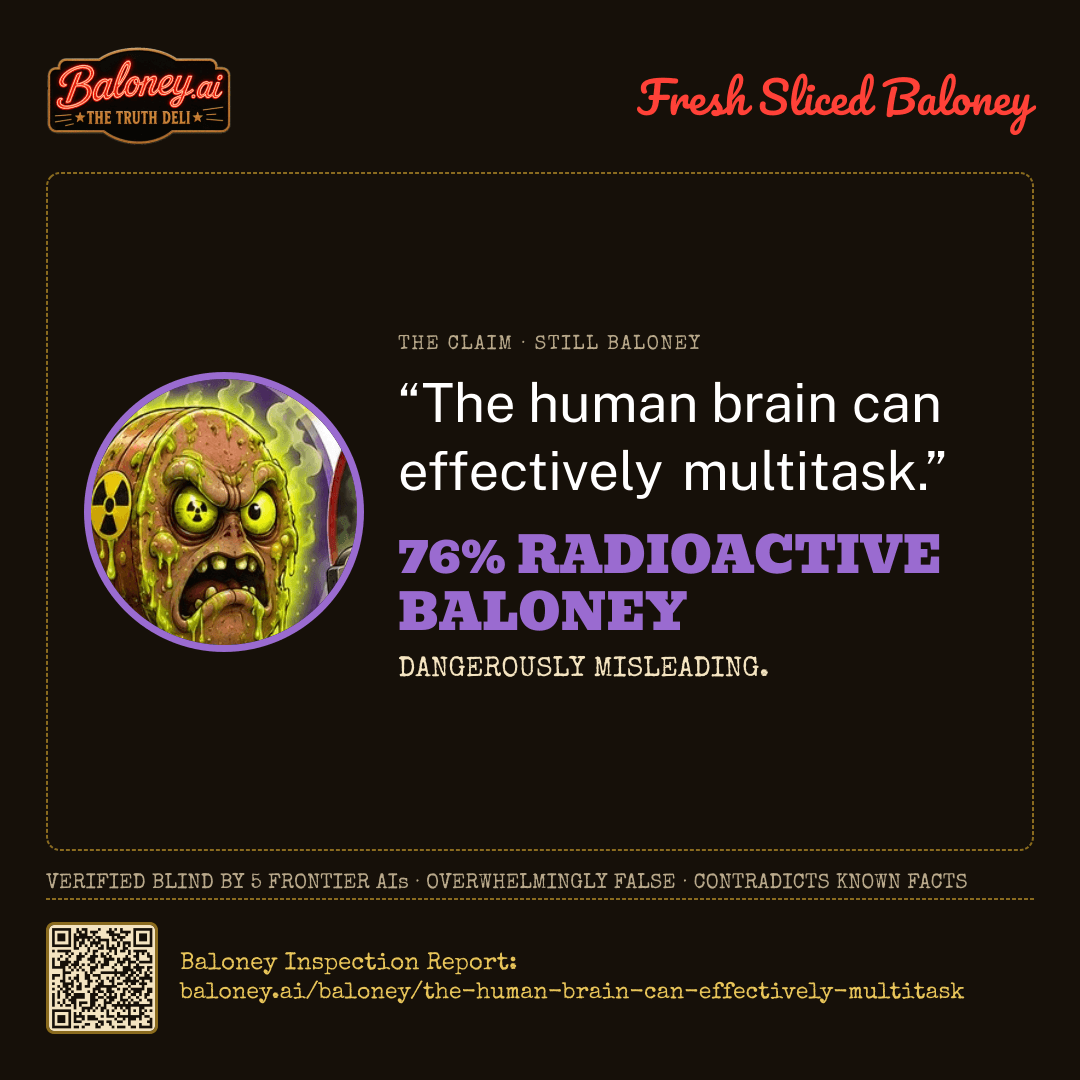
The overwhelming consensus from cognitive neuroscience and experimental psychology is that the human brain cannot genuinely process multiple attention-demanding tasks simultaneously. Instead, it engages in rapid task-switching, which introduces measurable delays, increases error rates, and reduces overall productivity. While automated or simple tasks (like walking and talking) can be performed concurrently, and a tiny fraction of the population (~2%) possesses exceptional dual-tasking abilities, applying the term 'effectively multitask' to demanding cognitive work is fundamentally false and demonstrably harmful in contexts like driving. Evaluator 4's low score is an outlier that relies on defining simple automated overlap as true multitasking, which contradicts the core findings of the provided literature.
All evaluators agree that humans can perform automated, simple tasks concurrently and that alternating between complex tasks incurs measurable 'switch costs.' They diverge primarily on semantics: Evaluator 4 argues that because automated tasks overlap, the brain can technically multitask, whereas the other evaluators assert that in the context of conscious, demanding activities, true multitasking is a harmful myth.
ZOMBIE FLAG: TRUE — DEBUNK HISTORY ON RECORD
Blind Validation Master · never saw the Primary’s work
claude-opus-5
70% BALONEY
As written, the claim is an unqualified generalisation that runs against the dominant body of cognitive-science evidence. All five reports converge on the same core finding: for any pair of attention-demanding tasks, the brain does not process in true parallel but rapidly switches, incurring reliable reaction-time and accuracy costs (Rubinstein, Meyer & Evans; Pashler's central bottleneck / psychological refractory period). Applied research is even more damning for the popular reading of the claim — Strayer & Johnston and NHTSA/CDC data show that even hands-free phone conversation degrades hazard detection while driving, and Ophir, Nass & Wagner found that self-identified heavy multitaskers are actually *worse* at filtering and switching, while Sanbonmatsu et al. found self-rated multitasking ability is negatively correlated with real performance — i.e. the subjective feeling of multitasking effectively is systematically unreliable. This is precisely the popular belief that decades of research have set out to debunk.
The claim is not a total fabrication, which keeps it out of the very top of the scale. There are genuine, well-documented exceptions: highly automated or practiced activities (walking while talking) combine with little cost; tasks using different input/output modalities interfere far less (Wickens' multiple-resource theory); Schumacher et al. reported 'virtually perfect time sharing' after extensive training on simple tasks; Charron & Koechlin showed the frontal lobes can divide representation of two concurrent goals; and Watson & Strayer identified 'supertaskers' (~2.5%) with no measurable dual-task decrement. In the loose everyday sense of interleaving projects across hours, people manage fine.
But those exceptions are narrow, heavily qualified, and apply to a tiny minority or to low-demand/automated combinations — they do not support the blanket statement that 'the human brain can effectively multitask.' The bare claim omits the essential limiting conditions and carries a real-world harm dimension (distracted driving), which is why it belongs in the high band rather than merely 'facts omitted.' Four of the five independent assessments landed between 68 and 85; the single outlier at 30 leaned heavily on the exception literature while its own evidence-against section still concedes the brain's default is serial control with limited parallelism. Placed at the lower edge of Radioactive Baloney: overwhelmingly false as a general statement, but with a genuine kernel of truth in restricted conditions.
AGREEMENT TEST PASSED — MASTERS SCORED 78% AND 70% · BLIND VALIDATION CONFIRMED THIS SCORE · NO RE-EVALUATION REQUIRED
The Evidence
Evidence offered for the claim
Simple or automated tasksDEBUNKED — Highly practiced motor skills, like walking or chewing gum, can be performed alongside other tasks with minimal interference.
The "supertasker" anomalyDEBUNKED — Research identifies a tiny minority of people (about 2%) who can genuinely manage dual demanding tasks without dropping performance.
Divided brain representationDEBUNKED — The left and right frontal lobes can divide focus to handle up to two concurrent goals.
Evidence against the claim
Rapid task-switching costs Cognitive neuroscience shows the brain does not process complex tasks in parallel; it switches back and forth, which can reduce overall productivity by as much as 40%.
The central processing bottleneck Core mental operations, such as response selection, cannot occur simultaneously, leading to unavoidable delays and increased errors during dual-tasking.
Heavy multitaskers perform worse Studies show that people who frequently multitask (like heavy media multitaskers) are actually worse at filtering distractions and task-switching than those who rarely multitask.
Driving impairment Concurrent cognitive load, like talking on a phone (even hands-free), degrades critical event detection and causes "inattention blindness," demonstrating severe limits to divided attention.
Self-perception is flawed Research indicates a negative correlation between self-rated multitasking ability and actual performance; those who multitask most often are usually the worst at it.
Sources · Reliability · Why Accepted or Discounted
Source
Type
Reliability
Ruling
American Psychological Association
other
95
ACCEPTED — Highly reputable professional organization representing psychology.
Stanford University
edu
95
ACCEPTED — Major research university providing seminal studies on media multitasking.
Psychonomic Bulletin & Review
journal
90
ACCEPTED — Respected peer-reviewed journal in experimental psychology.
Cleveland Clinic
other
90
ACCEPTED — Leading medical research and clinical institution.