Baloney Inspection Report: Claim #1169 · Inspected Oct 31, 2026, 7:48 AM PDT · Scoring model v2
 14%
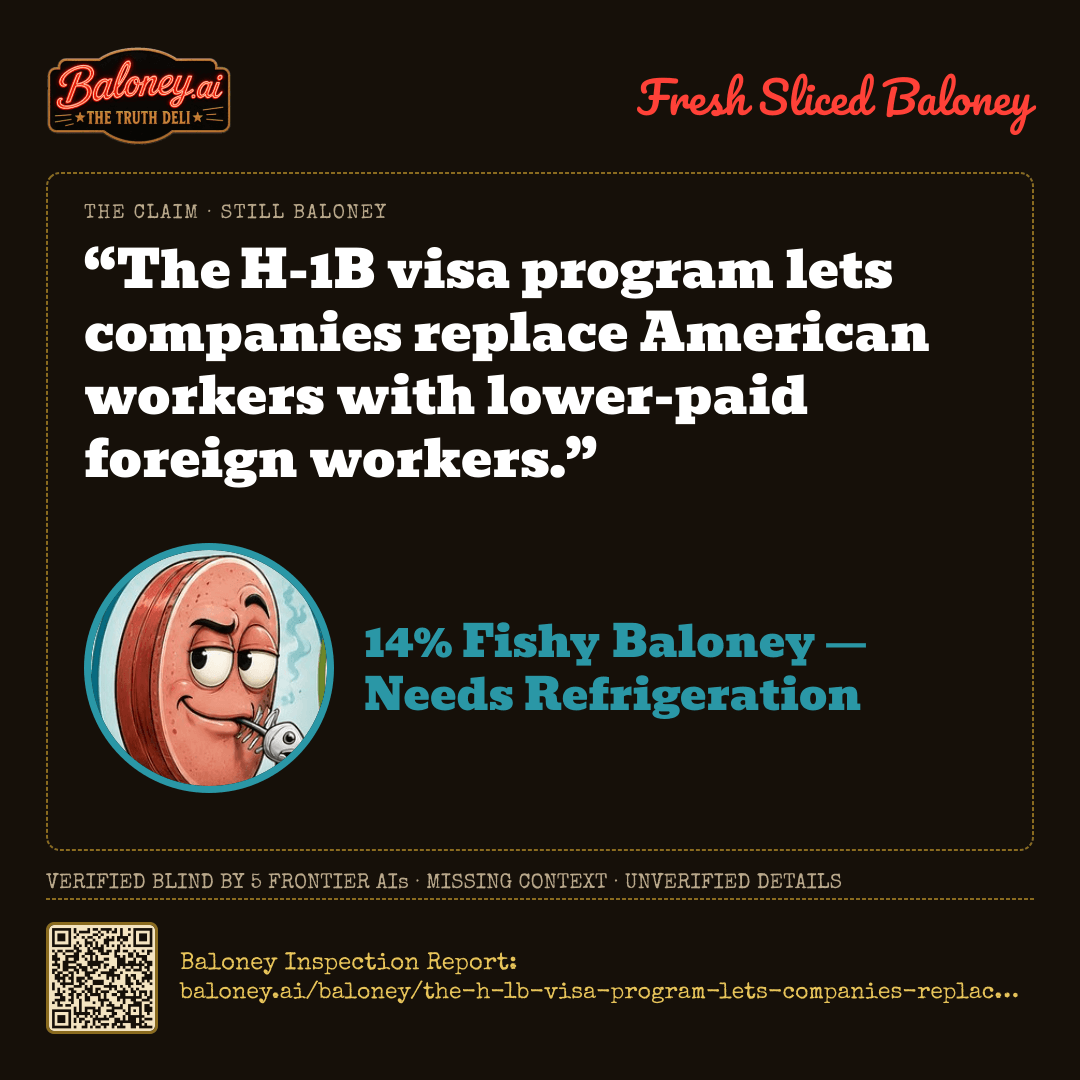
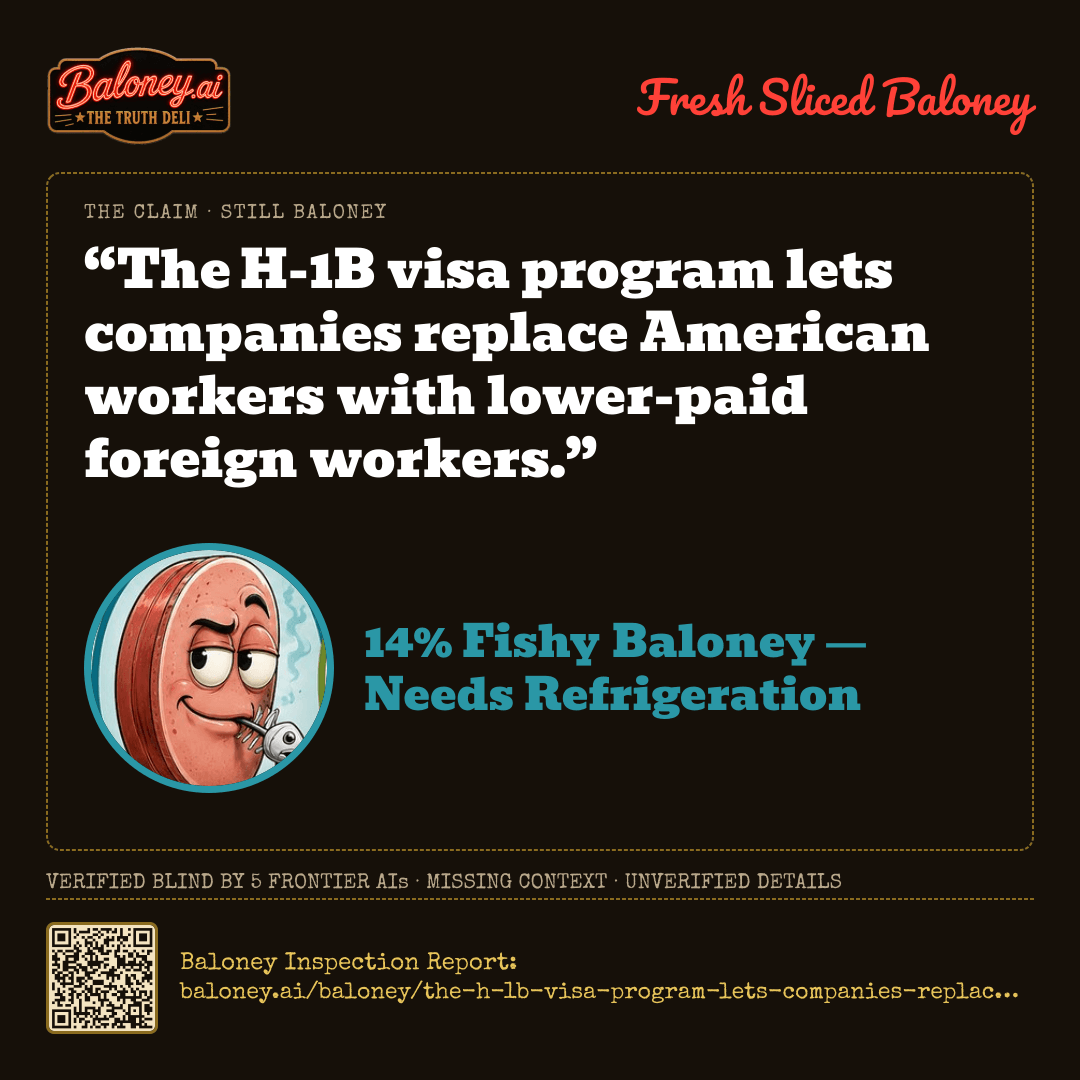
“The H-1B visa program lets companies replace American workers with lower-paid foreign workers.”
14%Fishy Baloney — Needs Refrigeration
Something smells off…
Missing contextUnverified detailsSuspicious framingMay be exaggerated
Serve It Fresh
Ready to Serve11 servings
Serve it the way you want it
The Verdict
 “The H-1B visa program lets companies replace American workers with lower-paid foreign workers.”14% Fishy Baloney — Needs RefrigerationVerified blind by 5 frontier AIs · Baloney Inspection Report: baloney.ai/baloney/the-h-1b-visa-program-lets-companies-replace-american
The Baloney Sampler
The H-1B program can allow companies to replace U.S. workers with foreign workers at lower pay in some circumstances. The Department of Labor requires wage attestations, but ordinary employers generally face no broad U.S.-recruitment or non-displacement requirement; extra rules mainly cover H-1B-dependent employers and willful violators.
The Government Accountability Office found weaknesses in oversight, while reported Disney and Southern California Edison cases showed laid-off workers training H-1B replacements supplied through outsourcing firms. The Department of Labor’s rules and accepted economic research also show that the claim is not universal: many H-1B workers are highly paid, and some uses expand or complement the U.S. workforce.
Resting on U.S. Department of Labor · U.S. Department of Labor · U.S. Government Accountability Office · U.S. Government Accountability Office
Original Claim Source https://www.whitehouse.gov/presidential-actions/2026/09/restriction-on-entry-of-certain-nonimmigrant-workers-faad/
Other ways to slice it — phrasings that might have changed the rating
- “The H-1B program generally allows companies to replace American workers with lower-paid foreign workers.” The reports identify documented replacement cases and legal gaps, but also say replacement is not the predominant use and that evidence on wages and aggregate effects is mixed.
- “H-1B-dependent companies can use outsourcing firms to replace U.S. workers with H-1B workers in the same jobs.” The reports specifically describe additional non-displacement rules for H-1B-dependent employers and secondary-displacement episodes involving staffing companies.
- “H-1B workers are usually paid less than comparable American workers.” The reports include evidence of lower pay in some settings, but also cite high median H-1B compensation and studies finding comparable or higher wages.
Written from the panel’s reports by Perplexity · sonar-pro. Nothing here changed the score.
The Order Ticket
14:48:49CLAIM RECEIVED — QUEUED FOR INSPECTION✓
14:50:14claude-opus-5 REPORTED — SCORE 5, CONFIDENCE 84✓
14:49:59gpt-5.5 REPORTED — SCORE 18, CONFIDENCE 82✓
14:49:30gemini-3.1-pro-preview REPORTED — SCORE 4, CONFIDENCE 95✓
14:48:55sonar-pro REPORTED — SCORE 24, CONFIDENCE 91✓
14:50:53grok-4.6 REPORTED — SCORE 14, CONFIDENCE 72✓
14:51:10PRIMARY MASTER PERPLEXITY — SCORE 5✓
14:51:14BLIND VALIDATION CLAUDE — SCORE 7✓
14:51:36AGREEMENT CONFIRMED — DELTA 9✓
14:51:36SCORING MODEL V2 — MEDIAN OF 5 COUNTED LAB SCORES: 5, 18, 4, 24, 14 → 14.✓
14:51:36SOURCE RULE — LABS CITED 33 SOURCES: 0 DISCARDED FOR HAVING NO URL, 5 DISCARDED AS DEAD LINKS (404/410), 7 COULD NOT BE OPENED BY US AND ARE MARKED UNVERIFIED.✓
14:51:36SOURCE RULE — PRIMARY MASTER RULED ON 20 SOURCES: 0 DISCARDED FOR HAVING NO URL, 0 DISCARDED AS DEAD LINKS, 3 MARKED UNVERIFIED, 17 VERIFIED.✓
How This One Was Sliced
Station 1 · Blind Inspection — Five Graders, Zero Peeking
Each lab scored the claim independently, without seeing the others. Open a breakdown for its evidence, its sources, and how sure it was.
Anthropic · EQUAL WEIGHT · 85.2s
claude-opus-5
5%BALONEY
ROUND-1 BREAKDOWN
Evidence offered for the claim- No general U.S.-worker protection: under the Immigration and Nationality Act as amended, most H-1B employers need only attest that they will pay the required wage and not adversely affect working conditions. Only 'H-1B-dependent' employers and willful violators must attest that they have not displaced and will not displace a U.S. worker within 90 days before/after filing — and even they are exempt from that requirement when the H-1B workers are paid $60,000+ or hold a master's degree. The Department of Labor's own program description confirms there is no across-the-board recruitment or non-displacement requirement.
- Documented replacement cases: in 2015 Walt Disney World and Southern California Edison laid off hundreds of IT employees and, in several reported instances, required them to train H-1B workers supplied by outsourcing contractors (HCL, Infosys, Tata) before leaving. These episodes were reported by mainstream outlets and prompted Senate Judiciary Committee inquiries by Sens. Grassley and Durbin.
- Wage-level structure permits below-market pay: the DOL prevailing-wage system has four wage levels, and an Economic Policy Institute analysis of DOL Labor Condition Application data found roughly 60% of certified H-1B positions are assigned to the two lowest wage levels (Level 1 = 17th percentile, Level 2 = 34th percentile) — i.e., legally 'prevailing' but below the local median for the occupation.
- GAO found enforcement and design weaknesses: GAO-11-26 concluded the program's protections are limited, that DOL's review of Labor Condition Applications is largely a check for completeness/obvious errors rather than substantive scrutiny, and that the statutory structure makes it difficult to ensure U.S. workers are protected.
- Economic evidence of substitution: Doran, Gelber and Isen, exploiting randomized H-1B visa lotteries, found that firms winning additional H-1B visas substantially substituted H-1B workers for other workers and reduced their overall employee earnings — consistent with cost-lowering substitution rather than pure net job creation.
- Business-model concentration: the largest users of new H-1B petitions in many years have been IT staffing/outsourcing firms that place workers at third-party client sites, the mechanism through which client companies' existing employees can be displaced without the client ever filing a visa petition.
Evidence against the claim- The claim is permissive ('lets'), not universal: the statute does require payment of the higher of the actual wage paid to similar employees or the prevailing wage for the occupation and area, and knowingly displacing U.S. workers is illegal for H-1B-dependent employers. Willful violations can trigger debarment and back-wage orders.
- Absolute wages are high: USCIS data show median annual compensation for approved H-1B beneficiaries well above the U.S. median wage (in the $100,000+ range in recent fiscal years), so most H-1B workers are not 'low-paid' in any absolute sense — the dispute is whether they are paid below the market rate for their specific job and location.
- Scale is limited: the annual cap is 85,000 new visas (65,000 plus 20,000 for U.S. advanced-degree holders), with cap-exempt universities and nonprofits on top, in a labor force of roughly 165 million — so any aggregate displacement effect is bounded.
- Contested economics: studies by Peri, Shih and Sparber, and by Kerr and Lincoln, find H-1B-driven increases in STEM employment are associated with higher productivity, wage growth for native college-educated workers in affected cities, and increased patenting — results inconsistent with the view that the program's main function is wage-cutting replacement.
- Litigation outcomes: lawsuits by displaced Disney workers alleging a conspiracy to violate H-1B law (e.g., against HCL and Cognizant) were dismissed, with courts finding plaintiffs had not shown the contractors made false visa attestations — so the most-cited replacement episodes were not judicially established as illegal.
- Many H-1B uses are not replacement at all: a large share of petitions are extensions, transfers, or hires of U.S.-educated graduates on OPT moving into first jobs, where no incumbent American worker is displaced.
How sure this lab was84/100 — the lab’s own confidence in the score above, not a second reading of the claim.
SourcesU.S. Department of Labor, Wage and Hour Divisiongov · 95 · U.S. Government Accountability Officegov · 95 · U.S. Citizenship and Immigration Servicesgov · 92 · Economic Policy Institute (Costa & Hira)other · 70 · The New York Timesnews · 88 · National Bureau of Economic Research (Doran, Gelber & Isen)journal · 88 · National Bureau of Economic Research (Peri, Shih & Sparber)journal · 88 · Congressional Research Service (via EveryCRSReport)gov · 88
OpenAI · EQUAL WEIGHT · 69.4s
gpt-5.5
18%BALONEY
ROUND-1 BREAKDOWN
Evidence offered for the claim- Documented replacement cases exist. The New York Times reported that laid-off Disney IT employees were required to train foreign replacements supplied through outsourcing firms using H-1B workers, and later reported similar concerns involving large outsourcing companies and U.S. layoffs.
- The program has a structural loophole: H-1B employers generally do not have to prove no qualified U.S. worker is available. DOL describes extra non-displacement/recruitment attestations mainly for H-1B-dependent employers and willful violators; FactCheck.org likewise noted that most employers are not required to recruit Americans first.
- Wage protections are partly attestation-based. DOL requires prevailing/actual wage attestations, but GAO found oversight weaknesses and risks in the H-1B system, meaning the rules do not fully prevent lower-cost substitution in practice.
- Economic research has found downward wage pressure in some affected labor markets. An NBER study by Bound, Demirci, Khanna and Turner estimated that H-1B-driven increases in foreign computer scientists reduced wages for competing U.S. computer scientists, consistent with the claim’s lower-labor-cost mechanism.
Evidence against the claim- The claim is overbroad if read as saying H-1B generally or legally authorizes underpayment. DOL rules require employers to pay H-1B workers at least the higher of the actual wage paid to similar employees or the prevailing wage for the occupation and area.
- There are some anti-displacement and recruitment requirements, especially for H-1B-dependent employers and willful violators, so the program is not an unrestricted license to fire Americans and replace them with visa workers.
- Empirical evidence on pay is mixed. A peer-reviewed Management Science study found foreign IT professionals on H-1B visas earned a wage premium relative to comparable U.S. citizen IT workers, undermining the blanket idea that H-1B workers are generally lower-paid.
- The strongest evidence for the claim comes from notable outsourcing/replacement cases, not proof that most H-1B use replaces American workers. Many H-1B jobs are specialty occupations requiring degrees and are used for hiring rather than direct replacement.
How sure this lab was82/100 — the lab’s own confidence in the score above, not a second reading of the claim.
SourcesThe New York Timesnews · 86 · The New York Timesnews · 86 · U.S. Department of Laborgov · 95 · U.S. Citizenship and Immigration Servicesgov · 94 · U.S. Government Accountability Officegov · 93 · Management Sciencejournal · 90 · National Bureau of Economic Researchother · 85
Google · EQUAL WEIGHT · 40.5s
gemini-3.1-pro-preview
4%BALONEY
ROUND-1 BREAKDOWN
Evidence offered for the claim- Under current regulations, standard employers using the H-1B program are not legally required to attest that they will not displace American workers. Only 'H-1B dependent' companies (those with a high proportion of H-1B staff) face this requirement.
- Even 'H-1B dependent' employers can legally bypass the non-displacement attestation through a loophole: they are exempt from the rule if the H-1B worker is paid an annual salary of at least $60,000 or holds a master's degree.
- A well-documented 'secondary displacement' loophole allows U.S. companies to lay off their domestic staff and contract with third-party IT outsourcing firms (such as Cognizant, Tata, or Infosys) that supply H-1B workers to do the same jobs. High-profile examples include Disney and Southern California Edison, where laid-off Americans were required to train their foreign replacements.
- Prevailing wage rules allow employers to categorize and pay H-1B workers at Level 1 or Level 2 wage rates, which are statutorily set below the local median wage for that occupation. This effectively enables companies to pay foreign workers less than the experienced U.S. professionals they are replacing.
Evidence against the claim- The statutory intent of the H-1B program is to help U.S. employers fill specialized roles when there is a shortage of qualified domestic talent, not to facilitate the displacement of American workers.
- By law, companies must pay H-1B workers the 'prevailing wage' for their occupation and location, or the actual wage paid to similarly employed U.S. workers (whichever is higher). This mechanism was designed specifically to protect domestic wage levels.
- Many major technology companies (such as Apple, Microsoft, and Google) utilize the H-1B program primarily to hire and retain highly skilled global talent, including international students graduating from U.S. universities, rather than to replace existing domestic employees.
- Various economic and immigration studies suggest that, on a macroeconomic scale, highly skilled H-1B workers complement the U.S. workforce, increase overall patenting and innovation, and do not cause widespread aggregate wage depression.
How sure this lab was95/100 — the lab’s own confidence in the score above, not a second reading of the claim.
SourcesThe New York Timesnews · 90 · NPRnews · 90 · Economic Policy Instituteother · 85 · American Immigration Councilother · 80
Perplexity · EQUAL WEIGHT · 5.9s
sonar-pro
24%BALONEY
ROUND-1 BREAKDOWN
Evidence offered for the claim- Some evidence supports the claim’s concern about lower pay: a 2024 peer-reviewed study of Big Four accounting hires found that newly hired H-1B accountants received starting salaries approximately 10% lower than matched U.S.-citizen new hires, although it found no evidence that this reduced the wages of comparable citizen hires. [https://link.springer.com/article/10.1007/s10551-024-05823-8][Reliability:90]
- Recent research summarized by the Federal Reserve found that some college-educated workers at firms that won H-1B lotteries experienced lower wages or were less likely to remain at the firm, suggesting adverse effects for certain groups rather than uniformly positive effects. [https://www.richmondfed.org/publications/research/economic_brief/2024/eb_24-15][Reliability:88]
- The Government Accountability Office has recognized that H-1B employment can affect U.S. workers and that the program requires employer attestations concerning wages and displacement, indicating that displacement is a real policy risk even though it is restricted. [https://www.gao.gov/assets/a239564.html][Reliability:95]
Evidence against the claim- The statement is too broad as written because H-1B employers generally must pay at least the higher of the prevailing wage or the wage paid to similarly employed workers, rather than being freely permitted to undercut U.S. workers. [https://www.dol.gov/agencies/whd/immigration/h1b][Reliability:98]
- For H-1B-dependent employers and willful violators, federal rules prohibit displacement of similarly employed U.S. workers within defined periods around an H-1B filing or placement, with possible civil penalties and debarment. [https://www.dol.gov/agencies/whd/fact-sheets/62n-h1b-displacement][Reliability:98]
- A Northwestern summary of published research reported that H-1B workers tended to fill specialized or less desirable positions, found no evidence that additional H-1B hiring lowered wages at the affected offices, and characterized the workers as complements rather than replacements for U.S. workers. [https://insight.kellogg.northwestern.edu/article/does-the-h1-b-visa-program-hurt-american-workers][Reliability:86]
- A peer-reviewed study found lower starting pay for H-1B accountants than matched U.S.-citizen hires but no evidence that H-1B hiring reduced wages for comparable citizen hires, weakening the claim that the program broadly enables replacement of Americans with cheaper labor. [https://link.springer.com/article/10.1007/s10551-024-05823-8][Reliability:90]
How sure this lab was91/100 — the lab’s own confidence in the score above, not a second reading of the claim.
SourcesU.S. Department of Laborgov · 98 · U.S. Department of Laborgov · 98 · U.S. Government Accountability Officegov · 95 · Journal of Business Ethics / Springer Naturejournal · 90 · Federal Reserve Bank of Richmondgov · 88 · Northwestern University Kellogg School of Managementedu · 86
xAI · EQUAL WEIGHT · 124.2s
grok-4.6
14%BALONEY
ROUND-1 BREAKDOWN
Evidence offered for the claim- Documented cases exist of U.S. firms (Disney 2015, Southern California Edison 2015, and others) laying off American IT workers and replacing them with H-1B holders supplied by outsourcing contractors; remaining U.S. staff were sometimes required to train their replacements.
- Most H-1B employers are not required to recruit U.S. workers or show that qualified Americans were unavailable; only H-1B-dependent employers and willful violators face extra no-displacement and recruitment attestations, which the contracting/outsourcing model often circumvents.
- A large share of H-1B petitions come from IT staffing/outsourcing firms; many approvals occur at DOL prevailing-wage Level I or II, which can be well below median pay for experienced U.S. workers in the same occupation, enabling labor-cost savings.
- GAO and labor-oriented analyses have repeatedly flagged weak LCA enforcement, paper-based attestations, and the resulting risk of displacement and wage undercutting.
Evidence against the claim- Statute and DOL rules require every H-1B employer to file a Labor Condition Application attesting payment of the prevailing wage or actual wage (whichever is higher) and that the hiring will not adversely affect the working conditions of similarly employed U.S. workers.
- H-1B-dependent employers must make additional attestations that they did not displace U.S. workers and conducted good-faith U.S. recruitment.
- A substantial fraction of H-1B visas go to expanding U.S. technology employers adding headcount rather than substituting for existing staff; some academic and industry studies find H-1B wages comparable to or higher than those of similar natives and point to skill-shortage and innovation effects.
- The legal design is not an unrestricted license to pay below-market wages; critics of the claim argue that observed cost advantages often stem from age/experience mix or contracting structure rather than a simple waiver of wage rules.
How sure this lab was72/100 — the lab’s own confidence in the score above, not a second reading of the claim.
SourcesThe New York Timesnews · 85 · U.S. Department of Laborgov · 95 · U.S. Government Accountability Officegov · 96
Station 2 · The Masters
Primary Master · drawn at random
sonar-pro
5% BALONEY
The statement is substantially true as written because “lets” describes legal permission or practical opportunity, not universal frequency. Most H-1B employers must pay the higher of the actual wage or prevailing wage, but ordinary employers generally do not face a broad no-displacement or U.S.-recruitment requirement. The additional displacement restrictions mainly apply to H-1B-dependent employers and willful violators, cover limited periods, and can be weakened by the statutory exemptions and staffing-company structure. The reports identify documented Disney and Southern California Edison replacement episodes, weak oversight of labor-condition attestations, low prevailing-wage levels, and research finding substitution or wage effects for some U.S. workers. Those facts outweigh evidence that many H-1B workers are highly paid, that the program can complement domestic workers, and that aggregate innovation or wage effects may be positive. The claim should not be read as saying all H-1B workers are low-paid or that replacement is the program’s predominant use; those qualifications do not make the core statement false. Sources were accepted when they directly addressed statutory requirements, oversight, documented replacement events, or peer-reviewed economic findings. Advocacy and media sources were retained for relevant empirical or reported claims but given less weight than government and academic sources. No long, well-documented public debunk history was established, so the zombie flag is false.
All five evaluators agreed that H-1B employers must satisfy wage rules and that the statement is too broad if interpreted as describing every H-1B job or as claiming unrestricted legal authority to underpay and displace Americans. All five also recognized some evidence of displacement risk or actual replacement, especially through outsourcing. They disagreed mainly over weighting: evaluators 1 and 4 viewed the statutory loopholes, Disney/Southern California Edison cases, wage-level structure, and weak enforcement as decisive; evaluators 2, 3, and 5 emphasized wage compliance, mixed economic findings, high absolute H-1B pay, and the absence of proof that most placements replace Americans. The panel therefore treats the claim as substantially accurate about what the program permits in some circumstances, while rejecting an interpretation that replacement is universal or typical.
Blind Validation Master · never saw the Primary’s work
claude-opus-5
7% BALONEY
The claim is phrased permissively ("lets"), not as a universal description of how the program operates, and in that form it is largely supported. All five reports agree on the core facts: ordinary H-1B employers face no general requirement to recruit American workers or attest that they will not displace them; the non-displacement attestation applies only to H-1B-dependent employers and willful violators, and even they are exempt when workers earn $60,000+ or hold a master's degree; the 'secondary displacement' route through IT staffing/outsourcing contractors (Disney, Southern California Edison) produced well-documented episodes in which laid-off Americans trained their foreign replacements; and DOL's four-tier prevailing-wage system permits Level I/II wages (17th/34th percentile) that are legally 'prevailing' yet below the local median for experienced incumbents, with roughly 60% of certifications at those levels. Peer-reviewed and quasi-experimental work (Doran/Gelber/Isen lottery study; the Big Four accounting study showing ~10% lower starting pay; Bound et al. on computer scientists) supports the lower-cost substitution mechanism in at least some settings. The deductions are modest and concern implication rather than fact: the statute does require the higher of actual or prevailing wage, displacement is illegal for dependent employers, median H-1B pay is high in absolute terms, the cap bounds aggregate effects, and a large share of petitions are extensions, transfers, or first hires of U.S.-educated graduates where no incumbent is displaced — so the sentence can mislead if read as describing the program's typical or primary function. Evidence on aggregate wage effects is genuinely mixed (Peri/Shih/Sparber, Kerr/Lincoln, the Management Science premium finding), and the Disney-related lawsuits were dismissed without a finding of illegality. Those caveats are context, not contradiction: the loopholes and documented cases establish that the program does permit exactly what the claim describes. That places it just outside the cleanest 'true' band for framing, but well short of the 'important facts omitted/misleading' tier.
AGREEMENT TEST PASSED — MASTERS SCORED 5% AND 7% · BLIND VALIDATION CONFIRMED THIS SCORE · NO RE-EVALUATION REQUIRED
How the number was reached · scoring model v2 · how our models work
- Median of 5 counted lab scores: 5, 18, 4, 24, 14 → 14.
The Evidence
Evidence offered for the claim
- Limited no-displacement protection Most employers do not have to attest that they will not displace U.S. workers. The additional no-displacement and recruitment duties generally apply to H-1B-dependent employers and willful violators, and operate within defined periods. This makes replacement legally possible for ordinary employers.
- Outsourcing loophole GAO found that protections are weakened when companies obtain H-1B workers through staffing firms. Reports described Disney and Southern California Edison employees being laid off and, in some cases, required to train foreign workers supplied by outsourcing companies.
- Below-median wage levels The required wage is the higher of the actual wage or prevailing wage, but the prevailing-wage system includes lower wage levels below the local occupational median. The evaluators cited analyses finding substantial H-1B certification at Levels 1 and 2, creating potential cost savings relative to experienced U.S. workers.
- Economic substitution evidence The reports cited research finding substitution of H-1B workers for other workers, reduced employee earnings at affected firms, and downward wage effects for some competing U.S. computer scientists. This supports the possibility of lower-cost replacement, though it does not establish that most H-1B jobs have that effect.
- Documented cases prove general replacement DEBUNKED — The Disney and Southern California Edison episodes show that replacement can occur, but they do not prove that H-1B use generally or predominantly replaces American workers. The cited lawsuits were dismissed, and the broader frequency of such cases remains contested.
Evidence against the claim
- Wage floor applies broadly All H-1B employers must attest to paying at least the higher of the actual wage paid to similarly employed workers or the prevailing wage for the occupation and area. The program therefore is not an unrestricted license to pay below the applicable legal wage.
- Extra protections exist H-1B-dependent employers and willful violators face no-displacement and recruitment requirements, with possible civil penalties and debarment. The rules also require inquiries concerning displacement at secondary worksites in covered circumstances.
- Many workers are not low-paid The reports cited USCIS compensation data showing median H-1B compensation above the overall U.S. median and research finding comparable or higher wages for some H-1B workers. “Lower-paid” is therefore relative to the specific job, experience, and location, not necessarily absolute income.
- Evidence on aggregate effects is mixed Studies cited by the evaluators found complementary employment, wage growth for some native workers, greater productivity or patenting, and no wage reduction for comparable citizen hires in one accounting study. Many H-1B placements are expansions, transfers, or first jobs for U.S.-educated graduates rather than direct replacements.
- The claim overstates prevalence The annual cap limits many new cap-subject approvals, and the reports did not establish that replacement is the predominant use of H-1B visas. The statement is accurate as a claim about permission and documented possibility, but misleading if understood as a description of typical program-wide outcomes.
Sources · Reliability · Why Accepted or Discounted
| Source | Type | Reliability | Ruling |
|---|
| U.S. Department of Labor | gov | 98 | ACCEPTED — Primary government source for the general wage and working-condition attestations. |
| U.S. Department of Labor | gov | 98 | ACCEPTED — Directly states the covered employers, limited time periods, secondary-placement rules, penalties, and displacement definition. |
| U.S. Department of Labor | gov | 98 | ACCEPTED — Summarizes required wages and the additional obligations for dependent or willful-violator employers. |
| U.S. Department of Labor | gov | 98 | ACCEPTED — Primary statutory text supporting the actual-wage/prevailing-wage rule and covered displacement attestation. |
| U.S. Department of Labor | gov | 90 | DISCOUNTED — The report cited it only indirectly through its described requirements, and the provided document is a later beta-era source rather than necessary support for the core verdict. |
| U.S. Department of Labor | gov | 90 | DISCOUNTED — Useful summary, but a beta DOL page and duplicative of the more direct statutory and fact-sheet sources. |
| U.S. Government Accountability Office | gov | 95 | ACCEPTED — Primary oversight source documenting weakened protections, restricted oversight, and staffing-company accountability gaps. |
| U.S. Government Accountability Office | gov | 95 | ACCEPTED — GAO testimony directly supports the staffing-company and oversight concerns. |
| U.S. Government Accountability Office | gov | 95 | ACCEPTED — Cited for government recognition of worker-impact and displacement issues. |
| U.S. Government Accountability Office | gov | 90 | ACCEPTED — Supports the limited nature of DOL review of labor-condition applications, although it is older evidence. |
| U.S. Government Accountability Office | gov | 95 | ACCEPTED — Concise GAO summary of weakened worker protections; consistent with the full report. |
| U.S. Citizenship and Immigration Services | gov | 92 | ACCEPTED — Appropriate government source for H-1B compensation and employer data, though the reports did not provide a precise extract. |
| U.S. Citizenship and Immigration Services | gov | 94 | ACCEPTED — Primary source for the specialty-occupation framework and program purpose. |
| The New York Timesunverified | news | 88 | ACCEPTED — Cited for the reported Disney layoffs and training of replacement workers; treated as evidence of a documented episode, not proof of general prevalence. |
| The New York Timesunverified | news | 86 | ACCEPTED — Relevant reporting on outsourcing and displacement concerns, with less weight than primary legal or academic evidence. |
| NPRunverified | news | 90 | ACCEPTED — Corroborates the Disney litigation and reported replacement allegations; not treated as a judicial finding that the conduct was unlawful. |
| Economic Policy Institute | other | 70 | ACCEPTED — Relevant analysis of wage-level distributions, but advocacy-oriented and therefore given less weight than government data. |
| National Bureau of Economic Research | journal | 88 | ACCEPTED — Directly relevant empirical research on randomized H-1B lottery outcomes and worker substitution. |
| National Bureau of Economic Research | journal | 88 | ACCEPTED — Relevant research on H-1B effects on employment, wages, productivity, and innovation, used as counterevidence to broad displacement claims. |
| Congressional Research Service via EveryCRSReport | gov | 88 | ACCEPTED — Secondary reproduction of CRS analysis relevant to program rules and effects; lower weight than an official CRS-hosted publication but still useful. |
Every link was opened when this claim was inspected. A dead link was discarded before publication; “unverified” means the site refused our automated check and the link is the one the panel cited. A source without a URL was never kept.
Serve It Fresh
Ready to Serve11 servings
Serve it the way you want it
The Verdict
“The H-1B visa program lets companies replace American workers with lower-paid foreign workers.”14% Fishy Baloney — Needs RefrigerationVerified blind by 5 frontier AIs · Baloney Inspection Report: baloney.ai/baloney/the-h-1b-visa-program-lets-companies-replace-american