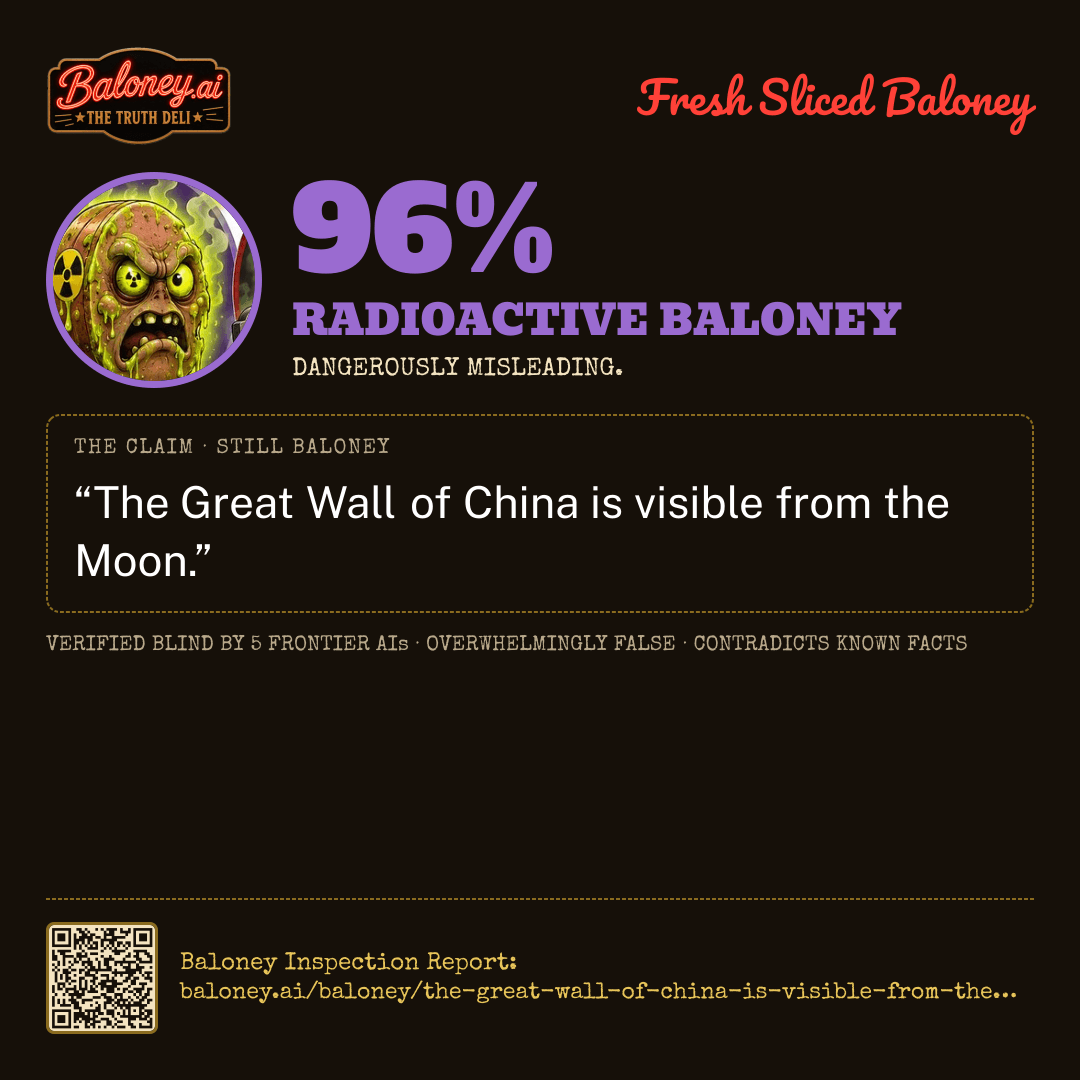
“The Great Wall of China is visible from the Moon.”
SUBMITTED ANONYMOUSLY · INSPECTED 2026-09-13T20:38:39.695Z · STATUS: PUBLISHED
96%
96%
RADIOACTIVE BALONEY — DANGEROUSLY TOXIC
Dangerously misleading.
Overwhelmingly falseContradicts known factsPromotes false beliefsPotential for harm
✓ BLIND VALIDATION CONFIRMED THIS SCORE
Serve It Fresh
Ready to Serve11 servings
Serve it the way you want it
The Verdict
96% RADIOACTIVE BALONEY — DANGEROUSLY TOXIC “The Great Wall of China is visible from the Moon.” Verified blind by 5 frontier AIs · Baloney Inspection Report: baloney.ai/baloney/the-great-wall-of-china-is-visible-from-the-moon
Station 1 · Blind Inspection — Five Graders, Zero Peeking
Each lab scored the claim independently, without seeing the others. Open a breakdown for its evidence, its sources, and how sure it was.
Anthropic · EQUAL WEIGHT · 43.3s
claude-opus-5
96%BALONEY
ROUND-1 BREAKDOWN
Evidence offered for the claim
The claim is very widely repeated in popular culture, travel literature and (formerly) school textbooks, which gives it surface plausibility; it appears to trace back to pre-spaceflight speculation, notably Richard Halliburton's 1938 'Second Book of Marvels', which asserted the Wall was the only man-made object visible from the Moon.
The Great Wall is extraordinarily long (roughly 21,000 km of total constructed sections), and length alone intuitively suggests visibility from great distances.
A weaker, related claim has some support: under ideal lighting, snow or contrast conditions, portions of the Wall have reportedly been seen or photographed from LOW EARTH ORBIT (~350 km). Astronaut Leroy Chiao took a 2004 ISS photograph using a 180 mm lens that NASA said may show a section of the Wall, and some astronauts (e.g., Eugene Cernan, Ed Lu) have said it can be glimpsed or resolved from orbit with optical aid. This is sometimes conflated with visibility 'from the Moon.'
Some other large human-made features (city grids at night, large reservoirs, open-pit mines, airport runways) are visible from LEO, so the general idea that human works can be seen from space is not absurd — only the lunar-distance version is.
Evidence against the claim
Basic optics rule it out: the unaided human eye resolves about 1 arcminute. At the Moon's mean distance (~384,400 km), 1 arcminute corresponds to roughly 110 km on Earth's surface. The Great Wall is typically only 5-10 m wide, i.e. about four orders of magnitude too narrow to resolve. Even generous estimates of visual acuity leave it far below the threshold.
The Wall is built of local earth and stone and has very low contrast against the surrounding terrain, further reducing detectability — a key reason it is hard to see even from low Earth orbit, where far smaller but higher-contrast objects (roads, runways) are easier to spot.
From lunar distance, Earth appears roughly 2 degrees across — about four times the apparent diameter of the Moon seen from Earth. At that scale no individual human-made structure, and not even most individual cities, can be discerned; only continents, oceans, weather systems and ice caps are visible.
Apollo astronauts who actually went to the Moon have repeatedly denied seeing the Wall or any man-made object from that distance. Alan Bean and others stated that from the Moon only white (clouds), blue (oceans), yellow patches (deserts) and occasional green vegetation were distinguishable.
Neil Armstrong is often quoted as confirming the claim; he explicitly denied ever saying or seeing it. The attribution is a fabrication.
Chinese astronaut Yang Liwei reported after China's first crewed spaceflight in 2003 that he could NOT see the Great Wall from orbit — a much closer vantage point than the Moon. This prompted Chinese education authorities to revise textbook claims.
NASA has published explicit statements and imagery analyses concluding the Wall is not visible from the Moon and is at best marginally detectable from low Earth orbit under exceptional conditions with magnification.
Peer-reviewed optical analysis (Journal of Optometry, 2008) concluded that seeing the Great Wall with the naked eye even from the ISS would require visual acuity several times better than normal, making lunar-distance visibility physically impossible.
The claim predates spaceflight entirely (1930s), so it was never based on observation — it is a pre-scientific assertion that survived by repetition.
How sure this lab was
97/100 — the lab’s own confidence in the score above, not a second reading of the claim.
Kernel of truth: parts of the Great Wall have been identified or photographed from low Earth orbit under favorable lighting and with camera lenses; NASA Earth Observatory published such an ISS photograph. This supports only a limited 'visible from space' idea, not naked-eye visibility from the Moon.
Large, high-contrast human-made features on Earth can be seen by astronauts from low Earth orbit, which likely helped the myth spread; however, this is much closer than the Moon and does not establish the claim.
Evidence against the claim
NASA Space Place directly says the Great Wall cannot be seen from the Moon: it is long but far too narrow to resolve with human eyesight at lunar distance.
At the Moon's average distance, a wall only several meters wide would subtend far below normal human visual acuity; length alone does not make a thin, low-contrast object resolvable.
NASA Earth Observatory notes the Great Wall is difficult to see even from low Earth orbit with the unaided eye; the Moon is roughly a thousand times farther away than the ISS.
Scientific American reports the traditional claim is false: the wall is hard to distinguish even from orbit because its color and materials often blend with surrounding terrain, while cities, airports, and roads are easier to see.
How sure this lab was
98/100 — the lab’s own confidence in the score above, not a second reading of the claim.
The claim was popularized in 1938 by Richard Halliburton in his 'Second Book of Marvels', which stated the Great Wall was the only man-made object visible from the Moon, decades before human spaceflight.
The Great Wall is exceptionally long (over 21,000 kilometers in total), which intuitively leads people to overestimate its overall visibility from vast distances.
The claim often survives due to the conflation of 'space' (Low Earth Orbit, ~400 km up) and 'the Moon' (~384,400 km away). Some astronauts have photographed or claimed to see the Wall from Low Earth Orbit under perfect lighting or with optical aids, which the public mistakenly applies to lunar visibility.
Evidence against the claim
The Moon is approximately 384,400 kilometers (238,855 miles) away from Earth. At this distance, the continents themselves are barely distinguishable, and no man-made structures are visible to the naked eye.
The human eye has an angular resolution limit of about 1 arcminute. To be seen from the Moon without a telescope, an object on Earth would need to be roughly 110 kilometers (70 miles) wide. The Great Wall is typically less than 10 meters wide, making it thousands of times too narrow.
The Great Wall is constructed from local stone and clay, meaning it perfectly matches the color and albedo of the surrounding terrain, providing no visual contrast to help it stand out from space.
Apollo astronauts who traveled to the Moon, including Neil Armstrong and Alan Bean, have explicitly stated that no man-made objects, including the Great Wall, are visible from the lunar surface.
How sure this lab was
100/100 — the lab’s own confidence in the score above, not a second reading of the claim.
The claim originated as a widely repeated legend, often stated as 'the only man-made object visible from the Moon', and has appeared in books, school materials, and popular media for decades, which some people took as evidence that it was true.[4][5][13]
Early space-era speculation (before humans went to the Moon) suggested that very long structures like the Great Wall might be visible, based on its length of thousands of kilometers, without carefully considering its narrow width or the limits of human vision.[4][5]
Synthetic aperture radar and other remote-sensing instruments in spacecraft can detect the Great Wall from orbit, which is sometimes mistakenly generalized into the idea that it is visible from the Moon with the naked eye.[4][12]
Evidence against the claim
NASA explicitly states that, 'Despite myths to the contrary, the wall isn't visible from the moon, and is difficult or impossible to see from Earth orbit without the high-powered lenses used for this photo,' directly rejecting the claim.[2]
Scientific American reports that both versions of the legend—visible from orbit and visible from the Moon—are false according to astronauts and remote-sensing specialists, noting that the Wall is only visible from low orbit under very specific conditions and certainly not from the Moon with unaided human vision.[5][8]
Snopes, a dedicated fact-checking outlet, concludes that the claim that the Great Wall can be seen from the Moon with the naked eye is a tenaciously incorrect 'fact' that has long been proved false and cites Apollo astronaut Alan Bean, who confirmed it cannot be seen.[4]
LiveScience explains that seeing the Wall from space with the human eye is physically impossible, quoting a vision-science professor who notes that the Wall’s narrow width and low contrast against the landscape make it undetectable at orbital distances, let alone from the Moon.[3][7]
Vision-science analysis published in a medical journal calculates that even from about 80 km altitude (edge of space), an astronaut would need visual acuity around 20/5—far better than normal human vision—to see the Great Wall; from the Moon (~380,000 km away) it is far beyond human optical resolution.[7]
NASA’s radar imagery shows that the Wall is 'easily detected from space by radar' because of its reflective geometry, but this is explicitly contrasted with ordinary photographs and naked-eye viewing, indicating that instrument detection does not imply naked-eye visibility from the Moon.[12][4]
Multiple astronauts report they have not seen the Great Wall with the naked eye from orbit: Scientific American quotes shuttle astronaut Jeffrey Hoffman saying he never saw the Wall despite many passes over China, and notes that any detailed images use telephoto lenses.[5]
Scientific American and other sources report that China’s first astronaut (Yang Liwei) stated he could not see the Great Wall from orbit, and BBC Sky at Night–style coverage and related write-ups emphasize that the Wall is too narrow and too similar in color to its surroundings to be visible at orbital distances.[5][6][8][11]
Britannica’s explanation notes that astronauts disproved the myth that the Wall is visible from the Moon, and that due to its coloration and atmospheric conditions it is only sometimes visible from low Earth orbit, not reliably and certainly not from the Moon.[13]
Quantitative debunkings highlight that the Wall is only about 4–9 meters wide; from hundreds of kilometers up it would subtend far less than the minimum angle resolvable by the human eye, and from lunar distance the required resolution would be thousands of times better than normal human vision—making naked-eye visibility physically impossible.[1][7][14]
How sure this lab was
99/100 — the lab’s own confidence in the score above, not a second reading of the claim.
The claim has been widely repeated as trivia in popular media, some older textbooks, and tourist materials, often tracing to early-20th-century exaggerations about the Wall's length.
The structure is extremely long, which some non-scientific accounts treat as sufficient for visibility at lunar distance.
Evidence against the claim
The Wall is only about 5–10 m wide; at lunar distance (~384,000 km) this is far below unaided human visual resolution (features smaller than hundreds of km cannot be distinguished on Earth's disk).
Apollo astronauts reported seeing continents, weather systems, and albedo contrasts but no man-made structures such as the Great Wall.
Even from low Earth orbit the Wall is difficult or impossible to pick out with the naked eye and is routinely invisible without knowing the exact location and lighting; the Moon is ~1000 times farther.
NASA and multiple astronaut accounts (including China's first astronaut) have stated it is not visible from the Moon.
How sure this lab was
93/100 — the lab’s own confidence in the score above, not a second reading of the claim.
All five evaluators independently converged on the same conclusion, with recommended scores of 95, 96, 96, 97 and 99 and confidence of 93-100. The decisive evidence is physical rather than testimonial: the unaided human eye resolves roughly one arcminute, which at the Moon's mean distance of ~384,400 km corresponds to a feature about 110 km across. The Great Wall is typically 4-10 m wide — four orders of magnitude below that threshold — and is built from local earth and stone, so it has almost no contrast against the surrounding terrain. Three reports independently supplied the same arcminute calculation, and two cited peer-reviewed vision-science work (Lopez-Gil, Journal of Optometry, 2008) finding that even at the edge of space an observer would need roughly 20/5 acuity. Testimony converges with the optics: Apollo astronauts who actually made the trip, including Alan Bean, reported seeing only clouds, oceans, deserts and vegetation; Neil Armstrong denied the quotation routinely attributed to him; shuttle astronaut Jeffrey Hoffman never picked out the Wall despite many passes over China; and China's first astronaut, Yang Liwei, reported in 2003 that he could not see it from low Earth orbit — a vantage point a thousand times closer than the Moon. NASA, Scientific American, Snopes and Britannica all state the claim is false. The only genuine kernel of truth — that sections of the Wall have been photographed from the ISS with a 180 mm lens, and that radar instruments detect it readily — concerns instrument-aided observation from low Earth orbit and does not support the statement as written. The claim also predates spaceflight entirely, tracing to Richard Halliburton's 1938 'Second Book of Marvels', so it was never founded on observation in the first place. I place this at the top of the scale rather than in the Radioactive band because the statement is not merely false: it has been publicly and repeatedly debunked for more than half a century, by NASA, by the astronauts themselves, and by Chinese education authorities who revised textbooks after Yang Liwei's flight — and it still circulates in travel literature and trivia.
There was no material disagreement. All five evaluators judged the claim false and recommended scores within a four-point band (95-99). All five identified the same origin story (pre-spaceflight legend, Halliburton 1938), the same core physics (angular resolution versus the Wall's width), and the same kernel of truth (limited, instrument-aided visibility from low Earth orbit being conflated with lunar visibility). Reports 1 and 5 went furthest in documenting the astronaut testimony and the peer-reviewed optics; Reports 3 and 4 were more compact but reached identical conclusions. The only variation was emphasis: Report 5 stressed radar detectability as a source of confusion, Report 1 stressed the fabricated Neil Armstrong quotation, and Report 4 leaned most heavily on NASA's own direct statements.
ZOMBIE FLAG: TRUE — DEBUNK HISTORY ON RECORD
Blind Validation Master · never saw the Primary’s work
gemini-3.1-pro-preview
99% BALONEY
The claim that the Great Wall of China is visible from the Moon is a classic, repeatedly debunked myth, perfectly fitting the definition of 'Zombie Baloney.' Basic optics and human visual acuity limits make it physically impossible to resolve an object only a few meters wide from roughly 384,000 kilometers away. Furthermore, the wall's materials offer very low visual contrast with the surrounding terrain, making it difficult to spot even from Low Earth Orbit without magnification. Apollo astronauts who traveled to the Moon have explicitly confirmed that no man-made objects are visible from that distance. The myth predates spaceflight (popularized as early as 1938) and persists in popular culture despite definitive scientific and observational refutation.
AGREEMENT TEST PASSED — BOTH MASTERS SCORED 99% · BLIND VALIDATION CONFIRMED THIS SCORE · NO RE-EVALUATION REQUIRED
The Evidence
Evidence offered for the claim
Repeated for decades in books and textbooksDEBUNKED — REFUTED: The claim was popularised by Richard Halliburton's 1938 'Second Book of Marvels', which asserted the Wall was the only man-made object visible from the Moon — three decades before anyone went there. It was never based on observation, only on repetition.
The Wall is enormously longDEBUNKED — REFUTED: Total constructed sections run to roughly 21,000 km, which intuitively suggests visibility at great range. But resolution depends on width, not length: the Wall is only about 4-10 m wide, and a thin, low-contrast line cannot be resolved no matter how far it extends.
It has been photographed from spaceDEBUNKED — REFUTED: Astronaut Leroy Chiao's 2004 ISS photograph, published by NASA Earth Observatory as possibly showing a section of the Wall, was taken with a 180 mm telephoto lens from about 350 km up. NASA itself notes the Wall is difficult or impossible to see from orbit without such lenses.
Radar instruments detect it from orbitDEBUNKED — REFUTED: Synthetic aperture radar picks the Wall out easily because of its reflective geometry, but NASA explicitly contrasts instrument detection with ordinary photography and naked-eye viewing. Instrument detection from orbit says nothing about human vision at lunar distance.
Other human works are visible from spaceDEBUNKED — REFUTED: City grids at night, reservoirs, open-pit mines and airport runways can be seen from low Earth orbit, so the general idea is not absurd. The Moon, however, is roughly a thousand times farther away than the ISS — only the orbital version of the claim survives.
Evidence against the claim
The arithmetic of human eyesight The unaided eye resolves about 1 arcminute. At the Moon's mean distance of ~384,400 km, that corresponds to roughly 110 km on Earth's surface. A structure 5-10 m wide is about four orders of magnitude too narrow to register.
Earth is a two-degree disc from the Moon Seen from lunar distance Earth spans roughly 2 degrees — about four times the apparent size of the Moon from Earth. At that scale no individual structure and not even most individual cities can be picked out; only continents, oceans, weather systems and ice caps.
The Wall blends into its surroundings It is built from local earth and stone and closely matches the colour and albedo of the terrain around it. This near-absence of contrast is why smaller but brighter features such as roads and runways are easier to spot from orbit than the Wall is.
The astronauts who went there say no Apollo crew members, including Alan Bean, reported that from the Moon they could distinguish white clouds, blue oceans, yellow desert patches and occasional green vegetation — no man-made object of any kind.
The Armstrong quotation is fabricated Neil Armstrong is routinely quoted as confirming the claim. He explicitly denied ever saying it or seeing the Wall. The attribution does not trace to anything he said.
Invisible even from low Earth orbit China's first astronaut, Yang Liwei, reported after his 2003 flight that he could not see the Great Wall from orbit — prompting Chinese education authorities to revise textbook claims. Shuttle astronaut Jeffrey Hoffman likewise never saw it despite many passes over China.
Peer-reviewed vision science Analysis published in the Journal of Optometry (Lopez-Gil, 2008) calculated that even from about 80 km altitude an observer would need acuity near 20/5 — several times better than normal — to see the Wall. At lunar distance the required resolution is thousands of times beyond human vision.
NASA states it outright NASA's own material says that despite myths to the contrary the Wall is not visible from the Moon and is difficult or impossible to see from Earth orbit without high-powered lenses.
Reference works concur Britannica records that astronauts disproved the myth, noting the Wall's coloration and atmospheric conditions make it at best occasionally visible from low Earth orbit and never from the Moon.
Sources · Reliability · Why Accepted or Discounted
Source
Type
Reliability
Ruling
NASA
gov
97
ACCEPTED — The agency that flew the missions in question and publishes the imagery; states directly that the Wall is not visible from the Moon. Cited independently by four of the five evaluators.
NASA Earth Observatory
gov
95
ACCEPTED — Primary publisher of the 2004 Chiao ISS photograph and of the caveat that the image required a 180 mm lens. Its own framing undercuts the claim it is sometimes used to support.
NASA Space Place
gov
96
ACCEPTED — NASA's public-education arm; addresses the exact claim and explains the width-versus-resolution point. Educational simplification does not weaken a statement this unambiguous.
NASA Science
gov
98
ACCEPTED — Agency science communication, including the radar-detection material that one evaluator correctly identified as a source of public confusion rather than support.
Scientific American
journal
90
ACCEPTED — Cited by all five evaluators; reports astronaut and remote-sensing testimony on both the orbital and lunar versions of the legend, including Jeffrey Hoffman's account.
Snopes
factcheck
90
ACCEPTED — Dedicated fact-checking outlet with a long-standing entry on this specific claim, sourcing Apollo astronaut Alan Bean directly. Independently cited by four evaluators.
Journal of Optometry (Lopez-Gil, 2008)
journal
85
ACCEPTED — Peer-reviewed quantitative analysis of exactly this question; supplies the acuity figures that convert the anecdote into physics. The strongest single item on the panel.
National Library of Medicine (PMC)
journal
96
ACCEPTED — Archive hosting the vision-science analysis; corroborates the same acuity calculation reached independently in another report.
BBC News
news
85
ACCEPTED — Contemporaneous reporting of Yang Liwei's 2003 statement and the subsequent Chinese textbook revisions — a documented event, not an interpretation.
BBC Sky at Night Magazine
news
88
ACCEPTED — Specialist astronomy publication; corroborates the width and contrast arguments already established by the primary sources.
LiveScience
news
85
ACCEPTED — Science news outlet quoting a vision-science professor; its account matches the peer-reviewed optics rather than adding independent claims.
Encyclopaedia Britannica
edu
90
ACCEPTED — Edited reference work stating that astronauts disproved the myth; useful as a check that the correction is settled in mainstream reference material.
Universe Today
news
80
ACCEPTED — Space-science outreach site; purely corroborative here and consistent with the NASA material, so it carries no independent weight but introduces no error.
Halley (space science outreach)
other
60
DISCOUNTED — Non-expert outreach material of unclear editorial provenance, adding only restatements of points already carried by NASA and the peer-reviewed optics. Nothing in the verdict rests on it.
Archaeology Travel
other
50
DISCOUNTED — A travel-interest site with no scientific editorial process — and travel literature is itself one of the main vectors that keeps this myth alive. Excluded; the conclusion is unaffected.
Serve It Fresh
Ready to Serve11 servings
Serve it the way you want it
The Verdict
96% RADIOACTIVE BALONEY — DANGEROUSLY TOXIC “The Great Wall of China is visible from the Moon.” Verified blind by 5 frontier AIs · Baloney Inspection Report: baloney.ai/baloney/the-great-wall-of-china-is-visible-from-the-moon