Baloney Inspection Report: Claim #1117 · Inspected Oct 6, 2026, 12:19 AM PDT · Scoring model v2
95%
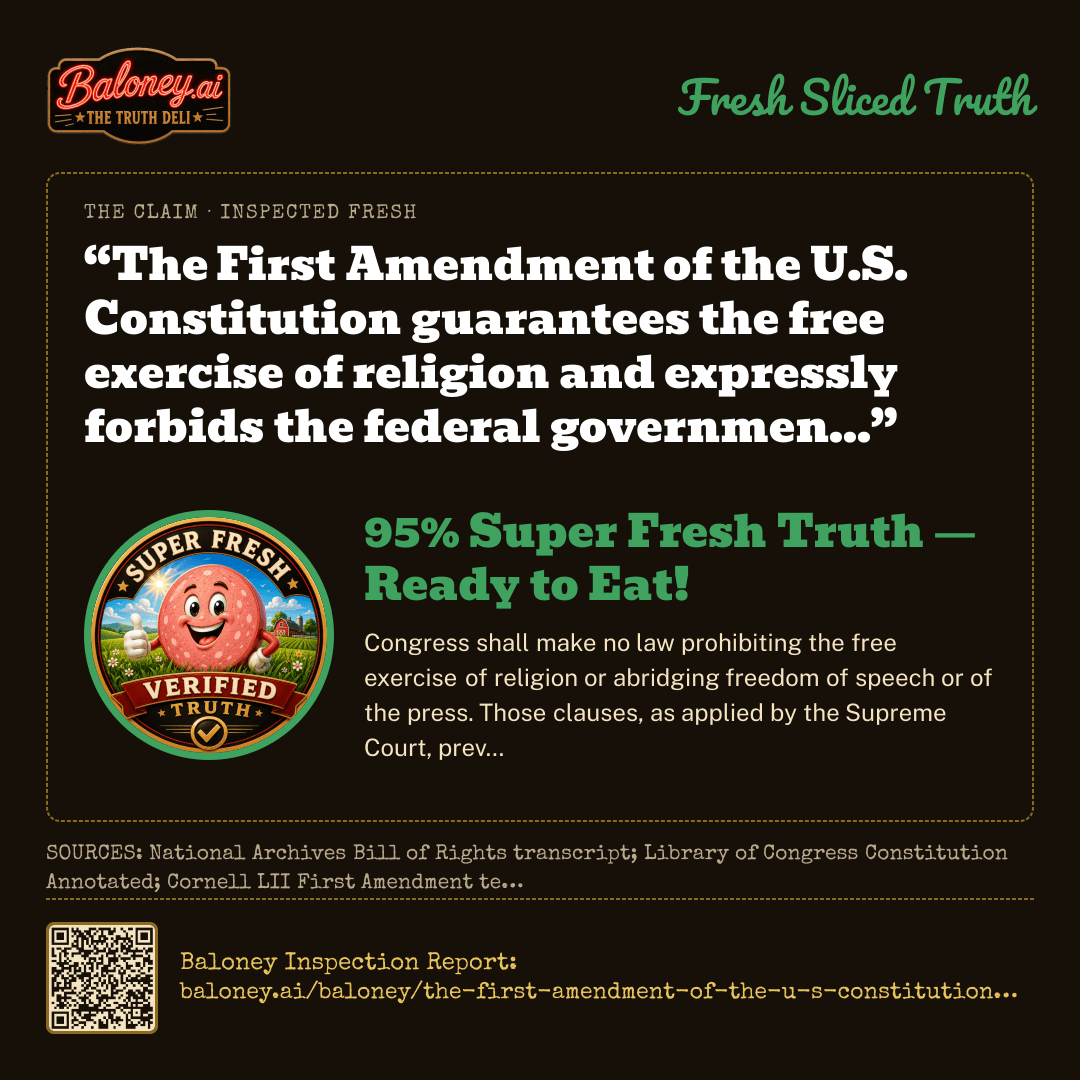
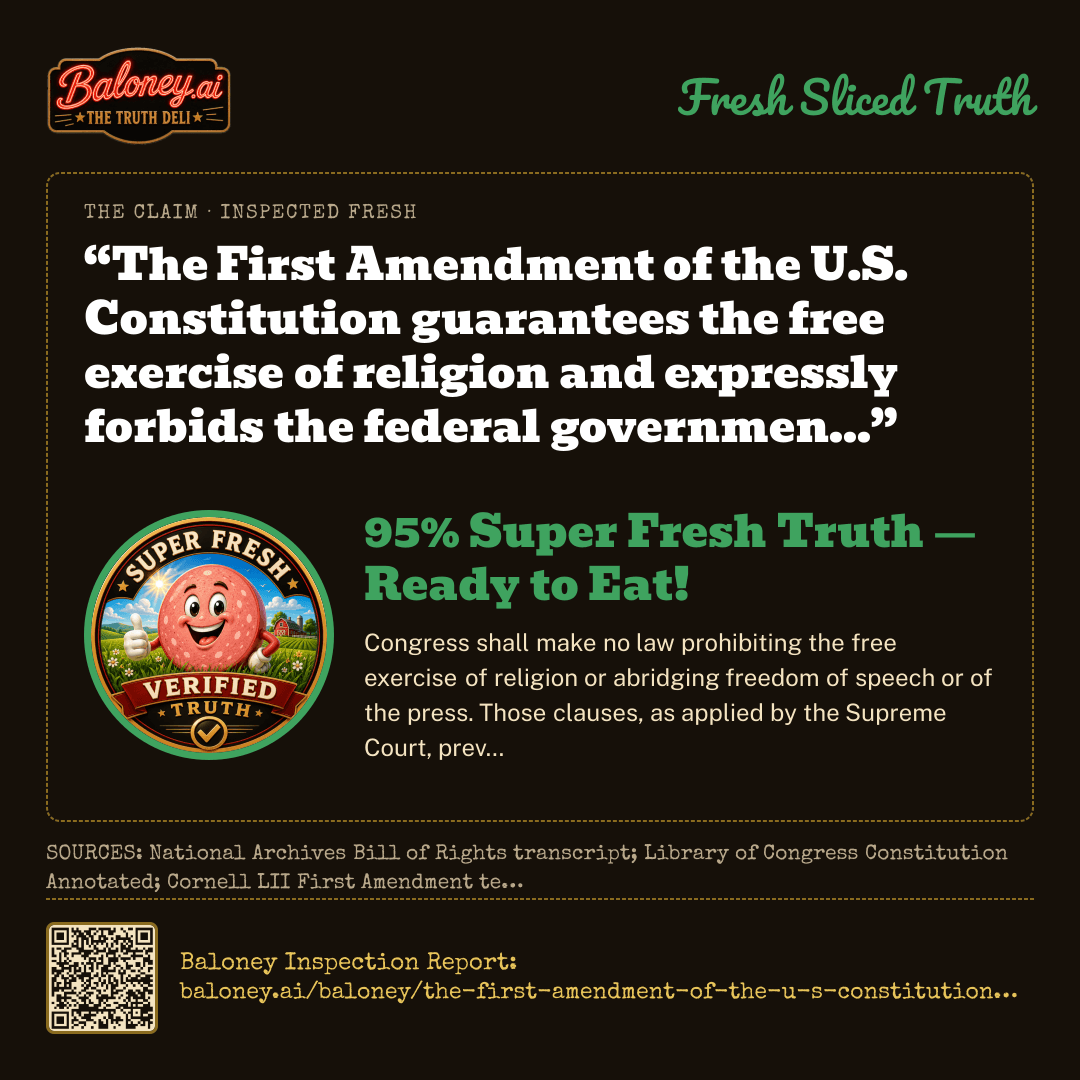
“The First Amendment of the U.S. Constitution guarantees the free exercise of religion and expressly forbids the federal government from banning any religious texts.”
95%Super Fresh Truth — Ready to Eat!
THE CLAIM CHECKS OUT.
Independently verifiedPhysically repeatable evidenceConfirmed across rival labsSafe to serve
“The First Amendment of the U.S. Constitution guarantees the free exercise of religion and expressly forbids the federal government from banning any religious texts.”95% Super Fresh Truth — Ready to Eat!Verified blind by 5 frontier AIs · Baloney Inspection Report: baloney.ai/baloney/the-first-amendment-of-the-u-s-constitution-guarantees-the
The Rating Card
The claim this refutes
The Baloney Sampler
The First Amendment, as recorded by the National Archives and the Library of Congress, states that Congress shall make no law prohibiting the free exercise of religion, or abridging freedom of speech or of the press. All five reports found that this text, plus settled doctrine, would invalidate a federal ban on a religious text because of its religious content. The U.S. Department of Justice describes free exercise as protecting religious expression subject to the same narrow limits as other speech.
The only defect all five reports flagged is the word "expressly." The amendment never mentions books, scriptures, or banning; the bar on banning religious texts is a well-settled application of those broad clauses, not an explicit sentence. The Library of Congress Constitution Annotated distinguishes protected belief from regulated conduct, but that does not change the result for a federal ban targeting a religious text. No report identified any precedent upholding such a ban.
Other ways to slice it — phrasings that might have changed the rating
“The First Amendment of the U.S. Constitution guarantees the free exercise of religion and, through its speech and press clauses, forbids the federal government from banning a religious text because of its religious content.” All five reports said the amendment never mentions books or banning, so the protection is a well-settled application of those clauses rather than an express textual rule.
“The First Amendment of the U.S. Constitution does not forbid the federal government from banning religious texts.” The reports found a content-based federal ban on a religious text would be a paradigm unconstitutional act under the Free Exercise, Speech, and Press Clauses, with no precedent upholding such a ban.
“The First Amendment of the U.S. Constitution makes every religiously motivated act immune from generally applicable federal law.” Reports cited Employment Division v. Smith and Reynolds v. United States showing that free exercise does not exempt all religiously motivated conduct from neutral, generally applicable laws.
Written from the panel’s reports by xAI · grok-4.6. Nothing here changed the score.
07:22:59SCORING MODEL V2 — MEDIAN OF 5 COUNTED LAB SCORES: 7, 24, 4, 34, 4 → 7. FRESH RULE: THE PRIMARY MASTER SCORES 5 AND THE BLIND MASTER 5 — BOTH SUPER FRESH TRUTH — AND THE COUNTED MEDIAN IS 7, ON THE TRUE SIDE. PUBLISHED AS 5, THE MORE CAUTIOUS OF THE TWO MASTERS.✓
07:22:59SOURCE RULE — LABS CITED 28 SOURCES: 0 DISCARDED FOR HAVING NO URL, 1 DISCARDED AS DEAD LINKS (404/410), 16 COULD NOT BE OPENED BY US AND ARE MARKED UNVERIFIED.✓
07:22:59SOURCE RULE — PRIMARY MASTER RULED ON 20 SOURCES: 0 DISCARDED FOR HAVING NO URL, 0 DISCARDED AS DEAD LINKS, 13 MARKED UNVERIFIED, 7 VERIFIED.✓
How This One Was Sliced
Station 1 · Blind Inspection — Five Graders, Zero Peeking
Each lab scored the claim independently, without seeing the others. Open a breakdown for its evidence, its sources, and how sure it was.
Anthropic · EQUAL WEIGHT · 44.1s
claude-opus-5
93%TRUTH
ROUND-1 BREAKDOWN
Evidence offered for the claim
The literal text of the First Amendment states: 'Congress shall make no law respecting an establishment of religion, or prohibiting the free exercise thereof; or abridging the freedom of speech, or of the press...' The Free Exercise Clause portion of the claim is accurate on the face of the document.
A federal ban on a religious text would be a paradigm case of an unconstitutional law: it would target religious practice (Free Exercise), suppress a category of expression based on content and viewpoint (Free Speech), and restrict publication/distribution (Free Press). Content- and viewpoint-based bans are presumptively invalid under settled doctrine.
Church of the Lukumi Babalu Aye v. City of Hialeah (1993) held that laws that are not neutral and generally applicable, but instead target religious conduct, must survive strict scrutiny — a standard a religious-text ban could not plausibly meet.
Even under the more permissive rule of Employment Division v. Smith (1990), the Court expressly preserved heightened protection for laws that target religion as such and for 'hybrid' claims combining free exercise with speech/press rights — exactly the posture of a book ban.
Board of Education v. Pico (1982) establishes that even government removal of books from a school library cannot be motivated by disapproval of the ideas in them, reinforcing that an outright federal ban on a text would be far beyond constitutional limits.
Via the Fourteenth Amendment (Cantwell v. Connecticut, 1940), these protections also bind state and local governments, so the claim understates rather than overstates the breadth of the protection.
No U.S. federal government has ever successfully banned a religious scripture; there is no contrary legal precedent upholding such a ban.
Evidence against the claim
The word 'expressly' is inaccurate. The First Amendment's text nowhere mentions books, scriptures, or 'religious texts.' The protection is an application of the Free Exercise, Speech, and Press Clauses by judicial interpretation — it is implied and well-settled, not express.
Free exercise is not absolute. Reynolds v. United States (1878) held that religious belief is absolutely protected but religiously motivated conduct can be regulated (there, polygamy), so 'guarantees the free exercise of religion' is true as to the clause's wording but not as an unlimited substantive right.
Under Employment Division v. Smith, neutral and generally applicable laws that incidentally burden religion need not satisfy strict scrutiny; relief in such cases often comes from statutes like RFRA rather than the First Amendment itself.
Narrow, non-religion-targeting restrictions could theoretically touch a text's distribution (e.g., export controls, customs, prison security restrictions on specific materials, or material-support laws), so 'forbids banning any religious text' is an absolute framing the case law does not phrase so categorically.
The First Amendment as written constrains 'Congress'; its extension to the full federal executive and to the states is itself a product of interpretation and incorporation, not express text.
How sure this lab was
90/100 — the lab’s own confidence in the score above, not a second reading of the claim.
The First Amendment's text directly supports the first half of the claim: it says Congress shall make no law 'prohibiting the free exercise' of religion. It also expressly protects speech and the press, which would strongly protect religious writings from a federal ban based on their religious content.
Supreme Court First Amendment doctrine strongly supports the practical implication that the federal government generally cannot ban a religious book because of its religious ideas. In West Virginia State Board of Education v. Barnette, the Court stated that no official may prescribe what is orthodox in religion, politics, or other matters of opinion.
Evidence against the claim
The statement is not literally correct as written: the First Amendment does not expressly mention 'religious texts,' 'books,' or an explicit rule saying the federal government may not ban 'any religious texts.' The express language is broader: free exercise, speech, press, assembly, and petition.
The word 'any' is overbroad. First Amendment protections are powerful but not absolute. Supreme Court doctrine permits regulation of some categories of expression, such as obscenity under Miller v. California and incitement under Brandenburg v. Ohio; a text would not become categorically immune from all regulation merely by being labeled religious.
Free exercise doctrine also does not make every religiously motivated act immune from generally applicable laws. In Employment Division v. Smith, the Supreme Court held that neutral, generally applicable laws may be applied even when they incidentally burden religious practice.
How sure this lab was
92/100 — the lab’s own confidence in the score above, not a second reading of the claim.
The First Amendment strictly states, 'Congress shall make no law respecting an establishment of religion, or prohibiting the free exercise thereof; or abridging the freedom of speech, or of the press.'
Through both the Free Exercise Clause and the Free Speech and Press Clauses, the First Amendment absolutely protects the right to possess, publish, distribute, and read religious texts without federal prohibition.
Decades of Supreme Court jurisprudence have firmly established that the federal government cannot ban books, including religious texts, rendering the substance of the claim legally accurate.
Evidence against the claim
The use of the word 'expressly' (meaning explicitly stated) is technically inaccurate. The 45-word text of the First Amendment speaks broadly of 'religion,' 'speech,' and the 'press,' but does not literally contain the words 'ban', 'book', or 'religious texts'.
The constitutional prohibition on banning religious texts is a derived application of the broad clauses against prohibiting the free exercise of religion and abridging the freedom of the press, rather than an explicit clause naming texts.
How sure this lab was
98/100 — the lab’s own confidence in the score above, not a second reading of the claim.
The First Amendment expressly states that “Congress shall make no law respecting an establishment of religion, or prohibiting the free exercise thereof.” This directly supports the claim’s first component: the Constitution protects the free exercise of religion.[https://constitution.congress.gov/browse/essay/amdt1-4-1/ALDE_00013221/][https://www.justice.gov/jm/1-15000-respect-religious-liberty-0]
The U.S. Department of Justice explains that free exercise includes acting or abstaining from action according to religious beliefs and that government may not restrict conduct because of the religious beliefs it expresses.[https://www.justice.gov/jm/1-15000-respect-religious-liberty-0]
The Department of Justice also states that religious expression is protected subject to the same narrow limits that apply to other forms of speech, supporting protection for religious writings as expressive material.[https://www.justice.gov/crt/page/file/1006786/dl]
Evidence against the claim
The First Amendment does not expressly mention “religious texts,” “books,” or a categorical prohibition on banning them. Its text protects free exercise and speech generally; the claim adds a specific textual guarantee that does not appear in the amendment.[https://constitution.congress.gov/browse/essay/amdt1-4-1/ALDE_00013221/]
The Free Exercise Clause primarily protects religious belief and exercise, while government regulation of conduct can be evaluated under constitutional standards. The Constitution Annotated distinguishes protected religious belief from acts prompted by religious beliefs, indicating that protection is not an unlimited exemption from every generally applicable law.[https://constitution.congress.gov/browse/essay/amdt1-4-2/ALDE_00013222/]
The First Amendment applies by its terms to Congress and, through constitutional doctrine, to government action—not to private individuals, private organizations, or every book-removal decision. Therefore, it does not categorically forbid all bans or removals of religious texts by every actor.[https://constitution.congress.gov/browse/essay/amdt1-7-2-4/ALDE_00013541/][https://www.justice.gov/archives/opa/press-release/file/1287721/dl?inline]
Religious texts may receive protection through multiple doctrines, including free exercise and freedom of speech, but that is different from an express First Amendment sentence specifically forbidding the federal government from banning religious texts. The claim therefore conflates a broad constitutional protection with an explicit textual prohibition.
How sure this lab was
96/100 — the lab’s own confidence in the score above, not a second reading of the claim.
The First Amendment text includes the Free Exercise Clause: Congress shall make no law ... prohibiting the free exercise of religion.
The same amendment also bars abridging freedom of speech or of the press, which covers printing, distributing, or possessing religious writings.
The original First Amendment constrains the federal government (Congress), matching the claim's scope.
Evidence against the claim
The Amendment never mentions religious texts, books, or banning; any bar on banning religious texts is inferred from the religion, speech, and press clauses rather than stated expressly.
The adverb 'expressly' overstates the actual wording, which is general rather than specific to religious texts.
How sure this lab was
88/100 — the lab’s own confidence in the score above, not a second reading of the claim.
The five reports agree on the core facts: the Free Exercise Clause is in the First Amendment’s text, the speech and press clauses cover religious writings, and settled doctrine would invalidate a federal ban on a text because of its religious content. They disagree only on how much the words “expressly” and “any” should move the score. Two high-confidence reports treated that as a minor wording caveat and scored 4; a third scored 7. The scale instruction is that a substantially true statement with a small overstatement belongs in 1–5, not outside it. The higher scores (24 and 34) overweight a technical textual point that does not make the claim false. Weighted equally, the panel’s evidence supports Super Fresh Truth.
All five agreed the Free Exercise Clause is express, that speech and press protections cover religious writings, and that a federal content-based ban on a religious text would be unconstitutional. They split on “expressly” and “any”: two scored 4, one scored 7, and two scored in the 20s–30s for treating those words as a material misstatement rather than a small caveat.
SUPER FRESH — VERIFIED AGAINST NATIONAL ARCHIVES BILL OF RIGHTS TRANSCRIPT; LIBRARY OF CONGRESS CONSTITUTION ANNOTATED; CORNELL LII FIRST AMENDMENT TEXT.
Blind Validation Master · never saw the Primary’s work
claude-opus-5
95% TRUTH
The substance of the claim is correct. The First Amendment's text literally contains the Free Exercise Clause ('Congress shall make no law... prohibiting the free exercise thereof'), so the first half is verbatim accurate. The second half is substantively right as a matter of settled law: a federal ban on a religious text would be a paradigm unconstitutional act under the Free Exercise, Speech, and Press Clauses, targeting religion and suppressing expression based on content and viewpoint, triggering strict scrutiny it could not survive (Lukumi; the religion-targeting and hybrid-rights carve-outs preserved in Smith; Pico). No evaluator identified any precedent upholding such a ban. The only genuine defect, flagged by all five reports, is the word 'expressly': the 45-word text never mentions books, scriptures, or banning, so the protection is a well-settled application of broad clauses rather than an explicit textual provision. The secondary quibbles — that 'any' is absolute, and that free exercise does not exempt all religiously motivated conduct — do not undercut the specific proposition at issue, since bans on religious texts are precisely the case where protection is strongest, and the claim correctly limits itself to the federal government (if anything understating the scope, which incorporation extends to the states). This is a substantially true statement with one overstated adverb, which the rubric treats as a 3-5, not a reason to demote it. The two reports scoring 24 and 34 appear to over-penalize a wording caveat and, in one case, to argue against a broader claim about private actors and book removals that the statement never makes.
AGREEMENT TEST PASSED — BOTH MASTERS SCORED 95% · BLIND VALIDATION CONFIRMED THIS SCORE · NO RE-EVALUATION REQUIRED
Median of 5 counted lab scores: 7, 24, 4, 34, 4 → 7.
Fresh rule: the Primary Master scores 5 and the Blind Master 5 — both Super Fresh Truth — and the counted median is 7, on the true side. Published as 5, the more cautious of the two masters.
The Evidence
Evidence for the claim
Free Exercise Clause is in the text The First Amendment states that Congress shall make no law prohibiting the free exercise of religion, which directly supports the claim’s first component.
Speech and press cover religious writings The same amendment bars abridging freedom of speech or of the press, covering printing, distributing, and possessing religious texts.
Doctrine blocks content-based religious book bans Cases such as Barnette, Lukumi, and Pico establish that government may not prescribe religious orthodoxy or remove books because it disapproves of their ideas; a federal ban on a scripture would fail.
The Amendment expressly forbids banning religious textsDEBUNKED — The First Amendment never mentions religious texts, books, or banning; any such bar is inferred from the religion, speech, and press clauses rather than stated expressly.
Evidence offered against the claim
No express mention of texts or bans The amendment’s text speaks of religion, speech, and the press but does not contain the words ban, book, or religious texts; the prohibition is a derived application, not an explicit clause.
Protections are powerful but not absolute Obscenity, incitement, and some other categories can be regulated; a work is not categorically immune merely by being labeled religious. Neutral, generally applicable laws may incidentally burden religion.
Text originally binds Congress As written the Amendment constrains Congress; its application to the rest of the federal government and to the states comes from later interpretation and incorporation.
Sources · Reliability · Why Accepted or Discounted
ACCEPTED — Academic case summary of Employment Division v. Smith.
Every link was opened when this claim was inspected. A dead link was discarded before publication; “unverified” means the site refused our automated check and the link is the one the panel cited. A source without a URL was never kept.
“The First Amendment of the U.S. Constitution guarantees the free exercise of religion and expressly forbids the federal government from banning any religious texts.”95% Super Fresh Truth — Ready to Eat!Verified blind by 5 frontier AIs · Baloney Inspection Report: baloney.ai/baloney/the-first-amendment-of-the-u-s-constitution-guarantees-the
Support the Baloney Slicer
CONTRIBUTE $25 → GET THE HAT
“Democracy Makes America Great”
A non-partisan, non-political ethos. Democracy is what makes America great. But without truth — honest, real, scientifically validated truth — democracy fails. The baloney slicer is on: feeding fresh sliced truth to protect what makes America great. Democracy.
Veritate Libertas — Latin for “Through Truth, Liberty.”