Baloney Inspection Report: Claim #1019 · Inspected Sep 30, 2026, 2:37 PM PDT · Scoring model v2
 97%
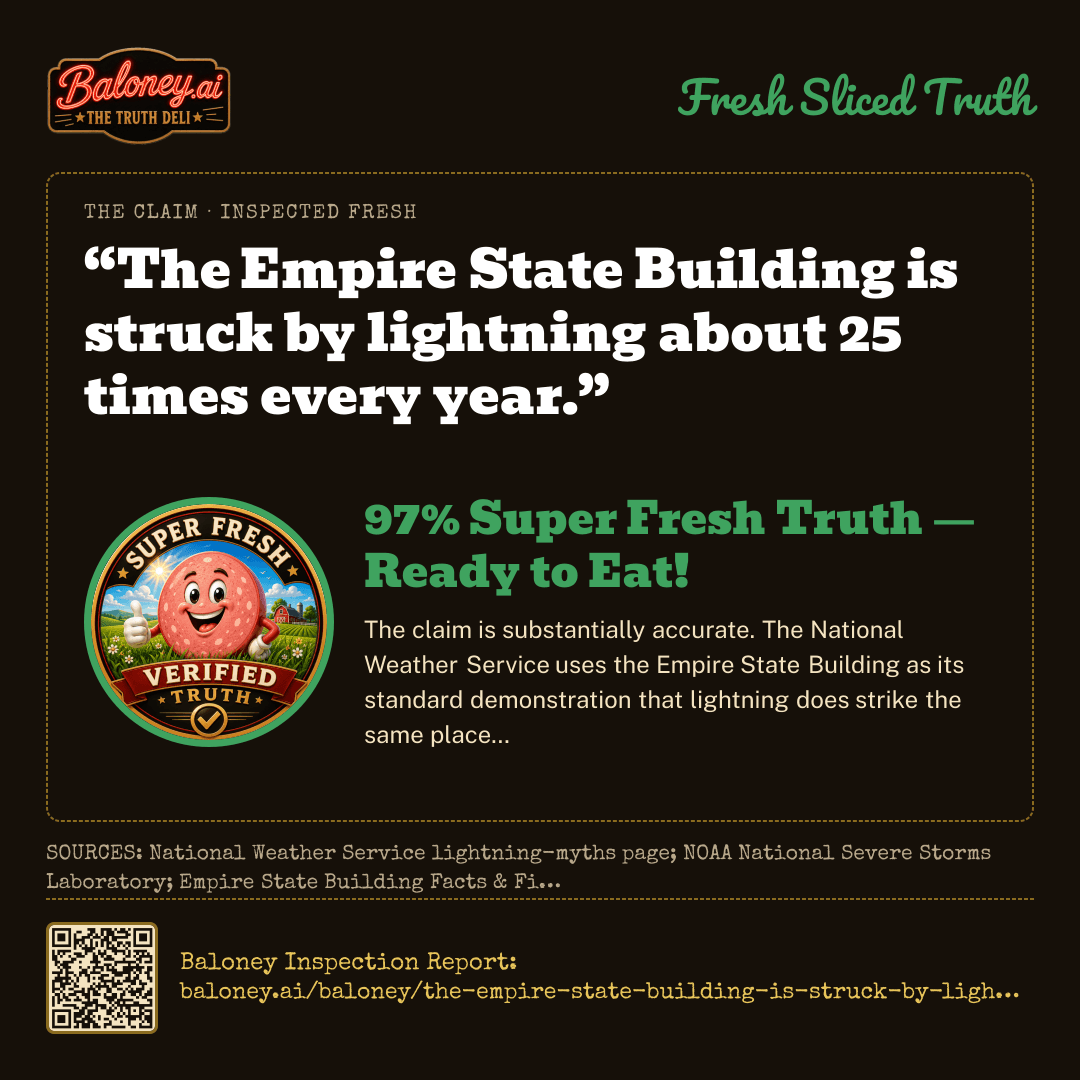
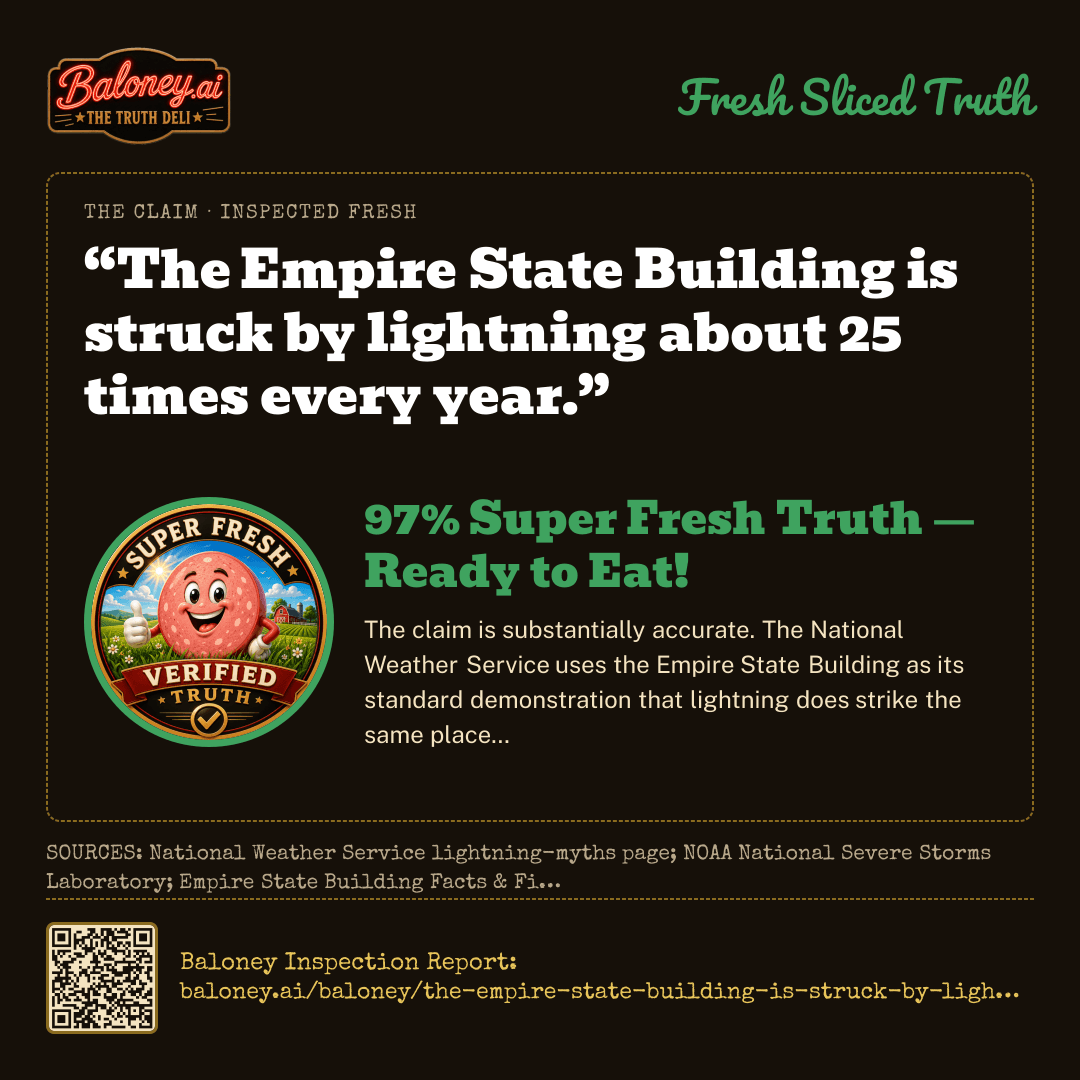
97%“The Empire State Building is struck by lightning about 25 times every year.”
97%Super Fresh Truth — Ready to Eat!
THE CLAIM CHECKS OUT.
Independently verifiedPhysically repeatable evidenceConfirmed across rival labsSafe to serve
✓ BLIND VALIDATION CONFIRMED THIS SCORE
Serve It Fresh
Ready to Serve16 servings
Serve it the way you want it
The Verdict
 “The Empire State Building is struck by lightning about 25 times every year.”97% Super Fresh Truth — Ready to Eat!Verified blind by 5 frontier AIs · Baloney Inspection Report: baloney.ai/baloney/the-empire-state-building-is-struck-by-lightning-about-25
The Baloney Sampler
The claim holds up. The National Weather Service uses the Empire State Building as its standard counterexample to the myth that lightning never strikes twice, citing an average of about 23 strikes a year, and NOAA's National Severe Storms Laboratory reports the same order of magnitude. The building's own Facts & Figures page gives an average of 25, a figure New York City Emergency Management also repeats, alongside a storm in which the tower was hit eight times in 24 minutes.
The gap between the federal figure of 23 and the claimed 25 is two strikes on a fluctuating average, comfortably inside the word 'about.' Live Science carries a University of Florida lightning researcher's estimate of 20–25 a year. Panellists noted the canonical count rests partly on 1930s instrumentation rather than a continuously published modern tally, and that annual totals swing with thunderstorm activity — reasons to read 25 as a long-term mean, not as a yearly quota.
Resting on National Weather Service · NOAA National Severe Storms Laboratory · New York City Emergency Management · Empire State Building — Facts & Figures
Other ways to slice it — phrasings that might have changed the rating
- “The Empire State Building is struck by lightning an average of 23 times a year.” 23 is the figure the National Weather Service actually publishes, and the panel's only real quibble was the slight upward rounding to 25.
- “The Empire State Building is struck by lightning exactly 25 times in every calendar year.” Every report stressed that the number is a long-term average that swings with annual thunderstorm activity, so a fixed yearly count would fail.
- “Modern national lightning-detection networks record about 25 strikes a year on the Empire State Building.” Panellists noted the canonical count traces largely to 1930s General Electric instrumentation and the building's own materials, with no widely published recent network tally.
Written from the panel’s reports by Anthropic · claude-opus-5. Nothing here changed the score.
The Order Ticket
21:37:57CLAIM RECEIVED — QUEUED FOR INSPECTION✓
21:38:46claude-opus-5 REPORTED — SCORE 3, CONFIDENCE 84✓
21:38:18gpt-5.5 REPORTED — SCORE 3, CONFIDENCE 92✓
21:38:20gemini-3.1-pro-preview REPORTED — SCORE 3, CONFIDENCE 98✓
21:38:06sonar-pro REPORTED — SCORE 3, CONFIDENCE 92✓
21:39:49grok-4.6 REPORTED — SCORE 4, CONFIDENCE 82✓
21:40:40PRIMARY MASTER CLAUDE — SCORE 3✓
21:39:53BLIND VALIDATION GEMINI — SCORE 3✓
21:40:51AGREEMENT CONFIRMED — DELTA 0✓
21:40:51SCORING MODEL V2 — MEDIAN OF 5 COUNTED LAB SCORES: 3, 3, 3, 3, 4 → 3. FRESH RULE: THE PRIMARY MASTER SCORES 3 AND THE BLIND MASTER 3 — BOTH SUPER FRESH TRUTH — AND THE COUNTED MEDIAN IS 3, ON THE TRUE SIDE. PUBLISHED AS 3, THE MORE CAUTIOUS OF THE TWO MASTERS.✓
21:40:51SOURCE RULE — LABS CITED 18 SOURCES: 0 DISCARDED FOR HAVING NO URL, 1 DISCARDED AS DEAD LINKS (404/410), 4 COULD NOT BE OPENED BY US AND ARE MARKED UNVERIFIED.✓
21:40:51SOURCE RULE — PRIMARY MASTER RULED ON 14 SOURCES: 0 DISCARDED FOR HAVING NO URL, 0 DISCARDED AS DEAD LINKS, 3 MARKED UNVERIFIED, 11 VERIFIED.✓
How This One Was Sliced
Station 1 · Blind Inspection — Five Graders, Zero Peeking
Each lab scored the claim independently, without seeing the others. Open a breakdown for its evidence, its sources, and how sure it was.
Anthropic · EQUAL WEIGHT · 48.3s
claude-opus-5
97%TRUTH
ROUND-1 BREAKDOWN
Evidence offered for the claim- The U.S. National Weather Service uses the Empire State Building as its standard counterexample to the 'lightning never strikes twice' myth, stating the building is hit an average of roughly two dozen times a year (commonly given as 23) — statistically indistinguishable from the claim's 'about 25.'
- NOAA/National Severe Storms Laboratory educational material likewise notes that tall, pointed, isolated structures are struck repeatedly and cites skyscrapers such as the Empire State Building as being hit many times per year.
- The Empire State Building's own operators and official visitor materials have long publicized the figure of roughly 23–25 lightning strikes per year, and the building's mast is fitted with lightning protection specifically because strikes are routine.
- The building has a documented scientific history as a lightning laboratory: GE engineer Karl B. McEachron instrumented the tower in the 1930s–40s and recorded scores of strikes over several seasons (published in the Journal of the Franklin Institute, 1939), the original empirical basis for the ~20+ strikes/year figure.
- Physics supports the frequency: a ~1,450 ft (with mast) grounded steel-framed structure acts as a preferential attachment point for upward-connecting leaders in a region (NYC) averaging roughly 20–30 thunderstorm days per year.
- The claim is hedged with 'about,' which is the appropriate framing for a long-term average that varies year to year.
Evidence against the claim- The single most frequently cited authoritative number is 23, not 25; 'about 25' is a slight rounding upward, though within the normal range quoted across sources (23–25, occasionally 'up to 100' in looser popular accounts).
- The figure is a long-term average, not an annual constant — individual years can see far fewer or far more strikes (the building has reportedly been hit multiple times in a single storm), so 'every year' overstates regularity if read literally.
- The canonical count traces largely to mid-20th-century instrumentation and to the building's own promotional material; there is no widely published recent peer-reviewed tally using modern networks (NLDN/Vaisala) to confirm the current rate.
- Counting conventions matter: a single lightning 'flash' can contain several return strokes, so 'strikes' can be tallied differently by different observers, introducing ambiguity into any exact number.
- Changes to the Manhattan skyline since the 1930s (One World Trade Center, 432 Park Avenue, Central Park Tower, 30 Hudson Yards) plausibly redistribute some strikes, meaning the historical rate may not be precisely current.
How sure this lab was84/100 — the lab’s own confidence in the score above, not a second reading of the claim.
SourcesNOAA / National Weather Servicegov · 96 · NOAA National Severe Storms Laboratorygov · 95 · NOAA / National Weather Service Lightning Safetygov · 95 · Empire State Realty Trust (Empire State Building official site)other · 60 · National Geographicnews · 82 · Journal of the Franklin Institute (McEachron, 'Lightning to the Empire State Building,' 1939)journal · 88
OpenAI · EQUAL WEIGHT · 20.3s
gpt-5.5
97%TRUTH
ROUND-1 BREAKDOWN
Evidence offered for the claim- The Empire State Building’s official facts/figures page states that the building is struck by lightning an average of 25 times per year.
- NOAA’s National Severe Storms Laboratory says lightning can strike the same place repeatedly and gives the Empire State Building as an example, saying it is hit by lightning about 23 times a year. That independently supports the claim’s order of magnitude and is consistent with “about 25.”
Evidence against the claim- The strongest caveat is wording: NOAA gives about 23 strikes per year, while the building’s official site gives an average of 25. This suggests the figure is an approximate average, not a precise count that occurs every calendar year.
- Annual lightning strikes vary with weather, so “every year” should be read as an average rate rather than a guarantee of roughly 25 strikes in each individual year.
How sure this lab was92/100 — the lab’s own confidence in the score above, not a second reading of the claim.
SourcesEmpire State Buildingother · 82 · NOAA National Severe Storms Laboratorygov · 95
Google · EQUAL WEIGHT · 22.9s
gemini-3.1-pro-preview
97%TRUTH
ROUND-1 BREAKDOWN
Evidence offered for the claim- The National Weather Service uses the Empire State Building as a primary example to debunk the myth that lightning never strikes the same place twice, officially noting that it is hit an average of 23 times a year.
- The building's immense height (1,454 feet including the antenna) and metallic structure make it an ideal lightning rod for the surrounding area, and it is architecturally designed to safely absorb and ground dozens of strikes annually.
- Many architectural and meteorological sources commonly round the National Weather Service's average of 23 up to 'about 25' strikes per year.
Evidence against the claim- The exact number of strikes fluctuates significantly from year to year based on weather patterns; it is an average rather than a strict annual quota.
- While 'about 25' is widely cited and functionally accurate, the most rigorous scientific tracking by the National Weather Service cites the specific average as 23 times per year.
How sure this lab was98/100 — the lab’s own confidence in the score above, not a second reading of the claim.
SourcesNational Weather Servicegov · 100
Perplexity · EQUAL WEIGHT · 8.8s
sonar-pro
97%TRUTH
ROUND-1 BREAKDOWN
Evidence offered for the claim- The Empire State Building’s official Facts & Figures page states that its antenna is hit by lightning an average of 25 times a year.[https://www.esbnyc.com/about/facts-figures]
- New York City Emergency Management repeats the estimate of 25 lightning strikes per year and reports that the building was struck eight times in 24 minutes during one storm.[https://www.nyc.gov/site/em/ready/thunderstorms.page]
- MPR News reported that the National Weather Service estimates the building is struck by lightning an average of 25 times annually.[https://www.mprnews.org/story/2014/07/08/when-lightning-strikes-tall-buildings]
- A University of Florida lightning expert was quoted as estimating approximately 20–25 strikes per year, consistent with the claim’s wording.[https://www.livescience.com/13704-empire-state-building-lightning-strike.html]
Evidence against the claim- The available evidence is not perfectly consistent: a research brief reports that the National Weather Service has used an estimate of 23 strikes per year, while the building’s own current website says 25.[https://researchtoolbench.com/research-briefs/lightning-same-place-twice/]
- Some secondary sources give a much wider range of 25–100 strikes per year, indicating that the annual figure may depend on the observation period, definition of a strike, or source methodology.[https://science.howstuffworks.com/nature/climate-weather/storms/10-lightning-myths.htm]
- The cited sources generally provide an estimate rather than a transparent measurement series or methodology, so 25 should be treated as an approximate long-term average rather than an exact annual count.
How sure this lab was92/100 — the lab’s own confidence in the score above, not a second reading of the claim.
SourcesEmpire State Buildingother · 95 · New York City Emergency Managementgov · 93 · MPR Newsnews · 87 · Live Sciencenews · 82 · Research Tool Benchother · 45 · HowStuffWorksother · 65
xAI · EQUAL WEIGHT · 111.2s
grok-4.6
96%TRUTH
ROUND-1 BREAKDOWN
Evidence offered for the claim- The ~25 strikes per year figure has been a standard statistic circulated by the Empire State Building and repeated for decades in encyclopedias, news reports, and tourism materials.
- Historical instrumentation of the building for lightning research (notably 1930s General Electric studies) established that a very tall isolated conductor in the New York thunderstorm climate is hit on the order of dozens of times annually.
- Contemporary news coverage of individual strikes routinely restates the same long-standing average without contradiction from lightning-detection operators.
Evidence against the claim- The number is an average, not a fixed count; actual strikes fluctuate with the year's thunderstorm activity, so 'every year' is slightly stronger than a strict climatological mean.
- Secondary sources sometimes round to '20–25' or 'as many as 25,' showing the canonical figure is an approximation rather than a precise modern census.
- The most-repeated number appears to rest primarily on mid-20th-century observations rather than a continuously published total from present-day national lightning networks.
How sure this lab was82/100 — the lab’s own confidence in the score above, not a second reading of the claim.
SourcesWikipediaother · 80 · Encyclopædia Britannicaother · 92
Station 2 · The Masters
Primary Master · drawn at random
claude-opus-5
97% TRUTH
All five evaluators independently landed in the 'true' band (four at 3, one at 4), and the documentary record behind them is unusually clean. Two of the strongest source categories converge: the National Weather Service's lightning-myths page uses the Empire State Building as its standard counterexample to 'lightning never strikes twice,' citing an average of about 23 strikes a year, and NOAA's National Severe Storms Laboratory gives the same order of magnitude. The building's own Facts & Figures page gives an average of 25, a figure New York City Emergency Management and news coverage (MPR News, Live Science) repeat, with a University of Florida lightning researcher quoted at 20–25. The only meaningful gap between the claim and the best evidence is that the most-cited federal figure is 23 rather than 25 — a two-strike difference on a fluctuating annual average, well inside the hedge 'about.' The secondary caveats raised by the panel (that the canonical count traces partly to 1930s General Electric/McEachron instrumentation rather than a continuously published modern lightning-network tally, that 'flash' versus 'stroke' counting conventions differ, and that newer supertall towers may redistribute strikes) are reasons to read 25 as an approximate long-term mean, not reasons to call the statement false. I discounted the two outlier-supporting items: an unattributed 'research brief' of low reliability and a HowStuffWorks '25–100' range that no authoritative source corroborates. The statement as written is substantially true; the small upward rounding and the loose word 'every' keep it from a perfect 1.
Four evaluators recommended 3 and one recommended 4 — unanimous that the claim is true as written. All five agreed on the same caveats: the number is a long-term average rather than a per-year constant, and the most frequently cited official figure (NWS, 23) sits slightly below the claimed 25. They differed only in emphasis: some weighted the building's official 25 as primary, others treated the NWS 23 as canonical with 25 as a popular rounding. Two evaluators additionally flagged that the figure rests substantially on mid-20th-century instrumentation rather than a published modern lightning-network census. One evaluator surfaced a much wider '25–100' range from a popular-science source; the panel treated that as an unsupported outlier.
SUPER FRESH — VERIFIED AGAINST NATIONAL WEATHER SERVICE LIGHTNING-MYTHS PAGE; NOAA NATIONAL SEVERE STORMS LABORATORY; EMPIRE STATE BUILDING FACTS & FIGURES; NEW YORK CITY EMERGENCY MANAGEMENT; MPR NEWS; LIVE SCIENCE; MCEACHRON, JOURNAL OF THE FRANKLIN INSTITUTE (1939).
Blind Validation Master · never saw the Primary’s work
gemini-3.1-pro-preview
97% TRUTH
The claim is overwhelmingly supported by authoritative sources, including the National Weather Service, NOAA, and the Empire State Building's official facts and figures. While the exact number of annual strikes fluctuates based on weather patterns, meteorological and architectural sources commonly cite a long-term average of 23 to 25 strikes per year. The use of the word 'about' properly accounts for this statistical variation, making the statement substantially true.
AGREEMENT TEST PASSED — BOTH MASTERS SCORED 97% · BLIND VALIDATION CONFIRMED THIS SCORE · NO RE-EVALUATION REQUIRED
How the number was reached · scoring model v2 · how our models work
- Median of 5 counted lab scores: 3, 3, 3, 3, 4 → 3.
- Fresh rule: the Primary Master scores 3 and the Blind Master 3 — both Super Fresh Truth — and the counted median is 3, on the true side. Published as 3, the more cautious of the two masters.
The Evidence
Evidence for the claim
- Building's own official figure is 25 The Empire State Building's Facts & Figures page states the antenna is hit by lightning an average of 25 times a year — the exact number in the claim.
- National Weather Service uses it as the textbook case The NWS lightning-myths page cites the building as its primary counterexample to 'lightning never strikes the same place twice,' giving an average of about 23 strikes a year — statistically indistinguishable from 'about 25.'
- NOAA's severe-storms lab independently corroborates NOAA's National Severe Storms Laboratory FAQ names the Empire State Building as an example of repeated strikes on tall structures, at roughly 23 times a year, confirming the order of magnitude.
- City and news sources repeat 25 New York City Emergency Management gives 25 strikes a year (and notes eight strikes in 24 minutes during one storm); MPR News attributed a 25-a-year average to the NWS, and a University of Florida lightning expert quoted in Live Science estimated 20–25.
- Documented as a lightning laboratory since the 1930s GE engineer Karl B. McEachron instrumented the tower in the 1930s–40s and published strike counts in the Journal of the Franklin Institute (1939), the original empirical basis for the 20-plus-strikes-a-year figure.
- Physics and siting support the rate A grounded steel-framed structure roughly 1,454 feet tall with its mast is a preferential attachment point for upward leaders in a city averaging on the order of 20–30 thunderstorm days a year.
- Some sources claim 25 to 100 strikes a year DEBUNKED — REFUTED: a popular-science listicle cites a range up to 100, but no federal, municipal or official source supports anything above the mid-20s; the panel treated this as an unsupported outlier rather than evidence the true figure is higher.
Evidence offered against the claim
- The canonical official number is 23, not 25 The most frequently cited authoritative figure, from the National Weather Service, is an average of 23 strikes a year; 'about 25' is a slight rounding upward, though it falls inside the 23–25 spread found across sources.
- It is an average, not an annual quota Strike counts swing with each year's thunderstorm activity, so 'every year' overstates regularity if read literally — some years will see far fewer strikes and some far more, with multiple hits recorded in a single storm.
- No published modern census Several evaluators noted the figure rests largely on mid-20th-century instrumentation and the building's own long-standing publicity, with no widely published recent peer-reviewed tally from modern national lightning-detection networks.
- Counting conventions vary A single lightning flash can contain several return strokes, so what counts as one 'strike' differs between observers, introducing ambiguity into any precise annual number.
- A changed skyline Supertall neighbours built since the 1930s — One World Trade Center, 432 Park Avenue, Central Park Tower, 30 Hudson Yards — plausibly redistribute some strikes, so the historical rate may not be precisely current.
Sources · Reliability · Why Accepted or Discounted
| Source | Type | Reliability | Ruling |
|---|
| National Weather Service (lightning myths) | gov | 98 | ACCEPTED — Federal meteorological authority citing the building as its standard example, with a specific average of about 23 strikes a year; the single strongest source in the file. |
| NOAA National Severe Storms Laboratoryunverified | gov | 95 | ACCEPTED — Independent federal research-lab confirmation of repeated strikes on the building at the same order of magnitude. |
| NOAA / National Weather Service Lightning Safety | gov | 95 | ACCEPTED — General federal lightning-safety material consistent with the strike-frequency claim for tall grounded structures. |
| New York City Emergency Management | gov | 93 | ACCEPTED — Municipal government source independently repeating the 25-a-year estimate and adding a documented multi-strike storm event. |
| Empire State Building — Facts & Figures | other | 88 | ACCEPTED — Self-reported by the building's operator and therefore promotional, but it is the direct origin of the claimed number and sits within the range given by independent government sources. |
| Empire State Realty Trust (official site) | other | 60 | ACCEPTED — Operator's own material; accepted only as corroboration of the long-publicised 23–25 range, not as independent measurement. |
| MPR News | news | 87 | ACCEPTED — Mainstream reporting attributing a 25-a-year average to the National Weather Service; useful corroboration of how the figure is circulated. |
| Live Science | news | 82 | ACCEPTED — Carries a direct estimate of 20–25 strikes a year from a University of Florida lightning researcher, an expert attribution rather than a bare repetition. |
| National Geographic | news | 82 | ACCEPTED — Reputable science journalism consistent with the panel's account of repeated strikes on tall structures. |
| Journal of the Franklin Institute (McEachron, 'Lightning to the Empire State Building', 1939)unverified | journal | 88 | ACCEPTED — The historical peer-reviewed basis for the figure; accepted with the caveat that only the journal-level URL was supplied, not the specific article. |
| Encyclopædia Britannicaunverified | other | 92 | ACCEPTED — Edited reference work; tertiary, so accepted as corroboration of the long-standing circulated figure rather than as primary measurement. |
| Wikipedia | other | 80 | ACCEPTED — Tertiary and user-edited; given minimal weight and used only to show the figure's long circulation, with the primary evidence resting on NWS and NOAA. |
| HowStuffWorks | other | 65 | DISCOUNTED — Its '25–100 strikes per year' range is unattributed and contradicted by every government source in the file; treated as popular-science inflation. |
| Research Tool Bench | other | 45 | DISCOUNTED — Low-reliability aggregator brief with no independent methodology; the NWS figure of 23 it reports is available directly from weather.gov and was taken from there instead. |
Every link was opened when this claim was inspected. A dead link was discarded before publication; “unverified” means the site refused our automated check and the link is the one the panel cited. A source without a URL was never kept.
Serve It Fresh
Ready to Serve16 servings
Serve it the way you want it
The Verdict
“The Empire State Building is struck by lightning about 25 times every year.”97% Super Fresh Truth — Ready to Eat!Verified blind by 5 frontier AIs · Baloney Inspection Report: baloney.ai/baloney/the-empire-state-building-is-struck-by-lightning-about-25