Baloney Inspection Report: Claim #1010 · Inspected Sep 30, 2026, 10:58 AM PDT · Scoring model v2
 99%
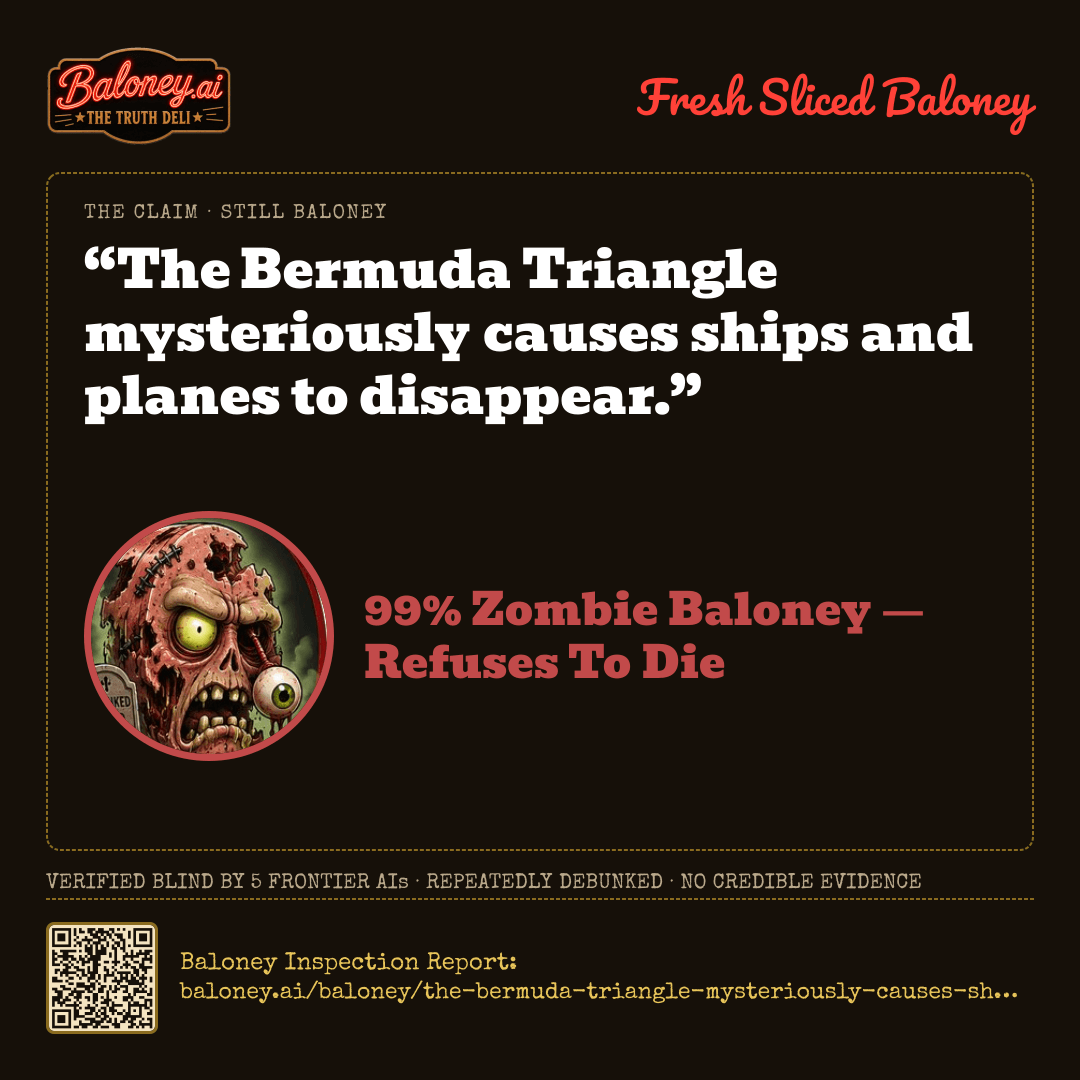
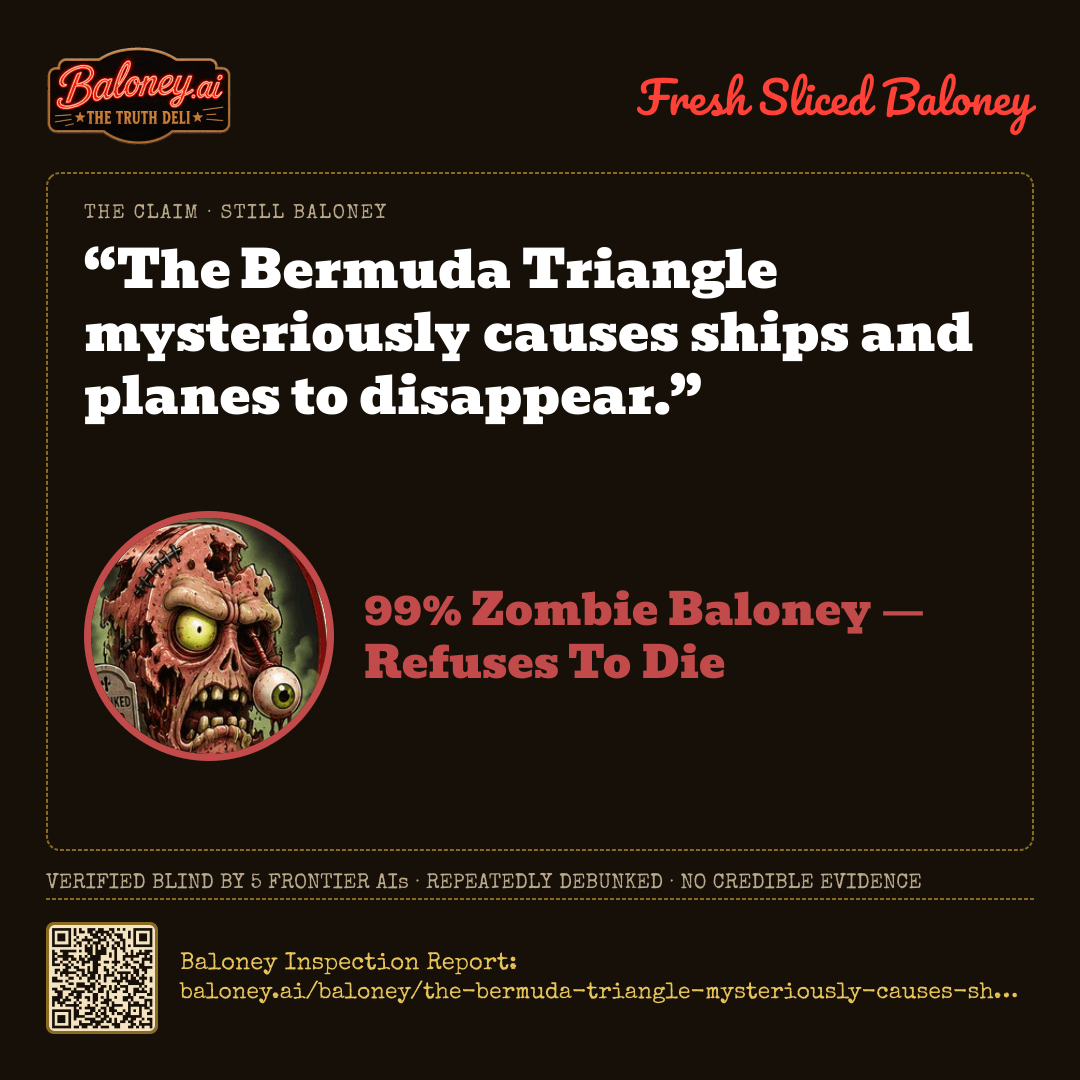
99%“The Bermuda Triangle mysteriously causes ships and planes to disappear.”
99%Zombie Baloney — Refuses To Die
DEAD. BURIED. STILL SHAMBLING AROUND.
Repeatedly debunkedNo credible evidenceRefuses to dieLives on in delusion
✓ BLIND VALIDATION CONFIRMED THIS SCORE
Serve It Fresh
Ready to Serve20 servings
Serve it the way you want it
The Verdict
 “The Bermuda Triangle mysteriously causes ships and planes to disappear.”99% Zombie Baloney — Refuses To DieVerified blind by 5 frontier AIs · Baloney Inspection Report: baloney.ai/baloney/the-bermuda-triangle-mysteriously-causes-ships-and-planes
The Baloney Sampler
The panel found no evidence that the Bermuda Triangle mysteriously causes disappearances. NOAA and the U.S. Naval History and Heritage Command say it is not an official or unusually dangerous hazard area, and the accepted evidence says losses there are not unusually frequent compared with other busy ocean regions.
Real ships and aircraft have been lost there, including USS Cyclops and Flight 19, and some wreckage was not recovered. But the reports point to ordinary causes: heavy traffic, storms, the Gulf Stream, reefs, navigation error, mechanical failure, and selective pop-culture storytelling, as summarized by Encyclopaedia Britannica and fact-checking by Snopes.
Resting on NOAA · U.S. Naval History and Heritage Command · Encyclopaedia Britannica · Snopes
Other ways to slice it — phrasings that might have changed the rating
- “Ships and aircraft have disappeared in or near the region popularly called the Bermuda Triangle.” The reports agree that real losses occurred there, including USS Cyclops and Flight 19, even though that does not prove a mysterious cause.
- “Ships and aircraft disappear in the Bermuda Triangle at a higher rate than in other heavily traveled ocean regions.” The reports say government, insurance, and traffic-based evidence directly addresses frequency and finds no unusual disappearance rate.
- “Ordinary hazards in the Bermuda Triangle, including storms, the Gulf Stream, reefs, human error, and mechanical failure, can explain many reported losses and make wreckage hard to recover.” The reports repeatedly identify those environmental and navigational factors as plausible mundane explanations for incidents often presented as mysterious.
Written from the panel’s reports by OpenAI · gpt-5.5. Nothing here changed the score.
The Order Ticket
17:58:59CLAIM RECEIVED — QUEUED FOR INSPECTION✓
17:58:59claude-opus-5 REPORT CARRIED OVER FROM THE EARLIER RUN — SCORE 90, CONFIDENCE 93✓
17:58:59gpt-5.5 REPORT CARRIED OVER FROM THE EARLIER RUN — SCORE 88, CONFIDENCE 90✓
17:59:30gemini-3.1-pro-preview REPORTED — SCORE 99, CONFIDENCE 100✓
17:58:59sonar-pro REPORT CARRIED OVER FROM THE EARLIER RUN — SCORE 90, CONFIDENCE 94✓
17:58:59grok-4.6 REPORT CARRIED OVER FROM THE EARLIER RUN — SCORE 92, CONFIDENCE 90✓
18:00:51PRIMARY MASTER CHATGPT — SCORE 99✓
18:00:13BLIND VALIDATION GEMINI — SCORE 99✓
18:00:37AGREEMENT CONFIRMED — DELTA 0✓
18:00:37SCORING MODEL V2 — MEDIAN OF 5 COUNTED LAB SCORES: 90, 88, 99, 90, 92 → 90. ZOMBIE RULE: THE PRIMARY MASTER FLAGS A LONG DEBUNK HISTORY, THE BLIND MASTER SCORES 99, THE COUNTED MEDIAN IS 90 — PUBLISHED AS 99.✓
18:00:37SOURCE RULE — LABS CITED 29 SOURCES: 0 DISCARDED FOR HAVING NO URL, 4 DISCARDED AS DEAD LINKS (404/410), 10 COULD NOT BE OPENED BY US AND ARE MARKED UNVERIFIED.✓
18:00:37SOURCE RULE — PRIMARY MASTER RULED ON 16 SOURCES: 0 DISCARDED FOR HAVING NO URL, 0 DISCARDED AS DEAD LINKS, 6 MARKED UNVERIFIED, 10 VERIFIED.✓
How This One Was Sliced
Station 1 · Blind Inspection — Five Graders, Zero Peeking
Each lab scored the claim independently, without seeing the others. Open a breakdown for its evidence, its sources, and how sure it was.
Anthropic · EQUAL WEIGHT · 51.5s
claude-opus-5
90%BALONEY
ROUND-1 BREAKDOWN
Evidence offered for the claim- Real, documented losses have occurred in the region, including the disappearance of the U.S. Navy collier USS Cyclops with 306 people in March 1918 and of Flight 19 (five TBM Avengers) plus a Martin Mariner search plane in December 1945 — cases in which no wreckage was definitively recovered.
- The area does have genuinely hazardous natural conditions that can destroy vessels and aircraft quickly: the fast, warm Gulf Stream; sudden and violent tropical storms, hurricanes and squall lines; and shallow shoals interspersed with very deep trenches (the Puerto Rico Trench exceeds 8,000 m), which can scatter or bury debris and make wreck recovery unlikely.
- Physically plausible mechanisms for sudden losses have been proposed and partially modeled, e.g., large methane-hydrate gas releases reducing water density enough to sink a ship (modeled in a peer-reviewed physics paper) and rogue/confluent wave formation where multiple storm systems meet — giving the appearance of vanishing without a trace.
- Compass behavior is genuinely unusual in part of the region: an agonic line (where magnetic north and true north align) has historically passed near the area, so navigators who fail to correct properly can accumulate large course errors — a real effect often mythologized into 'supernatural' compass failure.
- Popular accounts (Vincent Gaddis 1964, Charles Berlitz 1974) assembled dozens of cases that, taken at face value, appear to cluster in one region, which is the core of the claim's surface plausibility.
Evidence against the claim- No U.S. government agency recognizes the Bermuda Triangle as a real or anomalous hazard. NOAA's National Ocean Service states there is no evidence that mysterious disappearances occur with any greater frequency there than in other well-traveled areas of the ocean, and that environmental and human factors account for the losses.
- The U.S. Navy and U.S. Coast Guard have stated that the 'Bermuda Triangle' does not exist as an official designation and that no extraordinary factors have ever been identified; the Coast Guard attributes losses to the region's heavy traffic, weather, and navigational error.
- Larry Kusche's systematic 1975 re-investigation of the original case list found that many 'mysteries' were manufactured: some ships/planes were lost far outside the region, some in documented severe storms, some never existed, and in several cases the disappearance had a published, mundane resolution that the popular authors omitted.
- Insurance and traffic data undercut the claim: Lloyd's of London and marine insurers have not applied special premiums to the region because loss rates there are not anomalous. The area is one of the most heavily transited ocean regions on Earth (Florida/Caribbean shipping and cruise lanes, private aviation to the Bahamas), so an absolute number of accidents is expected without any excess rate.
- The 'Triangle' has no fixed boundaries — different authors give areas ranging from roughly 500,000 to 1.5 million square miles — which allows incidents to be included or excluded post hoc, a classic sign of a statistical artifact rather than a real phenomenon.
- The specific flagship cases have plausible conventional explanations: Flight 19's flight leader was disoriented and, per the Navy board of inquiry, flew the formation out to sea until fuel exhaustion at night in worsening seas; the search Mariner was a type known for fuel-vapor fires and an explosion was reported by a nearby ship. USS Cyclops was overloaded with dense manganese ore, had a failing starboard engine, and sailed in a period of storms and wartime hazards.
- Systematic analyses of modern incident databases (e.g., by the World Wide Fund for Nature's 2013 shipping-hazard review and by Australian science communicator Karl Kruszelnicki's review of Lloyd's/Coast Guard records) rank other areas — South China Sea, Mediterranean, North Sea, Black Sea, British Isles — as more dangerous than the Bermuda Triangle, which did not make the top ten.
- There is no measured anomaly in the region: no unusual magnetic field beyond normal declination, no confirmed 'electronic fog,' no gravitational or dimensional effect has ever been detected by aircraft, satellites, ships, or ocean-survey instrumentation operating there daily.
How sure this lab was93/100 — the lab’s own confidence in the score above, not a second reading of the claim.
SourcesNOAA National Ocean Servicegov · 95 · U.S. Naval History and Heritage Commandgov · 94 · U.S. Naval History and Heritage Command (DANFS, USS Cyclops)gov · 92 · Encyclopaedia Britannicaother · 80 · Lawrence D. Kusche, 'The Bermuda Triangle Mystery—Solved' (Harper & Row 1975; Prometheus Books 1995)other · 85
OpenAI · EQUAL WEIGHT · 25.7s
gpt-5.5
88%BALONEY
ROUND-1 BREAKDOWN
Evidence offered for the claim- Several real vessels and aircraft have been lost in or near the area popularly called the Bermuda Triangle, including the U.S. Navy's Flight 19 in 1945 and USS Cyclops in 1918; some wrecks/remains were not found, leaving individual cases incompletely explained.
- The area has genuine hazards that can make losses hard to investigate, including heavy traffic, sudden weather, and the Gulf Stream, which NOAA says can rapidly disperse debris; these factors can make ordinary accidents appear mysterious.
Evidence against the claim- NOAA states there is no evidence that mysterious disappearances occur in the Bermuda Triangle at a greater frequency than in any other large, well-traveled area of ocean.
- NOAA says the U.S. Navy and U.S. Coast Guard do not recognize the Bermuda Triangle as a hazard area of special significance, and the U.S. Board on Geographic Names does not recognize it as an official geographic name.
- The claim uses causal language—'mysteriously causes'—but credible sources do not identify any paranormal, unique, or unexplained mechanism causing ships or planes to vanish there.
- Many reported Bermuda Triangle cases are consistent with ordinary causes such as storms, navigation error, mechanical failure, poor communications, or the difficulty of recovering evidence at sea; unresolved cases do not by themselves show a special mysterious cause.
How sure this lab was90/100 — the lab’s own confidence in the score above, not a second reading of the claim.
SourcesNOAA National Ocean Servicegov · 95 · U.S. Naval History and Heritage Commandgov · 90 · U.S. Naval History and Heritage Commandgov · 90 · Encyclopaedia Britannicaother · 78
Google · EQUAL WEIGHT · 30.8s
gemini-3.1-pro-preview
99%BALONEY
ROUND-1 BREAKDOWN
Evidence offered for the claim- The area roughly bounded by Miami, Bermuda, and Puerto Rico has historically been the site of several high-profile maritime and aviation disappearances, most notably the loss of the USS Cyclops in 1918 and a squadron of five U.S. Navy bombers (Flight 19) in 1945.
- Because the region is one of the most heavily traveled shipping lanes in the world, it inherently experiences a higher raw number of accidents, distress calls, and missing vessels than less traversed ocean regions.
Evidence against the claim- Statistical data confirms there is no unusual frequency of disappearances in the Bermuda Triangle; the rate of lost ships and planes is proportional to any other heavily navigated ocean region.
- Major maritime insurance entities, such as Lloyd's of London, do not recognize the Bermuda Triangle as unusually dangerous and do not charge higher premiums for vessels traveling through it.
- The U.S. Coast Guard and the National Oceanic and Atmospheric Administration (NOAA) explicitly dismiss the myth, attributing accidents to natural and mundane causes such as unpredictable severe weather (hurricanes), the fast-moving Gulf Stream current, shallow reefs, and human error.
- The 'mystery' was largely a manufactured pop-culture phenomenon, popularized by mid-20th-century pulp writers like Vincent Gaddis and Charles Berlitz, who notoriously sensationalized accounts by omitting crucial details like major storms occurring during the disappearances.
How sure this lab was100/100 — the lab’s own confidence in the score above, not a second reading of the claim.
SourcesNational Oceanic and Atmospheric Administration (NOAA)gov · 95 · Encyclopedia Britannicaedu · 90 · Historyother · 80
Perplexity · EQUAL WEIGHT · 18.5s
sonar-pro
90%BALONEY
ROUND-1 BREAKDOWN
Evidence offered for the claim- The Bermuda Triangle region has been associated with a long list of ship and aircraft losses, which is the empirical basis used by proponents of the claim that it mysteriously causes disappearances. General overviews (e.g., encyclopedia-style articles and popular science writeups) document numerous alleged incidents, ranging from Flight 19 in 1945 to various reported shipwrecks and missing vessels used in books and TV specials to support the idea of a special danger in this area.[2][8]
- Some scientific and semi-scientific hypotheses have been proposed that, if true and unusually common in the Triangle, could create an appearance of mysterious disappearances. These include **methane hydrate releases** from the seafloor that could reduce water density and sink ships, and potential **geomagnetic anomalies** that might affect navigation by causing compasses to point to true rather than magnetic north, increasing navigational errors.[2][9][12]
- Oceanographic explanations such as **rogue (extreme) waves**, which can reach heights of roughly 30 meters (100 feet), are sometimes invoked by media and researchers as a mechanism that could destroy ships or aircraft so completely that little wreckage is found, feeding the perception of vanishings without trace in the Bermuda Triangle specifically.[3][6][8][10][14][15]
- The area is one of the busiest shipping and flight corridors in the world. Heavy traffic combined with factors such as shallow reefs, complex currents, and severe tropical weather means a relatively high absolute number of incidents, which can be misinterpreted by the public as evidence of a uniquely dangerous or mysterious region rather than a statistically expected concentration of accidents in a high-traffic zone.[10][11][14][15]
Evidence against the claim- The U.S. National Oceanic and Atmospheric Administration (NOAA), a federal scientific agency, explicitly states that **there is no evidence that mysterious disappearances occur with any greater frequency in the Bermuda Triangle than in any other large, well‑traveled area of the ocean**, directly contradicting the claim that the Triangle mysteriously causes ships and planes to disappear.[8][9][10]
- NOAA and other scientific summaries attribute most incidents in the Bermuda Triangle to **environmental and navigational factors**: hurricanes and tropical storms, rapid weather changes driven by the Gulf Stream, hazardous shallow waters and reefs, complex currents, and ordinary human error. These factors are well-understood and not mysterious, undermining the idea of a unique, unexplained causal force in the region.[2][8][9][10][11][14][15]
- Analyses by scientists such as Karl Kruszelnicki and others conclude that the disappearances can be explained by **human error, bad weather, heavy traffic, and statistical probability**, not supernatural or inherently mysterious causes. Kruszelnicki notes that the proportional rate of accidents is similar to other busy ocean regions, and that the apparent “mystery” arises from selective reporting and sensationalism.[3][11][14][15]
- Encyclopedic and science-journalism treatments emphasize that while many theories have been proposed (methane gas, geomagnetic anomalies, rogue waves, hexagonal clouds), there is **little or no empirical evidence** that these phenomena occur in the Bermuda Triangle at rates or intensities greater than elsewhere or that they produce unexplained disappearances beyond known physics. Hypotheses like the methane hydrate “burp” mechanism are described as possible in principle but extremely unlikely and insufficient to account for the purported pattern of vanishings.[1][2][8][9][10][12]
- Fact‑checking organizations such as Snopes have repeatedly debunked specific sensational claims tied to the Bermuda Triangle, including fabricated stories about crystal pyramids on the seafloor or supposed definitive ‘scientific solutions’ based on exotic phenomena (e.g., hexagonal clouds and air bombs), showing that much of the public narrative around the Triangle relies on **myths, misinterpretations, and media exaggeration** rather than verifiable evidence of a region that mysteriously causes disappearances.[5][7][13]
- Scientific and educational sources stress that the *number* and *nature* of incidents in the Bermuda Triangle have been distorted by authors and broadcasters who cherry‑pick cases, ignore resolved explanations, and sometimes misreport or inflate casualty figures, creating a misleading impression of a uniquely deadly, mysterious zone. When incident data are examined systematically, the Triangle does not stand out statistically from comparable ocean areas.[2][8][10][11][14]
How sure this lab was94/100 — the lab’s own confidence in the score above, not a second reading of the claim.
SourcesNOAA National Ocean Servicegov · 95 · Encyclopaedia Britannicaedu · 92 · BBC Science Focusnews · 88 · Popular Mechanicsnews · 85 · National Geographicnews · 90 · Snopesfactcheck · 93 · Snopesfactcheck · 93 · Snopesfactcheck · 93 · The Times of Indianews · 80 · The Times of Indianews · 80 · Geotimes / Earth science magazinejournal · 82
xAI · EQUAL WEIGHT · 67.3s
grok-4.6
92%BALONEY
ROUND-1 BREAKDOWN
Evidence offered for the claim- Documented historical losses of ships and aircraft in the region include the USS Cyclops (1918) and Flight 19 (1945), which were popularized as leaving little wreckage or clear distress signals.
- Sensational books and media since the mid-20th century compiled lists of incidents and attributed them to unexplained compass issues, sudden weather, or unknown forces.
Evidence against the claim- U.S. government agencies (NOAA, Navy, Coast Guard) do not recognize the Bermuda Triangle as an official or unusually hazardous area and report no elevated disappearance rate versus other busy shipping/aviation corridors.
- Virtually all well-known cases have conventional explanations including human error, fuel exhaustion, structural problems, hurricanes, and the strong Gulf Stream.
- The modern legend was amplified by error-filled popular books rather than systematic data; insurance and maritime records show ordinary risk levels.
- No reproducible scientific evidence exists for a unique mysterious causal mechanism.
How sure this lab was90/100 — the lab’s own confidence in the score above, not a second reading of the claim.
SourcesNOAAgov · 95 · Encyclopædia Britannicaother · 90
Station 2 · The Masters
Primary Master · drawn at random
gpt-5.5
99% BALONEY
I weighted government and institutional sources most heavily: NOAA, the U.S. Navy/Naval History and Heritage Command, and the Coast Guard-related conclusions reported by the evaluators directly address whether the Bermuda Triangle is an official or statistically anomalous hazard. They consistently say it is not. Encyclopaedia Britannica and fact-checking sources reinforced that the legend rests on cherry-picked, sensationalized cases rather than a demonstrated mysterious cause. I gave limited weight to popular-science and news sources: they are useful for summarizing hypotheses such as rogue waves, methane hydrates, compass variation, and severe weather, but they do not establish that these mechanisms are unique to the region or produce an unusual disappearance rate. The strongest evidence for the claim is that real ships and aircraft have been lost in or near the region, including USS Cyclops and Flight 19, and that some cases remain incompletely documented. But unresolved maritime or aviation losses do not demonstrate a mysterious regional cause. The claim as written asserts mysterious causation, and the panel evidence overwhelmingly contradicts that. Because this is a famous, long-running pop-culture myth that has been publicly debunked for decades and still circulates, I score it as Zombie Baloney rather than merely false.
All five evaluators agreed that the Bermuda Triangle has real historical losses but no credible evidence of an unusual, mysterious causal force. They differed mainly in severity: Report 5 gave 88 and Report 1-3 clustered around 90-92, allowing some surface plausibility from unresolved cases and natural hazards, while Report 4 recommended 99 because the myth is repeatedly debunked and still widespread. No evaluator endorsed the claim as true.
ZOMBIE FLAG: TRUE — DEBUNK HISTORY ON RECORD
Blind Validation Master · never saw the Primary’s work
gemini-3.1-pro-preview
99% BALONEY
The claim is completely false and represents a classic example of 'Zombie Baloney'—a myth that has been repeatedly debunked yet continues to circulate in popular culture. Statistical evidence from credible institutions, including NOAA, the U.S. Coast Guard, and marine insurers like Lloyd's of London, confirms that the rate of lost ships and aircraft in the Bermuda Triangle is proportional to any other heavily traveled ocean region. The 'mystery' is a manufactured phenomenon popularized by mid-20th-century sensationalist writers who often cherry-picked cases and omitted crucial details such as severe storms, human error, and mechanical failures. The region does feature heavy traffic, unpredictable weather, and the fast-moving Gulf Stream, which can explain the accidents and the difficulty in recovering wreckage, but there is zero evidence of any supernatural, unique, or mysterious causal mechanism.
AGREEMENT TEST PASSED — BOTH MASTERS SCORED 99% · BLIND VALIDATION CONFIRMED THIS SCORE · NO RE-EVALUATION REQUIRED
How the number was reached · scoring model v2 · how our models work
- Median of 5 counted lab scores: 90, 88, 99, 90, 92 → 90.
- Zombie rule: the Primary Master flags a long debunk history, the Blind Master scores 99, the counted median is 90 — published as 99.
The Evidence
Evidence offered for the claim
- Real losses occurred The panel noted documented disappearances in or near the region, including USS Cyclops in 1918 and Flight 19 in 1945, with wreckage not definitively recovered in some cases.
- Hazardous ocean conditions DEBUNKED — The region has heavy traffic, sudden storms, hurricanes, the Gulf Stream, shallow reefs, and deep water that can make accidents more likely and debris recovery difficult. These factors support ordinary risk, not mysterious causation.
- Speculative mechanisms DEBUNKED — Methane hydrate releases, rogue waves, and compass or geomagnetic issues have been proposed. The panel found no evidence that these occur there at unusual rates or explain a special pattern of disappearances.
- Popular case lists DEBUNKED — Books and media assembled lists of alleged disappearances and framed them as a mystery. The panel found those lists were often cherry-picked, sensationalized, loosely bounded, or missing ordinary explanations such as storms, navigational error, and mechanical failure.
Evidence against the claim
- No elevated disappearance rate NOAA states there is no evidence that mysterious disappearances occur in the Bermuda Triangle more often than in any other large, well-traveled area of ocean.
- No official hazard designation The evaluators reported that U.S. government agencies, including NOAA, the U.S. Navy, and the U.S. Coast Guard, do not recognize the Bermuda Triangle as an official or unusually hazardous area.
- Ordinary explanations fit Known cases are consistent with human error, fuel exhaustion, mechanical or structural problems, storms, hurricanes, reefs, strong currents, and the difficulty of recovering wreckage at sea.
- Insurance and traffic context The area is heavily traveled, so a raw number of incidents is expected; evaluators also cited insurance and maritime records indicating ordinary risk levels rather than special premiums or anomalous loss rates.
- Legend built by sensationalism The panel agreed that mid-20th-century books and media amplified the mystery by selecting cases, blurring the region's boundaries, and omitting mundane details.
- No unique mechanism detected No credible source identified a reproducible paranormal, magnetic, oceanographic, or other mysterious force that causes ships or planes to vanish in the region.
Sources · Reliability · Why Accepted or Discounted
| Source | Type | Reliability | Ruling |
|---|
| NOAA National Ocean Service | gov | 95 | ACCEPTED — Primary government scientific source directly addressing the claim; it states there is no evidence of unusually frequent mysterious disappearances. |
| Encyclopaedia Britannicaunverified | other | 90 | ACCEPTED — Reliable reference overview useful for historical context, the development of the legend, and mainstream assessment. |
| BBC Science Focus | news | 88 | ACCEPTED — Credible popular-science coverage; accepted for explanatory context but weighted below government and reference sources. |
| Popular Mechanics | news | 85 | ACCEPTED — Useful secondary science-journalism source on statistical and ordinary explanations; not treated as primary evidence. |
| National Geographic | news | 90 | ACCEPTED — Generally reliable science and history journalism; accepted as background support for the mainstream view. |
| Snopes | factcheck | 93 | ACCEPTED — Fact-checking source relevant to debunking specific sensational claims and media misreadings. |
| Snopes | factcheck | 93 | ACCEPTED — Accepted for evaluating alleged explanations and the recurring public myth. |
| Snopes | factcheck | 93 | ACCEPTED — Accepted for showing that specific Bermuda Triangle stories have been fabricated or unsupported. |
| The Times of India | news | 80 | DISCOUNTED — Secondary news coverage and redundant to stronger sources; not needed to establish the verdict. |
| The Times of India | news | 80 | DISCOUNTED — Travel/news coverage is less authoritative than NOAA, Navy, reference, and fact-checking sources; discounted as redundant. |
| Geotimes / Earth science magazineunverified | journal | 82 | ACCEPTED — Accepted for background on earth-science hypotheses, while not treated as proof of a Bermuda Triangle anomaly. |
| U.S. Naval History and Heritage Commandunverified | gov | 94 | ACCEPTED — Authoritative government historical source directly addressing the Bermuda Triangle and Navy-related context. |
| U.S. Naval History and Heritage Commandunverified | gov | 92 | ACCEPTED — Authoritative source on USS Cyclops, one of the central cases invoked by proponents. |
| History | other | 80 | ACCEPTED — Accepted for general folklore and pop-culture background, but weighted below government and reference sources. |
| U.S. Naval History and Heritage Commandunverified | gov | 90 | ACCEPTED — Authoritative government source on Flight 19, a key historical incident cited in the claim's lore. |
| U.S. Naval History and Heritage Commandunverified | gov | 90 | ACCEPTED — Authoritative source on USS Cyclops; accepted for case-specific historical facts. |
Every link was opened when this claim was inspected. A dead link was discarded before publication; “unverified” means the site refused our automated check and the link is the one the panel cited. A source without a URL was never kept.
Serve It Fresh
Ready to Serve20 servings
Serve it the way you want it
The Verdict
“The Bermuda Triangle mysteriously causes ships and planes to disappear.”99% Zombie Baloney — Refuses To DieVerified blind by 5 frontier AIs · Baloney Inspection Report: baloney.ai/baloney/the-bermuda-triangle-mysteriously-causes-ships-and-planes