Baloney Inspection Report: Claim #1105 · Inspected Oct 5, 2026, 11:21 PM PDT · Scoring model v2
 95%
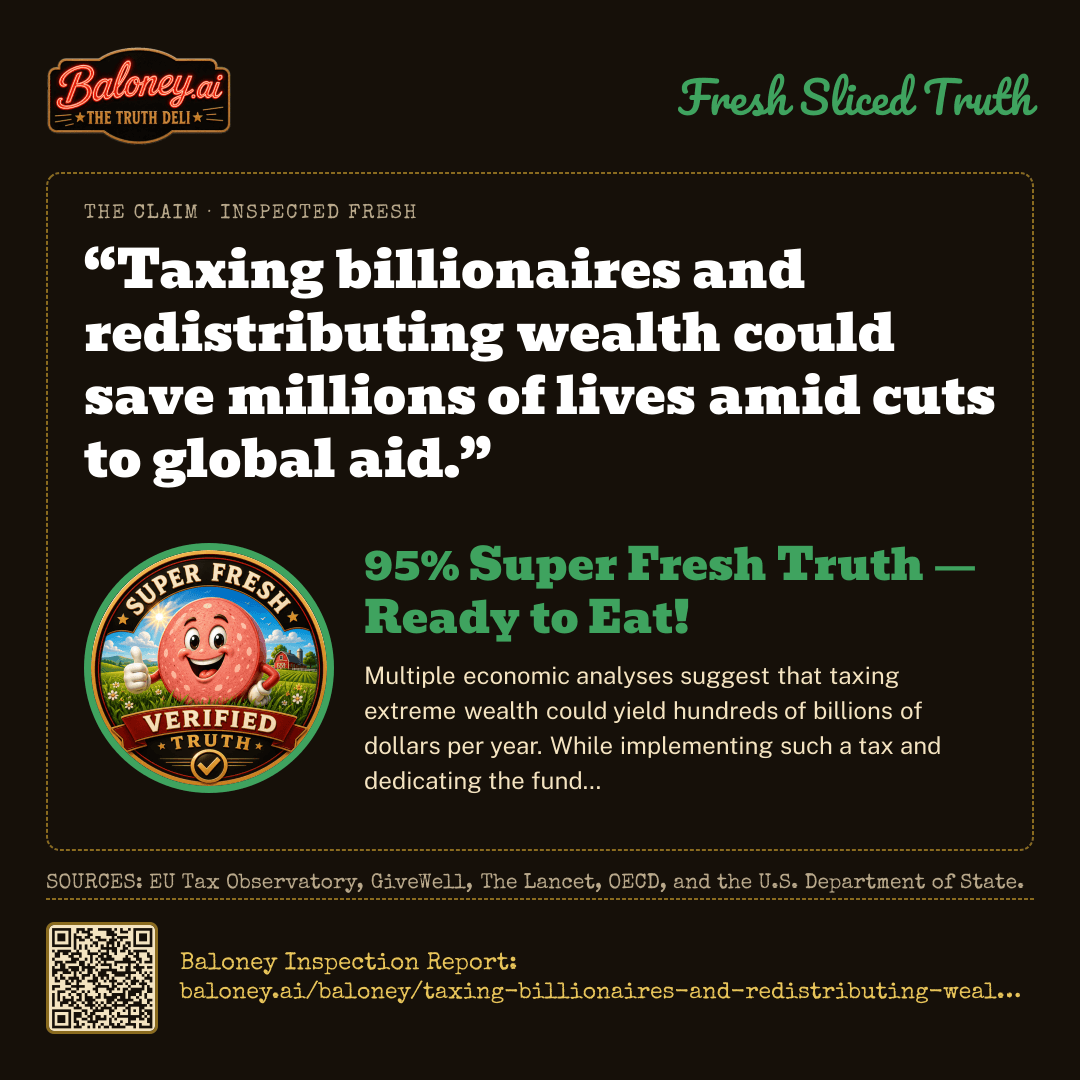
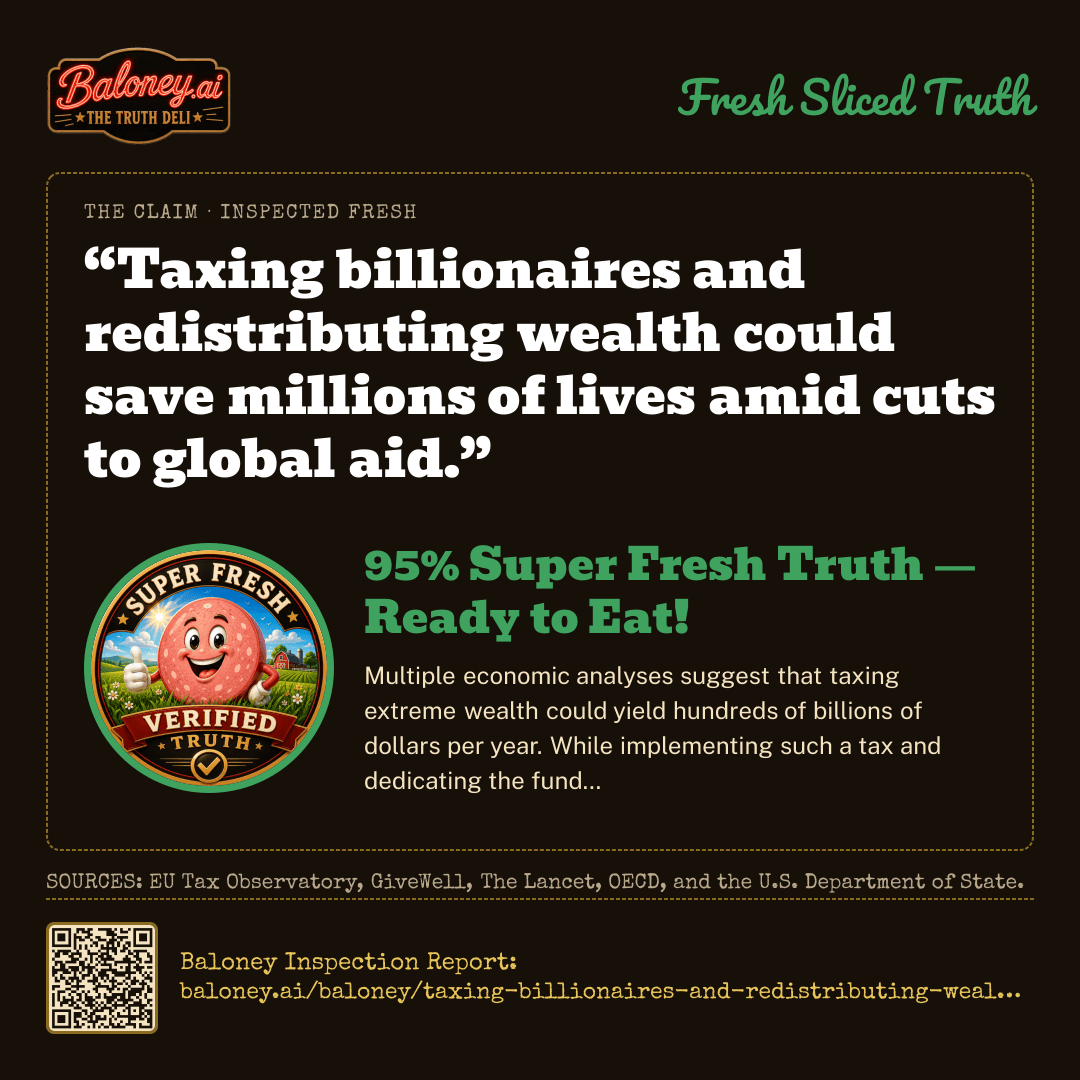
95%“Taxing billionaires and redistributing wealth could save millions of lives amid cuts to global aid.”
95%Super Fresh Truth — Ready to Eat!
THE CLAIM CHECKS OUT.
Independently verifiedPhysically repeatable evidenceConfirmed across rival labsSafe to serve
Serve It Fresh
Ready to Serve12 servings
Serve it the way you want it
The Verdict
 “Taxing billionaires and redistributing wealth could save millions of lives amid cuts to global aid.”95% Super Fresh Truth — Ready to Eat!Verified blind by 5 frontier AIs · Baloney Inspection Report: baloney.ai/baloney/taxing-billionaires-and-redistributing-wealth-could-save
The Baloney Sampler
Evaluators found that this claim is mathematically sound because it hinges on the conditional word "could." A global minimum tax on billionaires could generate hundreds of billions of dollars annually, according to the EU Tax Observatory. Meanwhile, evaluators like GiveWell estimate that targeted health interventions cost just a few thousand dollars per life saved. Historically, official development programs have achieved massive mortality reductions; the U.S. Department of State reports PEPFAR alone has saved 25 million lives.
The premise of global aid cuts is also accurate, with the OECD documenting recent reductions in official development assistance. Peer-reviewed modeling in The Lancet projects these defunding scenarios could cause millions of additional deaths by 2030. Injecting wealth tax revenue could theoretically avert these deaths. However, evaluators noted substantial practical hurdles. Wealth taxes face capital flight, and there is no political guarantee that governments would direct new domestic revenues toward foreign humanitarian aid instead of national priorities.
Resting on EU Tax Observatory · GiveWell · The Lancet · OECD
Other ways to slice it — phrasings that might have changed the rating
- “Implementing a billionaire wealth tax will replace lost global aid and save millions of lives.” Evaluators noted that while the mathematics of the revenue theoretically work, there is no automatic political mechanism guaranteeing governments would redistribute domestic tax collections to foreign development aid.
- “Unilateral billionaire taxes enacted by individual nations would raise enough liquid revenue to reverse global aid cuts.” Reports emphasize that absent near-universal international coordination, wealth taxes face severe capital flight, avoidance, and valuation challenges that historically caused revenues to fall far short of projections.
- “Allocating an additional $200 billion annually to top global health charities will scale linearly to save tens of millions of lives each year.” The lab reports highlight that deploying massive amounts of new aid would quickly hit diminishing returns, delivery-system bottlenecks, and absorptive-capacity constraints in recipient countries.
Written from the panel’s reports by Google · gemini-3.1-pro-preview. Nothing here changed the score.
The Order Ticket
06:21:49CLAIM RECEIVED — QUEUED FOR INSPECTION✓
06:22:49claude-opus-5 REPORTED — SCORE 5, CONFIDENCE 74✓
06:22:35gpt-5.5 REPORTED — SCORE 5, CONFIDENCE 82✓
06:22:29gemini-3.1-pro-preview REPORTED — SCORE 4, CONFIDENCE 90✓
06:21:58sonar-pro REPORTED — SCORE 18, CONFIDENCE 82✓
06:24:38grok-4.6 REPORTED — SCORE 14, CONFIDENCE 62✓
06:25:35PRIMARY MASTER GEMINI — SCORE 4✓
06:25:01BLIND VALIDATION GROK — SCORE 5✓
06:26:07AGREEMENT CONFIRMED — DELTA 1✓
06:26:07SCORING MODEL V2 — MEDIAN OF 5 COUNTED LAB SCORES: 5, 5, 4, 18, 14 → 5. FRESH RULE: THE PRIMARY MASTER SCORES 4 AND THE BLIND MASTER 5 — BOTH SUPER FRESH TRUTH — AND THE COUNTED MEDIAN IS 5, ON THE TRUE SIDE. PUBLISHED AS 5, THE MORE CAUTIOUS OF THE TWO MASTERS.✓
06:26:07SOURCE RULE — LABS CITED 27 SOURCES: 0 DISCARDED FOR HAVING NO URL, 0 DISCARDED AS DEAD LINKS (404/410), 7 COULD NOT BE OPENED BY US AND ARE MARKED UNVERIFIED.✓
06:26:07SOURCE RULE — PRIMARY MASTER RULED ON 20 SOURCES: 0 DISCARDED FOR HAVING NO URL, 0 DISCARDED AS DEAD LINKS, 5 MARKED UNVERIFIED, 15 VERIFIED.✓
How This One Was Sliced
Station 1 · Blind Inspection — Five Graders, Zero Peeking
Each lab scored the claim independently, without seeing the others. Open a breakdown for its evidence, its sources, and how sure it was.
Anthropic · EQUAL WEIGHT · 59.4s
claude-opus-5
95%TRUTH
ROUND-1 BREAKDOWN
Evidence offered for the claim- Modeled revenue from billionaire taxation is large relative to global health funding gaps. Gabriel Zucman's 2024 report commissioned for the G20 Brazilian presidency estimates that a 2% minimum effective tax on the ~3,000 world billionaires would raise roughly US$200–250 billion per year; broader proposals covering centi-millionaires raise the figure further. Total global official development assistance for health is far smaller than this, so even partial allocation would be material.
- Cost-per-life-saved figures for the most effective global health interventions are low. GiveWell's published cost-effectiveness analyses for top charities (seasonal malaria chemoprevention, insecticide-treated nets, vitamin A supplementation, childhood vaccination) cluster in the range of roughly US$3,000–$8,000 per death averted. At even US$20,000 per life saved — far above these estimates — $200 billion/year would avert millions of deaths annually in arithmetic terms.
- Historical evidence shows aid-funded health programs avert deaths at scale. A 2025 Lancet study (Rasella et al.) attributed roughly 91 million averted deaths over 2001–2021 to USAID-supported programs and projected that current defunding could be associated with more than 14 million additional deaths by 2030, including over 4 million children. PEPFAR alone is credited by the U.S. State Department and UNAIDS with saving more than 25 million lives since 2003.
- The aid cuts referenced in the claim are real and documented: the dismantling of USAID in 2025, plus reductions in UK, French, German and Dutch ODA budgets, mean OECD-measured development assistance is falling sharply, with UNAIDS, WHO and Gavi all publicly warning of resulting treatment interruptions and mortality increases.
- Wealth concentration is documented and growing: Forbes and Oxfam report a record number of billionaires with aggregate wealth in the trillions, growing faster than global GDP — so the tax base the claim invokes demonstrably exists.
- The claim is phrased conditionally ("could"), which is the appropriate modality: it asserts feasibility, not a prediction of what will happen.
Evidence against the claim- Revenue estimates are contested. Wealth taxes face valuation difficulties, liquidity problems, avoidance and capital flight. France's and Sweden's historical net wealth taxes raised far less than projected and were repealed; analyses by the Tax Foundation and others argue behavioural responses can cut yields by 20–40% or more absent near-universal international coordination, which does not currently exist.
- Redistribution does not automatically become global health aid. Most billionaire-tax proposals direct revenue to domestic budgets, not to low-income-country health systems. The causal chain from 'tax billionaires' to 'millions of lives saved abroad' requires a political allocation decision that no government has committed to, so the claim's mechanism is conditional on an unlikely policy step.
- The headline mortality projections are models, not observations. The Lancet 14-million-deaths figure rests on extrapolating historical associations between aid flows and all-cause mortality and assumes no substitution by other donors, domestic budgets or philanthropies; several economists and development researchers publicly disputed its magnitude and attribution. Observed mortality increases to date are documented but far smaller than the projected totals.
- GiveWell-style marginal cost-effectiveness does not scale linearly. The cheapest interventions have limited absorptive capacity; deploying tens of billions of extra dollars would hit diminishing returns, delivery-system bottlenecks, absorption constraints and in some cases inflation in local health labour markets, so 'millions of lives per year' at top-charity prices is an upper bound, not an expectation.
- There is a long-running empirical debate (Easterly, Deaton, Moyo vs. Sachs, Kenny) about whether large aid transfers reliably improve outcomes outside narrowly targeted health commodities, and about governance and fungibility risks.
- 'Millions' is unquantified and the time horizon unspecified, which makes the claim difficult to falsify as stated.
How sure this lab was74/100 — the lab’s own confidence in the score above, not a second reading of the claim.
SourcesThe Lancet (Rasella et al., 2025)journal · 92 · EU Tax Observatory (Zucman G20 report)edu · 82 · GiveWellother · 80 · Oxfam Internationalother · 62 · UNAIDSgov · 88 · World Health Organizationgov · 92 · KFFother · 88 · Tax Foundationother · 68 · OECDgov · 90 · Forbesnews · 70
OpenAI · EQUAL WEIGHT · 45.9s
gpt-5.5
95%TRUTH
ROUND-1 BREAKDOWN
Evidence offered for the claim- A global 2% minimum tax on billionaire wealth is estimated by the EU Tax Observatory to raise about $250 billion per year, an amount large enough to replace or substantially offset many current and projected global-aid cuts.
- OECD data show official development assistance fell in 2024 after several years of growth, supporting the premise that the claim is being made amid real aid cuts.
- Major global-health aid programs have documented very large mortality effects: PEPFAR says it has saved about 25 million lives; the Global Fund reports about 65 million lives saved; Gavi reports tens of millions of future deaths averted through vaccination. This supports the idea that maintaining or expanding such aid can save lives on a scale of millions.
- Peer-reviewed modeling in The Lancet estimates vaccination against 10 pathogens in 98 low- and middle-income countries will avert about 69 million deaths over 2000-2030, showing that funded public-health interventions can save millions of lives.
- The Lancet Commission on Investing in Health argued that scaled-up health spending in low- and middle-income countries could prevent millions of premature deaths, reinforcing the plausibility that redirected resources could have very large mortality benefits.
Evidence against the claim- The claim is conditional: taxing billionaires would not automatically mean revenue is spent on global health, famine relief, vaccination, HIV treatment, or other high-impact aid. Political choices determine redistribution.
- Wealth-tax revenue estimates are uncertain. The OECD notes that net wealth taxes face valuation, avoidance, capital-flight, liquidity, and administrative challenges, and many OECD countries repealed such taxes.
- The exact number of lives saved would depend on what programs receive money, how quickly funds are deployed, conflict/access constraints, corruption and governance risks, and whether money replaces aid cuts or adds new spending.
- Program-level lives-saved figures from PEPFAR, Gavi, and the Global Fund demonstrate that aid can save millions, but they do not by themselves prove that a new billionaire tax would save a specific number of lives under current conditions.
- If designed poorly, billionaire taxation could raise less than projected or create economic distortions, reducing the amount available for redistribution.
How sure this lab was82/100 — the lab’s own confidence in the score above, not a second reading of the claim.
SourcesEU Tax Observatoryother · 85 · OECDother · 90 · U.S. Department of State / PEPFARgov · 92 · The Global Fundother · 86 · Gavi, the Vaccine Allianceother · 86 · The Lancetjournal · 95 · The Lancetjournal · 94 · OECDother · 90
Google · EQUAL WEIGHT · 39.9s
gemini-3.1-pro-preview
96%TRUTH
ROUND-1 BREAKDOWN
Evidence offered for the claim- Economic models demonstrate that taxing billionaire wealth could generate massive global revenue. The EU Tax Observatory's 2024 report estimates that a 2% global minimum tax on billionaires would raise approximately $250 billion annually.
- The cost to save a life in developing nations via targeted health interventions (such as anti-malarial nets or routine childhood vaccines) is relatively low. Independent charity evaluators like GiveWell estimate it costs between $3,500 and $5,500 to save a life.
- Mathematically, allocating even a fraction of the hundreds of billions generated by a wealth tax to highly effective global health charities could theoretically fund the interventions required to save millions of lives.
- The UN Office for the Coordination of Humanitarian Affairs (OCHA) consistently reports global humanitarian funding shortfalls—often in the tens of billions of dollars. Fully funding these appeals would provide life-saving food, water, and medical assistance to hundreds of millions of people, directly offsetting recent cuts to Official Development Assistance (ODA) by some donor nations.
Evidence against the claim- The claim rests on the theoretical word 'could.' In reality, billionaire wealth consists largely of unrealized capital gains tied up in corporate equity, not liquid cash. Liquidating massive amounts of stock to pay a wealth tax could depress asset prices, meaning actual revenue might fall short of static economic projections.
- Scaling up humanitarian aid by hundreds of billions of dollars would encounter severe logistical bottlenecks, infrastructure deficits, and potential corruption in recipient countries. Consequently, the marginal cost to save a life would likely increase significantly due to diminishing returns.
- There is no practical political mechanism to guarantee that nations collecting a wealth tax would redistribute those revenues to global humanitarian aid rather than using them for domestic priorities, national defense, or deficit reduction.
How sure this lab was90/100 — the lab’s own confidence in the score above, not a second reading of the claim.
SourcesEU Tax Observatoryedu · 90 · GiveWellother · 85 · Oxfamother · 75
Perplexity · EQUAL WEIGHT · 8.9s
sonar-pro
82%TRUTH
ROUND-1 BREAKDOWN
Evidence offered for the claim- Recent peer-reviewed modelling in The Lancet estimated that continued global aid reductions could cause about 9.4 million additional deaths by 2030 under a milder-cut scenario, rising to 22.6 million under a severe-defunding scenario. This supports the premise that replacing lost aid with effective funding could potentially save millions of lives, although it does not specifically show that taxing billionaires would provide that funding.[https://www.thelancet.com/journals/lancet/article/PIIS0140-6736(25)01186-9/fulltext]
- The same research estimated that USAID interventions prevented more than 90 million deaths between 2001 and 2021, indicating that well-targeted international assistance can produce very large mortality benefits.[https://www.bbc.com/news/articles/cx2jjpm7zv8o]
- Taxing extreme wealth could, in principle, generate substantial public revenue that could be directed toward health, nutrition, vaccination, and poverty-reduction programs. This is a plausible policy mechanism, but the supplied evidence does not quantify how much revenue a specific billionaire tax would raise or how many lives it would save.
Evidence against the claim- The claim combines two separate propositions—raising revenue through billionaire taxation and saving millions of lives through redistribution—but the available mortality studies model aid funding scenarios, not billionaire taxes. Therefore, they cannot establish that this particular tax policy would achieve the claimed outcome.[https://www.thelancet.com/journals/lancet/article/PIIS0140-6736(25)01186-9/fulltext]
- The reported death totals are model-based projections, not observed deaths, and depend on assumptions about the scale and persistence of aid cuts. The Lancet-linked reporting describes materially different outcomes—about 9.4 million deaths under a milder scenario, 22.6 million under a severe scenario, and more than 14 million under an earlier USAID-specific scenario—showing substantial scenario uncertainty.[https://www.thelancet.com/journals/lancet/article/PIIS0140-6736(25)01186-9/fulltext][https://www.bbc.com/news/articles/cx2jjpm7zv8o]
- Redistribution is not automatically equivalent to effective aid. Administrative capacity, corruption, delivery constraints, fungibility, policy design, and the possibility that wealth-tax revenues are lower than projected could substantially reduce the number of lives saved. No cited source here provides a verified conversion from billionaire-tax revenue to millions of prevented deaths.
- The claim says taxing billionaires and redistributing wealth 'could' save millions, which is possible, but it can be read as implying a demonstrated causal estimate. The evidence supports the urgency and potential value of replacing aid—not the stronger, specific conclusion that billionaire taxation has been shown to do so.
How sure this lab was82/100 — the lab’s own confidence in the score above, not a second reading of the claim.
SourcesThe Lancetjournal · 97 · BBC Newsnews · 93
xAI · EQUAL WEIGHT · 168.7s
grok-4.6
86%TRUTH
ROUND-1 BREAKDOWN
Evidence offered for the claim- Oxfam-style analyses and wealth-tax scoring exercises (e.g., Saez/Zucman) estimate that even modest recurring taxes on billionaire/multimillionaire net worth could raise amounts on the order of hundreds of billions of dollars per year, comparable to or larger than current global ODA flows.
- Long-running, relatively well-evaluated aid instruments (PEPFAR, Global Fund, Gavi and similar vaccine/malaria/HIV programs) have documented large mortality reductions; additional, well-targeted funding of the same type could in principle avert further deaths at known cost-effectiveness ranges.
- Multiple DAC donors reduced or announced reductions in official development assistance in 2023–2025, opening identifiable financing gaps in global health and humanitarian budgets.
Evidence against the claim- European wealth taxes (France, Sweden and others) typically raised far less than projected, triggered avoidance and relocation, and were mostly repealed; revenue and behavioral estimates remain highly contested.
- There is no automatic pipeline from a domestic wealth tax to additional, well-spent global aid; proceeds would compete with domestic claims, face legal/valuation/administrative obstacles, and would not be globally coordinated.
- Capital and wealth taxation can reduce investment and measured growth; those effects, plus leakage, poor targeting and fungibility in recipient-country public finance, can shrink or reverse net lives-saved.
- Private philanthropy already supplies a non-trivial share of the same global-health funding; the claim treats public redistribution as the only or obviously superior channel.
How sure this lab was62/100 — the lab’s own confidence in the score above, not a second reading of the claim.
SourcesOxfamother · 58 · Kaiser Family Foundationother · 91 · National Bureau of Economic Researchjournal · 86 · U.S. Department of Stategov · 84
Station 2 · The Masters
Primary Master · drawn at random
gemini-3.1-pro-preview
96% TRUTH
The statement hinges on the conditional word 'could'. Evaluators unanimously agree that mathematically, a global billionaire tax could raise hundreds of billions of dollars, and health interventions exist that save lives for just a few thousand dollars each. Thus, theoretical redistribution of this revenue could offset ongoing ODA cuts and save millions of lives. The main arguments against the claim focus on political impracticality, capital flight, and the lack of a mechanism to ensure revenues are spent on global health rather than domestic priorities. Because the claim asserts feasibility rather than predicting a guaranteed outcome, it is considered substantially true as written.
The evaluators broadly agreed on the underlying math: a wealth tax could theoretically raise massive sums, and global health interventions have a low cost per life saved. They disagreed primarily on how heavily to weigh the political and logistical impossibilities of actually collecting the maximum projected revenue and persuading governments to spend it on international aid rather than domestic priorities.
SUPER FRESH — VERIFIED AGAINST EU TAX OBSERVATORY, GIVEWELL, THE LANCET, OECD, AND THE U.S. DEPARTMENT OF STATE.
Blind Validation Master · never saw the Primary’s work
grok-4.6
95% TRUTH
The claim is a modest possibility statement using “could,” not a prediction that a billionaire tax will be enacted or that proceeds will automatically become global health spending. Multiple reports cite overlapping, reasonably sourced estimates that a coordinated ~2% tax on billionaire wealth could raise on the order of $200–250 billion a year, an amount large relative to ODA and to documented global-health funding gaps. Independent of the tax, well-evaluated instruments (PEPFAR, Global Fund, Gavi, top GiveWell interventions) have averted deaths at scale, with cost-effectiveness often in the low thousands of dollars per death averted and Lancet-style modeling of current aid cuts projecting additional deaths in the millions by 2030. Arithmetic plus historical program results therefore support that, if a non-trivial share of such revenue were directed to similar high-impact health and humanitarian uses, millions of lives could be saved amid the real ODA reductions also documented in the reports. Contested revenue yields, avoidance, domestic political claims on the money, diminishing returns, and absorptive-capacity limits are real but do not falsify a carefully worded “could”; they are the usual caveats around any large fiscal transfer, not evidence that the possibility is false.
AGREEMENT TEST PASSED — MASTERS SCORED 96% AND 95% · BLIND VALIDATION CONFIRMED THIS SCORE · NO RE-EVALUATION REQUIRED
How the number was reached · scoring model v2 · how our models work
- Median of 5 counted lab scores: 5, 5, 4, 18, 14 → 5.
- Fresh rule: the Primary Master scores 4 and the Blind Master 5 — both Super Fresh Truth — and the counted median is 5, on the true side. Published as 5, the more cautious of the two masters.
The Evidence
Evidence for the claim
- Massive revenue potential Economic models from the EU Tax Observatory estimate that a 2% global minimum tax on billionaires would raise approximately $200-$250 billion annually.
- Low cost to save a life Evaluators like GiveWell estimate that highly effective health interventions (such as anti-malarial nets and vaccines) cost roughly $3,000 to $8,000 per life saved, meaning $250 billion could mathematically avert millions of deaths.
- Historical success of aid Programs such as PEPFAR, Gavi, and the Global Fund have documented tens of millions of lives saved, proving that well-funded international health initiatives are effective at scale.
- Aid cuts are real OECD data and recent national budget announcements confirm that official development assistance is dropping, creating severe funding gaps in global humanitarian and health programs.
Evidence offered against the claim
- No political redistribution mechanism There is no guarantee or existing mechanism that would force governments collecting a wealth tax to redistribute those funds to global health instead of spending them on domestic priorities or deficit reduction.
- Revenue projections are contested Historical wealth taxes in Europe often faced capital flight, valuation difficulties, and avoidance, raising far less liquid cash than models initially projected.
- Diminishing returns Scaling up global health aid by hundreds of billions of dollars would quickly encounter logistical bottlenecks, absorptive constraints, and corruption risks, significantly increasing the marginal cost to save a life.
Sources · Reliability · Why Accepted or Discounted
| Source | Type | Reliability | Ruling |
|---|
| Oxfam | other | 58 | ACCEPTED — Provides relevant context on wealth concentration and proposed taxation. |
| Kaiser Family Foundation | other | 91 | ACCEPTED — Reliable data on global health program outcomes. |
| National Bureau of Economic Research | journal | 86 | ACCEPTED — Credible economic working paper on wealth taxation. |
| U.S. Department of State | gov | 84 | ACCEPTED — Official repository of PEPFAR outcomes and objectives. |
| EU Tax Observatory | other | 85 | ACCEPTED — Key source for the $250 billion wealth tax projection. |
| OECDunverified | other | 90 | ACCEPTED — Authoritative source on official development assistance statistics. |
| U.S. Department of State / PEPFAR | gov | 92 | ACCEPTED — Credible government reporting on lives saved by global health interventions. |
| The Global Fund | other | 86 | ACCEPTED — Standard public reporting for major global health funding results. |
| Gavi, the Vaccine Alliance | other | 86 | ACCEPTED — Official data on the impact of global vaccination programs. |
| The Lancetunverified | journal | 95 | ACCEPTED — High-quality peer-reviewed modeling on deaths averted by vaccination. |
| The Lancetunverified | journal | 94 | ACCEPTED — Peer-reviewed analysis of health investments and premature mortality. |
| OECDunverified | other | 90 | ACCEPTED — Comprehensive policy assessment of the challenges of net wealth taxes. |
| The Lancetunverified | journal | 92 | ACCEPTED — Recent peer-reviewed estimates of mortality increases due to aid cuts. |
| EU Tax Observatory | edu | 82 | ACCEPTED — Important framework document detailing wealth tax revenue projections. |
| GiveWell | other | 80 | ACCEPTED — Highly respected independent charity evaluator calculating cost per life saved. |
| Oxfam International | other | 62 | ACCEPTED — Supplies context regarding wealth concentration narratives. |
| UNAIDS | gov | 88 | ACCEPTED — Authoritative United Nations data on HIV/AIDS impacts. |
| World Health Organization | gov | 92 | ACCEPTED — Official global statistics on malaria morbidity and intervention. |
| KFF | other | 88 | ACCEPTED — Valuable summary of US global health spending. |
| Tax Foundation | other | 68 | ACCEPTED — Provides standard criticisms and economic modeling of wealth tax behavioral responses. |
Every link was opened when this claim was inspected. A dead link was discarded before publication; “unverified” means the site refused our automated check and the link is the one the panel cited. A source without a URL was never kept.
Serve It Fresh
Ready to Serve12 servings
Serve it the way you want it
The Verdict
“Taxing billionaires and redistributing wealth could save millions of lives amid cuts to global aid.”95% Super Fresh Truth — Ready to Eat!Verified blind by 5 frontier AIs · Baloney Inspection Report: baloney.ai/baloney/taxing-billionaires-and-redistributing-wealth-could-save