Baloney Inspection Report: Claim #1181 · Inspected Oct 31, 2026, 8:33 AM PDT · Scoring model v2
 82%
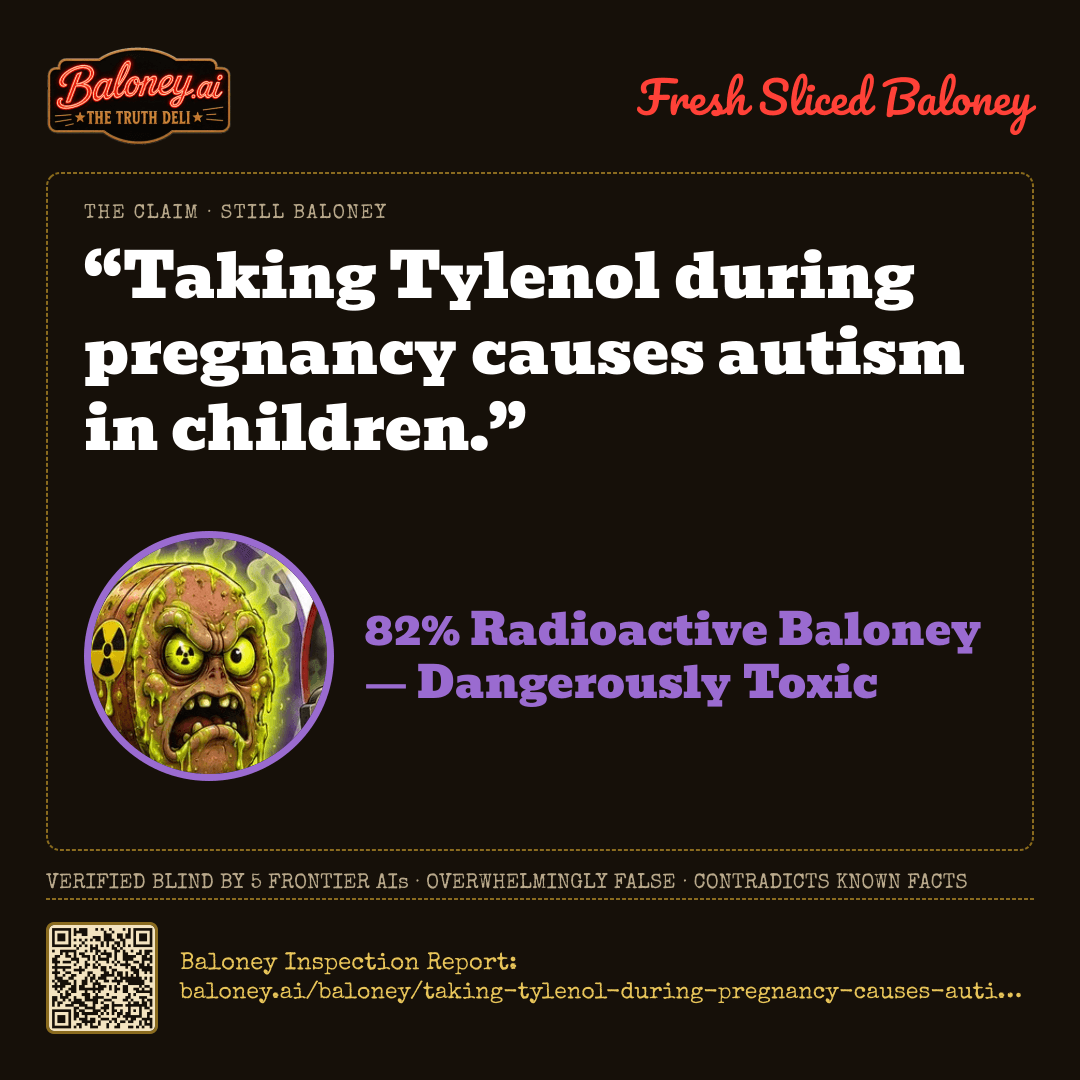
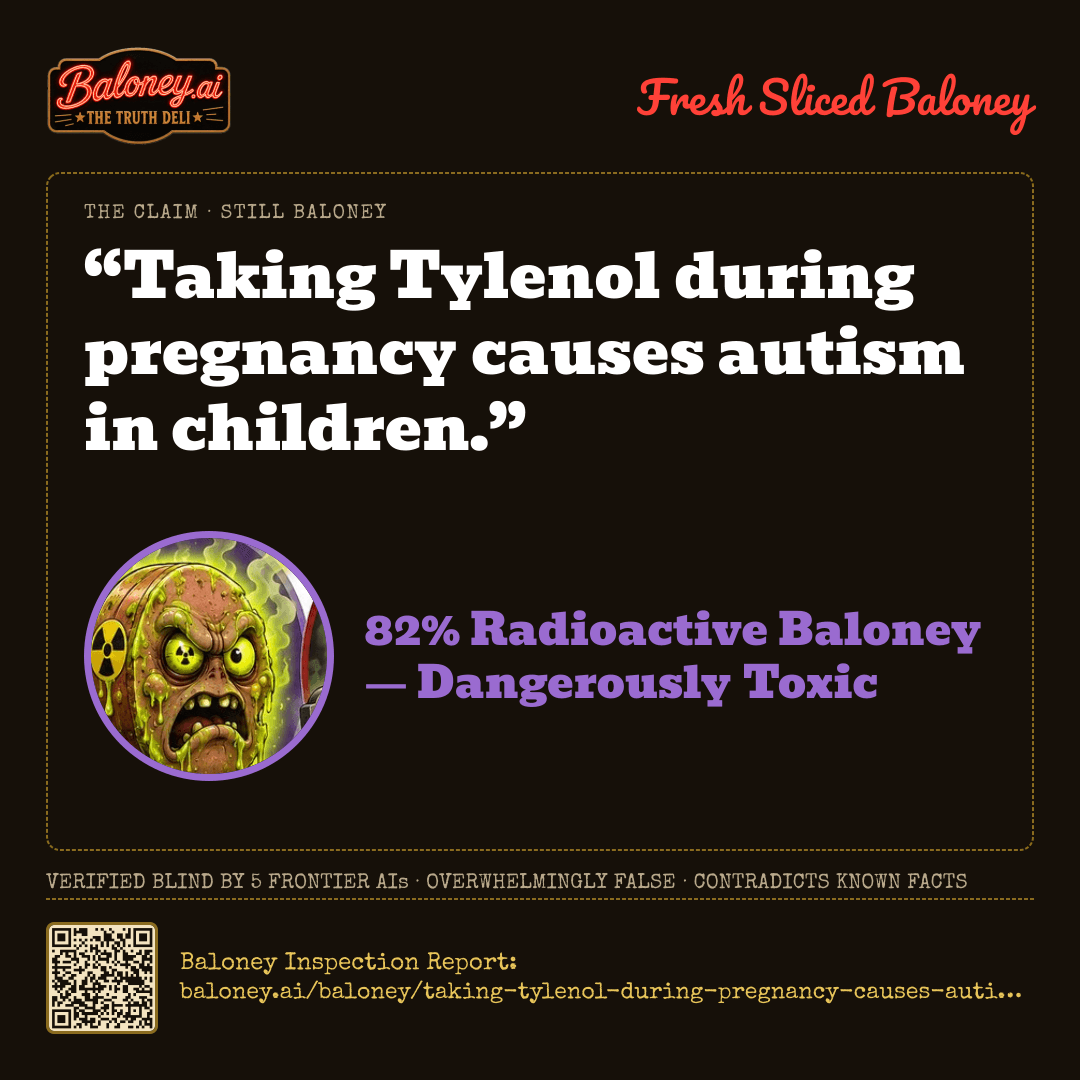
“Taking Tylenol during pregnancy causes autism in children.”
82%Radioactive Baloney — Dangerously Toxic
Dangerously misleading.
Overwhelmingly falseContradicts known factsPromotes false beliefsPotential for harm
Serve It Fresh
Ready to Serve12 servings
Serve it the way you want it
The Verdict
 “Taking Tylenol during pregnancy causes autism in children.”82% Radioactive Baloney — Dangerously ToxicVerified blind by 5 frontier AIs · Baloney Inspection Report: baloney.ai/baloney/taking-tylenol-during-pregnancy-causes-autism-in-children
The Baloney Sampler
Observational studies have reported modest associations between acetaminophen use in pregnancy and later autism or ADHD diagnoses, and a 2021 Nature Reviews Endocrinology consensus statement urged precautionary use on that basis. But the strongest test of causation undercuts it: the 2024 JAMA nationwide Swedish study of about 2.48 million children found the association disappeared when exposed and unexposed siblings of the same mother were compared, with a hazard ratio near 0.98 — the signature of family confounding.
Regulators and clinicians agree. The World Health Organization says no conclusive link is established; the US Food and Drug Administration states causality has not been established; ACOG and the Society for Maternal-Fetal Medicine still recommend acetaminophen as the preferred option in pregnancy. Reuters reported a US federal judge dismissed the mass Tylenol-autism litigation in December 2023 for failing the Daubert standard. The claim also carries harm: untreated maternal fever brings its own risks and NSAIDs are contraindicated for much of pregnancy.
Resting on JAMA (Ahlqvist et al., 2024 Swedish nationwide cohort) · World Health Organization · US Food and Drug Administration · Reuters
Original Claim Source https://www.whitehouse.gov/releases/2025/09/fact-evidence-suggests-link-between-acetaminophen-autism/
Other ways to slice it — phrasings that might have changed the rating
- “Some observational studies have reported a statistical association between prenatal acetaminophen use and later autism diagnoses.” All five reports agree that modest associations have genuinely been published in cohort studies and meta-analyses — it is the leap to causation that the evidence fails.
- “A group of scientists has recommended that pregnant women use acetaminophen at the lowest effective dose for the shortest time as a precaution.” The 2021 Nature Reviews Endocrinology consensus statement, signed by 91 clinicians and scientists, made exactly this precautionary recommendation without claiming causation.
- “Prenatal acetaminophen exposure does not increase a child's risk of autism once genetic and family factors are accounted for.” This is what the 2024 JAMA sibling-control study, a sibling-comparison systematic review, and an umbrella review of more than 3 million mother-child pairs actually found.
Written from the panel’s reports by Anthropic · claude-opus-5. Nothing here changed the score.
The Order Ticket
15:33:39CLAIM RECEIVED — QUEUED FOR INSPECTION✓
15:34:56claude-opus-5 REPORTED — SCORE 82, CONFIDENCE 88✓
15:34:14gpt-5.5 REPORTED — SCORE 78, CONFIDENCE 90✓
15:34:08gemini-3.1-pro-preview REPORTED — SCORE 85, CONFIDENCE 98✓
15:33:45sonar-pro REPORTED — SCORE 82, CONFIDENCE 93✓
15:35:03grok-4.6 REPORTED — SCORE 68, CONFIDENCE 85✓
15:36:30PRIMARY MASTER CLAUDE — SCORE 80✓
15:35:11BLIND VALIDATION GEMINI — SCORE 85✓
15:36:48AGREEMENT CONFIRMED — DELTA 3✓
15:36:48SCORING MODEL V2 — MEDIAN OF 5 COUNTED LAB SCORES: 82, 78, 85, 82, 68 → 82.✓
15:36:48SOURCE RULE — LABS CITED 26 SOURCES: 0 DISCARDED FOR HAVING NO URL, 5 DISCARDED AS DEAD LINKS (404/410), 10 COULD NOT BE OPENED BY US AND ARE MARKED UNVERIFIED.✓
15:36:48SOURCE RULE — PRIMARY MASTER RULED ON 18 SOURCES: 0 DISCARDED FOR HAVING NO URL, 0 DISCARDED AS DEAD LINKS, 9 MARKED UNVERIFIED, 9 VERIFIED.✓
How This One Was Sliced
Station 1 · Blind Inspection — Five Graders, Zero Peeking
Each lab scored the claim independently, without seeing the others. Open a breakdown for its evidence, its sources, and how sure it was.
Anthropic · EQUAL WEIGHT · 76.7s
claude-opus-5
82%BALONEY
ROUND-1 BREAKDOWN
Evidence offered for the claim- Numerous observational cohort studies have reported modest statistical associations between prenatal acetaminophen (paracetamol/Tylenol) exposure and later diagnoses of autism spectrum disorder or ADHD. Examples include analyses of the Danish National Birth Cohort and the Norwegian MoBa cohort, with pooled meta-analyses typically reporting risk ratios in the ~1.2–1.3 range for ADHD and somewhat weaker for ASD.
- A 2020 JAMA Psychiatry study (Ji et al., Boston Birth Cohort) measured acetaminophen and its metabolites directly in umbilical cord plasma — an objective biomarker rather than maternal recall — and found higher biomarker levels associated with increased odds of later ADHD and ASD diagnoses, with an apparent dose-response gradient.
- In 2021, a consensus statement in Nature Reviews Endocrinology signed by 91 clinicians and scientists argued the cumulative evidence warranted 'precautionary action' — use at the lowest effective dose for the shortest time — citing experimental and mechanistic data on acetaminophen as a possible endocrine disruptor and source of oxidative stress in the developing brain.
- Animal and in-vitro work provides some biological plausibility: acetaminophen crosses the placenta, depletes glutathione, and has been shown in rodent models to affect neurodevelopmental and behavioral endpoints.
- In September 2025, HHS/FDA publicly announced a label-change initiative for acetaminophen referencing studies of prenatal exposure and neurodevelopmental outcomes, which gave the association official-sounding endorsement in the U.S. (though the FDA's own notice stated a causal relationship had not been established).
Evidence against the claim- The single largest and methodologically strongest study — Ahlqvist et al., JAMA 2024, covering 2.48 million Swedish children — found the crude association vanished in sibling-control analysis. Comparing exposed and unexposed siblings from the same mother (which holds genetics and family environment constant), the hazard ratio for autism was ~0.98, i.e., no association. This pattern is the classic signature of confounding, not causation.
- Earlier sibling-control and negative-control analyses (including Norwegian MoBa and Japanese cohort work) show the same attenuation toward null, indicating the raw associations largely reflect shared familial factors.
- Confounding by indication is severe and hard to remove: the reasons women take acetaminophen — fever, infection, inflammation, chronic pain, migraine — are themselves independently linked to adverse neurodevelopmental outcomes. Maternal pain/fever/infection, not the drug, may carry the risk.
- Autism is strongly heritable (twin and family studies put heritability around 60–90%). Mothers with neurodevelopmental or chronic-pain conditions both use more analgesics and are more likely to have autistic children — a genetic pathway that non-sibling designs cannot separate out.
- No randomized controlled trial supports causation, and no study has demonstrated the Bradford Hill criteria (consistency, specificity, temporality with dose, biological gradient that survives confounding control) for an acetaminophen–autism causal link.
- Major professional bodies — ACOG, the Society for Maternal-Fetal Medicine, and counterpart bodies in the UK (MHRA/NHS) and EU (EMA, which completed a review finding no change warranted) — state that acetaminophen remains the safest available analgesic/antipyretic in pregnancy and that the evidence does not establish causation.
- Untreated maternal fever is itself associated with neural tube defects, miscarriage and adverse neurodevelopmental outcomes, and the main alternatives (NSAIDs) are contraindicated in much of pregnancy. A blanket causal claim carries real potential for harm.
- The documented rise in autism prevalence is substantially explained by broadened diagnostic criteria (DSM changes), screening expansion, and increased service-linked identification, per CDC ADDM surveillance — it does not track acetaminophen sales in a way that implies causation.
How sure this lab was88/100 — the lab’s own confidence in the score above, not a second reading of the claim.
SourcesJAMA (Ahlqvist et al., 2024 — Swedish 2.48M sibling-control cohort)journal · 96 · PubMed / National Library of Medicine (record for Ahlqvist et al., JAMA 2024)gov · 95 · JAMA Psychiatry (Ji et al., 2020 — cord-plasma biomarker study; evidence FOR)journal · 88 · Nature Reviews Endocrinology (2021 consensus statement calling for precautionary action)journal · 85 · NHS (UK) — paracetamol in pregnancy guidancegov · 88 · U.S. Centers for Disease Control and Prevention — autism prevalence/ADDM datagov · 93
OpenAI · EQUAL WEIGHT · 34.7s
gpt-5.5
78%BALONEY
ROUND-1 BREAKDOWN
Evidence offered for the claim- Tylenol is acetaminophen, also called paracetamol. Some observational studies have reported associations between prenatal acetaminophen exposure and later autism-related outcomes, especially with higher or longer exposure. For example, a 2019 JAMA Psychiatry study using cord-blood biomarkers in the Boston Birth Cohort found higher measured acetaminophen exposure was associated with higher odds of later ASD and ADHD diagnoses.
- A 2016 International Journal of Epidemiology cohort study reported that prenatal acetaminophen use was associated with more autism-spectrum symptoms in boys and more attention-related symptoms overall.
- A 2021 Nature Reviews Endocrinology consensus statement argued that epidemiologic and experimental evidence was sufficient to recommend precautionary use during pregnancy, though it did not prove acetaminophen causes autism.
Evidence against the claim- The claim says acetaminophen causes autism. The strongest available human evidence does not establish causation. Many earlier positive studies were observational and vulnerable to confounding by the reasons acetaminophen was taken, such as fever, infection, pain, migraine, inflammation, genetics, parental neurodevelopmental traits, and other shared family factors.
- A very large 2024 JAMA Swedish nationwide sibling-control study of about 2.48 million children found that conventional models showed small associations, but these disappeared in sibling comparisons: sibling-control analyses did not support a causal link between prenatal acetaminophen use and autism, ADHD, or intellectual disability.
- The FDA has reviewed studies on pain-medicine use in pregnancy and stated that available evidence on acetaminophen and neurodevelopmental outcomes was inconclusive, not proof of causation.
- ACOG states that no clear evidence proves a direct relationship between prudent acetaminophen use during pregnancy and fetal developmental problems, and it continues to regard acetaminophen as an important option when medically needed.
- Overall, the accurate statement would be that some studies found correlations and researchers have investigated a possible risk; the stronger statement that taking Tylenol during pregnancy causes autism is not supported by the best evidence.
How sure this lab was90/100 — the lab’s own confidence in the score above, not a second reading of the claim.
SourcesJAMAjournal · 97 · JAMA Psychiatryjournal · 94 · International Journal of Epidemiologyjournal · 91 · Nature Reviews Endocrinologyjournal · 93
Google · EQUAL WEIGHT · 29.0s
gemini-3.1-pro-preview
85%BALONEY
ROUND-1 BREAKDOWN
Evidence offered for the claim- Some observational cohort studies over the last decade have identified a statistical correlation between prenatal exposure to acetaminophen (the active ingredient in Tylenol) and a moderately increased rate of neurodevelopmental conditions like autism spectrum disorder (ASD) and ADHD in children.
- In 2021, a consensus statement by a group of international scientists and medical professionals published in Nature Reviews Endocrinology highlighted these observational associations. The authors called for precautionary action, recommending that pregnant women minimize acetaminophen use unless medically indicated.
Evidence against the claim- Major medical organizations, including the American College of Obstetricians and Gynecologists (ACOG) and the Society for Maternal-Fetal Medicine (SMFM), have consistently rejected the claim that Tylenol causes autism. They emphasize that observational studies cannot prove causation due to significant confounding factors, such as maternal genetics, family environment, and the underlying indications for taking the medication (e.g., untreated high maternal fever, which is a known risk factor for fetal neurodevelopmental issues).
- A rigorous, definitive 2024 nationwide cohort study published in JAMA utilized sibling-control analyses to account for unmeasured genetic and environmental variables. When comparing siblings with different prenatal exposures to acetaminophen, researchers found no evidence of an increased risk of autism, ADHD, or intellectual disability, concluding that earlier reported correlations were the result of familial confounding.
- In December 2023, a U.S. federal judge dismissed a massive multidistrict litigation (MDL) involving thousands of lawsuits alleging that Tylenol caused autism. The judge ruled that the plaintiffs' expert witnesses failed to meet the Daubert standard for admissibility, stating there was no scientifically sound evidence or reliable methodology to prove a causal link.
How sure this lab was98/100 — the lab’s own confidence in the score above, not a second reading of the claim.
SourcesJAMAjournal · 95 · Reutersnews · 95 · Nature Reviews Endocrinologyjournal · 90
Perplexity · EQUAL WEIGHT · 5.2s
sonar-pro
82%BALONEY
ROUND-1 BREAKDOWN
Evidence offered for the claim- Several observational studies and reviews have reported a statistical association between prenatal acetaminophen exposure and autism diagnoses, particularly with prolonged or repeated use. A 2026 meta-analysis of eight observational studies involving about 2.56 million participants reported an 18% higher odds of autism diagnosis, though this evidence is observational and cannot establish causation.[2]
- The U.S. Food and Drug Administration states that an association has been reported in multiple studies and that some studies suggest the association may be strongest with chronic use throughout pregnancy; however, it explicitly says causality has not been established and that contrary studies exist.[3][5]
Evidence against the claim- The claim says acetaminophen causes autism, but available evidence does not establish a causal relationship. The FDA describes the issue as an association under scientific debate and notes contrary findings.[3][5]
- The World Health Organization says there is currently no conclusive scientific evidence confirming a link and that no consistent association has been established.[1]
- A systematic review focused on sibling-comparison and other lower-bias studies found no association between prenatal acetaminophen exposure and autism, ADHD, or intellectual disability; it concluded that high-quality evidence does not support an association.[6]
- An umbrella review covering more than 3 million mother-child pairs found that small associations weakened or disappeared in the highest-quality, lowest-bias analyses, with confounding by pain, fever, infection, and measurement limitations likely explaining at least part of the apparent association.[4]
- Even if some observational studies show increased risk, they cannot by themselves distinguish an effect of acetaminophen from the illnesses or other factors for which it was taken. The evidence therefore does not support the categorical statement that taking Tylenol during pregnancy causes autism.[1][3][4]
How sure this lab was93/100 — the lab’s own confidence in the score above, not a second reading of the claim.
SourcesWorld Health Organizationgov · 98 · National Library of Medicine / peer-reviewed systematic review and meta-analysisjournal · 75 · U.S. Food and Drug Administrationgov · 97 · Developmental Medicine & Child Neurology / umbrella reviewjournal · 88 · U.S. Food and Drug Administrationgov · 97 · Anesthesia Patient Safety Foundationother · 78
xAI · EQUAL WEIGHT · 84.1s
grok-4.6
68%BALONEY
ROUND-1 BREAKDOWN
Evidence offered for the claim- Several observational cohort studies (Norway, Denmark, U.S. and others) have reported statistical associations between reported acetaminophen use in pregnancy and higher rates of autism or ADHD diagnoses.
- A 2021 consensus statement by 91 scientists in Nature Reviews Endocrinology urged precautionary limits on acetaminophen in pregnancy, citing possible fetal neurodevelopmental effects.
- Limited animal and mechanistic studies have suggested acetaminophen can influence brain development pathways.
Evidence against the claim- A 2024 nationwide Swedish sibling-comparison study of 2.48 million children (JAMA) found no increased risk of autism, ADHD or intellectual disability after controlling for familial confounding, indicating earlier associations were likely spurious.
- The U.S. FDA reviewed the literature in 2015, found the data inconclusive, and has not advised against acetaminophen use in pregnancy.
- ACOG, SMFM and other obstetric authorities continue to recommend acetaminophen as the preferred analgesic/antipyretic because untreated fever and pain themselves raise risks, and no causal human mechanism has been demonstrated.
- Autism is predominantly genetic; indication confounding (infection, inflammation, pain) and recall bias readily explain non-sibling observational links.
How sure this lab was85/100 — the lab’s own confidence in the score above, not a second reading of the claim.
SourcesJAMAjournal · 95 · Nature Reviews Endocrinologyjournal · 85
Station 2 · The Masters
Primary Master · drawn at random
claude-opus-5
80% BALONEY
The statement is a flat causal assertion, and causation is precisely what the evidence fails to support. All five evaluators converged on the same structure of evidence: a set of observational cohort studies and meta-analyses report modest associations (odds/risk ratios roughly 1.2–1.3 for ADHD, weaker for autism), and a 2021 Nature Reviews Endocrinology consensus statement urged precaution on that basis — but the designs capable of separating drug effect from family confounding show the association collapse. The decisive piece is the 2024 JAMA nationwide Swedish study of ~2.48 million children, where sibling-control analysis returned a hazard ratio of about 0.98 for autism: exposed and unexposed siblings of the same mother had the same autism rate. That is the classic signature of confounding rather than causation, and it is corroborated by a systematic review restricted to sibling-comparison designs and an umbrella review of more than 3 million mother–child pairs, both finding associations weakening or vanishing in the lowest-bias analyses. Confounding by indication (fever, infection, migraine, chronic pain) and autism's high heritability (60–90%) supply ready explanations for the raw correlations. Regulators and professional bodies line up the same way: the FDA states causality has not been established, the WHO says no conclusive link exists, and ACOG and SMFM continue to recommend acetaminophen as the preferred analgesic/antipyretic in pregnancy. A US federal judge dismissed the mass Tylenol–autism litigation in December 2023 for failure to meet the Daubert admissibility standard. I placed the score at 80 rather than higher because the claim is not fabricated from nothing — a real, published association exists and a credentialled group of scientists called for precaution — and not lower because the statement as written asserts causation categorically, which the best evidence contradicts, and because the claim carries concrete potential for harm: untreated maternal fever is itself linked to adverse outcomes and the main alternatives (NSAIDs) are contraindicated for much of pregnancy. That combination of 'contradicted by the strongest evidence' plus 'plausible real-world harm' sits in the Radioactive band.
All five evaluators reached the same substantive verdict — the association is real in weaker designs but the causal claim is not supported — and all five cited the 2024 JAMA Swedish sibling-control study as decisive and the 2021 Nature Reviews Endocrinology consensus statement as the strongest material on the other side. Scores clustered tightly (68, 78, 82, 82, 85), the spread reflecting only how much credit each gave the surviving observational signal and the 2025 FDA/HHS label activity. Report 1 was the most lenient, weighting the existence of a published scientific consensus statement and mechanistic data more heavily; Report 3 was the harshest, adding the December 2023 federal dismissal of the Tylenol MDL under Daubert. Reports 2 and 5 added evidence the others omitted — the 2020 JAMA Psychiatry cord-plasma biomarker study and the 2026 pooled meta-analysis on the 'for' side, the WHO statement and an umbrella review on the 'against' side. No evaluator endorsed the causal claim.
Blind Validation Master · never saw the Primary’s work
gemini-3.1-pro-preview
85% BALONEY
The claim definitively asserts that taking Tylenol (acetaminophen) during pregnancy causes autism. While some earlier observational studies noted a statistical correlation, these findings did not establish causation. A massive 2024 nationwide sibling-control study of nearly 2.5 million children published in JAMA demonstrated that the previously observed associations vanish when controlling for genetic and familial confounding factors. The correlations were likely driven by the underlying reasons mothers took the medication, such as untreated fever or infection, which themselves carry neurodevelopmental risks, as well as genetic predispositions. Major medical and public health organizations, including the FDA, ACOG, and SMFM, maintain that no causal link exists and that acetaminophen remains the safest recommended analgesic and antipyretic during pregnancy. Because untreated maternal fever poses real risks to fetal development, spreading this false causal claim has significant potential for harm.
AGREEMENT TEST PASSED — MASTERS SCORED 80% AND 85% · BLIND VALIDATION CONFIRMED THIS SCORE · NO RE-EVALUATION REQUIRED
How the number was reached · scoring model v2 · how our models work
- Median of 5 counted lab scores: 82, 78, 85, 82, 68 → 82.
The Evidence
Evidence offered for the claim
- Observational cohorts report an association DEBUNKED — Danish, Norwegian (MoBa), US and other cohort studies have reported modest associations between prenatal acetaminophen use and later autism or ADHD diagnoses, with pooled risk ratios around 1.2–1.3 for ADHD and weaker for autism; a pooled meta-analysis of eight studies reported roughly 18% higher odds of an autism diagnosis. REFUTED: these designs cannot separate the drug from the reasons it was taken or from shared family genetics, and the 2024 JAMA Swedish study found the same associations in conventional models vanished entirely when siblings were compared.
- Cord-blood biomarker study DEBUNKED — A 2020 JAMA Psychiatry study (Ji et al., Boston Birth Cohort) measured acetaminophen metabolites directly in umbilical cord plasma — an objective measure rather than maternal recall — and found higher levels associated with greater odds of later ADHD and ASD, with an apparent dose gradient. REFUTED: removing recall bias does not remove confounding by indication or heritability; biomarker levels still track maternal illness and family factors, and the finding is not reproduced in designs that control for them.
- 2021 scientists' consensus statement DEBUNKED — A consensus statement in Nature Reviews Endocrinology signed by 91 clinicians and scientists argued the cumulative epidemiological and experimental evidence warranted precautionary action — lowest effective dose, shortest time — citing acetaminophen's placental transfer, glutathione depletion and possible endocrine-disrupting effects. REFUTED: the statement called for precaution, not a finding of causation, and it predates the 2.48-million-child sibling-control analysis that undercut the epidemiology it relied on.
- Mechanistic and animal data DEBUNKED — Acetaminophen crosses the placenta, depletes glutathione, and rodent and in-vitro studies have reported effects on neurodevelopmental and behavioural endpoints. REFUTED: biological plausibility is not evidence of a human effect, and no causal human mechanism for autism has been demonstrated.
- 2025 US regulatory attention DEBUNKED — In September 2025 HHS/FDA announced a label-change initiative for acetaminophen referencing prenatal exposure and neurodevelopmental outcomes. REFUTED: the FDA's own notice states that an association has been reported but that causality has not been established and that contrary studies exist.
Evidence against the claim
- Sibling comparison erases the association The 2024 JAMA nationwide Swedish study of about 2.48 million children found small associations in conventional models that disappeared in sibling-control analysis — comparing exposed and unexposed children of the same mother gave a hazard ratio of roughly 0.98 for autism, with no increased risk of ADHD or intellectual disability either.
- Lower-bias reviews agree A systematic review restricted to sibling-comparison and other low-bias designs found no association with autism, ADHD or intellectual disability, and an umbrella review covering more than 3 million mother–child pairs found associations weakening or vanishing in the highest-quality analyses.
- Confounding by indication Acetaminophen is taken for fever, infection, inflammation, migraine and chronic pain — conditions independently linked to adverse neurodevelopmental outcomes. Observational studies cannot distinguish the drug from the illness it treats.
- Autism is strongly heritable Twin and family studies put heritability at roughly 60–90%. Mothers with neurodevelopmental or chronic-pain conditions both use more analgesics and are more likely to have autistic children, a genetic pathway that only sibling or family-controlled designs can remove.
- Regulators say causality is not established The FDA has described the issue as a reported association under scientific debate with contrary findings and causality not established, and the WHO states there is no conclusive scientific evidence of a link and no consistent association.
- Obstetric bodies still recommend it ACOG, the Society for Maternal-Fetal Medicine, and UK and EU counterparts hold that acetaminophen remains the preferred analgesic and antipyretic in pregnancy, noting no clear evidence of a direct relationship with fetal developmental problems.
- The litigation failed in court In December 2023 a US federal judge dismissed the multidistrict litigation of thousands of Tylenol–autism lawsuits, ruling that plaintiffs' expert witnesses failed the Daubert admissibility standard for scientifically sound methodology.
- Real potential for harm Untreated maternal fever is associated with neural tube defects, miscarriage and adverse neurodevelopmental outcomes, and NSAIDs are contraindicated for much of pregnancy — so discouraging acetaminophen on an unproven causal claim carries its own risk.
- Rising autism prevalence has other explanations CDC ADDM surveillance attributes much of the documented rise in autism prevalence to broadened diagnostic criteria, expanded screening and service-linked identification rather than any environmental exposure trend.
Sources · Reliability · Why Accepted or Discounted
| Source | Type | Reliability | Ruling |
|---|
| JAMA (Ahlqvist et al., 2024 Swedish nationwide cohort)unverified | journal | 96 | ACCEPTED — The largest and methodologically strongest study on the question, cited independently by three evaluators; sibling-control design directly addresses the confounding that limits all earlier work. |
| Nature Reviews Endocrinology (2021 consensus statement) | journal | 87 | ACCEPTED — Genuine expert statement and the best material supporting caution, but accepted for what it says — a precautionary recommendation, not a causal finding — and it predates the decisive 2024 evidence. |
| JAMA (Ahlqvist et al. 2024, DOI link)unverified | journal | 96 | ACCEPTED — DOI for the same Swedish sibling-control study; independent citation by a second evaluator corroborates the reported hazard ratio of approximately 0.98. |
| PubMed / National Library of Medicine | gov | 95 | ACCEPTED — Indexing record confirming the existence and details of the JAMA 2024 study. |
| JAMA Psychiatry (Ji et al., cord-plasma biomarker study)unverified | journal | 88 | ACCEPTED — Legitimate peer-reviewed evidence on the supporting side; accepted but outweighed because an objective exposure measure does not remove confounding by indication or heritability. |
| Nature Reviews Endocrinology (DOI link) | journal | 85 | ACCEPTED — DOI for the same 2021 consensus statement, cited independently; corroborates the content described. |
| NHS (UK) — paracetamol in pregnancy guidance | gov | 88 | ACCEPTED — National health authority guidance, relevant to how regulators outside the US assess the same literature. |
| US Centers for Disease Control and Prevention — autism prevalence/ADDM data | gov | 93 | ACCEPTED — Authoritative surveillance data bearing on the alternative explanation for rising autism prevalence. |
| JAMA (2024 cohort study, second article link)unverified | journal | 95 | ACCEPTED — A second JAMA article identifier cited for the same 2024 Swedish study or its accompanying commentary; the substance described matches the corroborated findings. |
| Reutersunverified | news | 95 | ACCEPTED — Wire-service reporting of a documented court ruling; appropriate sourcing for the December 2023 Daubert dismissal. |
| JAMA Psychiatry (Boston Birth Cohort, article link)unverified | journal | 94 | ACCEPTED — Direct link to the cord-blood biomarker study cited by two evaluators; accepted as genuine supporting evidence that nonetheless does not establish causation. |
| International Journal of Epidemiology (2016 cohort study)unverified | journal | 91 | ACCEPTED — Peer-reviewed cohort study reporting the association; accepted as part of the observational literature later undercut by sibling-control designs. |
| World Health Organization statement on autism-related issues | gov | 98 | ACCEPTED — Global health authority statement directly addressing this claim; high weight for the consensus position. |
| National Library of Medicine / PMC meta-analysis | journal | 75 | DISCOUNTED — Cited by only one evaluator at the lowest reliability rating of any source here, with an identifier and publication year that cannot be verified from the material supplied; it also pools the same confounded observational studies rather than addressing their central weakness. |
| US Food and Drug Administration (review document) | gov | 97 | ACCEPTED — Primary regulatory document; notable that it is cited by the evaluator on both sides and explicitly states causality has not been established. |
| Developmental Medicine & Child Neurology umbrella reviewunverified | journal | 88 | ACCEPTED — Peer-reviewed synthesis across more than 3 million mother–child pairs; its finding that associations weaken in low-bias analyses matches the Swedish sibling results independently. |
| US Food and Drug Administration (press announcement) | gov | 97 | ACCEPTED — Official agency communication documenting both the regulatory action and the agency's explicit statement that a causal relationship is not established. |
| Anesthesia Patient Safety Foundationunverified | other | 78 | ACCEPTED — Professional-society literature commentary; corroborative only, carrying less weight than the primary studies and regulatory statements it summarises. |
Every link was opened when this claim was inspected. A dead link was discarded before publication; “unverified” means the site refused our automated check and the link is the one the panel cited. A source without a URL was never kept.
Serve It Fresh
Ready to Serve12 servings
Serve it the way you want it
The Verdict
“Taking Tylenol during pregnancy causes autism in children.”82% Radioactive Baloney — Dangerously ToxicVerified blind by 5 frontier AIs · Baloney Inspection Report: baloney.ai/baloney/taking-tylenol-during-pregnancy-causes-autism-in-children