Station 1 · Blind Inspection — Five Graders, Zero Peeking
Each lab scored the claim independently, without seeing the others. Open a breakdown for its evidence, its sources, and how sure it was.
Anthropic · EQUAL WEIGHT · 60.5s
claude-opus-5
85%BALONEY
ROUND-1 BREAKDOWN
Evidence offered for the claim
Parental and teacher anecdote is near-universal: caregivers frequently report observing increased activity after sugary treats, and such widespread observation is the main basis for the belief.
Some observational/epidemiological studies report a correlation between high sugar or sugar-sweetened-beverage intake and ADHD symptoms or hyperactivity scores in children (e.g., Taiwanese school-age cohort work on SSB consumption; systematic reviews of 'Western'/high-sugar dietary patterns and ADHD). These are cross-sectional and cannot establish causation, and reverse causation (impulsive children consuming more sweets) is plausible.
A minority of older, small studies and case reports suggested subgroups of children (e.g., those with reactive hypoglycemia or an exaggerated adrenaline/counter-regulatory response to a glucose load) might show behavioral change; this has never been robustly replicated as a general effect.
Real-world contexts where children eat lots of sugar (birthday parties, Halloween, holidays) do involve genuinely elevated excitement — the behavior is real, even if the cause is the setting rather than the sucrose.
Some evidence exists that certain artificial food colourings and sodium benzoate — often co-consumed with sugar in sweets and soft drinks — can modestly increase hyperactive behaviour in the general child population (McCann et al., Lancet 2007). This supports 'sweets can affect behaviour' but not 'sugar does.'
Evidence against the claim
The definitive meta-analysis (Wolraich, Wilson & White, JAMA 1995) pooled 23 double-blind, placebo-controlled trials and found sugar does not affect children's behaviour or cognitive performance, including in children described as 'sugar-sensitive' and in those with ADHD.
A rigorous 3-week randomized double-blind crossover trial (Wolraich et al., NEJM 1994) fed children diets high in sucrose, aspartame, or saccharin and found no differences in behaviour or cognition, even in children whose parents reported sugar sensitivity.
Hoover & Milich (1994) gave all children a placebo (aspartame) but told half of the mothers their child had received a large sugar dose. Those mothers rated their children as significantly more hyperactive and were more critical and controlling toward them — direct experimental evidence that the effect is largely expectancy/observer bias.
Meta-analytic work on carbohydrate ingestion and mood/arousal (Mantantzis et al., 2019) found no evidence of a 'sugar rush'; if anything, sugar increased fatigue and reduced alertness within an hour.
Causal biology is weak: dietary sucrose produces modest, buffered blood-glucose changes in healthy children and does not produce the stimulant-like CNS effects the folk claim requires.
Confounding explains the anecdotes: high-sugar occasions are also high-stimulation social occasions (parties, holidays, late bedtimes, peer groups), and parental expectation shapes both perception and the child's treatment.
Major clinical bodies (e.g., AAP guidance, NHS ADHD information, Mayo Clinic patient materials) state that sugar has not been shown to cause hyperactivity or ADHD and do not recommend sugar elimination as a behavioural treatment.
How sure this lab was
92/100 — the lab’s own confidence in the score above, not a second reading of the claim.
Weak anecdotal/observational support: parents often notice children acting energetic after sweets, but this usually occurs in confounded settings such as parties, holidays, excitement, disrupted routines, and peer stimulation, so it does not isolate sugar as the cause.
Indirect support: many sweet foods and drinks also contain caffeine, chocolate, or artificial colors; these could affect arousal or behavior and be mistaken for a sugar effect.
Indirect support from food-additive research: a meta-analysis found small adverse effects of synthetic food colors on ADHD/hyperactivity symptoms in some children, but this is not evidence that sugar itself causes hyperactivity.
Evidence against the claim
The strongest evidence is against the claim: a JAMA meta-analysis of controlled studies found that sugar did not affect children’s behavior or cognitive performance, including among children described as hyperactive or sugar-sensitive.
A double-blind New England Journal of Medicine trial comparing high-sucrose, aspartame, and saccharin diets found no meaningful behavioral or cognitive differences in preschool children thought to be sugar-sensitive or in school-age children.
Expectancy bias appears important: in a controlled study, mothers who were falsely told their children had consumed sugar rated them as more hyperactive, even when the children had not received sugar.
Overall, controlled trials do not support a general causal sugar-to-hyperactivity effect; perceived “sugar rushes” are better explained by expectations, context, sleep/routine disruption, caffeine, or additives in some foods.
How sure this lab was
92/100 — the lab’s own confidence in the score above, not a second reading of the claim.
Parents frequently report anecdotal observations of their children becoming hyperactive after consuming sugary treats, fueling widespread cultural belief in the phenomenon.
Consuming large amounts of simple carbohydrates (sugar) can cause a rapid spike in blood glucose levels, followed by a sudden drop (hypoglycemia). This crash can result in irritability, shakiness, or mood swings, which may be misinterpreted by caregivers as hyperactivity.
Early dietary theories in the 1970s, such as the Feingold diet, suggested that removing artificial colors, flavors, and certain foods improved ADHD symptoms. While the diet targeted additives rather than sugar, the public frequently conflated the two, contributing to the sugar-hyperactivity hypothesis.
Evidence against the claim
A definitive 1995 meta-analysis published in the Journal of the American Medical Association (JAMA) reviewed 16 double-blind, placebo-controlled studies and concluded that sugar does not affect the behavior or cognitive performance of children.
Scientific studies have proven that parental confirmation bias plays a major role. In a landmark 1994 study, mothers who were told their children ingested sugar rated them as significantly more hyperactive, criticized them more, and hovered over them, even though the children had actually been given a sugar-free placebo (aspartame).
Researchers attribute the perceived hyperactivity to the environmental context in which children usually consume high amounts of sugar (e.g., birthday parties, Halloween, holidays). The excitement, lack of routine, and high-stimulation environments cause the hyperactive behavior, not the sugar itself.
How sure this lab was
98/100 — the lab’s own confidence in the score above, not a second reading of the claim.
Some observational studies report associations between higher intake of sugar-sweetened beverages and increased risk or prevalence of ADHD symptoms in children, but these studies generally cannot establish causation and are prone to confounding (e.g., overall diet quality, sleep, parenting, screen time).[1][3]
A 2019 systematic review and meta-analysis on sugar consumption, sugar-sweetened beverages, and ADHD found a small overall association between high sugar intake and ADHD symptoms, although the authors emphasized substantial heterogeneity and limitations, meaning the results do not prove that sugar itself makes children acutely hyperactive.[1][3]
A few individual studies within broader diet/behavior reviews have reported that very high sugar loads may transiently affect attention or activity in some children, but these effects are inconsistent and often not replicated in more rigorous blinded trials.[2][12]
Evidence against the claim
A landmark meta-analysis led by Wolraich and colleagues (published in JAMA in the mid‑1990s) pooled data from 16 randomized, double‑blind, placebo‑controlled trials and concluded that dietary sugar does **not** affect children’s behavior or cognitive performance; effect sizes for hyperactivity and related measures were essentially zero.[2][4][5][8][10][13][14]
A carefully controlled nine‑week randomized trial in the New England Journal of Medicine tested diets high in sucrose or aspartame in preschool and school‑age children, including those whose parents believed them to be “sugar sensitive,” and found that even when intake exceeded typical levels, neither sucrose nor aspartame affected children’s behavior or cognitive function.[15]
Guidance from the American Academy of Pediatrics (via its Pediatric Nutrition Handbook and HealthyChildren.org) states that there is no scientific basis for claims that sugar or other sweeteners influence behavior or cause ADHD, even at intakes many times higher than normal, and therefore does not recommend special sugar‑restricted diets to treat hyperactivity.[6][9]
A review article on childhood behavior and diet synthesized 12 controlled trials and reiterated that blinded sugar challenge studies consistently fail to show that sugar makes children hyperactive; parents who believe their child is sugar‑sensitive often rate behavior as worse when they *think* the child had sugar, even when the child received placebo.[2][4][5][8][11]
Large cohort data following children from ages 6 to 11 found that changes in sucrose consumption over time had essentially zero effect on ADHD incidence after adjustment for confounders, arguing against sugar as a meaningful causal factor in hyperactivity development.[3][12]
Science communication pieces from reputable outlets (e.g., National Geographic, PBS, CNN summaries hosted by NCBI) review the controlled trial evidence and state that hyperactivity from sugar has been thoroughly debunked; the consensus among pediatric nutrition experts is that there is *no association* between sugar intake and acute hyperactive behavior in children.[7][10][11]
How sure this lab was
95/100 — the lab’s own confidence in the score above, not a second reading of the claim.
Parental and cultural anecdotes of children seeming more energetic or 'wired' after candy, cake, or soda, especially at parties and holidays.
Observational pairing of high-sugar foods with stimulating social settings, which can be misattributed to sugar itself.
Expectancy and confirmation bias: caregivers who believe in a sugar-hyperactivity link tend to notice and report more activity.
Evidence against the claim
Multiple double-blind, placebo-controlled trials, including a 1994 New England Journal of Medicine study, found no differences in children's behavior or cognitive performance on high-sucrose versus aspartame or saccharin diets.
A 1995 JAMA meta-analysis of the available controlled studies concluded that sugar does not affect behavior or cognition in children.
Expectancy experiments show parents rate children as more hyperactive when they believe sugar was given, even if a placebo was actually administered.
No consistent, clinically meaningful physiological mechanism has been demonstrated for typical dietary sugar causing hyperactivity in children.
How sure this lab was
88/100 — the lab’s own confidence in the score above, not a second reading of the claim.
All five evaluators converged on the same picture, and the underlying evidence base is unusually decisive for a behavioural question. The claim as written asserts a general causal effect of dietary sugar on children's activity levels. That has been tested directly and repeatedly under the strongest available design: the Wolraich et al. JAMA meta-analysis pooled double-blind, placebo-controlled sugar-challenge trials (reports cite 16 and 23 trials in different counts of the same body of work) and found effect sizes on behaviour and cognition essentially at zero, including in children labelled 'sugar-sensitive' and children with ADHD. The NEJM crossover trial fed children diets high in sucrose, aspartame or saccharin at above-normal intakes and found no behavioural or cognitive differences. Hoover & Milich supplied the positive explanation: mothers falsely told their child had received sugar rated that child as markedly more hyperactive and behaved more critically toward them. Mantantzis et al.'s meta-analysis of carbohydrate effects on mood found no 'sugar rush' at all, and if anything increased fatigue. The AAP, NHS and Mayo Clinic all state sugar is not an established cause of hyperactivity and do not recommend sugar elimination.
I weighted blinded experimental and meta-analytic evidence far above the observational and anecdotal material offered in support. The strongest 'for' evidence — cross-sectional associations between sugar-sweetened beverage intake and ADHD symptom scores — is confounded by diet quality, sleep, screen time and parenting, and is vulnerable to reverse causation (impulsive children eating more sweets); cohort data cited by one evaluator found essentially zero effect of changing sucrose intake on ADHD incidence after adjustment. The Lancet food-additive findings (McCann et al.) and caffeine in chocolate and cola are real behavioural signals, but they support 'some sweets contain things that affect behaviour', not 'sugar makes children hyperactive'. The blood-sugar-crash mechanism offered in one report is speculative and, as that evaluator noted, describes irritability rather than hyperactivity; dietary sucrose produces modest, buffered glucose changes in healthy children.
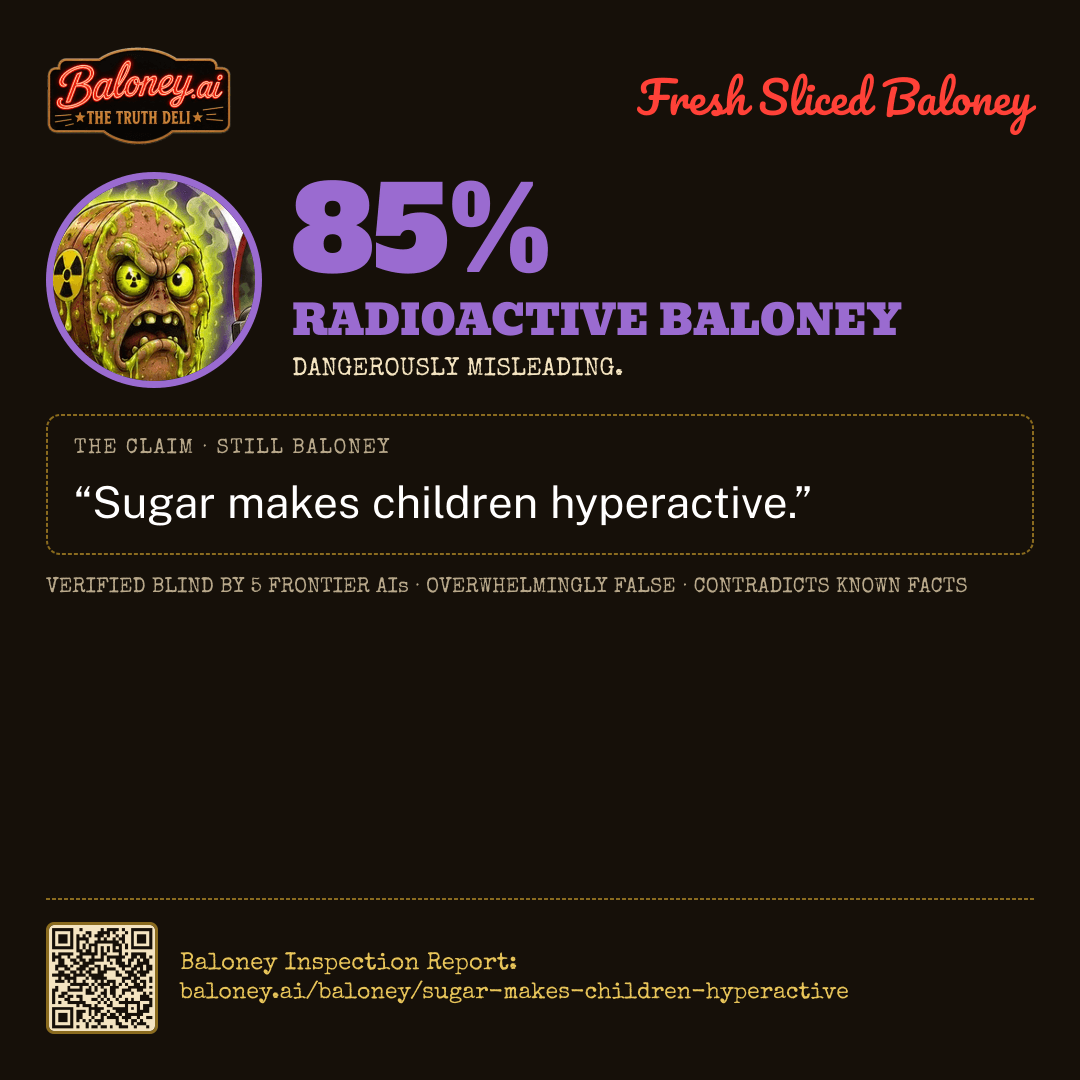
Score placed at 88 — firmly in Radioactive Baloney. The claim is not merely under-evidenced, it is contradicted by the best-powered direct tests of exactly this proposition, and the observed phenomenon has a well-demonstrated alternative cause (expectancy plus high-stimulation settings). It falls short of 99 because it is a sincere folk misperception rooted in a genuine confound rather than an organised, conspiracy-grade denial of established fact, and because the small observational signal, while unpersuasive, is not fabricated.
Agreement was near-total. All five evaluators recommended 85-90 with confidence of 88-98, all five identified the JAMA meta-analysis and the NEJM sucrose/aspartame trial as decisive, and all five independently named parental expectancy bias (Hoover & Milich) and the party/holiday context confound as the real explanation for the anecdotes. Disagreements were minor and technical: evaluators cited 16 versus 23 trials in the JAMA meta-analysis, and described the NEJM trial as three-week versus nine-week. Two evaluators gave more weight to the residual observational literature — cross-sectional sugar-sweetened-beverage/ADHD associations and a 2019 systematic review reporting a small heterogeneous association — while others treated that literature as too confounded to count. One evaluator alone raised the blood-glucose-crash mechanism as a partial explanation for perceived behaviour change; no other evaluator supported it and the broader panel's evidence contradicts a stimulant-like effect. No evaluator dissented on the bottom line.
Blind Validation Master · never saw the Primary’s work
gpt-5.5
88% BALONEY
The claim is overwhelmingly contradicted by the strongest evidence presented. Multiple double-blind, placebo-controlled trials, including the NEJM diet trial, found no meaningful effect of sucrose on children’s behavior or cognition, even among children described as “sugar-sensitive.” The JAMA meta-analysis of controlled studies likewise concluded that sugar does not affect children’s behavior or cognitive performance. Reports also cite expectancy-bias experiments showing parents rate children as more hyperactive when they believe sugar was consumed, even when it was not. The evidence for the claim is mostly anecdotal or observational and is heavily confounded by parties, holidays, disrupted routines, caffeine, food dyes, peer excitement, and parental expectations. Some observational links between sugary drinks or high-sugar diets and ADHD-like symptoms exist, but they do not establish that sugar acutely causes hyperactivity and may reflect confounding or reverse causation. As written, “Sugar makes children hyperactive” is a broad causal claim that controlled evidence has repeatedly failed to support, so it belongs firmly in Radioactive Baloney rather than merely needing context.
AGREEMENT TEST PASSED — BOTH MASTERS SCORED 88% · BLIND VALIDATION CONFIRMED THIS SCORE · NO RE-EVALUATION REQUIRED
The Evidence
Evidence offered for the claim
Parents and teachers see it constantlyDEBUNKED — Near-universal caregiver anecdote is the main basis for the belief. But the Hoover & Milich experiment showed mothers falsely told their child had been given a large dose of sugar rated that child as significantly more hyperactive — and were more critical and controlling toward them — when the child had actually received a placebo. The observation is of the observer, not the sugar.
Sugary occasions really are wildDEBUNKED — Birthday parties, Halloween and holidays genuinely produce elevated excitement, and the behaviour parents see is real. The panel found the cause is the setting — peer groups, disrupted routines, late bedtimes, high stimulation — which happens to be where children eat the most sugar. The confound, not the sucrose, explains the pattern.
Observational studies link sugary drinks to ADHD symptomsDEBUNKED — Cross-sectional work on sugar-sweetened-beverage intake, and a 2019 systematic review, report small associations with ADHD symptom scores. These cannot establish causation, carry substantial heterogeneity, and are confounded by overall diet quality, sleep, screen time and parenting; reverse causation is plausible. Cohort data following children from 6 to 11 found changes in sucrose consumption had essentially zero effect on ADHD incidence after adjustment.
Sweets contain other active ingredientsDEBUNKED — Many sweet foods also carry caffeine, chocolate or artificial colours. McCann et al. (Lancet 2007) found certain artificial food colourings and sodium benzoate modestly increased hyperactive behaviour in the general child population. This supports 'some sweets can affect behaviour' — it is not evidence that sugar does.
Blood-sugar crash after a big doseDEBUNKED — One evaluator proposed that a glucose spike followed by a drop could cause irritability or mood swings misread as hyperactivity. The panel found this weak: dietary sucrose produces modest, buffered blood-glucose changes in healthy children and no stimulant-like CNS effect, and the described symptoms are not hyperactivity. Mantantzis et al. (2019) found carbohydrate ingestion increased fatigue and reduced alertness within an hour.
Evidence against the claim
The meta-analysis settled it Wolraich, Wilson & White (JAMA, 1995) pooled double-blind, placebo-controlled sugar-challenge trials and concluded dietary sugar does not affect children's behaviour or cognitive performance. Effect sizes for hyperactivity were essentially zero, including in children described as 'sugar-sensitive' and in children with ADHD.
Feeding children high-sucrose diets changed nothing Wolraich et al. (NEJM, 1994) ran a randomised double-blind crossover trial with diets high in sucrose, aspartame or saccharin in preschool and school-age children, at intakes exceeding typical levels. No behavioural or cognitive differences emerged, even in children whose parents reported them to be sugar-sensitive.
The effect is in the parent's head, and it was measured Hoover & Milich (Journal of Abnormal Child Psychology, 1994) gave every child a placebo but told half the mothers their child had received a large sugar dose. Those mothers rated their children as significantly more hyperactive and treated them more critically — direct experimental evidence that the effect is expectancy and observer bias.
No 'sugar rush' exists in the data Mantantzis et al. (Neuroscience & Biobehavioral Reviews, 2019) meta-analysed carbohydrate effects on mood and arousal and found no evidence of a sugar rush; if anything sugar increased fatigue and reduced alertness within the first hour.
No plausible mechanism Dietary sucrose produces modest, buffered blood-glucose changes in healthy children and does not produce the stimulant-like central nervous system effects the folk claim requires. No consistent, clinically meaningful physiological pathway from typical dietary sugar to hyperactivity has been demonstrated.
Clinical bodies say so plainly The American Academy of Pediatrics states there is no scientific basis for claims that sugar or other sweeteners influence behaviour or cause ADHD, even at intakes many times normal, and does not recommend sugar-restricted diets as behavioural treatment. NHS and Mayo Clinic guidance agree that sugar is not an established cause of hyperactivity or ADHD.
Sources · Reliability · Why Accepted or Discounted
ACCEPTED — Cited independently by all five evaluators; a peer-reviewed meta-analysis restricted to double-blind placebo-controlled trials, the highest-quality evidence directly on this question.
ACCEPTED — Randomised double-blind crossover feeding trial in a top-tier journal, cited by four evaluators; tests the claim directly at above-normal sugar intakes.
ACCEPTED — Peer-reviewed experiment cited by three evaluators; supplies the positive causal explanation for the anecdote rather than merely negating it.
ACCEPTED — Rigorous randomised trial, accepted for what it shows — additives, not sugar — and correctly flagged by evaluators as not supporting the claim under review.
ACCEPTED — Legitimate peer-reviewed observational work; accepted, but weighted low because cross-sectional design cannot separate cause from confounding or reverse causation.
ACCEPTED — Indexing database for the underlying peer-reviewed studies; accepted as a pointer to primary literature rather than as an authority in itself.
ACCEPTED — The relevant professional body's formal guidance on paediatric nutrition and behaviour; states plainly that sugar has no demonstrated effect on behaviour or ADHD.