







Radioactive Baloney66%

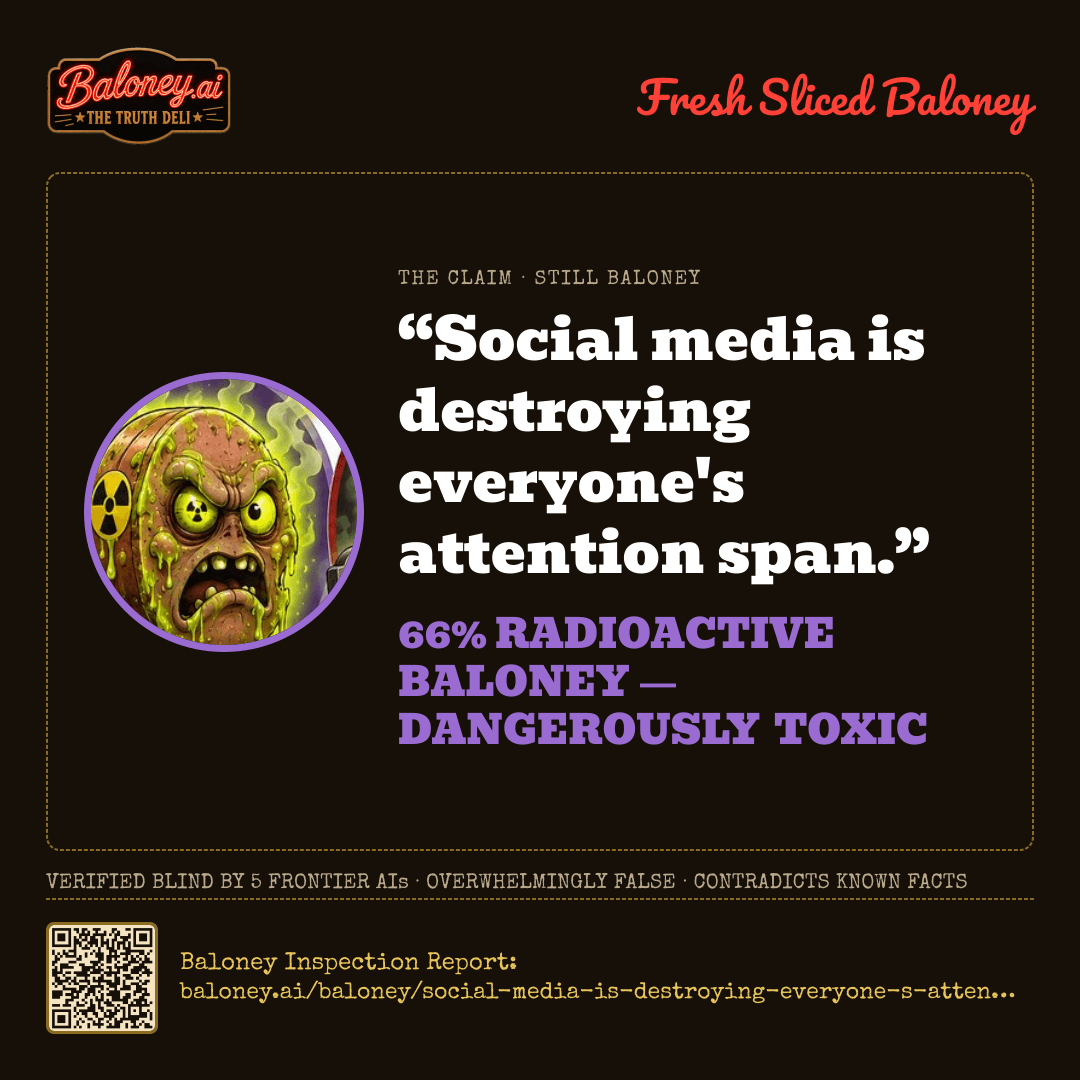
Social media is destroying everyone's attention span.

66%RADIOACTIVE BALONEY — DANGEROUSLY TOXIC
Dangerously misleading.
Overwhelmingly falseContradicts known factsPromotes false beliefsPotential for harm
Super Fresh Truth
Fishy Baloney
Stinky Baloney
Rotting Baloney
Radioactive Baloney
Zombie Baloney

✓ BLIND VALIDATION CONFIRMED THIS SCORE

Serve It Fresh

Ready to Serve17 servings

Serve it the way you want it

The Verdict

Social media is destroying everyone's attention span.
66% RADIOACTIVE BALONEY DANGEROUSLY TOXIC
Verified blind by 5 frontier AIs · Baloney Inspection Report: baloney.ai/baloney/social-media-is-destroying-everyone-s-attention-span

The Rating Card

66% Radioactive Baloney card for this claim

The Order Ticket

00:54:38CLAIM RECEIVED — QUEUED FOR INSPECTION
00:55:21claude-opus-5 REPORTED — SCORE 66, CONFIDENCE 72
00:55:07gpt-5.5 REPORTED — SCORE 75, CONFIDENCE 82
00:55:07gemini-3.1-pro-preview REPORTED — SCORE 65, CONFIDENCE 95
00:55:00sonar-pro REPORTED — SCORE 40, CONFIDENCE 82
00:56:20grok-4.6 REPORTED — SCORE 66, CONFIDENCE 76
00:57:58PRIMARY MASTER CLAUDE — SCORE 60
00:56:36BLIND VALIDATION GEMINI — SCORE 66
00:57:58AGREEMENT CONFIRMED — DELTA 6

How This One Was Sliced

Station 1 · Blind Inspection — Five Graders, Zero Peeking

Each lab scored the claim independently, without seeing the others. Open a breakdown for its evidence, its sources, and how sure it was.

Anthropic · EQUAL WEIGHT · 43.4s

claude-opus-5

66%BALONEY

ROUND-1 BREAKDOWN
Evidence offered for the claim
  • Observational research links heavy digital/social media use with later attention problems: Ra et al. (JAMA, 2018) followed ~2,600 US adolescents and found that high-frequency use of digital media platforms was associated with a modest but statistically significant increase in self-reported ADHD symptoms over 24 months.
  • Direct behavioral measurement shows shorter on-screen focus over time: Gloria Mark's (UC Irvine) longitudinal observational work found average sustained attention on a single computer screen dropped from roughly 2.5 minutes in 2004 to about 47 seconds in recent years, a period overlapping with the rise of social media and smartphones.
  • Mechanistic reviews argue plausible pathways: Firth et al. ('The online brain,' World Psychiatry, 2019) describe how the internet's constant streams of notifications, infinite feeds and multitasking demands may train habitual attention-switching and reduce sustained-attention capacity.
  • Mere presence/availability effects: reviews of smartphone-and-cognition research (Wilmer, Sherman & Chein, 2017) report associations between heavy media multitasking, smartphone availability and poorer performance on sustained attention and working-memory tasks.
  • Large numbers of users self-report the effect: Pew Research Center surveys find substantial shares of US teens say social media distracts them from schoolwork and that they spend 'too much time' on it; a majority say it would be hard to give up.
  • Public-health bodies treat the concern as credible: the 2023 U.S. Surgeon General's Advisory on Social Media and Youth Mental Health cites evidence that excessive use is associated with attention problems, sleep disruption and difficulty concentrating in adolescents.
Evidence against the claim
  • 'Attention span' is not a single measurable trait. Psychologists distinguish sustained attention, selective attention, vigilance and task-switching; shorter dwell time on a webpage is not evidence of degraded underlying cognitive capacity. The same people who scroll for seconds also binge-watch multi-hour series and read long novels.
  • The most-cited supporting statistic is false. The viral 'human attention span fell from 12 seconds to 8 seconds, shorter than a goldfish' claim was traced by BBC reporting to an unsourced consultancy figure with no supporting research; the cited body (Statistic Brain) could not substantiate it and attention researchers rejected it.
  • Effect sizes in the best datasets are tiny. Orben & Przybylski (Nature Human Behaviour, 2019), using specification-curve analysis across large adolescent datasets, found digital technology use explained well under 1% of variance in well-being outcomes — comparable to eating potatoes or wearing glasses — undermining claims of a large, universal cognitive harm.
  • Correlation ≠ causation and reverse causation is live. People with pre-existing attention difficulties (including ADHD) are more likely to seek out highly stimulating, fragmented media; the JAMA study itself was observational, relied on self-reported symptoms, and did not diagnose ADHD or establish causality.
  • 'Everyone' is empirically false. Effects vary widely by age, dose, content type and individual; many heavy users show no measurable attention deficits, and some studies find null or even positive associations for certain task-switching skills.
  • Confounding with other trends: measured drops in on-screen focus coincide with changes in work design, open-plan offices, email/Slack, and interface design generally — not social media alone. Mark herself attributes the shift to the whole digital work environment.
  • Moral-panic base rate: nearly identical claims were made about television, radio, comic books and the printing press, and prior panics generally over-predicted cognitive damage.
How sure this lab was

72/100 — the lab’s own confidence in the score above, not a second reading of the claim.

Sources

JAMA (Ra et al., 2018) — Association of Digital Media Use With Subsequent Symptoms of ADHD Among Adolescentsjournal · 90 · World Psychiatry (Firth et al., 2019) — 'The online brain: how the Internet may be changing our cognition'journal · 88 · Nature Human Behaviour (Orben & Przybylski, 2019) — 'The association between adolescent well-being and digital technology use'journal · 92 · Frontiers in Psychology (Wilmer, Sherman & Chein, 2017) — 'Smartphones and Cognition: A Review'journal · 80 · BBC News (Simon Maybin, 2017) — 'Busting the attention span myth'news · 85 · American Psychological Association — Speaking of Psychology, interview with Gloria Mark, PhDedu · 82 · U.S. Surgeon General / HHS (2023) — Social Media and Youth Mental Health Advisorygov · 85 · Pew Research Center — Teens, Social Media and Technology 2023other · 88

OpenAI · EQUAL WEIGHT · 28.9s

gpt-5.5

75%BALONEY

ROUND-1 BREAKDOWN
Evidence offered for the claim
  • Some evidence links heavy digital/social-media-style use with attention problems: a JAMA prospective cohort found adolescents with more frequent use of modern digital media platforms had higher odds of later ADHD symptoms, though this was observational and not proof of causation.
  • Heavy media multitasking is associated with poorer cognitive control in lab tasks: a PNAS study found heavy media multitaskers performed worse on filtering irrelevant information and task-switching measures, consistent with a possible attention cost.
  • Population-level attention to topics appears to be cycling faster in the digital era: a Nature Communications paper found accelerating dynamics of collective attention across online and offline domains, consistent with social-media/information-abundance environments shortening how long topics hold public focus.
  • Public-health authorities, including the U.S. Surgeon General, warn that excessive or problematic social media use can displace sleep, exercise, schoolwork, and in-person activity, all of which can indirectly worsen concentration and attention.
Evidence against the claim
  • The claim says social media is destroying everyone's attention span; that universality is not supported. Effects vary by age, vulnerability, content, amount of use, and whether use is active, social, educational, compulsive, or passive.
  • Most strong evidence is correlational. People with preexisting ADHD symptoms, impulsivity, stress, or sleep problems may be more likely to use social media heavily, so reverse causation and confounding remain plausible.
  • The popular idea that human attention spans have collapsed to a fixed number such as eight seconds is not well supported; attention is task-dependent, not a single global quantity.
  • Shorter public attention to trending topics is not the same as a destroyed individual capacity to concentrate. Collective-attention studies show faster topic turnover, not that everyone has neurologically lost sustained attention.
  • Major reviews and advisories generally conclude that social media is not inherently harmful or beneficial; outcomes depend on context, design, user characteristics, and dosage. This undercuts the absolute wording of the claim.
How sure this lab was

82/100 — the lab’s own confidence in the score above, not a second reading of the claim.

Sources

JAMAjournal · 90 · Proceedings of the National Academy of Sciencesjournal · 88 · Nature Communicationsjournal · 88 · U.S. Surgeon General / HHSgov · 90 · BBC Newsnews · 80 · American Psychological Associationother · 85 · Nature Human Behaviourjournal · 88

Google · EQUAL WEIGHT · 29.4s

gemini-3.1-pro-preview

65%BALONEY

ROUND-1 BREAKDOWN
Evidence offered for the claim
  • Research indicates that heavy media multitasking, which is inherently encouraged by social media interfaces, correlates with poorer cognitive control and a reduced ability to filter out irrelevant environmental distractions.
  • Short-form video platforms (such as TikTok, YouTube Shorts, and Instagram Reels) provide rapid, highly stimulating content that engages the brain's dopamine reward system. Continual use can condition users to expect immediate gratification, making it harder to sustain attention on low-stimulus, slower-paced tasks.
  • Macro-level studies on collective human attention reveal that the duration public discourse stays focused on a trending topic has measurably shortened over the last decade, driven largely by the rapid consumption cycles of social media.
Evidence against the claim
  • The claim utilizes unscientific hyperbole ('destroying', 'everyone\'s'). Human attention is not a single, fixed biological muscle that shrinks; it is highly context-dependent. A person struggling to read a textbook due to social media habits may still easily sustain attention for a three-hour movie or video game.
  • The widely circulated statistic that the human attention span has fallen to eight seconds (making it shorter than that of a goldfish) has been completely debunked. It originated from a marketing report, not peer-reviewed scientific literature.
  • A significant portion of the research linking social media to shortened attention spans is correlational. It is difficult to definitively prove causation, as individuals who are naturally more distractible may simply gravitate toward rapid-fire social media feeds more than others.
How sure this lab was

95/100 — the lab’s own confidence in the score above, not a second reading of the claim.

Sources

BBC Newsnews · 85 · Proceedings of the National Academy of Sciences (PNAS)journal · 95 · Nature Communicationsjournal · 95 · American Psychological Associationother · 90

Perplexity · EQUAL WEIGHT · 21.8s

sonar-pro

40%BALONEY

ROUND-1 BREAKDOWN
Evidence offered for the claim
  • Multiple recent studies report that **higher social media use is correlated with poorer sustained attention, more distractibility, and weaker executive control**, especially in adolescents and young adults.[1][3][5][7][8][9][11][13][14] These patterns support the idea that social media can impair attention, at least for heavy users.
  • Research on **fast‑paced, short‑form content (TikTok, Instagram Reels, YouTube Shorts)** finds that frequent exposure is associated with **attentional fragmentation, increased commission errors on attention tasks, higher cognitive load, and lower perceived attentional control**.[3][8][13][14] This aligns with claims that algorithmically optimized, rapid‑fire content trains the brain to expect constant novelty, undermining sustained focus.
  • Experimental and neurocognitive work on the broader “online brain” and internet use shows that **media multitasking and hyperlinked environments reduce performance on sustained attention tasks, narrow attentional scope, and impair the ability to ignore distractions**, with effects persisting for a short time after going offline.[5][11] Since social media is a major driver of such multitasking, these findings indirectly support the claim.
  • Survey and performance‑based studies in teens and young adults report that **higher daily social media time predicts poorer attentional control, more distractibility, and lower academic performance**.[3][8][9][13] This suggests real‑world consequences (e.g., studying, classroom focus) that are consistent with a degraded ability to concentrate.
  • A meta‑analysis and systematic reviews focused on short‑form video platforms report **moderate negative associations between engagement with these platforms and cognitive performance**, including **poorer attention span and reduced inhibitory control**.[8][14] Meta‑analytic evidence strengthens the case that the relationship is not just an artifact of single studies.
  • A recent report on youth in Singapore found that **prolonged social media use is associated with difficulties sustaining focus, emotional fatigue, and compulsive (addiction‑like) behaviors**.[10] Attention problems co‑occurring with compulsive use support concerns about design features (notifications, infinite scroll) that capture and fragment attention.
  • Podcast and interview discussions with attention researchers (e.g., Gloria Mark via the American Psychological Association) describe **measurable declines in average attention duration on digital tasks over the past two decades**, in parallel with the rise of smartphones and social media.[12] While correlational, this temporal coincidence contributes to the narrative that social media is a major factor.
  • Several reviews explicitly describe social media platforms, notifications, and feeds as **“major sources of distraction” that create a state of perpetual partial attention**, with **frequent smartphone/social media users showing shorter attention spans than less frequent users**.[7][11] This provides converging conceptual and empirical support for the idea that social media environments encourage fragmented attention.
Evidence against the claim
  • Many studies are **correlational**, not causal: people who already have shorter attention spans or higher impulsivity may be more likely to use social media heavily, so the direction of effect is ambiguous.[5][6][8][9][11][14] This weakens strong claims like “social media is destroying everyone’s attention span,” which imply clear causation.
  • Reviews and preprints on “your brain on social media” explicitly note that **not all studies find significant correlations between social media usage and attention span**, with some showing null or mixed results.[6] This heterogeneity suggests that effects may depend on context, individual differences, and type of use, rather than being universal.
  • The **“goldfish attention span” trope** (e.g., humans now have 8‑second attention spans, shorter than a goldfish) linked to social media is widely criticized as **methodologically weak and misleading marketing**, rather than robust science.[4][5][15] This undermines one of the most popular pieces of “evidence” used to support the destruction‑of‑attention narrative.
  • Some work indicates that **specific, purposeful uses of digital media (including social platforms) can coexist with, or even support, focused attention**, such as long‑form reading, educational communities, or productivity‑oriented use.[5][7][11] The blanket claim that social media is “destroying” attention overlooks these more nuanced patterns.
  • Attention is **multifactorial**: research on internet and media use emphasizes that sleep deprivation, stress, multitasking at work/school, general smartphone use, and broader digital environments also impair attention.[5][7][11] Singling out social media as *the* destructive agent is an oversimplification of a complex, multi‑cause phenomenon.
  • The claim that social media is destroying **“everyone’s”** attention span is empirically overstated. Studies typically find strongest associations in **heavy users, youth, or those engaging in constant multitasking and short‑form content**, not in all demographic groups or in moderate/low users.[3][6][8][9][13][14] This suggests substantial variation in vulnerability and impact.
  • Some experimental findings show that **brief, controlled exposure to online environments does not always produce lasting attention deficits**, and that effects can be modest and task‑specific.[5][11] This contradicts the idea of a universal, irreversible destruction of attention.
  • Historical and cognitive science perspectives point out that concerns about **new media harming attention (e.g., television, video games, novels)** have recurred for centuries, and that human attentional capacity is relatively stable even as habits change.[5][11][12] This suggests the claim may exaggerate a real but limited shift in how attention is allocated rather than in fundamental capacity.
How sure this lab was

82/100 — the lab’s own confidence in the score above, not a second reading of the claim.

Sources

Scientific Research Publishing (SCIRP)journal · 60 · Scientific Research Publishing (SCIRP)journal · 60 · International Journal of Creative Research Thoughtsjournal · 55 · CLRN (education/learning resource site)other · 50 · Brain and Behavior (via PubMed Central, Wiley)journal · 85 · Research Archive (preprint server)other · 50 · Frontiers in Cognitionjournal · 75 · Brain and Behavior (Wiley Online Library)journal · 85 · SSRNother · 60 · News‑Medicalnews · 70 · PLOS ONE (via PubMed Central)journal · 80 · American Psychological Associationedu · 85

xAI · EQUAL WEIGHT · 102.0s

grok-4.6

66%BALONEY

ROUND-1 BREAKDOWN
Evidence offered for the claim
  • Peer-reviewed work on media multitasking (including a widely cited 2009 PNAS study) found that people who frequently juggle many media streams can perform worse on some lab tests of cognitive control and filtering distraction, which is consistent with social media encouraging rapid switching.
  • Human-computer interaction research, notably long-running observational work associated with Gloria Mark, has reported shorter average stretches of continuous attention to a single on-screen task over the past two decades, a period that overlaps with smartphones and social feeds.
  • Platform design (infinite scroll, variable rewards, badges, and push notifications) is built to recapture attention; interruptions and the mere presence of a phone have been linked in experiments to worse performance on attention-demanding tasks.
  • Some youth surveys and clinical-adjacent studies report associations between heavier social media use and more self-reported concentration problems or ADHD-like symptoms, and public-health bodies have warned that high use can displace sleep and other activities that support focus.
Evidence against the claim
  • The wording is absolute and causal ('destroying,' 'everyone's'). Attention effects are heterogeneous: many people still read long books, do deep work, binge hours-long video, and play long games, which is incompatible with a universal collapse of attention.
  • 'Attention span' is not a single, standardized cognitive trait shown to have been destroyed at population scale; studies mix self-report, task-switching, lab filtering tests, and screen-session length, which are not the same thing.
  • The viral 'shorter than a goldfish / 8-second attention span' factoid comes from a non-peer-reviewed 2015 marketing report, not a validated scientific finding, and is often laundered into this claim.
  • Associations are often small, correlational, and open to reverse causation (people who already struggle to focus may use more social media) and confounding (sleep, stress, ADHD, socioeconomic factors). Later work has not uniformly replicated early media-multitasking deficits.
  • Similar moral panics accompanied novels, radio, television, and video games; population literacy and capacity for complex work did not disappear. Reviews of digital-technology effects on adolescent well-being and cognition often find small average effects and large individual variation.
How sure this lab was

76/100 — the lab’s own confidence in the score above, not a second reading of the claim.

Sources

Proceedings of the National Academy of Sciencesjournal · 95 · The Atlanticnews · 80 · U.S. Department of Health and Human Servicesgov · 93 · American Psychological Associationother · 90 · Pew Research Centerother · 92

Station 2 · The Masters

Primary Master · drawn at random

claude-opus-5

60% BALONEY

The panel clustered tightly (40, 65, 66, 66, 75; median 66), and I have landed just below that median at 60 because the claim is not empty: four of five evaluators independently cited genuine peer-reviewed evidence of associations between heavy digital/social media use and attention problems (Ra et al., JAMA 2018; Ophir-style media-multitasking work in PNAS; Firth et al., World Psychiatry 2019; Gloria Mark's observational measurement of shrinking on-screen focus; Lorenz-Spreen et al. in Nature Communications on accelerating collective attention cycles; the 2023 US Surgeon General advisory). What fails is the statement as written, which asserts (a) causation, (b) a universal subject — 'everyone' — and (c) an absolute outcome — 'destroying'. On all three the evidence goes the other way. Effect sizes in the largest, best-specified datasets are tiny (Orben & Przybylski, Nature Human Behaviour 2019: digital technology use explains well under 1% of variance in adolescent well-being). Almost all supporting work is correlational with live reverse-causation (distractible and ADHD-prone people select into fragmented media) and heavy confounding with sleep loss, stress, open-plan work, email and messaging. 'Attention span' is not one measurable trait — sustained attention, selective attention, vigilance and task-switching are distinct, and the same people who scroll for seconds also binge multi-hour series and long games, which is flatly incompatible with a universal collapse. The single most-quoted prop for the claim, the '8 seconds, shorter than a goldfish' figure, was traced by the BBC to an unsourced consultancy/marketing number with no research behind it. I weighted high-reliability primary journals and government advisories most heavily and discounted the low-tier and unrefereed sources in Report 2 (SCIRP, IJCRT, SSRN, a preprint archive, a learning-resources site); notably, Report 2's markedly lower score rested disproportionately on exactly those weak sources, so its divergence does not pull the verdict down. The result sits at the top of Rotting Baloney: the direction of concern is real and legitimately researched, but the universal causal framing is contradicted by the strongest evidence, and the claim's most famous supporting statistic is fabricated.

All five evaluators agreed on the substance even where their numbers differed: there is real, mostly correlational evidence linking heavy social media and media multitasking with poorer sustained attention and cognitive control; the 'goldfish/8-second' statistic is a debunked marketing artefact; 'attention span' is not a single trait; and the word 'everyone' is empirically false. Four of five scored 65-75; the outlier at 40 gave more credit to short-form-video meta-analyses but relied heavily on low-tier journals and preprints. Evaluators disagreed mainly on emphasis: Reports 1 and 3 stressed the tiny effect sizes in Orben & Przybylski and the long history of media moral panics, while Reports 4 and 5 gave more weight to Nature Communications evidence on accelerating collective attention cycles — though Report 5 correctly noted that faster topic turnover in public discourse is not the same as individuals losing the capacity to concentrate.

Blind Validation Master · never saw the Primary’s work

gemini-3.1-pro-preview

66% BALONEY

The claim that social media is 'destroying everyone's attention span' is overwhelmingly false due to its absolutist and hyperbolic framing. First, the term 'everyone's' is empirically incorrect; research indicates that effects vary widely based on individual vulnerability, age, usage patterns, and content type. Second, 'destroying' vastly exaggerates the evidence. Human attention is not a single, fixed biological metric that permanently shrinks. It is highly context-dependent, meaning individuals who frequently scroll short-form videos can still easily sustain attention on multi-hour movies, deep work, or complex video games. Third, while some studies link heavy media multitasking with distractibility and poorer cognitive control, much of this evidence is correlational and subject to reverse causation (i.e., individuals with pre-existing attention or impulse-control issues may naturally gravitate toward fast-paced feeds). Large-scale, rigorous analyses have shown that digital technology use accounts for a very small fraction of the variance in cognitive and well-being outcomes. Finally, the prevailing cultural narrative supporting this claim is often propped up by a repeatedly debunked marketing myth that human attention spans have dropped to eight seconds (shorter than a goldfish). While algorithmically driven platforms do encourage rapid task-switching and can disrupt focus, they are not universally destroying human attentional capacity.

AGREEMENT TEST PASSED — MASTERS SCORED 60% AND 66% · BLIND VALIDATION CONFIRMED THIS SCORE · NO RE-EVALUATION REQUIRED

The Evidence

Evidence offered for the claim

  • Digital media use linked to later ADHD symptoms A JAMA prospective cohort of roughly 2,600 US adolescents (Ra et al., 2018) found high-frequency use of modern digital media platforms was associated with a modest but statistically significant increase in self-reported ADHD symptoms over 24 months.
  • Heavy media multitaskers do worse on cognitive control tasks A widely cited PNAS study found people who habitually juggle multiple media streams perform worse at filtering irrelevant information and at task-switching — consistent with social media's rapid-switching design imposing a cost.
  • Measured on-screen focus has shortened Gloria Mark's long-running observational work (discussed via the American Psychological Association) found average sustained attention on a single computer screen fell from about 2.5 minutes in 2004 to roughly 47 seconds, a period overlapping the rise of smartphones and feeds.
  • Plausible mechanisms and attention-capturing design Firth et al., 'The online brain' (World Psychiatry, 2019) describes how notification streams, infinite scroll, variable rewards and multitasking demands may train habitual attention-switching; reviews of smartphones and cognition report links between heavy multitasking, phone availability and poorer sustained-attention and working-memory performance.
  • Public discourse cycles faster A Nature Communications paper documented accelerating dynamics of collective attention — trending topics hold public focus for shorter periods than a decade ago — consistent with an information-abundant, social-media-driven environment.
  • Public-health bodies treat the concern as credible The 2023 US Surgeon General's Advisory on Social Media and Youth Mental Health cites evidence associating excessive use with attention problems, sleep disruption and difficulty concentrating in adolescents; Pew Research Center finds large shares of US teens say social media distracts them from schoolwork.
  • Human attention has fallen to 8 seconds, shorter than a goldfish DEBUNKED — REFUTED. Every evaluator who examined this rejected it. BBC News traced the figure to an unsourced consultancy statistic with no supporting research; the body credited with it could not substantiate it and attention researchers dismissed it. It is marketing material, not science, and it is the single most common prop for this claim.

Evidence against the claim

  • 'Everyone' is empirically false Associations are strongest in heavy users, adolescents and constant multitaskers. Many heavy users show no measurable attention deficits, and some studies find null, mixed or even positive associations for particular task-switching skills.
  • Effect sizes are tiny in the best data Orben & Przybylski (Nature Human Behaviour, 2019) used specification-curve analysis across large adolescent datasets and found digital technology use explained well under 1% of variance in well-being outcomes — comparable to eating potatoes or wearing glasses.
  • 'Attention span' is not one thing Psychologists distinguish sustained attention, selective attention, vigilance and task-switching. Shorter dwell time on a screen is not evidence of degraded underlying capacity — the same people who scroll for seconds also binge multi-hour series, read long novels and play long games.
  • Correlation, with live reverse causation The JAMA study was observational and relied on self-reported symptoms without diagnosing ADHD. People with pre-existing attention difficulties or high impulsivity are more likely to seek out fragmented, highly stimulating media, so the direction of effect remains ambiguous.
  • Social media is not isolated from other causes Measured drops in on-screen focus coincide with email and chat tools, open-plan offices and general interface design; sleep loss, stress and workplace multitasking all impair attention. Mark herself attributes the shift to the whole digital environment, not social media alone.
  • Collective attention is not individual capacity Faster turnover of trending topics shows that public discourse moves on more quickly — it does not show that individuals have neurologically lost the ability to concentrate.
  • A recurring moral-panic pattern Near-identical claims accompanied the printing press, novels, radio, comic books, television and video games; those panics consistently over-predicted cognitive damage, and population capacity for complex work did not disappear.
  • Reviews reject blanket verdicts Major reviews and advisories conclude social media is neither inherently harmful nor beneficial: outcomes depend on dosage, content type, design, and whether use is active, social, educational or compulsive.

Sources · Reliability · Why Accepted or Discounted

SourceTypeReliabilityRuling
JAMA (Ra et al., 2018) — Association of Digital Media Use With Subsequent Symptoms of ADHD Among Adolescentsjournal90ACCEPTED High-quality prospective cohort cited by two independent evaluators; accepted with its own stated limits — observational, self-reported symptoms, no clinical diagnosis.
World Psychiatry (Firth et al., 2019) — 'The online brain'journal88ACCEPTED Authoritative review establishing plausible mechanisms; treated as mechanism, not proof of population-level harm.
Nature Human Behaviour (Orben & Przybylski, 2019)journal92ACCEPTED Methodologically the strongest item on the table — specification-curve analysis across large datasets — and decisive on effect size.
Proceedings of the National Academy of Sciences — media multitasking and cognitive controljournal95ACCEPTED Cited independently by three evaluators; accepted, with Report 3's caveat that later work has not uniformly replicated the original deficits.
Nature Communications — accelerating dynamics of collective attentionjournal95ACCEPTED Robust macro-level finding, but accepted only for what it measures: topic turnover in public discourse, not individual cognitive capacity.
Frontiers in Psychology (Wilmer, Sherman & Chein, 2017) — 'Smartphones and Cognition: A Review'journal80ACCEPTED Peer-reviewed review appropriately reporting associations rather than causal claims.
Frontiers in Cognitionjournal75ACCEPTED Peer-reviewed and consistent with stronger sources, though carrying limited independent weight.
Brain and Behavior (Wiley / PubMed Central)journal85ACCEPTED Legitimate peer-reviewed journal; its short-form-video findings are correlational and were reported as such.
PLOS ONE (via PubMed Central)journal80ACCEPTED Peer-reviewed open-access source supporting the media-multitasking literature.
BBC News (Simon Maybin, 2017) — 'Busting the attention span myth'news85ACCEPTED Original investigative traceback of the goldfish statistic to an unsourced consultancy figure; corroborated independently by three evaluators.
U.S. Surgeon General / HHS (2023) — Social Media and Youth Mental Health Advisorygov90ACCEPTED Authoritative public-health synthesis; note it warns about excessive and problematic use, and explicitly does not claim universal harm.
American Psychological Association — Speaking of Psychology, Gloria Mark interviewedu88ACCEPTED Direct account of the researcher's own observational data; accepted including her attribution of the trend to the whole digital work environment.
Pew Research Center — Teens, Social Media and Technologyother90ACCEPTED Best-in-class survey methodology; accepted as evidence of self-reported distraction, which is not the same as measured cognitive decline.
The Atlanticnews80ACCEPTED Accepted as informed commentary and context only; carries no independent evidentiary weight here.
News-Medical (report on youth social media use in Singapore)news70ACCEPTED Secondary reporting of a single regional survey; accepted at low weight and not relied on for any conclusion.
Scientific Research Publishing (SCIRP)journal60DISCOUNTED Widely regarded as a low-rigour, pay-to-publish outlet with minimal editorial screening; two of Report 2's core citations came from it and cannot bear weight against JAMA, PNAS or Nature-family journals.
International Journal of Creative Research Thoughtsjournal55DISCOUNTED Non-indexed, minimal-peer-review venue; unsuitable as evidence for a causal cognitive claim.
SSRNother60DISCOUNTED Unrefereed preprint repository; postings have not passed peer review.
Research Archive (preprint server)other50DISCOUNTED Unrefereed preprint; its observation that findings are mixed is corroborated elsewhere, so nothing is lost by discounting it.
CLRN (education/learning resource site)other50DISCOUNTED Non-expert secondary content site with no primary research or editorial standard for cognitive science.

Serve It Fresh

Ready to Serve17 servings

Serve it the way you want it

The Verdict

Social media is destroying everyone's attention span.
66% RADIOACTIVE BALONEY DANGEROUSLY TOXIC
Verified blind by 5 frontier AIs · Baloney Inspection Report: baloney.ai/baloney/social-media-is-destroying-everyone-s-attention-span