Baloney Inspection Report: Claim #1134 · Inspected Oct 7, 2026, 1:23 PM PDT · Scoring model v2
 28%
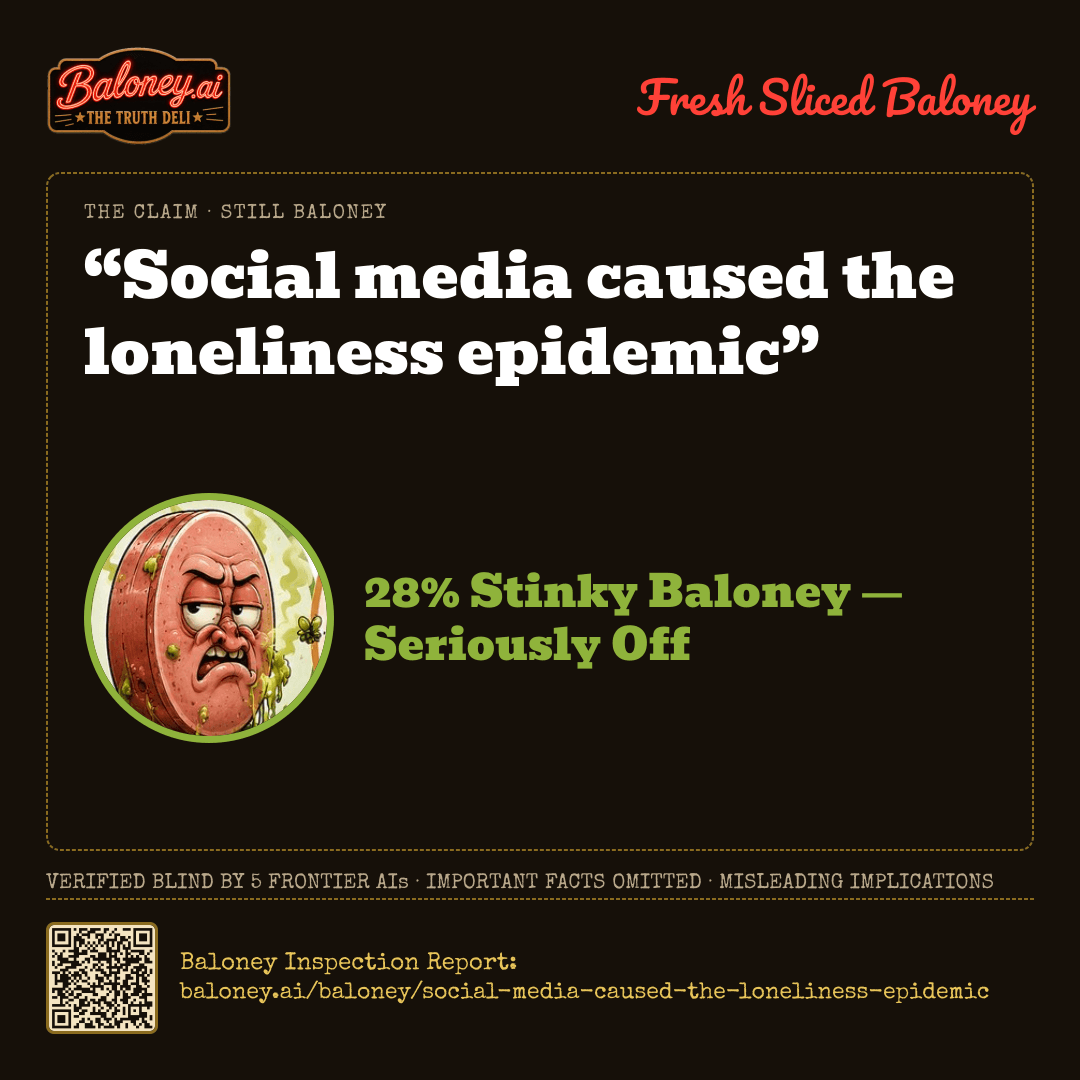
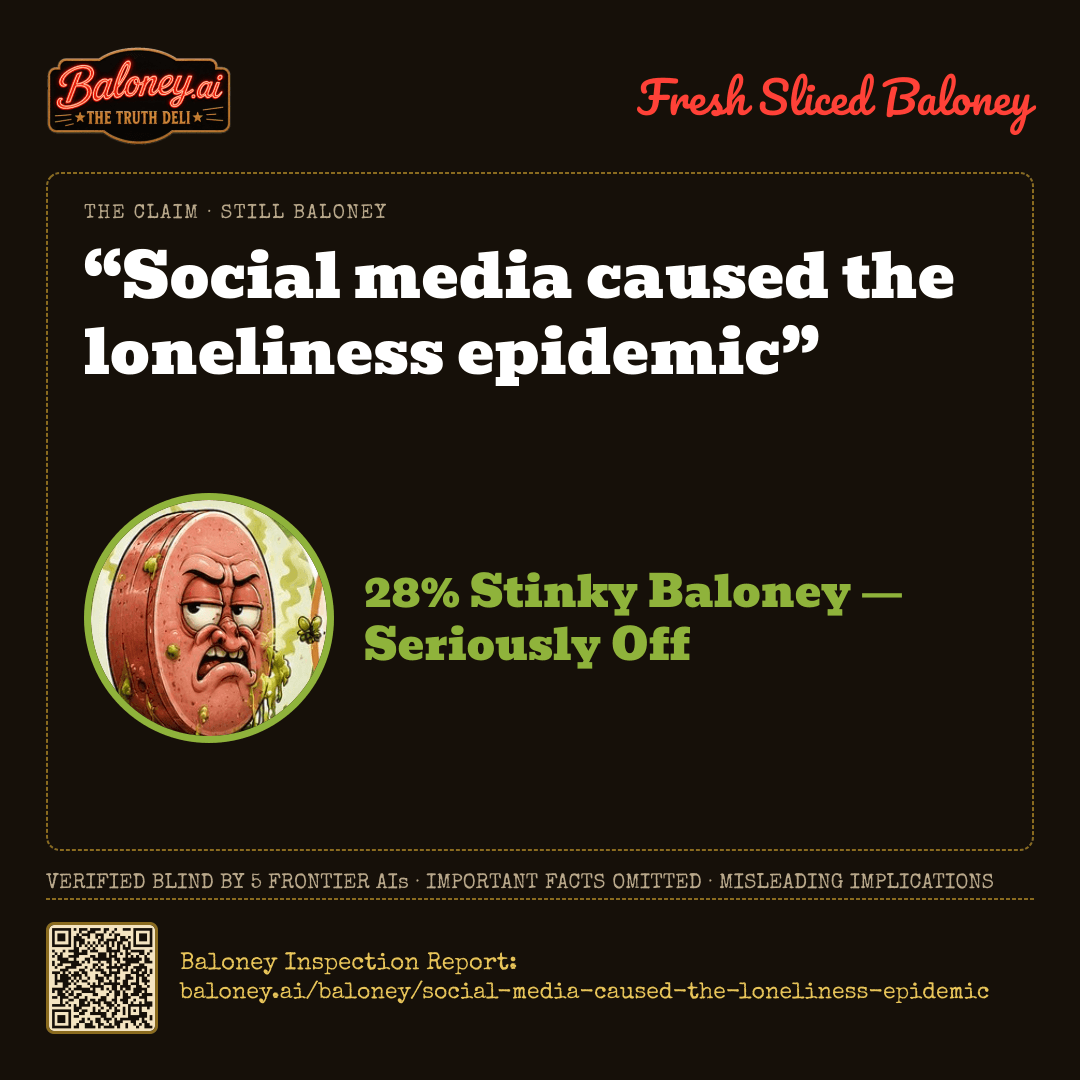
28%“Social media caused the loneliness epidemic”
28%Stinky Baloney — Seriously Off
That’s not the whole story…
Important facts omittedMisleading implicationsCherry-picked infoSpins the truth
Serve It Fresh
Ready to Serve12 servings
Serve it the way you want it
The Verdict
 “Social media caused the loneliness epidemic”28% Stinky Baloney — Seriously OffVerified blind by 5 frontier AIs · Baloney Inspection Report: baloney.ai/baloney/social-media-caused-the-loneliness-epidemic
The Baloney Sampler
Social media did not cause the loneliness epidemic, though heavy or passive use is linked to increased isolation in youth. Massive structural declines in community participation and rising single-person households began decades before social media existed. According to the U.S. Department of Health and Human Services and the National Academies of Sciences, Engineering, and Medicine, the loneliness epidemic is driven by multiple factors—including aging, living alone, and changing workplaces—with technology acting as just one contributor.
The evidence does not support a strong, one-way causal link. Large-scale data published in Nature Human Behaviour reveals that digital technology use explains less than half a percent of the variance in adolescent well-being. Furthermore, much of the research points to bidirectional effects, where lonely people turn to social media to cope. For some isolated groups, social media actually reduces loneliness by sustaining social ties, directly contradicting a simple one-way causal story.
Resting on U.S. Department of Health and Human Services · National Academies of Sciences, Engineering, and Medicine · Nature Human Behaviour
Original Claim Source https://eddit.com/r/decadeology/comments/1n8npzz/the_current_loneliness_epidemic_is_caused_by/
Other ways to slice it — phrasings that might have changed the rating
- “Heavy social media use contributes to increased loneliness among adolescents.” Narrows the population to youth and softens the claim from a sole cause to a contributing factor, which aligns with dose-response findings and official public health advisories.
- “The decline in U.S. in-person social connection began decades before the invention of social media.” Shifts the focus to the chronological evidence showing that civic participation, in-person socializing, and institutional trust have been dropping since the mid-20th century.
- “Social media use reduces loneliness for some isolated and marginalized demographic groups.” Highlights the contrasting evidence that active digital connection sustains vital social ties for disabled individuals, LGBTQ+ youth, migrants, and isolated older adults.
Written from the panel’s reports by Google · gemini-3.1-pro-preview. Nothing here changed the score.
The Order Ticket
20:23:28CLAIM RECEIVED — QUEUED FOR INSPECTION✓
20:24:31claude-opus-5 REPORTED — SCORE 57, CONFIDENCE 80✓
20:24:04gpt-5.5 REPORTED — SCORE 36, CONFIDENCE 84✓
20:24:09gemini-3.1-pro-preview REPORTED — SCORE 28, CONFIDENCE 95✓
20:23:37sonar-pro REPORTED — SCORE 28, CONFIDENCE 91✓
20:24:36grok-4.6 REPORTED — SCORE 28, CONFIDENCE 74✓
20:25:32PRIMARY MASTER GEMINI — SCORE 38✓
20:24:55BLIND VALIDATION CLAUDE — SCORE 40✓
20:26:04AGREEMENT MODERATE DISAGREEMENT — DELTA 12✓
20:26:04SCORING MODEL V2 — MEDIAN OF 5 COUNTED LAB SCORES: 57, 36, 28, 28, 28 → 28.✓
20:26:04SOURCE RULE — LABS CITED 34 SOURCES: 0 DISCARDED FOR HAVING NO URL, 1 DISCARDED AS DEAD LINKS (404/410), 18 COULD NOT BE OPENED BY US AND ARE MARKED UNVERIFIED.✓
20:26:04SOURCE RULE — PRIMARY MASTER RULED ON 20 SOURCES: 0 DISCARDED FOR HAVING NO URL, 0 DISCARDED AS DEAD LINKS, 9 MARKED UNVERIFIED, 11 VERIFIED.✓
How This One Was Sliced
Station 1 · Blind Inspection — Five Graders, Zero Peeking
Each lab scored the claim independently, without seeing the others. Open a breakdown for its evidence, its sources, and how sure it was.
Anthropic · EQUAL WEIGHT · 62.2s
claude-opus-5
57%BALONEY
ROUND-1 BREAKDOWN
Evidence offered for the claim- Adolescent loneliness at school rose sharply in many countries after 2012, coinciding with the global spread of smartphones and social media. Twenge and colleagues documented increases in school loneliness in 36 of 37 countries using PISA data, with the rise tracking smartphone access and internet use rather than economic indicators.
- Time-use data show a large decline in face-to-face socializing among U.S. teens and young adults over the same period that social media adoption became near-universal; in-person interaction is the strongest known protective factor against loneliness, so displacement is a plausible mechanism.
- Randomized and quasi-experimental studies find small causal effects in the expected direction: Hunt et al. (2018) found that limiting undergraduates to 30 minutes/day of social media reduced self-reported loneliness and depression; Allcott et al. (AER 2020) found that four weeks of Facebook deactivation modestly improved subjective well-being (though it also reduced some social activity).
- The U.S. Surgeon General issued two advisories (2023) linking heavy social media use to harms in youth and declaring loneliness and isolation a public-health concern, noting that some patterns of social media use are associated with worse mental health and displaced in-person connection.
- Specific use patterns — passive scrolling, social comparison, cyberbullying, and displacement of sleep — are consistently associated with higher loneliness in observational research.
Evidence against the claim- The word 'caused' asserts sole or primary causation, which no study establishes. The Surgeon General's own loneliness advisory attributes declining social connection to multiple decades-long forces: smaller households, fewer children, reduced religious and civic participation, longer commutes, workplace change, geographic mobility, and more time alone — with technology as one contributing factor among many.
- Declines in social connection and civic participation in the U.S. began in the 1960s-1980s, decades before social media existed (the trends Putnam documented in 'Bowling Alone,' published in 2000). A cause cannot postdate its effect.
- It is disputed whether a broad 'loneliness epidemic' — in the sense of a large population-wide increase — actually exists. Longitudinal studies of U.S. older adults (Hawkley and colleagues) and several national cohort comparisons found loneliness roughly stable across recent decades; the clearest increases are concentrated in adolescents and young adults, not the whole population.
- Effect sizes in large correlational datasets are very small. Orben and Przybylski (Nature Human Behaviour, 2019), using specification-curve analysis on three large datasets, found digital technology use explains roughly 0.4% of variance in adolescent well-being — comparable to wearing glasses or eating potatoes.
- Vuorre and Przybylski's analyses of technology adoption and well-being across many countries found no consistent evidence that associations between digital engagement and mental health have strengthened over time, or that country-level internet/smartphone adoption predicts worsening well-being.
- Odgers and Jensen's review in the Journal of Child Psychology and Psychiatry concludes the evidence base is dominated by small, cross-sectional, self-report correlations with weak causal identification, and that effects are likely bidirectional (lonely people use more social media).
- Reverse causation and confounding are unresolved: loneliness predicts increased social media use in longitudinal panels, and the post-2010 period also saw the 2008 financial crisis aftermath, changes in parenting and unstructured play, rising academic pressure, and (after 2020) pandemic isolation.
- For some groups — isolated elderly people, disabled people, LGBTQ+ youth in unsupportive environments, migrants — social media measurably reduces loneliness by sustaining ties, which contradicts a simple one-directional causal story.
How sure this lab was80/100 — the lab’s own confidence in the score above, not a second reading of the claim.
SourcesU.S. Surgeon General / HHS — 'Our Epidemic of Loneliness and Isolation' (2023)gov · 92 · U.S. Surgeon General / HHS — 'Social Media and Youth Mental Health' (2023)gov · 90 · Orben & Przybylski, Nature Human Behaviour (2019)journal · 94 · Odgers & Jensen, Journal of Child Psychology and Psychiatry (2020)journal · 90 · Vuorre, Orben & Przybylski, Clinical Psychological Science (2021)journal · 88 · Allcott, Braghieri, Eichmeyer & Gentzkow, 'The Welfare Effects of Social Media,' American Economic Review (2020)journal · 92 · Hunt et al., 'No More FOMO,' Journal of Social and Clinical Psychology (2018)journal · 75 · National Academies of Sciences, Engineering, and Medicine (2020)edu · 93 · Our World in Data (University of Oxford / Global Change Data Lab)other · 85 · Pew Research Center, 'Teens, Social Media and Technology 2022'news · 90 · U.S. Bureau of Labor Statistics, American Time Use Surveygov · 93
OpenAI · EQUAL WEIGHT · 35.6s
gpt-5.5
36%BALONEY
ROUND-1 BREAKDOWN
Evidence offered for the claim- A nationally representative study of U.S. young adults found a dose-response association: people in the highest social-media-use groups had substantially higher odds of perceived social isolation than those in the lowest-use groups. This supports the idea that heavy social media use may contribute to loneliness for some users.
- A randomized experiment found that limiting Facebook, Instagram, and Snapchat to about 10 minutes per platform per day for three weeks reduced loneliness and depression compared with usual use, suggesting at least some causal effect from high social-media use in that sample.
- Longitudinal evidence on Facebook use found that greater use predicted later declines in subjective well-being, a plausible pathway through which social media could worsen loneliness or related distress.
- The U.S. Surgeon General’s loneliness advisory states that technology can displace in-person engagement and that some online interactions may be lower quality, reinforcing a plausible mechanism by which social media could contribute to social disconnection.
Evidence against the claim- The claim says social media caused the loneliness epidemic, but major public-health summaries describe loneliness and social isolation as multifactorial, involving social infrastructure, living arrangements, health, work, civic participation, demographics, and COVID-era disruption, not one single cause.
- Large-scale analyses of adolescent data have found that digital technology use explains only a very small share of variation in well-being, which weakens strong claims that social media alone drove a population-wide loneliness epidemic.
- A major review of adolescent mental health in the digital age concluded that evidence is mixed, effect sizes are generally small, and causal claims are often overstated; effects may be bidirectional, with lonely people also using social media more.
- Research reviews find that internet and social media use can either increase or reduce loneliness depending on how it is used: active relationship maintenance can support connection, while passive scrolling or replacement of offline relationships may worsen loneliness.
- Loneliness is common among older adults, and the National Academies identifies risk factors such as living alone, bereavement, chronic illness, sensory impairment, mobility limits, and caregiving burdens, showing that major drivers of loneliness exist independently of social media.
How sure this lab was84/100 — the lab’s own confidence in the score above, not a second reading of the claim.
SourcesU.S. Department of Health and Human Services / U.S. Surgeon Generalgov · 95 · American Journal of Preventive Medicinejournal · 88 · Journal of Social and Clinical Psychologyjournal · 84 · PLOS ONEjournal · 83 · Nature Human Behaviourjournal · 91 · Journal of Child Psychology and Psychiatryjournal · 90 · National Academies of Sciences, Engineering, and Medicineother · 94 · Perspectives on Psychological Sciencejournal · 88
Google · EQUAL WEIGHT · 40.8s
gemini-3.1-pro-preview
28%BALONEY
ROUND-1 BREAKDOWN
Evidence offered for the claim- Numerous psychological studies and surveys show a strong correlation between heavy social media use and increased feelings of loneliness, isolation, and depression, particularly among adolescents and young adults.
- The 2023 U.S. Surgeon General's Advisory on the Healing Effects of Social Connection and Community explicitly identifies technology and social media as exacerbating factors that can displace in-person interaction, monopolize attention, and foster negative social comparisons.
- Mechanisms such as the 'fear of missing out' (FOMO) and algorithmically driven echo chambers can artificially distort users' perceptions of their peers' social lives, directly contributing to feelings of inadequacy and loneliness.
Evidence against the claim- The decline in social connection significantly predates the invention of modern social media. Sociologists have documented plummeting community participation, institutional trust, and in-person socializing since the mid-to-late 20th century (prominently detailed in Robert Putnam's 2000 book 'Bowling Alone').
- Demographic and structural changes are massive primary drivers of the epidemic. These include a drastic increase in people living alone (single-person households rose from 13% of U.S. households in 1960 to nearly 30% today), an aging population, urbanization, and a decline in community-based institutions like churches and unions.
- The relationship between social media and loneliness is often bidirectional (reverse causality). Research indicates that individuals who are already lonely or socially anxious are more likely to turn to heavy screen time and social media as a coping mechanism, making it a symptom as well as a contributing factor.
- The loneliness epidemic severely impacts older adults—who suffer from isolation due to bereavement, chronic illness, and mobility loss—despite this demographic historically having much lower social media adoption rates than younger generations.
How sure this lab was95/100 — the lab’s own confidence in the score above, not a second reading of the claim.
SourcesU.S. Department of Health and Human Servicesgov · 95 · Office of the U.S. Surgeon Generalgov · 95 · American Psychological Associationother · 90
Perplexity · EQUAL WEIGHT · 8.3s
sonar-pro
28%BALONEY
ROUND-1 BREAKDOWN
Evidence offered for the claim- The U.S. Surgeon General’s 2023 advisory identifies excessive social-media use as a potential contributor to social disconnection: using social media for more than two hours daily was associated with roughly twice the odds of perceived social isolation compared with use under 30 minutes daily. This supports an association, not proof that social media caused the broader loneliness epidemic.
- A 2024 nine-year longitudinal study reported that loneliness increased more sharply among people who actively engaged with social media as their weekly use increased, suggesting that some patterns of use may contribute to loneliness.
- Potential mechanisms include displacement of face-to-face interaction, lower-quality interactions, social comparison, fear of missing out, and passive or problematic use.
Evidence against the claim- The Surgeon General’s advisory presents social media as one possible influence within a wider social-connection crisis; it does not conclude that social media alone caused the epidemic.
- A 2024 systematic review of longitudinal risk factors in people younger than 25 found that social-media screen time did not significantly predict future loneliness, and reported little consensus across longitudinal studies.
- A systematic review of social-media use and psychosocial outcomes in older adults found that longitudinal findings were mixed: some studies reported reduced loneliness, while others found no association. The review states that most evidence is cross-sectional and cannot establish causation.
- The relationship is likely bidirectional and heterogeneous: lonely people may turn to social media more often, while active, supportive use can strengthen social contact. The strongest concerns involve how social media is used, rather than time online alone.
- The wording is too broad because loneliness has multiple causes, including social isolation, economic and community conditions, relationship changes, health, work, and demographic factors. The available evidence does not establish that social media caused population-wide loneliness.
How sure this lab was91/100 — the lab’s own confidence in the score above, not a second reading of the claim.
SourcesU.S. Department of Health and Human Services, Office of the Surgeon Generalgov · 98 · National Library of Medicine / PubMedgov · 97 · Personality and Social Psychology Bulletinjournal · 91 · BMC Psychology / PubMed Centraljournal · 92 · International Psychogeriatrics, Cambridge University Pressjournal · 93
xAI · EQUAL WEIGHT · 68.0s
grok-4.6
28%BALONEY
ROUND-1 BREAKDOWN
Evidence offered for the claim- Teen loneliness, depressive symptoms, and related distress rose in several high-income countries after about 2010–2012, coinciding with mass smartphone and social-media adoption.
- Observational studies link heavier or more passive social media use with higher perceived social isolation among young adults.
- A small randomized trial found that limiting social media use reduced self-reported loneliness and depression in college students.
- U.S. Surgeon General advisories treat digital platforms as a plausible contributor: they can displace in-person time and degrade connection quality.
Evidence against the claim- The wording ‘caused the loneliness epidemic’ treats a contested, multifactorial trend as a settled single cause; that overstates the evidence.
- Large analyses of digital use and adolescent well-being typically find small associations and do not establish population-level causation.
- Declines in civic life, in-person community, and social capital were documented well before Facebook (1990s research such as Putnam).
- Loneliness has many drivers—living alone, delayed family formation, mobility, economic stress, COVID isolation, aging—and is high among older adults who use little social media.
- Reverse causation and confounding are plausible (lonely people use platforms more); experimental evidence is limited and mixed.
- Effects depend on how platforms are used; they also enable connection for distant, disabled, and minority users. Official U.S. reports list technology as one factor among many, not the proven cause of an epidemic.
How sure this lab was74/100 — the lab’s own confidence in the score above, not a second reading of the claim.
SourcesU.S. Department of Health and Human Services / Office of the Surgeon Generalgov · 93 · U.S. Department of Health and Human Services / Office of the Surgeon Generalgov · 93 · Nature Human Behaviourjournal · 95 · Journal of Social and Personal Relationshipsjournal · 86 · American Journal of Preventive Medicinejournal · 90 · Journal of American College Healthjournal · 82
Station 2 · The Masters
Primary Master · drawn at random
gemini-3.1-pro-preview
38% BALONEY
The evaluators uniformly agreed that while heavy or passive social media use correlates with increased loneliness—particularly among adolescents—labeling it the definitive 'cause' of the loneliness epidemic is a significant oversimplification. Major drivers of population-wide isolation, such as the rise in single-person households, an aging population, and declining civic participation, predate the existence of social media by several decades. Furthermore, the available evidence positions digital technology as one of many contributing factors rather than a singular cause, with massive datasets showing it explains only a tiny fraction of the variance in well-being. Because the statement elevates a partial, complex, and often bidirectional contributor into a definitive sole cause, it omits critical context and implies a misleading conclusion.
Evaluators agreed that social media usage correlates with youth loneliness and can exacerbate isolation through displacement of in-person activity and negative social comparison. However, they unanimously rejected the claim that it caused the broader epidemic, highlighting pre-existing sociological trends, demographic drivers (like aging and living alone), bidirectional causality, and the extremely small effect sizes found in population-level studies.
Blind Validation Master · never saw the Primary’s work
claude-opus-5
40% BALONEY
All five evaluators converge on the same core judgement: there is a real, replicated kernel here — heavy and especially passive social media use is associated with loneliness (dose-response findings in U.S. young adults), small randomised experiments (Hunt et al. 2018; Allcott et al. 2020) show modest causal effects in the expected direction, adolescent loneliness rose across ~36 of 37 PISA countries after 2012 in step with smartphone adoption, and the Surgeon General's advisories name technology as a contributing factor. So the claim is not fabricated; it points at a genuine candidate contributor.
But the statement as written says social media *caused* the loneliness epidemic — asserting sole or primary causation of a population-wide phenomenon — and that is contradicted by substantial evidence rather than merely being 'slightly stronger phrasing.' Four independent lines cut against it: (1) chronology — declines in civic participation, in-person socialising and social capital were documented from the 1960s–1990s (Putnam, 'Bowling Alone,' 2000), decades before social media existed; a cause cannot postdate its effect. (2) Effect size — Orben & Przybylski's specification-curve analysis of three large datasets finds digital technology use explains ~0.4% of variance in adolescent well-being, and Vuorre/Orben find no consistent strengthening of these associations as adoption rose across countries. (3) Causal identification — Odgers & Jensen conclude the literature is dominated by small cross-sectional self-report correlations with likely bidirectional effects; a 2024 systematic review found social-media screen time did not significantly predict future loneliness in under-25s. (4) Scope — loneliness is severe among older adults, for whom the National Academies identifies bereavement, chronic illness, sensory and mobility impairment, living alone and caregiving as drivers largely independent of social media; the Surgeon General's own advisory attributes disconnection to household size, fertility, religious and civic decline, commuting, mobility and workplace change, with technology as one factor among many. Social media also measurably *reduces* loneliness for some isolated groups, which contradicts a one-directional story.
The claim therefore omits the central fact that the trend predates its alleged cause, treats a contested and multifactorial phenomenon as settled single causation, and ignores that the measured effects are very small. It sits at the upper end of 'important facts omitted, misleading implications' and edges toward 'significant portions false' — the attribution of causation, which is the whole content of the sentence, is not supported. Slightly above the peer median (28–57, median 28) because the word 'caused' is doing load-bearing work that the evidence actively undermines, not merely fails to confirm.
AI EVALUATORS SHOWED MODERATE DISAGREEMENT — MASTERS SCORED 38% AND 40% · REVIEW THE EVIDENCE CAREFULLY
How the number was reached · scoring model v2 · how our models work
- Median of 5 counted lab scores: 57, 36, 28, 28, 28 → 28.
The Evidence
Evidence offered for the claim
- Correlations with youth loneliness Observational studies and U.S. Surgeon General advisories note a strong association between heavy, passive social media use and increased feelings of isolation, depression, and loneliness among young adults and adolescents.
- Displacement of in-person interaction Time-use data indicates that time spent on social platforms often displaces face-to-face socializing, which is widely recognized as the strongest protective factor against loneliness.
- Experimental reductions in use Small randomized and quasi-experimental trials suggest that strictly limiting daily social media usage can lead to modest improvements in self-reported well-being and a reduction in loneliness.
Evidence against the claim
- Pre-existing historical trends The decline in social connection and community participation in the U.S. began in the mid-20th century (prominently documented in the 1990s and 2000), decades before modern social media existed.
- Multifactorial demographic drivers The broader epidemic is heavily driven by structural changes such as an aging population, increased geographic mobility, and single-person households rising from 13% in 1960 to nearly 30% today.
- Bidirectional relationship (reverse causality) Longitudinal research indicates that individuals who are already lonely or socially anxious often turn to high screen time as a coping mechanism, making social media use a symptom as well as a potential contributor.
- Small population-level effect sizes Analyses of massive adolescent datasets show that digital technology use explains less than 1% (roughly 0.4%) of the variance in well-being, weakening claims of it being the primary driver of a massive epidemic.
- High impact on older adults The loneliness epidemic severely impacts older adults who suffer from isolation due to bereavement, chronic illness, and mobility loss, despite this demographic historically having much lower social media adoption rates.
Sources · Reliability · Why Accepted or Discounted
Every link was opened when this claim was inspected. A dead link was discarded before publication; “unverified” means the site refused our automated check and the link is the one the panel cited. A source without a URL was never kept.
Serve It Fresh
Ready to Serve12 servings
Serve it the way you want it
The Verdict
“Social media caused the loneliness epidemic”28% Stinky Baloney — Seriously OffVerified blind by 5 frontier AIs · Baloney Inspection Report: baloney.ai/baloney/social-media-caused-the-loneliness-epidemic