Baloney Inspection Report: Claim #1132 · Inspected Oct 6, 2026, 9:23 PM PDT · Scoring model v2
 97%
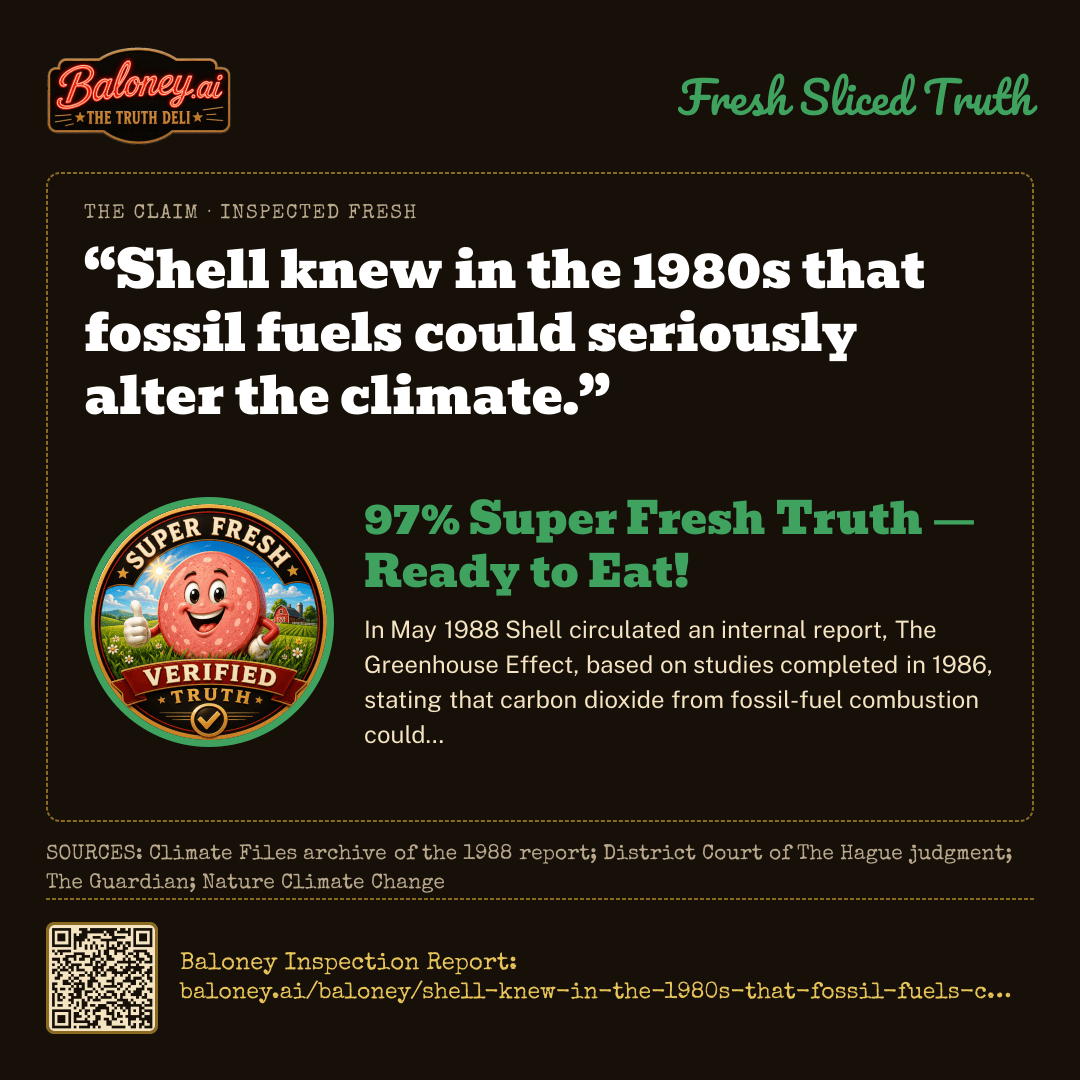
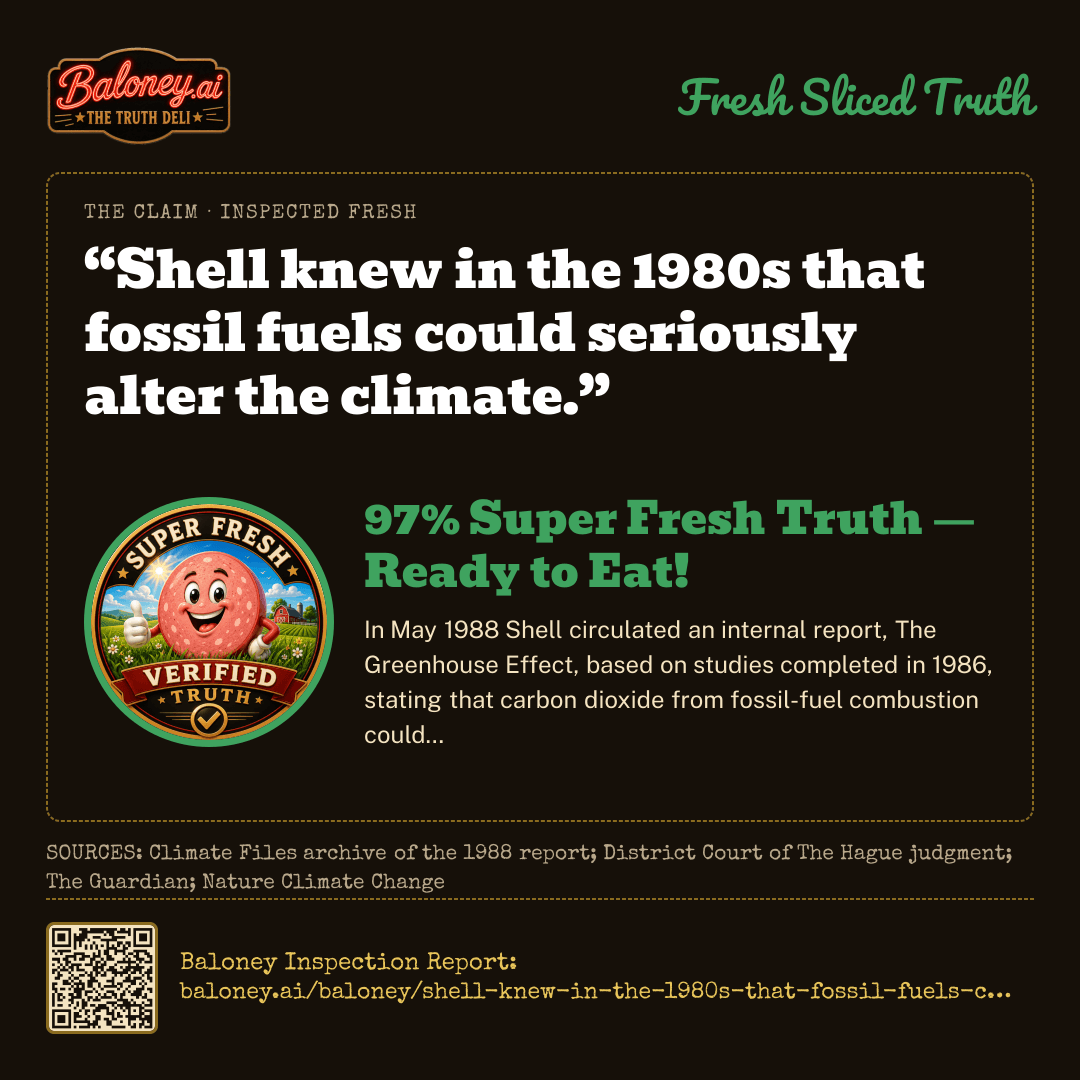
97%“Shell knew in the 1980s that fossil fuels could seriously alter the climate.”
97%Super Fresh Truth — Ready to Eat!
THE CLAIM CHECKS OUT.
Independently verifiedPhysically repeatable evidenceConfirmed across rival labsSafe to serve
Serve It Fresh
Ready to Serve11 servings
Serve it the way you want it
The Verdict
 “Shell knew in the 1980s that fossil fuels could seriously alter the climate.”97% Super Fresh Truth — Ready to Eat!Verified blind by 5 frontier AIs · Baloney Inspection Report: baloney.ai/baloney/shell-knew-in-the-1980s-that-fossil-fuels-could-seriously
The Baloney Sampler
Shell’s confidential 1988 report The Greenhouse Effect, based on 1986 internal studies, warned that CO2 from fossil-fuel burning could produce serious climate change, including sea-level rise, ecosystem disruption, and threats to agriculture and human habitats. Climate Files archives the report. The District Court of The Hague confirmed Shell held internal climate-change reports in the 1980s, including those 1986 and 1988 documents.
Nature Climate Change published peer-reviewed historical analysis finding that major fossil-fuel companies had this understanding of CO2-driven warming by the late 1970s and 1980s. The Guardian reported the same internal Shell warnings. Shell has not disputed the documents’ authenticity. Scientific uncertainty about exact timing and magnitude does not contradict the claim, which matches the reports’ own use of “could.”
Resting on Climate Files · District Court of The Hague · Nature Climate Change · The Guardian
Original Claim Source https://climateintegrity.org/uploads/deception/1988-Shell.pdf
Other ways to slice it — phrasings that might have changed the rating
- “Shell knew with certainty throughout the 1980s that fossil fuels would seriously alter the climate.” The documents used scenarios and flagged uncertainty about magnitude and timing, and the strongest evidence is concentrated in 1986–1988 rather than the whole decade.
- “Shell possessed unique secret science in the 1980s showing that fossil fuels could seriously alter the climate, beyond what the public scientific community already knew.” Evaluators found Shell’s internal work largely restated contemporaneous mainstream science rather than proprietary discovery.
- “Shell knew in the 1980s that fossil fuels could seriously alter the climate and used that knowledge to mislead the public while expanding production.” The inspected claim addresses knowledge only; the reports treat later communications, lobbying, and conduct as a separate inference the sentence itself does not establish.
Written from the panel’s reports by xAI · grok-4.6. Nothing here changed the score.
The Order Ticket
04:23:20CLAIM RECEIVED — QUEUED FOR INSPECTION✓
04:24:07claude-opus-5 REPORTED — SCORE 3, CONFIDENCE 92✓
04:23:49gpt-5.5 REPORTED — SCORE 2, CONFIDENCE 93✓
04:23:59gemini-3.1-pro-preview REPORTED — SCORE 2, CONFIDENCE 98✓
04:23:29sonar-pro REPORTED — SCORE 4, CONFIDENCE 90✓
04:25:15grok-4.6 REPORTED — SCORE 4, CONFIDENCE 78✓
04:26:41PRIMARY MASTER GROK — SCORE 3✓
04:25:21BLIND VALIDATION GEMINI — SCORE 2✓
04:27:56AGREEMENT CONFIRMED — DELTA 1✓
04:27:56SCORING MODEL V2 — MEDIAN OF 5 COUNTED LAB SCORES: 3, 2, 2, 4, 4 → 3. FRESH RULE: THE PRIMARY MASTER SCORES 3 AND THE BLIND MASTER 2 — BOTH SUPER FRESH TRUTH — AND THE COUNTED MEDIAN IS 3, ON THE TRUE SIDE. PUBLISHED AS 3, THE MORE CAUTIOUS OF THE TWO MASTERS.✓
04:27:56SOURCE RULE — LABS CITED 20 SOURCES: 0 DISCARDED FOR HAVING NO URL, 4 DISCARDED AS DEAD LINKS (404/410), 3 COULD NOT BE OPENED BY US AND ARE MARKED UNVERIFIED.✓
04:27:56SOURCE RULE — PRIMARY MASTER RULED ON 11 SOURCES: 0 DISCARDED FOR HAVING NO URL, 0 DISCARDED AS DEAD LINKS, 3 MARKED UNVERIFIED, 8 VERIFIED.✓
How This One Was Sliced
Station 1 · Blind Inspection — Five Graders, Zero Peeking
Each lab scored the claim independently, without seeing the others. Open a breakdown for its evidence, its sources, and how sure it was.
Anthropic · EQUAL WEIGHT · 47.0s
claude-opus-5
97%TRUTH
ROUND-1 BREAKDOWN
Evidence offered for the claim- Shell's own confidential internal report 'The Greenhouse Effect' (Shell Internationale Petroleum Maatschappij, Greenhouse Effect Working Group, May 1988) explicitly warned that CO2 from fossil fuel combustion could raise global temperatures, that changes could be 'the greatest in recorded history,' and that effects could include sea-level rise, altered precipitation, agricultural disruption and the need to defend low-lying areas such as the Netherlands. The document is publicly archived.
- The 1988 report estimated the contribution of Shell's own products to global CO2 emissions (roughly 4% of the global total from fossil fuels in 1984), showing the company linked its own business to the warming problem rather than treating it as abstract.
- The same report advised that 'by the time the global warming becomes detectable it could be too late to take effective countermeasures,' indicating the company understood the stakes and the lag in response time.
- Shell produced an internal/educational film, 'Climate of Concern' (1991), that told viewers global warming driven by fossil fuel use could bring famine, floods and refugee crises, and described the scientific consensus as a serious warning — evidence the knowledge extended into corporate communications at the turn of the decade.
- Earlier Shell internal work dates to at least 1986 ('The Greenhouse Effect' study/drafts), consistent with the claim that the knowledge existed during the 1980s, not only afterwards.
- Historians of the industry (e.g., Benjamin Franta) have documented that oil companies including Shell received internal and industry-body warnings about CO2 and warming well before 1988, and that this knowledge was more advanced and specific than their later public messaging implied.
- Shell has not disputed the authenticity of the leaked documents; its public response has been that the science at the time was uncertain and in the public domain — i.e., it concedes it had the information.
Evidence against the claim- The word 'knew' is stronger than the documents' own language: Shell's 1988 report repeatedly flags scientific uncertainty about magnitude, timing and regional effects, and frames projections as scenarios rather than established fact.
- Shell was not uniquely privy to secret science. By 1979–1988 the Charney Report, the US National Academy of Sciences, the WMO/Villach conferences and James Hansen's 1988 Senate testimony had made similar conclusions public, so Shell's internal documents largely restate contemporaneous mainstream science rather than proprietary knowledge.
- The claim as worded is silent on what Shell did with that knowledge; the controversy (funding doubt, lobbying, expanding production) is an inference many readers add, not something the sentence itself establishes.
- Some popular retellings compress dates — the most-cited documentary evidence is from 1986–1988 and the film from 1991 — so 'in the 1980s' is accurate but rests mainly on the second half of the decade.
How sure this lab was92/100 — the lab’s own confidence in the score above, not a second reading of the claim.
SourcesClimate Files (Climate Investigations Center)other · 72 · The Guardian (Benjamin Franta)news · 80 · Climate Files (Climate Investigations Center)other · 70 · Nature Climate Changejournal · 92
OpenAI · EQUAL WEIGHT · 28.7s
gpt-5.5
98%TRUTH
ROUND-1 BREAKDOWN
Evidence offered for the claim- Shell’s own 1988 internal report, “The Greenhouse Effect,” stated that CO2 from fossil-fuel combustion was a major driver of the greenhouse effect and warned of potentially serious consequences, including significant warming, sea-level rise, ecosystem disruption, and social/economic impacts. Source: https://www.climatefiles.com/shell/1988-shell-report-greenhouse/
- A Dutch court, summarizing Shell’s internal history, noted that Shell had internal climate-change reports in the 1980s, including a 1986 report and the 1988 “The Greenhouse Effect” report, showing Shell was aware of the possible climate risks associated with fossil-fuel use. Source: https://uitspraken.rechtspraak.nl/details?id=ECLI:NL:RBDHA:2021:5339
- The Guardian reported on Shell’s 1980s internal documents and described them as warning that fossil-fuel CO2 emissions could cause warming and serious climate-related harms. Source: https://www.theguardian.com/environment/climate-consensus-97-per-cent/2018/sep/19/shell-and-exxons-secret-1980s-climate-change-warnings
- Peer-reviewed historical analysis of oil-industry climate knowledge finds that by the late 1970s and 1980s major fossil-fuel companies had access to scientific understanding that fossil-fuel CO2 emissions could cause global warming. Source: https://www.nature.com/articles/s41558-018-0349-9
Evidence against the claim- The claim should not be read as saying Shell had certain, proprietary proof in the 1980s of the exact magnitude or timing of future climate change. The science at the time was probabilistic and contained uncertainties, as reflected in early IPCC assessments. Source: https://www.ipcc.ch/report/ar1/wg1/
- The strongest evidence shows Shell knew fossil-fuel emissions could seriously alter the climate, not necessarily that every Shell executive accepted all projections or that Shell had uniquely advanced knowledge beyond the broader scientific literature.
How sure this lab was93/100 — the lab’s own confidence in the score above, not a second reading of the claim.
SourcesClimate Filesother · 82 · District Court of The Hague / Rechtspraakgov · 92 · The Guardiannews · 85 · Nature Climate Changejournal · 94 · Intergovernmental Panel on Climate Changegov · 95
Google · EQUAL WEIGHT · 39.4s
gemini-3.1-pro-preview
98%TRUTH
ROUND-1 BREAKDOWN
Evidence offered for the claim- In 2018, journalists unearthed a confidential 1988 internal report produced by Shell titled 'The Greenhouse Effect'.
- The 1988 report, which was based on internal company studies dating back to 1986, explicitly acknowledged that burning fossil fuels releases CO2 that could lead to significant global warming.
- Shell's internal document warned of severe potential consequences from this warming, including sea-level rises of up to 3.5 meters, significant shifts in global ecosystems, and drastic impacts on human habitats, proving the company understood the potential for fossil fuels to 'seriously alter the climate' during the 1980s.
Evidence against the claim- The fundamental science of the greenhouse effect was already established and publicly discussed in the broader academic and scientific community well before the 1980s, meaning Shell's knowledge was largely a synthesis of existing scientific consensus rather than exclusive or secret discoveries.
- Shell's internal documents from the 1980s noted that climate models of the era possessed significant uncertainties regarding the exact timing and magnitude of global warming, though this does not contradict the claim that they knew it 'could seriously alter' the climate.
How sure this lab was98/100 — the lab’s own confidence in the score above, not a second reading of the claim.
SourcesClimate Filesother · 95 · The Guardiannews · 85
Perplexity · EQUAL WEIGHT · 9.2s
sonar-pro
96%TRUTH
ROUND-1 BREAKDOWN
Evidence offered for the claim- Shell commissioned internal research on the greenhouse effect beginning in 1981, and a 1988 confidential report based on work completed in 1986 stated that fossil-fuel burning was considered the main cause of rising atmospheric CO2.[1][2]
- The 1988 report reportedly concluded that increased greenhouse gases would cause global warming and warned that the consequences could include major impacts on living standards, food supplies, economies, politics, flooding, sea-level rise, and migration.[1][3]
- Shell researchers warned that waiting until climate change was conclusively detectable could leave too little time for effective countermeasures, indicating awareness of serious risk rather than merely abstract scientific uncertainty.[4]
- The claim is consistent with the broader scientific state of knowledge available in the 1980s: Shell's internal assessments relied on established greenhouse-effect research and projected substantial warming from rising CO2 concentrations.[2][5]
Evidence against the claim- The wording 'knew' can overstate the certainty available at the time. Shell's reports described projections, ranges, and scientific uncertainty; they did not establish that every consequence or timing was known with certainty.[1][2]
- The strongest publicly documented evidence cited here concerns Shell's knowledge by 1988, especially a report based on 1986 work. It does not by itself prove that every part of Shell, or Shell's senior leadership, had the same understanding throughout the entire 1980s.[1][3]
- Evidence that Shell understood the risk is not identical to evidence that the company knowingly misled the public during the 1980s. The claim addresses knowledge, not subsequent communications or conduct.
How sure this lab was90/100 — the lab’s own confidence in the score above, not a second reading of the claim.
SourcesInside Climate Newsnews · 91 · Scientific Americannews · 94 · CBC Newsnews · 92 · The Conversationedu · 87
xAI · EQUAL WEIGHT · 114.4s
grok-4.6
96%TRUTH
ROUND-1 BREAKDOWN
Evidence offered for the claim- A confidential 1988 Shell report titled The Greenhouse Effect stated that CO2 from fossil-fuel burning could produce detectable climate change, possibly too late to reverse, with serious effects such as sea-level rise and weather disruption.
- Shell internal assessments and later public materials (including a 1991 film built on 1980s research) treated the climate risk from continued fossil-fuel use as a real possibility requiring attention.
- This internal awareness coincided with, and drew on, the same emerging scientific literature that produced James Hansen’s 1988 testimony and the founding of the IPCC.
Evidence against the claim- 1980s climate projections still carried large uncertainties about magnitude, timing and regional impacts; Shell’s documents described a possibility (“could”), not a proven outcome.
- By 1988 the same risk was already being discussed in open scientific and policy forums, so Shell’s knowledge was not uniquely secret or ahead of the public scientific community.
- Later Shell statements sometimes stressed remaining uncertainties, which does not erase the earlier recognition of the risk but shows the company did not treat the science as fully settled.
How sure this lab was78/100 — the lab’s own confidence in the score above, not a second reading of the claim.
SourcesCenter for International Environmental Lawother · 68
Station 2 · The Masters
Primary Master · drawn at random
grok-4.6
97% TRUTH
All five evaluators placed the claim in the 2–4 range, i.e. Super Fresh Truth. The decisive evidence is Shell’s own confidential 1988 report The Greenhouse Effect (based on 1986 internal studies), which stated that CO2 from fossil-fuel burning could produce serious, possibly irreversible climate change including sea-level rise and weather disruption; a 1991 company film and a Dutch court summary of 1980s internal reports corroborate the same awareness. The word “could” in the claim matches the documents’ language. Caveats about remaining scientific uncertainty, non-unique public science, and late-1980s dating are real but do not make the statement false as written. Primary archived documents and the court record were weighted most heavily; news and historical papers were treated as corroboration only.
Evaluators unanimously treated the claim as substantially true (scores 2, 2, 3, 4, 4). They agreed on the authenticity and content of the 1986–1988 Shell reports. They differed only on how heavily to weigh contemporaneous uncertainty and the fact that similar science was already public; none regarded those points as enough to leave the true band.
SUPER FRESH — VERIFIED AGAINST CLIMATE FILES ARCHIVE OF THE 1988 REPORT; DISTRICT COURT OF THE HAGUE JUDGMENT; THE GUARDIAN; NATURE CLIMATE CHANGE
Blind Validation Master · never saw the Primary’s work
gemini-3.1-pro-preview
98% TRUTH
All five independent evaluators found overwhelming documentary evidence supporting the claim. Internal company documents, most notably a 1988 report titled 'The Greenhouse Effect' (based on internal studies from 1986), show that Shell explicitly recognized the risks of CO2 emissions from fossil fuels. The company's own research concluded that burning fossil fuels could lead to significant global warming with severe consequences, including sea-level rise, disrupted ecosystems, and threats to agriculture and human habitats. While Shell's internal documents noted scientific uncertainties regarding the exact timing and magnitude of climate change, the claim accurately uses the word 'could' to reflect the probabilistic nature of their warnings. The evidence overwhelmingly confirms that Shell was fully aware of the serious potential climate impacts of its products during the 1980s.
AGREEMENT TEST PASSED — MASTERS SCORED 97% AND 98% · BLIND VALIDATION CONFIRMED THIS SCORE · NO RE-EVALUATION REQUIRED
How the number was reached · scoring model v2 · how our models work
- Median of 5 counted lab scores: 3, 2, 2, 4, 4 → 3.
- Fresh rule: the Primary Master scores 3 and the Blind Master 2 — both Super Fresh Truth — and the counted median is 3, on the true side. Published as 3, the more cautious of the two masters.
The Evidence
Evidence for the claim
- 1988 confidential report warned of serious effects Shell’s May 1988 internal report The Greenhouse Effect, based on 1986 studies, stated that CO2 from fossil-fuel burning could produce detectable climate change possibly too late to reverse, with sea-level rise, weather disruption, agricultural impacts and the need to defend low-lying areas such as the Netherlands.
- Company linked its own products to the problem The same report estimated Shell’s products contributed roughly 4% of global fossil-fuel CO2 in 1984 and warned that waiting until warming became detectable could leave too little time for effective countermeasures.
- Awareness spanned internal work, a 1991 film and later court findings Internal greenhouse-effect research dated from at least 1981–1986; Shell’s 1991 film Climate of Concern described fossil-fuel-driven risks including famine, floods and refugees; a Dutch court later recorded Shell’s 1980s internal climate reports. Shell has not disputed the documents’ authenticity.
Evidence offered against the claim
- Documents used “could” and flagged uncertainty 1980s projections carried large uncertainties about magnitude, timing and regional impacts; Shell’s reports framed scenarios rather than proven outcomes and repeatedly noted remaining scientific uncertainty.
- Knowledge was not secret or unique By 1979–1988 similar conclusions were already public via the Charney Report, NAS, Villach conferences and Hansen’s 1988 testimony, so Shell’s internal work largely restated contemporaneous mainstream science.
- Timing and scope have modest caveats The strongest cited documents are from 1986–1988 (late in the decade) and the claim itself does not address later company conduct or whether every executive accepted every projection.
Sources · Reliability · Why Accepted or Discounted
| Source | Type | Reliability | Ruling |
|---|
| Center for International Environmental Lawunverified | other | 68 | ACCEPTED — Advocacy compilation, but it accurately points to the same internal Shell documents the other sources archive. |
| Climate Files | other | 85 | ACCEPTED — Primary public archive of the 1988 Shell report itself; multiple evaluators treated it as the core documentary source. |
| The Guardian | news | 85 | ACCEPTED — Contemporary reporting that quotes and contextualises the leaked 1980s Shell documents. |
| Climate Files | other | 70 | ACCEPTED — Index of Shell climate documents; used only as supporting context for the 1988 report. |
| Nature Climate Change | journal | 93 | ACCEPTED — Peer-reviewed historical analysis of oil-industry climate knowledge in the 1970s–1980s. |
| District Court of The Hague / Rechtspraak | gov | 92 | ACCEPTED — Official court summary confirming Shell held internal climate-change reports in the 1980s, including 1986 and 1988 documents. |
| Intergovernmental Panel on Climate Change | gov | 95 | ACCEPTED — Used solely for the contemporaneous-uncertainty context, not to contradict Shell’s internal warnings. |
| Inside Climate Newsunverified | news | 91 | ACCEPTED — Reporting on the same 1980s Shell documents and related litigation. |
| Scientific American | news | 94 | ACCEPTED — Independent summary of Shell’s 1980s internal climate assessments. |
| CBC Newsunverified | news | 92 | ACCEPTED — Corroborating news account of the unearthed Shell documents. |
| The Conversation | edu | 87 | ACCEPTED — Academic explainer quoting industry documents in their own words. |
Every link was opened when this claim was inspected. A dead link was discarded before publication; “unverified” means the site refused our automated check and the link is the one the panel cited. A source without a URL was never kept.
Serve It Fresh
Ready to Serve11 servings
Serve it the way you want it
The Verdict
“Shell knew in the 1980s that fossil fuels could seriously alter the climate.”97% Super Fresh Truth — Ready to Eat!Verified blind by 5 frontier AIs · Baloney Inspection Report: baloney.ai/baloney/shell-knew-in-the-1980s-that-fossil-fuels-could-seriously