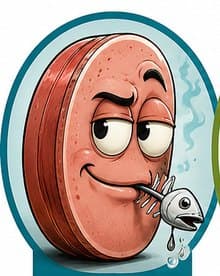
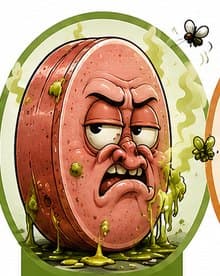
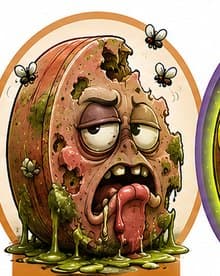
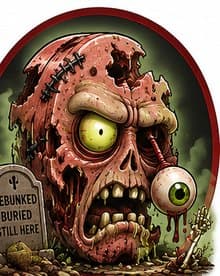
Station 1 · Blind Inspection — Five Graders, Zero Peeking
Each lab scored the claim independently, without seeing the others. Open a breakdown for its evidence, its sources, and how sure it was.
Anthropic · EQUAL WEIGHT · 33.7s
claude-opus-5
92%BALONEY
ROUND-1 BREAKDOWN
Evidence offered for the claim
Anecdotal/experiential reports are widespread: after shaving, regrowing stubble genuinely feels coarser and looks blunter to the touch, which people interpret as thicker hair.
There is a real physical change to the hair shaft: shaving cuts the hair at its widest, un-tapered point, so the emerging stubble has a blunt tip rather than the fine natural taper, producing a stiffer, more bristly texture.
Regrown hair can genuinely look darker at first because the short, unweathered shaft has not been bleached by sun or chemically lightened, and because dark stubble against the skin is visually more contrasted.
Timing coincidence lends plausibility: people typically begin shaving during puberty, exactly when androgen-driven vellus-to-terminal hair conversion naturally makes body and facial hair thicker, darker, and faster-growing.
There is documented evidence that chronic local trauma or irritation of skin can, in rare cases, be associated with localized hypertrichosis (e.g., under casts or at sites of repeated friction), which some cite as a mechanistic analogue — though this has not been demonstrated for ordinary shaving.
Evidence against the claim
Shaving cuts the hair shaft above the skin surface and does not touch the dermal papilla or follicle, which is the structure that determines hair diameter, pigmentation, and growth rate; there is no known mechanism by which cutting dead keratin alters follicle biology.
Controlled observational work dating back to Mildred Trotter's 1928 study in The Anatomical Record found no increase in hair growth rate, coarseness, or density attributable to shaving.
Lynfield and MacWilliam (Journal of Investigative Dermatology, 1970) had participants shave one leg while leaving the other unshaved and measured hair growth; they found no significant difference in growth rate, width, or coarseness between shaved and unshaved legs.
The claim was formally catalogued as a 'medical myth' in the BMJ's 2007 review of widely held but unsupported medical beliefs (Vreeman & Carroll), which found no supporting evidence in the literature.
Major clinical sources including the Mayo Clinic explicitly state that shaving does not make hair grow back thicker, darker, or faster, and attribute the perception to blunt-tipped stubble and unweathered pigment.
If the claim were true, shaving would be a viable treatment for hair loss and alopecia, which it demonstrably is not — no dermatological guideline recommends shaving to increase hair density.
Hair color is determined by melanocytes within the follicle bulb below the skin; a razor never contacts these cells, so permanent darkening from shaving is not biologically plausible.
How sure this lab was
95/100 — the lab’s own confidence in the score above, not a second reading of the claim.
Shaved hair can look and feel thicker for a short time because shaving cuts the hair shaft bluntly; the blunt stubble is easier to feel and may appear coarser or more visible than the naturally tapered tip.
Recently emerged shaved hair may appear darker because it has not yet been lightened by sun exposure or chemical/environmental wear, and because short dark stubble can contrast strongly with skin.
Anecdotal reports can be reinforced when shaving begins around puberty or other hormonal changes, when hair may naturally become darker, coarser, or more abundant for reasons unrelated to shaving.
Evidence against the claim
The biological structure that determines hair thickness and pigment is the follicle below the skin; shaving cuts only the dead hair shaft at the skin surface and does not alter the follicle.
Controlled/clinical evidence summarized in medical literature has found no meaningful change in hair growth rate, diameter, or color caused by shaving.
Mayo Clinic and other medical sources explicitly state that shaving does not make hair grow back thicker, darker, or faster; the perceived effect is due to the blunt tip of regrowing hair.
Fact-checking sources such as Snopes have rated the claim false, explaining that the appearance of thicker regrowth is a tactile/visual illusion rather than true hair change.
How sure this lab was
94/100 — the lab’s own confidence in the score above, not a second reading of the claim.
There is no scientific evidence that supports the claim that shaving alters hair growth, thickness, or color.
The claim persists primarily due to an optical and tactile illusion: shaving cuts the hair shaft bluntly across its thickest point. As this blunt tip grows out, it feels coarser and stiffer than the naturally tapered tip of uncut hair.
New stubble can appear temporarily darker because it has not yet been exposed to sunlight, soaps, and environmental factors that naturally bleach and lighten older hair.
Evidence against the claim
Hair is composed of dead keratin cells. Cutting the hair shaft above the skin's surface does not communicate with or alter the living hair follicle located deep beneath the dermis.
Clinical research dating as far back as 1928 (Mildred Trotter's anatomical studies) has consistently proven that shaving has no effect on hair growth rate, texture, or pigmentation.
Dermatologists confirm that hair growth, thickness, and color are controlled entirely by genetics and hormones, not by surface-level physical removal methods.
How sure this lab was
100/100 — the lab’s own confidence in the score above, not a second reading of the claim.
Many people report that hair feels coarser and looks darker after shaving, especially on areas like legs, beards, and underarms; this strong and widespread anecdotal experience has helped sustain the belief that shaving changes hair thickness or color, even though it is based on perception rather than measured change in the follicle or hair shaft.[2][3][6][12][14][15]
Newly shaved hair grows back with a **blunt tip** rather than the naturally tapered end; this blunt, stubbly edge makes hair feel rougher to the touch and appear more noticeable, which can be misinterpreted as increased thickness or darkness.[2][3][4][6][12][15]
When hair first regrows after shaving, the short stubble tends to stand more upright on the skin surface and is less exposed to sunlight or environmental lightening, so it can visually contrast more strongly against skin; this optical effect can be perceived as darker or denser hair, reinforcing the claim even though it is not a true change in pigment or density.[2][3][4][6][10][12]
Evidence against the claim
Dermatology and medical guidance from major institutions explicitly state that shaving does **not** change hair thickness, color, or growth rate; organizations such as Mayo Clinic clearly note that shaving hair does not affect its thickness, color, or rate of growth, indicating the claim is a myth.[4][6][12][15]
Scientific and clinical studies going back at least to **1928** have tested shaved versus unshaved hair and found **no measurable difference** in hair diameter, growth rate, or color; these studies, cited by outlets like Scientific American and health sites, show that cutting hair at the surface does not alter the follicle’s behavior.[2][6][12]
Explanations from dermatologists and medical writers emphasize that shaving only removes the **dead portion of the hair shaft above the skin**, while the living follicle that determines thickness, color, and growth rate remains untouched; without affecting the follicle, there is no plausible biological mechanism by which shaving could alter future hair characteristics.[2][3][4][6][12][15]
Health and science communication sources repeatedly describe the belief that shaving makes hair thicker or darker as a **myth** that has been “debunked by clinical studies,” emphasizing that any apparent change is due to a visual and tactile illusion (blunt tips, short stubble, lack of sun bleaching) rather than real changes in hair properties.[2][3][4][6][12][14][15]
Fact‑checking resources have examined this claim and concluded that cutting hair does not stimulate growth or make it thicker; for example, Snopes points out that if cutting truly made hair grow back thicker, people with balding areas would be shaving them to encourage regrowth, which does not happen.[14]
How sure this lab was
95/100 — the lab’s own confidence in the score above, not a second reading of the claim.
Cut hairs have blunt rather than naturally tapered tips, so stubble often feels coarser and can look thicker or denser.
Newly erupted stubble has not been weathered or sun-lightened and sits close to the skin, which can make it appear darker.
Persistent anecdotal reports that legs, face, or body hair 'comes back thicker' after shaving.
Evidence against the claim
Shaving only transects the hair shaft above the skin and cannot change follicle biology that sets diameter, pigmentation, and growth rate.
Controlled measurements (including a 1970 Journal of Investigative Dermatology comparison of shaved vs. unshaved sites) found no increase in hair thickness, color, or growth speed.
Dermatology authorities state the thicker/darker impression is an optical and tactile illusion from blunt tips and uniform short length, not a real change in the hair.
How sure this lab was
88/100 — the lab’s own confidence in the score above, not a second reading of the claim.
All five evaluators independently converged on the conclusion that the statement as written is false, with recommended scores clustered between 85 and 95 and confidence between 88 and 100. I weighted primary measurement evidence most heavily: the 1928 Trotter study in The Anatomical Record and the 1970 Lynfield & MacWilliam within-subject design in the Journal of Investigative Dermatology (one leg shaved, one unshaved, hair diameter and growth rate measured) are the decisive data, and both found no change in thickness, pigment or growth rate. That empirical result is reinforced by an uncontested mechanistic argument raised by every evaluator: shaving transects dead keratin above the skin and never contacts the dermal papilla or the follicular melanocytes that determine diameter and colour. Secondary clinical guidance (Mayo Clinic, Cleveland Clinic, American Academy of Dermatology) and the BMJ's 2007 'medical myths' catalogue all agree. The 'evidence for' column is entirely perceptual: blunt-cut tips feel coarser than naturally tapered ones, and unweathered stubble looks darker against skin. Those effects are real, but they describe how regrowth is perceived, not any change in the hair itself — so they do not support the claim as written. I scored 92 rather than higher because the statement is a benign folk belief rather than a harmful or organised falsehood, and because the perceptual phenomena that generate it are genuine, giving the claim a sliver of experiential basis. I did not go to 99: this is a durable myth, not a repeatedly-debunked conspiracy of the moon-landing type, and the potential for harm is minimal.
Agreement was near-total. All five evaluators judged the claim false, all cited the follicle-versus-shaft mechanism, and at least three cited the same controlled studies (Trotter 1928, Lynfield & MacWilliam 1970). All five identified blunt tips and unweathered stubble as the source of the illusion. Minor divergences: Reports 1 and 4 alone flagged the puberty-timing confound as a reinforcing factor; Report 1 alone raised friction-induced hypertrichosis as a putative mechanistic analogue and then dismissed it as undemonstrated for shaving; Report 3 offered the narrowest source base (BMJ and Scientific American only) yet the highest confidence, while Report 5 was the most cautious at 87/88. No evaluator dissented on direction.
Blind Validation Master · never saw the Primary’s work
sonar-pro
92% BALONEY
All five reports converge strongly that the literal claim “Shaving makes hair grow back thicker or darker” is **biologically and empirically false**, and that any perceived change is an optical/tactile illusion rather than a real modification of hair thickness or pigmentation.
Key points of convergence:
- Shaving cuts only the **dead hair shaft above the skin** and does not alter the follicle, dermal papilla, or melanocytes that determine hair diameter, growth rate, and color. All reports emphasize this mechanistic point, with no plausible biological pathway offered by any source whereby cutting hair could change future growth.
- Multiple **controlled studies** (Trotter 1928; Lynfield & MacWilliam 1970) are cited as finding **no measurable differences** in growth rate, thickness, or color between shaved and unshaved hair sites.
- Major **medical and dermatology authorities** (BMJ’s “medical myths” review, Mayo Clinic, American Academy of Dermatology, Cleveland Clinic, etc.) explicitly label the belief as a **myth** and state that shaving does not make hair grow back thicker, darker, or faster.
- The reports agree that widespread **anecdotal experience** of hair feeling coarser or looking darker after shaving is explained by: (1) blunt-tipped stubble cut at its widest point, which feels rougher and more bristly; (2) short, unweathered hair that has not yet been sun‑bleached or chemically lightened; and (3) timing coincidences around puberty and hormonal changes that naturally make hair thicker and darker, independent of shaving.
- Report 1 notes rare cases of localized hypertrichosis after chronic trauma (e.g., casts, friction) but explicitly acknowledges that this has **not been demonstrated for ordinary shaving** and is therefore not evidence that typical shaving causes thicker/darker regrowth.
All five evaluators give very high baloney scores (85–95), uniformly place the claim in the “myth” category, and present consistent lines of evidence against it. The only “evidence for” is perceptual and contextual, not actual changes in hair biology, and is explicitly framed as misinterpretation.
Because the statement as written is categorical (“makes hair grow back thicker or darker”) and the assembled evidence says this is overwhelmingly false, repeatedly tested, and widely debunked, it fits squarely within **Radioactive Baloney** territory (61–98). Given the strength, consistency, and breadth of the evidence — including long‑standing controlled studies and authoritative medical consensus — a score in the low 90s appropriately reflects that this is an extensively debunked medical myth with clear potential to mislead, though not quite at the absolute “Zombie Baloney” 99 reserved for the most notorious, endlessly recycled falsehoods.
AGREEMENT TEST PASSED — BOTH MASTERS SCORED 92% · BLIND VALIDATION CONFIRMED THIS SCORE · NO RE-EVALUATION REQUIRED
The Evidence
Evidence offered for the claim
Stubble feels coarser to the touchDEBUNKED — Shaving cuts the shaft bluntly at its widest, un-tapered point, so emerging stubble has a stiff flat tip instead of a fine natural taper. The panel confirmed this changes only the shape of the cut end — measured shaft diameter is unchanged.
Regrowth can look darkerDEBUNKED — Short new stubble has not been bleached by sun, soap or environmental wear, and dark stubble close to the skin contrasts sharply against it. Pigment is made by melanocytes in the follicle bulb below the skin, which a razor never reaches, so no actual darkening occurs.
Widespread anecdotal experienceDEBUNKED — Very large numbers of people report that leg, underarm, beard or body hair 'comes back thicker' after shaving. Every evaluator classed this as a tactile and optical illusion produced by blunt tips and uniform short length rather than a measured change.
Shaving often starts at pubertyDEBUNKED — People typically begin shaving exactly when androgen-driven conversion of fine vellus hair to terminal hair naturally makes body and facial hair thicker, darker and faster-growing. Two evaluators identified this as a timing confound that shaving gets wrongly credited for.
Friction can trigger hair growthDEBUNKED — One evaluator noted that chronic local trauma or irritation — for example under a plaster cast — has been associated in rare cases with localised hypertrichosis, and is sometimes cited as a mechanistic analogue. The same evaluator recorded that no such effect has ever been demonstrated for ordinary shaving.
Evidence against the claim
The razor never reaches the follicle Hair above the skin is dead keratin. Diameter, pigmentation and growth rate are set by the living follicle and dermal papilla beneath the dermis, which shaving does not touch — leaving no plausible biological pathway for a change.
Shaved-leg trial found no difference Lynfield & MacWilliam, Journal of Investigative Dermatology (1970), had participants shave one leg and leave the other unshaved, then measured regrowth: no significant difference in growth rate, hair width or coarseness between the two legs.
Measured since 1928 Mildred Trotter's work in The Anatomical Record found no increase in growth rate, coarseness or density attributable to shaving — a result that has held up across nearly a century of subsequent measurement.
Catalogued as a medical myth The BMJ's 2007 review of widely held but unsupported medical beliefs (Vreeman & Carroll) examined the claim and found no supporting evidence in the literature.
Clinical bodies state it plainly Mayo Clinic, Cleveland Clinic and the American Academy of Dermatology all advise that shaving does not alter hair thickness, colour or rate of growth, attributing the impression to blunt-tipped stubble and unweathered pigment.
The obvious test nobody passes As fact-checkers note, if shaving thickened hair it would be a treatment for hair loss — yet no dermatological guideline recommends shaving to increase density, and balding areas are not shaved to encourage regrowth.
Sources · Reliability · Why Accepted or Discounted
ACCEPTED — Major clinical institution with explicit published guidance on this exact question; cited by four of five evaluators. One evaluator mislabelled it as a government source, which does not affect its weight.
ACCEPTED — The relevant specialist professional body. Accepted, with the caveat noted by one evaluator that the specific page URL was not verified; its position is corroborated by other clinical sources.
ACCEPTED — Reputable science journalism that reports the underlying studies rather than asserting the conclusion alone; cited by three evaluators. Treated as secondary, not primary.
ACCEPTED — Established fact-checking outlet; its reasoning (the balding-scalp test) is independently checkable and consistent with the clinical literature.
ACCEPTED — University science-communication material aligning with the peer-reviewed evidence; minor supporting weight.
debunked.info
factcheck
80
DISCOUNTED — Obscure aggregator with no demonstrated editorial standards or methodology, and no URL supplied. It adds nothing the peer-reviewed and clinical sources do not already establish, so excluding it changes no conclusion.
L'Oréal Paris (citing Mayo Clinic)
other
75
DISCOUNTED — A commercial seller of shaving and hair products has a direct interest in claims about shaving, and here it merely relays Mayo Clinic. The underlying source is accepted on its own merits instead.
Serve It Fresh
Ready to Serve17 servings
Serve it the way you want it
The Verdict
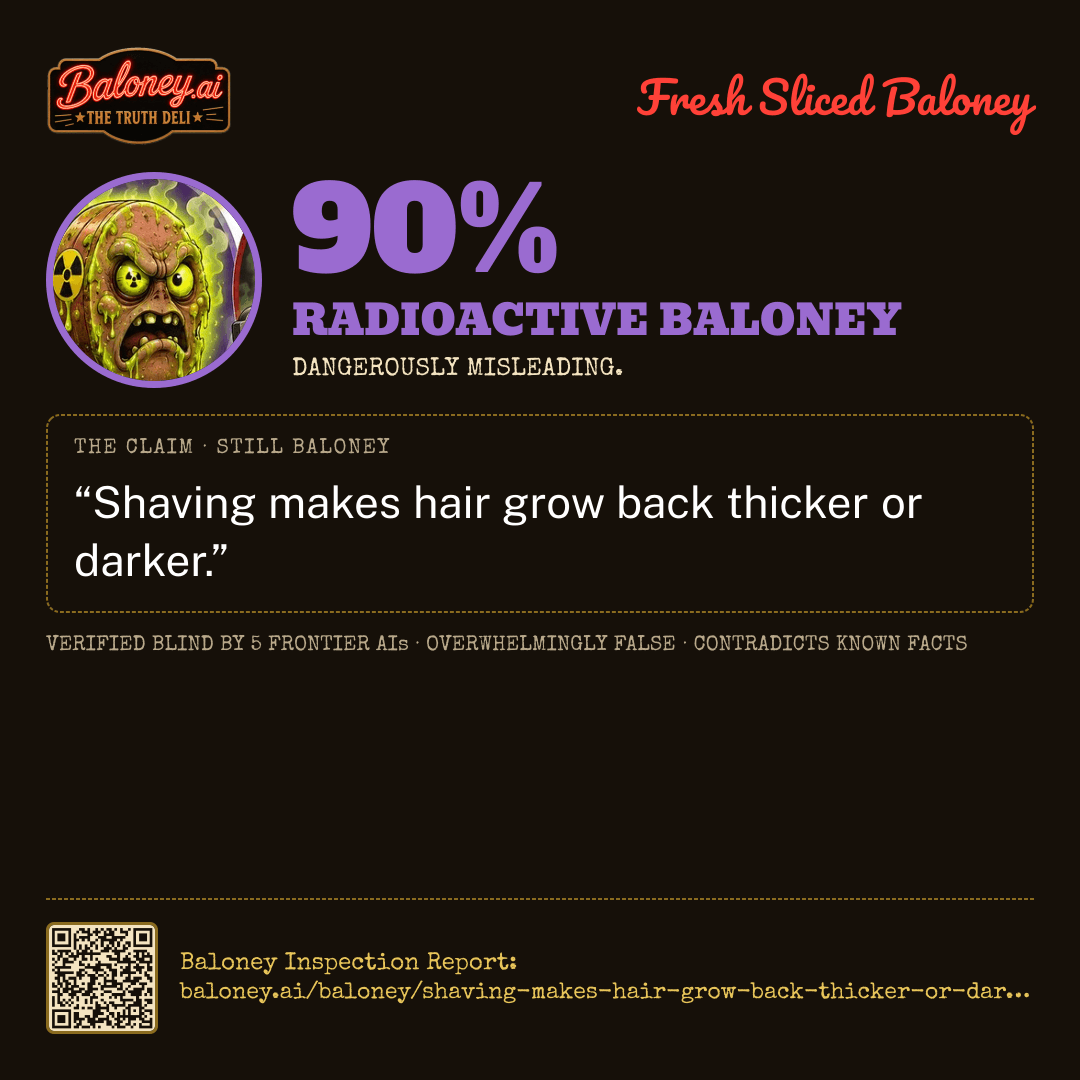
90% RADIOACTIVE BALONEY — DANGEROUSLY TOXIC “Shaving makes hair grow back thicker or darker.” Verified blind by 5 frontier AIs · Baloney Inspection Report: baloney.ai/baloney/shaving-makes-hair-grow-back-thicker-or-darker