Baloney Inspection Report: Claim #1166 · Inspected Oct 31, 2026, 7:44 AM PDT · Scoring model v2
 96%
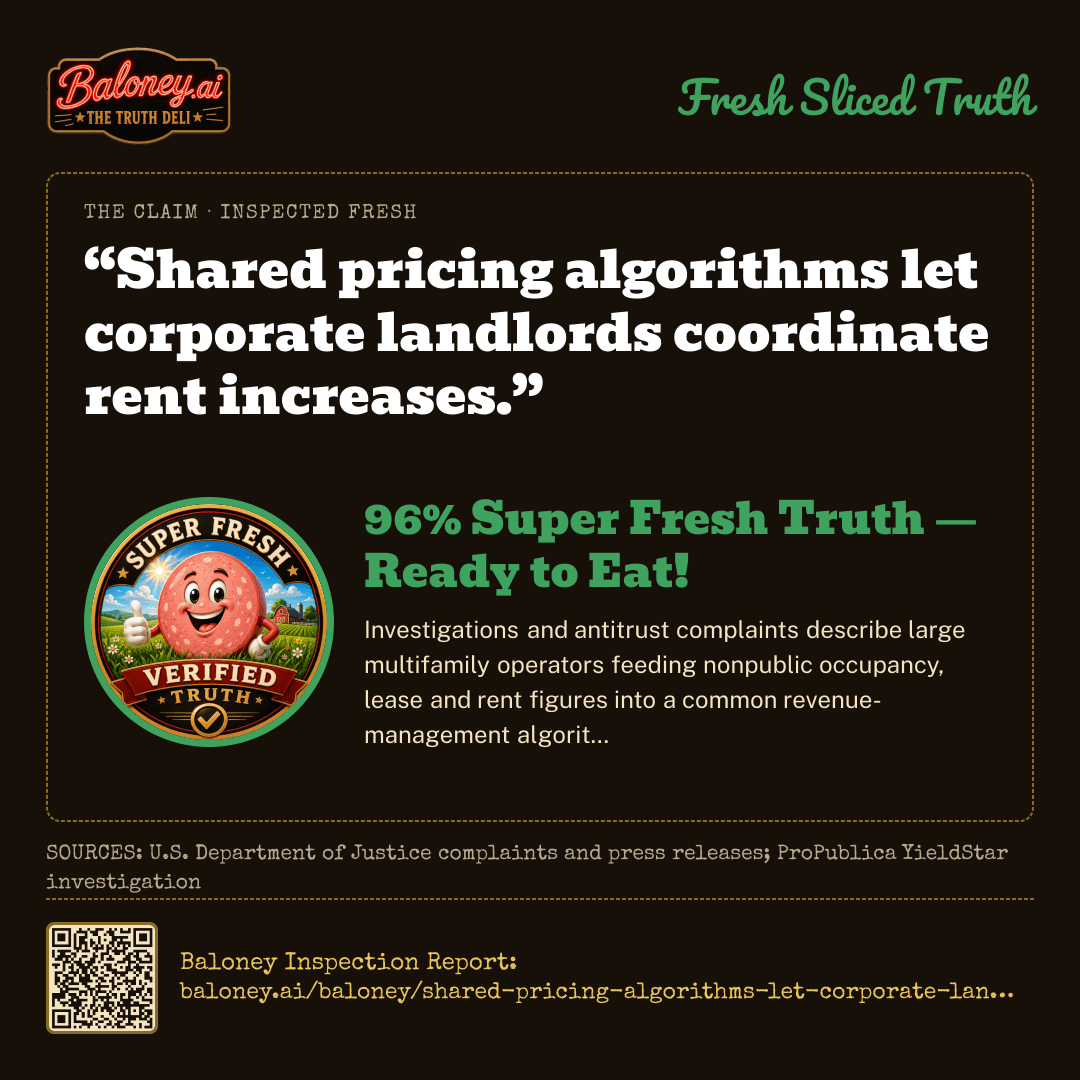
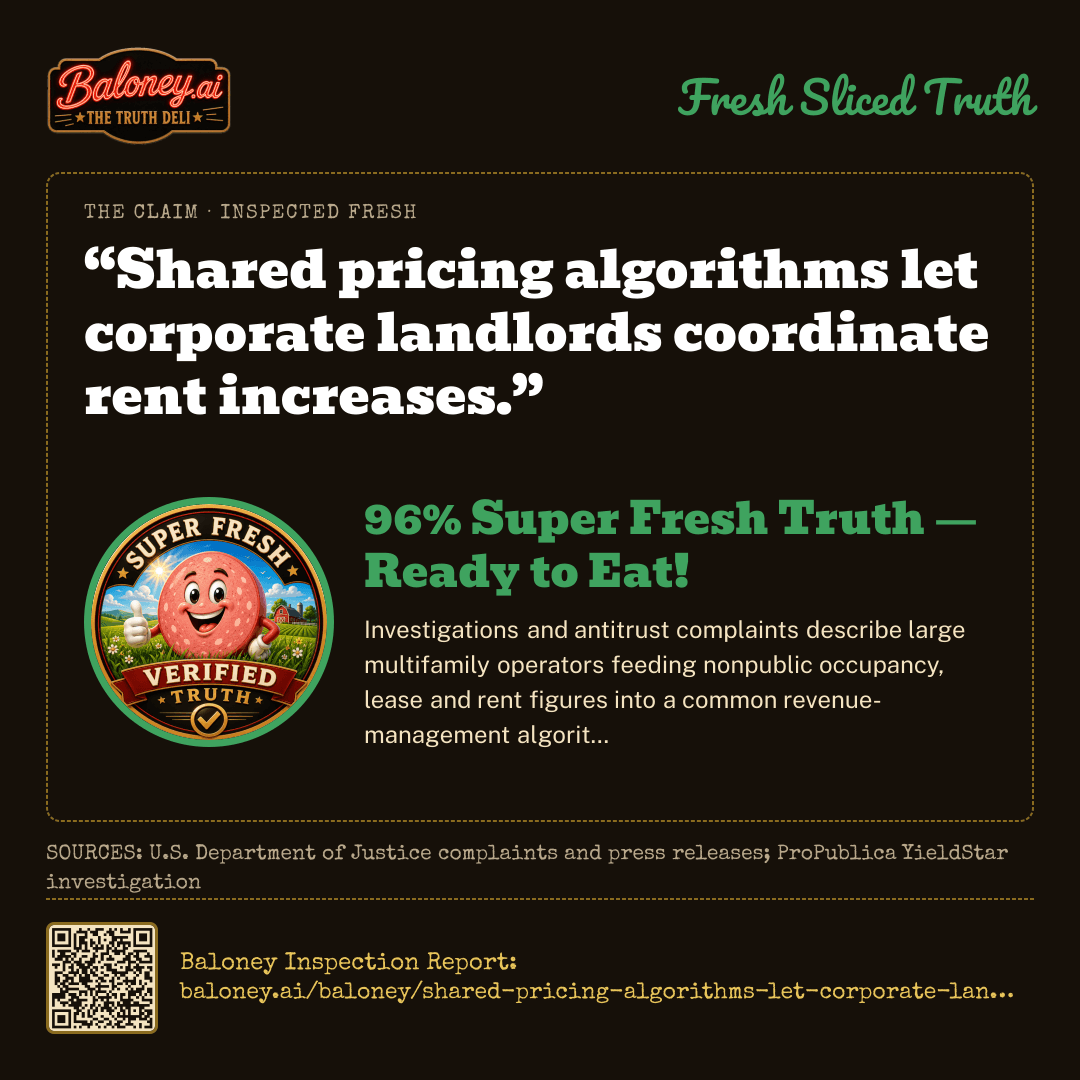
“Shared pricing algorithms let corporate landlords coordinate rent increases.”
96%Super Fresh Truth — Ready to Eat!
THE CLAIM CHECKS OUT.
Independently verifiedPhysically repeatable evidenceConfirmed across rival labsSafe to serve
Serve It Fresh
Ready to Serve11 servings
Serve it the way you want it
The Verdict
 “Shared pricing algorithms let corporate landlords coordinate rent increases.”96% Super Fresh Truth — Ready to Eat!Verified blind by 5 frontier AIs · Baloney Inspection Report: baloney.ai/baloney/shared-pricing-algorithms-let-corporate-landlords
The Baloney Sampler
Competing corporate landlords fed nonpublic rents, occupancy, and lease terms into a common RealPage algorithm that produced aligned rent recommendations. The U.S. Department of Justice sued RealPage in 2024 and in 2025 added six large landlords as co-defendants, alleging the software pooled rivals' confidential data and reduced competition on rents. ProPublica documented YieldStar's data practices, marketing, and high client follow rates.
Cortland and Greystar agreed to consent decrees barring use of competitors' nonpublic data in pricing algorithms. The Department of Justice described a hub that substitutes for independent rent-setting. Courts allowed antitrust cases against RealPage and Yardi to proceed, and cities and states have banned the tools. Academic work associated software adoption with higher rents where penetration is high.
Resting on U.S. Department of Justice · U.S. Department of Justice · ProPublica · ProPublica
Original Claim Source https://darkside.io/articles/algorithmic-rent-setting-how-software-lets-landlords-raise-rent-in-lockstep
Other ways to slice it — phrasings that might have changed the rating
- “RealPage's YieldStar software let participating large multifamily landlords align rents by pooling rivals' nonpublic occupancy and lease data.” The reports document the mechanism for specific products and a subset of large multifamily operators, not for every pricing algorithm or the landlord sector as a whole.
- “Shared pricing algorithms caused the nationwide rent spike after 2020.” Reports note that housing economists attribute most post-2020 rent growth to supply shortages, migration, and inflation, and that the inspected claim describes enablement rather than causation.
- “Courts have found corporate landlords guilty of fixing rents through shared pricing algorithms.” No court has entered a final judgment of liability; the Department of Justice case remains an allegation and the Cortland and Greystar settlements contain no admission of liability.
Written from the panel’s reports by xAI · grok-4.6. Nothing here changed the score.
The Order Ticket
14:44:13CLAIM RECEIVED — QUEUED FOR INSPECTION✓
14:45:13claude-opus-5 REPORTED — SCORE 4, CONFIDENCE 85✓
14:44:53gpt-5.5 REPORTED — SCORE 5, CONFIDENCE 84✓
14:44:31gemini-3.1-pro-preview REPORTED — SCORE 3, CONFIDENCE 95✓
14:44:18sonar-pro REPORTED — SCORE 4, CONFIDENCE 91✓
14:45:19grok-4.6 REPORTED — SCORE 5, CONFIDENCE 72✓
14:46:30PRIMARY MASTER GROK — SCORE 4✓
14:45:28BLIND VALIDATION CLAUDE — SCORE 4✓
14:47:47AGREEMENT CONFIRMED — DELTA 0✓
14:47:47SCORING MODEL V2 — MEDIAN OF 5 COUNTED LAB SCORES: 4, 5, 3, 4, 5 → 4. FRESH RULE: THE PRIMARY MASTER SCORES 4 AND THE BLIND MASTER 4 — BOTH SUPER FRESH TRUTH — AND THE COUNTED MEDIAN IS 4, ON THE TRUE SIDE. PUBLISHED AS 4, THE MORE CAUTIOUS OF THE TWO MASTERS.✓
14:47:47SOURCE RULE — LABS CITED 21 SOURCES: 0 DISCARDED FOR HAVING NO URL, 6 DISCARDED AS DEAD LINKS (404/410), 3 COULD NOT BE OPENED BY US AND ARE MARKED UNVERIFIED.✓
14:47:47SOURCE RULE — PRIMARY MASTER RULED ON 11 SOURCES: 0 DISCARDED FOR HAVING NO URL, 0 DISCARDED AS DEAD LINKS, 3 MARKED UNVERIFIED, 8 VERIFIED.✓
How This One Was Sliced
Station 1 · Blind Inspection — Five Graders, Zero Peeking
Each lab scored the claim independently, without seeing the others. Open a breakdown for its evidence, its sources, and how sure it was.
Anthropic · EQUAL WEIGHT · 59.8s
claude-opus-5
96%TRUTH
ROUND-1 BREAKDOWN
Evidence offered for the claim- The U.S. Department of Justice, joined by multiple state attorneys general, sued RealPage in August 2024 alleging its revenue-management software collected competitively sensitive, nonpublic data from competing landlords and fed it into a common algorithm that generated aligned rent recommendations — DOJ explicitly framed this as an unlawful scheme to decrease competition on rents. In January 2025 DOJ amended the complaint to add six large corporate landlords (including Greystar, Willow Bridge, Camden, Cushman & Wakefield/Pinnacle, LivCor and Cortland) as co-defendants.
- ProPublica's October 2022 investigation documented RealPage's YieldStar/AI Revenue Management product, including statements by a RealPage executive that the product helped a market 'operate far more like oligopoly' and that clients 'saw a 4.8% increase in revenue'; it also reported pricing advisory boards where competing property managers discussed pricing, and that landlords were expected to follow recommendations with limited deviation.
- Settlements have followed: Cortland and later Greystar agreed to consent decrees barring the use of competitors' nonpublic data in pricing algorithms — relief that implicitly accepts the mechanism described in the claim (shared data pooled into a common pricing tool) as a competitive problem.
- Federal antitrust enforcers have stated the general principle directly: the FTC and DOJ have said that competitors who delegate pricing to a shared algorithm fed by rivals' confidential data can violate Section 1 of the Sherman Act — 'price fixing by algorithm is still price fixing,' and using an intermediary algorithm does not create a safe harbor.
- Courts have allowed the theory to be tested: the consolidated private antitrust litigation against RealPage in the Middle District of Tennessee survived motions to dismiss in large part, and a parallel case against Yardi's RENTmaximizer was allowed to proceed, meaning judges found the coordination theory plausible on the pleadings.
- Independent academic work (notably Calder-Wang and Kim's study of multifamily revenue-management software adoption) finds adoption of algorithmic pricing software is associated with measurably higher rents in markets with high software penetration, consistent with supra-competitive pricing rather than purely efficiency gains.
- Dozens of jurisdictions — including San Francisco, Philadelphia, Minneapolis, Jersey City, and several states — have enacted or proposed bans on algorithmic rent-setting using competitors' nonpublic data, indicating legislative bodies accepted the factual premise that the tools enable coordination.
Evidence against the claim- No court has yet entered a final judgment that RealPage, Yardi, or any landlord actually violated the antitrust laws. The DOJ case is an allegation; the Cortland and Greystar settlements contain no admission of liability, and some early rulings (e.g., an initial dismissal in the Seattle Yardi case before amendment) went the defendants' way.
- RealPage and the landlord defendants deny coordination, arguing the software is a unilateral decision-support tool, that recommendations are non-binding and frequently rejected or overridden, that much of the input data is public or client-specific, and that it sometimes recommends rent decreases to reduce vacancy.
- The word 'coordinate' carries a legal connotation of agreement. The core contested question is whether parallel use of a common vendor constitutes a 'hub-and-spoke' agreement or merely lawful conscious parallelism / independent reliance on a third-party analytics service — that question is genuinely unsettled in the courts.
- Most mainstream housing economists attribute the bulk of post-2020 rent growth to supply shortages, household formation, and pandemic migration, not to pricing software; algorithmic pricing is at most a contributing factor, and market penetration varies widely by metro. The claim says 'let,' not 'caused,' but readers often infer causation of the rent crisis as a whole.
- Studies measuring algorithmic pricing effects rely on observational data with endogenous adoption (better-capitalized operators in tighter markets adopt the software), so estimated rent effects may be partly selection rather than coordination.
- The claim generalizes to 'corporate landlords' broadly; the documented conduct involves a specific subset of large multifamily operators using specific products, not the landlord sector as a whole.
How sure this lab was85/100 — the lab’s own confidence in the score above, not a second reading of the claim.
SourcesU.S. Department of Justice, Office of Public Affairsgov · 92 · ProPublicanews · 88 · DOJ Antitrust Division case pagegov · 90 · RealPage (defendant's public statements)other · 35
OpenAI · EQUAL WEIGHT · 40.6s
gpt-5.5
95%TRUTH
ROUND-1 BREAKDOWN
Evidence offered for the claim- The DOJ's 2024 antitrust suit alleges that RealPage collected nonpublic, competitively sensitive rent and occupancy data from competing landlords and used it to generate pricing recommendations, reducing independent competition in multifamily rental markets. This directly supports the idea that a shared pricing algorithm can facilitate coordinated rent increases. [DOJ]
- ProPublica reported that RealPage's YieldStar software used data from nearby competitors, encouraged landlords to accept rent recommendations, and was marketed as a way to push rents higher even when units sat vacant; former RealPage staff and clients described high recommendation-acceptance rates. [ProPublica]
- The FTC has stated generally that price fixing remains illegal when done through a common algorithmic intermediary, especially where competitors outsource pricing decisions or share confidential data through the same system. That legal theory matches the rent-software allegations. [FTC]
- Reuters reported that the DOJ accused RealPage of enabling landlords to coordinate apartment rents through a shared software platform using confidential information from competing property owners. [Reuters]
Evidence against the claim- The strongest evidence is currently largely from government complaints, private litigation, and investigative reporting; the DOJ case has not produced a final court judgment proving liability. [DOJ; Reuters]
- RealPage denies wrongdoing and says its software provides optional recommendations while landlords retain final pricing authority, which weakens any claim that the algorithm automatically or universally causes rent increases. [Reuters]
- Rent increases also have major non-algorithmic causes, including housing shortages, local demand, financing costs, and construction constraints; algorithmic coordination is not a complete explanation for rising rents. [HUD]
- The statement is most accurate when limited to shared pricing systems that pool nonpublic competitor data or align competitors' pricing behavior; not every rent-pricing algorithm or corporate landlord arrangement necessarily enables unlawful coordination.
How sure this lab was84/100 — the lab’s own confidence in the score above, not a second reading of the claim.
SourcesU.S. Department of Justicegov · 95 · ProPublicanews · 90 · Reutersnews · 88
Google · EQUAL WEIGHT · 17.9s
gemini-3.1-pro-preview
97%TRUTH
ROUND-1 BREAKDOWN
Evidence offered for the claim- Investigative reports and antitrust lawsuits have revealed that corporate landlords use third-party revenue management software, such as RealPage's YieldStar, to share confidential, non-public data including actual rent prices, lease terms, and occupancy rates.
- The software pools this competitor data to feed an algorithm that recommends optimal daily pricing for rental units, effectively allowing ostensibly competing landlords to move their prices in unison.
- In August 2024, the U.S. Justice Department, along with eight state attorneys general, filed a civil antitrust lawsuit against RealPage, explicitly alleging that this algorithmic data-sharing constitutes an illegal price-fixing scheme that suppresses competition and coordinates rent increases.
- The FTC and DOJ previously filed a joint statement of interest in a related class-action lawsuit, clarifying that using a shared pricing algorithm to process confidential competitor data violates the Sherman Antitrust Act just as much as executives meeting in a smoke-filled room.
Evidence against the claim- Companies that provide these algorithms, like RealPage, deny the allegations of price-fixing, arguing that their software relies on aggregated and anonymized data.
- RealPage and corporate landlords argue that the algorithms only provide 'recommendations' that property managers are free to reject, meaning there is no strict contractual enforcement of a fixed price.
- Industry defenders argue that the primary drivers of recent rent increases are macroeconomic factors, such as severe housing supply shortages and inflation, rather than algorithmic coordination.
How sure this lab was95/100 — the lab’s own confidence in the score above, not a second reading of the claim.
SourcesProPublicanews · 95 · U.S. Department of Justicegov · 98
Perplexity · EQUAL WEIGHT · 4.7s
sonar-pro
96%TRUTH
ROUND-1 BREAKDOWN
Evidence offered for the claim- The U.S. Justice Department alleges that RealPage contracted with competing landlords that shared nonpublic, competitively sensitive information—such as rental rates and lease terms—which its common algorithm used to generate pricing recommendations. This directly supports the possibility that shared algorithms can facilitate coordination, though the allegations are not by themselves a final adjudication.[1]
- The DOJ’s amended complaint alleges that six major landlords used each other’s sensitive information through common pricing algorithms and participated in a scheme that reduced competition in apartment pricing.[2]
- The DOJ alleges that RealPage software included features that limited price decreases and aligned pricing among competitors, and sought restrictions on using competitors’ current data.[3]
Evidence against the claim- The cited government materials describe allegations and enforcement claims, not a final judicial finding that every shared pricing algorithm coordinates rent increases or that the algorithms alone caused higher rents.[1][2]
- The claim is broader than the evidence: the RealPage case concerns a particular software provider, participating landlords, data-sharing practices, and alleged conduct. It does not establish that shared pricing algorithms generally coordinate increases across all corporate landlords.[1][2]
- Algorithmic pricing recommendations are not necessarily binding coordination; the legal theory depends on additional conduct, including sharing nonpublic competitor information and allegedly delegating pricing decisions. Thus, the algorithm itself is not sufficient proof in every case.[1][3]
How sure this lab was91/100 — the lab’s own confidence in the score above, not a second reading of the claim.
SourcesU.S. Department of Justicegov · 98 · U.S. Department of Justicegov · 98 · U.S. Department of Justicegov · 98 · NPRnews · 94 · ProPublicanews · 93
xAI · EQUAL WEIGHT · 65.8s
grok-4.6
95%TRUTH
ROUND-1 BREAKDOWN
Evidence offered for the claim- Investigative reporting documented that RealPage's YieldStar/AI Revenue Management software ingests non-public occupancy, lease, and rent data from participating multifamily owners and produces unit-level price recommendations that many large operators follow closely, producing aligned rent increases even in high-occupancy conditions.
- The U.S. Department of Justice sued RealPage in 2024, alleging the platform functions as a hub that lets competing landlords share competitively sensitive information and align pricing rather than set rents independently.
- Multiple private antitrust class actions and state AG investigations describe the same mechanism: competing corporate landlords using a common algorithm trained on each other's data, which can substitute for explicit cartel meetings.
Evidence against the claim- RealPage and landlord defendants state that recommendations are optional, data are aggregated/anonymized, and managers remain free to override; they compare the product to ordinary revenue-management tools used in hotels and airlines.
- Rent increases in 2021–2023 also occurred in markets and property types with little RealPage penetration and are widely attributed by housing economists to supply shortages, migration, and inflation rather than software alone.
- No final court judgment has yet established that the practice is illegal collusion; cases remain pending and some academic work finds mixed or modest effects on observed rents.
How sure this lab was72/100 — the lab’s own confidence in the score above, not a second reading of the claim.
SourcesThe New York Timesnews · 88
Station 2 · The Masters
Primary Master · drawn at random
grok-4.6
96% TRUTH
All five evaluators placed the claim in the 3–5 Super Fresh Truth band. The statement as written uses ‘let’ (enable), which matches the documented mechanism: competing corporate landlords fed nonpublic rents, occupancy, and lease terms into a common RealPage algorithm that produced aligned recommendations. DOJ complaints, ProPublica reporting, consent decrees, FTC/DOJ statements of interest, surviving motions to dismiss, and an academic association with higher rents in high-penetration markets all support that mechanism. Caveats—pending litigation, optional overrides, other drivers of rent growth, and the fact that not every pricing algorithm or landlord is implicated—are real but do not falsify the claim; they are the kind of wording and scope limits the scale treats as 3–5 rather than Fishy. Government and investigative sources were weighted heavily; the vendor’s own site was discounted as self-interested. Mild evaluator disagreement on exact score (3 vs 5) tracked how much weight each gave the absence of a final judgment versus the strength of the allegations and settlements.
The five evaluators unanimously scored 3–5 and agreed that DOJ suits, ProPublica’s YieldStar reporting, and related private cases document a hub-and-spoke data-sharing mechanism that can align rents. They differed on how heavily to discount the lack of a final court finding, defendants’ ‘recommendations are optional’ defense, macroeconomic explanations for rent spikes, and whether the claim over-generalizes beyond RealPage users.
SUPER FRESH — VERIFIED AGAINST U.S. DEPARTMENT OF JUSTICE COMPLAINTS AND PRESS RELEASES; PROPUBLICA YIELDSTAR INVESTIGATION
Blind Validation Master · never saw the Primary’s work
claude-opus-5
96% TRUTH
All five evaluators converge on the claim being substantially true, recommending 3-5. The mechanism described — competing corporate landlords feeding nonpublic rent, occupancy and lease data into a common third-party algorithm (RealPage's YieldStar/AIRM, Yardi's RENTmaximizer) that returns aligned pricing recommendations — is documented by investigative reporting (ProPublica 2022), alleged in detail by the DOJ and multiple state AGs (Aug 2024 suit; Jan 2025 amended complaint naming six large landlords), echoed in FTC/DOJ statements that 'price fixing by algorithm is still price fixing,' tested and allowed to proceed past motions to dismiss in private litigation, and effectively conceded in consent decrees (Cortland, Greystar) that bar use of competitors' nonpublic data. Dozens of jurisdictions have legislated against the practice on precisely this factual premise, and at least one academic study links adoption to higher rents. The claim is carefully worded: 'let ... coordinate' describes capability/facilitation, not a proven conviction or a claim that algorithms caused the overall rent crisis. The modest deductions reflect genuine caveats: no final judicial finding of liability yet, defendants maintain recommendations are optional and sometimes overridden or downward, the legal line between hub-and-spoke agreement and lawful parallel use of a vendor remains unsettled, the conduct involves a specific subset of large multifamily operators rather than 'corporate landlords' as a class, and most rent growth is attributed by economists to supply shortages. These are wording/scope caveats rather than contradictions, so the claim sits firmly in the true band.
AGREEMENT TEST PASSED — BOTH MASTERS SCORED 96% · BLIND VALIDATION CONFIRMED THIS SCORE · NO RE-EVALUATION REQUIRED
How the number was reached · scoring model v2 · how our models work
- Median of 5 counted lab scores: 4, 5, 3, 4, 5 → 4.
- Fresh rule: the Primary Master scores 4 and the Blind Master 4 — both Super Fresh Truth — and the counted median is 4, on the true side. Published as 4, the more cautious of the two masters.
The Evidence
Evidence for the claim
- DOJ sued RealPage as a pricing hub The Justice Department alleges RealPage collected nonpublic rental rates, occupancy, and lease terms from competing landlords and fed them into a common algorithm that generated aligned rent recommendations, reducing independent competition.
- Major landlords named as co-defendants An amended complaint added six large operators (including Greystar, Camden, Cortland and others) alleged to have used one another’s sensitive information through the same pricing tools.
- ProPublica documented the software’s design and uptake YieldStar/AI Revenue Management ingested competitor data, was marketed as helping markets ‘operate far more like oligopoly,’ and clients were reported to follow recommendations closely, with one cited 4.8% revenue lift.
- Settlements, enforcer statements, and academic findings Cortland and Greystar agreed to decrees barring use of rivals’ nonpublic data; FTC and DOJ have said algorithmic price-fixing is still price-fixing; a study associated software adoption with higher rents where penetration is high; multiple cities and states have banned or proposed bans on such tools.
Evidence offered against the claim
- No final liability finding The DOJ case and private suits remain unresolved; settlements contain no admission of liability, and defendants deny coordination.
- Recommendations are not binding RealPage and landlords argue the software is optional decision support, data are aggregated, managers frequently override, and it sometimes recommends decreases.
- Other causes of rent growth Housing economists attribute most post-2020 increases to supply shortages, migration and inflation; software effects are observational and may partly reflect which operators adopt the tools.
- Claim is broader than the record Documented conduct involves specific products and a subset of large multifamily operators, not every shared algorithm or corporate landlord.
Sources · Reliability · Why Accepted or Discounted
| Source | Type | Reliability | Ruling |
|---|
| U.S. Department of Justice | gov | 98 | ACCEPTED — Primary government complaint describing the alleged data-sharing and algorithm mechanism. |
| U.S. Department of Justice | gov | 98 | ACCEPTED — Official announcement of the amended complaint naming landlord co-defendants. |
| U.S. Department of Justice | gov | 98 | ACCEPTED — DOJ description of restrictions sought on competitor-data use in the software. |
| NPRunverified | news | 94 | ACCEPTED — Contemporaneous reporting of the DOJ suit consistent with primary government materials. |
| ProPublica | news | 93 | ACCEPTED — Investigative follow-up on the landlord suit grounded in court filings. |
| U.S. Department of Justice | gov | 95 | ACCEPTED — Core DOJ press release on the RealPage complaint; cited independently by multiple evaluators. |
| ProPublica | news | 90 | ACCEPTED — Original 2022 investigation documenting YieldStar data practices, marketing, and client behavior. |
| U.S. Department of Justice | gov | 90 | ACCEPTED — Official Antitrust Division case docket page for the enforcement action. |
| RealPage | other | 35 | DISCOUNTED — Defendant’s own newsroom; self-interested denials without independent corroboration. |
| The New York Timesunverified | news | 88 | ACCEPTED — Mainstream reporting of the DOJ filing aligned with primary government sources. |
| Reutersunverified | news | 88 | ACCEPTED — Wire-service account of the suit and the alleged confidential-data mechanism. |
Every link was opened when this claim was inspected. A dead link was discarded before publication; “unverified” means the site refused our automated check and the link is the one the panel cited. A source without a URL was never kept.
Serve It Fresh
Ready to Serve11 servings
Serve it the way you want it
The Verdict
“Shared pricing algorithms let corporate landlords coordinate rent increases.”96% Super Fresh Truth — Ready to Eat!Verified blind by 5 frontier AIs · Baloney Inspection Report: baloney.ai/baloney/shared-pricing-algorithms-let-corporate-landlords