Baloney Inspection Report: Claim #1131 · Inspected Oct 6, 2026, 9:23 PM PDT · Scoring model v2
 92%
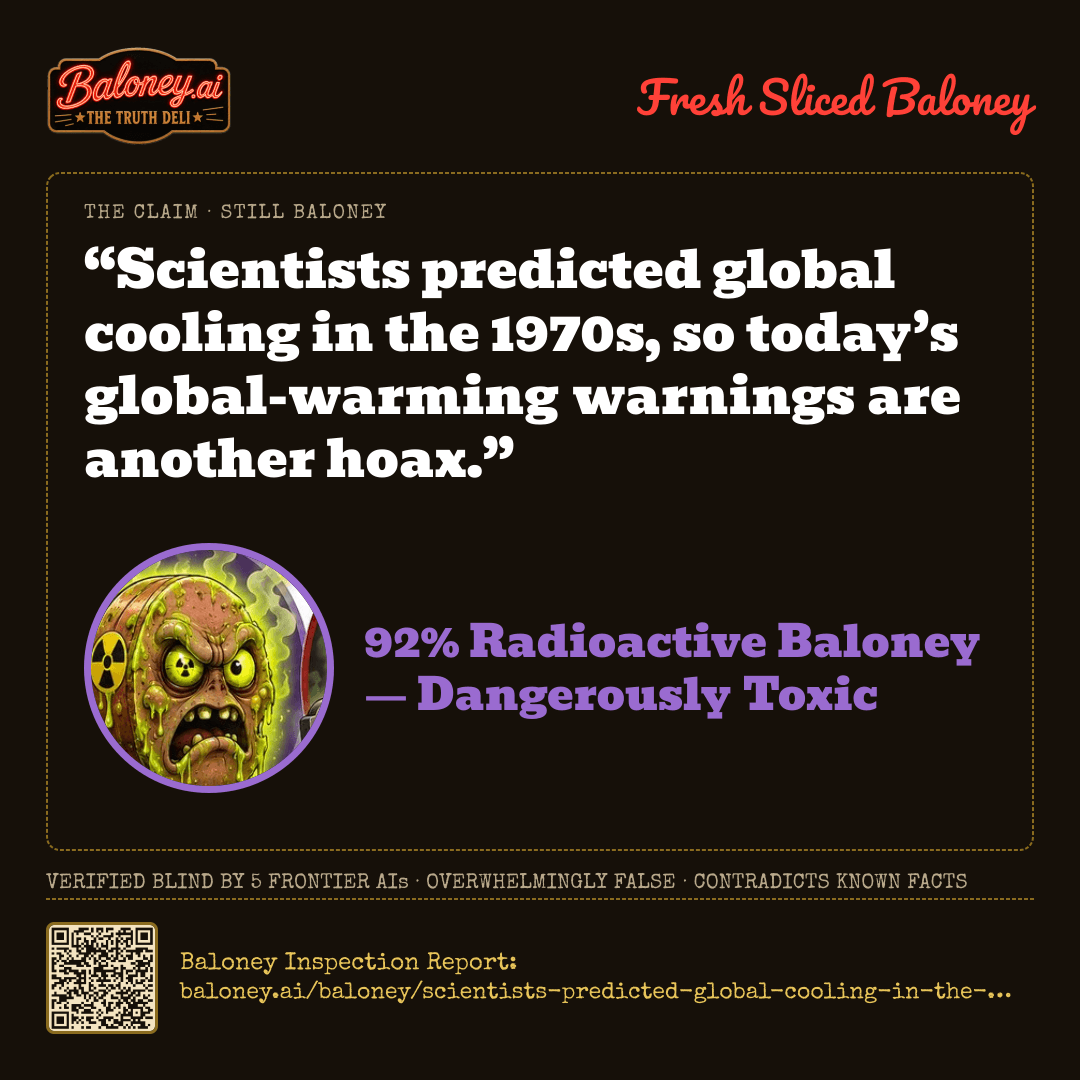
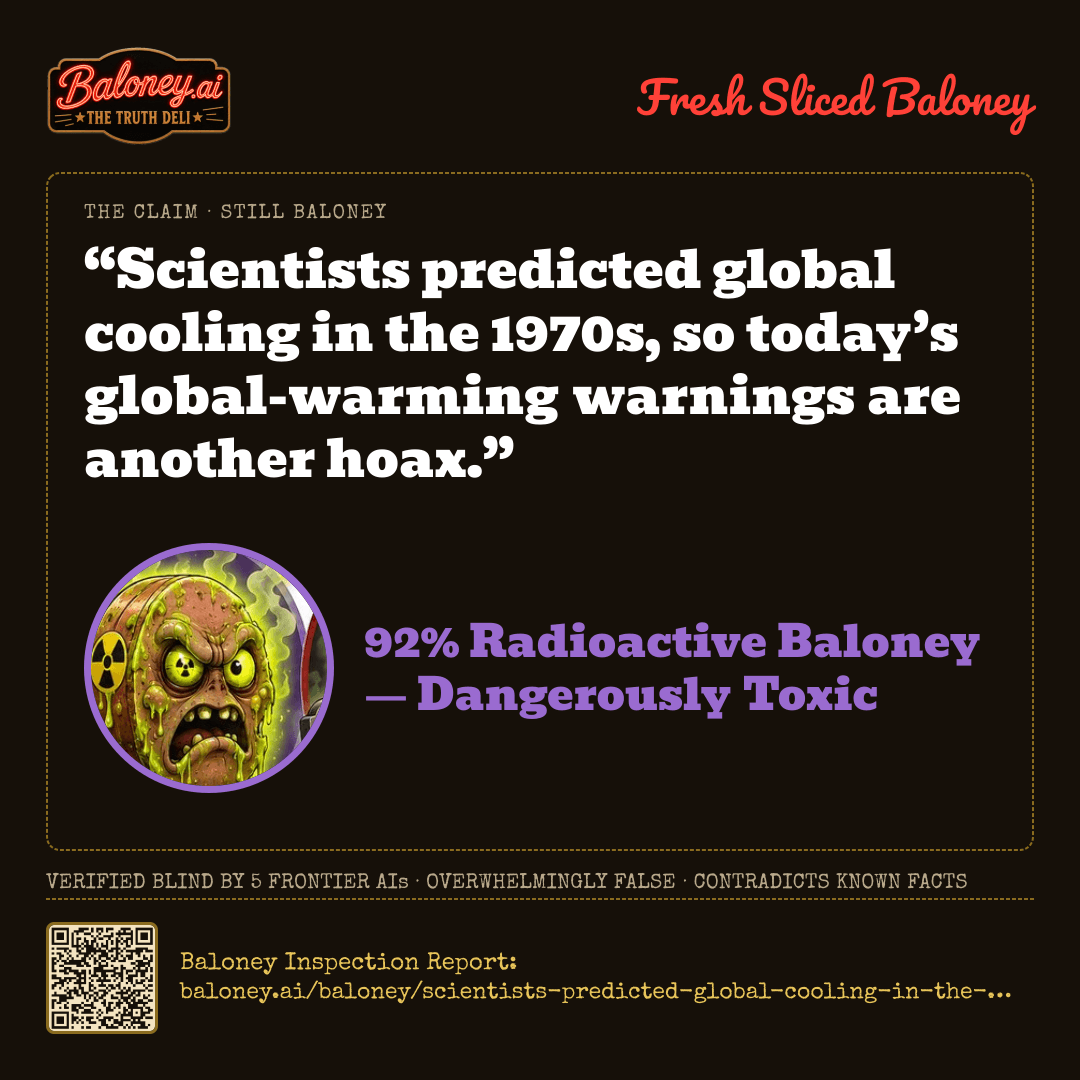
92%“Scientists predicted global cooling in the 1970s, so today’s global-warming warnings are another hoax.”
92%Radioactive Baloney — Dangerously Toxic
Dangerously misleading.
Overwhelmingly falseContradicts known factsPromotes false beliefsPotential for harm
Serve It Fresh
Ready to Serve20 servings
Serve it the way you want it
The Verdict
 “Scientists predicted global cooling in the 1970s, so today’s global-warming warnings are another hoax.”92% Radioactive Baloney — Dangerously ToxicVerified blind by 5 frontier AIs · Baloney Inspection Report: baloney.ai/baloney/scientists-predicted-global-cooling-in-the-1970s-so-today-s
The Baloney Sampler
A minority of 1970s papers did explore cooling from aerosol pollution — Rasool & Schneider's 1971 paper in Science is the best-known — and Newsweek's 1975 'The Cooling World' and Time pushed the idea far beyond its standing in the literature. But the Bulletin of the American Meteorological Society's systematic survey of 1965–1979 papers counted 44 projecting warming, 20 neutral and only 7 projecting cooling. The U.S. National Academy of Sciences' 1979 Charney Report already put doubled-CO2 warming at 1.5–4.5 °C, essentially today's range.
The second half fails outright. NASA's GISTEMP record and NOAA show the cooling scenario did not happen and the warming did, about 1.1–1.3 °C since the late 19th century, with the IPCC calling human influence unequivocal. A minority hypothesis that was tested and superseded shows science working, not deceiving; 'hoax' alleges deliberate fraud, and the panel found no substantiation for it anywhere.
Resting on Bulletin of the American Meteorological Society · U.S. National Academy of Sciences — 'Charney Report' (1979) · NASA Goddard Institute for Space Studies — GISTEMP · Intergovernmental Panel on Climate Change (AR6 WG1 SPM)
Original Claim Source https://www.factcheck.org/2018/11/the-science-trump-got-wrong-in-the-post-interview/
Other ways to slice it — phrasings that might have changed the rating
- “A minority of scientific papers in the 1970s projected global cooling, mainly from sulfate aerosol pollution.” This is the kernel every report accepted, matching the survey's count of 7 cooling papers and the aerosol physics behind them.
- “Popular magazines in the 1970s, including Newsweek and Time, told the public an ice age was coming.” All five reports confirm the media amplification, and the Newsweek author later said his piece was poorly sourced and should not be used against climate science.
- “Because scientists revised their view on 1970s aerosol cooling, current climate projections should be treated as uncertain rather than settled.” This swaps the unsupported fraud allegation for a question about uncertainty, which the reports address directly by noting the Charney range has barely changed in 45 years.
Written from the panel’s reports by Anthropic · claude-opus-5. Nothing here changed the score.
The Order Ticket
04:23:20CLAIM RECEIVED — QUEUED FOR INSPECTION✓
04:24:12claude-opus-5 REPORTED — SCORE 96, CONFIDENCE 95✓
04:23:56gpt-5.5 REPORTED — SCORE 88, CONFIDENCE 93✓
04:23:45gemini-3.1-pro-preview REPORTED — SCORE 99, CONFIDENCE 100✓
04:23:30sonar-pro REPORTED — SCORE 92, CONFIDENCE 96✓
04:25:19grok-4.6 REPORTED — SCORE 92, CONFIDENCE 88✓
04:26:43PRIMARY MASTER CLAUDE — SCORE 96✓
04:25:25BLIND VALIDATION CHATGPT — SCORE 98✓
04:27:05AGREEMENT CONFIRMED — DELTA 6✓
04:27:05SCORING MODEL V2 — MEDIAN OF 5 COUNTED LAB SCORES: 96, 88, 99, 92, 92 → 92.✓
04:27:05SOURCE RULE — LABS CITED 28 SOURCES: 0 DISCARDED FOR HAVING NO URL, 3 DISCARDED AS DEAD LINKS (404/410), 3 COULD NOT BE OPENED BY US AND ARE MARKED UNVERIFIED.✓
04:27:05SOURCE RULE — PRIMARY MASTER RULED ON 19 SOURCES: 0 DISCARDED FOR HAVING NO URL, 0 DISCARDED AS DEAD LINKS, 2 MARKED UNVERIFIED, 17 VERIFIED.✓
How This One Was Sliced
Station 1 · Blind Inspection — Five Graders, Zero Peeking
Each lab scored the claim independently, without seeing the others. Open a breakdown for its evidence, its sources, and how sure it was.
Anthropic · EQUAL WEIGHT · 51.8s
claude-opus-5
96%BALONEY
ROUND-1 BREAKDOWN
Evidence offered for the claim- A minority of 1970s scientific papers did explore a possible cooling trend, chiefly because of the mid-century temperature plateau (~1940–1975) and the cooling effect of sulfate aerosol pollution. Rasool & Schneider (Science, 1971) famously calculated that a large increase in aerosols could trigger substantial cooling — Schneider later published a correction of that estimate.
- Mainstream media amplified the cooling idea well beyond its standing in the literature: Newsweek's 'The Cooling World' (28 April 1975) and similar Time and New York Times pieces gave the public the impression of an imminent ice age. The author of the Newsweek piece, Peter Gwynne, later wrote that his article was poorly sourced and should not be used to discredit modern climate science.
- The 1975 U.S. National Academy of Sciences report 'Understanding Climatic Change' stressed deep uncertainty and noted that the Holocene interglacial could eventually end — language that cooling-myth proponents quote selectively.
- So the narrow factual kernel — 'some scientists in the 1970s discussed or predicted cooling' — is not invented out of nothing.
Evidence against the claim- There was no scientific consensus for global cooling. A systematic survey of the peer-reviewed literature from 1965–1979 (Peterson, Connolley & Fleck, Bulletin of the American Meteorological Society, 2008) found 7 papers projecting cooling, 20 neutral, and 44 projecting greenhouse warming — warming papers outnumbered cooling papers roughly 6 to 1, and were cited far more often.
- The authoritative assessments of the era pointed to warming, not cooling. The 1979 NAS 'Charney Report' concluded that doubling CO2 would warm the planet by about 1.5–4.5 °C — a range essentially unchanged by 45 years of subsequent work. The IPCC's historical overview (AR4 WG1, Ch. 1) documents the same trajectory.
- The cooling discussion was itself a legitimate, self-correcting scientific episode: it arose from real aerosol physics, was tested, and was resolved once aerosol emissions fell (post-Clean Air Act) and the greenhouse signal emerged. Science changing its mind on a minority hypothesis is evidence the process works, not evidence of deception.
- The predictions that were made have been verified. Hansen et al. (Science, 1981) projected warming that has broadly tracked observations. NASA GISTEMP and NOAA records show roughly 1.1–1.3 °C of warming since the late 19th century, with the warmest years on record occurring in the last decade — the cooling scenario did not happen, while the warming scenario did.
- The conclusion is a logical non sequitur even if the premise were true. A mistaken minority hypothesis 50 years ago, based on far less data and computing power, says nothing about the validity of today's evidence base (satellites, ocean heat content, ice cores, isotopic fingerprinting of fossil carbon, dozens of independent datasets).
- 'Hoax' implies deliberate fraud. No evidence of coordinated fabrication has ever been substantiated; multiple independent investigations (including of the 'Climategate' emails) found no scientific misconduct. Every major national academy of science endorses the human-caused warming conclusion.
- The widely circulated 'Time magazine: The Coming Ice Age' cover image used to support this claim is a doctored version of a 2007 global-warming cover.
How sure this lab was95/100 — the lab’s own confidence in the score above, not a second reading of the claim.
SourcesBulletin of the American Meteorological Society (Peterson, Connolley & Fleck 2008)journal · 96 · U.S. National Academy of Sciences — 'Charney Report' (1979)gov · 96 · Science — Rasool & Schneider (1971), 'Atmospheric Carbon Dioxide and Aerosols'journal · 92 · NASA GISS — Hansen et al. (1981), Sciencegov · 93 · NASA Goddard Institute for Space Studies — GISTEMP surface temperature recordgov · 97 · Skeptical Scienceother · 75 · NOAA Climate.govgov · 92
OpenAI · EQUAL WEIGHT · 36.4s
gpt-5.5
88%BALONEY
ROUND-1 BREAKDOWN
Evidence offered for the claim- There is a real kernel of truth: a minority of 1970s scientific papers projected or discussed cooling, especially from sulfate aerosols reflecting sunlight. For example, Rasool and Schneider's 1971 Science paper modeled large aerosol increases causing significant cooling under their assumptions.
- A later peer-reviewed review of the 1965-1979 literature found 7 papers projecting cooling, so it is not true that no scientists ever predicted or considered global cooling in that period.
- Popular press coverage in the 1970s sometimes amplified cooling/ice-age scenarios, helping create a public memory that 'scientists predicted global cooling.'
Evidence against the claim- The claim is misleading as written because 'scientists predicted global cooling' implies a broad scientific consensus. A peer-reviewed review found 44 papers projecting warming, 20 neutral, and only 7 projecting cooling in the 1965-1979 scientific literature; warming projections dominated even then.
- The cooling arguments in the 1970s were generally conditional on aerosol pollution and/or short-term climate variability, not a settled conclusion that greenhouse warming was false. As aerosol pollution controls improved and greenhouse-gas concentrations kept rising, the expected net effect shifted further toward warming.
- Modern global-warming warnings are not based on 1970s media stories; they rest on multiple independent lines of evidence: thermometer records, ocean heat content, satellite observations, melting ice, sea-level rise, greenhouse-gas physics, and detection/attribution studies.
- The IPCC concludes it is 'unequivocal' that human influence has warmed the atmosphere, ocean, and land, and NASA/NOAA temperature records show a long-term warming trend. Calling the warnings a 'hoax' is unsupported by the evidence.
- Fact-checkers have specifically debunked the '1970s global cooling consensus' narrative: there were some cooling discussions, but no broad consensus comparable to today's evidence-backed warming consensus.
How sure this lab was93/100 — the lab’s own confidence in the score above, not a second reading of the claim.
SourcesBulletin of the American Meteorological Societyjournal · 94 · Sciencejournal · 92 · Intergovernmental Panel on Climate Changeother · 96 · NASAgov · 95 · NOAA Climate.govgov · 94
Google · EQUAL WEIGHT · 24.5s
gemini-3.1-pro-preview
99%BALONEY
ROUND-1 BREAKDOWN
Evidence offered for the claim- During the early 1970s, a small number of scientific papers investigated the potential cooling effects of atmospheric aerosols (particulate pollution), noting that if aerosol emissions continued to increase exponentially, it could lead to global cooling.
- Global temperatures experienced a slight decline from the 1940s to the early 1970s, primarily driven by high levels of aerosol pollution before major clean-air legislation was enacted.
- Popular media heavily amplified the cooling narrative. Notably, Time Magazine (1974) and Newsweek (1975) published sensationalized articles warning of a 'cooling world' and a looming ice age, which embedded the idea in the public consciousness.
Evidence against the claim- A rigorous 2008 review of peer-reviewed climate science literature from 1965 to 1979 found no scientific consensus on global cooling. In fact, out of the papers surveyed, 44 predicted global warming, 20 were neutral, and only 7 predicted cooling.
- The 1970s media articles were not accurate reflections of the scientific consensus. Peter Gwynne, the author of the famous 1975 Newsweek article 'The Cooling World,' has publicly stated that the piece was a gross oversimplification and that he regrets how it is used to deny climate change today.
- Science operates by updating models based on new empirical data. By the late 1970s, it became clear that the warming effect of greenhouse gases (like CO2) would overwhelmingly dominate the cooling effect of aerosols.
- Modern global warming warnings are not a hoax; they are based on more than a century of atmospheric physics, continuous direct observations of rising temperatures, melting ice, and rising sea levels, and are backed by a near-unanimous consensus of major scientific organizations worldwide.
How sure this lab was100/100 — the lab’s own confidence in the score above, not a second reading of the claim.
SourcesAmerican Meteorological Societyjournal · 95 · Scientific Americannews · 90 · NASAgov · 95
Perplexity · EQUAL WEIGHT · 10.0s
sonar-pro
92%BALONEY
ROUND-1 BREAKDOWN
Evidence offered for the claim- Some scientists and scientific papers in the 1970s did discuss possible cooling. For example, aerosol pollution was considered capable of offsetting or temporarily exceeding greenhouse warming, and contemporaneous observations showed cooling from roughly the 1940s to the 1970s.[https://yaleclimateconnections.org/2007/11/common-climate-misconceptions-1970s-global-cooling-concerns-lacked-todays-scientific-rigor-and-relevance/]
- Media reports and popular discussions sometimes portrayed an imminent ice age, and scientific understanding at the time contained substantial uncertainty about the magnitude and timing of competing aerosol and greenhouse-gas effects.[https://journals.ametsoc.org/view/journals/bams/89/9/2008bams2370_1.xml]
- Therefore, it is fair to say that some researchers made cooling projections or warnings, although these represented a minority view and often involved conditional scenarios rather than a settled consensus.[https://www.sciencenews.org/article/cooling-climate-consensus-1970s-never-was]
Evidence against the claim- The claim falsely implies that scientists generally predicted global cooling in the 1970s. A peer-reviewed review of climate literature from 1965 to 1979 found 7 papers supporting cooling, 20 neutral papers, and 44 supporting warming.[https://journals.ametsoc.org/view/journals/bams/89/9/2008bams2370_1.xml]
- The 1970s did not have a scientific consensus that an imminent ice age was coming; greenhouse warming was already a dominant concern in the scientific literature.[https://journals.ametsoc.org/view/journals/bams/89/9/2008bams2370_1.xml]
- The historical review found that cooling predictions received disproportionate public attention compared with the much larger number of warming projections.[https://www.sciencenews.org/article/cooling-climate-consensus-1970s-never-was]
- A mistaken or minority forecast in the past does not establish that present-day global-warming warnings are a hoax. Current warming conclusions rest on later observations, improved physical models, and multiple independent lines of evidence; the claim provides no evidence that those data are fabricated or invalid.
- The statement conflates uncertainty and disagreement about the timing or size of climate effects with the allegation that current warnings are fraudulent. The available historical evidence supports the former, not the latter.[https://science.feedback.org/review/uncertainties-about-future-climate-change-1970s-does-not-invalidate-today-evidence-reality-global-warming/]
- Fact-checking and scientific reviews consistently identify the alleged 1970s global-cooling consensus as a myth or serious distortion of the historical record.[https://www.aap.com.au/factcheck/scientists-never-warmed-to-the-idea-of-global-cooling/]
How sure this lab was96/100 — the lab’s own confidence in the score above, not a second reading of the claim.
SourcesBulletin of the American Meteorological Societyjournal · 98 · Science Newsnews · 92 · Yale Climate Connectionsedu · 90 · Science Feedbackfactcheck · 88 · Australian Associated Press FactCheckfactcheck · 88
xAI · EQUAL WEIGHT · 118.5s
grok-4.6
92%BALONEY
ROUND-1 BREAKDOWN
Evidence offered for the claim- Popular magazines in the 1970s (notably Newsweek 1975 'The Cooling World' and Time 1974) ran stories citing scientists about possible cooling or a coming ice age.
- A minority of papers discussed aerosol-driven cooling that might temporarily outweigh CO2 warming (e.g., Rasool & Schneider, Science, 1971).
- Some researchers and NAS-related discussions in the early 1970s treated cooling from pollution or natural variability as a live hypothesis.
Evidence against the claim- There was never a scientific consensus on global cooling. A systematic survey of 1965–1979 peer-reviewed climate papers found 44 projecting warming, 20 neutral, and only 7 cooling (Peterson, Connolley & Fleck, BAMS, 2008).
- Greenhouse warming from CO2 was already established (Manabe & Wetherald 1967 onward); the 1979 Charney report estimated ~3°C (1.5–4.5°C) for doubled CO2.
- Present-day warming is observed across surface temperature, ocean heat content, ice-mass loss and sea level and is attributed to human greenhouse gases with high confidence (IPCC AR6; NASA/NOAA records). A superseded 1970s media narrative does not make that evidence a hoax.
- The 'therefore today's warnings are a hoax' step is a non sequitur: science updates with data; aerosol cooling concerns were partly addressed by clean-air rules that unmasked the CO2 signal.
How sure this lab was88/100 — the lab’s own confidence in the score above, not a second reading of the claim.
SourcesAmerican Meteorological Societyjournal · 96 · NASAgov · 95 · IPCCother · 97 · Sciencejournal · 94 · Skeptical Scienceother · 78
Station 2 · The Masters
Primary Master · drawn at random
claude-opus-5
96% BALONEY
The statement has two parts, and the panel converged on how each fares. The premise contains a genuine kernel of truth that no evaluator disputed: a minority of 1970s papers (Rasool & Schneider 1971 being the most cited) explored aerosol-driven cooling, and the popular press — Newsweek's 'The Cooling World' (1975), Time (1974) — amplified it far beyond its standing in the literature. But the premise as written ('scientists predicted global cooling') implies a field-wide expectation that never existed: the systematic survey of 1965–1979 peer-reviewed literature (Peterson, Connolley & Fleck, BAMS 2008) found 44 papers projecting warming, 20 neutral and only 7 projecting cooling, and the 1979 Charney Report already put doubled-CO2 warming at 1.5–4.5 °C — essentially today's range. The conclusion ('therefore today's warnings are another hoax') is a straightforward non sequitur that all five evaluators rejected: a minority hypothesis that was tested and superseded is evidence of a working scientific process, not deception, and 'hoax' implies deliberate fraud for which no evaluator found any substantiation. I weighted the BAMS survey most heavily — it is the only systematic count of the actual literature, it was cited independently by all five evaluators, and it directly settles the factual dispute. Observational records (GISTEMP, NOAA, IPCC AR6) carry the second part: the cooling scenario did not occur, the warming scenario did, at roughly 1.1–1.3 °C since the late 19th century. I landed at 96 rather than the top of the scale because the premise is not fabricated out of nothing — the misleading step is the leap from 'some researchers discussed cooling' to 'science flip-flopped, so it is lying now.' I did not set the zombie flag: although this is a durable talking point, the claim rests on a real, verifiable historical episode rather than on a wholly invented one, which distinguishes it from the moon-landing and flat-earth archetypes.
All five evaluators agreed on every substantive point: there was no 1970s cooling consensus, the BAMS 2008 survey (44 warming / 20 neutral / 7 cooling) is the decisive evidence, the cooling idea was real but minority and conditional on aerosol assumptions, the media overstated it, and the 'therefore a hoax' conclusion is a non sequitur. Disagreement was confined to severity: recommendations ran from 88 to 99 (median 92). The lower scorer gave more weight to the genuine kernel of truth in the premise; the highest scorer treated the claim as a fully debunked zombie. Two evaluators added material the others did not: the 1979 Charney Report's 1.5–4.5 °C sensitivity range and Hansen et al. (1981) verified projections, and the observation that the widely shared 'Time: The Coming Ice Age' cover image is a doctored 2007 global-warming cover.
Blind Validation Master · never saw the Primary’s work
gpt-5.5
98% BALONEY
The statement is overwhelmingly misleading. The reports agree that there was a real kernel of truth: a minority of scientists and papers in the 1970s discussed or projected possible cooling, mainly from aerosol pollution and the mid-century temperature slowdown, and popular media amplified those scenarios. But the evidence presented shows there was no 1970s scientific consensus for global cooling. A peer-reviewed review of 1965–1979 climate literature found 44 papers projecting warming, 20 neutral, and only 7 projecting cooling. Greenhouse warming was already a major scientific concern, and by 1979 the Charney Report estimated substantial warming from doubled CO2. The second half of the claim is even less supported: modern global-warming warnings are not a continuation of a failed 1970s media narrative, but are based on extensive observations, physical theory, improved models, and multiple independent datasets showing warming, ocean heat gain, ice loss, and sea-level rise. Calling them a “hoax” implies fraud, for which the reports provide no evidence. Because this is a repeatedly debunked argument with a small factual kernel but a false implication and conclusion, it rates as near-maximum baloney.
AGREEMENT TEST PASSED — MASTERS SCORED 96% AND 98% · BLIND VALIDATION CONFIRMED THIS SCORE · NO RE-EVALUATION REQUIRED
How the number was reached · scoring model v2 · how our models work
- Median of 5 counted lab scores: 96, 88, 99, 92, 92 → 92.
The Evidence
Evidence offered for the claim
- Some 1970s papers did model cooling A minority of researchers examined whether sulfate aerosol pollution could offset or temporarily exceed greenhouse warming; Rasool & Schneider (Science, 1971) calculated that a large increase in aerosols could trigger substantial cooling. Schneider later published a correction to that estimate. The panel accepts this as true but notes it was 7 papers out of 71 surveyed for 1965–1979.
- Temperatures really did dip mid-century Global temperatures plateaued or declined slightly from roughly the 1940s to the early 1970s, largely driven by heavy aerosol pollution before clean-air legislation. This was a real observation, and it ended: the post-Clean Air Act fall in aerosols unmasked the CO2 signal and warming resumed.
- The press ran ice-age stories Newsweek's 'The Cooling World' (28 April 1975) and a 1974 Time piece gave the public an impression of imminent glaciation. Peter Gwynne, who wrote the Newsweek article, has since said it was poorly sourced, a gross oversimplification, and should not be used to discredit modern climate science.
- The famous Time 'Coming Ice Age' cover DEBUNKED — REFUTED. The Time magazine cover headlined 'The Coming Ice Age' that circulates in support of this claim is a doctored version of a 2007 global-warming cover. It was never published.
- The 1975 NAS report warned of cooling DEBUNKED — REFUTED as presented. The National Academy of Sciences' 1975 'Understanding Climatic Change' stressed deep uncertainty and noted the Holocene interglacial would eventually end — language cooling-myth proponents quote selectively. Four years later the NAS Charney Report put doubled-CO2 warming at 1.5–4.5 °C.
Evidence against the claim
- Warming papers outnumbered cooling six to one A systematic survey of peer-reviewed climate literature from 1965 to 1979 (Peterson, Connolley & Fleck, Bulletin of the American Meteorological Society, 2008) found 44 papers projecting greenhouse warming, 20 neutral, and only 7 projecting cooling. The warming papers were also cited far more often.
- The authoritative assessments pointed to warming Greenhouse warming was already established work by the late 1960s (Manabe & Wetherald, 1967 onward), and the 1979 NAS 'Charney Report' estimated about 1.5–4.5 °C of warming for doubled CO2 — a range essentially unchanged by 45 years of subsequent research.
- Cooling claims were conditional, not settled The cooling arguments depended on assumed continued exponential growth in aerosol pollution or on short-term variability. They were never a conclusion that greenhouse warming was false, and as pollution controls took effect and CO2 kept rising, the expected net effect shifted further toward warming.
- The warming forecast was the one that came true Hansen et al. (Science, 1981) projected warming that has broadly tracked observations. NASA GISTEMP and NOAA records show roughly 1.1–1.3 °C of warming since the late 19th century, with the warmest years on record in the last decade. The cooling scenario did not happen.
- Today's warnings rest on independent modern evidence Surface thermometers, ocean heat content, satellites, ice-mass loss, sea-level rise, isotopic fingerprinting of fossil carbon and detection-attribution studies all converge. The IPCC AR6 concludes it is 'unequivocal' that human influence has warmed the atmosphere, ocean and land. None of this depends on 1970s media stories.
- The conclusion is a logical non sequitur Even if the premise were fully true, a minority hypothesis from 50 years ago — made with far less data and computing power, then tested and superseded — says nothing about the validity of today's evidence base. Science revising a minority view is the process working, not deception.
- 'Hoax' implies fraud no one has found No coordinated fabrication has ever been substantiated; multiple independent investigations, including of the 'Climategate' emails, found no scientific misconduct. Every major national academy of science endorses the human-caused warming conclusion.
- Fact-checkers have repeatedly addressed this Science Feedback and AAP FactCheck have both examined the '1970s global cooling consensus' narrative and found it a myth or serious distortion: there were some cooling discussions, but no broad consensus comparable to today's evidence-backed warming consensus.
Sources · Reliability · Why Accepted or Discounted
Every link was opened when this claim was inspected. A dead link was discarded before publication; “unverified” means the site refused our automated check and the link is the one the panel cited. A source without a URL was never kept.
Serve It Fresh
Ready to Serve20 servings
Serve it the way you want it
The Verdict
“Scientists predicted global cooling in the 1970s, so today’s global-warming warnings are another hoax.”92% Radioactive Baloney — Dangerously ToxicVerified blind by 5 frontier AIs · Baloney Inspection Report: baloney.ai/baloney/scientists-predicted-global-cooling-in-the-1970s-so-today-s