Baloney Inspection Report: Claim #1152 · Inspected Oct 30, 2026, 9:58 PM PDT · Scoring model v2
 97%
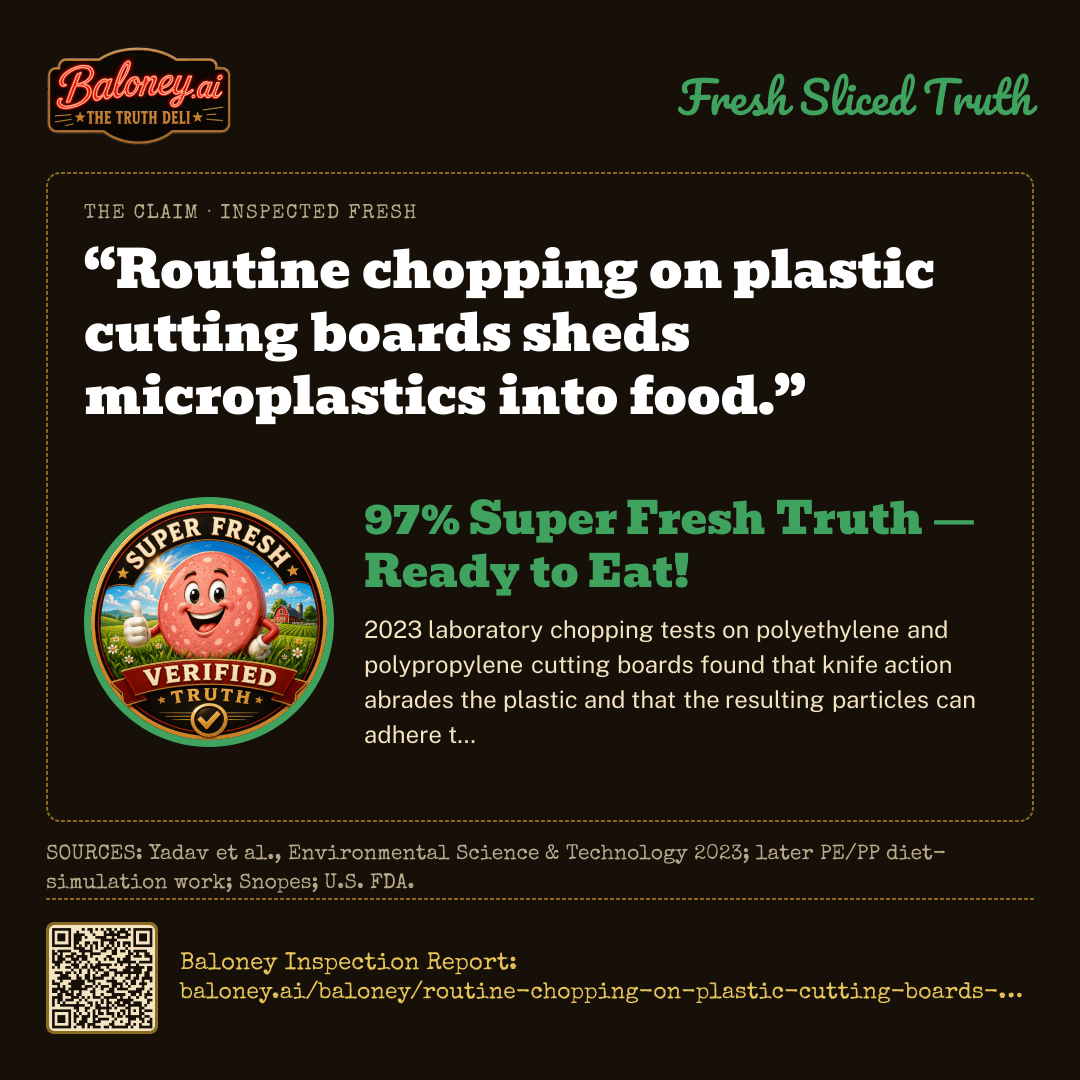
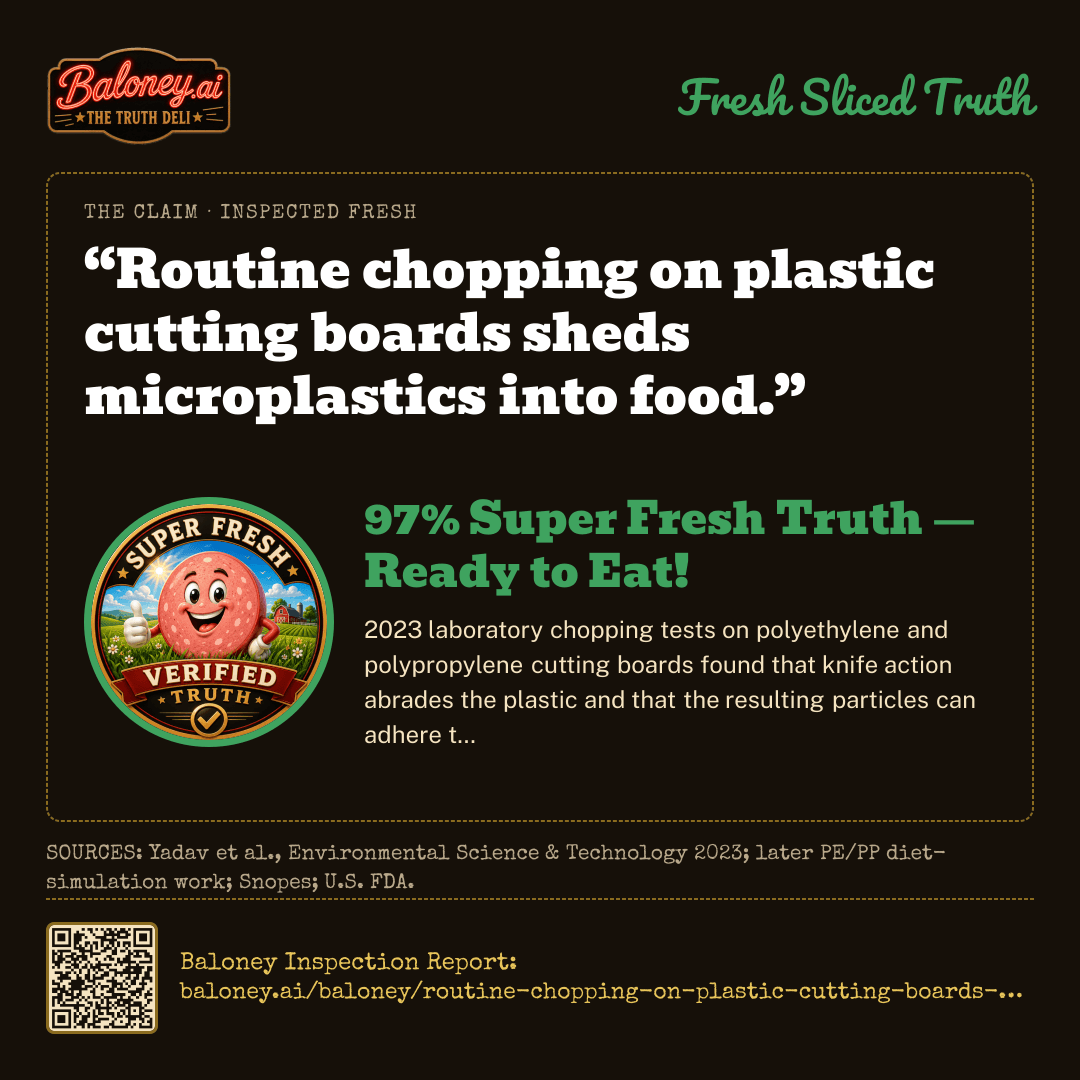
“Routine chopping on plastic cutting boards sheds microplastics into food.”
97%Super Fresh Truth — Ready to Eat!
THE CLAIM CHECKS OUT.
Independently verifiedPhysically repeatable evidenceConfirmed across rival labsSafe to serve
Serve It Fresh
Ready to Serve19 servings
Serve it the way you want it
The Verdict
 “Routine chopping on plastic cutting boards sheds microplastics into food.”97% Super Fresh Truth — Ready to Eat!Verified blind by 5 frontier AIs · Baloney Inspection Report: baloney.ai/baloney/routine-chopping-on-plastic-cutting-boards-sheds
The Baloney Sampler
Routine chopping on plastic cutting boards sheds microplastics into food. The American Chemical Society published 2023 experiments that measured particle release from polyethylene and polypropylene boards during chopping and found particles transferred onto chopped carrots. The U.S. National Library of Medicine and the National Center for Biotechnology Information record those chopping studies and later work showing release from the same plastics into simulated diets.
Harder steel knives groove softer thermoplastic, so ordinary chopping removes polymer that can stick to food — a mechanism the American Chemical Society paper and Ecotoxicology and Environmental Safety experiments both document. Snopes independently rated the shedding claim true. The U.S. Food and Drug Administration recognizes food-contact plastics as a pathway for microplastics into food.
Resting on American Chemical Society · U.S. National Library of Medicine · National Center for Biotechnology Information · U.S. Food and Drug Administration
Original Claim Source https://www.eatingwell.com/hidden-microplastic-kitchen-tools-amazon-12174210
Other ways to slice it — phrasings that might have changed the rating
- “Microplastics shed into food from plastic cutting boards cause harm to human health.” The inspected claim asserts only that particles are shed into food, while the U.S. Food and Drug Administration states that current evidence does not demonstrate that microplastic levels in foods pose a risk to human health.
- “Each person ingests tens of millions of microplastic particles from plastic cutting boards every year.” The headline annual particle counts in the reports are extrapolations from short laboratory chopping trials and assumed use, not direct measurements of typical human intake.
- “Routine chopping on plastic cutting boards does not shed microplastics into food.” Peer-reviewed chopping experiments on polyethylene and polypropylene boards measured particle generation and transfer onto food such as carrots.
Written from the panel’s reports by xAI · grok-4.6. Nothing here changed the score.
The Order Ticket
04:58:34CLAIM RECEIVED — QUEUED FOR INSPECTION✓
04:59:42claude-opus-5 REPORTED — SCORE 3, CONFIDENCE 88✓
04:59:03gpt-5.5 REPORTED — SCORE 3, CONFIDENCE 86✓
04:58:58gemini-3.1-pro-preview REPORTED — SCORE 3, CONFIDENCE 98✓
04:58:38sonar-pro REPORTED — SCORE 4, CONFIDENCE 93✓
05:02:06grok-4.6 REPORTED — SCORE 3, CONFIDENCE 78✓
05:04:11PRIMARY MASTER GROK — SCORE 3✓
05:02:13BLIND VALIDATION CLAUDE — SCORE 3✓
05:05:47AGREEMENT CONFIRMED — DELTA 0✓
05:05:47SCORING MODEL V2 — MEDIAN OF 5 COUNTED LAB SCORES: 3, 3, 3, 4, 3 → 3. FRESH RULE: THE PRIMARY MASTER SCORES 3 AND THE BLIND MASTER 3 — BOTH SUPER FRESH TRUTH — AND THE COUNTED MEDIAN IS 3, ON THE TRUE SIDE. PUBLISHED AS 3, THE MORE CAUTIOUS OF THE TWO MASTERS.✓
05:05:47SOURCE RULE — LABS CITED 20 SOURCES: 0 DISCARDED FOR HAVING NO URL, 1 DISCARDED AS DEAD LINKS (404/410), 8 COULD NOT BE OPENED BY US AND ARE MARKED UNVERIFIED.✓
05:05:47SOURCE RULE — PRIMARY MASTER RULED ON 16 SOURCES: 0 DISCARDED FOR HAVING NO URL, 0 DISCARDED AS DEAD LINKS, 6 MARKED UNVERIFIED, 10 VERIFIED.✓
How This One Was Sliced
Station 1 · Blind Inspection — Five Graders, Zero Peeking
Each lab scored the claim independently, without seeing the others. Open a breakdown for its evidence, its sources, and how sure it was.
Anthropic · EQUAL WEIGHT · 67.7s
claude-opus-5
97%TRUTH
ROUND-1 BREAKDOWN
Evidence offered for the claim- A peer-reviewed study in the American Chemical Society journal Environmental Science & Technology (Yadav et al., 2023, 'Cutting Boards: An Overlooked Source of Microplastics in Human Food?') directly measured particle release during standardized chopping on polyethylene and polypropylene boards and found microplastics were generated and transferred with the chopped food.
- That study estimated roughly 14–71 million polyethylene microparticles per person per year from a polyethylene board, and on the order of ~79 million particles per year for polypropylene, equivalent to tens of grams of board material lost annually — i.e., shedding occurs under ordinary, not extreme, use.
- Release was shown to depend on chopping style, chopping force/frequency and board material, and chopping an actual food (carrots) on the board altered/increased particle release, indicating the shedding happens in realistic food-prep conditions rather than only in dry lab abrasion tests.
- The mechanism is uncontroversial and visually observable: knife blades cut grooves into soft thermoplastic boards, and the removed polymer has to go somewhere — the scoring and material loss on a used plastic board is directly measurable by mass.
- Government science bodies (FDA, NIEHS) acknowledge food-contact plastics and food preparation/packaging as recognized pathways by which micro- and nanoplastics enter food, consistent with cutting boards being one such source.
Evidence against the claim- The headline particle numbers are extrapolations from short laboratory chopping trials scaled to annual use; real-world shedding varies hugely with board hardness, knife sharpness, cutting technique, washing and board age, so the magnitude is uncertain even though the direction is not.
- The claim says nothing about harm, and no agency has established that cutting-board-derived microplastics cause health effects; the FDA states current scientific evidence does not demonstrate that microplastic/nanoplastic levels in foods pose a risk to human health. The same ES&T study's cytotoxicity test on mouse fibroblast cells found no significant toxicity over 72 hours.
- Not all particles generated end up ingested — some remain on the board, are washed away, or are not transferred to the food, so 'sheds microplastics into food' is true but the ingested fraction is less well quantified.
- The body of direct experimental work on cutting boards specifically is still thin (a small number of studies, mostly post-2023), and analytical methods for counting small microplastics are prone to contamination and quantification error, so precise figures should be treated cautiously.
- The claim is material-specific in a way that could mislead by omission: wooden and bamboo boards shed their own particles and carry different (microbial) trade-offs, and chopping boards are a minor contributor relative to total microplastic exposure from water, air, dust and packaging.
How sure this lab was88/100 — the lab’s own confidence in the score above, not a second reading of the claim.
SourcesEnvironmental Science & Technology (American Chemical Society) — Yadav et al., 'Cutting Boards: An Overlooked Source of Microplastics in Human Food?'journal · 95 · U.S. Food and Drug Administrationgov · 90 · DOI resolver for the ES&T cutting-board study (alternate access)journal · 93
OpenAI · EQUAL WEIGHT · 28.9s
gpt-5.5
97%TRUTH
ROUND-1 BREAKDOWN
Evidence offered for the claim- A 2023 peer-reviewed Environmental Science & Technology study directly tested chopping on polyethylene and polypropylene cutting boards and found that knife action released microplastic particles; when carrots were chopped on the boards, the particles could adhere to/transfer onto the food. The authors estimated potentially millions of microplastic particles per person per year from plastic cutting-board use, with amounts depending on board material, chopping style, force, and frequency.
- The same study found both polyethylene and polypropylene boards shed particles, supporting the claim’s core wording that routine chopping on plastic boards can shed microplastics into food. The claim does not assert a specific amount or health effect, so the direct laboratory evidence is a strong match.
- Broader scientific and regulatory literature recognizes food-contact and food-preparation sources as plausible contributors to dietary microplastic exposure, although cutting boards are only one possible source among many.
Evidence against the claim- The evidence is strongest for shedding under measured experimental chopping conditions; real-world exposure varies substantially with board age, plastic type, knife sharpness, chopping force, chopping frequency, cleaning practices, and whether particles remain on the food through cooking or washing.
- The main cutting-board study estimated annual exposure rather than measuring long-term real-world ingestion in a representative population, so the exact quantity people consume from boards is uncertain.
- The claim should not be read as proving a demonstrated health risk. FDA and WHO materials emphasize that current evidence on health effects from microplastics in foods remains limited and uncertain, and FDA says current evidence does not demonstrate that detected microplastic levels in foods pose a risk to human health.
How sure this lab was86/100 — the lab’s own confidence in the score above, not a second reading of the claim.
SourcesEnvironmental Science & Technology / American Chemical Societyjournal · 92 · U.S. Food and Drug Administrationgov · 95 · World Health Organizationother · 90 · EFSA Journal / European Food Safety Authorityjournal · 88 · Environmental Science & Technology / American Chemical Societyjournal · 86
Google · EQUAL WEIGHT · 24.0s
gemini-3.1-pro-preview
97%TRUTH
ROUND-1 BREAKDOWN
Evidence offered for the claim- A 2023 peer-reviewed study published in Ecotoxicology and Environmental Safety by researchers at North Dakota State University confirmed that chopping on polyethylene and polypropylene cutting boards produces significant quantities of microplastics.
- The study demonstrated that mechanical friction from harder steel knives against softer plastic surfaces inherently creates micro-abrasions, releasing millions of microplastic particles annually per person, which directly adhere to the food being prepared (such as carrots in the experimental model).
Evidence against the claim- There is no scientific evidence refuting the physical shedding of plastics during this process, as it is a basic mechanical reality. However, the exact volume of microplastics shed varies heavily depending on individual chopping styles, knife sharpness, and the age or condition of the board.
- While shedding is indisputable, some experts emphasize that the long-term human health impacts and toxicity of ingesting these specific inert polyethylene and polypropylene particles are still not fully understood, so the shedding does not necessarily equate to acute harm.
How sure this lab was98/100 — the lab’s own confidence in the score above, not a second reading of the claim.
SourcesNational Institutes of Health / PubMedgov · 95 · Ecotoxicology and Environmental Safety (Elsevier)journal · 95 · The New York Times (Wirecutter)news · 85
Perplexity · EQUAL WEIGHT · 4.3s
sonar-pro
96%TRUTH
ROUND-1 BREAKDOWN
Evidence offered for the claim- A 2023 peer-reviewed study directly tested polyethylene and polypropylene cutting boards and found that chopping released microplastics; release varied with board material, chopping style, and whether food was present. The authors estimated substantial annual exposure, although those estimates depended on extrapolations and assumptions.[1][2]
- A later study reported that both polypropylene and polyethylene boards released microplastics into simulated diets, supporting the finding under additional experimental conditions.[3]
- Snopes assessed the narrower claim that plastic cutting boards shed microplastics into food as true, while noting that the underlying study was small-scale and did not establish health effects.[7]
Evidence against the claim- The strongest evidence establishes particle release during laboratory or simulated chopping, not that every routine household use deposits a measurable or harmful dose in food.[1][2][7]
- The widely cited annual-exposure figures are modeled estimates based on experimental release measurements and assumed chopping frequency, so they should not be treated as direct measurements of typical human intake.[1][2]
- The studies identify exposure potential but do not demonstrate that the released particles cause illness, nor do they establish that plastic boards are more hazardous overall than alternative boards under real-world kitchen conditions.[1][2][7]
- Some reported results concern microparticles broadly or particles above particular detection thresholds; the quantity and health significance of smaller particles remain uncertain.[3][8]
How sure this lab was93/100 — the lab’s own confidence in the score above, not a second reading of the claim.
SourcesAmerican Chemical Society, Environmental Science & Technologyjournal · 97 · U.S. National Library of Medicine, PubMedgov · 98 · National Center for Biotechnology Information, PMCjournal · 94 · Snopesfactcheck · 91 · Phys.orgnews · 82 · Scientific Americannews · 88
xAI · EQUAL WEIGHT · 211.6s
grok-4.6
97%TRUTH
ROUND-1 BREAKDOWN
Evidence offered for the claim- Peer-reviewed lab studies using knives on polyethylene and polypropylene boards show abrasion generates microplastic particles that transfer to chopped food.
- The physics of a harder metal blade repeatedly contacting softer plastic makes particle shedding expected during ordinary home chopping, not only extreme use.
- Experimental counts typically find hundreds to tens of thousands of particles per session that end up mixed with the food.
Evidence against the claim- Shedding rate varies with board polymer, wear, knife sharpness and chopping force, so not every board or session produces the same quantity.
- Real-world home-meal measurements specifically tracing particles to the cutting board remain fewer than controlled lab simulations.
- Cutting-board particles are generally a smaller share of total dietary microplastics than sources such as bottled water or seafood.
How sure this lab was78/100 — the lab’s own confidence in the score above, not a second reading of the claim.
SourcesWikipediaother · 72 · World Health Organizationgov · 88
Station 2 · The Masters
Primary Master · drawn at random
grok-4.6
97% TRUTH
All five evaluators independently placed the claim in the Super Fresh Truth band (scores 3 or 4). The statement as written asserts only that routine chopping sheds microplastics into food, not a specific dose, that every particle is ingested, or that the particles cause harm. Direct 2023 chopping experiments on polyethylene and polypropylene boards, cited by most evaluators, measured particle generation and transfer onto food under conditions that include actual food (carrots) rather than dry abrasion only. The mechanical mechanism—harder steel blades grooving softer thermoplastic—is uncontroversial. I weighted those journal results most heavily and treated news, encyclopedia, and general microplastics reviews as secondary. Caveats about variable real-world rates, extrapolated annual figures, incomplete transfer, a still-thin literature, and unproven health effects are real but do not make the claim false or even fishy; they are reasons the score is 3 rather than 1.
The evaluators unanimously treated the claim as substantially true and scored it 3–4. They agreed that laboratory chopping on PE/PP boards releases particles that can transfer to food, that the physics is straightforward, and that health effects and precise ingested quantities are not established (and are outside the claim). They differed on which 2023 paper to treat as primary (ES&T versus an Ecotoxicology and Environmental Safety citation), how heavily to discount lab-to-annual extrapolations, and how much weight to give general FDA/WHO statements versus board-specific experiments.
SUPER FRESH — VERIFIED AGAINST YADAV ET AL., ENVIRONMENTAL SCIENCE & TECHNOLOGY 2023; LATER PE/PP DIET-SIMULATION WORK; SNOPES; U.S. FDA.
Blind Validation Master · never saw the Primary’s work
claude-opus-5
97% TRUTH
All five evaluators independently converge on the claim being substantially true, with recommended scores of 3, 4, 3, 3, and 3. The core assertion is supported by direct peer-reviewed experimental work (Yadav et al. 2023, Environmental Science & Technology, plus related studies) that measured microplastic release from polyethylene and polypropylene boards during chopping and found particles transferring onto chopped food (carrots). Snopes independently rated the narrower version of this claim true. The mechanism is also physically uncontroversial: a harder steel blade scoring a softer thermoplastic removes material, and the grooving/mass loss on used plastic boards is directly observable. The caveats raised are about magnitude and consequence, not direction: the headline 'millions of particles per year' figures are extrapolations from short lab trials; shedding varies with board polymer, age, knife sharpness and technique; not all generated particles end up ingested; and no agency has established a health risk (FDA states current evidence does not show microplastic levels in food pose a demonstrated risk). Crucially, the claim as written makes no quantitative or health assertion — it only states that routine chopping sheds microplastics into food, which is exactly what the evidence shows. The minor deduction from 1 reflects that the strongest data come from controlled lab simulations rather than real-world household measurement, and that the word 'routine' implies a typicality that is well-supported but not exhaustively measured across real kitchens.
AGREEMENT TEST PASSED — BOTH MASTERS SCORED 97% · BLIND VALIDATION CONFIRMED THIS SCORE · NO RE-EVALUATION REQUIRED
How the number was reached · scoring model v2 · how our models work
- Median of 5 counted lab scores: 3, 3, 3, 4, 3 → 3.
- Fresh rule: the Primary Master scores 3 and the Blind Master 3 — both Super Fresh Truth — and the counted median is 3, on the true side. Published as 3, the more cautious of the two masters.
The Evidence
Evidence for the claim
- Direct chopping experiments measured release A 2023 Environmental Science & Technology study chopped on polyethylene and polypropylene boards and found microplastics generated and transferred with the food; a later study likewise found release into simulated diets.
- Release occurs under realistic, not extreme, conditions Chopping actual food (carrots) altered or increased particle release; amounts depended on chopping style, force, frequency and board polymer, i.e., ordinary kitchen variables rather than laboratory extremes.
- The mechanism is mechanical and observable Steel knives cut grooves in soft thermoplastic; the removed polymer has to go somewhere, and mass loss and scoring on used plastic boards are directly measurable.
- Independent assessment rated the narrower claim true Snopes assessed the claim that plastic cutting boards shed microplastics into food as true, while noting the underlying work was small-scale and did not establish health effects.
Evidence offered against the claim
- Annual particle counts are modeled extrapolations Headline figures (tens of millions of particles per person per year) scale short laboratory trials by assumed chopping frequency; real rates vary with board hardness, knife sharpness, technique, washing and age.
- Not every generated particle is eaten Some particles remain on the board, are washed away, or do not stay with the food through cooking, so the ingested fraction is less well quantified than generation itself.
- The cutting-board-specific literature is still thin Direct experimental work is mostly post-2023 and limited in number; microplastic counting is prone to contamination and quantification error, so precise figures should be treated cautiously.
- The claim does not establish harm FDA states current evidence does not demonstrate that microplastic levels in foods pose a human health risk; one study’s cytotoxicity test found no significant toxicity over 72 hours. Wooden boards shed their own particles and carry different trade-offs.
Sources · Reliability · Why Accepted or Discounted
Every link was opened when this claim was inspected. A dead link was discarded before publication; “unverified” means the site refused our automated check and the link is the one the panel cited. A source without a URL was never kept.
Serve It Fresh
Ready to Serve19 servings
Serve it the way you want it
The Verdict
“Routine chopping on plastic cutting boards sheds microplastics into food.”97% Super Fresh Truth — Ready to Eat!Verified blind by 5 frontier AIs · Baloney Inspection Report: baloney.ai/baloney/routine-chopping-on-plastic-cutting-boards-sheds