Baloney Inspection Report: Claim #1180 · Inspected Oct 31, 2026, 8:33 AM PDT · Scoring model v2
 96%
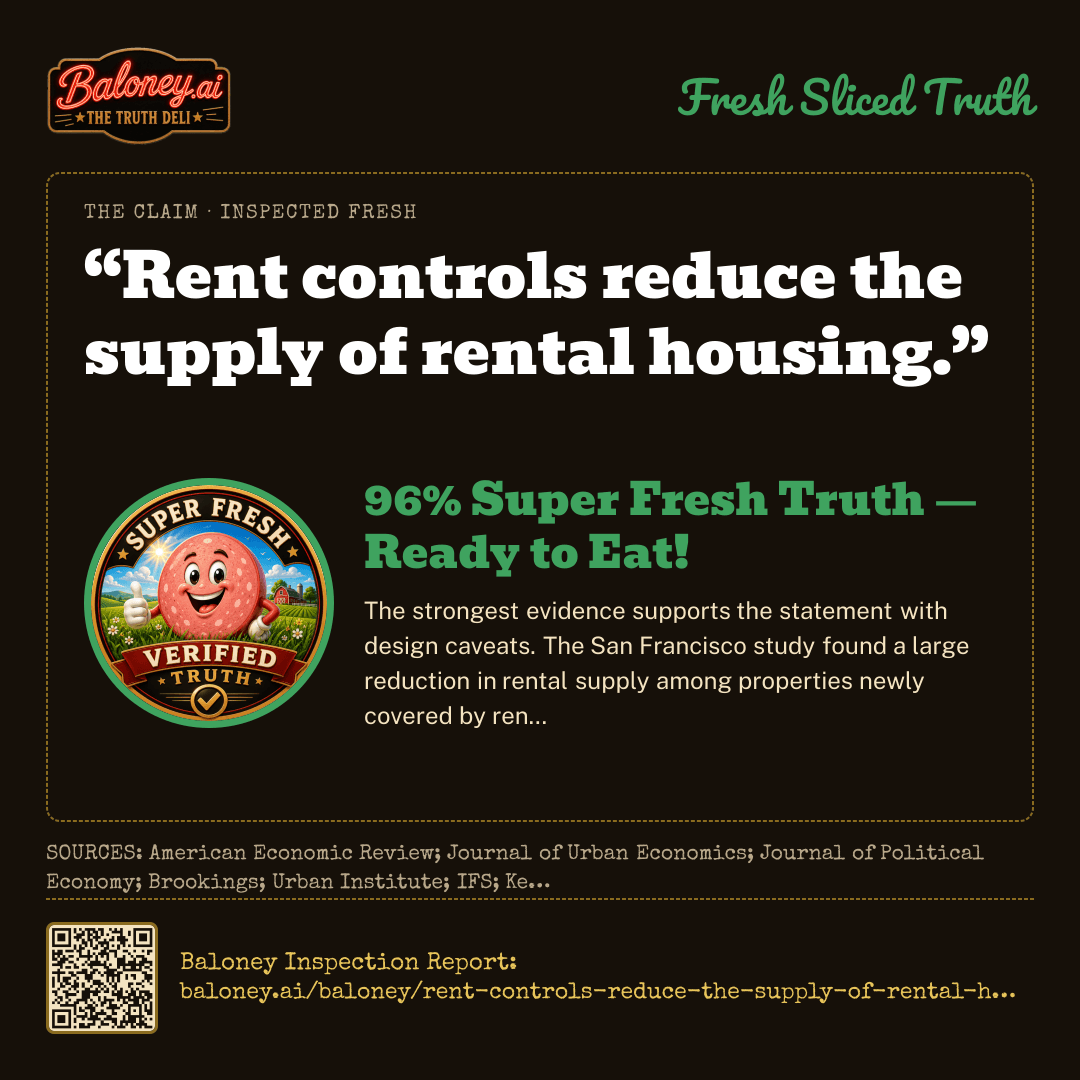
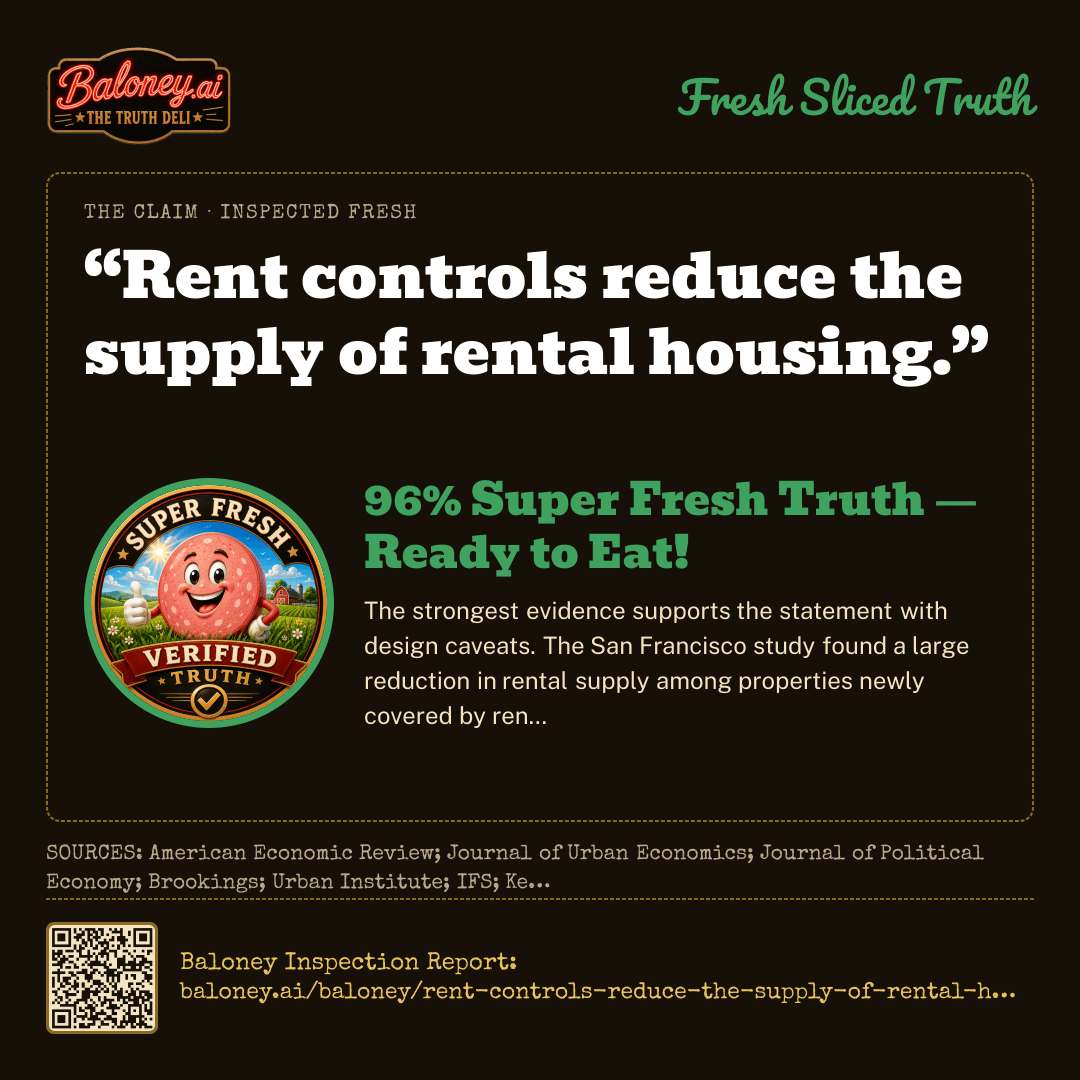
“Rent controls reduce the supply of rental housing.”
96%Super Fresh Truth — Ready to Eat!
THE CLAIM CHECKS OUT.
Independently verifiedPhysically repeatable evidenceConfirmed across rival labsSafe to serve
Serve It Fresh
Ready to Serve11 servings
Serve it the way you want it
The Verdict
 “Rent controls reduce the supply of rental housing.”96% Super Fresh Truth — Ready to Eat!Verified blind by 5 frontier AIs · Baloney Inspection Report: baloney.ai/baloney/rent-controls-reduce-the-supply-of-rental-housing
The Baloney Sampler
The reports found that rent controls generally reduce rental housing supply, especially when binding. The central evidence is the American Economic Association’s San Francisco study: after the 1994 expansion, affected landlords cut rental supply by about 15% through condo/TIC conversion, redevelopment, or sales to owner-occupiers, shrinking the rental stock and raising citywide rents. Journal of Political Economy and Journal of Urban Economics studies of Massachusetts decontrol point the same way through increased investment, renovation, property values, and rental-market supply after controls ended.
The main caveat is design. Modern stabilization often exempts new construction and allows vacancy or inflation adjustments, so effects on new building can be weaker or hard to detect. The evidence is mainly about rental units, not total homes: units may shift to owner-occupancy rather than disappear. Brookings, the Urban Institute, the Kent A. Clark Center, and California’s Legislative Analyst’s Office describe the same mechanisms and broad expert consensus, while noting incumbent-tenant benefits and place-specific variation.
Resting on American Economic Association · Journal of Political Economy · Journal of Urban Economics · Kent A. Clark Center for Global Markets
Original Claim Source https://www.reddit.com/r/neoliberal/comments/1w9zwml/rent_controls_do_far_more_harm_than_good/
Other ways to slice it — phrasings that might have changed the rating
- “Rent controls reduce the supply of rental units available in the regulated private market over time.” The reports say the strongest evidence concerns landlords converting or withdrawing units from rental use, not homes physically disappearing.
- “Modern rent-stabilization laws that exempt new construction do not significantly reduce new rental construction.” The reports note that second-generation policies often insulate new building, and evidence on new construction effects is thinner and more contested.
- “All rent-control ordinances reduce total housing supply in every city where they are adopted.” The reports describe design-dependent effects, shifts from rental to owner-occupied housing, and counterexamples or mild regimes with little detected supply response.
Written from the panel’s reports by OpenAI · gpt-5.5. Nothing here changed the score.
The Order Ticket
15:33:39CLAIM RECEIVED — QUEUED FOR INSPECTION✓
15:34:45claude-opus-5 REPORTED — SCORE 3, CONFIDENCE 90✓
15:34:33gpt-5.5 REPORTED — SCORE 4, CONFIDENCE 87✓
15:34:01gemini-3.1-pro-preview REPORTED — SCORE 4, CONFIDENCE 95✓
15:33:44sonar-pro REPORTED — SCORE 4, CONFIDENCE 91✓
15:35:33grok-4.6 REPORTED — SCORE 5, CONFIDENCE 72✓
15:36:15PRIMARY MASTER CHATGPT — SCORE 4✓
15:35:42BLIND VALIDATION CLAUDE — SCORE 4✓
15:36:43AGREEMENT CONFIRMED — DELTA 0✓
15:36:43SCORING MODEL V2 — MEDIAN OF 5 COUNTED LAB SCORES: 3, 4, 4, 4, 5 → 4. FRESH RULE: THE PRIMARY MASTER SCORES 4 AND THE BLIND MASTER 4 — BOTH SUPER FRESH TRUTH — AND THE COUNTED MEDIAN IS 4, ON THE TRUE SIDE. PUBLISHED AS 4, THE MORE CAUTIOUS OF THE TWO MASTERS.✓
15:36:43SOURCE RULE — LABS CITED 28 SOURCES: 0 DISCARDED FOR HAVING NO URL, 1 DISCARDED AS DEAD LINKS (404/410), 5 COULD NOT BE OPENED BY US AND ARE MARKED UNVERIFIED.✓
15:36:43SOURCE RULE — PRIMARY MASTER RULED ON 16 SOURCES: 0 DISCARDED FOR HAVING NO URL, 0 DISCARDED AS DEAD LINKS, 4 MARKED UNVERIFIED, 12 VERIFIED.✓
How This One Was Sliced
Station 1 · Blind Inspection — Five Graders, Zero Peeking
Each lab scored the claim independently, without seeing the others. Open a breakdown for its evidence, its sources, and how sure it was.
Anthropic · EQUAL WEIGHT · 65.7s
claude-opus-5
97%TRUTH
ROUND-1 BREAKDOWN
Evidence offered for the claim- The best-identified causal study of rent control in the U.S. — Diamond, McQuade & Qian (American Economic Review, 2019) on San Francisco's 1994 expansion of rent control to small multi-family buildings — found landlords subject to control reduced rental housing supply by about 15 percent, by converting units to condominiums/TICs, redeveloping, or selling to owner-occupiers. They estimate the policy reduced the city's rental stock by roughly 6 percent and, by tightening the market, pushed citywide rents up about 5 percent.
- Autor, Palmer & Pathak (Journal of Political Economy, 2014) studied the 1995 abolition of rent control in Cambridge, Massachusetts and found decontrol was followed by large increases in investment, renovation and property values in formerly controlled housing — the mirror image of a supply-suppressing effect while controls were in place.
- Sims (Journal of Urban Economics, 2007), examining the same Massachusetts decontrol event, found rent control had reduced the number of units offered on the rental market and discouraged maintenance/investment, with decontrol increasing rental supply in previously regulated areas.
- Economist opinion is close to unanimous on the direction of the effect: in the IGM/Kent Clark Center expert panel, a large majority of leading academic economists disagreed that local rent-control ordinances have had a positive effect on the amount and quality of affordable rental housing in cities that adopted them.
- Reviews by Brookings (Diamond, 2018) and the Urban Institute (2019) summarize the literature as showing that rent regulation reliably reduces the supply of rental units available on the regulated market, even while it benefits incumbent tenants.
- Official fiscal/policy analyses reach the same conclusion: California's nonpartisan Legislative Analyst's Office warned that expanded rent control (Prop 10, 2018) would likely reduce the supply of rental housing as owners converted units to other uses.
- The mechanism is not merely theoretical: documented channels include condo conversion, owner move-in, withdrawal of units under 'Ellis Act'-style provisions, conversion to short-term rentals, deferred maintenance leading to deterioration, and reduced incentive to build unregulated-in-theory new supply where exemptions are seen as politically insecure.
Evidence against the claim- Magnitudes and even signs are design-dependent. Most modern 'second-generation' rent stabilization exempts new construction (and often small landlords) and includes vacancy decontrol, which largely insulates new building from the policy; the documented supply losses come mainly from conversion of existing stock rather than from suppressed new construction.
- Supply effects are usually measured as the supply of *rental* units, not total housing: Sims and others find units shifted into owner-occupancy rather than disappearing, so the total housing stock may be little changed while the rental stock shrinks.
- The empirical literature is not uniform. International reviews (e.g., Kholodilin's survey of rent-control studies) report heterogeneous results, with some jurisdictions showing little measurable short-run supply response, particularly where controls are mild, temporary, or paired with construction subsidies.
- Evidence on new construction specifically is thinner and contested. Short-run permit declines after new ordinances (e.g., St. Paul, Minnesota, 2021) are confounded by interest rates, pandemic-era cost shocks and anticipatory permit pull-forward, and the strictest version of that ordinance was amended within a year.
- The claim as written is unqualified and omits that the same studies find substantial offsetting benefits for sitting tenants (reduced displacement, rent savings) — a completeness issue, though not a factual contradiction of the supply finding.
How sure this lab was90/100 — the lab’s own confidence in the score above, not a second reading of the claim.
SourcesAmerican Economic Review (Diamond, McQuade & Qian 2019)journal · 96 · National Bureau of Economic Researchjournal · 93 · Journal of Political Economy (Autor, Palmer & Pathak 2014)journal · 94 · National Bureau of Economic Researchjournal · 92 · Journal of Urban Economics (Sims 2007)journal · 88 · Kent A. Clark Center for Global Markets (IGM Forum), University of Chicago Boothedu · 88 · Brookings Institution (Rebecca Diamond)other · 85 · Urban Instituteother · 84 · California Legislative Analyst's Officegov · 88
OpenAI · EQUAL WEIGHT · 53.6s
gpt-5.5
96%TRUTH
ROUND-1 BREAKDOWN
Evidence offered for the claim- A well-identified San Francisco study found that expanding rent control increased covered tenants' stability but led treated landlords to reduce the supply of rental housing by about 15%, largely by converting units to condos/TICs or otherwise removing them from the rental market; the authors also found this pushed up market rents citywide. Source: Diamond, McQuade & Qian, American Economic Review.
- Economists broadly expect a binding rent ceiling to reduce quantity/quality supplied, and a Kent A. Clark Center/IGM expert survey found strong agreement that local rent-control ordinances had not had a positive impact on the amount and quality of affordable rental housing.
- Evidence from Cambridge, Massachusetts, after rent control ended found large increases in property values, including spillovers to nearby never-controlled properties, consistent with rent control having suppressed investment/maintenance and the value of rental housing assets.
- Policy summaries by Brookings and the Urban Institute conclude that rent control can help incumbent tenants but may discourage supply through reduced construction incentives, lower maintenance, conversion to owner-occupied uses, or reduced turnover—especially when controls are strict and binding.
Evidence against the claim- The claim is too broad if read as 'all rent controls always reduce total rental housing supply.' Effects depend heavily on design: modern rent-stabilization laws often exempt new construction or allow vacancy/annual adjustments, which can reduce the direct disincentive to build.
- Sims's study of the end of Massachusetts rent control found little evidence that rent control affected new construction, though it did find some evidence of shifts away from rental status and quality effects. That supports a narrower claim—rent control can reduce rental availability—but not a universal effect on construction.
- In the short run, rent control does not physically eliminate most existing apartments; it often changes allocation, turnover, maintenance, and conversion incentives. Thus 'reduce supply' is most accurate when referring to available rental units over time, not immediate disappearance of housing.
How sure this lab was87/100 — the lab’s own confidence in the score above, not a second reading of the claim.
SourcesAmerican Economic Reviewjournal · 96 · Journal of Urban Economicsjournal · 90 · Journal of Political Economyjournal · 93 · Kent A. Clark Center for Global Markets / IGM Forumedu · 84 · Brookings Institutionother · 82
Google · EQUAL WEIGHT · 21.6s
gemini-3.1-pro-preview
96%TRUTH
ROUND-1 BREAKDOWN
Evidence offered for the claim- According to basic economic theory, price ceilings like rent control create shortages by increasing demand and reducing the incentive to supply the good.
- A landmark 2019 study published in the American Economic Review analyzed a rent control expansion in San Francisco and found that landlords responded by converting rental properties into condos, Tenancies in Common (TICs), or selling them to owner-occupants. This led to a 15% reduction in the rental supply of the affected properties.
- Rent control policies reduce the financial returns on rental properties, which can deter developers from building new rental units unless they are permanently exempted, and can cause existing landlords to under-maintain their buildings or remove them from the rental market.
- In cities with strict rent controls, such as Stockholm, Sweden, the lack of turnover and reduced supply of available rentals has resulted in waiting lists that can stretch from 9 to 20 years for a rent-controlled apartment.
Evidence against the claim- 'Second-generation' rent control policies (often called rent stabilization) typically exempt new construction to prevent stifling the creation of new housing. Studies of these policies often show they do not significantly reduce the rate of new housing construction.
- A 2007 study of rent control in New Jersey municipalities found no significant difference in the construction of new housing between towns with rent control and those without it, primarily due to exemptions for new developments.
- Some urban planners argue that when rent controls are paired with robust public housing investments and strict zoning reforms, the overall housing supply is not necessarily diminished, though the private rental market supply may shift.
How sure this lab was95/100 — the lab’s own confidence in the score above, not a second reading of the claim.
SourcesAmerican Economic Associationjournal · 95 · Brookings Institutionother · 90 · Urban Instituteother · 90 · BBC Newsnews · 85
Perplexity · EQUAL WEIGHT · 5.0s
sonar-pro
96%TRUTH
ROUND-1 BREAKDOWN
Evidence offered for the claim- A peer-reviewed American Economic Review study of San Francisco's 1994 rent-control expansion found that affected landlords reduced rental housing supply by 15%, primarily through selling units to owner-occupants and redeveloping buildings; the authors estimated this contributed to a 5.1% citywide rent increase.[1]
- A 2025 Journal of Housing Economics study using cross-city panel data found that more restrictive rent-control reforms were associated with a 10% reduction in total rental units, although the effects differed by affordability category.[2]
- An Institute for Fiscal Studies review reports that international studies generally find landlords exit the rental market through sales or conversion to nonresidential use, and some studies find reduced construction.[3]
Evidence against the claim- The claim is too absolute because effects depend on policy design, coverage, duration, and how supply is measured. A study of Catalonia's 2020 high-coverage rent-control policy found no evidence of reduced rental supply using signed and ended leases or the active rental stock.[4]
- Evidence summarized by Rutgers reports that some carefully designed rent regulations did not significantly suppress new construction, and research on Cambridge found no meaningful supply increase after rent-control repeal, challenging the idea that supply responses are uniform or immediate.[5]
- Rent controls can increase the availability of units affordable to extremely low-income households even while reducing overall rental units; the 2025 study estimated a roughly 52% increase in such units alongside declines among higher-income units.[2]
How sure this lab was91/100 — the lab’s own confidence in the score above, not a second reading of the claim.
SourcesAmerican Economic Associationjournal · 98 · Journal of Housing Economics / Elsevierjournal · 88 · Institute for Fiscal Studiesedu · 94 · HAL / academic working paper recordjournal · 78 · Rutgers University Bloustein Schooledu · 82
xAI · EQUAL WEIGHT · 113.4s
grok-4.6
95%TRUTH
ROUND-1 BREAKDOWN
Evidence offered for the claim- Price-ceiling theory predicts that binding rent caps reduce the quantity of rental housing supplied by lowering returns to landlords.
- Diamond, McQuade and Qian (American Economic Review, 2019) found San Francisco’s 1994 rent-control expansion caused landlords to convert properties out of the rental market, shrinking the rental stock by about 15 percent.
- Removal of rent control in Cambridge, Massachusetts, was followed by increased investment in the housing stock (Autor, Palmer and Pathak).
- Long-run international evidence and economist surveys (including the IGM Chicago Booth panel) associate strict rent regulation with shortages, deferred maintenance, and lower rental supply.
Evidence against the claim- Most modern ordinances exempt new construction, so they need not reduce the flow of newly built rental units.
- Second-generation controls (vacancy decontrol, inflation adjustments) have theoretically milder supply effects; Arnott (Journal of Economic Perspectives, 1995) argued they need not produce the classic shortage result.
- Some studies of milder or short-lived caps find small or statistically insignificant effects on permitting and new supply, with other constraints (zoning, land costs) often more binding.
- Observed reductions frequently take the form of tenure conversion of existing buildings rather than a collapse in overall housing production.
How sure this lab was72/100 — the lab’s own confidence in the score above, not a second reading of the claim.
SourcesAmerican Economic Reviewjournal · 95 · National Bureau of Economic Researchother · 90 · Journal of Economic Perspectivesjournal · 92 · Brookings Institutionother · 82
Station 2 · The Masters
Primary Master · drawn at random
gpt-5.5
96% TRUTH
The statement is substantially true as written. I gave greatest weight to the peer-reviewed causal studies repeatedly cited by the evaluators, especially Diamond, McQuade and Qian's American Economic Review study of San Francisco, which found a sizable reduction in rental supply among treated landlords, and the Cambridge/Massachusetts evidence on investment, maintenance, and rental-market exit. I also gave weight to the basic price-ceiling mechanism and to review and expert-survey evidence showing broad agreement on the direction of the effect. I did not treat the claim as saying that every rent-control ordinance always reduces total housing construction, because it says rental housing supply; the best evidence often shows conversion out of rental use rather than physical disappearance of homes. The main caveat is that effects vary with design: modern rent stabilization often exempts new construction, allows vacancy or inflation adjustments, and may have small or unmeasured short-run effects in some places. Those caveats make the claim slightly broad, but not misleading enough to move it out of the true band.
All five evaluators agreed that the economic and empirical evidence supports a negative effect of binding rent controls on rental supply, especially through conversion or withdrawal of existing units. They differed mainly on how much to penalize the statement for being unqualified: some emphasized strong causal evidence from San Francisco and Cambridge, while others stressed that modern, milder, or temporary rent controls may have little effect on new construction or may affect rental availability rather than total housing stock.
SUPER FRESH — VERIFIED AGAINST AMERICAN ECONOMIC REVIEW; JOURNAL OF URBAN ECONOMICS; JOURNAL OF POLITICAL ECONOMY; BROOKINGS; URBAN INSTITUTE; IFS; KENT A. CLARK CENTER.
Blind Validation Master · never saw the Primary’s work
claude-opus-5
96% TRUTH
All five independent evaluators converge on the claim being substantially true, recommending scores of 3-5 with high confidence. The core empirical finding is well-established: Diamond, McQuade & Qian (AER 2019) on San Francisco's 1994 rent-control expansion found treated landlords reduced rental supply ~15% via condo/TIC conversion, redevelopment, and sales to owner-occupants, raising citywide rents ~5%. This is corroborated by Sims (JUE 2007) and Autor, Palmer & Pathak (JPE 2014) on Massachusetts decontrol, a 2025 Journal of Housing Economics cross-city panel finding ~10% fewer rental units under stricter regimes, an IFS international review, policy syntheses from Brookings and the Urban Institute, the California LAO, and near-unanimous expert opinion in the IGM/Kent Clark panel. The direction of the effect is about as settled as housing economics gets.
The deductions are for scope and precision rather than factual error. First, the effect is primarily on the *rental* stock, not total housing: units largely shift into owner-occupancy rather than vanish. Second, magnitudes are design-dependent — second-generation stabilization with new-construction exemptions and vacancy decontrol shows much weaker effects, and evidence on suppressed new construction specifically is thinner and contested (New Jersey municipalities, Sims on construction, St. Paul permit data confounded by rates and pandemic cost shocks). Third, at least one credible counterexample exists (Catalonia 2020, no detected supply reduction), and Arnott (JEP 1995) argued soft controls need not produce the classic shortage. Read as a universal law it overreaches slightly; read as the standard directional finding it is correct. That is a wording caveat on an otherwise accurate statement, placing it firmly in the Super Fresh band.
AGREEMENT TEST PASSED — BOTH MASTERS SCORED 96% · BLIND VALIDATION CONFIRMED THIS SCORE · NO RE-EVALUATION REQUIRED
How the number was reached · scoring model v2 · how our models work
- Median of 5 counted lab scores: 3, 4, 4, 4, 5 → 4.
- Fresh rule: the Primary Master scores 4 and the Blind Master 4 — both Super Fresh Truth — and the counted median is 4, on the true side. Published as 4, the more cautious of the two masters.
The Evidence
Evidence for the claim
- Price-ceiling mechanism Economic theory predicts that a binding cap on rent lowers the return to supplying rental housing, encouraging landlords to reduce maintenance, convert units, sell to owner-occupants, or avoid future rental investment.
- San Francisco rental loss Diamond, McQuade and Qian's American Economic Review study of San Francisco's 1994 rent-control expansion found affected landlords reduced rental housing supply by about 15%, largely through condo/TIC conversion, redevelopment, or sale to owner-occupants.
- Cambridge decontrol evidence Studies of rent-control abolition in Cambridge, Massachusetts found increases in investment, renovation, property values, and rental-market activity after decontrol, consistent with rent control having suppressed rental housing investment and availability.
- Reviews and expert opinion Brookings, Urban Institute, IFS, and economist-survey evidence generally describe rent control as benefiting incumbent tenants while tending to reduce the amount, quality, or availability of rental housing when controls are binding.
- Documented exit channels The supply reduction is often not a collapse in construction but a shift out of the rental market: condo conversion, owner move-in, sales to owner-occupants, redevelopment, nonresidential conversion, or deferred maintenance.
Evidence offered against the claim
- Design matters Modern second-generation rent stabilization often exempts new construction, allows rent increases, or includes vacancy decontrol, which can reduce the direct disincentive to build new rental housing.
- Not always construction Several reports stressed that the strongest evidence concerns rental units leaving the rental market, not necessarily a reduction in the total physical housing stock or a uniform fall in new construction.
- Mixed empirical findings Some studies of milder, short-lived, or carefully designed rent controls, including evidence cited for Catalonia and New Jersey, find small, statistically insignificant, or short-run effects on rental stock or new construction.
- Affordable-stock composition One cited cross-city study found overall rental-unit reductions alongside an increase in units affordable to extremely low-income households, showing that rent control can change the composition of available rentals as well as the total.
- Tenant benefits The same literature often finds benefits for sitting tenants, such as lower rents and reduced displacement; these benefits do not overturn the supply finding but are important context.
Sources · Reliability · Why Accepted or Discounted
| Source | Type | Reliability | Ruling |
|---|
| American Economic Association | journal | 96 | ACCEPTED — Peer-reviewed American Economic Review causal study; central evidence on San Francisco rental-supply reductions. |
| National Bureau of Economic Research | other | 90 | ACCEPTED — Working-paper version of the San Francisco study; useful supporting record, though the peer-reviewed AER article carries more weight. |
| Journal of Economic Perspectives | journal | 92 | ACCEPTED — Peer-reviewed review article on rent-control theory and policy design; useful for caveats about second-generation controls. |
| Brookings Institution | other | 84 | ACCEPTED — Credible policy review summarizing the research literature; not primary evidence but consistent with the peer-reviewed findings. |
| Journal of Housing Economics / Elsevier | journal | 88 | ACCEPTED — Peer-reviewed journal evidence cited for cross-city effects and distributional nuance; relevant but less central than the landmark causal studies. |
| Institute for Fiscal Studiesunverified | edu | 94 | ACCEPTED — Credible research institute review of international evidence; useful as a synthesis rather than a primary causal estimate. |
| HAL / academic working paper record | other | 78 | ACCEPTED — Relevant counter-evidence on Catalonia; accepted cautiously because it is less established than the main peer-reviewed U.S. studies. |
| Rutgers University Bloustein School | edu | 82 | ACCEPTED — Academic institutional summary useful for identifying contrary and design-dependent findings; treated as secondary context, not decisive evidence. |
| Urban Institute | other | 86 | ACCEPTED — Credible policy review summarizing mixed but generally supply-negative research; helpful for context and limitations. |
| BBC News | news | 85 | DISCOUNTED — Reputable news source, but the waiting-list example is anecdotal and not a causal estimate of rent control's effect on supply. |
| Journal of Political Economyunverified | journal | 94 | ACCEPTED — Peer-reviewed Cambridge decontrol study; strong evidence on investment and property-value effects associated with rent-control removal. |
| National Bureau of Economic Research | other | 92 | ACCEPTED — Working-paper version of the Cambridge study; accepted as supporting documentation, with the journal publication given primary weight. |
| Journal of Urban Economicsunverified | journal | 88 | ACCEPTED — Peer-reviewed study of Massachusetts decontrol; relevant evidence on rental-market exit, maintenance, and limited new-construction effects. |
| Kent A. Clark Center for Global Markets | edu | 86 | ACCEPTED — Expert survey is not direct empirical evidence, but it credibly reflects professional consensus on the direction of rent-control effects. |
| California Legislative Analyst's Office | gov | 88 | ACCEPTED — Nonpartisan government policy analysis; useful for expected mechanisms and fiscal implications, though not a primary research study. |
| Journal of Urban Economicsunverified | journal | 90 | ACCEPTED — DOI link to the peer-reviewed Sims study; accepted for the same reasons as the ScienceDirect record. |
Every link was opened when this claim was inspected. A dead link was discarded before publication; “unverified” means the site refused our automated check and the link is the one the panel cited. A source without a URL was never kept.
Serve It Fresh
Ready to Serve11 servings
Serve it the way you want it
The Verdict
“Rent controls reduce the supply of rental housing.”96% Super Fresh Truth — Ready to Eat!Verified blind by 5 frontier AIs · Baloney Inspection Report: baloney.ai/baloney/rent-controls-reduce-the-supply-of-rental-housing