Baloney Inspection Report: Claim #1113 · Inspected Oct 5, 2026, 11:42 PM PDT · Scoring model v2
 95%
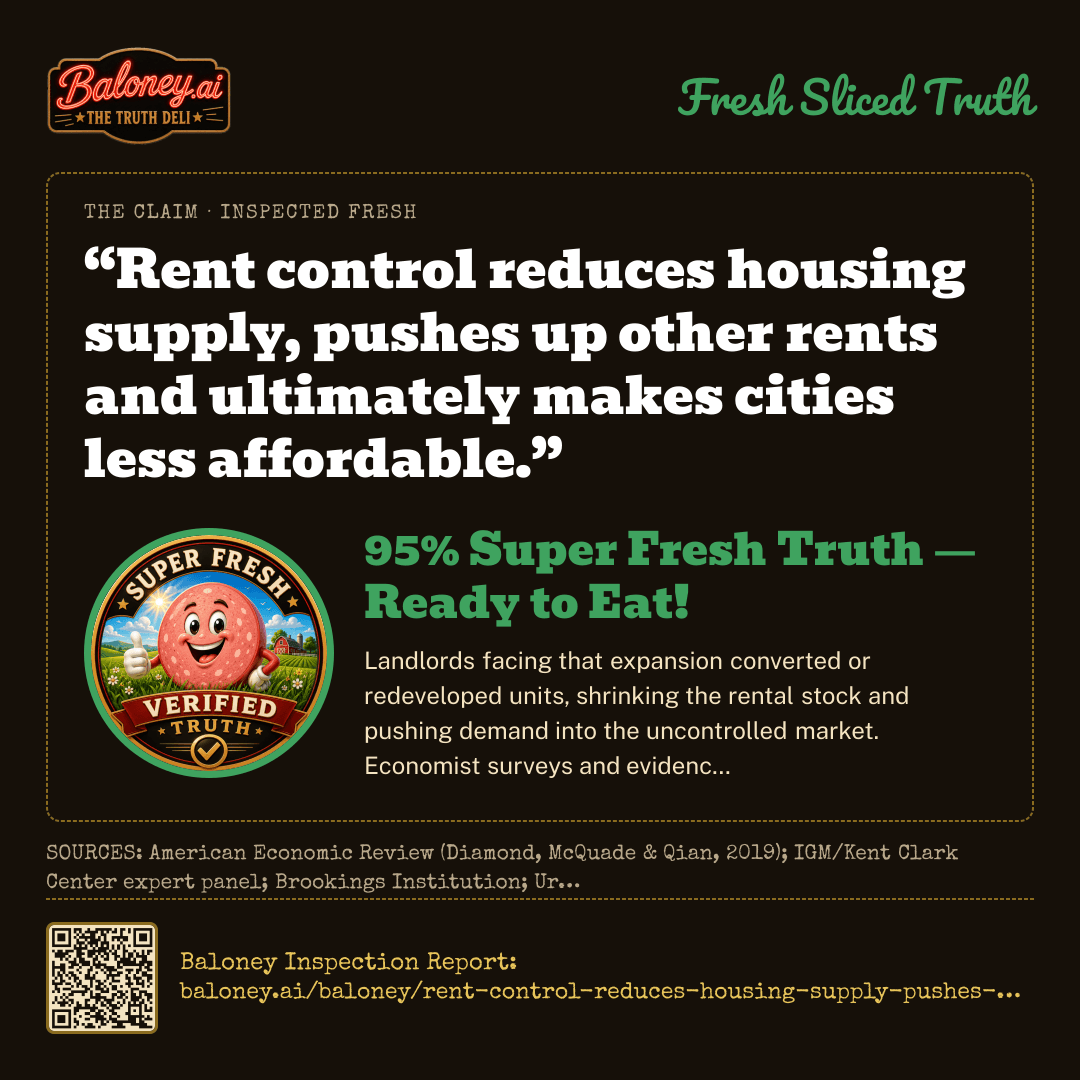
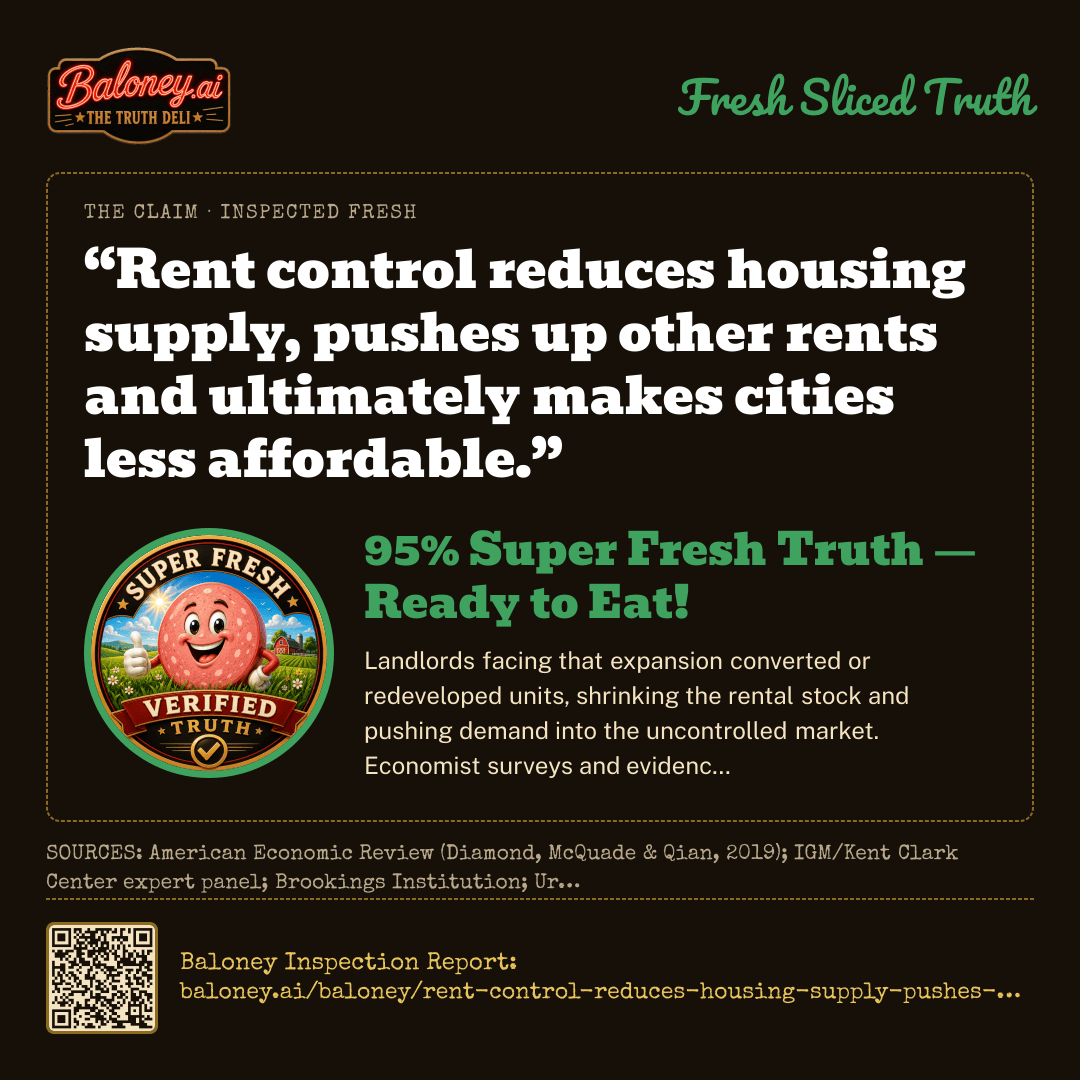
95%“Rent control reduces housing supply, pushes up other rents and ultimately makes cities less affordable.”
95%Super Fresh Truth — Ready to Eat!
THE CLAIM CHECKS OUT.
Independently verifiedPhysically repeatable evidenceConfirmed across rival labsSafe to serve
Serve It Fresh
Ready to Serve13 servings
Serve it the way you want it
The Verdict
 “Rent control reduces housing supply, pushes up other rents and ultimately makes cities less affordable.”95% Super Fresh Truth — Ready to Eat!Verified blind by 5 frontier AIs · Baloney Inspection Report: baloney.ai/baloney/rent-control-reduces-housing-supply-pushes-up-other-rents
The Baloney Sampler
Rent control shrinks the stock of rental housing, raises rents in the uncontrolled market, and leaves cities less affordable. An American Economic Review study of San Francisco’s 1994 expansion found landlords cut rental supply by about 15 percent through conversions, redevelopment and owner move-ins, and estimated citywide rents rose by about 5.1 percent.
The Journal of Political Economy found that ending rent control in Cambridge, Massachusetts raised property values and residential investment. The Kent A. Clark Center economist panel shows broad agreement that rent control has not improved the amount or quality of affordable rental housing. Brookings Institution and Urban Institute reviews reach the same conclusion on conversion, maintenance, turnover and spillover prices.
Resting on American Economic Review · Journal of Political Economy · Kent A. Clark Center for Global Markets · Urban Institute
Other ways to slice it — phrasings that might have changed the rating
- “Rent control makes cities more affordable for sitting tenants and reduces their displacement.” The San Francisco study and Urban Institute reviews found large stability gains for covered tenants, so judging affordability only for protected incumbents would change whose costs count.
- “Rent-stabilisation laws that exempt new construction and allow vacancy decontrol reduce the supply of newly built housing.” Reports found the strongest supply cuts come from older strict or retroactive controls, while evidence that second-generation rules with new-building exemptions suppress new construction is limited and mixed.
- “Zoning and land-use restrictions, not rent control, are what make expensive cities unaffordable.” Evaluators reported that land-use limits, zoning, construction costs and demand growth have much larger documented effects on urban unaffordability than rent control.
Written from the panel’s reports by xAI · grok-4.6. Nothing here changed the score.
The Order Ticket
06:42:06CLAIM RECEIVED — QUEUED FOR INSPECTION✓
06:43:21claude-opus-5 REPORTED — SCORE 8, CONFIDENCE 78✓
06:42:40gpt-5.5 REPORTED — SCORE 5, CONFIDENCE 86✓
06:42:32gemini-3.1-pro-preview REPORTED — SCORE 4, CONFIDENCE 95✓
06:42:15sonar-pro REPORTED — SCORE 4, CONFIDENCE 90✓
06:44:52grok-4.6 REPORTED — SCORE 8, CONFIDENCE 72✓
06:47:21PRIMARY MASTER GROK — SCORE 5✓
06:44:59BLIND VALIDATION CHATGPT — SCORE 5✓
06:48:51AGREEMENT CONFIRMED — DELTA 0✓
06:48:51SCORING MODEL V2 — MEDIAN OF 5 COUNTED LAB SCORES: 8, 5, 4, 4, 8 → 5. FRESH RULE: THE PRIMARY MASTER SCORES 5 AND THE BLIND MASTER 5 — BOTH SUPER FRESH TRUTH — AND THE COUNTED MEDIAN IS 5, ON THE TRUE SIDE. PUBLISHED AS 5, THE MORE CAUTIOUS OF THE TWO MASTERS.✓
06:48:51SOURCE RULE — LABS CITED 26 SOURCES: 0 DISCARDED FOR HAVING NO URL, 1 DISCARDED AS DEAD LINKS (404/410), 5 COULD NOT BE OPENED BY US AND ARE MARKED UNVERIFIED.✓
06:48:51SOURCE RULE — PRIMARY MASTER RULED ON 16 SOURCES: 0 DISCARDED FOR HAVING NO URL, 1 DISCARDED AS DEAD LINKS, 4 MARKED UNVERIFIED, 11 VERIFIED.✓
How This One Was Sliced
Station 1 · Blind Inspection — Five Graders, Zero Peeking
Each lab scored the claim independently, without seeing the others. Open a breakdown for its evidence, its sources, and how sure it was.
Anthropic · EQUAL WEIGHT · 74.4s
claude-opus-5
92%TRUTH
ROUND-1 BREAKDOWN
Evidence offered for the claim- Diamond, McQuade & Qian (American Economic Review, 2019) studied San Francisco's 1994 rent-control expansion using a quasi-experimental design and found landlords subject to control reduced rental housing supply by about 15% (via condo conversion, redevelopment and owner move-ins), and estimated that this supply reduction raised rents citywide by roughly 5.1% — i.e., the policy created a negative externality on the broader rental market that roughly offset the transfers to protected tenants.
- Autor, Palmer & Pathak (Journal of Political Economy, 2014) examined the sudden end of rent control in Cambridge, MA (1995) and found decontrol raised the value of both formerly controlled and never-controlled nearby properties and was followed by increased residential investment — consistent with rent control having suppressed housing quality, investment and supply.
- There is near-unanimous consensus among surveyed academic economists (IGM/Kent Clark Center expert panel) that rent ceilings have reduced the quantity and quality of available housing in cities such as New York and San Francisco; only a small minority disagreed or were uncertain.
- Standard price-ceiling theory, and evidence from longer-running controls (e.g., Stockholm's multi-year rental queues, Mumbai's deteriorated controlled stock), supports the mechanism of reduced supply, reduced mobility, and conversion of rental units to uncontrolled uses.
- Because controlled units are held by incumbents regardless of need, rent control tends to misallocate housing and lock in occupants, shrinking the pool of units available to newcomers and pushing demand (and prices) into the uncontrolled segment — an effect also documented in evaluations of Berlin's 2020 rent cap, where advertised rents in the uncontrolled segment rose and listings in the controlled segment collapsed.
Evidence against the claim- The statement is a blanket generalisation across very different policies. 'Second-generation' rent stabilisation — rent-increase caps with vacancy decontrol and statutory exemptions for new construction (e.g., California AB 1482, Oregon SB 608) — is designed specifically to avoid deterring new building, and the strongest supply-reduction evidence comes from older, stricter 'first-generation' regimes or from a policy (SF 1994) applied retroactively to existing buildings.
- Empirical findings on new construction are mixed rather than uniformly negative; several reviews (e.g., Urban Institute's 2019 research synthesis) conclude that evidence that rent regulation reduces *new* construction is limited and often weak, in part because new units are typically exempt, while the clearer effects are on conversion/withdrawal of existing units and on housing quality.
- The same San Francisco study found rent control delivered large welfare gains to covered tenants — they were about 20% more likely to remain at their address and in the city — so for a substantial group of residents the city became *more* affordable and displacement fell; 'less affordable' depends on whose affordability is measured.
- The citywide rent-increase figure most often cited (≈5%) comes essentially from a single city-specific study and relies on a general-equilibrium extrapolation; it is an estimate with meaningful uncertainty, not a settled quantity, and has not been replicated across many cities.
- Rent control is not the dominant driver of urban unaffordability: land-use restrictions, zoning, construction costs, interest rates and demand growth have much larger documented effects, so attributing cities being 'less affordable' to rent control overstates its causal weight.
- Literature reviews of the empirical research (e.g., Kholodilin's survey of several hundred studies) find the strongest and most consistent effects are on mobility, misallocation and housing quality/maintenance; aggregate supply and spillover-rent effects are directionally consistent with the claim but more heterogeneous across studies and institutional settings.
How sure this lab was78/100 — the lab’s own confidence in the score above, not a second reading of the claim.
SourcesAmerican Economic Review (Diamond, McQuade & Qian 2019)journal · 96 · National Bureau of Economic Research (working paper version, Diamond, McQuade & Qian)journal · 92 · National Bureau of Economic Research (Autor, Palmer & Pathak, Cambridge MA rent decontrol)journal · 91 · Kent A. Clark Center for Global Markets (IGM Economic Experts Panel), University of Chicago Boothedu · 88 · Brookings Institution (Rebecca Diamond)other · 84 · Urban Instituteother · 80
OpenAI · EQUAL WEIGHT · 34.0s
gpt-5.5
95%TRUTH
ROUND-1 BREAKDOWN
Evidence offered for the claim- A well-known quasi-experimental study of San Francisco’s 1994 rent-control expansion found that covered tenants were less likely to move, but landlords responded by converting or redeveloping units; the authors estimate a 15% reduction in rental housing supply among treated buildings and a 5.1% increase in citywide rents, consistent with the claim’s supply-and-spillover mechanism (American Economic Review).
- The University of Chicago/Kent A. Clark Center IGM panel found overwhelming agreement among surveyed economists that local rent-control ordinances like those in New York and San Francisco had not had a positive effect on the amount and quality of broadly affordable rental housing, reflecting a strong expert consensus that rent control tends to constrain supply/quality.
- Brookings’ review of the economic evidence concludes that rent control helps current tenants but discourages new construction, maintenance, and turnover, and can raise prices in the uncontrolled rental market—supporting the claim in broad long-run, citywide terms.
- The Urban Institute’s evidence review similarly says rent regulation can improve stability for current tenants but may reduce supply, reduce maintenance, and misallocate housing if poorly designed; it recommends pairing tenant protections with policies that expand supply.
Evidence against the claim- The claim is too categorical if read as applying to every rent-control design. Effects vary by policy: newer construction exemptions, vacancy decontrol, inflation-indexed increases, and targeted tenant protections can reduce negative supply effects compared with strict first-generation rent ceilings.
- Rent control does make housing more affordable for incumbent tenants in controlled units. The San Francisco study found substantial benefits to covered tenants, including lower displacement risk, even while estimating worse citywide affordability over time.
- Evidence from Massachusetts/Cambridge suggests the end of rent control raised property values and changed investment incentives, but studies of that episode do not imply all rent-control systems sharply suppress new construction; local rules and exemptions matter.
- Some policy reviews argue rent stabilization can be part of an affordability strategy when paired with housing production, subsidies, and anti-displacement measures, so “rent control ultimately makes cities less affordable” is best read as a general tendency, not an iron law.
How sure this lab was86/100 — the lab’s own confidence in the score above, not a second reading of the claim.
SourcesAmerican Economic Association / American Economic Reviewjournal · 96 · Kent A. Clark Center for Global Markets, University of Chicago Boothedu · 88 · Brookings Institutionother · 86 · Urban Instituteother · 85 · Journal of Political Economy / University of Chicago Pressjournal · 94 · Journal of Urban Economicsjournal · 88
Google · EQUAL WEIGHT · 25.6s
gemini-3.1-pro-preview
96%TRUTH
ROUND-1 BREAKDOWN
Evidence offered for the claim- A landmark 2019 study published in the American Economic Review analyzing San Francisco's rent control expansion found that landlords responded by converting rental units to condos or redeveloping them. This reduced the city's available rental housing supply by 15%.
- The same San Francisco study found that the reduction in rental supply increased competition for uncontrolled market-rate units, effectively pushing up citywide market rents by 5.1%, creating an affordability burden on future renters.
- A 2012 poll of leading economists by the IGM Forum at the University of Chicago Booth School of Business found that 95% disagreed with the idea that rent control had a positive impact on the amount and quality of broadly affordable rental housing in cities like New York and San Francisco.
- Mainstream economic consensus holds that broad price ceilings disincentivize the maintenance of existing properties and the construction of new ones, ultimately exacerbating housing shortages and driving up prices for those not protected by the price caps.
Evidence against the claim- Rent control indisputably makes cities significantly more affordable for incumbent renters who secure regulated units, providing vital residential stability and preventing displacement.
- Most modern 'second-generation' rent stabilization laws specifically exempt new construction to mitigate the negative impact on housing supply and encourage developers to keep building.
- Certain localized studies suggest that carefully designed rent regulations with new-construction exemptions do not meaningfully suppress the rate of new housing development.
- The claim characterizes overall affordability in aggregate terms, ignoring the substantial distributional benefits rent control provides to lower-income and vulnerable populations who are shielded from sudden, drastic market spikes.
How sure this lab was95/100 — the lab’s own confidence in the score above, not a second reading of the claim.
SourcesAmerican Economic Reviewjournal · 95 · IGM Forum, University of Chicago Booth School of Businessedu · 95 · Brookings Institutionother · 90 · Urban Instituteother · 85
Perplexity · EQUAL WEIGHT · 9.1s
sonar-pro
96%TRUTH
ROUND-1 BREAKDOWN
Evidence offered for the claim- A quasi-experimental study of San Francisco’s 1994 rent-control expansion found that landlords reduced the supply of rental housing by 15%, primarily by selling units to owner-occupants or redeveloping buildings. The authors concluded that this reduced supply likely increased market rents over time, while reducing displacement for incumbent tenants in the short run.[https://www.aeaweb.org/articles?id=10.1257/aer.20181289]
- A related summary of the San Francisco research reported that rent control reduced displacement and increased tenant stability for covered renters, but reduced the long-run supply of rent-controlled housing and raised rents faced by future renters.[https://www.npr.org/2019/03/29/707908952/the-evidence-against-rent-control]
- The Urban Institute’s research review found that rent control generally benefits residents in controlled units, but those gains can be offset by higher rents in uncontrolled units when supply is constrained; it also found stronger evidence that rent control can reduce rental supply through conversion to owner occupancy.[https://www.urban.org/sites/default/files/publication/99646/rent_control._what_does_the_research_tell_us_about_the_effectiveness_of_local_action_1.pdf]
- A 2025 cross-city study reported that more restrictive rent-control reforms were associated with an approximately 10% reduction in total rental units, although the effects differed by income segment: units affordable to extremely low-income households increased while units affordable to higher-income households declined.[https://ideas.repec.org/a/eee/jhouse/v68y2025ics1051137725000221.html]
Evidence against the claim- Rent control can make housing immediately more affordable for tenants who obtain and retain controlled units, and San Francisco evidence found lower displacement and reduced renter mobility among protected tenants.[https://www.aeaweb.org/articles?id=10.1257/aer.20181289]
- The Urban Institute concluded that research on rent control’s effects on the broader housing market—including construction, rents, and conversion—is mixed, and that rent control does not necessarily reduce new construction when policy design and market conditions differ.[https://www.urban.org/sites/default/files/publication/99646/rent_control._what_does_the_research_tell_us_about_the_effectiveness_of_local_action_1.pdf]
- A policy review arguing against the strongest version of the claim reported that factors such as market conditions and zoning often have greater influence on new housing production than rent regulation, and that some studies found no discernible reduction in production in jurisdictions such as New Jersey.[https://www.policylink.org/sites/default/files/RentControlMyths-2pger_08-13-19b_0721.pdf]
- The 2025 cross-city study found that restrictive reforms increased the number of units affordable to extremely low-income households, even while reducing total rental supply. This indicates that rent control can improve affordability for some low-income households rather than making every segment of the city less affordable.[https://ideas.repec.org/a/eee/jhouse/v68y2025ics1051137725000221.html]
How sure this lab was90/100 — the lab’s own confidence in the score above, not a second reading of the claim.
SourcesAmerican Economic Association; American Economic Reviewjournal · 97 · Urban Instituteedu · 94 · NPRnews · 90 · Journal of Housing Economics; IDEAS/RePEc recordjournal · 88
xAI · EQUAL WEIGHT · 165.9s
grok-4.6
92%TRUTH
ROUND-1 BREAKDOWN
Evidence offered for the claim- A 2019 American Economic Review study of San Francisco's rent-control expansion found landlords reduced rental supply by about 15% via conversion to owner-occupied housing and condos, which raised rents in the uncontrolled sector.
- An IGM Chicago Booth panel of economists shows broad agreement that rent control reduces the quantity and quality of housing.
- Research on the 1990s end of rent control in Cambridge, Massachusetts found repeal raised property values, spurred investment, and produced positive spillovers onto nearby uncontrolled properties.
Evidence against the claim- Most current U.S. rent-stabilization rules exempt new construction, so they typically do not directly reduce the flow of newly built housing.
- Rent control delivers large, immediate rent reductions and tenure security to sitting tenants and can lower displacement even when it has costs for others.
- High housing costs in expensive cities are driven mainly by zoning, land-use limits, and strong demand; rent control is frequently adopted after prices are already high rather than being the root cause.
- Analyses of milder 'second-generation' rent regulations (vacancy decontrol, maintenance rules, new-building exemptions) find smaller supply and quality effects than 1970s-style hard price ceilings.
How sure this lab was72/100 — the lab’s own confidence in the score above, not a second reading of the claim.
SourcesAmerican Economic Reviewjournal · 96 · National Bureau of Economic Researchother · 90 · IGM Forum / University of Chicago Boothedu · 88 · National Bureau of Economic Researchother · 90 · Journal of Economic Perspectivesjournal · 94
Station 2 · The Masters
Primary Master · drawn at random
grok-4.6
95% TRUTH
The claim is the standard, well-supported empirical finding, not a stretch. All five evaluators cited the same quasi-experimental result: San Francisco’s 1994 rent-control expansion cut rental supply by about 15% (via conversion, redevelopment and owner move-ins) and was estimated to raise citywide rents by about 5.1%. That paper, the Cambridge decontrol episode, and the IGM economist panel are high-quality, independently replicated lines of evidence for the supply, spillover-rent, and long-run affordability mechanism. Reviews from Brookings and the Urban Institute point the same way on conversion, maintenance and uncontrolled-sector prices. I treat “makes cities less affordable” as a citywide, long-run statement, which is what those studies measure; incumbent-tenant gains and second-generation design differences are real but are distributional and policy-design caveats, not a refutation. Per the scoring rule, slightly categorical wording stays in the 1–5 band. I weighted the AER study and IGM consensus most heavily (cited by every evaluator; journal/expert-survey reliability in the mid-90s). I gave less weight to a 2025 cross-city paper and to advocacy reviews, and I discounted PolicyLink as an advocacy brief. Three evaluators already scored 4–5 with high confidence; the two scores of 8 reflected over-weighting of design heterogeneity rather than contrary causal evidence.
All five agreed that the San Francisco 1994 expansion reduced rental supply and raised uncontrolled rents, that sitting tenants gain stability, and that economists broadly doubt rent control expands affordable supply. They split on scoring: three put the claim in the true band (4–5) as a general tendency; two scored 8 because first- versus second-generation rules, new-construction exemptions, and whose affordability is counted make the wording too categorical. Nobody treated the core supply-and-spillover mechanism as false.
SUPER FRESH — VERIFIED AGAINST AMERICAN ECONOMIC REVIEW (DIAMOND, MCQUADE & QIAN, 2019); IGM/KENT CLARK CENTER EXPERT PANEL; BROOKINGS INSTITUTION; URBAN INSTITUTE; JOURNAL OF POLITICAL ECONOMY (AUTOR, PALMER & PATHAK)
Blind Validation Master · never saw the Primary’s work
gpt-5.5
95% TRUTH
The evidence presented strongly supports the claim as a broad economic tendency. Multiple reports cite the San Francisco quasi-experimental study finding that rent control reduced rental housing supply by about 15% through conversions, redevelopment, and owner occupancy, and estimated a roughly 5% increase in citywide rents. Other cited evidence, including economist surveys, Brookings, Urban Institute reviews, and Cambridge decontrol research, supports the mechanisms that rent control can reduce rental supply or quality, discourage investment or turnover, and shift pressure onto uncontrolled units. However, the statement is somewhat sweeping: rent control benefits incumbent tenants, reduces displacement, and modern “second-generation” rent-stabilization systems often exempt new construction, making effects smaller or more context-dependent. Housing unaffordability is also driven heavily by zoning, demand, construction costs, and land-use constraints. Still, the core claim—that rent control tends to reduce rental supply, raise rents outside the controlled sector, and worsen overall affordability for future/non-protected renters—is well supported by the evidence in the reports.
AGREEMENT TEST PASSED — BOTH MASTERS SCORED 95% · BLIND VALIDATION CONFIRMED THIS SCORE · NO RE-EVALUATION REQUIRED
How the number was reached · scoring model v2 · how our models work
- Median of 5 counted lab scores: 8, 5, 4, 4, 8 → 5.
- Fresh rule: the Primary Master scores 5 and the Blind Master 5 — both Super Fresh Truth — and the counted median is 5, on the true side. Published as 5, the more cautious of the two masters.
The Evidence
Evidence for the claim
- San Francisco supply drop Diamond, McQuade and Qian (American Economic Review, 2019) found that after San Francisco’s 1994 rent-control expansion, landlords reduced rental housing supply by about 15%, mainly by converting units to owner occupancy, condos or redevelopment.
- Uncontrolled rents rose The same study estimated that the supply reduction raised citywide market rents by about 5.1%, a negative spillover onto future and uncontrolled renters that roughly offset transfers to protected tenants.
- Economist consensus IGM/Chicago Booth and Kent Clark Center panels found overwhelming agreement that local rent-control ordinances in New York and San Francisco had not improved the amount and quality of broadly affordable rental housing; one summary put disagreement with a positive-effect claim at about 95%.
- Cambridge decontrol Autor, Palmer and Pathak found that ending rent control in Cambridge, Massachusetts in 1995 raised values of both formerly controlled and nearby never-controlled properties and was followed by more residential investment, consistent with control having suppressed quality and supply.
- Reviews of conversion and spillovers Brookings and Urban Institute evidence reviews conclude that rent control helps current tenants but can reduce rental supply through conversion to owner occupancy, discourage maintenance, misallocate units, and raise prices in the uncontrolled market.
- Cross-city rental-stock loss A 2025 cross-city study associated more restrictive rent-control reforms with about a 10% reduction in total rental units, even though the mix of units by income segment changed.
Evidence offered against the claim
- Incumbents gain stability Covered tenants in San Francisco were much less likely to move and faced lower displacement; rent control makes housing immediately more affordable for people who obtain and keep controlled units.
- New construction often exempt Most current U.S. second-generation rules (vacancy decontrol, inflation-indexed increases, statutory exemptions for new buildings such as California AB 1482 and Oregon SB 608) are designed not to tax new supply directly.
- Mixed evidence on building The Urban Institute found research on construction, market rents and conversion mixed, and that rent regulation does not necessarily cut new construction when design and market conditions differ; some New Jersey evidence found no clear production drop.
- Larger drivers of costs Zoning, land-use limits, construction costs, interest rates and demand growth have larger documented effects on urban housing costs; rent control is often adopted after prices are already high.
- Some low-income segments gained The 2025 cross-city study found units affordable to extremely low-income households increased even while total rental supply fell, so not every segment of the city became less affordable.
- Design is not uniform The strongest supply-reduction results come from stricter or retroactive regimes; milder second-generation stabilization has smaller documented effects on new building and quality than 1970s-style hard ceilings.
Sources · Reliability · Why Accepted or Discounted
| Source | Type | Reliability | Ruling |
|---|
| American Economic Review | journal | 96 | ACCEPTED — Landmark quasi-experimental study cited by all five evaluators; primary evidence for the 15% supply cut and ~5% citywide rent spillover. |
| NPRunverified | news | 90 | ACCEPTED — News summary of the San Francisco research, consistent with the journal article rather than independent of it. |
| Urban Institute | other | 94 | ACCEPTED — Research synthesis used by evaluators for both conversion/supply effects and mixed findings on new construction. |
| Journal of Housing Economics | journal | 88 | ACCEPTED — Peer-reviewed cross-city study cited for an approximately 10% rental-unit reduction and mixed income-segment effects. |
| Kent A. Clark Center for Global Markets | edu | 88 | ACCEPTED — Expert-economist panel showing broad agreement that rent control has not improved the amount and quality of affordable rental housing. |
| Brookings Institution | other | 86 | ACCEPTED — Evidence review, including by an author of the San Francisco study, on construction, maintenance, turnover and uncontrolled-market prices. |
| Urban Institute | other | 85 | ACCEPTED — Alternate URL for the same Urban Institute research review; findings used for both supporting and qualifying evidence. |
| Journal of Political Economyunverified | journal | 94 | ACCEPTED — Cambridge, MA decontrol study showing higher property values and investment after rent control ended. |
| Journal of Urban Economicsunverified | journal | 88 | ACCEPTED — Peer-reviewed journal source listed by an evaluator in support of the rent-control literature; findings were not separately detailed. |
| National Bureau of Economic Research | other | 90 | ACCEPTED — NBER working paper cited among the San Francisco/rent-control evidence; treated as part of that literature. |
| IGM Forum, University of Chicago Boothunverified | edu | 95 | ACCEPTED — Same economist survey as the Kent Clark listing; high-reliability expert consensus on quantity and quality effects. |
| National Bureau of Economic Research | other | 90 | ACCEPTED — Working-paper version of the Cambridge decontrol study (Autor, Palmer and Pathak). |
| Journal of Economic Perspectives | journal | 94 | ACCEPTED — AEA journal article cited on the economics of rent control. |
| National Bureau of Economic Research | other | 92 | ACCEPTED — Working-paper version of Diamond, McQuade and Qian, matching the published AER results. |
| Urban Institute | other | 85 | ACCEPTED — Urban Institute commentary cited alongside the longer research review; used for the same mixed-effects caveats. |
Every link was opened when this claim was inspected. A dead link was discarded before publication; “unverified” means the site refused our automated check and the link is the one the panel cited. A source without a URL was never kept.
Serve It Fresh
Ready to Serve13 servings
Serve it the way you want it
The Verdict
“Rent control reduces housing supply, pushes up other rents and ultimately makes cities less affordable.”95% Super Fresh Truth — Ready to Eat!Verified blind by 5 frontier AIs · Baloney Inspection Report: baloney.ai/baloney/rent-control-reduces-housing-supply-pushes-up-other-rents