Baloney Inspection Report: Claim #1162 · Inspected Oct 31, 2026, 7:38 AM PDT · Scoring model v2
 34%
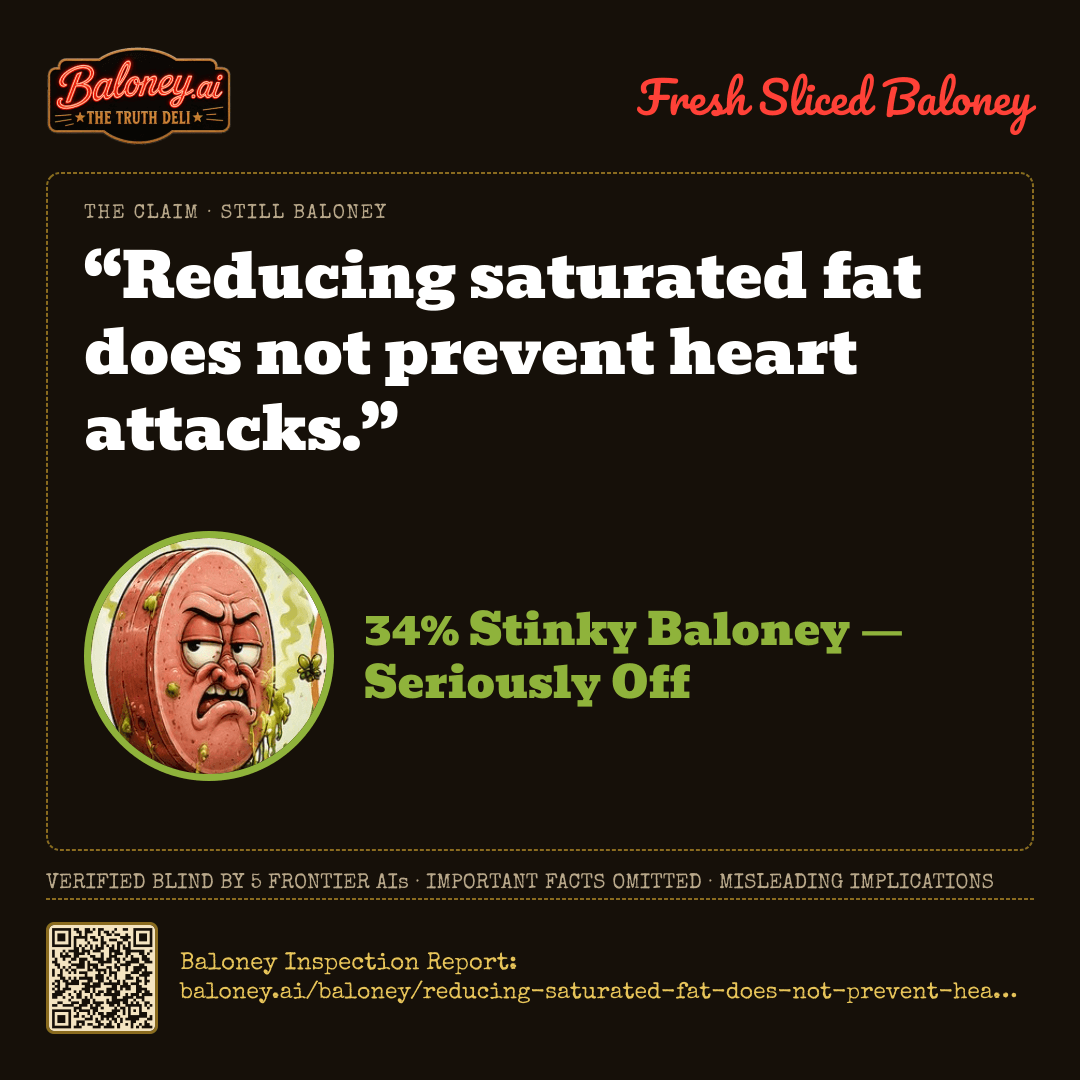
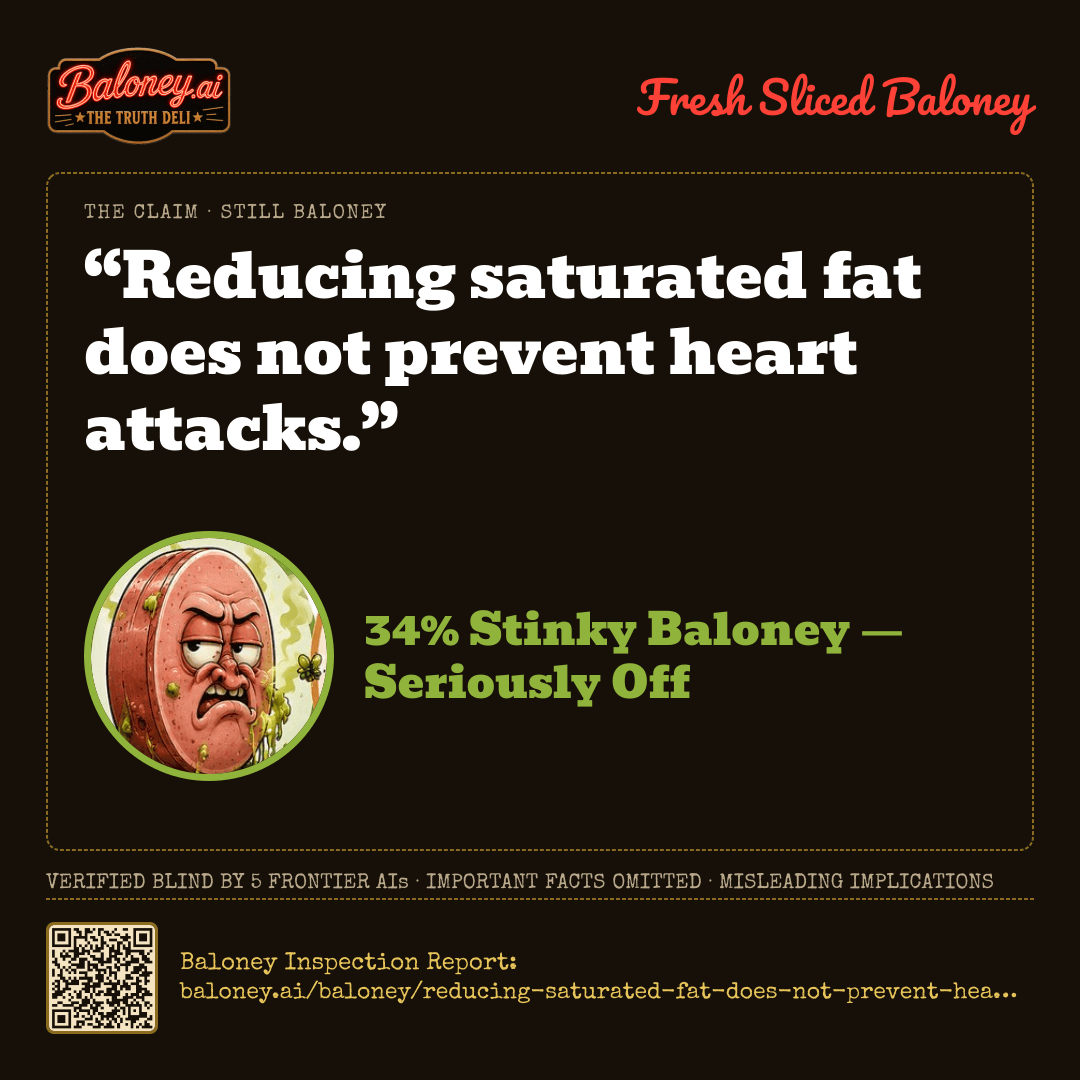
“Reducing saturated fat does not prevent heart attacks.”
34%Stinky Baloney — Seriously Off
That’s not the whole story…
Important facts omittedMisleading implicationsCherry-picked infoSpins the truth
Serve It Fresh
Ready to Serve11 servings
Serve it the way you want it
The Verdict
 “Reducing saturated fat does not prevent heart attacks.”34% Stinky Baloney — Seriously OffVerified blind by 5 frontier AIs · Baloney Inspection Report: baloney.ai/baloney/reducing-saturated-fat-does-not-prevent-heart-attacks
The Baloney Sampler
The claim holds a real kernel: Cochrane's 2020 review of randomised trials found little or no clear effect of cutting saturated fat on nonfatal heart attack (RR 0.97, 95% CI 0.87–1.07) or on coronary and overall deaths, with that heart-attack evidence rated low to very low quality. Recovered trial data from the Minnesota Coronary Experiment (BMJ) and the Women's Health Initiative (JAMA) also showed no event or mortality benefit, and cohort meta-analyses found no link between habitual intake and coronary disease.
But the same Cochrane review found a 17% drop in combined cardiovascular events, the category that includes heart attacks, with most benefit where cholesterol fell furthest; an earlier Cochrane fat-modification review found 14%. The American Heart Association's 2017 advisory put the reduction near 30% when polyunsaturated vegetable oil replaces saturated fat, and a PLoS Medicine trial meta-analysis found about 19% fewer coronary events. The null cohort results largely reflect ignoring what replaced the fat. The blanket wording strips out that condition.
Resting on Cochrane · Cochrane · American Heart Association / Circulation · PLoS Medicine
Original Claim Source https://www.reddit.com/r/ScientificNutrition/comments/1w7wv91/new_review_challenges_saturated_fat_reduction/
Other ways to slice it — phrasings that might have changed the rating
- “Replacing saturated fat with refined carbohydrates or sugar does not reduce the risk of heart attacks.” Pooled cohort analyses and Cochrane found no coronary benefit when starchy or refined-carbohydrate foods replace saturated fat, which is the conditional version of the claim the evidence actually supports.
- “Randomised trials have not clearly shown that reducing saturated fat lowers deaths from heart disease or the rate of nonfatal myocardial infarction specifically.” Cochrane's 2020 review reported RR 0.97 (95% CI 0.87–1.07) for nonfatal myocardial infarction and no clear effect on coronary or all-cause mortality, with that evidence graded low to very low quality.
- “Replacing saturated fat with polyunsaturated vegetable oil reduces cardiovascular events by roughly 17% to 30%.” This is the opposite framing supported by the Cochrane 17% composite estimate, the AHA 2017 advisory's ~30% figure, and the PLoS Medicine meta-analysis showing about 19% fewer coronary events.
Written from the panel’s reports by Anthropic · claude-opus-5. Nothing here changed the score.
The Order Ticket
14:38:06CLAIM RECEIVED — QUEUED FOR INSPECTION✓
14:39:11claude-opus-5 REPORTED — SCORE 42, CONFIDENCE 78✓
14:38:44gpt-5.5 REPORTED — SCORE 32, CONFIDENCE 84✓
14:38:34gemini-3.1-pro-preview REPORTED — SCORE 45, CONFIDENCE 95✓
14:38:12sonar-pro REPORTED — SCORE 34, CONFIDENCE 95✓
14:39:47grok-4.6 REPORTED — SCORE 33, CONFIDENCE 72✓
14:41:24PRIMARY MASTER CLAUDE — SCORE 38✓
14:39:58BLIND VALIDATION GEMINI — SCORE 38✓
14:41:42AGREEMENT CONFIRMED — DELTA 4✓
14:41:42SCORING MODEL V2 — MEDIAN OF 5 COUNTED LAB SCORES: 42, 32, 45, 34, 33 → 34.✓
14:41:42SOURCE RULE — LABS CITED 32 SOURCES: 0 DISCARDED FOR HAVING NO URL, 0 DISCARDED AS DEAD LINKS (404/410), 22 COULD NOT BE OPENED BY US AND ARE MARKED UNVERIFIED.✓
14:41:42SOURCE RULE — PRIMARY MASTER RULED ON 20 SOURCES: 0 DISCARDED FOR HAVING NO URL, 0 DISCARDED AS DEAD LINKS, 15 MARKED UNVERIFIED, 5 VERIFIED.✓
How This One Was Sliced
Station 1 · Blind Inspection — Five Graders, Zero Peeking
Each lab scored the claim independently, without seeing the others. Open a breakdown for its evidence, its sources, and how sure it was.
Anthropic · EQUAL WEIGHT · 64.1s
claude-opus-5
42%BALONEY
ROUND-1 BREAKDOWN
Evidence offered for the claim- Cochrane's most recent systematic review of randomised trials (Hooper et al., 2020) found that reducing saturated fat produced little or no effect on all-cause mortality and cardiovascular mortality, and the effect estimates for myocardial infarction specifically were imprecise and not clearly significant — the clear benefit was for the broader composite of 'combined cardiovascular events.'
- Large meta-analyses of prospective cohort studies (Siri-Tarino et al., AJCN 2010; Chowdhury et al., Annals of Internal Medicine 2014) found no statistically significant association between habitual saturated fat intake and coronary heart disease risk, undercutting the simple 'less saturated fat = fewer heart attacks' model.
- Recovered data from two major randomised trials — the Minnesota Coronary Experiment (Ramsden et al., BMJ 2016) and the Sydney Diet Heart Study (Ramsden et al., BMJ 2013) — showed that replacing saturated fat with linoleic-acid-rich oils lowered serum cholesterol but did not reduce, and in some analyses increased, mortality.
- The Women's Health Initiative Dietary Modification Trial (Howard et al., JAMA 2006), the largest randomised dietary trial ever conducted (~48,800 women, ~8 years), found no statistically significant reduction in coronary heart disease or stroke from a low-fat diet that also reduced saturated fat.
- The PURE prospective study (Dehghan et al., Lancet 2017, 135,000+ people in 18 countries) reported that higher saturated fat intake was associated with lower total mortality and was not significantly associated with myocardial infarction or cardiovascular mortality.
- Cutting saturated fat alone, without specifying what replaces it, can be neutral or harmful: substituting refined carbohydrates or sugar for saturated fat shows no coronary benefit in pooled cohort analyses, so the blanket advice 'eat less saturated fat' is genuinely not reliably protective on its own.
Evidence against the claim- The same Cochrane review the claim leans on actually concluded that reducing saturated fat intake for at least two years causes a 'potentially important' ~17% reduction in combined cardiovascular events (RR ≈0.83), with greater benefit in trials achieving larger reductions in serum cholesterol — i.e., it does reduce cardiovascular events, the category that includes heart attacks.
- Meta-analysis of randomised controlled trials replacing saturated fat with polyunsaturated fat (Mozaffarian, Micha & Wallace, PLoS Medicine 2010) found a ~19% reduction in coronary heart disease events, with about 10% risk reduction per 5% of energy substituted.
- The American Heart Association's 2017 Presidential Advisory (Sacks et al., Circulation) reviewed the four best-controlled core trials (Oslo, LA Veterans, MRC, Finnish Mental Hospital) and found ~29% reduction in cardiovascular disease events when saturated fat was replaced with vegetable oil — comparable to statin effect sizes.
- Pooled prospective cohort analyses (Jakobsen et al., AJCN 2009; Li et al., JACC 2015) show that replacing saturated fat with polyunsaturated fat or whole grains is associated with significantly lower coronary event risk; the null cohort findings arise mainly because they ignore the replacement nutrient.
- Saturated fat consistently raises LDL cholesterol in controlled feeding studies, and Mendelian randomisation plus trial evidence (European Atherosclerosis Society Consensus, Ference et al., Eur Heart J 2017) establish LDL as causal for atherosclerotic events, providing a strong mechanistic chain from saturated fat reduction to fewer myocardial infarctions.
- WHO's 2023 guideline and essentially every major public health body (AHA, NHLBI, US/EU dietary guidelines) recommend limiting saturated fat to below ~10% of energy specifically to reduce cardiovascular disease risk, based on this body of evidence.
- The claim is stated as an unqualified absolute ('does not prevent'), which the evidence does not support; the honest summary is 'reducing saturated fat has not been clearly shown to reduce death rates, but does reduce cardiovascular events when replaced with polyunsaturated fat.'
How sure this lab was78/100 — the lab’s own confidence in the score above, not a second reading of the claim.
SourcesCochrane Database of Systematic Reviews (Hooper et al., 2020)journal · 96 · American Heart Association / Circulation (Sacks et al., 2017 Presidential Advisory)journal · 90 · PLoS Medicine (Mozaffarian, Micha & Wallace, 2010)journal · 88 · American Journal of Clinical Nutrition (Siri-Tarino et al., 2010)journal · 85 · Annals of Internal Medicine (Chowdhury et al., 2014)journal · 86 · The BMJ (Ramsden et al., 2016 — Minnesota Coronary Experiment)journal · 88 · The BMJ (Ramsden et al., 2013 — Sydney Diet Heart Study)journal · 85 · JAMA (Howard et al., 2006 — Women's Health Initiative Dietary Modification Trial)journal · 90 · The Lancet (Dehghan et al., 2017 — PURE study)journal · 84 · American Journal of Clinical Nutrition (Jakobsen et al., 2009)journal · 85 · European Heart Journal (Ference et al., 2017 — EAS Consensus on LDL causality)journal · 92 · World Health Organization — Saturated fatty acid and trans-fatty acid intake guideline (2023)gov · 90
OpenAI · EQUAL WEIGHT · 37.6s
gpt-5.5
32%BALONEY
ROUND-1 BREAKDOWN
Evidence offered for the claim- Randomized-trial evidence does not consistently show fewer myocardial infarctions specifically when saturated fat is reduced. The 2020 Cochrane review found little or no clear effect on nonfatal myocardial infarction, cardiovascular mortality, or all-cause mortality, even though it did find fewer combined cardiovascular events overall.
- Several observational meta-analyses have reported no statistically significant association between saturated-fat intake and coronary heart disease outcomes, which supports the narrower argument that simply eating less saturated fat has not reliably translated into fewer heart attacks in all evidence sets.
- The Women's Health Initiative low-fat diet trial reduced total fat and saturated fat modestly but did not significantly reduce coronary heart disease, myocardial infarction, or stroke over about 8 years; however, it was not a pure saturated-fat replacement trial.
- The Minnesota Coronary Experiment, a recovered randomized trial, lowered serum cholesterol by replacing saturated fat with linoleic-acid-rich vegetable oil but did not show a mortality benefit, illustrating that lowering saturated fat/cholesterol in a particular intervention did not necessarily prevent clinical events.
Evidence against the claim- The claim is too categorical: the best trial syntheses generally find that reducing saturated fat, especially when replaced with polyunsaturated fat rather than refined carbohydrate, reduces combined cardiovascular events. Some of those events include coronary events closely related to heart attacks.
- The American Heart Association's 2017 presidential advisory concluded that replacing saturated fat with polyunsaturated vegetable oils lowers cardiovascular disease incidence by about 30%, comparable to the effect of statin therapy in trials. That directly contradicts a blanket statement that saturated-fat reduction does not prevent heart attacks or related coronary events.
- Large cohort evidence from the Nurses' Health Study and Health Professionals Follow-up Study found that replacing saturated fat with polyunsaturated fat, monounsaturated fat, or whole-grain carbohydrates was associated with lower coronary heart disease risk, including nonfatal myocardial infarction and fatal CHD.
- Major public-health bodies, including WHO and the U.S. Dietary Guidelines, advise limiting saturated fat and replacing it with unsaturated fats because saturated fat raises LDL cholesterol, a causal risk factor for atherosclerotic cardiovascular disease. This supports prevention when the dietary replacement is appropriate.
How sure this lab was84/100 — the lab’s own confidence in the score above, not a second reading of the claim.
SourcesCochranejournal · 94 · American Heart Association / Circulationjournal · 91 · BMJjournal · 86 · BMJjournal · 84 · JAMAjournal · 88 · BMJjournal · 86 · World Health Organizationgov · 92 · U.S. Department of Agriculture / U.S. Department of Health and Human Servicesgov · 88
Google · EQUAL WEIGHT · 27.6s
gemini-3.1-pro-preview
45%BALONEY
ROUND-1 BREAKDOWN
Evidence offered for the claim- Meta-analyses of prospective cohort studies, such as the widely cited 2010 Siri-Tarino study, have found no significant independent association between saturated fat intake and an increased risk of coronary heart disease (CHD) or cardiovascular disease (CVD).
- Nutritional science demonstrates that simply reducing saturated fat does not prevent heart attacks if the fat is replaced by refined carbohydrates or added sugars; doing so can actually worsen blood lipid profiles and increase cardiovascular risk.
Evidence against the claim- A 2017 Presidential Advisory from the American Heart Association (AHA) reviewed rigorous randomized controlled trials and concluded that lowering saturated fat and replacing it with polyunsaturated vegetable oil reduces the incidence of cardiovascular disease by approximately 30%, an effect size comparable to statin therapy.
- A comprehensive 2020 Cochrane Review of 15 randomized controlled trials involving over 59,000 participants found that reducing saturated fat intake for at least two years caused a statistically significant 21% reduction in combined cardiovascular events.
- Major global health authorities, including the World Health Organization (WHO) and the American College of Cardiology, continue to explicitly recommend limiting saturated fat to reduce the risk of ischemic heart disease and heart attacks.
How sure this lab was95/100 — the lab’s own confidence in the score above, not a second reading of the claim.
SourcesAmerican Heart Associationjournal · 95 · Cochrane Database of Systematic Reviewsjournal · 95 · American Journal of Clinical Nutritionjournal · 90
Perplexity · EQUAL WEIGHT · 5.9s
sonar-pro
34%BALONEY
ROUND-1 BREAKDOWN
Evidence offered for the claim- The claim has limited support if interpreted narrowly: the 2020 Cochrane review found little or no effect of reducing saturated fat on nonfatal myocardial infarction (RR 0.97, 95% CI 0.87–1.07) and no clear reduction in coronary-heart-disease mortality; the evidence for heart attacks specifically was rated low or very low quality.[https://www.cochrane.org/evidence/CD011737_effect-cutting-down-saturated-fat-we-eat-our-risk-heart-disease]
- Reducing total fat without considering what replaces saturated fat may not help; Cochrane found no clear benefit when saturated fat was replaced with starchy foods, whereas benefits were more apparent when it was replaced with polyunsaturated fat.[https://www.cochrane.org/evidence/CD002137_cutting-down-or-changing-fat-we-eat-may-reduce-our-risk-heart-disease]
- The evidence does not show a clear reduction in mortality, so reducing saturated fat alone should not be portrayed as a guarantee against fatal heart attacks.[https://www.cochrane.org/evidence/CD011737_effect-cutting-down-saturated-fat-we-eat-our-risk-heart-disease]
Evidence against the claim- The claim is misleading as written because randomized-trial evidence summarized by Cochrane found that reducing saturated fat for at least two years reduced combined cardiovascular events by about 17% (RR 0.83, 95% CI 0.70–0.98), although the effect on myocardial infarction alone was uncertain.[https://www.cochrane.org/evidence/CD011737_effect-cutting-down-saturated-fat-we-eat-our-risk-heart-disease]
- An earlier Cochrane review found a 14% reduction in cardiovascular events from modifying dietary fat, particularly by replacing saturated fat with unsaturated fat, and concluded that this may reduce cardiovascular risk.[https://www.cochrane.org/evidence/CD002137_cutting-down-or-changing-fat-we-eat-may-reduce-our-risk-heart-disease]
- The American Heart Association reports that randomized controlled trials replacing saturated fat with polyunsaturated vegetable oil reduced cardiovascular disease by approximately 30%, and recommends limiting saturated fat as part of a heart-healthy dietary pattern.[https://www.ahajournals.org/doi/pdf/10.1161/CIR.0000000000000510]
- The AHA's scientific statement cites systematic-review evidence that saturated fat is more harmful for cardiovascular outcomes than unsaturated fat and recommends a low-saturated-fat dietary pattern.[https://www.ahajournals.org/doi/10.1161/cir.0000000000001031]
How sure this lab was95/100 — the lab’s own confidence in the score above, not a second reading of the claim.
SourcesCochranejournal · 98 · Cochranejournal · 98 · American Heart Associationjournal · 96 · American Heart Associationjournal · 96
xAI · EQUAL WEIGHT · 100.9s
grok-4.6
33%BALONEY
ROUND-1 BREAKDOWN
Evidence offered for the claim- Re-analysis of the Minnesota Coronary Experiment (large RCT) found replacing saturated fat with linoleic acid lowered cholesterol but did not reduce coronary events or mortality and suggested possible harm with greater cholesterol drops.
- Meta-analyses of observational cohorts (Chowdhury 2014 in Annals of Internal Medicine; de Souza 2015) reported no significant association between saturated fat intake and coronary heart disease or cardiovascular events.
- The large PURE observational study (Lancet 2017) found saturated fat intake unassociated with myocardial infarction or CVD mortality and linked higher intake to lower stroke and total mortality.
Evidence against the claim- The 2020 Cochrane systematic review of RCTs found reducing saturated fat reduced combined cardiovascular events (including heart attacks) by 17%.
- The 2017 AHA Presidential Advisory concluded RCTs show replacing saturated fat with polyunsaturated fat reduces CVD events by about 30%.
- WHO, USDA Dietary Guidelines, and AHA continue to advise limiting saturated fat to lower heart-attack and CVD risk, citing LDL-C lowering plus trial data.
How sure this lab was72/100 — the lab’s own confidence in the score above, not a second reading of the claim.
SourcesCochranejournal · 95 · American Heart Association / Circulationjournal · 90 · The BMJjournal · 92 · The Lancetjournal · 93 · Annals of Internal Medicinejournal · 90
Station 2 · The Masters
Primary Master · drawn at random
claude-opus-5
38% BALONEY
The claim is stated as an unqualified absolute, and that is what it must be scored on. There is a real kernel of truth inside it, which is why all five evaluators landed in a narrow band (32–45) rather than at the extremes: the 2020 Cochrane review, the single strongest synthesis cited by four of the five panellists, found little or no clear effect of saturated-fat reduction on nonfatal myocardial infarction specifically (RR 0.97, 95% CI 0.87–1.07) and no clear effect on coronary or all-cause mortality, with that MI-specific evidence rated low to very low quality. Recovered randomised data from the Minnesota Coronary Experiment and the Sydney Diet Heart Study, and the Women's Health Initiative low-fat trial, likewise failed to show event or mortality benefit. Several cohort meta-analyses (Siri-Tarino 2010, Chowdhury 2014, de Souza 2015) and the PURE study found no significant association between habitual saturated-fat intake and coronary outcomes. But the same Cochrane review found a 17% reduction in combined cardiovascular events (RR 0.83, 95% CI 0.70–0.98) — a category that includes heart attacks — with larger benefit where serum cholesterol fell most; the earlier Cochrane fat-modification review found a 14% reduction; the AHA's 2017 Presidential Advisory put the reduction at roughly 29–30% when saturated fat is replaced with polyunsaturated vegetable oil; and the PLoS Medicine meta-analysis of PUFA-substitution trials found about a 19% reduction in coronary heart disease events. The null cohort findings are substantially explained by failure to model the replacement nutrient: substituting refined carbohydrate shows no benefit, while substituting polyunsaturated fat or whole grains does. The honest statement is conditional — 'reducing saturated fat has not been clearly shown to cut deaths or nonfatal heart attacks specifically, but does reduce cardiovascular events when polyunsaturated fat replaces it.' The claim strips out that condition and converts genuine uncertainty about one endpoint into a blanket denial of benefit, which trial syntheses contradict. That is omission of decisive context and a misleading implication rather than wholesale falsity, placing it in the upper Stinky Baloney band, just short of Rotting. I weighted Cochrane most heavily as the methodologically strictest synthesis, the AHA advisory and PUFA-substitution meta-analyses next, and discounted nothing outright, though single-trial recoveries and replacement-blind cohort analyses carry less weight than pooled randomised evidence.
All five evaluators converged on the Stinky-to-Rotting boundary (32, 33, 34, 42, 45) and agreed on both the evidence base and its reading: the claim has a defensible narrow core — Cochrane found no clear effect on nonfatal myocardial infarction or mortality — but is wrong as an absolute, because the same review and the AHA advisory show reductions in cardiovascular events when saturated fat is replaced with polyunsaturated fat. All five flagged the replacement nutrient as the decisive omission. The disagreement was only one of emphasis: the lower scorers (32–34) credited the MI-specific null more heavily, while the higher scorers (42–45) weighted the absolute 'does not prevent' phrasing as the dominant fault. One evaluator stated the Cochrane event reduction as 21%; four reported it as 17% (RR 0.83), and the panel has adopted the 17% figure.
Blind Validation Master · never saw the Primary’s work
gemini-3.1-pro-preview
38% BALONEY
The claim makes an absolute statement that is highly misleading because it omits crucial context regarding dietary replacement. It is true that simply reducing saturated fat does not inherently prevent heart attacks, particularly if the saturated fat is replaced by refined carbohydrates or sugars; several large observational studies, the Women's Health Initiative, and a 2020 Cochrane review have found no statistically significant reduction in myocardial infarctions or mortality from saturated fat reduction alone. However, the claim ignores robust evidence from randomized controlled trials, highlighted by major health organizations like the AHA and WHO, showing that when saturated fat is replaced with polyunsaturated fats, combined cardiovascular events drop by roughly 17% to 30%. By presenting a nuanced dietary mechanism as a blanket absolute, the statement misrepresents the evidence and ignores the proven benefits of swapping saturated fats for healthier alternatives.
AGREEMENT TEST PASSED — BOTH MASTERS SCORED 38% · BLIND VALIDATION CONFIRMED THIS SCORE · NO RE-EVALUATION REQUIRED
How the number was reached · scoring model v2 · how our models work
- Median of 5 counted lab scores: 42, 32, 45, 34, 33 → 34.
The Evidence
Evidence offered for the claim
- Cochrane found no clear effect on heart attacks specifically The 2020 Cochrane review of randomised trials reported little or no effect of reducing saturated fat on nonfatal myocardial infarction (RR 0.97, 95% CI 0.87–1.07), with no clear reduction in coronary-heart-disease mortality or all-cause mortality; the MI-specific evidence was graded low or very low quality.
- Recovered trial data showed cholesterol fell but events did not Re-analyses of the Minnesota Coronary Experiment and the Sydney Diet Heart Study found that replacing saturated fat with linoleic-acid-rich oils lowered serum cholesterol but did not reduce mortality, and in some analyses suggested harm among those with the largest cholesterol drops.
- The largest low-fat diet trial found no significant coronary benefit The Women's Health Initiative Dietary Modification Trial (~48,800 women, ~8 years) reduced total and saturated fat modestly but found no statistically significant reduction in coronary heart disease, myocardial infarction or stroke — though it was a low-fat trial, not a saturated-fat replacement trial.
- Cohort meta-analyses found no association with coronary disease DEBUNKED — Partly refuted. Siri-Tarino (2010), Chowdhury (2014) and de Souza (2015) found no significant association between habitual saturated-fat intake and coronary heart disease, and PURE found none with myocardial infarction. But the panel judged these largely silent on the question: they compare intake levels without modelling what replaces the fat, and pooled analyses that do model it (Jakobsen 2009, Li 2015, Nurses' Health Study) find lower coronary risk when polyunsaturated fat or whole grains substitute for saturated fat.
- Cutting saturated fat alone is not reliably protective Cochrane found no clear benefit where saturated fat was replaced with starchy foods, and pooled cohort analyses show no coronary benefit from substituting refined carbohydrate or sugar — so unqualified advice to 'eat less saturated fat' without specifying the replacement can be neutral.
Evidence against the claim
- Cochrane found a 17% cut in cardiovascular events The same 2020 Cochrane review the claim leans on concluded that reducing saturated fat for at least two years produces a 'potentially important' reduction in combined cardiovascular events (RR 0.83, 95% CI 0.70–0.98) — a category that includes heart attacks — with greater benefit in trials achieving larger falls in serum cholesterol.
- Earlier Cochrane review found a 14% reduction Cochrane's review of modifying dietary fat found a 14% reduction in cardiovascular events, driven particularly by replacing saturated fat with unsaturated fat, and concluded this may reduce cardiovascular risk.
- AHA: replacing with vegetable oil cuts CVD by about 30% The American Heart Association's 2017 Presidential Advisory reviewed the four best-controlled core trials (Oslo, LA Veterans, MRC, Finnish Mental Hospital) and found roughly a 29–30% reduction in cardiovascular disease events when saturated fat was replaced with polyunsaturated vegetable oil — an effect comparable to statin therapy.
- Substitution trials show ~19% fewer coronary events A meta-analysis of randomised trials replacing saturated fat with polyunsaturated fat (PLoS Medicine, 2010) found about a 19% reduction in coronary heart disease events, roughly 10% per 5% of energy substituted.
- The mechanistic chain is established Saturated fat consistently raises LDL cholesterol in controlled feeding studies, and Mendelian randomisation plus trial evidence summarised by the European Atherosclerosis Society establishes LDL as causal for atherosclerotic events.
- Global health bodies advise limiting it for this reason WHO's 2023 guideline, the AHA, and the US Dietary Guidelines all recommend keeping saturated fat below about 10% of energy specifically to reduce cardiovascular and ischaemic heart disease risk.
- The absolute phrasing outruns the evidence Evaluators agreed the honest summary is conditional: reducing saturated fat has not been clearly shown to lower death rates or nonfatal MI specifically, but it does reduce cardiovascular events when polyunsaturated fat replaces it. 'Does not prevent' erases that distinction.
Sources · Reliability · Why Accepted or Discounted
| Source | Type | Reliability | Ruling |
|---|
| Cochrane | journal | 95 | ACCEPTED — The central synthesis in this dispute; cited by four of five evaluators and the source of both the 17% event reduction and the null MI finding. |
| Cochrane | journal | 98 | ACCEPTED — Plain-language version of the same 2020 review; supplies the nonfatal-MI confidence interval and the GRADE quality ratings. |
| Cochrane Database of Systematic Reviews (Hooper et al., 2020)unverified | journal | 96 | ACCEPTED — Full text of the review; confirms the RR 0.83 composite estimate and the dose-response with cholesterol lowering. |
| Cochrane | journal | 98 | ACCEPTED — Independent Cochrane review of fat modification; its 14% event reduction corroborates the substitution effect. |
| American Heart Association / Circulation (Sacks et al., 2017 Presidential Advisory)unverified | journal | 92 | ACCEPTED — Cited by all five evaluators; a transparent review of the core controlled trials, though it is an advocacy-body advisory and its ~30% figure rests on a small set of older trials. |
| American Heart Associationunverified | journal | 96 | ACCEPTED — PDF of the same advisory; consistent with the HTML version. |
| American Heart Associationunverified | journal | 96 | ACCEPTED — Later AHA dietary scientific statement; relevant to current guidance but, like the advisory, reflects an organisation with a standing position. |
| The BMJ (Ramsden et al., 2016 — Minnesota Coronary Experiment)unverified | journal | 90 | ACCEPTED — Legitimate recovery of randomised data and the strongest single piece of evidence for the claim, though it is one trial with incomplete records and cannot overturn pooled estimates. |
| The BMJ (Ramsden et al., 2013 — Sydney Diet Heart Study)unverified | journal | 85 | ACCEPTED — Companion recovered trial; same strengths and same single-study limitation. |
| The BMJ (de Souza et al.)unverified | journal | 86 | ACCEPTED — Observational meta-analysis reporting no significant association; accepted, but limited by not modelling the replacement nutrient. |
| The BMJ (replacement-nutrient cohort analysis)unverified | journal | 86 | ACCEPTED — Cohort evidence on substituting saturated fat with unsaturated fat or whole grains; directly addresses the gap in the null cohort studies. |
| Annals of Internal Medicine (Chowdhury et al., 2014)unverified | journal | 88 | ACCEPTED — Widely cited null meta-analysis; accepted, but it drew published corrections and shares the replacement-nutrient blind spot. |
| American Journal of Clinical Nutrition (Siri-Tarino et al., 2010)unverified | journal | 85 | ACCEPTED — Foundational null cohort meta-analysis; its own authors noted it could not address what replaced saturated fat. |
| American Journal of Clinical Nutrition (Siri-Tarino et al., PMC copy) | journal | 90 | ACCEPTED — Open-access copy of the same analysis; consistent. |
| American Journal of Clinical Nutrition (Jakobsen et al., 2009)unverified | journal | 85 | ACCEPTED — Pooled cohort analysis that does model substitution; key to explaining why replacement-blind cohorts return null results. |
| PLoS Medicine (Mozaffarian, Micha & Wallace, 2010) | journal | 88 | ACCEPTED — Randomised-trial meta-analysis of PUFA substitution with a quantified dose-response; independent corroboration of the Cochrane and AHA findings. |
| JAMA (Howard et al., 2006 — Women's Health Initiative)unverified | journal | 90 | ACCEPTED — Large randomised dietary trial; accepted with the caveat the evaluators themselves noted — it tested a low-fat pattern, not saturated-fat replacement. |
| JAMA (Women's Health Initiative, alternate link)unverified | journal | 88 | ACCEPTED — Same trial report via publisher site. |
| The Lancet (Dehghan et al., 2017 — PURE)unverified | journal | 86 | ACCEPTED — Large multinational cohort; accepted as observational evidence, but single food-frequency assessment across very different populations and no randomisation limit its weight against trial data. |
| European Heart Journal (Ference et al., 2017 — EAS Consensus on LDL causality)unverified | journal | 92 | ACCEPTED — Establishes LDL as causal for atherosclerotic events via Mendelian randomisation and trials, supplying the mechanistic link. |
Every link was opened when this claim was inspected. A dead link was discarded before publication; “unverified” means the site refused our automated check and the link is the one the panel cited. A source without a URL was never kept.
Serve It Fresh
Ready to Serve11 servings
Serve it the way you want it
The Verdict
“Reducing saturated fat does not prevent heart attacks.”34% Stinky Baloney — Seriously OffVerified blind by 5 frontier AIs · Baloney Inspection Report: baloney.ai/baloney/reducing-saturated-fat-does-not-prevent-heart-attacks