Baloney Inspection Report: Claim #1184 · Inspected Oct 31, 2026, 8:39 AM PDT · Scoring model v2
 35%
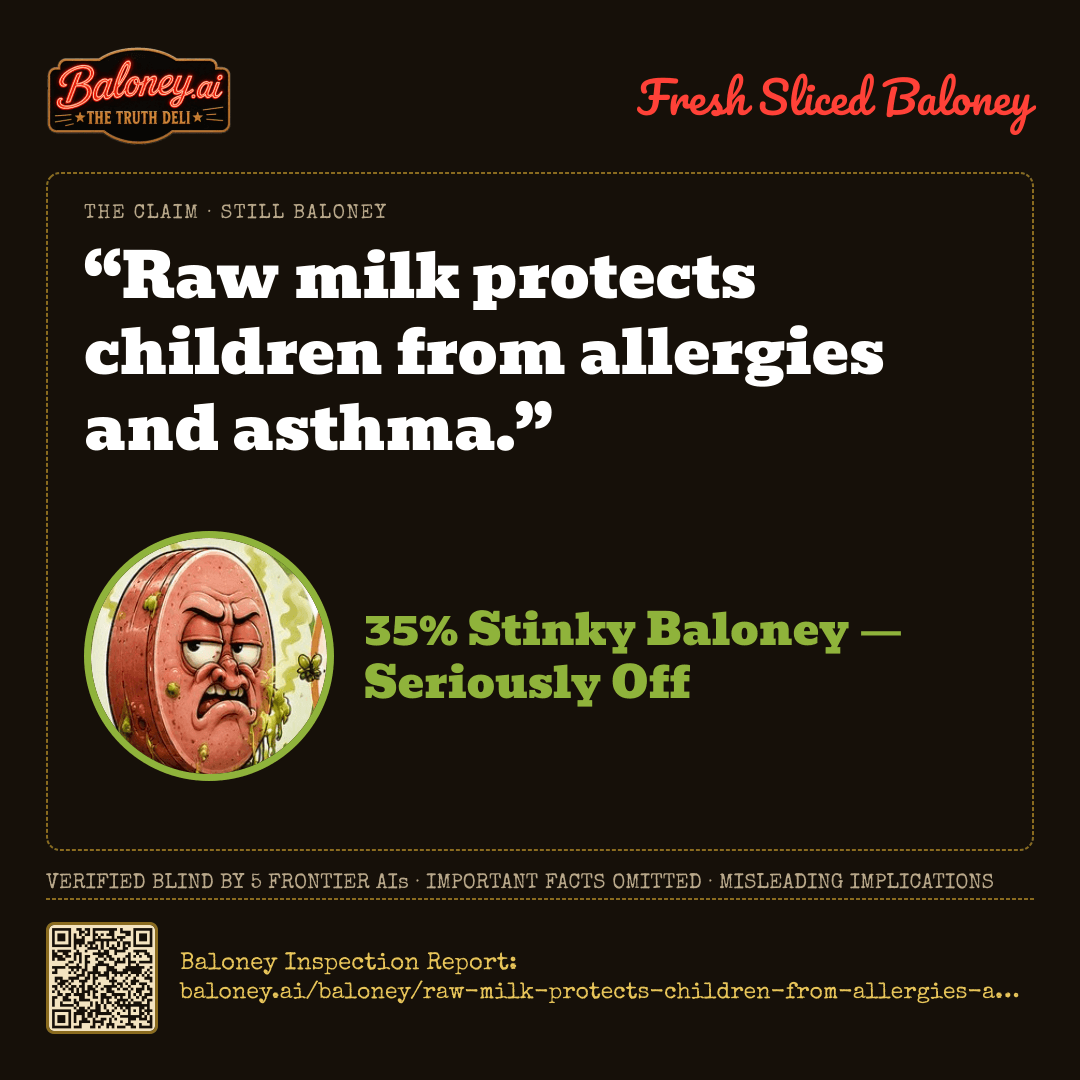
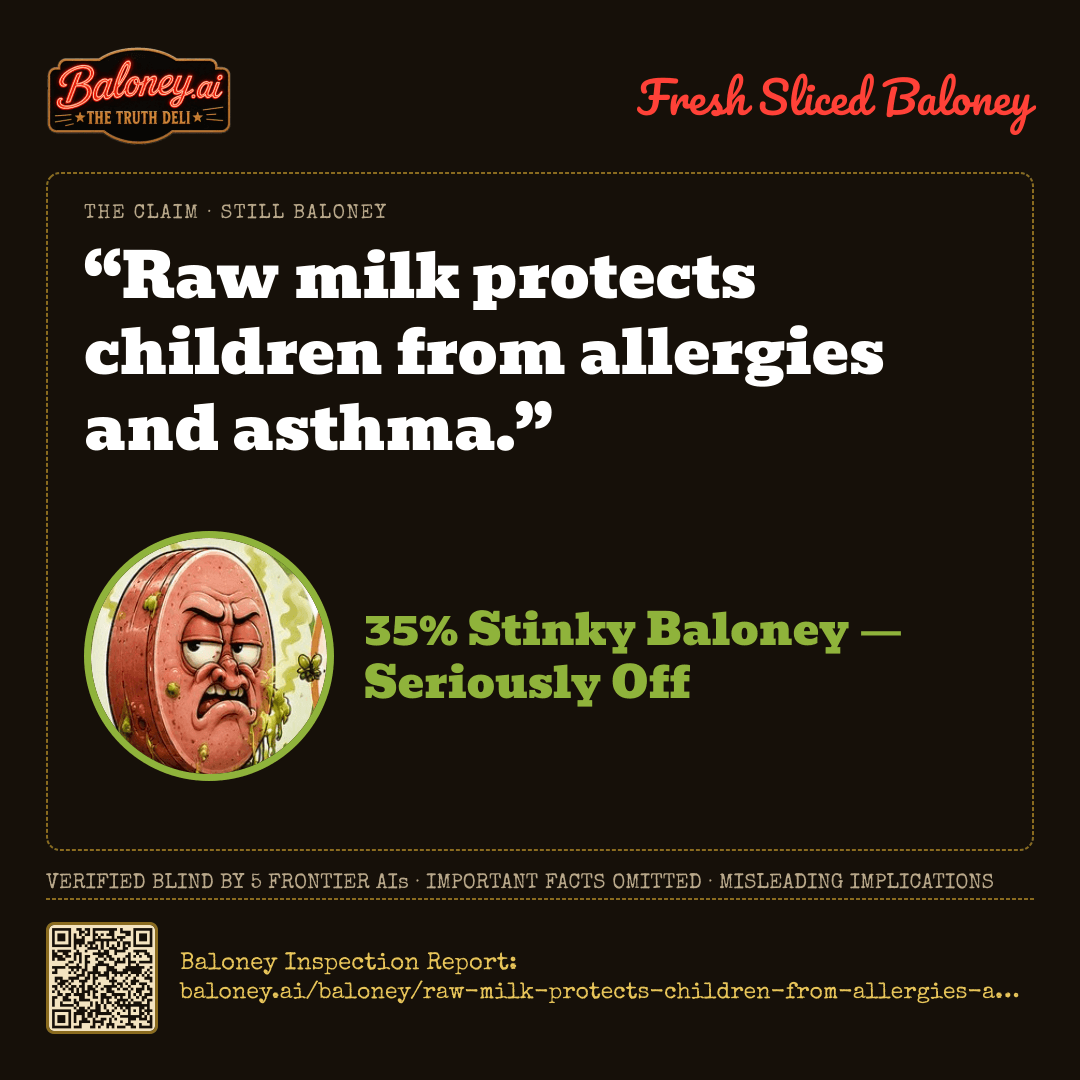
“Raw milk protects children from allergies and asthma.”
35%Stinky Baloney — Seriously Off
That’s not the whole story…
Important facts omittedMisleading implicationsCherry-picked infoSpins the truth
Serve It Fresh
Ready to Serve10 servings
Serve it the way you want it
The Verdict
 “Raw milk protects children from allergies and asthma.”35% Stinky Baloney — Seriously OffVerified blind by 5 frontier AIs · Baloney Inspection Report: baloney.ai/baloney/raw-milk-protects-children-from-allergies-and-asthma
The Baloney Sampler
Several European observational studies found that children who drank farm or unprocessed milk had lower rates of asthma, hay fever and allergic sensitization. But the studies could not show that raw milk caused the difference: farm environment, animal contact, dust, diet and other factors may explain it, and the key studies did not always confirm that the milk was raw. The FDA says the PARSIFAL study concerned farm milk, not verified raw milk.[1]
The claim also wrongly suggests protection against all allergies: the FDA reports that raw and pasteurized milk can both trigger allergic reactions in people sensitive to milk proteins.[2] The CDC and FDA warn that raw milk can carry dangerous pathogens and that children face particular risks.[3][2] The evidence supports, at most, a limited association in some early-childhood European cohorts—not established protection.
Resting on U.S. Food and Drug Administration · U.S. Food and Drug Administration · Centers for Disease Control and Prevention
Original Claim Source https://www.rawmilkinstitute.org/updates/allergies-and-raw-milk
Other ways to slice it — phrasings that might have changed the rating
- “In some European cohorts, regular consumption of unprocessed farm milk during early childhood was associated with lower rates of asthma and allergic sensitization.” This keeps the repeated observational finding while limiting it to the studied population, exposure, timing and non-causal association.
- “Raw milk does not protect children from cow’s-milk allergy and can still trigger allergic reactions.” The FDA reports that raw and pasteurized milk did not differ in their capacity to cause reactions in people sensitive to milk proteins.
- “Children should drink pasteurized rather than raw milk because any possible allergy-related benefit of raw milk remains unproven while its pathogen risks are established.” The CDC and FDA identify serious infectious hazards in raw milk and particular vulnerability among children, while the protective effect has not been established.
Written from the panel’s reports by Perplexity · sonar-pro. Nothing here changed the score.
The Order Ticket
15:39:34CLAIM RECEIVED — QUEUED FOR INSPECTION✓
15:41:09claude-opus-5 REPORTED — SCORE 35, CONFIDENCE 80✓
15:40:13gpt-5.5 REPORTED — SCORE 38, CONFIDENCE 88✓
15:40:24gemini-3.1-pro-preview REPORTED — SCORE 35, CONFIDENCE 95✓
15:39:39sonar-pro REPORTED — SCORE 78, CONFIDENCE 96✓
15:41:09grok-4.6 REPORTED — SCORE 34, CONFIDENCE 78✓
15:41:23PRIMARY MASTER PERPLEXITY — SCORE 37✓
15:41:22BLIND VALIDATION CLAUDE — SCORE 36✓
15:41:36AGREEMENT CONFIRMED — DELTA 2✓
15:41:36SCORING MODEL V2 — MEDIAN OF 5 COUNTED LAB SCORES: 35, 38, 35, 78, 34 → 35.✓
15:41:36SOURCE RULE — LABS CITED 29 SOURCES: 0 DISCARDED FOR HAVING NO URL, 3 DISCARDED AS DEAD LINKS (404/410), 3 COULD NOT BE OPENED BY US AND ARE MARKED UNVERIFIED.✓
15:41:36SOURCE RULE — PRIMARY MASTER RULED ON 20 SOURCES: 0 DISCARDED FOR HAVING NO URL, 0 DISCARDED AS DEAD LINKS, 3 MARKED UNVERIFIED, 17 VERIFIED.✓
How This One Was Sliced
Station 1 · Blind Inspection — Five Graders, Zero Peeking
Each lab scored the claim independently, without seeing the others. Open a breakdown for its evidence, its sources, and how sure it was.
Anthropic · EQUAL WEIGHT · 94.5s
claude-opus-5
35%BALONEY
ROUND-1 BREAKDOWN
Evidence offered for the claim- Multiple large European observational studies report an inverse association between consumption of unprocessed ('farm') cow's milk in early childhood and later asthma, hay fever and atopic sensitization. The GABRIELA study (Loss et al., Journal of Allergy and Clinical Immunology, 2011; ~8,000 school-age children in rural Germany, Austria and Switzerland) found roughly a 25–40% lower odds of asthma and atopy among children who had consumed farm milk, with the association persisting after adjustment for other farm exposures.
- The earlier PARSIFAL study (Waser et al., Clinical & Experimental Allergy, 2007) reported a similar inverse association across five European countries, and importantly found it in non-farm as well as farm children, arguing against the effect being purely a proxy for living on a farm.
- The PASTURE birth cohort (Loss et al., JACI, 2015) found infants given unprocessed cow's milk had fewer common respiratory infections, febrile illnesses and otitis media than those given UHT/shop milk — a related, consistent finding in a prospective design.
- There is a plausible biological mechanism: heat-labile whey proteins (e.g., bovine serum albumin, alpha-lactalbumin, lactoferrin, immunoglobulins), milk fat globule membrane components, and microbial/immunomodulatory factors are reduced or destroyed by boiling and by high-heat processing. In GABRIELA, the protective association weakened or disappeared for farm milk that was boiled before drinking, and whey protein levels (not fat) correlated with reduced asthma risk — consistent with a milk-component effect rather than mere confounding by farm lifestyle.
- A dose-response relationship (more farm milk, lower risk) and the timing effect (exposure in the first year of life being most important) have been reported, which are features that strengthen a causal interpretation of observational data.
- Because of these findings, researchers (including the GABRIELA/PASTURE investigators and EU-funded follow-ups) are actively trying to identify the protective constituents and develop a safely processed milk that retains them — i.e., mainstream science takes the association seriously rather than dismissing it.
Evidence against the claim- All of the supporting evidence is observational; there is no randomized controlled trial showing that raw milk prevents allergy or asthma. Associations of this kind are vulnerable to residual confounding (farm dust, barn exposure, endotoxin, animal contact, diet, family size, rural lifestyle) and to reverse causation (families with an already-allergic or wheezy child are less likely to give raw milk, and milk-allergic children are excluded from the exposed group).
- Key exposure data were collected by parental questionnaire and recall, and 'farm milk' in these cohorts means fresh milk from the family's own or a neighbouring herd in Central Europe — not retail raw milk sold through stores, cow-shares or vending machines, which differs in storage time, handling and microbial load.
- The investigators themselves explicitly do NOT recommend that children drink raw milk. The GABRIELA/PASTURE authors have repeatedly stated that the microbiological hazards outweigh the observed benefit and that the goal is to find a processing method that keeps the protective proteins, not to promote unpasteurized milk.
- The word 'protects' states an established causal, population-wide effect. Even on the most favourable reading, the data support 'is associated with modestly reduced risk in some early-childhood European cohorts', and some analyses find the association attenuates substantially once farm exposures are fully adjusted for.
- Raw milk carries well-documented, serious risks for exactly the group named in the claim. Campylobacter, Salmonella, Listeria, Brucella and Shiga toxin-producing E. coli (which can cause haemolytic uraemic syndrome and kidney failure) are transmitted by raw milk; CDC analyses estimate raw dairy causes on the order of 840 times more illnesses and 45 times more hospitalizations per unit consumed than pasteurized dairy, and children under five are disproportionately represented among cases. Highly pathogenic H5N1 avian influenza virus has also been detected in raw cow's milk in the US since 2024.
- Raw milk does not protect against cow's-milk allergy itself — it contains the same allergenic caseins and can trigger severe reactions — so the blanket claim about 'allergies' is misleading.
- Major health authorities (US FDA, US CDC, American Academy of Pediatrics, UK Food Standards Agency) advise that children, pregnant women and immunocompromised people should consume only pasteurized milk, and state that pasteurization does not meaningfully destroy milk's nutritional value.
- The claim as written omits the dose and timing conditions (benefit was tied mainly to regular consumption in the first year or two of life) and implies a benefit for any child drinking raw milk at any age, which the studies do not support.
How sure this lab was80/100 — the lab’s own confidence in the score above, not a second reading of the claim.
SourcesUS Food and Drug Administrationgov · 93 · UK Food Standards Agencygov · 90 · PubMed / Journal of Allergy and Clinical Immunology (Loss et al., GABRIELA study, 2011)journal · 92 · PubMed / Journal of Allergy and Clinical Immunology (Loss et al., PASTURE cohort, 2015)journal · 90 · PubMed / Clinical & Experimental Allergy (Waser et al., PARSIFAL study, 2007)journal · 88 · American Academy of Pediatrics, Pediatrics (policy statement on raw/unpasteurized milk, 2014)journal · 92 · US Centers for Disease Control and Prevention (H5N1 situation summary, includes raw milk risk)gov · 92
OpenAI · EQUAL WEIGHT · 38.4s
gpt-5.5
38%BALONEY
ROUND-1 BREAKDOWN
Evidence offered for the claim- Large European observational studies of farm children have repeatedly found that children who drank farm/unprocessed milk had lower rates of asthma, hay fever, atopy, or allergic sensitization than comparable children who did not; the GABRIELA study reported an inverse association between farm-milk consumption and childhood asthma/atopy, with results suggesting heat-sensitive milk components may be involved.
- The PARSIFAL study also found an inverse association between farm-milk consumption and asthma/allergy outcomes across rural and suburban European populations, even after adjustment for several farm-related exposures.
- Reviews of the literature conclude that there is a consistent epidemiologic signal linking raw or minimally processed farm milk with lower allergy/asthma risk, and propose plausible mechanisms such as altered whey proteins, fat composition, and microbial exposures.
Evidence against the claim- The claim is phrased causally, but the main supportive evidence is observational. Children who drink raw/farm milk often differ in many other ways—farm residence, animal exposure, microbial environment, diet, socioeconomic factors—so the studies cannot prove that raw milk itself protects children.
- FDA explicitly says there is no scientific evidence that raw milk prevents or treats asthma or allergies, and warns that raw milk can contain dangerous pathogens including E. coli, Salmonella, Campylobacter, and Listeria.
- CDC warns that raw milk can carry harmful germs and that children are among those at higher risk for severe illness from raw-milk infections; this public-health risk is well established and is not offset by proven allergy/asthma prevention.
- The American Academy of Pediatrics recommends that infants, children, and pregnant people avoid raw/unpasteurized milk and milk products because of infectious-disease risk, and does not endorse raw milk as an allergy/asthma preventive.
- EFSA concluded that raw drinking milk may contain pathogens and that claimed protective effects against allergy/asthma cannot be firmly established because of confounding and limitations in the evidence.
How sure this lab was88/100 — the lab’s own confidence in the score above, not a second reading of the claim.
SourcesJournal of Allergy and Clinical Immunology / PubMedjournal · 92 · Clinical & Experimental Allergy / PubMedjournal · 90 · Nutrients / PubMedjournal · 78 · U.S. Food and Drug Administrationgov · 95 · U.S. Centers for Disease Control and Preventiongov · 95 · American Academy of Pediatrics / Pediatricsjournal · 92 · European Food Safety Authoritygov · 94
Google · EQUAL WEIGHT · 50.1s
gemini-3.1-pro-preview
35%BALONEY
ROUND-1 BREAKDOWN
Evidence offered for the claim- Several large-scale epidemiological studies, such as the PARSIFAL and GABRIEL studies in Europe, have observed a strong correlation between children who consume raw 'farm milk' and lower rates of asthma, hay fever, and allergic sensitization.
- These findings align with the 'hygiene hypothesis,' which suggests that early-life exposure to diverse microbes and un-denatured whey proteins (often altered by the heat of pasteurization) may help train a child's developing immune system to avoid allergic responses.
Evidence against the claim- Observational correlation does not equal causation. Public health experts note that children who drink raw milk often live on or frequently visit farms, meaning other environmental exposures (such as animal dander, endotoxins, or farm dust) could be the true protective factors.
- The FDA, CDC, and the American Academy of Pediatrics (AAP) officially reject the claim that raw milk is a safe or proven preventative for asthma and allergies, citing a lack of causal clinical evidence.
- Health authorities strongly warn that framing raw milk as a protective health measure is dangerous. Any theoretical allergy benefits are vastly outweighed by the severe, immediate health risks of consuming raw milk, which is a frequent vector for deadly pathogens like E. coli, Salmonella, Campylobacter, and Listeria.
How sure this lab was95/100 — the lab’s own confidence in the score above, not a second reading of the claim.
SourcesU.S. Food and Drug Administration (FDA)gov · 95 · National Institutes of Health (PubMed)gov · 90 · National Institutes of Health (PubMed)gov · 95
Perplexity · EQUAL WEIGHT · 5.2s
sonar-pro
78%BALONEY
ROUND-1 BREAKDOWN
Evidence offered for the claim- Some observational studies have found that children raised on farms or consuming farm milk have lower rates of asthma and allergies, an association sometimes called the “farm effect.” However, these studies often cannot establish that the milk was raw, and farm exposure includes many other factors.[4][5]
- A 2011 systematic review reported literature suggesting a possible beneficial association between raw-milk consumption and allergies, while also noting that multiple confounding factors could explain the finding.[5]
Evidence against the claim- The FDA states that raw milk does not cure or treat asthma or allergies and emphasizes that the often-cited PARSIFAL study examined farm milk, not confirmed raw milk; the study could not evaluate pasteurized versus raw milk.[4]
- In a clinical study summarized by the FDA, children with confirmed cow-milk allergy had similar significant allergic reactions after consuming raw, pasteurized, and homogenized-pasteurized milk. Raw milk therefore did not reduce allergic reactions.[4]
- CDC and FDA warn that raw milk can contain dangerous pathogens and that children are especially vulnerable to severe illness. CDC advises not giving children raw or unpasteurized milk.[1][2][9]
- Government health guidance reports that there are no demonstrated health benefits of raw milk that cannot be obtained from pasteurized milk, and that pasteurization has not been shown to cause allergies or asthma.[7]
- The evidence for allergy or asthma protection is observational and inconsistent, whereas the infection risks of raw milk are established; CDC materials describe any possible protective effect as unproven and not worth the risk.[10]
How sure this lab was96/100 — the lab’s own confidence in the score above, not a second reading of the claim.
SourcesU.S. Food and Drug Administrationgov · 98 · Centers for Disease Control and Preventiongov · 98 · U.S. Food and Drug Administrationgov · 98 · Centers for Disease Control and Preventiongov · 98 · Centers for Disease Control and Preventiongov · 94 · Washington State Department of Healthgov · 96 · Centers for Disease Control and Preventiongov · 95
xAI · EQUAL WEIGHT · 94.6s
grok-4.6
34%BALONEY
ROUND-1 BREAKDOWN
Evidence offered for the claim- Large European observational studies (GABRIELA, PARSIFAL, PASTURE/ALEX) found children who regularly drank farm milk—often unpasteurized—had lower reported rates of asthma, hay fever, and atopic sensitization than peers who did not.
- Researchers have hypothesized that heat-labile whey proteins, TGF-beta, microRNA, or microbial components preserved in raw milk could influence immune maturation, consistent with aspects of the hygiene/farm-effect hypothesis.
Evidence against the claim- The studies are observational, not randomized; farm-dwelling children have many co-exposures (livestock, endotoxin, diverse microbiota) that independently reduce allergy risk, so raw milk itself has not been isolated as the causal agent. Some analyses found similar associations with boiled farm milk.
- Raw milk is a well-documented vehicle for Campylobacter, STEC E. coli (including O157), Salmonella, and Listeria. CDC outbreak data show children are disproportionately affected, with outcomes including hemolytic uremic syndrome, hospitalization, and death. No RCTs support a protective effect that would justify these risks.
- FDA, CDC, and the American Academy of Pediatrics state that infectious hazards outweigh unproven allergy benefits and explicitly advise against raw milk for children.
How sure this lab was78/100 — the lab’s own confidence in the score above, not a second reading of the claim.
SourcesJournal of Allergy and Clinical Immunologyjournal · 90 · U.S. Food and Drug Administrationgov · 95
Station 2 · The Masters
Primary Master · drawn at random
sonar-pro
37% BALONEY
The statement overclaims weak-to-moderate observational evidence. Several European studies reported associations between farm or reportedly raw milk consumption and lower asthma, hay fever, or atopic sensitization, with plausible hypotheses involving whey proteins and microbial exposure. However, these studies were observational, relied partly on reported exposure, and could not establish that raw milk itself caused the lower risk; farm environment, animal contact, dust, endotoxins, diet, and other factors remain plausible explanations. The claim also improperly generalizes to all children and all allergies. Clinical evidence cited by the panel found no meaningful reduction in allergic reactions from raw milk compared with pasteurized milk, while infectious hazards from raw milk are established and particularly serious for children. FDA, CDC, AAP, and EFSA guidance therefore does not support using raw milk preventively. The most favorable defensible wording is that some early-childhood European cohorts found an association, not that raw milk protects children. The score is in the Stinky Baloney range rather than the higher bands because the epidemiological signal is repeated and not wholly fabricated.
All five evaluators agreed that observational farm-milk studies reported lower asthma, hay fever, or allergic sensitization, but that these studies do not prove causation and do not justify recommending raw milk. Four evaluators gave scores from 34 to 38. One evaluator scored 78, placing greater weight on the causal overstatement, the absence of randomized evidence, the established infection risks, and the FDA-described clinical evidence; its reasoning is persuasive about the claim's wording but does not erase the consistent observational signal. The reports differed mainly in how severely to penalize the causal wording and safety implications, not about the underlying evidence or public-health recommendation.
Blind Validation Master · never saw the Primary’s work
claude-opus-5
36% BALONEY
The claim contains a real kernel of evidence but is stated as an established causal, population-wide fact, which the data do not support. Supporting evidence: multiple large European observational cohorts (PARSIFAL, GABRIELA, PASTURE/ALEX) consistently report 25-40% lower odds of asthma, hay fever and atopic sensitization among children consuming unprocessed 'farm' milk, with dose-response, an early-life timing window, attenuation when the milk was boiled, and whey-protein correlations — features that make a milk-component effect biologically plausible and taken seriously by mainstream researchers. However: (1) all evidence is observational with no RCT; farm children share many confounding exposures (barn dust, endotoxin, animal contact, rural diet/lifestyle) and residual confounding or reverse causation (milk-allergic or wheezy children being excluded from the exposed group) cannot be excluded; (2) FDA notes the key studies examined 'farm milk' of unverified pasteurization status and that a clinical study found children with cow's-milk allergy reacted equally to raw, pasteurized and homogenized milk — raw milk does not protect against milk allergy itself, so the blanket word 'allergies' is misleading; (3) the Central European 'fresh milk from the family herd' exposure is not the same as retail raw milk sold through stores, cow-shares or vending machines; (4) the effect was tied to regular consumption in the first year or two of life, a condition the claim omits; (5) the GABRIELA/PASTURE investigators themselves explicitly do not recommend raw milk for children and are instead seeking a processing method that preserves the protective constituents; (6) FDA, CDC, AAP, EFSA and UK FSA all state the protective effect is unproven and that raw milk's documented pathogen risks (Campylobacter, STEC/HUS, Salmonella, Listeria, Brucella, now H5N1) fall disproportionately on young children. So the honest reading is 'unprocessed farm milk in early life is associated with modestly lower allergy/asthma risk in some European cohorts, mechanism unconfirmed' — not 'raw milk protects children.' Important facts omitted and a misleading, potentially harmful causal implication: Stinky Baloney. The single outlier report recommending 78 overstates the case — the epidemiologic signal is real and replicated, so this is not 'overwhelmingly false.'
AGREEMENT TEST PASSED — MASTERS SCORED 37% AND 36% · BLIND VALIDATION CONFIRMED THIS SCORE · NO RE-EVALUATION REQUIRED
How the number was reached · scoring model v2 · how our models work
- Median of 5 counted lab scores: 35, 38, 35, 78, 34 → 35.
The Evidence
Evidence offered for the claim
- European farm-milk associations GABRIELA, PARSIFAL, and related European studies reported lower asthma, hay fever, atopy, or allergic sensitization among children consuming farm or reportedly unprocessed milk. Some analyses found associations after adjustment for several farm exposures, and researchers proposed heat-sensitive whey proteins, milk-fat components, and microbial factors as possible mechanisms.
- Prospective and dose-related clues The PASTURE cohort and other analyses supplied prospective, timing, or dose-related clues consistent with a possible early-life milk-component effect. These findings strengthen the hypothesis but remain nonrandomized and do not isolate raw milk from farm lifestyle or other exposures.
- Possible immune effects DEBUNKED — The hygiene or farm-effect hypothesis offers a biologically plausible explanation involving diverse microbial exposure and milk constituents. Plausibility supports further research, not a demonstrated preventive benefit.
Evidence against the claim
- No causal clinical proof The supporting studies were observational and vulnerable to confounding by farm residence, animal contact, dust, endotoxins, microbiota, diet, socioeconomic factors, and family behavior. Some studies concerned farm milk rather than confirmed raw milk, and no randomized controlled trial demonstrated that raw milk prevents asthma or allergies.
- Clinical allergy evidence does not show protection The panel reports that children with confirmed cow-milk allergy had similar significant reactions to raw, pasteurized, and homogenized-pasteurized milk. Raw milk therefore does not provide a general reduction in milk-allergy reactions.
- Established infection risk for children Raw milk can transmit Campylobacter, Salmonella, Shiga-toxin-producing E. coli, Listeria, Brucella, and other pathogens. Children are especially vulnerable to severe outcomes, including hospitalization, hemolytic uremic syndrome, kidney failure, and death.
- Health authorities advise against it FDA, CDC, the American Academy of Pediatrics, EFSA, and the UK Food Standards Agency do not endorse raw milk for allergy or asthma prevention and advise children to consume pasteurized milk because the infectious risks outweigh unproven benefits.
- The claim is too broad The reported associations mainly concern particular early-life exposure patterns in European farm-milk cohorts. They do not establish protection for children generally, at any age, against allergies as a whole or against asthma.
Sources · Reliability · Why Accepted or Discounted
| Source | Type | Reliability | Ruling |
|---|
| U.S. Food and Drug Administration | gov | 98 | ACCEPTED — Directly addresses the farm-milk studies, their limitations, clinical allergy evidence, and pathogen risks. |
| U.S. Food and Drug Administration | gov | 98 | ACCEPTED — Authoritative source on raw-milk pathogens, child vulnerability, and allergic reactions. |
| U.S. Food and Drug Administration | gov | 95 | ACCEPTED — Supports the public-health guidance that raw milk is unsafe for children and is not endorsed by FDA, CDC, or AAP. |
| Centers for Disease Control and Prevention | gov | 98 | ACCEPTED — Authoritative summary of raw-milk pathogens and increased risk of serious illness in young children. |
| Centers for Disease Control and Prevention | gov | 98 | ACCEPTED — Direct child-nutrition guidance warning that raw milk can cause life-threatening illness. |
| Centers for Disease Control and Prevention | gov | 94 | ACCEPTED — Used by the panel for public-health evidence concerning raw-milk risks. |
| Centers for Disease Control and Prevention | gov | 95 | ACCEPTED — Panel cited it for documented risks associated with nonpasteurized milk. |
| Centers for Disease Control and Prevention | gov | 92 | ACCEPTED — Panel cited it for the reported H5N1 raw-milk concern, though that issue is supplementary rather than central to the allergy claim. |
| U.S. Centers for Disease Control and Prevention | gov | 95 | ACCEPTED — Duplicate citation supplied in another report; it supports the same pathogen-risk conclusion. |
| American Academy of Pediatrics / Pediatricsunverified | journal | 92 | ACCEPTED — Supports pediatric advice to avoid raw milk because of infectious-disease hazards. |
| American Academy of Pediatrics, Pediatricsunverified | journal | 92 | ACCEPTED — Duplicate or alternate citation supplied for the same pediatric policy statement. |
| European Food Safety Authorityunverified | gov | 94 | ACCEPTED — Supports the conclusion that pathogen risks are established and protective allergy effects cannot be firmly established. |
| Journal of Allergy and Clinical Immunology | journal | 90 | ACCEPTED — Panel cited it for observational evidence and its limitations. |
| Journal of Allergy and Clinical Immunology / PubMed | journal | 92 | ACCEPTED — Reports the GABRIELA association between reported raw or farm-milk consumption and lower asthma, atopy, and hay fever. |
| Clinical & Experimental Allergy / PubMed | journal | 90 | ACCEPTED — Panel cited it for the PARSIFAL observational association. |
| Nutrients / PubMed | journal | 78 | DISCOUNTED — A lower-confidence review source and less decisive than the primary cohort studies and public-health guidance. |
| NIH PubMed | gov | 90 | ACCEPTED — Panel cited it as evidence concerning the epidemiological association and its interpretation. |
| NIH PubMed | gov | 95 | ACCEPTED — Panel cited it for evidence relevant to raw-milk allergy or asthma claims. |
| Washington State Department of Health | gov | 96 | ACCEPTED — Supports the panel's public-health conclusion about raw-milk hazards. |
| UK Food Standards Agency | gov | 90 | ACCEPTED — Supports advice that children should consume pasteurized milk and that raw-milk benefits are unproven. |
Every link was opened when this claim was inspected. A dead link was discarded before publication; “unverified” means the site refused our automated check and the link is the one the panel cited. A source without a URL was never kept.
Serve It Fresh
Ready to Serve10 servings
Serve it the way you want it
The Verdict
“Raw milk protects children from allergies and asthma.”35% Stinky Baloney — Seriously OffVerified blind by 5 frontier AIs · Baloney Inspection Report: baloney.ai/baloney/raw-milk-protects-children-from-allergies-and-asthma