Baloney Inspection Report: Claim #1190 · Inspected Oct 31, 2026, 8:57 AM PDT · Scoring model v2
 20%
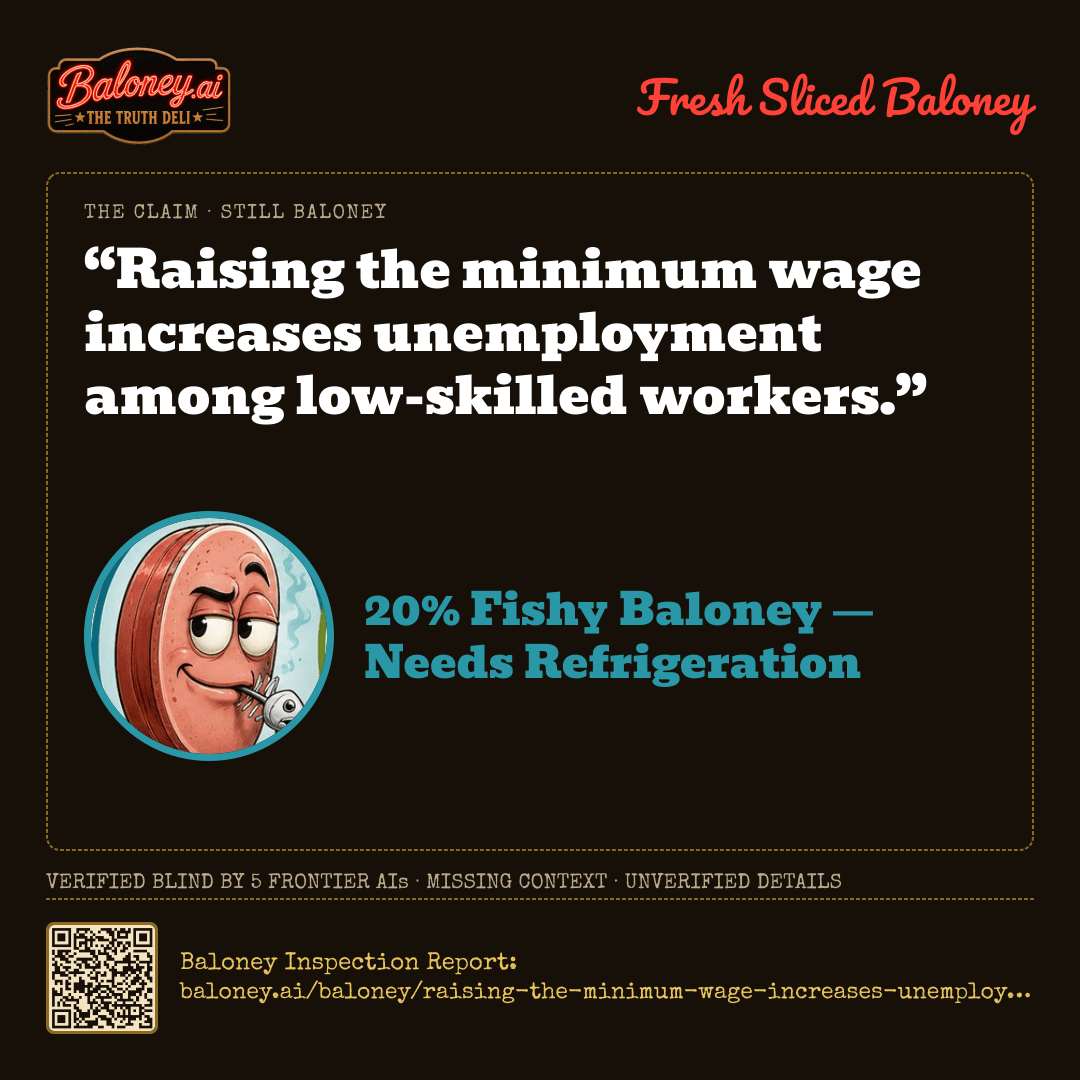
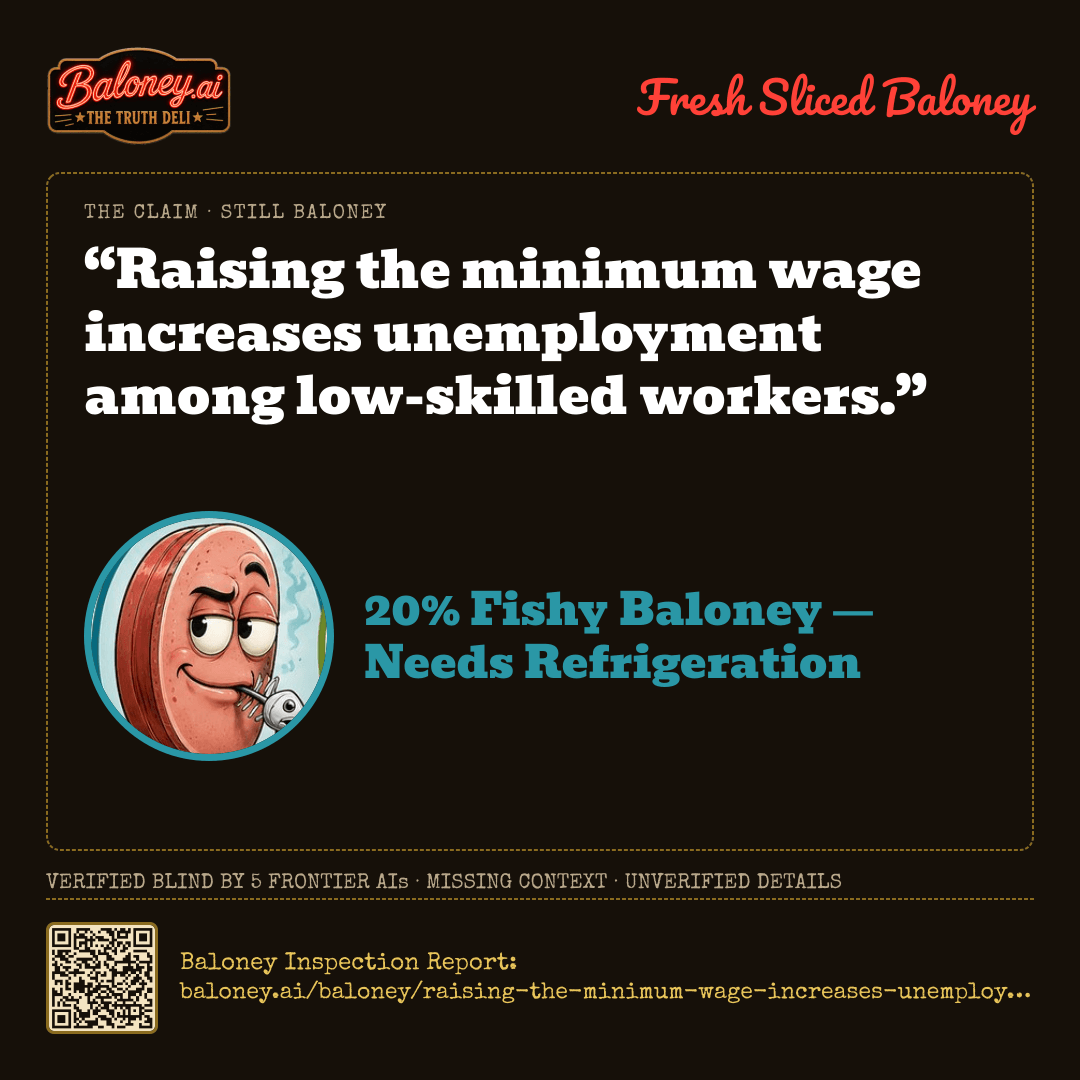
“Raising the minimum wage increases unemployment among low-skilled workers.”
20%Fishy Baloney — Needs Refrigeration
Something smells off…
Missing contextUnverified detailsSuspicious framingMay be exaggerated
Serve It Fresh
Ready to Serve16 servings
Serve it the way you want it
The Verdict
 “Raising the minimum wage increases unemployment among low-skilled workers.”20% Fishy Baloney — Needs RefrigerationVerified blind by 5 frontier AIs · Baloney Inspection Report: baloney.ai/baloney/raising-the-minimum-wage-increases-unemployment-among-low
The Baloney Sampler
The claim has a real basis, but only in particular cases. The Congressional Budget Office projected that a $15 federal minimum wage would reduce employment by about 1.4 million workers. National Bureau of Economic Research work on Seattle found a fall in low-wage hours. Competitive-market theory points the same way when a wage floor is strongly binding.
That does not make the claim a general rule. Quarterly Journal of Economics evidence on 138 state increases found no detectable net loss of low-wage jobs, and HM Treasury’s Dube review found muted effects for moderate minimum wages. Effects depend on size, local wages, labor markets, industry, and worker group; much evidence measures employment or hours, not unemployment.
Resting on Congressional Budget Office · National Bureau of Economic Research · Quarterly Journal of Economics · HM Treasury
Original Claim Source https://freemarketfoundation.com/the-minimum-wage-harms-the-poor/
Other ways to slice it — phrasings that might have changed the rating
- “Large minimum-wage increases set high relative to local median wages reduce employment or hours among low-skilled workers.” The reports found the clearest negative evidence for large or strongly binding increases, including CBO projections and Seattle low-wage hours evidence.
- “Moderate minimum-wage increases have little or no detectable effect on employment among low-paid workers.” The Quarterly Journal of Economics study and HM Treasury review found muted or near-zero employment effects for many historical or moderate increases.
- “Raising the minimum wage reduces hours worked in some low-wage jobs even when headcount employment does not clearly fall.” The reports noted that some supporting evidence, especially Seattle, measured reduced hours rather than a clear rise in unemployment.
Written from the panel’s reports by OpenAI · gpt-5.5. Nothing here changed the score.
The Order Ticket
15:57:26CLAIM RECEIVED — QUEUED FOR INSPECTION✓
15:58:29claude-opus-5 REPORTED — SCORE 33, CONFIDENCE 85✓
15:57:59gpt-5.5 REPORTED — SCORE 32, CONFIDENCE 86✓
15:57:57gemini-3.1-pro-preview REPORTED — SCORE 20, CONFIDENCE 95✓
15:57:31sonar-pro REPORTED — SCORE 18, CONFIDENCE 91✓
15:59:36grok-4.6 REPORTED — SCORE 18, CONFIDENCE 68✓
16:00:25PRIMARY MASTER CHATGPT — SCORE 29✓
15:59:53BLIND VALIDATION CLAUDE — SCORE 26✓
16:00:49AGREEMENT CONFIRMED — DELTA 9✓
16:00:49SCORING MODEL V2 — MEDIAN OF 5 COUNTED LAB SCORES: 33, 32, 20, 18, 18 → 20.✓
16:00:49SOURCE RULE — LABS CITED 31 SOURCES: 0 DISCARDED FOR HAVING NO URL, 1 DISCARDED AS DEAD LINKS (404/410), 12 COULD NOT BE OPENED BY US AND ARE MARKED UNVERIFIED.✓
16:00:49SOURCE RULE — PRIMARY MASTER RULED ON 19 SOURCES: 0 DISCARDED FOR HAVING NO URL, 0 DISCARDED AS DEAD LINKS, 7 MARKED UNVERIFIED, 12 VERIFIED.✓
How This One Was Sliced
Station 1 · Blind Inspection — Five Graders, Zero Peeking
Each lab scored the claim independently, without seeing the others. Open a breakdown for its evidence, its sources, and how sure it was.
Anthropic · EQUAL WEIGHT · 62.8s
claude-opus-5
33%BALONEY
ROUND-1 BREAKDOWN
Evidence offered for the claim- Standard competitive labor-market theory predicts that a binding price floor above the market-clearing wage reduces quantity of labor demanded, with the least-productive (lowest-skilled) workers most exposed.
- The Congressional Budget Office (2019) estimated that a $15 federal minimum wage by 2025 would, in its median estimate, eliminate about 1.3 million jobs (range 0 to 3.7 million), concentrated among less-educated and younger workers.
- CBO's February 2021 analysis of the Raise the Wage Act similarly projected roughly 1.4 million fewer jobs by 2025 alongside 0.9 million people lifted out of poverty — i.e., real disemployment effects in a large increase.
- Clemens and Wither (NBER 2014/2019) found that federal minimum wage increases during 2007–2009 reduced employment and medium-run earnings growth for low-skilled workers in states bound by the increase.
- Jardim et al. (NBER 2017) found Seattle's increase to $13 reduced hours worked in low-wage jobs by around 9%, producing a net decline in total low-wage payroll hours — a quantity-of-work reduction even if headcount effects were smaller.
- Neumark and Shirley (NBER 2021/2022), surveying the body of U.S. minimum-wage studies since the 1990s, report that the clear majority of estimates are negative, and that negative effects are more prevalent for teens, young adults and the less-educated.
- Very large minimum wages relative to local median wages (high 'Kaitz index'), and increases in low-wage regions, are where disemployment effects are most consistently detected in the literature — so the claim is not without empirical support for that subset of policies.
Evidence against the claim- Card and Krueger's (1994) New Jersey–Pennsylvania fast-food study found no employment loss — and possibly a small gain — after a minimum wage increase, launching a large body of contrary evidence.
- Cengiz, Dube, Lindner and Zipperer (QJE 2019), using a bunching estimator over 138 state-level increases, found the number of jobs below the new minimum fell but an almost equal number appeared just above it; the net employment change for low-wage jobs was statistically indistinguishable from zero.
- Arindrajit Dube's 2019 review for HM Treasury concluded the international evidence shows minimum wage increases to date have had little or no effect on overall employment, including for low-paid groups, up to roughly 55–60% of the median wage.
- Doucouliagos and Stanley's (2009) meta-regression of minimum wage research found strong publication selection bias; once corrected, the average estimated employment effect is close to zero.
- Monopsony/search-friction models predict that in imperfectly competitive labor markets a higher minimum wage can raise both wages and employment, and reduced turnover and higher productivity can offset labor-cost increases.
- Harasztosi and Lindner (AER 2019) found Hungary's very large minimum wage hike was mostly passed through to consumer prices rather than causing proportional job losses (disemployment was modest relative to the size of the increase).
- Re-analyses of Seattle (Reich, Allegretto and Godoey, UC Berkeley) found no significant employment loss in food services, illustrating that results are sensitive to data and method; economists remain openly split, as surveys such as the IGM/Kent Clark Center expert panel show.
- The claim as written is unconditional: it ignores the central findings of the modern literature that the effect depends on the size of the increase relative to local wages, labor market tightness and the sector studied, and that for typical moderate increases measured effects are small or near zero.
How sure this lab was85/100 — the lab’s own confidence in the score above, not a second reading of the claim.
SourcesCongressional Budget Officegov · 93 · Congressional Budget Officegov · 93 · HM Treasury (Dube Review)gov · 90 · NBER (Card & Krueger)journal · 90 · Quarterly Journal of Economics (Cengiz et al.)journal · 92 · NBER (Neumark & Shirley)journal · 87 · NBER (Jardim et al., Seattle)journal · 86 · NBER (Clemens & Wither)journal · 86 · British Journal of Industrial Relations (Doucouliagos & Stanley)journal · 85 · American Economic Review (Harasztosi & Lindner)journal · 90 · Kent A. Clark Center (IGM Economic Experts Panel)edu · 80
OpenAI · EQUAL WEIGHT · 32.6s
gpt-5.5
32%BALONEY
ROUND-1 BREAKDOWN
Evidence offered for the claim- Standard competitive-labor-market theory predicts that, if a minimum wage is set above the market-clearing wage, employers may demand fewer low-skilled workers; some empirical work finds this effect for teens or the least-skilled. Neumark and Wascher’s review concluded that much of the evidence points to negative employment effects concentrated among low-skilled workers.
- The Congressional Budget Office estimated that raising the federal minimum wage to $15 by 2025 would, on average, reduce employment by about 1.4 million workers, while also raising pay for millions and reducing poverty. This supports the claim for large increases, though it is a model estimate and not proof that every increase raises unemployment.
- A Seattle study by Jardim et al. found that the city’s move toward a higher minimum wage reduced hours worked in low-wage jobs and reduced average monthly earnings for affected low-wage workers after the increase to $13, suggesting possible disemployment or hours effects in at least some contexts.
Evidence against the claim- The claim is too categorical. A large body of modern empirical research finds that modest minimum-wage increases often have little to no detectable negative effect on employment, including among low-wage workers.
- Card and Krueger’s well-known study of fast-food restaurants in New Jersey and Pennsylvania found no evidence that New Jersey’s minimum-wage increase reduced fast-food employment; employment rose relative to the comparison group in their survey data.
- Dube, Lester, and Reich compared contiguous counties across state borders and found strong wage effects but no detectable adverse employment effects from minimum-wage increases, arguing that earlier negative estimates were partly driven by inadequate geographic controls.
- Cengiz et al. examined U.S. minimum-wage changes from 1979 to 2016 and found that jobs paying below the new minimum largely disappeared but were replaced by jobs at or just above the new minimum, with no significant net employment loss in the five years after increases.
- A UK-government-commissioned international evidence review by Arindrajit Dube concluded that minimum wages up to moderate levels have generally had muted employment effects, with the clearest risk of job loss arising when minimum wages are set very high relative to typical wages.
- The statement uses 'unemployment' broadly, but many studies examine employment levels or hours rather than unemployment rates. The best evidence suggests effects depend on the size of the increase, starting wage level, local labor market, affected industry, and worker group.
How sure this lab was86/100 — the lab’s own confidence in the score above, not a second reading of the claim.
SourcesCongressional Budget Officegov · 95 · National Bureau of Economic Researchother · 84 · National Bureau of Economic Researchother · 82 · American Economic Review / UC Berkeley hosted copyjournal · 93 · Review of Economics and Statisticsjournal · 92 · Quarterly Journal of Economicsjournal · 95 · UK Government / Low Pay Commissiongov · 90
Google · EQUAL WEIGHT · 31.2s
gemini-3.1-pro-preview
20%BALONEY
ROUND-1 BREAKDOWN
Evidence offered for the claim- Classical neoclassical economic models predict that imposing a wage floor above the market equilibrium reduces the demand for labor, leading to unemployment specifically among low-skilled workers whose marginal productivity falls below the new minimum.
- The Congressional Budget Office (CBO) projected in a 2021 report that raising the U.S. federal minimum wage to $15 an hour by 2025 would reduce overall employment by roughly 1.4 million workers.
- A 2017 National Bureau of Economic Research (NBER) study examining Seattle's minimum wage increase to $13 an hour concluded that it reduced hours worked in low-wage jobs by around 9 percent, negatively impacting the total earnings of low-skilled workers.
Evidence against the claim- A massive body of modern empirical research challenges the theoretical classical model, demonstrating that moderate minimum wage increases historically produce little to no job losses.
- A foundational 1994 empirical study by David Card and Alan Krueger examined fast-food restaurants in New Jersey and Pennsylvania after a minimum wage hike, finding no evidence that the wage increase reduced employment.
- A comprehensive 2019 study published in The Quarterly Journal of Economics evaluated 138 state-level minimum wage changes between 1979 and 2016, concluding that the overall number of low-wage jobs remained effectively unchanged following the raises.
- Economists point to 'monopsony' market dynamics to explain this phenomenon: when employers possess significant wage-setting power, modest mandatory wage increases can actually reduce costly employee turnover, increase worker productivity, and fill vacancies rather than forcing layoffs.
How sure this lab was95/100 — the lab’s own confidence in the score above, not a second reading of the claim.
SourcesCongressional Budget Officegov · 90 · The Quarterly Journal of Economicsjournal · 95 · National Bureau of Economic Researchedu · 85 · American Economic Reviewjournal · 95
Perplexity · EQUAL WEIGHT · 4.8s
sonar-pro
18%BALONEY
ROUND-1 BREAKDOWN
Evidence offered for the claim- The Congressional Budget Office estimated that raising the federal minimum wage to $15 would reduce employment by about 1.4 million workers by 2025, with young and less-educated workers bearing a disproportionate share of the reduction.[1][2]
- A National Bureau of Economic Research study found that binding minimum-wage increases had significant negative effects on low-skilled workers’ employment and income growth over the following three years.[3]
- A review summarized by CBO found a median short-term employment elasticity of −0.130 for directly affected workers, indicating that higher minimum wages generally reduce employment among affected workers on average.[4]
Evidence against the claim- A Quarterly Journal of Economics study of 138 state-level minimum-wage changes from 1979–2016 found that the overall number of low-wage jobs remained essentially unchanged over five years and found no evidence of disemployment even at higher minimum-wage levels, although it found some reduced employment in tradeable sectors.[5]
- A peer-reviewed Malaysian study found that minimum-wage increases were associated with a statistically significant positive effect on low-skilled employment in the short and long terms in its primary specification; interaction specifications produced a negative but statistically insignificant effect.[6]
- The evidence is mixed rather than uniform: some studies find employment losses, while others find little or no detectable job loss. Effects vary with the size of the increase, labor-market conditions, geography, industry, and the workers directly affected.
How sure this lab was91/100 — the lab’s own confidence in the score above, not a second reading of the claim.
SourcesCongressional Budget Officegov · 98 · Congressional Budget Officegov · 98 · National Bureau of Economic Researchjournal · 94 · Quarterly Journal of Economics / Oxford Academicjournal · 96 · Malaysian Journal of Economic Studies, University of Malayajournal · 86
xAI · EQUAL WEIGHT · 129.9s
grok-4.6
18%BALONEY
ROUND-1 BREAKDOWN
Evidence offered for the claim- Competitive labor-market theory predicts a binding wage floor reduces quantity of labor demanded, hitting low-productivity/low-skilled workers first.
- CBO analyses of federal hikes have projected hundreds of thousands to 1.4 million fewer jobs, concentrated among low-wage workers.
- University of Washington studies of Seattle’s large local increase found statistically significant drops in hours and employment for low-wage employees.
- Reviews by Neumark and coauthors conclude the bulk of credible U.S. estimates show negative employment elasticities for teens and the least skilled.
Evidence against the claim- Card and Krueger (1994) difference-in-differences study of New Jersey’s fast-food sector found no employment loss (and a small gain) relative to Pennsylvania.
- Multiple papers using contiguous-county or state-panel designs (Dube, Lester, Reich and others) report employment elasticities indistinguishable from zero for modest increases.
- Monopsony models imply a moderate minimum wage can raise both wages and employment when firms hold wage-setting power.
- Many observed effects are small, appear mainly as reduced hours rather than head-count losses, and are hard to separate from contemporaneous economic growth.
How sure this lab was68/100 — the lab’s own confidence in the score above, not a second reading of the claim.
SourcesCongressional Budget Officegov · 93 · National Bureau of Economic Researchother · 86 · National Bureau of Economic Researchother · 86
Station 2 · The Masters
Primary Master · drawn at random
gpt-5.5
29% BALONEY
The statement has real support in theory and in some empirical estimates, especially for large or strongly binding increases. The panel cited CBO projections that a $15 federal minimum wage would reduce employment by about 1.4 million workers, Seattle evidence showing reduced low-wage hours after a large increase, and studies or reviews finding negative effects concentrated among teens, less-educated workers, or directly affected low-wage workers. But the statement is phrased as a general rule: “Raising the minimum wage increases unemployment among low-skilled workers.” That overstates the evidence. Several major studies and reviews cited by the evaluators find little or no detectable net employment loss from many historical or moderate minimum-wage increases, and the best-supported conclusion is conditional: effects depend on the size of the increase relative to local wages, labor-market conditions, industry, and worker group. The claim also says “unemployment,” while much of the evidence measures employment levels or hours worked. I therefore score it as materially misleading rather than broadly false.
All five evaluators agreed that there is some evidence for job or hours losses among low-skilled workers in some settings, especially large increases. They also agreed that the literature is mixed and that moderate increases often show small or statistically insignificant employment effects. The main disagreement was severity: Reports 1, 2, and 5 treated the claim as fishy but partly supported, while Reports 3 and 4 judged the unconditional wording more misleading.
Blind Validation Master · never saw the Primary’s work
claude-opus-5
26% BALONEY
The claim is stated as an unconditional empirical law, and that framing is where it fails. It has genuine support: standard competitive labor-market theory predicts it, CBO's modelling of a $15 federal floor projects roughly 1.3-1.4 million fewer jobs concentrated among young and less-educated workers, Clemens and Wither find negative employment and earnings-growth effects for low-skilled workers from the 2007-09 federal increases, Jardim et al. find a ~9% drop in low-wage hours in Seattle, and Neumark and Shirley's survey reports that a clear majority of US estimates are negative and most pronounced for teens and the least-skilled. So the claim is far from fabricated, and for large increases relative to local median wages it is reasonably well supported.
But all five reports converge on the same decisive caveat: the modern literature does not support the claim as a general, unconditional statement. Cengiz, Dube, Lindner and Zipperer's bunching analysis of 138 state-level changes found jobs below the new minimum were almost exactly replaced just above it, with no detectable net low-wage job loss over five years; Card and Krueger, and the contiguous-county designs of Dube, Lester and Reich, find elasticities indistinguishable from zero; Dube's HM Treasury review concludes employment effects are muted up to roughly 55-60% of the median wage; Doucouliagos and Stanley find the average effect is near zero once publication selection bias is corrected; Harasztosi and Lindner show a very large Hungarian increase passed mostly into prices; and monopsony/search models give a coherent reason why moderate increases need not reduce employment. Re-analyses of Seattle reach opposite conclusions from the same policy, and expert panels show economists openly split.
Two further precision problems: the claim says "unemployment," while most of the supporting evidence measures employment levels or hours (Seattle's effect was largely hours, not headcount), and it omits the magnitude-dependence that is the central organising finding of the field. A statement that was accurate but merely a shade strong would belong near the top of the fresh band; this one instead asserts as universal something the evidence supports only conditionally, while omitting the large contrary literature. That is missing-context and misleading-implication territory rather than outright falsehood, placing it in the lower-middle of the Stinky Baloney band.
AGREEMENT TEST PASSED — MASTERS SCORED 29% AND 26% · BLIND VALIDATION CONFIRMED THIS SCORE · NO RE-EVALUATION REQUIRED
How the number was reached · scoring model v2 · how our models work
- Median of 5 counted lab scores: 33, 32, 20, 18, 18 → 20.
The Evidence
Evidence offered for the claim
- Large-hike projections The Congressional Budget Office projected that raising the federal minimum wage to $15 by 2025 would reduce employment by about 1.3 to 1.4 million workers, with losses concentrated among younger and less-educated workers.
- Competitive-market theory DEBUNKED — A binding wage floor above the market-clearing wage can reduce labor demand, with the least-skilled workers most exposed. As a universal claim, however, this model is incomplete because monopsony and search-friction models can predict small, zero, or even positive employment effects from moderate increases.
- Negative empirical estimates Clemens and Wither found that binding federal minimum-wage increases during 2007–2009 reduced employment and earnings growth for low-skilled workers, and Neumark-linked reviews reported more negative estimates for teens, young adults, and less-educated workers.
- Seattle hours evidence Jardim et al. found that Seattle’s increase toward $13 reduced hours worked in low-wage jobs by about 9%, suggesting a reduction in total low-wage labor used even where head-count effects were debated.
- Average elasticity estimates One CBO-cited review reported a median short-run employment elasticity of about -0.130 for directly affected workers, implying some average employment reduction among affected workers.
Evidence against the claim
- State-level evidence Cengiz, Dube, Lindner, and Zipperer examined 138 state-level minimum-wage changes from 1979 to 2016 and found that jobs below the new minimum largely disappeared but were replaced by jobs at or just above it, leaving no significant net loss of low-wage jobs over five years.
- Classic case study Card and Krueger’s New Jersey–Pennsylvania fast-food study found no evidence that New Jersey’s minimum-wage increase reduced employment relative to the comparison group.
- Contiguous-county results Dube, Lester, and Reich found strong wage effects but no detectable adverse employment effects when comparing contiguous counties across state borders, suggesting some earlier negative estimates may have reflected inadequate geographic controls.
- Moderate increases Dube’s review for HM Treasury concluded that minimum wages up to moderate levels, roughly around 55–60% of median wages, have generally had muted employment effects, with clearer risk when set very high relative to typical wages.
- Publication bias and model uncertainty Doucouliagos and Stanley found publication selection bias in the minimum-wage literature and estimated an average effect close to zero after correction. Monopsony explanations also show why higher minimum wages need not mechanically reduce employment.
- Unemployment wording Many cited studies measure employment levels, low-wage jobs, or hours rather than unemployment rates, so the statement’s use of “unemployment” is broader than much of the evidence directly supports.
Sources · Reliability · Why Accepted or Discounted
| Source | Type | Reliability | Ruling |
|---|
| Congressional Budget Officeunverified | gov | 95 | ACCEPTED — Government budget analysis directly relevant to a large federal minimum-wage proposal; useful for projected effects, though model-based rather than direct empirical proof. |
| Congressional Budget Officeunverified | gov | 98 | ACCEPTED — CBO material explaining its minimum-wage estimates; accepted as a reliable source for the agency’s projections and assumptions. |
| National Bureau of Economic Research | other | 86 | ACCEPTED — Credible working-paper evidence on low-skilled workers after federal increases; weighed as one empirical study, not as a settled consensus. |
| Quarterly Journal of Economics / RePEc | journal | 96 | ACCEPTED — Index page for the QJE study cited by multiple evaluators; accepted for the reported findings on state-level minimum-wage changes. |
| Malaysian Journal of Economic Studies | journal | 86 | ACCEPTED — Peer-reviewed evidence from Malaysia; accepted but given limited weight for a broad claim because labor-market institutions and context may differ. |
| Congressional Budget Officeunverified | gov | 93 | ACCEPTED — Relevant CBO analysis of minimum-wage options; accepted as reliable projection evidence, with the usual caveat that projections depend on assumptions. |
| National Bureau of Economic Research | other | 86 | ACCEPTED — NBER version of the Card and Krueger New Jersey–Pennsylvania study; accepted as a central empirical contribution against simple disemployment claims. |
| National Bureau of Economic Research | other | 86 | ACCEPTED — Credible Seattle minimum-wage study; accepted as evidence for negative hours effects, while recognizing later reanalyses and methodological dispute. |
| Congressional Budget Officeunverified | gov | 93 | ACCEPTED — CBO analysis of a $15 proposal; accepted for its projected employment effects and uncertainty range. |
| HM Treasury | gov | 90 | ACCEPTED — Government-commissioned international review; accepted as useful synthesis evidence, especially on moderate minimum-wage levels. |
| Quarterly Journal of Economicsunverified | journal | 95 | ACCEPTED — High-quality peer-reviewed study of many U.S. minimum-wage changes; heavily weighted as evidence against a blanket employment-loss claim. |
| National Bureau of Economic Research | other | 87 | ACCEPTED — Survey of U.S. minimum-wage studies; accepted as relevant synthesis evidence, while noting that other reviews reach less negative conclusions. |
| British Journal of Industrial Relationsunverified | journal | 85 | ACCEPTED — Peer-reviewed meta-regression; accepted as evidence that publication selection may have overstated negative effects. |
| American Economic Review | journal | 90 | ACCEPTED — Peer-reviewed evidence from Hungary; accepted as context showing large increases may be absorbed partly through prices rather than proportional job losses. |
| Kent A. Clark Center | edu | 80 | ACCEPTED — Accepted only as evidence of expert disagreement, not as a direct empirical estimate of employment effects. |
| National Bureau of Economic Research | other | 84 | ACCEPTED — Review evidence associated with Neumark and Wascher; accepted as a major viewpoint in the literature, though older and contested by later designs. |
| American Economic Review / UC Berkeley | journal | 93 | ACCEPTED — Author-hosted copy of the AER Card and Krueger paper; accepted as a key empirical source finding no fast-food employment loss. |
| Review of Economics and Statisticsunverified | journal | 92 | ACCEPTED — Peer-reviewed contiguous-county study; accepted as important evidence that some negative estimates depend on geographic controls. |
| American Economic Review | journal | 95 | ACCEPTED — JSTOR record for the Card and Krueger AER article; accepted as a reliable source for the classic New Jersey–Pennsylvania findings. |
Every link was opened when this claim was inspected. A dead link was discarded before publication; “unverified” means the site refused our automated check and the link is the one the panel cited. A source without a URL was never kept.
Serve It Fresh
Ready to Serve16 servings
Serve it the way you want it
The Verdict
“Raising the minimum wage increases unemployment among low-skilled workers.”20% Fishy Baloney — Needs RefrigerationVerified blind by 5 frontier AIs · Baloney Inspection Report: baloney.ai/baloney/raising-the-minimum-wage-increases-unemployment-among-low