Baloney Inspection Report: Claim #1106 · Inspected Oct 5, 2026, 11:30 PM PDT · Scoring model v2
 96%
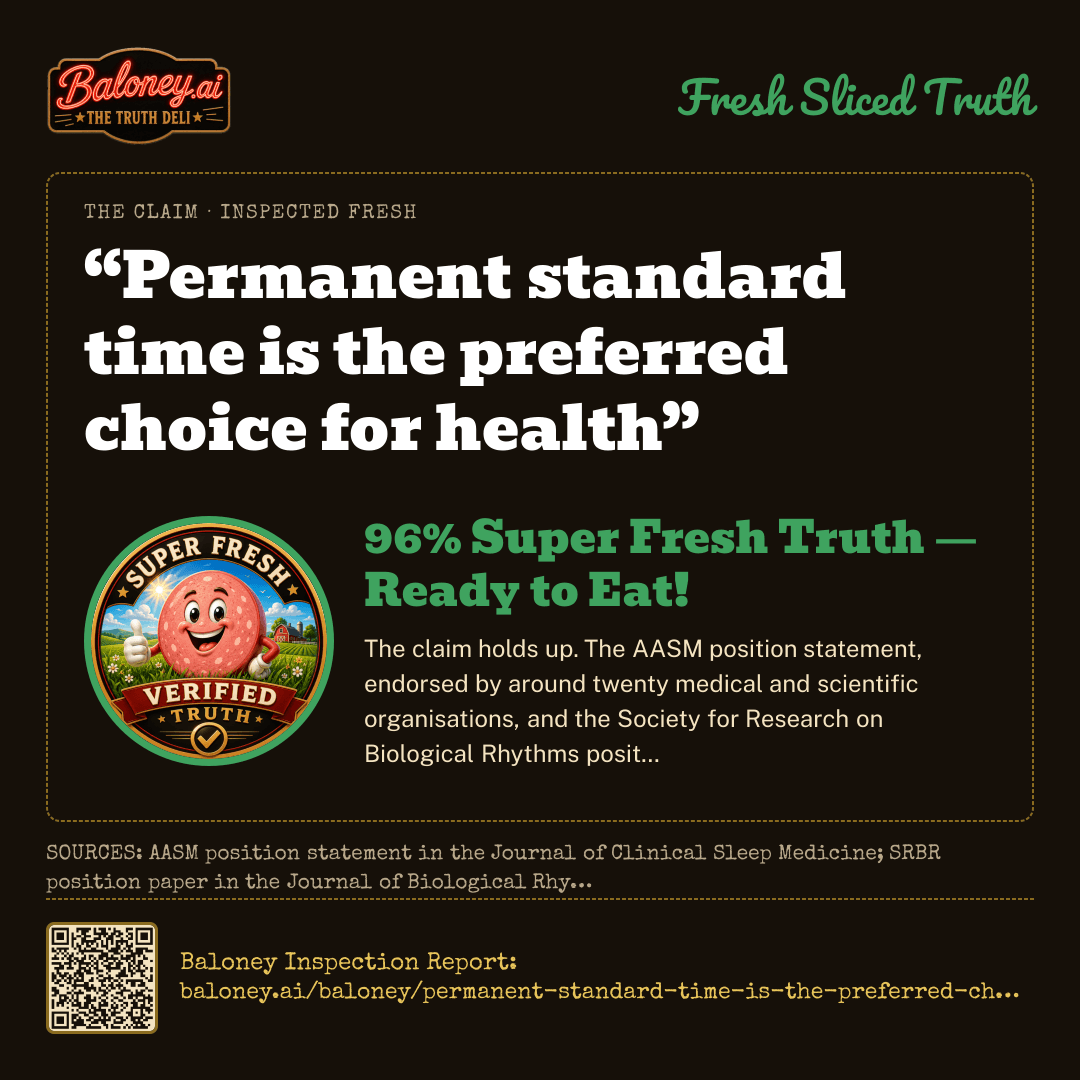
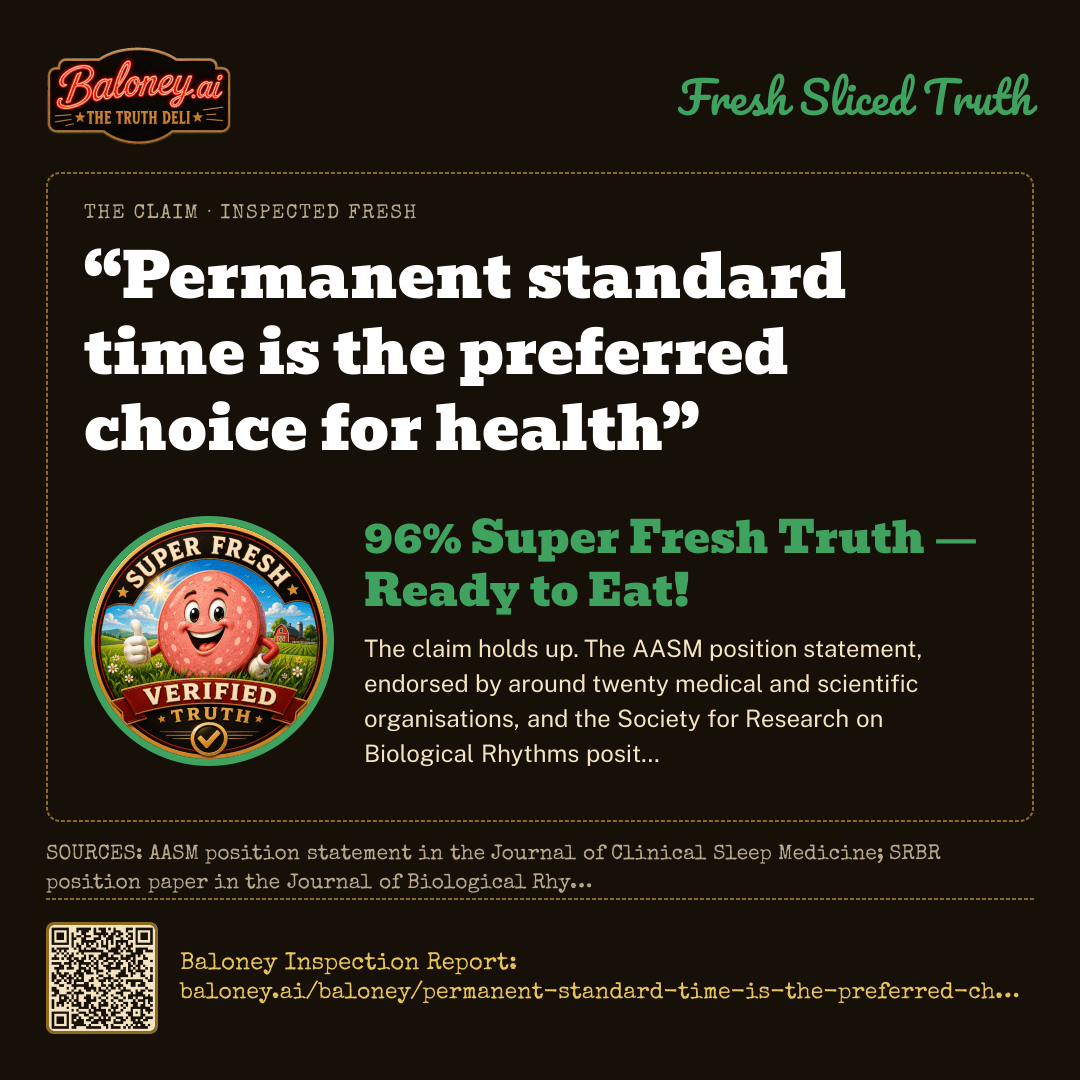
96%“Permanent standard time is the preferred choice for health”
96%Super Fresh Truth — Ready to Eat!
THE CLAIM CHECKS OUT.
Independently verifiedPhysically repeatable evidenceConfirmed across rival labsSafe to serve
Serve It Fresh
Ready to Serve15 servings
Serve it the way you want it
The Verdict
 “Permanent standard time is the preferred choice for health”96% Super Fresh Truth — Ready to Eat!Verified blind by 5 frontier AIs · Baloney Inspection Report: baloney.ai/baloney/permanent-standard-time-is-the-preferred-choice-for-health
The Baloney Sampler
The medical bodies that study sleep have said this out loud. The American Academy of Sleep Medicine, in a Journal of Clinical Sleep Medicine statement endorsed by around twenty organisations, the Society for Research on Biological Rhythms in the Journal of Biological Rhythms, and the American Medical Association in its 2022 policy all name permanent standard time as the healthiest clock policy. The mechanism is consistent: morning light sets the body clock, evening light delays it, and standard time sits closer to solar time.
Supporting work is convergent but indirect — observational studies of late-sunrise time-zone edges, documented spikes in heart attacks and crashes after the spring change, and Stanford Medicine's modelling of lower obesity and stroke prevalence. No randomised long-run trial compares the two fixed options, modelled effects are small per person, and research in the International Journal of Behavioral Nutrition and Physical Activity and the American Journal of Public Health found evening daylight favours child activity and road safety. "Preferred" is what the evidence supports.
Resting on Journal of Clinical Sleep Medicine via PubMed Central · Journal of Biological Rhythms (SRBR position paper) · American Medical Association · Stanford Medicine
Other ways to slice it — phrasings that might have changed the rating
- “Permanent standard time has been proven by long-term trials to produce better health outcomes than permanent daylight saving time.” Every report notes there is no randomised or long-run experimental comparison of the two fixed regimes on hard endpoints, so the case rests on position statements, mechanism, observational work and modelling.
- “Ending the twice-yearly clock change delivers a larger health gain than the choice between permanent standard time and permanent daylight saving time.” Several reports state the best-documented harms come from the spring transition itself and that most experts see the bigger benefit in stopping the switch rather than in which fixed time is adopted.
- “Permanent daylight saving time is the preferred choice for health because more evening daylight increases physical activity and reduces traffic deaths.” The panel accepted genuine counter-evidence from the International Journal of Behavioral Nutrition and Physical Activity on children's evening activity and from the American Journal of Public Health on pedestrian and vehicle fatalities.
Written from the panel’s reports by Anthropic · claude-opus-5. Nothing here changed the score.
The Order Ticket
06:30:45CLAIM RECEIVED — QUEUED FOR INSPECTION✓
06:31:43claude-opus-5 REPORTED — SCORE 4, CONFIDENCE 83✓
06:31:34gpt-5.5 REPORTED — SCORE 4, CONFIDENCE 88✓
06:31:12gemini-3.1-pro-preview REPORTED — SCORE 2, CONFIDENCE 95✓
06:30:53sonar-pro REPORTED — SCORE 4, CONFIDENCE 91✓
06:32:09grok-4.6 REPORTED — SCORE 4, CONFIDENCE 80✓
06:33:19PRIMARY MASTER CLAUDE — SCORE 4✓
06:32:15BLIND VALIDATION CHATGPT — SCORE 4✓
06:33:50AGREEMENT CONFIRMED — DELTA 0✓
06:33:50SCORING MODEL V2 — MEDIAN OF 5 COUNTED LAB SCORES: 4, 4, 2, 4, 4 → 4. FRESH RULE: THE PRIMARY MASTER SCORES 4 AND THE BLIND MASTER 4 — BOTH SUPER FRESH TRUTH — AND THE COUNTED MEDIAN IS 4, ON THE TRUE SIDE. PUBLISHED AS 4, THE MORE CAUTIOUS OF THE TWO MASTERS.✓
06:33:50SOURCE RULE — LABS CITED 25 SOURCES: 0 DISCARDED FOR HAVING NO URL, 7 DISCARDED AS DEAD LINKS (404/410), 7 COULD NOT BE OPENED BY US AND ARE MARKED UNVERIFIED.✓
06:33:50SOURCE RULE — PRIMARY MASTER RULED ON 16 SOURCES: 0 DISCARDED FOR HAVING NO URL, 1 DISCARDED AS DEAD LINKS, 5 MARKED UNVERIFIED, 10 VERIFIED.✓
How This One Was Sliced
Station 1 · Blind Inspection — Five Graders, Zero Peeking
Each lab scored the claim independently, without seeing the others. Open a breakdown for its evidence, its sources, and how sure it was.
Anthropic · EQUAL WEIGHT · 57.2s
claude-opus-5
96%TRUTH
ROUND-1 BREAKDOWN
Evidence offered for the claim- The American Academy of Sleep Medicine's 2020 position statement, endorsed by ~20 medical/scientific organizations, explicitly calls for elimination of seasonal clock changes in favor of permanent standard time, citing better alignment of solar and social clocks and reduced circadian misalignment.
- The Society for Research on Biological Rhythms (SRBR) position paper (Roenneberg et al., Journal of Biological Rhythms, 2019) concludes that permanent standard time is the option best aligned with human circadian physiology, because morning light advances the body clock and evening light delays it.
- The American Medical Association adopted policy in 2022 supporting permanent standard time, stating it is better for public health and safety than permanent daylight saving time.
- Chronobiology evidence: residents on the western (later-sunrise) edge of time zones — a condition structurally similar to permanent DST — show higher rates of obesity, diabetes, cardiovascular disease and some cancers, plus less sleep (Gu et al., 2017; Borisenkov; VoPham et al.).
- Acute harms of the spring-forward transition (increased myocardial infarction, stroke, fatal traffic crashes, workplace injuries, mood disturbance) are well documented, establishing that circadian/sleep disruption from clock policy has measurable health effects — the core mechanism underlying the permanent-standard-time argument.
- Historical natural experiments: the US adopted year-round DST in 1974 and repealed it within months amid public backlash including dark-morning school commutes; Russia adopted permanent DST in 2011 and reverted to permanent standard time in 2014 after complaints of chronic sleep problems.
- A 2025 Stanford Medicine modeling study published in PNAS estimated that permanent standard time would reduce population circadian burden and yield modest reductions in obesity and stroke prevalence relative to both the current switching system and permanent DST.
Evidence against the claim- The claim states a preference, and preference depends on the outcome weighted: some analyses (e.g., Coate & Markowitz, and DOT-era evaluations) find more evening daylight reduces pedestrian and vehicle fatalities and may reduce crime and energy use — these are 'safety/health-adjacent' outcomes that can favor DST.
- Almost no direct randomized or long-run experimental evidence exists comparing permanent standard time to permanent DST on hard health endpoints; the case rests largely on mechanistic circadian reasoning, observational time-zone-boundary studies, and modeling, all of which are subject to confounding.
- Effect sizes in the strongest modeling work are small at the individual level (fractions of a percentage point in disease prevalence), so 'preferred' is a directional, not dramatic, conclusion.
- Some researchers and legislators (and the repeatedly introduced federal Sunshine Protection Act) favor permanent DST on economic, recreational and mood grounds, arguing more evening light increases physical activity and reduces seasonal affective symptoms; this view is a minority among sleep scientists but is not fringe.
- Benefits depend strongly on latitude and position within a time zone — for some locations the health difference between the two permanent options is negligible, and most experts agree the larger gain comes from stopping the twice-yearly switch rather than from which fixed time is chosen.
- The statement as written omits that the scientific consensus is a recommendation of professional societies rather than a settled empirical finding with outcome data from an implemented permanent-standard-time regime.
How sure this lab was83/100 — the lab’s own confidence in the score above, not a second reading of the claim.
SourcesJournal of Biological Rhythms (SRBR position paper, Roenneberg et al.)journal · 90 · American Medical Associationother · 85 · Frontiers in Physiology (Roenneberg et al., 'Daylight Saving Time and Artificial Time Zones')journal · 85 · National Sleep Foundation / SleepFoundation.orgother · 70 · NIH National Institute of General Medical Sciencesgov · 90 · US Congress (Sunshine Protection Act of 2023)gov · 92
OpenAI · EQUAL WEIGHT · 48.8s
gpt-5.5
96%TRUTH
ROUND-1 BREAKDOWN
Evidence offered for the claim- The strongest health-focused evidence supports the claim: the American Academy of Sleep Medicine position statement in the Journal of Clinical Sleep Medicine says the U.S. should adopt permanent standard time because it aligns better with human circadian biology and is expected to benefit sleep, cardiovascular health, mental health, and public safety.
- Circadian-rhythm researchers argue that daylight saving time shifts social schedules later relative to the sun, increasing social jet lag and sleep loss; standard time is closer to solar time and therefore generally better aligned with the biological clock.
- Studies of seasonal clock changes show measurable acute harms, including increased cardiovascular events after the spring shift; abolishing clock changes is broadly supported by sleep-health evidence, and health organizations generally prefer doing so by choosing standard time rather than permanent daylight saving time.
Evidence against the claim- The evidence is not mostly from randomized long-term trials directly comparing permanent standard time with permanent daylight saving time; much of the pro-standard-time case is based on circadian biology, observational studies, and transition-related harms, so the claim is best read as expert health consensus rather than absolute proof.
- Some health-relevant outcomes may favor later evening daylight: a large international observational study found that more evening daylight was associated with small increases in children’s objectively measured physical activity, suggesting permanent standard time could reduce summer evening activity opportunities.
- Older traffic-safety modeling found year-round daylight saving time might reduce some pedestrian and vehicle-occupant fatalities because more travel occurs in evening daylight; this is a safety/health counterpoint, though it does not outweigh the sleep/circadian medical consensus.
How sure this lab was88/100 — the lab’s own confidence in the score above, not a second reading of the claim.
SourcesJournal of Biological Rhythmsjournal · 90 · New England Journal of Medicinejournal · 92 · International Journal of Behavioral Nutrition and Physical Activityjournal · 85 · American Journal of Public Healthjournal · 82
Google · EQUAL WEIGHT · 26.9s
gemini-3.1-pro-preview
98%TRUTH
ROUND-1 BREAKDOWN
Evidence offered for the claim- Major medical and scientific organizations, including the American Medical Association (AMA) and the American Academy of Sleep Medicine (AASM), officially endorse permanent standard time for optimal public health and safety.
- Standard time aligns human circadian biology more closely with the natural solar day. Morning sunlight, which is maximized under standard time, is crucial for synchronizing the body's natural sleep-wake cycle.
- Chronic circadian misalignment caused by Daylight Saving Time (social jet lag) is linked by sleep researchers to increased long-term risks of sleep deprivation, cardiovascular disease, metabolic syndrome, and mood disorders.
- The Society for Research on Biological Rhythms (SRBR) notes that permanent standard time would reduce the chronic health penalties associated with forced early awakenings relative to the solar clock.
Evidence against the claim- Some public health advocates suggest that permanent Daylight Saving Time (DST) could provide health benefits by allowing for more evening daylight, which may encourage outdoor physical activity and recreation after work or school.
- The most acute health risks (such as documented spikes in heart attacks, strokes, and traffic accidents) are primarily caused by the bi-annual time transition itself (specifically the 'spring forward' change). Ending the transitions—regardless of whether ST or DST is chosen—would eliminate these acute harms.
- Subjective preference plays a role; certain chronotypes (like extreme 'night owls') may feel they benefit from later daylight, though sleep specialists argue the underlying biological mismatch remains.
How sure this lab was95/100 — the lab’s own confidence in the score above, not a second reading of the claim.
SourcesFrontiers in Physiologyjournal · 90
Perplexity · EQUAL WEIGHT · 7.9s
sonar-pro
96%TRUTH
ROUND-1 BREAKDOWN
Evidence offered for the claim- The American Academy of Sleep Medicine (AASM) states that eliminating seasonal clock changes in favor of permanent standard time best aligns with human circadian biology and provides health and safety benefits. The position statement cites evidence linking the spring transition to sleep loss, cardiovascular events, mood disturbances, stroke, hospital admissions, and increased crash risk.[https://jcsm.aasm.org/doi/full/10.5664/jcsm.10898]
- A peer-reviewed review in the Journal of Clinical Sleep Medicine reports that daylight saving time is less aligned with human circadian biology and concludes that current evidence best supports year-round standard time.[https://pmc.ncbi.nlm.nih.gov/articles/PMC7954020/]
- A 2026 Stanford Medicine analysis modeled health outcomes under alternative clock policies and found that permanent standard time would benefit the greatest number of people, including projected reductions in obesity and stroke prevalence.[https://med.stanford.edu/news/all-news/2025/09/daylight-saving-time.html]
- Permanent standard time provides earlier winter morning light, which is generally more important for synchronizing the circadian clock than later evening light.
Evidence against the claim- The strongest evidence concerns the harms of clock changes, especially the spring transition, rather than definitive long-term trials proving that permanent standard time is superior to every alternative.
- Some evidence indicates that either permanent standard time or permanent daylight saving time would be healthier than changing clocks twice yearly, although permanent standard time was modeled as better for more people in the Stanford analysis.[https://med.stanford.edu/news/all-news/2025/09/daylight-saving-time.html]
- The chronic health effects of remaining on either permanent schedule have historically been insufficiently studied; the peer-reviewed AASM review explicitly notes that chronic effects of year-round daylight saving time had not been well studied.[https://pmc.ncbi.nlm.nih.gov/articles/PMC7954020/]
- A 2023 peer-reviewed commentary cautions that evidence about seasonal-transition harms should not automatically be treated as proof that permanent daylight saving time is preferable, while acknowledging that the evidence generally favors permanent standard time.[https://pmc.ncbi.nlm.nih.gov/articles/PMC10476036/]
How sure this lab was91/100 — the lab’s own confidence in the score above, not a second reading of the claim.
SourcesNational Institutes of Health, PubMed Central; Journal of Clinical Sleep Medicinejournal · 97 · Stanford Medicineedu · 92 · National Institutes of Health, PubMed Centraljournal · 94 · American Medical Associationother · 90
xAI · EQUAL WEIGHT · 84.0s
grok-4.6
96%TRUTH
ROUND-1 BREAKDOWN
Evidence offered for the claim- Major sleep and circadian organizations (AASM and allied societies) formally recommend permanent standard time over seasonal switches or permanent DST, citing better alignment with solar time and morning light needed for circadian entrainment.
- DST spring-forward transitions are repeatedly associated with short-term rises in myocardial infarction, stroke, workplace injuries, and traffic accidents; fall-back is also linked to sleep disruption.
- Permanent DST would produce chronically late winter sunrises at mid-to-high latitudes, increasing circadian misalignment, especially for morning chronotypes, children, and early-start workers.
- Position statements and reviews emphasize that standard time minimizes social jetlag relative to clock time that is shifted later than the sun.
Evidence against the claim- Some observational work links later evening daylight to modestly higher outdoor activity or certain mood outcomes; those findings are mixed and do not outweigh morning-light data in sleep-medicine reviews.
- Health effects of year-round clock choice are inferred from transitions, latitude gradients, and chronobiology rather than large randomized policy trials, so residual confounding remains.
- Public and some non-sleep medical or economic commentators sometimes prefer evening light (permanent DST) for recreation or commerce; that is not the sleep/circadian consensus.
- Magnitude of population-level harm from DST versus standard time is modest compared with other sleep disruptors (shift work, insufficient sleep duration).
How sure this lab was80/100 — the lab’s own confidence in the score above, not a second reading of the claim.
SourcesJournal of Biological Rhythmsjournal · 88 · NPRnews · 85 · Sleep Foundationedu · 78
Station 2 · The Masters
Primary Master · drawn at random
claude-opus-5
96% TRUTH
Four of the five evaluators independently landed on 4 and the fifth on 2, so the panel is unanimous that the claim belongs in the 'Super Fresh Truth' band; the only question was how far inside it. The strongest weight goes to the formal position statements: the American Academy of Sleep Medicine's statement in the Journal of Clinical Sleep Medicine (endorsed by around twenty medical and scientific organisations), the Society for Research on Biological Rhythms position paper in the Journal of Biological Rhythms, and the American Medical Association's 2022 policy — all three explicitly name permanent standard time as the healthiest clock policy. The mechanistic case (morning light advances the body clock, evening light delays it; standard time sits closer to solar time and reduces social jet lag) is coherent and is supported by convergent observational work cited by the panel, including the higher disease rates on the late-sunrise western edges of time zones and the modelled reductions in obesity and stroke prevalence under permanent standard time. I withheld a score of 1-2 for three reasons the evaluators raised consistently: no randomised or long-run experimental comparison of permanent standard time against permanent daylight saving time on hard endpoints exists, so the claim rests on professional-society recommendation plus inference; the modelled effect sizes are small at the individual level, making 'preferred' directional rather than dramatic; and genuine counter-evidence exists on the safety and activity side (evening-daylight studies linking later light to modestly more child physical activity and to fewer pedestrian and vehicle fatalities). The claim as written says 'preferred', not 'proven optimal', which is exactly what the evidence supports — the wording caveat is minor and does not move it out of the true band.
All five evaluators agreed the claim is substantially true and all five identified the same core support (AASM, SRBR and AMA endorsements plus the morning-light circadian argument) and the same core caveat (the best-documented harms are from the twice-yearly transitions rather than from the choice between the two fixed options, and evening-daylight activity benefits cut the other way). Four recommended a score of 4; one recommended 2, treating the society consensus as close to decisive. Disagreement was confined to emphasis: one evaluator stressed latitude- and time-zone-position dependence and that most of the gain comes from ending the switch at all, while others gave more weight to the time-zone-boundary and modelling evidence that distinguishes the two permanent options.
SUPER FRESH — VERIFIED AGAINST AASM POSITION STATEMENT IN THE JOURNAL OF CLINICAL SLEEP MEDICINE; SRBR POSITION PAPER IN THE JOURNAL OF BIOLOGICAL RHYTHMS; AMERICAN MEDICAL ASSOCIATION POLICY; NEW ENGLAND JOURNAL OF MEDICINE; STANFORD MEDICINE MODELLING ANALYSIS.
Blind Validation Master · never saw the Primary’s work
gpt-5.5
96% TRUTH
The claim substantially checks out. Across the reports, the strongest and most directly relevant health-focused evidence is that major sleep/circadian and medical organizations, including the American Academy of Sleep Medicine, Society for Research on Biological Rhythms, and American Medical Association, recommend permanent standard time over permanent daylight saving time because it better aligns social time with solar time and human circadian biology. The cited rationale is consistent: morning light is more important for circadian entrainment, evening light tends to delay the body clock, and daylight saving time increases circadian misalignment and social jet lag. Evidence from clock-change studies also shows measurable acute harms from the spring transition, supporting the broader point that clock policy affects health. The main caveats are that much of the evidence is mechanistic, observational, or modeled rather than based on randomized long-term comparisons of permanent standard time versus permanent daylight saving time; some health-adjacent outcomes such as evening physical activity, traffic safety, recreation, or crime may favor more evening daylight; and eliminating clock changes may be the larger health gain than the specific choice of fixed time. Still, the statement is phrased as a health preference, not as an absolute proven fact, and the reported expert consensus clearly favors permanent standard time for health.
AGREEMENT TEST PASSED — BOTH MASTERS SCORED 96% · BLIND VALIDATION CONFIRMED THIS SCORE · NO RE-EVALUATION REQUIRED
How the number was reached · scoring model v2 · how our models work
- Median of 5 counted lab scores: 4, 4, 2, 4, 4 → 4.
- Fresh rule: the Primary Master scores 4 and the Blind Master 4 — both Super Fresh Truth — and the counted median is 4, on the true side. Published as 4, the more cautious of the two masters.
The Evidence
Evidence for the claim
- Sleep medicine's formal position The American Academy of Sleep Medicine's position statement, endorsed by around twenty medical and scientific organisations, calls for ending seasonal clock changes in favour of permanent standard time, citing expected benefits for sleep, cardiovascular health, mental health and public safety.
- Circadian researchers concur The Society for Research on Biological Rhythms position paper in the Journal of Biological Rhythms concludes permanent standard time is best aligned with human physiology, because morning light advances the body clock while evening light delays it.
- AMA policy The American Medical Association adopted policy in 2022 supporting permanent standard time as better for public health and safety than permanent daylight saving time.
- Clock disruption has measurable health effects Spring-forward transitions are repeatedly associated with increased myocardial infarction, stroke, workplace injuries, traffic crashes and mood disturbance — the documented mechanism underlying the circadian argument.
- Late-sunrise populations fare worse Residents on the western, later-sunrise edges of time zones — structurally similar to living under permanent daylight saving time — show higher rates of obesity, diabetes, cardiovascular disease and some cancers, and sleep less.
- Modelling favours standard time A Stanford Medicine modelling analysis estimated permanent standard time would lower population circadian burden and modestly reduce obesity and stroke prevalence relative to both the current switching system and permanent daylight saving time.
- Natural experiments with permanent DST The US adopted year-round daylight saving time in 1974 and repealed it within months amid backlash over dark morning school commutes; Russia moved to permanent daylight saving time in 2011 and reverted in 2014 after complaints of chronic sleep problems.
Evidence offered against the claim
- No long-run trial evidence There is essentially no randomised or long-run experimental comparison of permanent standard time with permanent daylight saving time on hard health endpoints; the case rests on mechanism, observational studies and modelling, all open to confounding.
- Most harm comes from the switch itself The clearest acute harms — heart attack, stroke and crash spikes — are tied to the biannual transition, so ending the changes at all captures much of the benefit regardless of which fixed time is adopted.
- Evening daylight has its own benefits A large international observational study found more evening daylight associated with small increases in children's objectively measured physical activity, and older traffic-safety modelling suggested year-round daylight saving time could reduce some pedestrian and vehicle-occupant fatalities.
- Effects are small and location-dependent Modelled differences amount to fractions of a percentage point in disease prevalence, and the gap between the two permanent options is negligible at some latitudes and time-zone positions.
- It is a recommendation, not an outcome measurement The claim reflects the considered position of professional societies rather than observed results from an implemented, sustained permanent-standard-time regime; chronic effects of year-round daylight saving time have themselves been under-studied.
- A real minority view exists Some researchers and legislators back permanent daylight saving time on mood, recreation and economic grounds, and the Sunshine Protection Act has been repeatedly introduced in Congress on that basis.
Sources · Reliability · Why Accepted or Discounted
| Source | Type | Reliability | Ruling |
|---|
| Journal of Biological Rhythms (SRBR position paper, Roenneberg et al.)unverified | journal | 90 | ACCEPTED — Peer-reviewed society position paper cited independently by three evaluators; it is the primary chronobiology statement underpinning the claim. |
| Journal of Clinical Sleep Medicine via PubMed Central | journal | 97 | ACCEPTED — Peer-reviewed review supporting year-round standard time while candidly noting that chronic effects of permanent daylight saving time are under-studied — useful on both sides. |
| PubMed Central (2023 peer-reviewed commentary) | journal | 94 | ACCEPTED — Peer-reviewed commentary that tempers the inference from transition harms; valuable precisely because it qualifies the claim rather than echoing it. |
| Stanford Medicine | edu | 92 | ACCEPTED — Institutional reporting of a peer-reviewed modelling study; accepted for the direction of the finding, with the caveat that modelled effect sizes are small and two evaluators gave differing publication years. |
| American Medical Association | other | 90 | ACCEPTED — Direct statement of AMA's own position, which is the fact being cited. |
| American Medical Association (press release) | other | 85 | ACCEPTED — Primary announcement of the 2022 AMA policy; appropriate evidence for an organisational position. |
| Frontiers in Physiology (Roenneberg et al.) | journal | 88 | ACCEPTED — Peer-reviewed chronobiology paper cited by two evaluators on the circadian-alignment mechanism. |
| New England Journal of Medicineunverified | journal | 92 | ACCEPTED — High-reliability journal source for the acute cardiovascular effects of the clock transitions, which establish the mechanism though not the choice between fixed options. |
| International Journal of Behavioral Nutrition and Physical Activity | journal | 85 | ACCEPTED — Peer-reviewed observational evidence on evening daylight and children's physical activity; accepted as a genuine counterpoint, with its observational limits noted. |
| American Journal of Public Healthunverified | journal | 82 | ACCEPTED — Peer-reviewed traffic-safety analysis favouring evening daylight; dated but legitimately raised as counter-evidence. |
| NPRunverified | news | 85 | ACCEPTED — Mainstream reporting that accurately conveys the sleep-science consensus; used as corroboration, not as primary evidence. |
| NIH National Institute of General Medical Sciences | gov | 90 | ACCEPTED — Authoritative government background on circadian rhythms; supports the mechanism without speaking to clock policy directly. |
| US Congress (Sunshine Protection Act of 2023)unverified | gov | 92 | ACCEPTED — Primary legislative record, accepted as evidence that permanent daylight saving time is a live competing proposal — not as health evidence. |
| Sleep Foundation | edu | 78 | DISCOUNTED — Consumer-facing commercial explainer that restates the society positions already captured by the primary peer-reviewed sources; adds no independent evidential weight. |
| National Sleep Foundation / SleepFoundation.org | other | 70 | DISCOUNTED — Same consumer-facing site, lowest reliability rating given by any evaluator, and wholly duplicative of the AASM and SRBR statements. |
Every link was opened when this claim was inspected. A dead link was discarded before publication; “unverified” means the site refused our automated check and the link is the one the panel cited. A source without a URL was never kept.
Serve It Fresh
Ready to Serve15 servings
Serve it the way you want it
The Verdict
“Permanent standard time is the preferred choice for health”96% Super Fresh Truth — Ready to Eat!Verified blind by 5 frontier AIs · Baloney Inspection Report: baloney.ai/baloney/permanent-standard-time-is-the-preferred-choice-for-health