







Radioactive Baloney88%

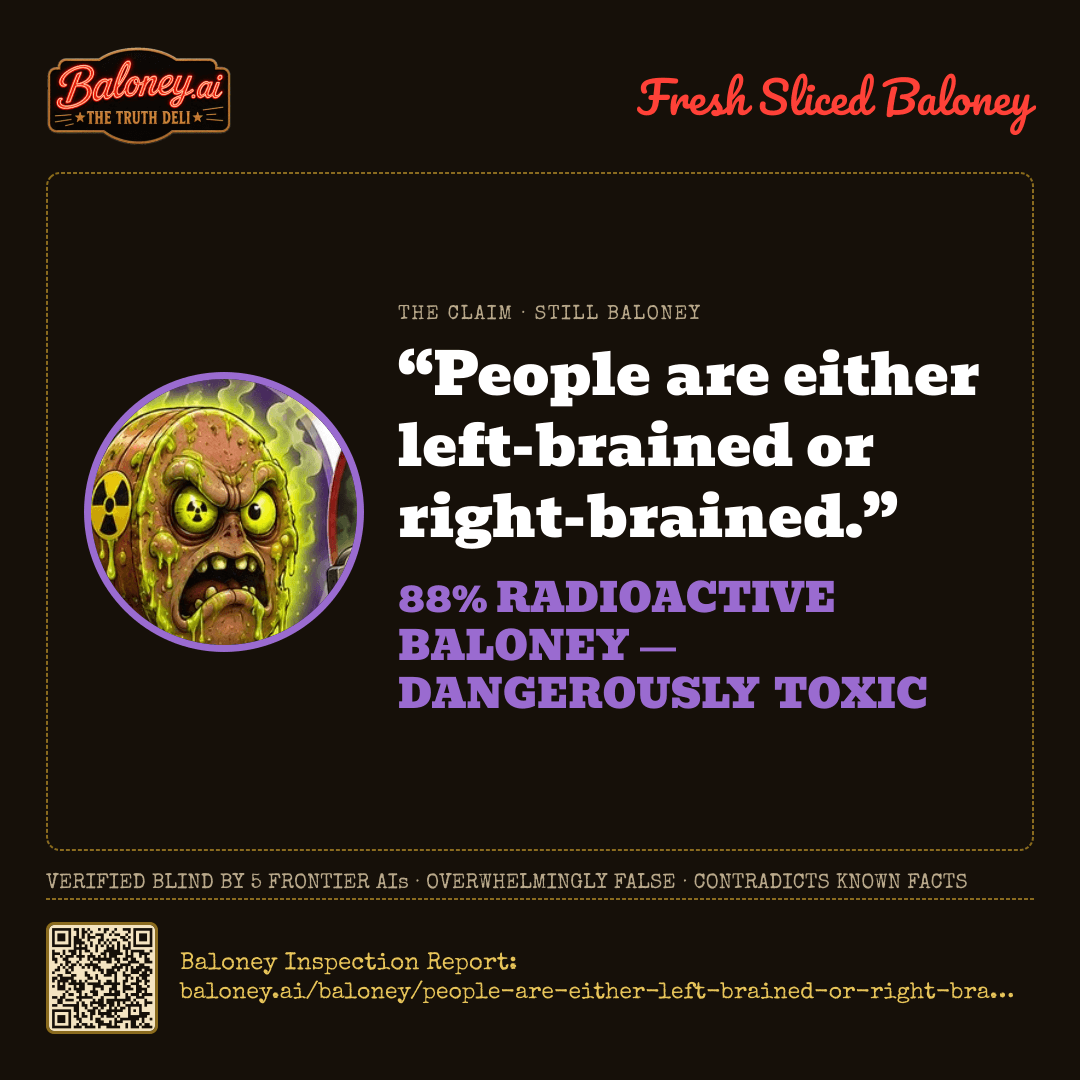
People are either left-brained or right-brained.

88%RADIOACTIVE BALONEY — DANGEROUSLY TOXIC
Dangerously misleading.
Overwhelmingly falseContradicts known factsPromotes false beliefsPotential for harm
Super Fresh Truth
Fishy Baloney
Stinky Baloney
Rotting Baloney
Radioactive Baloney
Zombie Baloney

✓ BLIND VALIDATION CONFIRMED THIS SCORE

Serve It Fresh

Ready to Serve18 servings

Serve it the way you want it

The Verdict

People are either left-brained or right-brained.
88% RADIOACTIVE BALONEY DANGEROUSLY TOXIC
Verified blind by 5 frontier AIs · Baloney Inspection Report: baloney.ai/baloney/people-are-either-left-brained-or-right-brained

The Rating Card

88% Radioactive Baloney card for this claim

The Order Ticket

01:05:33CLAIM RECEIVED — QUEUED FOR INSPECTION
01:06:06claude-opus-5 REPORTED — SCORE 88, CONFIDENCE 96
01:05:58gpt-5.5 REPORTED — SCORE 88, CONFIDENCE 96
01:05:56gemini-3.1-pro-preview REPORTED — SCORE 95, CONFIDENCE 99
01:05:53sonar-pro REPORTED — SCORE 90, CONFIDENCE 95
01:06:32grok-4.6 REPORTED — SCORE 80, CONFIDENCE 86
01:07:53PRIMARY MASTER CLAUDE — SCORE 90
01:06:37BLIND VALIDATION CHATGPT — SCORE 95
01:07:53AGREEMENT CONFIRMED — DELTA 7

How This One Was Sliced

Station 1 · Blind Inspection — Five Graders, Zero Peeking

Each lab scored the claim independently, without seeing the others. Open a breakdown for its evidence, its sources, and how sure it was.

Anthropic · EQUAL WEIGHT · 33.4s

claude-opus-5

88%BALONEY

ROUND-1 BREAKDOWN
Evidence offered for the claim
  • Functional lateralization is real: language production and comprehension are left-hemisphere dominant in roughly 95% of right-handers and a majority of left-handers, while some visuospatial, face-processing and prosody functions show right-hemisphere bias — so hemispheres are genuinely not interchangeable.
  • Split-brain research (Sperry, Gazzaniga; Nobel Prize 1981) showed that when the corpus callosum is severed, each hemisphere can process information independently and display different competencies, which is the historical kernel that the popular claim grew out of.
  • Structural and functional asymmetries (e.g., planum temporale asymmetry, right-biased attention networks) are measurable, and damage to one hemisphere produces characteristically different deficits (aphasia vs. hemispatial neglect).
  • A minority of individuals do show atypical or reversed dominance for specific functions, so hemispheric dominance profiles are not uniform across people.
Evidence against the claim
  • The claim conflates function-specific lateralization with whole-brain 'dominance.' No credible neuroscience shows individuals whose entire brain is globally driven by one hemisphere.
  • Nielsen et al. (2013, PLOS ONE) analyzed resting-state fMRI connectivity in 1,011 people aged 7–29 and found no evidence that individuals cluster into left- or right-brain-dominant types; lateralized networks were lateralized in essentially everyone, and there was no correlation of overall 'leftness' or 'rightness' across networks within individuals.
  • Traits popularly assigned to hemispheres (logic/math vs. creativity/intuition) are not lateralized in that way. Creativity, arithmetic, and emotion all recruit distributed bilateral networks; e.g., mathematical cognition involves bilateral parietal regions, and creative ideation shows bilateral default-mode and executive network involvement.
  • The two hemispheres are massively interconnected via the corpus callosum and function as an integrated system in intact brains; normal cognition is not a contest won by one side.
  • 'Left-brained/right-brained' learning styles and personality typologies have been formally catalogued as a 'neuromyth' in education research (Dekker et al. 2012; Howard-Jones 2014; OECD 2002), and interventions based on them have no demonstrated benefit.
  • Corballis (2014, PLOS Biology) reviews how genuine asymmetries were exaggerated into popular dichotomies, noting that lateralization is graded and function-specific rather than a personal type.
  • Even language dominance is not an all-or-nothing personal attribute: Knecht et al. (2000, Brain) showed hemispheric language dominance is distributed on a continuum and varies with handedness rather than sorting people into two brain types.
How sure this lab was

96/100 — the lab’s own confidence in the score above, not a second reading of the claim.

Sources

PLOS ONE (Nielsen, Zielinski, Ferguson, Lainhart, Anderson, 2013)journal · 90 · PLOS Biology (Corballis, 'Left Brain, Right Brain: Facts and Fantasies', 2014)journal · 92 · Nature Reviews Neuroscience (Howard-Jones, 'Neuroscience and education: myths and messages', 2014)journal · 95 · Frontiers in Psychology (Dekker et al., 'Neuromyths in education', 2012)journal · 82 · Brain / Oxford University Press (Knecht et al., 'Handedness and hemispheric language dominance in healthy humans', 2000)journal · 90 · Nobel Prize (Roger W. Sperry, Nobel Lecture, 1981)other · 88 · OECD, 'Understanding the Brain: The Birth of a Learning Science'gov · 85 · University of Utah Health (institutional news release on the Nielsen et al. left-brain/right-brain study; exact release URL not recalled)edu · 70

OpenAI · EQUAL WEIGHT · 25.5s

gpt-5.5

88%BALONEY

ROUND-1 BREAKDOWN
Evidence offered for the claim
  • There is a real kernel behind the idea: some brain functions are lateralized. For example, language is left-lateralized in most people, while some visuospatial and attentional functions are often more right-lateralized. Split-brain research also shows that the two hemispheres can process information differently when communication between them is disrupted.
  • Individual differences in lateralization exist: people can vary in how strongly particular functions are represented in one hemisphere versus the other. This makes it superficially plausible that people might differ in 'left' or 'right' tendencies, but it does not establish two global personality types.
Evidence against the claim
  • Large-scale brain-imaging evidence does not support the claim that people divide into globally 'left-brained' or 'right-brained' groups. Nielsen et al. analyzed resting-state fMRI data from 1,011 people and found no evidence that individuals preferentially use one hemisphere-wide network over the other.
  • Modern neuroscience supports functional specialization, not a binary person-type model. Different tasks recruit distributed networks across both hemispheres, and a person may show left-lateralization for one function and right-lateralization for another.
  • The popular version of the claim—logical/analytical people are 'left-brained' and creative/intuitive people are 'right-brained'—overstates and distorts real hemispheric differences. Creativity, reasoning, language, emotion, and perception generally involve coordinated activity across both hemispheres.
How sure this lab was

96/100 — the lab’s own confidence in the score above, not a second reading of the claim.

Sources

PLOS ONEjournal · 95 · PLOS Biologyjournal · 95 · Nature Reviews Neurosciencejournal · 95 · Harvard Health Publishingedu · 85

Google · EQUAL WEIGHT · 23.2s

gemini-3.1-pro-preview

95%BALONEY

ROUND-1 BREAKDOWN
Evidence offered for the claim
  • The claim originates from a grain of truth regarding 'lateralization' of brain function. In the 1960s, Nobel Prize-winning neurobiologist Roger Sperry conducted 'split-brain' studies on epilepsy patients whose corpus callosum had been severed. He found that the two hemispheres excel at different tasks (e.g., the left hemisphere is typically dominant for language and speech, while the right hemisphere handles spatial processing).
  • Popular psychology, self-help books, and media in the 1970s and 1980s extrapolated Sperry's clinical findings into broad personality traits, inventing the unscientific concept that logical, analytical people are 'left-brained' and creative, artistic people are 'right-brained'.
Evidence against the claim
  • A massive 2013 neuroimaging study published in PLOS ONE analyzed resting-state MRI scans of 1,011 individuals aged 7 to 29. The researchers evaluated thousands of brain regions and found no evidence whatsoever that individuals have stronger left-sided or right-sided brain networks. People use both hemispheres roughly equally.
  • Modern neuroscience shows that complex cognitive functions—like creativity, logic, and mathematics—are not localized to one side of the brain. They require massive, highly interconnected networks that span both the left and right hemispheres working together.
  • The concept of 'left-brained' or 'right-brained' personality types is universally classified by psychologists and neuroscientists as a 'neuromyth.' While specific micro-tasks can be lateralized, overarching personality types and learning styles are not governed by hemispheric dominance.
How sure this lab was

99/100 — the lab’s own confidence in the score above, not a second reading of the claim.

Sources

PLOS ONEjournal · 95 · Harvard Health Publishingedu · 90 · Scientific Americannews · 90

Perplexity · EQUAL WEIGHT · 20.5s

sonar-pro

90%BALONEY

ROUND-1 BREAKDOWN
Evidence offered for the claim
  • There is **real hemispheric specialization in the brain**: certain cognitive functions are more often supported by one hemisphere than the other (e.g., language and fine-grained analytic processing tend to be left-lateralized in most right-handed people, while visuospatial processing and some aspects of emotion and prosody tend to be more right-lateralized). This genuine lateralization was documented in classic split-brain work by Roger Sperry and Michael Gazzaniga and is summarized in modern reviews of brain asymmetry.[7]
  • Clinical neurology shows that **damage to one hemisphere can selectively impair certain abilities**, which encouraged the idea of distinct "styles": left-hemisphere strokes more often disrupt language and detailed analytic processing, while right-hemisphere strokes more often impair spatial awareness, facial recognition, and aspects of emotional processing.[7]
  • The popular left/right-brain claim was originally inspired by **real research on split-brain patients**, where surgically severing the corpus callosum produces dissociations in what each hemisphere can report or do, which was then generalized (over-extended) to healthy people as a dominant-hemisphere personality style.[9]
  • Many educational and self-help materials reference **survey and neuromyth data** showing that educators and the public commonly believe people are "left-brained" (logical) or "right-brained" (creative), often using this as a framework for explaining individual differences in thinking styles.[8][15]
Evidence against the claim
  • Large-scale neuroimaging work directly testing the hypothesis finds **no evidence that intact individuals have a globally dominant left or right hemisphere that determines personality or thinking style**. A University of Utah functional MRI study of more than 1,000 people measured activity in thousands of regions across both hemispheres and found *no relationship* indicating people preferentially use a "left-brain network" or "right-brain network" overall.[1][5][8]
  • Reviews aimed at lay audiences and clinicians state that the **left-brain/right-brain person idea is a neuromyth**: while some tasks are lateralized, there is typically no overall dominant side in healthy people, and personality/cognitive style cannot be reduced to one hemisphere being "in charge".[3][12][15]
  • Harvard Medical School’s health publication reports that **brain activity is broadly similar on both sides regardless of personality**, summarizing the Utah study and concluding that the notion of some people being more left- or right-brained is best understood as a figure of speech, not an anatomically accurate description.[1]
  • Healthline’s review of the evidence notes that MRI studies show the human brain **does not favor one side over the other**, nor are networks on one side generally stronger than the other in intact brains, directly contradicting the popular dominance claim.[2]
  • A detailed article in *Medical News Today* explains that the left/right-brain dominance theory **has no scientific basis** for claims about personality or cognitive style. It stresses that while certain functions (like language or math) more often rely on left-hemisphere networks and spatial or some creative tasks on the right, there is **no global hemisphere dominance** that makes someone categorically "left-brained" or "right-brained".[3]
  • Educational neuroscience resources and school-leadership organizations explicitly list **"we are either left-brained or right-brained" as a debunked neuromyth**, noting that although hemispheres specialize for some functions, the two sides work together via the corpus callosum and there is no evidence for the dominant-side personality typology.[12][15]
  • Expert commentary from neuroscience outreach pieces states that **"99 percent" of the popular claims that people are right-brained vs left-brained are nonsense**, again stressing that both hemispheres work together and that lateralization is task-specific, not person-defining.[10][11]
  • Educational blogs and neuroscience-informed teaching sites explain that **hemispheric specialization is real, but only locally for particular tasks**; global "left-brained" vs "right-brained" profiles were looked for with fine-grained imaging and **not found in any individual**, undermining the core premise of the claim.[8][13][14]
How sure this lab was

95/100 — the lab’s own confidence in the score above, not a second reading of the claim.

Sources

Harvard Health Publishing (Harvard Medical School)edu · 95 · Healthlinenews · 85 · Medical News Todaynews · 82 · University of Utah Healthedu · 90 · The Learning Scientistsedu · 88 · AASA, The School Superintendents Associationedu · 85 · National Institutes of Health / PMC (journal article: "Left Brain, Right Brain: Facts and Fantasies")journal · 96 · University of Strathclyde – School of Educationedu · 88 · Atlassian (science/innovation blog citing neuroscience sources)other · 75 · Neuroscience and Psychotherapy (expert blog)other · 78 · ScienceDaily (summarizing peer-reviewed research)news · 80 · Fiveable (education platform citing cognitive neuroscience)edu · 75

xAI · EQUAL WEIGHT · 59.6s

grok-4.6

80%BALONEY

ROUND-1 BREAKDOWN
Evidence offered for the claim
  • Some functions are lateralized: in most people language production and certain sequential/analytical processes rely more on left-hemisphere networks.
  • Split-brain research (Sperry, Gazzaniga and others) showed the hemispheres can operate with some independence and have different processing biases.
  • Clinical lesions and Wada testing confirm that damaging one hemisphere can disproportionately impair language versus visuospatial or affective processing.
Evidence against the claim
  • The popular idea that people are globally 'left-brained' (logical) or 'right-brained' (creative) as personality types is not supported by neuroimaging or behavioral data.
  • A large resting-state fMRI study found no evidence of individuals with a consistently dominant left or right hemisphere corresponding to those stereotypes.
  • Nearly all complex cognition (creativity, reasoning, emotion) uses distributed bilateral networks; the hemispheres are densely connected via the corpus callosum.
  • Education and psychology literature classify left/right-brain personality typing as a neuromyth.
How sure this lab was

86/100 — the lab’s own confidence in the score above, not a second reading of the claim.

Sources

PLOS ONEjournal · 88 · PLOS Biologyjournal · 90

Station 2 · The Masters

Primary Master · drawn at random

claude-opus-5

90% BALONEY

All five evaluators independently converged on the same verdict, recommending 80–95 with confidence 86–99. The claim as written asserts a binary personal typology — that each person is globally 'left-brained' or 'right-brained' — and that assertion is contradicted by the best available direct test. The panel's strongest evidence is the Nielsen et al. (2013, PLOS ONE) resting-state fMRI analysis of 1,011 people aged 7–29, which examined thousands of regions and found no individuals with a globally stronger left- or right-hemisphere network; lateralized networks were lateralized in essentially everyone, with no correlation of overall 'leftness' or 'rightness' within individuals. This is reinforced by Corballis in PLOS Biology, Howard-Jones in Nature Reviews Neuroscience, Dekker et al. in Frontiers in Psychology and the OECD, all of which formally catalogue left-brain/right-brain personality typing as a neuromyth. I weighted peer-reviewed primary and review literature above secondary health-media summaries, which were used only as corroboration. The claim is not scored at the very top of the scale because it is not pure fabrication: the panel unanimously credits a genuine kernel — functional lateralization is real, language is left-dominant in roughly 95% of right-handers, split-brain work (Sperry, Gazzaniga) and lesion/Wada data show real hemispheric differences, and Knecht et al. show dominance varies between people, though on a continuum. What is false is the leap from function-specific, graded lateralization to two whole-person brain types. That leap is comprehensively refuted, placing the statement deep in Radioactive Baloney. I did not set the zombie flag: although the myth is persistent in education, it grew out of legitimate science and retains a real factual kernel, which distinguishes it from the flat-earth/moon-landing archetype of a claim with no scientific basis whatsoever.

Agreement was near-total. All five evaluators identified the same core refutation (the 1,011-person resting-state fMRI study finding no hemisphere-dominant individuals), all credited the same kernel of truth (real, function-specific lateralization and the split-brain research it grew from), and all described the personality typology as a neuromyth. Disagreement was confined to severity: four evaluators clustered at 88–95, while one placed it at 80 with the lowest confidence (86), giving slightly more weight to the genuine lateralization findings. Reports differed mainly in sourcing depth — one rested almost entirely on primary journal literature (PLOS ONE, PLOS Biology, Nature Reviews Neuroscience, Brain, Frontiers), another leaned on popular health media and education blogs — but this produced no divergence in conclusion. One report uniquely noted survey data on how widely educators believe the myth; the panel treats prevalence of belief as evidence about the myth's reach, not about its truth.

Blind Validation Master · never saw the Primary’s work

gpt-5.5

95% BALONEY

The reports consistently agree that the popular claim is overwhelmingly false. There is a real kernel of truth: some brain functions are lateralized, such as language often being left-lateralized and some visuospatial/attentional functions more right-lateralized, and split-brain and lesion studies show meaningful hemispheric specialization. But that does not imply people fall into global 'left-brained' or 'right-brained' types. The cited large fMRI study of over 1,000 people found no evidence that individuals have overall stronger left- or right-hemisphere networks, and the reports emphasize that complex traits like logic, creativity, personality, emotion, and reasoning depend on distributed networks across both hemispheres. The claim as written states a binary person-level typology, not merely task-specific lateralization, so it is a debunked neuromyth rather than a substantially true statement. Because it is repeatedly debunked yet still common, it belongs near the top of the Radioactive Baloney range, though not quite 99 because it is loosely inspired by real hemispheric specialization.

AGREEMENT TEST PASSED — MASTERS SCORED 90% AND 95% · BLIND VALIDATION CONFIRMED THIS SCORE · NO RE-EVALUATION REQUIRED

The Evidence

Evidence offered for the claim

  • Lateralization of function is genuine Language production and comprehension are left-hemisphere dominant in roughly 95% of right-handers and a majority of left-handers, while some visuospatial, face-processing and prosody functions show a right-hemisphere bias. Structural asymmetries such as planum temporale asymmetry are measurable. The hemispheres are genuinely not interchangeable — but this is specialization for particular tasks, not a personal type.
  • Split-brain research is the historical kernel Roger Sperry and Michael Gazzaniga's work on patients whose corpus callosum had been severed (Nobel Prize 1981) showed each hemisphere can process information independently and display different competencies. Popular psychology in the 1970s–80s extrapolated these clinical findings in disconnected brains into sweeping personality categories for intact brains.
  • One-sided damage causes different deficits Clinical lesion data and Wada testing confirm that left-hemisphere strokes disproportionately disrupt language, while right-hemisphere damage more often impairs spatial awareness, face recognition and aspects of emotional processing — aphasia versus hemispatial neglect. Real dissociations, but within individual functions rather than across whole personalities.
  • Some people do have atypical dominance A minority of individuals show reversed or atypical dominance for specific functions, so lateralization profiles vary between people. The panel notes Knecht et al. (2000, Brain) found language dominance is distributed on a continuum varying with handedness — a gradient, not a sorting of people into two brain types.
  • The belief is widespread among educators DEBUNKED — REFUTED as evidence of truth. Survey and neuromyth data show educators and the public commonly endorse the left-brained/right-brained framework, but this measures the myth's reach, not its accuracy. The same literature that documents its popularity — Dekker et al., Howard-Jones, the OECD — catalogues it specifically as a neuromyth with no demonstrated instructional benefit.

Evidence against the claim

  • No hemisphere-dominant individuals exist Nielsen et al. (2013, PLOS ONE) analysed resting-state fMRI connectivity in 1,011 people aged 7–29 across thousands of brain regions. Lateralized networks were lateralized in essentially everyone, and there was no correlation of overall 'leftness' or 'rightness' across networks within individuals — no evidence anyone preferentially uses a left- or right-brain network overall.
  • Complex cognition is bilateral The traits popularly assigned to each side are not lateralized that way. Creativity, logic, arithmetic and emotion all recruit distributed networks spanning both hemispheres — mathematical cognition involves bilateral parietal regions, creative ideation shows bilateral default-mode and executive network involvement.
  • The hemispheres are one integrated system In intact brains the two sides are massively interconnected via the corpus callosum and operate together. Normal cognition is not a contest won by one side; a single person may show left-lateralization for one function and right-lateralization for another.
  • Formally catalogued as a neuromyth Education and psychology literature — Dekker et al. (2012), Howard-Jones (2014), the OECD's 'Understanding the Brain' — list left/right-brain personality and learning-style typing among the standard neuromyths, and interventions built on it have no demonstrated benefit.
  • Reviews trace the exaggeration directly Corballis (2014, PLOS Biology, 'Left Brain, Right Brain: Facts and Fantasies') reviews how genuine asymmetries were inflated into popular dichotomies, concluding that lateralization is graded and function-specific rather than a personal type.
  • Clinical and health authorities concur Harvard Health Publishing reports brain activity is broadly similar on both sides regardless of personality and calls being 'left-brained' a figure of speech rather than an anatomical description; Healthline and Medical News Today likewise report that imaging shows no global side preference in intact brains.

Sources · Reliability · Why Accepted or Discounted

SourceTypeReliabilityRuling
PLOS ONE (Nielsen, Zielinski, Ferguson, Lainhart, Anderson, 2013)journal95ACCEPTED Peer-reviewed primary study of 1,011 participants that directly tests the hypothesis at issue; cited independently by four of five evaluators and the decisive evidence in this ruling.
PLOS Biology (Corballis, 'Left Brain, Right Brain: Facts and Fantasies', 2014)journal92ACCEPTED Peer-reviewed review by a leading laterality researcher that separates the real asymmetries from the popular exaggeration; also the article cited via NIH/PMC by another evaluator.
Nature Reviews Neuroscience (Howard-Jones, 'Neuroscience and education: myths and messages', 2014)journal95ACCEPTED High-authority peer-reviewed review that formally classifies hemispheric-dominance typing as a neuromyth.
Frontiers in Psychology (Dekker et al., 'Neuromyths in education', 2012)journal82ACCEPTED Peer-reviewed survey establishing both the prevalence of the belief among teachers and its status as a myth.
Brain / Oxford University Press (Knecht et al., 'Handedness and hemispheric language dominance in healthy humans', 2000)journal90ACCEPTED Peer-reviewed evidence that even language dominance is continuous rather than categorical — directly relevant to the binary framing of the claim.
OECD, 'Understanding the Brain: The Birth of a Learning Science'gov85ACCEPTED Intergovernmental review of neuroscience for education that names this specific belief as a myth; long-standing and widely cited.
Harvard Health Publishing (Harvard Medical School)edu95ACCEPTED Clinically edited summary from a medical school publisher, cited independently by three evaluators; used as corroboration of the primary literature rather than as primary evidence.
University of Utah Healthedu85ACCEPTED Institutional communication from the group that conducted the underlying imaging study; accepted as accurate reportage of its own research, with the peer-reviewed paper carrying the evidentiary weight. One evaluator could not recall the exact release URL, so it is treated as secondary.
Scientific Americannews90ACCEPTED Established science journalism with subject-expert authorship; consistent with the peer-reviewed sources.
Healthlinenews85ACCEPTED Medically reviewed consumer health content; corroborative only, adding no independent evidence beyond the imaging literature.
Medical News Todaynews82ACCEPTED Medically reviewed consumer health content accurately summarising the primary research; corroborative weight only.
ScienceDailynews80ACCEPTED Aggregator of institutional press releases; accepted as a faithful conduit to the peer-reviewed study, not as independent evidence.
The Learning Scientistsedu88ACCEPTED Run by cognitive psychologists and grounded in the published neuromyth literature; useful for the education-practice dimension.
University of Strathclyde – School of Educationedu88ACCEPTED University education-faculty material consistent with the peer-reviewed neuromyth reviews.
AASA, The School Superintendents Associationedu85ACCEPTED Professional body documenting the myth's circulation in schools; accepted for that narrow purpose rather than as neuroscience evidence.
Nobel Prize (Roger W. Sperry, Nobel Lecture, 1981)other88ACCEPTED Primary-source account of the split-brain research that is the genuine kernel behind the claim; establishes what the original findings did and did not show.
Atlassian (science/innovation blog)other75DISCOUNTED A software company's corporate blog with no subject-matter authority or editorial review in neuroscience; it merely restates the journal literature and adds nothing that the primary sources do not already establish.
Fiveableedu75DISCOUNTED A student exam-revision platform summarising textbook material; not an independent evidentiary source, and its conclusions are already carried by the peer-reviewed reviews.
Neuroscience and Psychotherapy (expert blog)other78DISCOUNTED Unattributed personal blog offered for a colourful '99 percent is nonsense' quotation; the rhetorical framing is not verifiable and the substantive point is fully covered by the peer-reviewed sources.

Serve It Fresh

Ready to Serve18 servings

Serve it the way you want it

The Verdict

People are either left-brained or right-brained.
88% RADIOACTIVE BALONEY DANGEROUSLY TOXIC
Verified blind by 5 frontier AIs · Baloney Inspection Report: baloney.ai/baloney/people-are-either-left-brained-or-right-brained