Baloney Inspection Report: Claim #1186 · Inspected Oct 31, 2026, 8:39 AM PDT · Scoring model v2
 18%
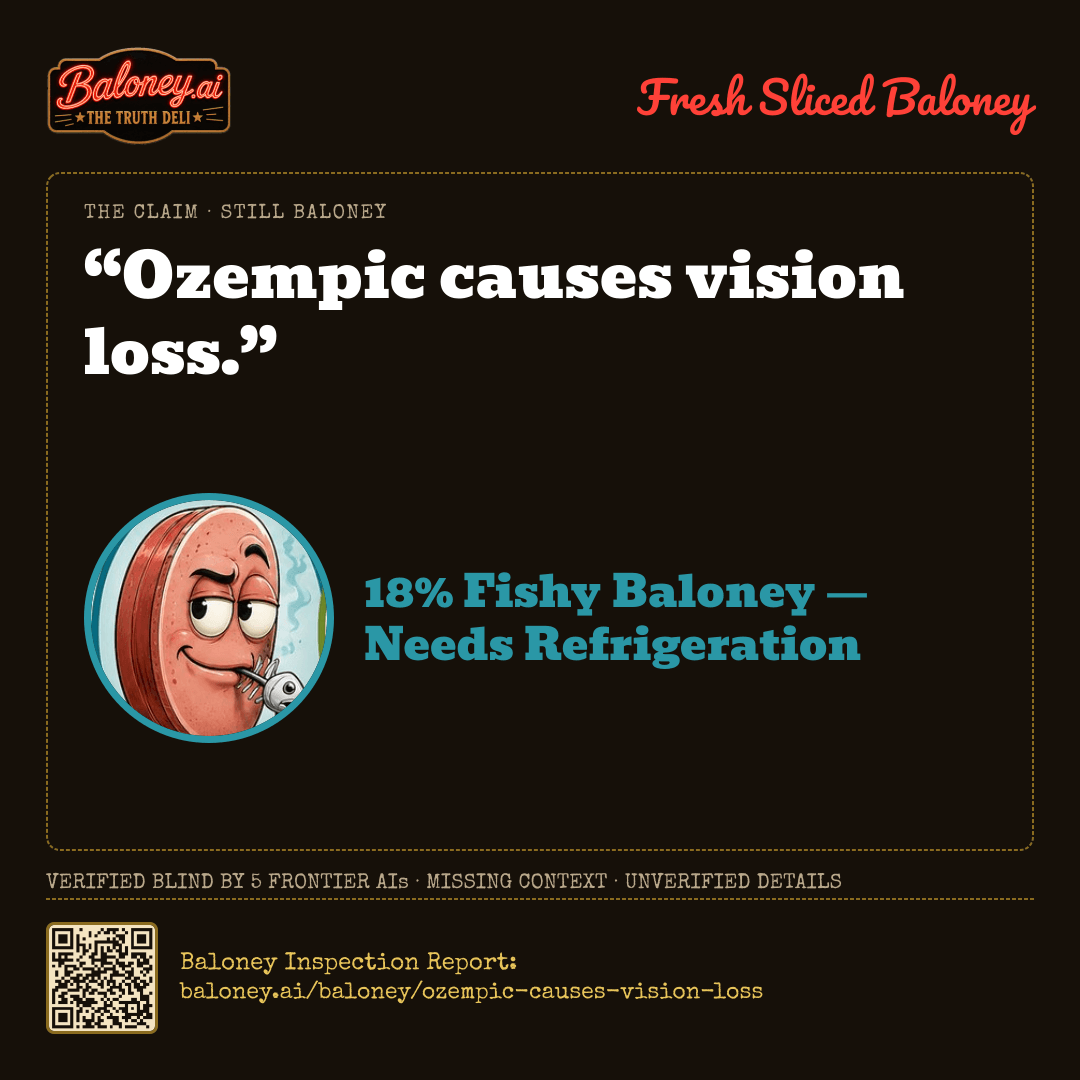
“Ozempic causes vision loss.”
18%Fishy Baloney — Needs Refrigeration
Something smells off…
Missing contextUnverified detailsSuspicious framingMay be exaggerated
Serve It Fresh
Ready to Serve14 servings
Serve it the way you want it
The Verdict
 “Ozempic causes vision loss.”18% Fishy Baloney — Needs RefrigerationVerified blind by 5 frontier AIs · Baloney Inspection Report: baloney.ai/baloney/ozempic-causes-vision-loss
The Baloney Sampler
The reports found real vision-related risks tied to Ozempic’s active ingredient semaglutide, but not the broad message that vision loss is a common or typical result. U.S. Food and Drug Administration prescribing information and the New England Journal of Medicine SUSTAIN-6 trial report higher diabetic-retinopathy complications with semaglutide than placebo, especially in people with existing diabetic eye disease and rapid glucose improvement.
For sudden optic-nerve vision loss, JAMA Ophthalmology cohort evidence and the European Medicines Agency pharmacovigilance review found a safety signal for NAION; the EMA treated it as a very rare side effect. The reports also found major limits: NAION studies are observational, results are inconsistent, absolute events are few, and most users are not expected to lose vision.
Resting on U.S. Food and Drug Administration · New England Journal of Medicine · JAMA Ophthalmology · European Medicines Agency
Original Claim Source https://www.reddit.com/r/USNEWS/comments/1x2q3rn/man_went_blind_in_both_eyes_on_ozempic_his_doctor/
Other ways to slice it — phrasings that might have changed the rating
- “Ozempic can very rarely cause NAION, a sudden optic-nerve condition that can lead to permanent vision loss.” The reports cite an EMA labeling action treating NAION as a very rare semaglutide side effect, while noting that much of the study evidence is observational.
- “Ozempic commonly causes vision loss in most people who take it.” The reports consistently reject this broader version because NAION is very rare and diabetic-retinopathy complications are concentrated in higher-risk diabetes patients.
- “Ozempic can worsen diabetic-retinopathy complications in some patients with diabetes, especially those with pre-existing retinopathy and rapid glucose improvement.” The FDA label and SUSTAIN-6 evidence cited by the reports support this narrower claim and distinguish it from general, direct vision loss in typical users.
Written from the panel’s reports by OpenAI · gpt-5.5. Nothing here changed the score.
The Order Ticket
15:39:34CLAIM RECEIVED — QUEUED FOR INSPECTION✓
15:40:48claude-opus-5 REPORTED — SCORE 10, CONFIDENCE 84✓
15:40:27gpt-5.5 REPORTED — SCORE 18, CONFIDENCE 86✓
15:40:04gemini-3.1-pro-preview REPORTED — SCORE 18, CONFIDENCE 95✓
15:39:39sonar-pro REPORTED — SCORE 24, CONFIDENCE 94✓
15:41:05grok-4.6 REPORTED — SCORE 18, CONFIDENCE 78✓
15:41:53PRIMARY MASTER CHATGPT — SCORE 10✓
15:41:31BLIND VALIDATION GEMINI — SCORE 5✓
15:42:09AGREEMENT MODERATE DISAGREEMENT — DELTA 13✓
15:42:09SCORING MODEL V2 — MEDIAN OF 5 COUNTED LAB SCORES: 10, 18, 18, 24, 18 → 18.✓
15:42:09SOURCE RULE — LABS CITED 23 SOURCES: 0 DISCARDED FOR HAVING NO URL, 1 DISCARDED AS DEAD LINKS (404/410), 10 COULD NOT BE OPENED BY US AND ARE MARKED UNVERIFIED.✓
15:42:09SOURCE RULE — PRIMARY MASTER RULED ON 17 SOURCES: 0 DISCARDED FOR HAVING NO URL, 0 DISCARDED AS DEAD LINKS, 7 MARKED UNVERIFIED, 10 VERIFIED.✓
How This One Was Sliced
Station 1 · Blind Inspection — Five Graders, Zero Peeking
Each lab scored the claim independently, without seeing the others. Open a breakdown for its evidence, its sources, and how sure it was.
Anthropic · EQUAL WEIGHT · 74.1s
claude-opus-5
10%BALONEY
ROUND-1 BREAKDOWN
Evidence offered for the claim- A retrospective cohort study of ~17,000 patients at Mass Eye and Ear (Hathaway et al., JAMA Ophthalmology, July 2024) found semaglutide-prescribed patients had a markedly higher rate of non-arteritic anterior ischemic optic neuropathy (NAION) — hazard ratio roughly 4 in type 2 diabetes and roughly 7 in overweight/obesity patients. NAION typically causes sudden, permanent, irreversible loss of vision in the affected eye.
- European regulators acted on the signal: after reviewing cohort data and post-marketing reports, the EMA's Pharmacovigilance Risk Assessment Committee concluded in 2025 that NAION is a side effect of semaglutide medicines (Ozempic, Rybelsus, Wegovy) with a frequency of 'very rare' (up to 1 in 10,000 people), and required this to be added to the EU product information — a formal regulatory causality judgment, not merely a hypothesis.
- The approved Ozempic prescribing information already carries a warning about diabetic retinopathy complications. In the SUSTAIN-6 cardiovascular outcomes trial (NEJM 2016), retinopathy complications (vitreous hemorrhage, blindness, or need for intravitreal/photocoagulation treatment) occurred in 3.0% of semaglutide patients versus 1.8% on placebo (HR 1.76), so a drug-associated pathway to vision loss is documented in a randomized trial.
- Multiple published case reports and case series describe NAION occurring in patients shortly after starting semaglutide, which contributed to the pharmacovigilance signal.
Evidence against the claim- The claim as written is unqualified and implies a general or likely effect; the actual regulatory frequency assigned to NAION is 'very rare' — on the order of 1 in 10,000 users or fewer. The overwhelming majority of Ozempic users will never experience vision loss.
- The strongest supporting study was an observational, single-center cohort subject to confounding by indication and referral bias: patients with diabetes, obesity, hypertension and sleep apnea already carry elevated baseline NAION risk, and the comparison groups were not randomized.
- Subsequent larger database and claims-based analyses have produced heterogeneous results, with some finding no statistically significant excess of NAION in semaglutide users; the evidence base is conflicting rather than settled, and absolute event counts in all studies are small.
- The diabetic retinopathy signal in SUSTAIN-6 is widely attributed to rapid improvement in glycemic control in patients with pre-existing retinopathy on insulin — a well-known phenomenon ('early worsening') also seen with insulin and after bariatric surgery — and is generally transient, while sustained glycemic control and weight loss reduce long-term retinopathy progression. On balance, eye outcomes for most diabetic patients are expected to improve, not worsen.
- Regulators did not withdraw or restrict the drug; they added a rare-adverse-event warning, which is a very different public health message from the blanket statement 'Ozempic causes vision loss.'
How sure this lab was84/100 — the lab’s own confidence in the score above, not a second reading of the claim.
SourcesJAMA Ophthalmology (Hathaway et al., Mass Eye and Ear / Harvard)journal · 90 · New England Journal of Medicine (SUSTAIN-6, Marso et al.)journal · 96 · European Medicines Agency — Ozempic EPAR and product informationgov · 95 · U.S. FDA, Drugs@FDA (Ozempic/semaglutide, NDA 209637) — approved labeling including diabetic retinopathy warninggov · 95 · PubMed Central (indexed literature on semaglutide and NAION)journal · 80
OpenAI · EQUAL WEIGHT · 53.1s
gpt-5.5
18%BALONEY
ROUND-1 BREAKDOWN
Evidence offered for the claim- Ozempic’s FDA-approved prescribing information warns about diabetic retinopathy complications: in a 2-year trial, diabetic retinopathy complications occurred in 3.0% of Ozempic-treated patients vs 1.8% on placebo, and patients with a history of diabetic retinopathy should be monitored.
- The SUSTAIN-6 cardiovascular outcomes trial published in NEJM found a statistically significant increase in diabetic retinopathy complications with semaglutide vs placebo; severe diabetic retinopathy can threaten vision.
- A 2024 JAMA Ophthalmology retrospective study reported an association between semaglutide prescriptions and nonarteritic anterior ischemic optic neuropathy, a rare optic-nerve condition that can cause sudden vision loss. The study raised a safety signal but did not prove causation.
Evidence against the claim- The statement is too broad as written: evidence does not show that Ozempic commonly or directly causes vision loss in most users.
- The diabetic-retinopathy signal appears concentrated in patients with pre-existing diabetic retinopathy, poor baseline glucose control, and rapid HbA1c improvement; this pattern is consistent with known early worsening of diabetic retinopathy after rapid glucose lowering, not necessarily a unique toxic effect of Ozempic.
- The JAMA Ophthalmology NAION study was observational and subject to confounding, referral bias, and coding limitations; it found an association, not proof that semaglutide causes the condition.
- Medical guidance generally recommends eye monitoring for higher-risk diabetes patients rather than avoiding semaglutide categorically. Temporary blurred vision or vision changes from shifting blood sugar are not the same as permanent vision loss.
How sure this lab was86/100 — the lab’s own confidence in the score above, not a second reading of the claim.
SourcesNovo Nordisk / FDA-approved prescribing informationother · 85 · New England Journal of Medicinejournal · 95 · Diabetes, Obesity and Metabolismjournal · 90 · JAMA Ophthalmologyjournal · 92 · American Diabetes Association / Diabetes Carejournal · 94
Google · EQUAL WEIGHT · 29.9s
gemini-3.1-pro-preview
18%BALONEY
ROUND-1 BREAKDOWN
Evidence offered for the claim- A July 2024 observational study published in JAMA Ophthalmology found a significant association between semaglutide (the active ingredient in Ozempic) and an increased risk of developing nonarteritic anterior ischemic optic neuropathy (NAION), a rare condition that can cause sudden, painless vision loss.
- The official FDA prescribing information for Ozempic includes a warning for 'Diabetic Retinopathy Complications.' It notes that rapid improvement in blood glucose control can be associated with a temporary worsening of diabetic retinopathy, which can lead to vision changes or vision loss.
Evidence against the claim- The JAMA Ophthalmology study was observational; it established a correlation or 'association' between semaglutide and NAION, but the authors explicitly noted it does not prove direct causation.
- NAION is a very rare condition, meaning the absolute risk to patients taking Ozempic remains extremely low.
- Worsening of diabetic retinopathy is a known consequence of rapidly lowering blood sugar levels with any effective diabetes treatment, rather than a direct toxic effect of Ozempic on the eye.
- The blanket claim 'Ozempic causes vision loss' is exaggerated and strips away vital context. It implies a definitive, common, and direct causal link, whereas the evidence points to rare associations (NAION) or secondary complications from rapid glucose reduction.
How sure this lab was95/100 — the lab’s own confidence in the score above, not a second reading of the claim.
SourcesJAMA Ophthalmologyjournal · 95 · CNNnews · 85 · Novo Nordisk / FDAother · 95
Perplexity · EQUAL WEIGHT · 5.2s
sonar-pro
24%BALONEY
ROUND-1 BREAKDOWN
Evidence offered for the claim- Ozempic’s FDA prescribing information reports diabetic-retinopathy complications in 3.0% of Ozempic-treated participants versus 1.8% with placebo over two years; the difference was larger among participants with pre-existing diabetic retinopathy (8.2% versus 5.2%). It advises patients to contact a physician for vision changes. [2]
- A 2025 JAMA Ophthalmology study involving 37.1 million adults with type 2 diabetes found a small increase in the relative incidence of non-arteritic anterior ischemic optic neuropathy (NAION), a rare cause of sudden vision loss, among semaglutide users. [4]
- A 2024 retrospective Danish study reported more than twice the risk of NAION among semaglutide users, although its observational design cannot prove causation. [5]
Evidence against the claim- The claim is too broad: evidence concerns specific eye complications and a possible association with rare NAION, not established, general vision loss caused by Ozempic in typical users. [2][4][10]
- The FDA evidence shows an increased risk of diabetic-retinopathy complications mainly in people with diabetes and especially those with pre-existing retinopathy; it does not establish that Ozempic generally causes blindness or permanent vision loss. [2]
- A 2025 medical review reported inconsistent study results, with relative NAION risk ranging from nonsignificant to fourfold, low absolute event numbers, and no established causal link because the principal studies were retrospective. [10]
- A review of the literature notes that some studies found no significant increase in NAION or ischemic optic neuropathy among semaglutide users compared with matched controls. [9]
How sure this lab was94/100 — the lab’s own confidence in the score above, not a second reading of the claim.
SourcesU.S. Food and Drug Administrationgov · 99 · JAMA Ophthalmologyjournal · 97 · International Journal of Retina and Vitreousjournal · 92 · PubMed; review in a medical journaljournal · 94 · PubMed Central; peer-reviewed review articlejournal · 90
xAI · EQUAL WEIGHT · 90.5s
grok-4.6
18%BALONEY
ROUND-1 BREAKDOWN
Evidence offered for the claim- A July 2024 observational study in JAMA Ophthalmology found patients prescribed semaglutide had a substantially higher subsequent rate of NAION (a condition causing sudden, often irreversible vision loss) than matched patients on other drugs.
- Ozempic prescribing information has long warned that rapid glucose lowering can worsen diabetic retinopathy complications, which can include vision loss, especially in patients who already have retinopathy.
- Post-marketing case reports and patient accounts describe sudden vision changes temporally associated with starting semaglutide.
Evidence against the claim- The JAMA NAION analysis was retrospective and cannot prove causation; people prescribed Ozempic typically have more severe diabetes, obesity, and vascular risk factors that independently raise NAION risk.
- Randomized trials of semaglutide did not show a clear NAION imbalance (the event is rare). Novo Nordisk has stated it sees no causal link in its data.
- Diabetes itself is a major cause of vision loss; absolute NAION risk remains low even in the observational data. Rapid glycemic improvement from any effective therapy can transiently worsen retinopathy.
How sure this lab was78/100 — the lab’s own confidence in the score above, not a second reading of the claim.
SourcesJAMA Ophthalmologyjournal · 95 · PubMed/NCBIgov · 92 · Reutersnews · 88 · Novo Nordiskother · 72
Station 2 · The Masters
Primary Master · drawn at random
gpt-5.5
10% BALONEY
The panel evidence supports a real but narrow version of the claim: semaglutide, the active ingredient in Ozempic, has documented eye-safety warnings and has been linked to specific vision-threatening complications. The strongest established evidence is the diabetic-retinopathy warning in prescribing information and SUSTAIN-6, where diabetic-retinopathy complications were higher with semaglutide than placebo. The strongest newer signal is NAION, a rare optic-nerve condition that can cause sudden vision loss; evaluators cited the 2024 JAMA Ophthalmology retrospective study and, in one report, an EMA pharmacovigilance conclusion requiring very-rare NAION labeling for semaglutide medicines. I weighted official labels, regulators, and peer-reviewed trial or cohort evidence most heavily. I gave less weight to case reports, patient accounts, company statements, and news articles except as summaries of primary evidence. The reason the score is not in the fully true band is that the statement as written is blunt and missing essential context: these are rare or high-risk complications, the NAION evidence is partly observational and heterogeneous, and the diabetic-retinopathy pathway appears concentrated in people with pre-existing diabetic eye disease and rapid glucose improvement. Still, the claim is much closer to an overbroad warning than to a falsehood.
All five evaluators agreed that Ozempic/semaglutide has credible links to eye complications and that the claim is too broad without rarity and risk-group context. They also agreed that the JAMA Ophthalmology NAION evidence is important but observational, and that diabetic-retinopathy complications are recognized in prescribing information. They differed mainly on how much the wording should be penalized: one evaluator treated the evidence, especially the EMA action, as close to proving the claim, while others emphasized that 'Ozempic causes vision loss' can misleadingly imply a common, direct, or settled effect.
Blind Validation Master · never saw the Primary’s work
gemini-3.1-pro-preview
5% BALONEY
Regulatory bodies and clinical trials have established a link between Ozempic (semaglutide) and conditions that cause vision loss. The FDA label warns of diabetic retinopathy complications (which can include blindness) based on trial data, and the EMA recently classified NAION (a condition causing sudden, irreversible vision loss) as a formal side effect. While the evaluators heavily penalised the claim for omitting crucial context—namely that these side effects are 'very rare' or primarily associated with rapid glucose lowering in patients with pre-existing eye conditions—the core claim is factually supported by medical regulators. Per the rubric, because the statement is substantially true, the omission of a frequency qualifier like 'rarely' is treated as a wording caveat rather than a reason to downgrade it to 'Fishy Baloney.'
AI EVALUATORS SHOWED MODERATE DISAGREEMENT — MASTERS SCORED 10% AND 5% · REVIEW THE EVIDENCE CAREFULLY
How the number was reached · scoring model v2 · how our models work
- Median of 5 counted lab scores: 10, 18, 18, 24, 18 → 18.
The Evidence
Evidence offered for the claim
- Diabetic-retinopathy warning Ozempic prescribing information reports more diabetic-retinopathy complications in semaglutide-treated patients than placebo in a two-year trial, with higher risk especially among people who already had diabetic retinopathy.
- SUSTAIN-6 trial signal The NEJM SUSTAIN-6 cardiovascular outcomes trial found diabetic-retinopathy complications in 3.0% of semaglutide patients versus 1.8% on placebo; the endpoint included serious events such as vitreous hemorrhage, blindness, or need for eye treatment.
- NAION association A 2024 JAMA Ophthalmology retrospective study found semaglutide-prescribed patients had a higher rate of non-arteritic anterior ischemic optic neuropathy, a rare condition that can cause sudden and often permanent vision loss.
- Regulatory action One evaluator cited the European Medicines Agency pharmacovigilance review as concluding that NAION should be listed as a very rare side effect of semaglutide medicines, including Ozempic, Rybelsus, and Wegovy.
- Post-marketing reports Case reports, case series, and patient accounts describe vision changes or NAION after starting semaglutide, supporting a safety signal but not proving causation by themselves.
Evidence against the claim
- Rarity matters The evidence concerns rare or very rare outcomes, not a common result of taking Ozempic; most users will not experience vision loss.
- Observational limits The NAION studies cited were largely retrospective and vulnerable to confounding because diabetes, obesity, hypertension, sleep apnea, and vascular disease already raise baseline eye-risk.
- Mixed study results Evaluators noted that later database, claims-based, and review evidence has been heterogeneous, with some analyses finding no statistically significant increase in NAION or ischemic optic neuropathy.
- Retinopathy context The diabetic-retinopathy signal appears concentrated in people with pre-existing retinopathy, poor baseline glucose control, insulin use, and rapid HbA1c improvement, a phenomenon also seen with other effective glucose-lowering interventions.
- Overbroad wording The statement leaves out whether the risk is rare, who is most vulnerable, and which eye condition is being discussed, making it more alarming than the evidence supports.
Sources · Reliability · Why Accepted or Discounted
| Source | Type | Reliability | Ruling |
|---|
| JAMA Ophthalmologyunverified | journal | 95 | ACCEPTED — Peer-reviewed primary study and central evidence for the NAION safety signal; accepted with the limitation that it was observational. |
| New England Journal of Medicineunverified | journal | 96 | ACCEPTED — High-quality peer-reviewed randomized trial evidence for diabetic-retinopathy complications. |
| European Medicines Agency | gov | 95 | ACCEPTED — Regulatory source for product information and pharmacovigilance actions; highly relevant to labeling judgments. |
| U.S. FDA Drugs@FDA | gov | 95 | ACCEPTED — Official FDA database for Ozempic approval and labeling information. |
| PubMed Central | journal | 80 | ACCEPTED — Useful indexed medical literature on semaglutide and NAION; weighed below primary trials and regulators. |
| JAMA Ophthalmologyunverified | journal | 95 | ACCEPTED — Journal page for the key 2024 NAION observational study; accepted with observational-design caveats. |
| PubMed/NCBI | gov | 92 | ACCEPTED — PubMed record for the cited medical literature; reliable indexing source, not a substitute for study-design assessment. |
| Reutersunverified | news | 88 | ACCEPTED — Reliable news summary of the 2024 study and reactions; used only as secondary context. |
| Novo Nordisk / FDA-approved prescribing information | other | 85 | ACCEPTED — Manufacturer-hosted prescribing information is relevant for labeled warnings, though company interpretations are weighed cautiously. |
| CNN | news | 85 | ACCEPTED — Secondary reporting on the NAION study; useful for context but not weighted like primary medical evidence. |
| Diabetes, Obesity and Metabolismunverified | journal | 90 | ACCEPTED — Peer-reviewed medical source cited for interpreting the diabetic-retinopathy signal and rapid glucose-lowering context. |
| American Diabetes Association / Diabetes Careunverified | journal | 94 | ACCEPTED — Authoritative clinical guidance source relevant to diabetes eye monitoring and risk management. |
| U.S. Food and Drug Administration | gov | 99 | ACCEPTED — Official FDA label; highly reliable for current prescribing warnings and trial-reported adverse events. |
| JAMA Ophthalmologyunverified | journal | 97 | ACCEPTED — Peer-reviewed large database evidence cited for NAION incidence; accepted while recognizing database-study limitations. |
| International Journal of Retina and Vitreous | journal | 92 | ACCEPTED — Peer-reviewed source cited for a retrospective Danish NAION study; useful but observational. |
| PubMed | journal | 94 | ACCEPTED — PubMed-indexed medical review cited for inconsistent NAION findings and lack of settled causation. |
| PubMed Central | journal | 90 | ACCEPTED — Peer-reviewed review article cited for the broader literature, including studies with nonsignificant findings. |
Every link was opened when this claim was inspected. A dead link was discarded before publication; “unverified” means the site refused our automated check and the link is the one the panel cited. A source without a URL was never kept.
Serve It Fresh
Ready to Serve14 servings
Serve it the way you want it
The Verdict
“Ozempic causes vision loss.”18% Fishy Baloney — Needs RefrigerationVerified blind by 5 frontier AIs · Baloney Inspection Report: baloney.ai/baloney/ozempic-causes-vision-loss